
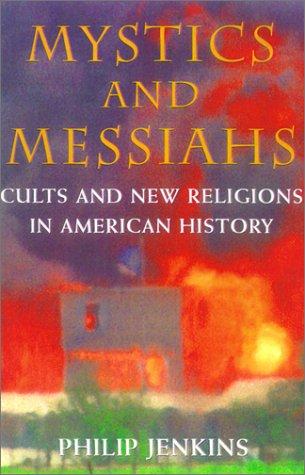
It is difficult to know where to begin when discussing Philip Jenkins’ Mystics and Messiahs: Cults and New Religions in American History. As a student of religion I early found myself drawn to the question of where religions begin. In the case of many religions we have an identifiable founder. Frequently that founder ends up being a god him (or more rarely) herself. In order for any putatively revealed religion to attain any credibility, the ultimate source must come from on high; God himself. So it is that we look askance at any religion that has appeared in the last couple of centuries, when, as we knew at the time, the earth was no longer the center of the universe and science had taught us to know better than to accept the old-timey stories of a god in the clouds. We can accept the ancient, time-honored stories, venerated as they are by centuries. If someone today tells us that God has spoken to him or her, we refer them to psychiatrists first, and then to the mind-altering drugs.
Jenkins, writing in the shadow of the tragedy of the Branch Davidians at Waco and the ritual suicide among the members of Heaven’s Gate (one of the members’ sons was one time a student of mine in seminary), tries to demonstrate that such groups are part of the fabric of religion. What is new in such movements is not the fact that they suddenly come into existence, or that society reacts violently to them, but that we now have a concept of “cult” to label them. Jenkins convincingly illustrates that fear of new religions stretches back for centuries. Even in the seventeenth century people experimented with new religions. When they survive, they become “churches.” Consider the Mormons, the Seventh-Day Adventists, and the Pentecostals. They all began as “cults” and are today considered just another variety of Christianity. Most adherents to religions do not inquire too closely as to the origins of their brand. Historically we know that the three denominations mentioned above are well under two hundred years old.
In a fascinating twist, Jenkins describes how the Zeitgeist of the early twentieth century was ripe for such developments. One of the sources, ironically, was the fiction of H. P. Lovecraft. His weird stories often invoked cult-like groups devoted to unusual practices that sometimes turned deadly. Also during that same time period, Christian Fundamentalism began as an effort to sort out what was “fundamental” to Christianity that set it apart from the cults (including Pentecostalism, now one of the most dominant Fundamentalist sects). As Jenkins points out, when these new sects become mainstream, they vehemently seek to destroy all new comers. Christianity began as a cult in the eyes of both Jews and Romans.
Religions are inherently conservative. As we will see in the approaching election, the religious background of a candidate plays a major role in public acceptability. We enjoy freedom of religion in the United States, but only to a point. Jenkins should be required reading for every religious believer. Tolerance would be the only proper and reasonable response.
 Steve A. Wiggins
3 thoughts on “Mystic Messiahs”