
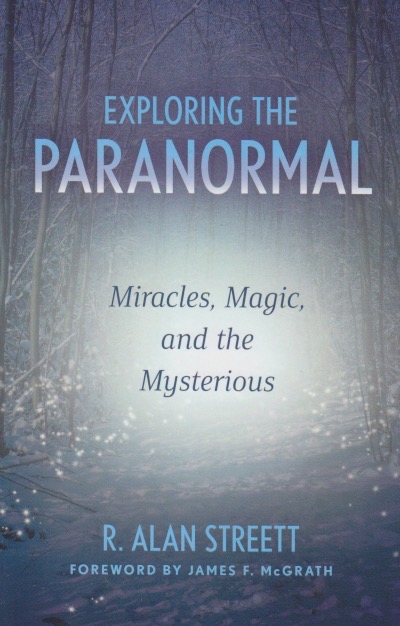
I remember well what it was like to be an evangelical. Measuring everything by what I thought the Bible said, fearing those things that seemed to come from outside. Being very concerned with salvation and its opposite. At the same time, I was fascinated by the paranormal. As I child I was teased for these interests and subsequently buried them. Then I had a slow, protracted, and continuing waking from dogmatic slumber. So it is natural that I would want to read R. Alan Streett’s Exploring the Paranormal: Miracles, Magic, and the Mysterious. I didn’t know how he would approach the subject, and I didn’t know where on the evangelical spectrum he fell. Still, I’m always interested to see how others handle what we all know—strange stuff happens and there is no real explanation for it. Scientific method may one day be able to address some of it, but at the moment it generally falls outside the bounds.
Streett’s book is somewhat autobiographical, from his non-religious childhood, believing in parapsychology, through seminary and having an evangelical awakening, to the point that he stopped supposing such things were demonic, and on to where he stands at the moment—thinking that most such things can be explained by brain science and alternative states of consciousness. There are a number of interesting situations and concepts described in this book; I learned quite a bit when he discussed different brain states. I understand his theological rejection of potential realities behind the phenomena he discusses (mostly mediumship, but also reincarnation and faith healing) but don’t always agree with the conclusions. There is much in the world that theology can’t explain.
Something that is perhaps overt between the covers, is that the paranormal is something that happens to evangelical, liberal, Muslim, Jew, Hindu, Buddhist, atheist, agnostic, and none alike. What differs is the interpretation, based on various faith traditions and their tolerance for that which is outside. Evangelicalism is a worldview, perhaps more so than it is a theological position. Non-divine miracles, or whatever you want to call paranormal occurrences, don’t fit comfortably into that worldview. Other interpreters, also raised in Christian traditions (Catholicism, for example, is quite open to mystical happenings that can fall into the paranormal category), might approach the question in a different way. Dialogue is important, however, and trying to make sense of this world we live in, in my humble opinion, has to reach outside the reductionistic view that brains alone account for human experience. Streett’s account offers a reasonable perspective on the issue from an evangelical outlook.
 Steve A. Wiggins
6 thoughts on “Paranormal Religion”