
Back at Nashotah House the local ghost was called “the Black Monk.” A plausible origin story circulated with the name; a student broke through the ice on the lake one winter night and met his demise. Some even claimed to know which was his gravestone in the cemetery on campus. I really didn’t give much thought to any of this until I learned that Anton Chekhov wrote a short story titled “The Black Monk.” Now, I don’t know if some literate Nashotah student was referencing Chekhov or if the color was just fitting for a cassocked community of quasi-monks. In either case, I decided to read the story. The Russian tale involves a man named Kovrin. He holds a Master of Arts degree, in the way that degrees in Russian stories bring the holder a great deal of respect. He was raised by a wealthy farmer who owns extensive orchards, and, needing some time to relax from his city schedule, goes to stay with his former guardian and his daughter. While there he relates the tale of the Black Monk, who was seen all around the world, and maybe even in space, from where he walked in Arabia or Syria, a thousand years ago. It was rumored that he would return a millennium later, and, as it turns out, Kovrin sees him.
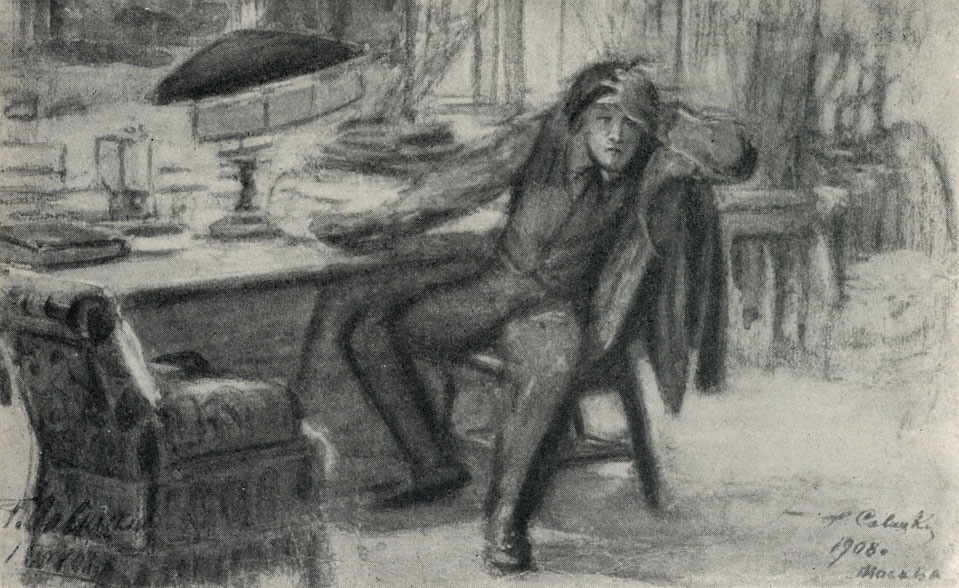
Kovrin is a successful, bright, and cheerful scholar. He begins to see the phantom and have conversations with him. The monk assures him that he (Kovrin) is extraordinary, a genius even. That other people, satisfied with mediocrity, melt into the herd. True genius, however, is often perceived by others as madness. They have long conversations. Kovrin marries the farmer’s daughter but their relationship is troubled. One night she awakes to find him speaking to an empty chair—nobody else sees the Black Monk. Convinced that he is mentally ill, she and her father put him in a doctor’s care and his new regime of lifestyle changes prevents further visits of the Monk. Kovrin, however, grows sullen and dull. He realizes that his genius is gone and that he has become ordinary. His marriage falls apart and when he goes on a vacation to the Crimea, he once again sees the Black Monk. His feelings of being extraordinary begin to return, but he dies that night. His corpse wears a smile.
This tale had me thinking. It’s not clear that Kovrin was really mad but no doubt he’d been quite intelligent. He was given a university chair and received the praise of others. It was the cure that destroyed him. It robbed him of his enjoyment of life and also led to the downfall of the farm since his father-in-law died and his daughter, now separated from Kovrin, writes to curse him for his insanity. The farmer and his daughter aren’t always sympathetic characters, but until his dying day (literally) Kovrin had lost all that made his life meaningful. The Black Monk admits he’s an apparition, but Kovrin was clearly brilliant while he met and conversed with him. I’m not sure of any parallels with Nashotah House, but it has a character in common with Chekhov’s story.
 Steve A. Wiggins
Pingback: The Black Monk | Talmidimblogging