Soulless Robots?

Robots have taken over my life. At least in the short term. As my friend Burke commented on Easter: “Alleluia! The robots have risen… up against us?!” Actually, the robots I encounter are benign and all follow Asimov’s rules. I have mentioned before the phenomenal First Robotics program, a venue to encourage high school students to consider careers in engineering. Team 102, Somerville High School’s robotics team, recently won a regional competition in Hartford, Connecticut. My role has mostly been to watch other people design and construct the robot while occasionally correcting the grammar on written documents. The joke my friend made, however, has at its roots a deep-seated human concern: how do people deal with soulless machines?

Stephen Asma, in his book On Monsters, has a chapter concerning the human fear of a robotic future. Electronic gadgets with uncompromising metal bodies and no consciousness that we recognize present a frightening combination. The question that concerns me more, however, is the concept of the soul itself. The Hebrew Bible has no concept of the soul as it would later be adopted by the Judeo-Christian tradition. In the Hebrew Bible a body is a soul; when the soul dies the body dies – people are a monistic unit, not a dualistic entity with a part that hangs around the spirosphere after the biological part rots away. Of course, in Christianity the soul has become an essential aspect of church doctrine and we fear other creatures that lack them. Souls have never been observed in a laboratory and we have yet to prove their existence.

Reading the news and seeing how biological, soul-fueled humans treat each other is a sobering task. Each day I lay the newspaper down with a new kind of dread. Perhaps souls are only mythical beings concocted to shore up a theology that can’t survive without them. Or maybe all living beings have souls. Perhaps even mechanical ones. As Team 102 heads to the national competition in Atlanta in the days ahead, I know that I’ll be rooting for a soulless machine that may be a bold step towards humanity’s continuing evolution.

Sorry for the blur, the robot just wouldn't stop shaking me!

Smile, You’re Condemned

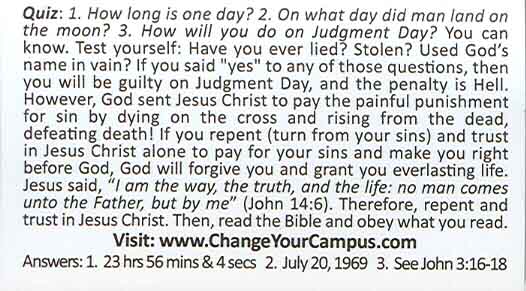
Yesterday at Montclair State University, I was sitting in the hallway (my office) prior to class. (Office hours are required, but space is limited for adjuncts such as myself.) While I was reading my book a student walked up and handed me a business card. “For you, sir,” she said politely. The card had a smiley face on it, and was designed to bring cheer.

Then I flipped the card over and found out I was going to Hell. A bit of a downer when you’re about to start class!

It isn’t the first time people have attempted to convert me without bothering to find out what I believe. It seems that if you already hold the zealot’s view you’ll appreciate the gesture of being condemned just to make sure your soul is saved. It is the thought that counts, after all.

The book I was reading was Joseph Campbell’s The Hero with a Thousand Faces – a book I’ve known since college but from which I have only taken a tipple until this year. Many scholars of mythology fault Campbell on being too much of a generalist and looking too much for connections where they are not obvious. His language can be florid and mystical, verging on “believer,” for those uncomfortable with any kind of faith. I find Campbell to be a welcome guide, although, as for any guide, I do not believe all he says! One nugget in particular stuck out at me: “Wherever the poetry of myth is interpreted as biography, history, or science, it is killed.” As we find ourselves on Good Friday, only those with eyes firmly shut will disregard Campbell’s wisdom.

I still remember my shock when I first learned that gods, centuries before Jesus, had been dying and rising. What had always been presented to me as a unique historical event actually had a long and venerable prehistory. It suddenly seemed as if the ministers I’d known hadn’t done their homework. Or perhaps they lacked the cognitive finesse to understand Orpheus, Adonis, Baal, Osiris, and even Ishtar, as types of either blatant or obscure resurrection. It is the Campbellian, or nearly universal hope: life prevails over death. As the young lady walked away, I sincerely wished her happiness in the quest she’s only beginning.


Eternal Dampnation

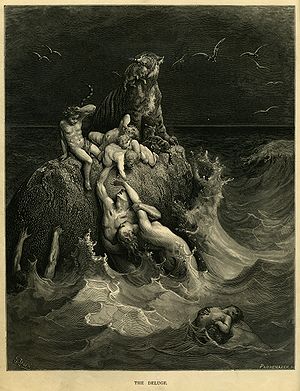
Does anybody have Noah’s telephone number? New Jersey has just experienced the wettest winter on record. Since the day records began, we’ve never had this much rain. That fact came home to me yesterday while driving the fifty miles to Montclair in a tremendous downpour. I had just purchased new windshield wipers, but the cap had fallen off the driver’s side blade. Driving on a truck-infested interstate where traffic continued to fly by at above posted speed limits, I realized with horror that at each passing swipe the rubber insert that actually swipes away the moisture was creeping out of the top of the wiper fixture. There it was, just at the top of my field of view, thrashing about like a demon-possessed snake, while my field of view grew smaller and smaller. I was in lane three of an eight-lane highway and couldn’t get over to make adjustments. In a nightmare I envisioned the slippery snake making a terminal bit for freedom and flying over my head as metal scraped glass and I drove blind into whatever lay ahead.

Well, the wiper stayed intact long enough to get me to the university. The rain did not abate, however. Even with battered umbrella and longsuffering raincoat, I was soaked below the knees by the time I squished into class. Unfortunately we studied the flood myth a few weeks ago. A few years back William Ryan and Walter Pitman, a couple of geologists, uncovered the fact that the Black Sea had been flooded by the Mediterranean some 7500 years ago. They posited that this sudden increase in sea-level around the Euxine Sea led to the dispersion of a world-wide flood myth. Their book became a best-seller and even Robert Ballard got in on the search for Noah’s homeland.

Hearing people talk about New Jersey’s incessant rain, I have no doubt that a major sea change was not necessary for flood stories to begin. As water levels rise, perhaps to the delight of whales and other blubber-laden beasts, the rest of us fear being perpetually covered by overwhelming waves. That is enough to start the story of a flood. Especially when your windshield wipers aren’t working on the Garden State Parkway.

Is it damnation or just New Jersey?


Jesus Lets Himself Go

Leonardo da Vinci's Last Supper


Carpentry is hard work, as Jesus must have known. The occasions when I head to the basement and chew through wood with an electric saw and nail boards together through pre-drilled pilot holes always leave me feeling like I’ve burned a few calories. Not to mention walking everywhere. No Hondas, Volkswagens, or Smart Cars in those days. A guy could sure build up an appetite. My wife pointed me to Newsweek’s blog this week, where a story about the portion sizes portrayed in paintings of the last supper over the past millennium is posted. The conclusion drawn: the food servings have continued to escalate in size as food production and acquisition have become easier.

This is not so surprising, given that what people value is what they portray in art. As I’ve mentioned before, Stephen Prothero, in his book American Jesus, demonstrates that portraits of Jesus reflect the self-perception of the society in which they are produced. Few attempt to make a life-like representation, largely because no one knows what Jesus might have looked like.

Jesus as an ordinary guy

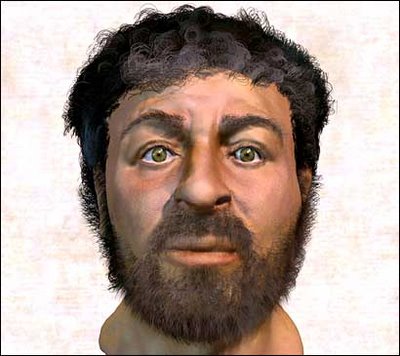
A few years back, Richard Neave, a retired medical artist from the University of Manchester reconstructed, based on forensic research, what he believes Jesus likely looked like. The portrait is not handsome, and to be fair, not based on the actual skull of Jesus which has been missing for a couple of millennia. I used to ask my students in Intro to Christianity what difference it would make if Jesus was not good-looking. They tended to react strongly – particularly those of Christian disposition – there was an inherent blasphemy in suggesting that Jesus might not have been drop-dead handsome.

Now, if we gently push his chair back into that fateful table one more time, we might wonder how an overweight Jesus might appeal to those who struggle with weight issues. More of him to go around, as the saying goes. I’ve viewed much religious art in my time, but I’ve never seen a love-handled Jesus, let alone a chunky savior. And perhaps that is the biggest miracle of all, given that he eats more each passing year.


Mournful Metaphor

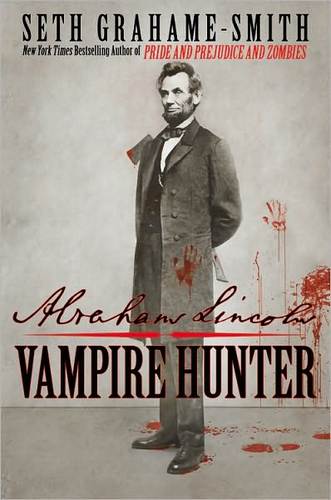
Sometimes the concept is great but the results disappoint. Those who have followed this blog know that a unifying concept over the past half-year has been the often hidden relationship between religion and monsters. Certainly this fascination has its roots in my refusal to admit that I’ve grown up, but with the popular media pushing the undead into our collective consciousness on a daily basis I feel a happy vindication. I posted last week about Seth Grahame-Smith’s new book, Abraham Lincoln: Vampire Hunter. Well, now that I’ve finished the book I would say that the jarring concept of our most honored president leading a secret life was fun to wrestle with, but the book failed to win me.

Lincoln’s great contribution to our nation is still echoing through a society slow to admit the equality of all. Perhaps that fact alone would render any book trying to throw some comic relief on a deadly serious issue mute before it even begins to spin its yarn. That, and I didn’t like the portrayal of the vampires. I’m no undead purist, and I’m aware that vampires have changed form and character over the centuries, but having masses of them in one place felt like being the proverbial cat-shepherd. Giving them political ambitions, with a nod to Francis Ford Coppola’s Bram Stoker’s Dracula, was too much. The issue of slavery, clearly the metaphor being utilized by Grahame-Smith, is hard to smile about. Lincoln’s personal suffering is difficult to lighten with his career as a vampire hunter. The story just didn’t work.

I’ve had enough bumps in my own life to eschew easy categorization. Even my current career must be listed in the TBD category. Nevertheless, I wasn’t sure if what I was reading was a serious attempt at a novel or a humorous exploration of a funny idea. I found the book catalogued in humor, but its narrative seems to have the earnestness of a determined novelist. When the story ended I felt as if I’d read a dime-store novel I’d purchased at Comedy Central. And with the headlines the way they are these days, I’d been hoping for a good laugh. Instead it seems that I have been bitten by a vampire wearing shades.

Two heroes, no smiles


Politicians and Blood-Suckers

The old icons and heroes are gone. It is best just to deal with it. No one is above reproach since we are all in this human morass together. Nevertheless, I’ve always held a soft spot in my cynical heart for Abraham Lincoln. I know he wasn’t perfect, but he stood for an issue that has been a driving force for my life: fairness. Now I see that he was a vampire hunter. After having read Seth Grahame-Smith’s Pride and Prejudice and Zombies last year, I’ve decided to give a try to his Abraham Lincoln: Vampire Hunter. My fascination with monsters and religion has not been disappointed in this fanciful story.

Our quasi-fictional honest Abe begins his vampire-slaying ways when he learns that, yes, a vampire killed his mother. As a boy of only twelve, he finds the knowledge stressful to the point of burning the family Bible that he used to read to his departed mother. Why? In Abraham’s own (fictitious) words: “How could I worship a God who would permit [vampires] to exist? A God that had allowed my mother to fall prey to their evil?” I admit that I was secretly pleased to see the classic issue of theodicy being raised in a story concerned with the undead. It is the dilemma of all who want to see a good God behind all the suffering in the world. It is a dilemma that stems from the same deep wells as our inhuman monsters. We can imagine a better world, but we can’t have it.

Politicians with axes

As I see New Jersey’s governor Christie (for whom I decidedly did not vote!) slashing away again and again like Freddie Kruger at the state’s educational system, I see the twin peaks of vampirism and theodicy peering distantly over the horizon. I am deeply disturbed by the facile disregard this “visionary” Republican has for the future of his own state, for the future of our children. And I am forcefully reminded once again that vampires are symbolic of all those who prey upon the unwary. When staring into the fireplace on a cold night, I imagine myself standing beside Grahame-Smith’s fictional Abraham Lincoln, wondering what god it is that vampires worship.


War and Peace

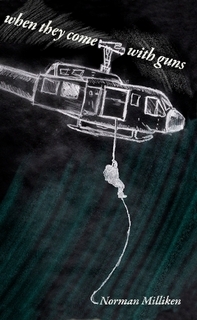
A few weeks back a friend pointed me to a Facebook-style website someone in my high school graduating class had put together. In high school I was awkward, shy, and a little too obvious about my religious beliefs, so I was a bit timid to join. Nostalgia eventually got me in a headlock, just like in gym class, so I signed up. One of my classmates helped me to find one of the people who had a profound impact on my life. Although I never had him for a class, Mr. Milliken was my Creative Writing Club advisor, and a person I utterly respect and admire. I’m not normally a hero worshiper, but Mr. Milliken had been through more suffering than many men his age and had come out of it a sincere, caring, and thoughtful individual. When I found out that he had published a brief collection of his poetry about his time in Vietnam, I immediately ordered it.

Available from Lulu.com

War has always haunted me. Perhaps it was partially because of the tales Mr. Milliken sometimes told, or because of my macabre reading about the terrors of twentieth-century conflicts, but whatever the cause for my fear, it was real. War has been with humanity for as long as its more docile cousin, civilization. Being rational creatures, there seems to be no reason that we should not be able to reason ourselves out of armed conflict, but we don’t. Knowing that one of my most respected high school influences had nearly died in Vietnam chilled me. Reading his poetry, I shiver once again.

While justifying it on theological grounds, the Hebrew Bible takes a fatalistic view of war. Killing of enemies who stand in the way of god’s plan is sanctioned, commanded even. The victims, however, are humans just like the victors.

When I get caught up in the complex web of difficulties my own life has woven into, I find it easy to complain. Reading when they come with guns, however, reminds me that many have had it much worse and have come out as superior human beings. For those who are victims of war, we can only hope that forgiveness will somehow descend on those of us who have not yet put an end to it.


Religion Embraces Science

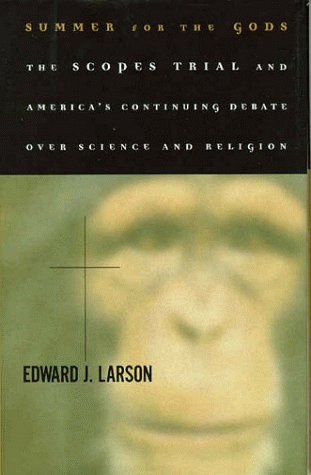
My colleague and one-time dean, Michael Zimmerman of Butler University, has brought his Clergy Letter Project to the Huffington Post. Well, he has written an online piece for the Huffington Post entitled “Redefining the Creation/Evolution Controversy.” His article is clear and to-the-point: the Creation/Evolution debate is not about religion versus science. That has been shown repeatedly for those who care to examine the history of this controversy. Evolution barely caused a ripple among clergy when it was first becoming popular among scientists. Ministers assumed it was just one of God’s mysteries and went about their clerical duties. The issue became a public relations boondoggle with the Scopes Trial of 1925. One of the best books written on that subject is Edward Larson’s Pulitzer Prize-winning Summer for the Gods.

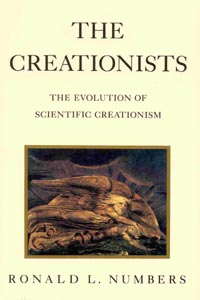
As I have stated in my podcast on this issue, Creationism is a splinter movement within Evangelical Christianity. Over the years it has drawn in members of a wide variety of Christian groups, including Roman Catholics and mainstream Protestant denominations. It has publicized its concerns so well that many people assume that this is the “Christian” viewpoint and that all other views are, by definition, non-Christian. This is the perspective that has driven a wedge between religion and science, creating a false front that has led to many confrontations between Evangelicals and scientists. My favorite history of the Creationist movement is Ronald Numbers’ The Creationists.

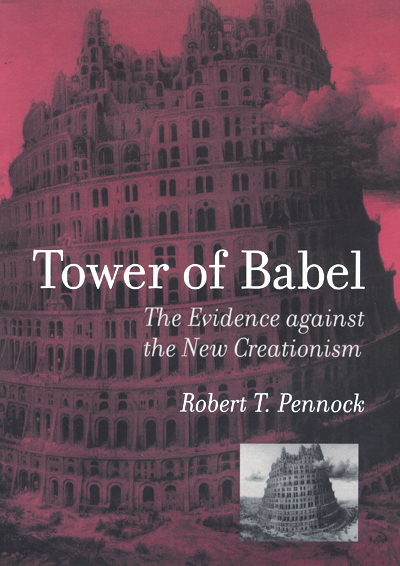
The true motivation of the movement is, without doubt, political. While many sophisticated people scoff at the apparently simplistic machinations of the Creationist movement, what they do not realize is that it is a highly organized and politically savvy alliance of special-interest groups. Robert Pennock’s Tower of Babel was an academic exposé of the inner workings of the Creationist movement. It is perhaps the most important book written on the subject. Published by an academic press, however, it has not found the wide public readership it deserves.

Do yourself a favor: read Dr. Zimmerman’s post. I believe he has framed the dilemma in the correct way: the struggle is one within a specific religion, Christianity, not one between religion and science. The more the public knows about this issue the better off we all will be in the long run.


Neo-Cons and Mockingbirds

Among my high school catch-up reading is one of my favorite novels, required in my own youth, Harper Lee’s To Kill a Mockingbird. While a certain distress accompanies the fact that I read this book over thirty years ago, as I reintroduce myself to the welcoming characters of Scout, Jem, and Dill, I lament that there is so much to read that we can’t simply linger on the great works of literature we’ve loved before. Reading the novel as an adult there is much, I am certain, that I missed the first time around, not knowing what to expect as I approached the story with no preconceived notions.

One of the constant stresses I lay on my students is how the Bible utterly suffuses American society. We are bombarded by Bible, whether we know it or not. It was with appreciation, therefore, that I saw the exchange between Scout Finch and Miss Maudie in chapter five. Miss Maudie, complaining that “foot-washing Baptists” take the Bible a little too literally, declares, “but sometimes the Bible in the hand of one man is worse than a whiskey bottle in the hand of – oh, of your father.” (The incongruous image of Atticus Finch drinking whiskey is not lost on his young daughter.) This statement summarizes much that is true in today’s society as is evident in Max Blumenthal’s Republican Gomorrah. Many Americans create an idolized image of the Bible that is used to gain control over others. When such individuals gain political power everyone else is at risk.

In the backlash to having a moderate man elected to the presidency, the news is full of biblically constricted complainers who fear the impotence of the Bible. Their fears are unfounded. Our society has been constructed on foundation blocks of biblical literalism and although the superstructure is unaware of it, the Bible continues to root many Americans firmly to their planet. The “founding fathers” were not Christians, but many of their country-folk, Puritans and others fleeing the formalized religions of Europe, were. The aggregate of their descendants has been tapped successfully by neo-con politicians to win elections and referenda around the nation. There is no end in sight. If only the wisdom of Miss Maudie were taken a little more seriously, we might have a chance to move beyond the illusion of a pristine yesteryear that never was.

Killing me biblically


Trojan Gods

Every great once in a while Hollywood produces a major motion picture that demands the attention of scholars. Well, at least those of us who like to stay current about the way our subject is being displayed to the wider public. When Troy was released in 2004, I was still firmly engaged in teaching biblical studies and the Trojan War, although located somewhere at the fringes of the Ancient Near East, was not a particular concern. Now that I’m also teaching a mythology course that covers the Iliad, I figured I’d better watch the movie. For research purposes only, of course. Although I hadn’t seen the film before, I knew of the critics’ complaints that the gods, conspicuous in Homer, had been left out. I was expecting to be disappointed, but I found the movie to be more intelligent and subtle than I supposed it might be. The absence of the gods, distressing as it may be to purists, gave the movie an angst that is generally reserved for more cerebral subjects.

The question of where the gods might be in all the slaughter and destruction of war reminded me of a book that had profound influence on me several years ago. Richard Elliott Friedman’s The Disappearance of God: A Divine Mystery (Little, Brown, 1995) traces the gradual withdrawal of God from the scene in the course of the writing of the Hebrew Bible. The god who appears so active in the early chapters of Genesis distances himself further and further until the latest writings, according to Friedman’s dating, show few traces of the divine at all. God subtly, quietly, goes away.

Portrayed as defying the power of the gods in the film, Achilles desecrates the temple of Apollo and seals his fate. Nevertheless, although he is shot by an archer, the death of the hero seems more like an arbitrary act than the design of divine majesty. The Greeks, after all, did win the war. Atheism, however, did not exist in any real terms in the twelfth century before the Common Era. Then again, Achilles probably did not exist in any real terms either. Although Troy will never be among my list of most profound films, its commentary on the quiet skies of ancient Ilium serves as a useful metaphor, even for today.


Abuse of Power

In many ways the naiveté of youth still clings to me. I was reared to respect authority and to trust those whom society placed in power over me. As skeptical experience wears away at this ancient veneer, I have become more retrospective of the whole enterprise of the social experiment. Perhaps I shouldn’t have read The Call of the Wild after all.

A few months back I wrote a post supporting a student at Butler University, Jess Zimmerman, who was being sued by the university for perceived slights against the administration on his anonymous blog. That post has forged a connection between Jess and myself, although I’ve never met him. That connection is one of justice and fairness, traits that should, above all, be upheld by institutions of higher learning. In an email last night, Jess updated me on his situation. The lawsuit has been dropped (my thanks to all of you who signed the electronic petition through this blog), but the recriminations continue. The details are available on Jess’ blog, but the short version is that in order to have a fair trial the university had placed him under a $100,000 bond. I am saddened, but not surprised, by this abuse of power.

Over the past several months I have wearily retrod this familiar path. I too have been the victim of institutional power in an episode that haunts me to this day. In slow motion I watch and rewatch men “in authority” dismantling the hopes and aspirations of a neophyte academic who was left wondering, like a dog, why he was being beaten so. There is no action to take. There is no club to wield. The only thing required is to be aware of the situation. Although I shouldn’t have done it, I did read Jack London’s Call of the Wild. And it is my hope that young students unfairly targeted, like Jess, have the resilience of Buck and will remember their pasts when they come to lead their companions in forging a better world.


The Gospel According to Caulfield

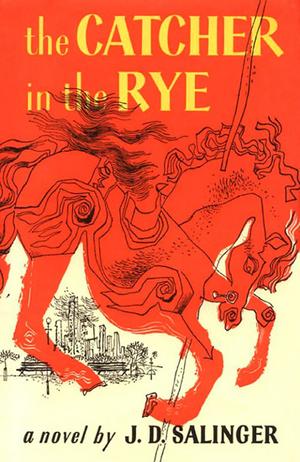
When one is asked to cite her or his favorite theologian, J. D. Salinger isn’t likely to be in the running. He might not even make the top ten. My personal introduction to Salinger, however, took place in a theological context. While in a Cambridge (Massachusetts) bookshop with a grad school buddy, I pointed out Mircea Eliade’s classic The Sacred and the Profane, insisting that my friend read it. Never to be outdone, Dave pointed at Salinger’s Franny and Zooey and said if I bought and read it he would do the same with Eliade. The Catcher in the Rye had not been part of my high school curriculum, so I was curious what all the fuss was about. I took him up on his dare. I’m not sure Dave ever read Eliade, but I read Salinger. My first impression was, “I don’t get it.”

Now my daughter’s school does require The Catcher in the Rye, and I’ve always tried (not always successfully) to keep up with her required reading. It gives us something to talk about – I’ve read several great books I’d otherwise have missed by this exercise. So I picked up the Catcher and plowed through. Salinger, I’m sure, requires no introduction. What is noteworthy, however, is that Holden Caulfield, while avowing himself an atheist, does make subtle but pointed comments about religion. (One of the occupational hazards of being a religionist is a constantly humming radar looking for any god-talk that might otherwise blend into the haze.) Holden, in chapter 14, points out the idiotic behavior of the disciples while Jesus was alive. He admits to thinking Jesus is okay, but his favorite character is the demon-possessed man who lives among the tombs. “I like him ten times as much as the Disciples, that poor bastard,” he says.

Who is as honest as Holden?

There is true religion in this statement. The “lunatic” running about in the tombs, rejected by society and even as far from God as you can get (demon possessed), is an image of humanity. Living a life of desperate alienation, the man in the tombs appeals to angst-ridden teenagers and displaced adults alike. He is likeable because he is like us. Holden scores bonus points on that observation!

With Salinger’s recent death, a renewed interest has sprung up about his novels – books that have changed the literary landscape. I read Catcher with more inherent appreciation than I did Franny and Zooey, but I’ve grown up a little since then. As an adult I can better appreciate the honest appraisals of Holden Caulfield.


Eine Kleine Neanderthal-Musik

I suffer a limited form of amusia. No, it’s not a fear of amusement, but rather lack of musical ability. I appreciate music very deeply, but I simply can’t make it. I’ve tried lessons and teachers end up turning away in exasperation. The embarrassing part about all this is that music is an integral part of religion – almost all forms of religion have their musical repertoire, and musicologists have demonstrated that the early human impulse to make music has a religious basis. I can only sit in the audience.

That's me on the left

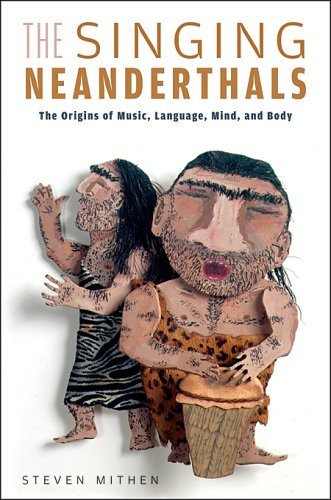
I’m finally getting around to reading Steven Mithen’s The Singing Neanderthals: The Origins of Music, Language, Mind, and Body. A few years back I gave an academic paper suggesting that musical development could be an analog to religious development on a neurological level in the Bronze Age. Since I’m not a neuroscientist I have to rely on others to do the experimental side of the equation. Mithen serves this function nicely. When I read about music and the brain, which I do frequently, I am surprised that more scholars of religion haven’t picked up on this connection. Since music is frequently “background noise” today, many people casually assume that it is insubstantial, a whim. I look at it (listen to it) from a different angle. I seldom listen to background music – if music is playing, I pay attention to it, and something in my unprofessional brain says Mithen is often right on target.

Of course, religion and music is not the main thrust of The Singing Neanderthals, but rather the idea that music was formative for human cognition. Perhaps music even developed before speech. For me this is an important piece of a much larger puzzle: whence did religion arise? Like all inquiries that delve too deeply into the past, the answer is lost among ambiguous artifacts and ancient dust. And yet, those who know more about this than I do seem to be pointing in the direction that both religion and music have their origins in the pre-Homo sapiens stage of our evolution. I’m not surprised. I only wish I could play along.


Saint John, Elton, That Is

“I think Jesus was a compassionate, super-intelligent gay man who understood human problems. On the cross, he forgave the people who crucified him. Jesus wanted us to be loving and forgiving. I don’t know what makes people so cruel. Try being a gay woman in the Middle East — you’re as good as dead.” According to Parade.com, this was Elton John’s take on Christianity. I find the comments endearing in a naïve sort of way. They further demonstrate how people construct their gods in their own images. Compassionate? No question. Super-intelligent? Well, maybe. He certainly was creative, witty, and above average in intellectual celerity. Gay? Not likely. Not for doctrinal reasons, but simply for cultural ones. “Gay” as a lifestyle simply did not exist in the first century. The Bible maintains a steely silence on any aspect of Jesus’ sexual life, so we can never know. Perhaps it’s a case of “don’t ask, don’t tell”? Understood human problems? Bingo! Yahtzee! That is, I believe, what Jesus was all about. In my humble opinion, Elton hit that one dead on.

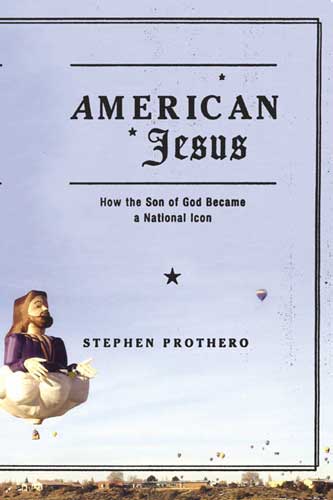
The crafting of Jesus into our own form is a major aspect of Stephen Prothero’s American Jesus. A fascinating romp through a bizarre collection of made-over Jesuses, Prothero’s book should be required reading for anyone interested in civil religion or Thucydides. Even a religion prof from my alma mater, however, didn’t fully convince me that anybody really understands who Jesus was. Such is the way with all truly great individuals.

Unlike some commentators who are clearly upset by Elton John’s summation of Christianity’s founder, I am a bit more circumspect about it. No one has cornered the market on Jesus. As hard as various Christianities have tried, Jesus still emerges in divergent forms to diverse individuals and populations. From Superstar to “super-intelligent gay man,” there is no doubt that Jesus left an eternal imprint on the human population of this planet and that those who believe in him will always portray him in their own image.


Klaatu Barada Nikto

I grew up with robots. Of course they were on the television screen and I was far away in rural-ish western Pennsylvania. They were exotic creatures built by guys much more intelligent than I could ever hope to be, and they were powerful, completely rational, and scary. Now I find myself involved with the FIRST Robotics team in my daughter’s high school where kids a third my age are building a robot. It is a humbling experience.

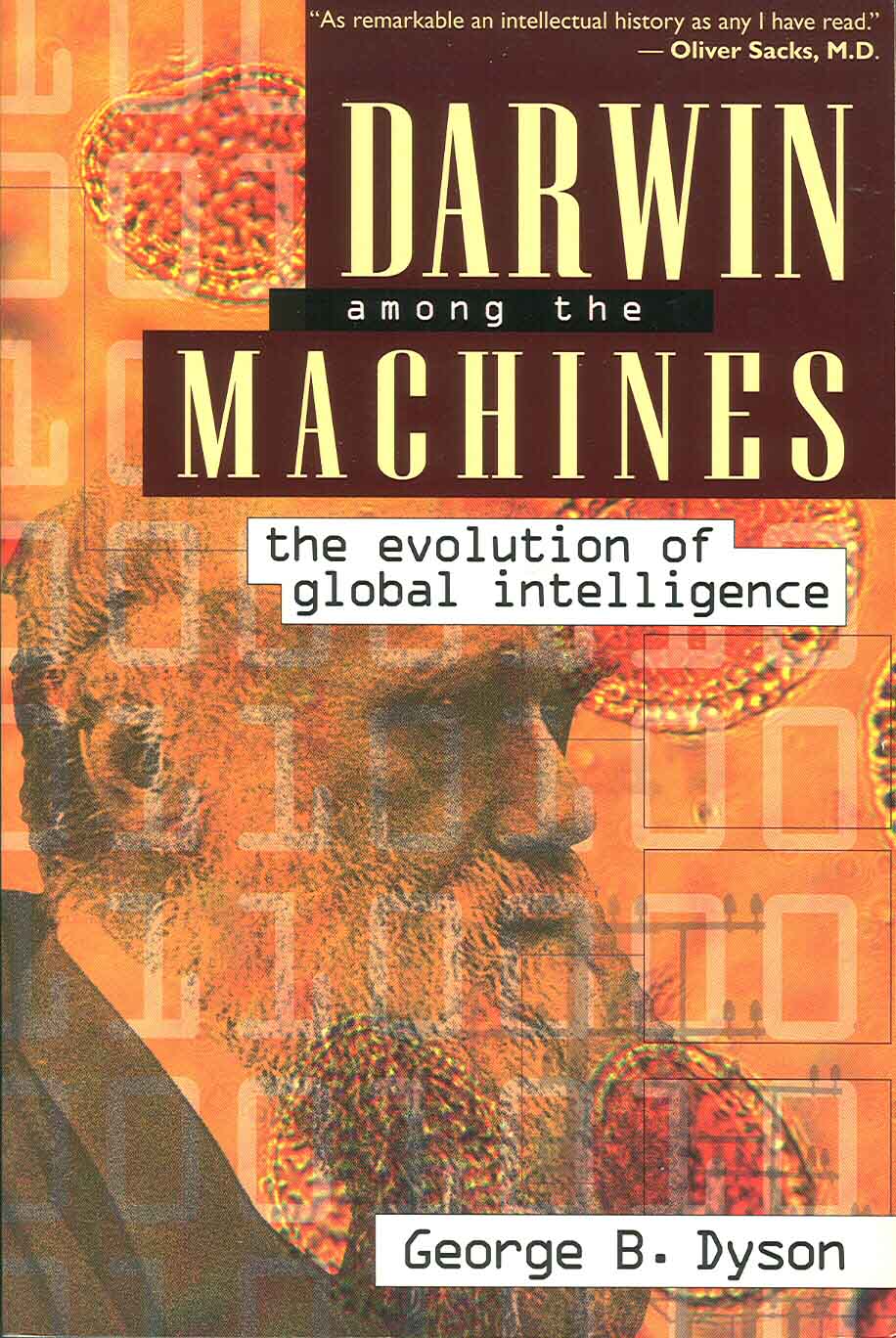
The more I ponder my small support role in the construction of a robotic creature, the more my thoughts turn to George Dyson’s masterful science writing in one of my favorite books — Darwin Among the Machines: the Evolution of Global Intelligence. I would not have known of this brilliant book had I not met George and a group of his friends several years back while they were discussing some of the ideas raised in his work. The main one that captured my attention was the premise that when we build machines we may be constructing an unrecognized form of consciousness. The greatest minds in neuroscience today cannot agree on what consciousness really is or how far it extends beyond this “three-pound universe” in our heads. Although most would decline to comment on the overtly religious term “soul,” we still know that any difference between consciousness, mind, psyche, and soul is very slim indeed.

Read this book!

Our lifestyle is made possible by robots. We drive cars largely constructed by them, use their chips to communicate over vast distances, and even take a stroll on the surface of Mars with them. My question from Monday’s post may have been whimsical, but it was serious. Where is it that the essence of a creature resides? Does it require carbon-based biology, or do we, unwittingly, create a race of slaves just like the gods of old?