
Here’s a podcast regarding Baal, El, and Yahweh. It is a discussion of why Israel had no problem with El but felt the need to get Baal completely out of the system.
Gods bless you
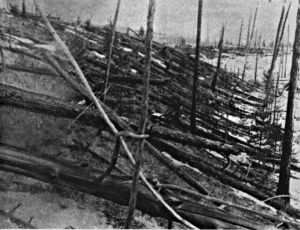
Which god sneezed?
In a recent reading project to keep me edgy and paranoid, I went through Surenda Verma’s The Mystery of the Tunguska Fireball (Icon Books, 2005). Quite apart from giving me a quick X-Files fix, this book is a thorough and reader-friendly account of an event that, no matter what you make of Mulder and Scully, should have been a major wake-up call for those of us who call planet Earth home (some exceptions apply).
On June 30, 1908, a fireball exploded over a remote region of Siberia. Even today it is nearly impossible to reach the spot. The traces of this event, which don’t seem to support any given theory completely, point to an explosion on the order of 10–20 megatons (the bomb dropped on Hiroshima, for contrast, weighed in at about a thousand times lighter on the TNT scale). The sparsely populated region was devastated by shock waves and fire, and only by a slim thread of fate did all of us not end up on the extinction list. A blast of that intensity, had it been located lower in the atmosphere, could have easily brought on a nuclear winter — with no Jingle Bells!
Sometimes when life seems too intense, I find it helpful to think of what a wonder it is to be here at all. Perhaps it is a religion of wonder. Earth’s history is replete with mass extinctions that ultimately allowed for our own evolution, but which wiped out over 99 percent of all species that have ever lived. The Permian Extinction, which allowed for the rise of the dinosaurs, nearly obliterated life itself from our rocky home. When I look to the future I see disjunction and continuity. Jupiter was dealt a second cometic blow within two decades last week, and the odds are ticking on our own tiny planet. I wonder what ancient mythology would have made of Tunguska — who was the lady or lord of the fireball?
Changing Faces of the Divine
One of the most intriguing books I’ve read on the origin of religion in the past few months has been Stewart Guthrie’s Faces in the Clouds (Oxford, 1993). Guthrie offers the suggestion that our in-born, evolutionarily driven need to see people or faces, even where these are false positives, may have led to the concept of god/s. As a respectable academic, I am obligated never to agree completely with anyone, but Guthrie seems to be onto something here. When I’m jogging in the pre-dawn hours it is amazing how many people are about — that is, until I get close enough to see that they are a small tree or a tall newspaper stand. We do see what we consider important everywhere.
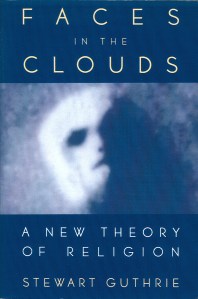
The picture says it all.
Having recently stumbled upon “Ghost Hunters,” I am amazed at how quickly some people (with the obvious exception of Jason, Grant, and the TAPS team) are inclined to claim a human shape to be a supernatural entity. This phenomenon is ubiquitous. On the web, while looking to find a good example of pareidolia to present to my class, I found an image of Michael Jackson’s face seared onto a piece of toast. If ever a divine sign was needed, here it is indeed! A more prosaic example was a natural water-stain I found on a saucepan in my own kitchen. I picked it up and asked my wife what she saw, just to assure myself I alone wasn’t crazy. Take a look and see what you see!
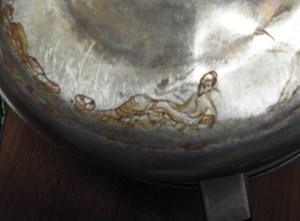
It looks like an eastern Asian man reclining to me; perhaps an oriental Jesus?
Ancient religions were quick to put human forms on dangerous, threatening, or awe-inspiring phenomena. Lightning and thunder became the purview of Baal. It is a natural defense mechanism: you can pray to or offer a tasty animal sacrifice to Baal and the terrible storm will stop. Of course, in time nature itself would take care of it too. One summer at Nashotah House, however, the storms kept on coming. It was termed a “recurrent mesoscale convective system” by the meteorologists, but to the Baal worshiper it would seem that nothing could assuage the divine anger. Baal kept coming back at you. I have a photo in a shoebox somewhere of me standing nearly up to my knees in the icy rain water. Better to consider it human than to face unfeeling nature.
Today people still look for faces in the clouds to allay their fears. But we also have a rudimentary understanding of the physics of our universe. When people are forced to choose between facts and faces, when fear or extreme desire comes into the equation, the safe odds are always on the faces.
God is Great (not)?
As a teacher/editor with an “advanced” degree in religious studies, I was intrigued by the sudden popularity of Christopher Hitchens’ God is Not Great (Twelve Books, 2007) a couple years back. I bought it as soon it was available and read it cover-to-cover after a morning out picking strawberries.
Reading Hitchens’ analysis I found myself nodding my head quite a bit; he scores a substantial number of points on which various religions should plead “guilty.” And while I found many of his arguments persuasive, part of me still wonders if perhaps religion, that most ancient of cultural forms, has not had at least some positive impact on humankind. In the most basic sense, our civilization would not be here to critique religion if religion had not been an impetus to get our civilization to begin its motion towards today’s civilization. Black and white are not in the palette of serious religious studies.
For the scholar of religion, however, Hitchens should be required reading. Sometimes we have to stare hard into the face of the facts of what our object of study has become and wonder, with Samuel F. B. Morse, “what hath god wrought?” Religion bears the mark of Janus, and scholars of religion have to pay attention to what people are saying about it.

