Moral Monsters

trees

Everyone likes to feel vindicated. From my childhood I have felt marginalized because of my interests in monsters, and now a book has just been released from Oxford University Press that vindicates my interest! Stephen Asma, a philosophy professor at Columbia College, Chicago, has written a monograph entitled On Monsters: An Unnatural History of Our Worst Fears. Further vindicating my idiosyncratic interest is the fact that the Chronicle of Higher Education even has an electronic front-page article on the book this week. I am overcome with credulity! I haven’t been able to lay my hands on the book yet, but I hungrily read the article and look forward to the whole product.

Readers of this blog know my assertion that monsters originate in a mental space shared by religion. Both are responses to the unknown. Asma writes in his Chronicle article, “The monster concept is still extremely useful, and it’s a permanent player in the moral imagination because human vulnerability is permanent.” Indeed, his article is entitled “Monsters and the Moral Imagination.” The thesis he promotes is that our morality (again tied to religion for many people) benefits from its struggle with monsters. We imagine our moral responses to being faced with the truly horrific, and the monsters themselves are less frightening than our imaginary responses. The top box-office winner this past weekend was Paranormal Activity, a movie noted for not showing the menace, but implying it. There is an evolutionary advantage here; we learn about coping with real danger by imagining danger.

So as I look out the window on yet another cold, gray, rainy October morning, and see the trees swaying in the wind, my imagination takes flight. Those Saturday afternoons and late nights filled with cinematographic visions of even worse things that could happen are cast in a new light. Instead of scaring myself, I was building moral character! As my friend K. Marvin Bruce likes to say, “monsters are only mirrors.” Sometimes the mirror reflects a truly untamed world, and Dr. Asma informs us “inhuman threats are great reminders of our own humanity.” I would simply add, “and of our religions.”
Daniel in the Lyin’s Den

Yesterday I found myself. Online, that is. I was cited ambivalently as “some guy” in the Uncommon Descent blog comments, noting my Creationism’s White Box podcast. For those unfamiliar with Uncommon Descent, this is a blog hosting many posts by William Dembski, a leading creationist. Finding myself there, I instantly recalled that Daniel was never masticated in the lion’s den.

Not being one to judge without good cause, I read the critique with care. It read: “Some guy I read in the last few days here [link to my podcast] has suggested (to the approval of a few clerics) that creationism is an early 20th century phenomenon but all he’s really done is conflate creationism with the Creationist movement that grew out of, or was associated with, the publication of ‘The Fundamentals’.” Since academics like to split hairs (and even atoms), I thought I’d use today’s post to explain, in History 101 style, the problems with this assertion.

Creationism, like any other human enterprise, has a history. Christianity was born in a literalistic age, of sorts. Early Christians took the Hebrew Bible (pretty much The Bible in those days) literally. Belief in a flat earth and mythic beings still predominated the upper cortices of early brains too. My detractor could have been correct had the conflationism charges been laid at my door prior to the Enlightenment. The fact is that everyone born since the eighteenth century (academically speaking) has had access to science and the facts we’ve ascertained about our world. One of those sets of facts has had to do with evolution, and another with the history of the Bible. Interestingly, both of these sets of facts coincide perfectly: biological evolution took place and the Bible was a product of its environment. These truths have been available for centuries for any who would look at them.

The veracity of this statement is attested by the nearly universal acceptance of evolutionary theory by Christians in the western world in the late nineteenth century. Creationism, as such, did not exist at this time. It was in reaction to a number of social and theological factors that Creationism first hatched around the turn of the twentieth century. It was a new bird (I’ll avoid saying “hopeful monster”). Any claim that it was a default version of Christianity is strictly Retro — any such claim is tantamount to declaring that the Enlightenment never happened. I’m not a supporter of revisionist history, so I just can’t accept this flimsy construct. Fact is, Creationism is relatively new.

There is a great bibliography out there for anyone interested in getting the actual facts. Start with Ronald Number’s The Creationists: The Evolution of Scientific Creationism (University of California Press, 1992) and read on. Otherwise, feel free to believe in a flat earth — you can find good proof of this in central Illinois or Kansas.


Let Us Make Moses in Our Own Image

This week’s Time magazine contains an article entitled “How Moses Shaped America” by Bruce Feiler (actually it is an abstract from his book, America’s Prophet: Moses and the American Story). Feiler points out how Moses has been manipulated and utilized by various factions of American society from the earliest pilgrims up through President Obama’s campaign. There’s some interesting stuff here, from the proposal of the Great Seal that depicts the parting of the Red Sea to the Mosaic elements in the Statue of Liberty. No doubt about it, America loves Moses.

As intriguing as I found Feiler’s thesis, I couldn’t help but be a little bit disturbed by it. Serious biblical scholars are early taught to avoid prooftexting like a plague of frogs. Prooftexting is part of a Fundamentalist’s daily spiritual calisthenics, right after chapter-and-verse-presses. Prooftexting is pulling random Bible verses out of context to support a confessional position on any issue. You can always tell it’s coming when someone opens with “the Bible says…” Then you get a chapter-and-verse punctuation mark. What Feiler is describing in his article is just that, a use of Moses that fits the crisis of the moment. While there is nothing wrong about looking to a great leader in time of need, whether that leader be mythical or historical, I wonder how different this is than marching into battle with “Gott und Ich” inscribed on your belt-buckle.

One statement Feiler makes, however, I must take exception to: “With the rise of secularism and the declining influence of the Bible in the 20th century, Moses might have melted away as a role model.” No doubt secularism was in the ascendant during the twentieth century, but the influence of the Bible was never stronger. The twentieth century saw the Bible co-opted as part of a powerful political agenda that drove this nation to the brink of destruction. Never before had the Bible been used to deceive many thousands of untrained religious believers in the ways of war and greed and inhumanity. Bible-thumping had become more effective than rational thinking or coherent speech in the political debates we all so painfully watched. No, the Bible’s influence has not been shrinking. What is needed is a Moses to wrestle it back to its proper place. Even the Bible can be a golden calf.

Moses gets down

Moses gets down


Religion or Death

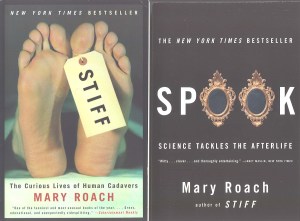
Researching traditions about death can lead to some occluded avenues shunned by many Ancient Near East scholars (generally anything after about the rise of the Roman Empire is irrelevant). It has long been my contention that death and religion are intricately intertwined, well nigh incapable of being teased apart. I’m also very interested in the research of writers on popular culture. Findings, no matter how erudite, if they don’t reach the public will only fail to impress. Mary Roach, ever masterful, wrote a morbidly fascinating account of the afterlife, so to speak, of corpses. This work (Stiff) was followed shortly by Spook — her foray into the science of ghosts. Anyone who can have you mortified one minute and laughing out loud the next deserves to be read.

Can't have one without the other

Can't have one without the other

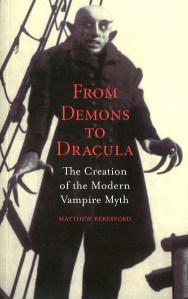
I recently finished Matthew Beresford’s From Demons to Dracula: The Creation of the Modern Vampire Myth (Reaktion, 2008). I was pleasantly surprised that Beresford ambled back to the Neolithic Period in his quest for vampire origins. A number of unexpected facts jumped out at me from his pages — vampires historically have very few traits that last through the folklore about them over the ages. Primarily all they share is being improperly dead. This horrific concept is among the most deeply rooted of human terrors. We prefer the properly dead who stay dead, thank you. Whether revenant or still alive, the vampire somehow threatens the lives of the living and must be dispatched by making him (or her) properly dead.

More rat than bat

More rat than bat

Having been a youngster and woefully unaware of international news at the time, I had never heard of England’s Highgate Vampire of the 1970s. A disjointed and confusing account involving an actual vampire-hunting Catholic priest, a rival vampire-hunting occultist, and ending with the actual staking of a corpse (in 1970! CE!), the tale in Beresford’s book is almost incredible. A little web research demonstrated that the story still has a much wider following than this blog will ever have. Overall, however, it convinced me that my inklings of the danse macabre between religion and death were as accurate as a vampire hunter’s stake.


Rosslyn, New Texaco

Back before Dan Brown had becoming the Most Important Human Ever, even before he published Angels and Demons, my wife and I visited Rosslyn Chapel in Roslin Glen, Scotland. While not actually seeking the Holy Grail, I had been doing some research on Celtic lore, ostensibly where the Grail legend originates, and so we made our way to the remote and (then) desolate site of this unusual church. Officially the Collegiate Chapel of St. Matthew, it is, without doubt, the busiest piece of architectural stonework I have ever witnessed. We went for the grail. We stayed for the art.

WikiCommons image, ours isn't this good

WikiCommons image, ours isn't this good

The research I had been conducting (finally published just last year as a contribution to a Festschrift for Nicolas Wyatt) involved the Mabinogian, a repository of Celtic mythology, and the legend of Bran. For sharing the name of a healthful breakfast cereal, Bran is renowned for also having had a life-restoring cauldron. He even made a journey to the netherworld and his head kept singing even after having been dissociated from his body. An uncommon hero indeed. All historical indicators, however, point to the cauldron as the original of the Holy Grail. Certainly the Bible does not mention it, nor does it appear very early in Christian mythology.

People, as Dan Brown’s financial independence loudly indicates, like a good conspiracy theory. There is a comfort in believing that a magical object of great power is out there somewhere and that a rather ordinary Harvard professor (!) might be able to find it, yet resist taking it. Far truer to life is Indiana Jones and the Final Crusade; people feel the need to touch, to control the power beyond themselves. Even at the cost of their lives. Despite the fact that the Grail is a fiction, it simply will not disappear — although no one can find it and it has never been seen. Faith tends not to be based on tangibles. This is attested every time Dan Brown makes his way to the bank and the population reads with wonder about meanings that simply don’t exist.


Turning Brown to Green

Dan Brown’s The Lost Symbol comes out tomorrow, and I, for one, will not be standing in line to purchase a copy. I actually read his previous two Langdon stories in the correct sequence — Angels and Demons then The DaVinci Code — and what immediately struck me was their similarity of plot and lack of historical veracity. Perhaps as a sometime writer who has had difficulty finding publishers I am just jealous, but the stories to me seem to draw on tired theories of some great conspiracy in antiquity that involved Jesus and Mary Magdalene eloping to France after the crucifixion where they happily raised a family only to be forgotten by history while he was off becoming a deity some thousands of miles away.

I read an interview with Dan Brown about his new book in which he confesses that he’s not a believer in conspiracy theories. To me some of the Area 51 stories sound more convincing than the trite material from Holy Blood, Holy Grail that has been recycled into a fictitious field of academics — symbology — and given a fake pedigree by placing Langdon at Harvard. I was in college when Holy Blood, Holy Grail came out and my literature prof told our class that the work was revolutionary and would restructure modern society. The only restructuring I’ve seen is the planet tipping a little towards Brown’s bank account trying to readjust to all the cash rushing in.

Perhaps my real frustration is with the fact that the ancient world is already fascinating without requiring fictionalization, yet those who actually do know something about it experience difficult times finding non-fictional university posts. Meanwhile average citizens will swirl around bookstores like the insects in an Indiana Jones movie waiting to purchase a copy of a book that fictitiously recreates that ancient world. If Harris tweeds are as miraculous as they seem to be in Brown’s books, maybe I should click my elbows together and say three times, “There’s no place like Rutgers” and I’ll end up in a fulltime professor of Symbology instead of teaching Ancient Near Eastern Religions as a mere adjunct tonight.

An authentic Harris tweed in its native Scottish environment

An authentic Harris tweed in its native Scottish environment


Intelligently Deceived

One of the most difficult things about the life of the academic gypsy is having tons of books. Literally tons. Having been cast from institution to institution in search of that mythical full-time teaching post, we’ve put books in storage and sometimes even forgotten that we’ve had them. So it was that when I was looking for a copy of Great Expectations for my daughter’s English class assignment, I was in the dusky attic, hoping the upstairs neighbors didn’t burst in on me, up to my armpits in boxes of books, that I rediscovered a treasure. Taking a leaf from Dr. Jim’s Thinking Shop, I decided I would review a few of the Creationist books I grew up with. Fortunately I had the presence of mind to keep them although I’d long dismissed their facile, often juvenile, point of view. They have provided great entertainment and even some poignant instruction in the ways of manipulating the minds of the young. Fear of Hell is a great motivating factor to a kid who sees ghosts in every corner and finds bats on his pillow!

So, without further ado, I present the top 5 creationist books of my youth. (Those that I purchased as an adult I bought from used bookstores so as not to add any royalties to the fundamentalists’ already bursting coffers.)

Textbook

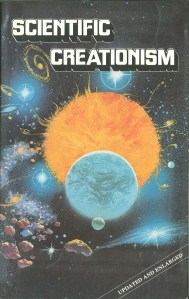
We’ll begin with the textbook. Scientific Creationism makes no pretense, such as the “Intelligent Design” school does, about being non-(necessarily-but-we-all-just-happen-to-be)Christian specific. Here Henry Morris begins with the assertion “the Bible and theistic religion have been effectively banned from [public school] curricula” and offers the present book as a corrective to the situation. A better title for the content, however, might have been Scientific Fiction.

GenFlood

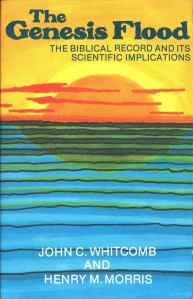
The work that really opened the flood-gates, so to speak, was The Genesis Flood. This craftsterpiece was penned by Henry Morris (again) and his compatriot John Whitcomb. Both proudly proclaiming themselves “doctors” they point out “evidence” designed to confuse the unsavvy into believing that there is a physical way the world could be entirely flooded. They even make room for dinosaurs on the ark, noting that they would have been juveniles of the various species. I’ve been in academics long enough to know that a Ph.D. does not guarantee credibility (or even sanity) on the part of the holder. The fact that Whitcomb’s doctorate is from Grace Theological Seminary ought to speak quite plainly as to its objectivity.

Gish

Written by Duane “the Fish” Gish, Evolution, the Fossils Say No! is an attempt to demonstrate that since not every single phase of the fossil record has been uncovered, the whole theory of evolution is in shambles. Gish, one of the few authentically scientifically credentialed Creationists, should have been able to see that his “back-and-fill” technique was going to fall on hard times as new fossil forms were discovered. As the fossil record grows more complete each year his book becomes more and more outdated.

EvolutionHS

Evolution and the High School Student terrified me in my delicate years. This booklet intimated that when I reached high school the unending assaults of the atheistic non-believers would be unrelenting. I feared for my very soul. Instead, in high school I found nose-picking, pocket-pool playing, and chalk-print-on-the-pants-seat teachers were among the openly committed Christians. Some even kept Bibles on their desks. (This was a public school.) The book lost its teeth.

GooZoo

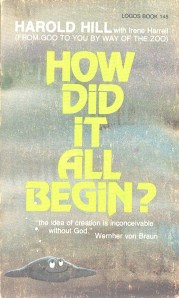
My personal favorite is How Did It All Begin? (or From Goo to You by Way of the Zoo) by Harold Hill (obviously when he was not out swindling River City, Iowa folk of their hard-earned cash to start a bogus boy’s band). This booklet, complete with cute, cartoon drawings, convinces grade-schoolers that evolution answers no questions at all. He had me going as a kid, until I got to the part where he claimed scientists had invented a machine that could indicate if you were “saved” or not. Even as a gullible child I couldn’t buy that.

The efforts of the Creationists are tireless. Even this brief survey of books that I happened to chance upon is nowhere near a comprehensive survey of what is out there. What it does serve to demonstrate is that all reasonable people should be wary. After all, even Jesus knew that a person in the wrong, if persistent enough, could convert even a hard-hearted judge.


Lost and Found

As a young lad I was fascinated by the supernatural. This may explain, but in no wise excuses, my choice of a career in religion. As I grew in years and skepticism, this interest began to feel like a security blanket in a college dormitory — an embarrassment to be jettisoned as quickly as possible. Along the way, of course, I’d given away what I thought to be the detritus of childish fantasy, including my collection of cheap, pulp fiction, tending toward the Gothic.

As I grow more ancient, and more observant, I see that sometimes the impetuousness of youth cradles a profound wisdom. Sometimes we do get it right the first time. I still haven’t figured out if that’s the case with me, but it seems to be a hypothesis worth the exploration. Part of my current search for reality is the reassessment of my childhood learning in the school of classical Gothic fiction. The books are no longer as cheap as they used to be, and when I take them out in public I hide them inside a larger, more academic book so that no one really knows what I’m reading. As a friend once observed, people think that those of us who hang out in the religion sections of Borders are immediately suspect. More so the adult toting a beaten-up paperback written for a teen readership a number of decades ago.

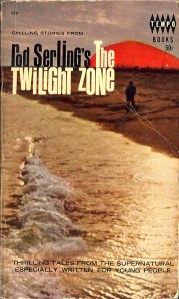
One of my lost memories was a juvenilized version of Rod Serling’s Stories from the Twilight Zone. I had shoveled my copy off to Goodwill along with many other shards of my childhood when I “grew up.” The memories of the angst that the very cover generated in me led to a frantic online used book hunt a few years back. Inside the stories seemed flatter than I’d recalled, but the larger ideas they generated were still worth paying attention to. Perhaps the real lesson is that childhood should not be dismissed as wasted time playing and indulging in carefree amusements. Our childhood proclivities, it now seems, preset the trajectories for our lives. So I still have a quasi-career in a religion department, and I have a copy of a book that started me asking the bigger questions.

Anybody else remember this?

Anybody else remember this?


Go and Dust No More

Finally getting around to reading Philip Pullman’s The Golden Compass (I hate to admit that it took the movie ads to prod me into reading the book), I have been surprised by the depth of the story. Spoiler warning! From the very first chapter I have been pondering what dust might be, and I have just discovered that it is Pullman’s metaphor for original sin. In the chapter where this is finally revealed to the protagonist, Lyra, her father reads an explanatory passage from Genesis 3 (somewhat altered). Indeed, dust drives the plot of the story.

With apologies to the magisterium

With apologies to the magisterium

Pullman’s treatment of the topic once again throws into relief a popular, but mistaken, concept. “Original sin” is simply not a biblical idea. Nowhere in either the Hebrew Bible or the Christian Scriptures does the text suggest that people are born with the taint of a physical liability passed on from the first human coupling, as Augustine hypothesized. In fact, the Bible hosts several potential explanations for the origins of human troubles. One solution that it never reaches is a genetic passing on of an original sin.

Tradition often makes Scripture into its own image. Ideas are inevitably read back into the story and a chimera of hazy concepts emerges. Pullman’s treatment of the human condition is to be applauded, and to his credit he does not attribute the concept of original sin directly to the Bible. Although he alters the text a bit he doesn’t add this most damaging concept to it. The belief that people are inherently defective has allowed for some of the worst crimes imaginable against our species. As a concept original sin is dust in the wind.


Hell on Earth

October 8, 1871 is remembered by many as the night of the great Chicago Fire. Few Americans ever learn that it was also the night of what many consider to be the greatest natural disaster in United States history: the Peshtigo Fire. The autumn of 1871 was tumbleweed dry in the upper midwest. A wildfire that burned over a million acres of northern Wisconsin and Michigan completely incinerated the town of Peshtigo, Wisconsin on the same night Chicago burned. 1,200 people were killed in a single night. One of the most terrifying books I’ve read is Robert Wells’ Embers of October (also published as Fire at Peshtigo), a factual horror story filled with survivors’ accounts and early aid workers’ reports. Many described the scene as reminiscent of Hell.

Gehenna in Wisconsin

Hell is an interesting concept. Following on from my podcast on the origins of the Devil, the concept of Hell is an equally interesting development. The Hebrew Bible knows of no Hell. The dead, good and bad alike, go to Sheol, the gloomy world of the dead, after they die. There is no punishment or torment beyond the languor of being deceased. People seem to be described as having some recollection of life and its benefits, but they are weak and sleepy and attached to their drying bones. The concept of an afterlife comes pretty late to the Israelites, depending on how you define “afterlife.” The book of Daniel, the latest in the Hebrew Bible, provides our first glimpses of a kind of resurrection for the righteous who died before their time. The earliest biblical Hell is the Gehenna of the Gospels, the garbage heap perpetually burning outside Jerusalem.

To picture an eternity of constant burning and torment requires a kind of distinction between an afterlife and afterdeath to be made. Zoroastrian influence on emergent Judaism provided the dualism that made a Devil possible after a few centuries. It also provided the distinction between the glorious afterlife of the good and the doleful fate of the wicked. Concepts that eventually blossomed into the theological constructs now regarded as Heaven and Hell drew their inspiration from an ancient religion of Afghanistan and Iran. Given what human imaginations are, Hell has naturally grown more and more gruesome over the centuries, but if one requires a sense of an entirely natural version of what can happen to good and bad alike, the Peshtigo Fire may also deliver many sleepless nights.


Edoc Elbib Eht

A number of 40-year commemorations of the Manson Family murders have brought these gruesome events of my childhood years back to memory. I was really too young to understand what all the fuss was about then, and now that I am old enough, I’m not sure I want to. Nevertheless, I have committed myself to exploring sects and violence in a religious setting, and the Manson murders have prongs of both phenomena. While recently refreshing my memory on these horrific events on a gray and rainy day, I noticed something I had not seen before.

Looks like someone's been on the yellow submarine a little too long

Looks like someone's been on the yellow submarine a little too long

Charles Manson was (probably still is) a believer in hidden codes. He allegedly cracked a code in the Beatles’ White Album that led him to the belief in an apocalyptic battle that he was determined to begin. I wondered why the Manson Family tends not to be listed among other apocalyptic groups such as the Branch Davidians or Heaven’s Gate. They all share several traits, and although Manson’s revelations came from the Fab Four rather than the Holy Trinity, a revelation from on high spurred him into actions that had a tragic outcome, just as David Koresh or Marshall Applewhite.

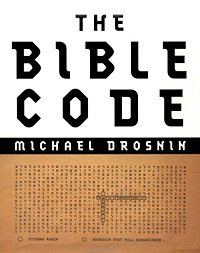
The whole Helter Skelter code also reminded me of another, equally bogus pawning of randomness as divine messages: Michael Drosnin’s The Bible Code. When I read this bestselling bit of intellectual dry rot a few years ago, I was amazed that anyone could possibly take it seriously. God writing hidden messages in a holy book like some hormone enraged high schooler? And figuring out that a singular genius would figure it out just before the apocalyptic end without realizing that it is possible to read messages back into any media after they occur? It seemed all too much for a rational mind to take. In one of my courses at the University of Wisconsin Oshkosh I gave students the option of reading it for a secondary project. To my chagrin, when I had the papers in one particularly tear-stained paper wailed (seriously) that the writer wished she had been warned sooner! This book changed her life! Everyone must know! Unfortunately I left Oshkosh without finding out what became of her.

God may not play dice, but apparently he likes crosswords!

God may not play dice, but apparently he likes crosswords!

I felt bad for introducing an undergrad to such “academic” sleight of hand; some college students just haven’t developed the critical facilities to see through the remarks of Balaam’s various sidekicks. Come to think of it, Manson’s followers accepted his revelations uncritically as well. Maybe the real lesson in all of this is that we must examine very closely those who claim special revelation, whether it be from Lenin, McCarthy, Starr, and Harrington, or just from God Almighty.


Animal Alarm

Where was Moses when the lights went out?

Where was Moses when the lights went out?

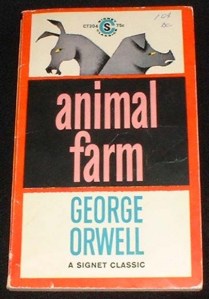
After undergoing a bout of oral surgery earlier this week, even before the nitrous oxide wore completely off, I pulled George Orwell’s Animal Farm off the shelf for a re-read. I hadn’t read it since at least 1984. It was even more disturbing reading it this time just off the Bush-Cheney years, and I realized that the Napoleons and Squealers are still with us. As a prophet Orwell may not have always got the dates right, but he was clever at spotting trends.

In this reading of Animal Farm a minor character leaped out at me. Among the tame, but non-domesticated animals was the raven Moses. Moses is the special favorite of farmer Jones and tells the animals of Sugarcandy Mountain vaguely up in the sky, where conformist animals go when they die. When the rebellion takes place, Moses flies off and remains absent until near the end of the story when the situation has deteriorated. Once again he is back to tell the others about Sugarcandy Mountain. The connection between Moses and Mount Sinai is transparent, although the heavenly connection is slightly misplaced.

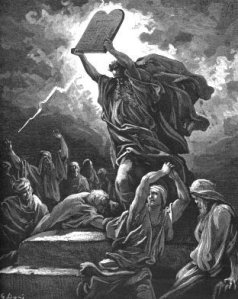
The Hebrew Bible (certainly in the period of Moses) does not recognize what will become the Christian concept of Heaven. Like many ancient West Asians, they supposed that Yahweh lived “up there” at times (at other times he lived in the temple, or on the world at large, or atop some mountain). The “heaven” they knew of had no place for dead humans; the afterlife was a concept that developed very slowly. Moses’ motivation for the ancient Israelites, however, also resonates in Animal Farm, even as it does in the startlingly similar film Chicken Run — freedom. Freedom is the pipe-dream of many religions, but even as early as Moses those dreams run into regulations. Religions have laws long before they have heavens. Perhaps Orwell was onto something after all.


Memento Mori

This is the end, my friend, my only friend, the end

This is the end, my friend, my only friend, the end

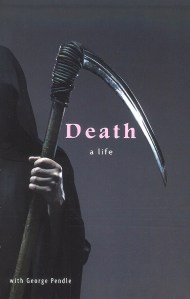
Those of you who’ve listened to my podcasts have no doubt noticed my reference to George Pendle’s, Death: A Life (Three Rivers Press, 2008). This fictitious account of Death’s memoir, all things considered, is a fun read and a wild romp through various ancient religions. Postulating a loveable, if somewhat obtuse, God (no more obtuse, however, than the supreme being in Harold Bloom’s Book of J) Pendle populates his mythological world with a vast array of embodiments, personifications and supernatural beings, all slightly neurotic, and more or less on an equal playing field. Although the book is intended as fun, it does offer some serious consideration to the phenomenon of death.

One of the earliest intimations that Homo sapiens had begun to consider religious sensibilities is burial, the concomitant state to death. Burial serves an important biological function of preventing the diseases borne of putrefaction from infecting others, but it also serves as a condensed statement of a fledgling belief in an afterlife in some form. Even Neanderthal burials have been discovered with rudimentary grave goods. Concern for the wellbeing of the departed is surely a religious sentiment. Death and religion are never far from each other. Even the early Mesopotamians trembled at the etemmu, their version of a ghost, and marked it with the divine determinative on their clay tablets. Religion has been a fine-turned handle that humans have used to get a grip on death.

That is not to say, of course, that death is religion’s only concern, but there is some wisdom in that old saying that people seek out their religious leaders when they are “hatched, matched, and dispatched.” Mesopotamian (and Hebrew Bible, for that matter) afterlife was a gloomy prospect, yet it was certainly brighter than the alternative of the simple cessation of biological functions. Death as a concept inserts meaning into the all-too-natural act of dying. Not a religion exists that does not address itself to this great leveler of all human aspirations. If at times it seems that my posts tend toward the macabre, peopled with vampires, werewolves, zombies and Republicans, bear in mind that such creatures of the night are expressions of the essentially human and indisputably religious preoccupation with death. Its unbeating heart transfuses life to religion.


Momma Maya, Is It the Apocalypse Already?

Where have all the Maya gone, long time passing?

Where have all the Maya gone, long time passing?

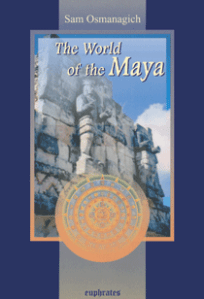
While recently reading a Gorgias Press book on the Maya (Sam Osmanagich’s The World of the Maya) I couldn’t help but notice the concern of the author with the year 2012. Actually, Osmanagich is looking forward to 2012; it will be when a new era in human existence begins. Since he freely admits throughout the book that extraterrestrials provided technical support in the Mayan monumental architecture, I suppose the fixation on 2012 should not be surprising. The book is charming as a folksy travelogue and disarming in its innocent sense of wonder, but academic it is not.

Concern with the end of the world as we know it seems to have entered the Judeo-Christian tradition with Zoroastrian contact. As soon as the idea was conceived it was immediately apparent that this was going to be a very large baby, and it has not disappointed. Back in my rural Pennsylvania high school, concern that the world would end in 1980 was seriously rampant. (Considering that the Reagan-Bush years were about to begin, it makes sense in retrospect, at least on a metaphorical level.) Worry ran so high that on the stated day — noon was the confirmed hour of doom — my English teacher laid down her grammar book and had us spend our final earthly minutes writing an essay arguing why the world was, or was not, going to end that day. When the class-bell rang, other than some soiled undergarments, everyone seemed pleased still to be there.

I was at Nashotah House for Y2K. A prominent administrator insisted that we all prepare for the likely event of a societal collapse. (From my present vantage point, I’d rather have taken my chances just about anywhere else.) Yet here I am to recount the tale.

Now only a dozen years down the road from Y2K we are being told to prepare for yet another apocalypse. People I speak to seem genuinely concerned about this one, and even I had a shiver or two as Osmanagich calmly laid out how the Maya just didn’t make mistakes like that. As I see it, there are two choices: people should study the origins and rationale of apocalypticism or someone should start a business selling Apocalypse insurance (the name Four Horsemen might be catchy). People seem ready to believe that extinct civilizations knew something about our fate that we just can’t see. And if the world does end in 2012, well, you wouldn’t want to have all those premiums weighing you down by then, would you?

The Four Horsemen -- would you buy insurance from them?

The Four Horsemen -- would you buy insurance from them?


Cenobites and Angels

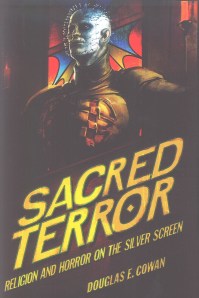
I recently became aware of Hellraiser. Actually, I’d seen images of Pinhead around for years, but never realized that he was a Cenobite until reading Douglas Cowan’s Sacred Terror (see my post on Vampires, Mummies and the Holy Ghost). In fact, Pinhead is featured on the dust jacket of the book and comprises a large part of Cowan’s evidence. Curious enough to watch the movie, I steeled myself for the macabre and terror, but although there were gory scenes it was no more disturbing than the Republican National Convention.

Pinhead for president?

Pinhead for president?

This movie draws its lifeblood from religious, particularly Christian, imagery. Cenobite, of course, is an old word for “monk” and in the movie Cenobites are interdimensional beings known as “demons to some, angels to others.” In a strange convergence of themes, I had recently viewed Dogma again after a gap of a few years. Here Loki and Bartleby are fallen angels, who, rather like myself, move from Wisconsin to New Jersey. Both of these films are pervaded with a healthy ambivalence towards those beings who have the potential for so much good but who opt for what most of us would consider evil.

Angels have a long pedigree in ancient religions, probably originally being gods who only ever achieved supporting roles. Not all gods were created equal. At Ugarit we find a whole class of deities below the power and dignity of reigning gods. Besides, in a non-scientific worldview, angels, especially fallen ones, had great explanatory value. When things unexpectedly go wrong and you’ve made all the proper sacrifices to appease the resident deity, bad angels might just be the cause. Theirs was a world of naive realism; what the eye observes is pure reality and what the eye doesn’t see is divine. Today we know this to be overly simplistic — reality is so complex that even our brightest can’t completely comprehend it. Yet when we have trouble explaining things, even in a scientific world, many are ready to point to the angels in the wings.