Make Room on the Ark — Another New Dinosaur!

Enter Aardonyx celestae! A new dinosaur announced yesterday in South Africa is being hailed as a missing link in the sauropod chain of development, much to the chagrin of Creationists. I have to admit that I never outgrew my childhood fascination with dinosaurs, and when we purchased the life-like models for my daughter as she was growing up I secretly coveted them for myself. The rate of discovery among new genera of dinosaurs is between 10 and 20 per year, meaning that the maybe 20 different dinosaur types I knew as a kid has ballooned into well over 500 different species and 1,800 genera. Late at night I still hear the call of paleontology and I slip Jurassic Park into the DVD player and weep.

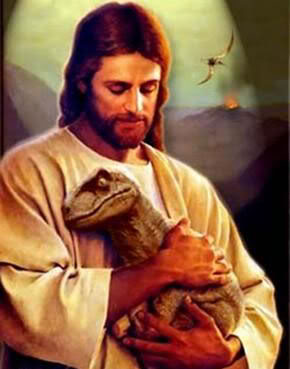
With each new dinosaur discovered Noah’s ark must evolve into a larger boat for some among the Creationist camp. After all Genesis says “two of every kind” lumbered aboard. The newbie this time is a proto-sauropod, a missing link between bi-pedal herbivores and their earth-shaking descendants who required four tree-like legs to support their immense weight. It seems that Noah must have been quite the engineer to handle all this displacement. And it is a good thing too — scientists predict that the new genera to be discovered represent only about 30 percent of the total, and the number will likely continue to climb for a century and a half yet.

Dinos

Wikipedia proto-sauropods race for the top deck

So it seems that the God-of-the-gaps grows smaller while the ark grows larger. Of course, the dinosaurs might have evolved into all these different genera over time, but then, Creationists can’t allow for that, since it would admit room for evolution. And that seems about as likely as the Church of Jesus Christ of Latter-day Saints backing anti-discrimination laws against homosexuals!


Let’s Do the Time-Warp Again!

Yesterday MSNBC reported that the Vatican has again called for a conference involving serious scientists to discuss the implications of astrobiology — life in space. Despite the mocking sneers of the media, growing numbers of serious thinkers are doing the calculations and scratching their heads. When I was a child, I was assured that earth-like planets elsewhere in the universe were virtually impossible, statically. Now we know of several rocky orbs circling distant suns. Our own sudden advances in technology have started some to think that if we raced from heavier-than-air flight to the moon in only 66 years, and from landline to audio implant in about a century, maybe other intelligent life could do the same? What would the implications be for the geocentric world of Genesis and the Gospels?

The Catholic Church and Science are hardly best buddies; frequently they are not even on speaking terms. No, the tide did not change to a warm embrace with the (centuries late) apology to Galileo or the sudden realization under John Paul II that evolution is “more than just a theory.” All one has to do is think of the issue of stem-cell research and the eagerly offered hand is suddenly withdrawn. But on the issue of aliens, perhaps the church can race ahead of the projected God-of-the-gaps, do an end-run, and be ready to embrace E.T. when he finally makes himself known.

Don’t get me wrong, I am grateful that the Vatican has embraced evolution and thumbed its Roman nose to the creationists. (They deserve even more than that!) I am glad they are considering the possibilities of extra-terrestrial life. There is, however, a nagging doubt in my mind that they may be coming to the conclusion that the late Larry Norman once did that “if there’s life on other planets, then I’m sure that he must know, and he’s been there once already and has died to save their souls.” What good is advancement in science if mythology refuses to budge? What would an extra-terrestrial priest look like? What if they don’t have blood to fill their chalices? Do they have trumpet-horns on their saucers to announce the second coming? Yes, let’s explore our universe, but let’s not forget to update our credibility meters as well.

ETpriest

Our father which art in heaven?


Mortarboards and Greenbacks

I admit to being an idealist. I grew up far, far from academia. No one in my family had ever been to college before, but when my high school teachers described it, it sounded like a bookish place where knowledge for knowledge’s sake was valued above all more pedestrian concerns. There men and women read and studied and devoted their lives to learning. They lived in shimmering ivory towers and led the way of the future from their scholastic bunkers. And so I worked my way through college. Granted, studying religion may not have been the wisest choice for changing the future, but it seemed the right course at the time. I found a limited acceptance in academia, an idealist who just didn’t know when to give up. It was only after earning a Ph.D. that I stopped to look over the landscape with informed eyes and began to feel a deep dismay.

The best way to encapsulate that dismay became clear in a headline in the New Jersey Star-Ledger earlier this week: “More millionaires among college presidents.” It seems that the extremely rare job of college president is increasing becoming the path to riches. Now to a guy who has never found that mythical teaching position that supports a small family, this felt like a kick in the gut. More than that, it also summarized the dismal view I’d garnered of academia as a whole: it has become a money-driven enterprise.

The tawdry reasons given to justify college presidents earning six figures, some creeping toward seven, per year is that of unadulterated capitalism. Prestige, keeping up with the other corporate executives in academia, showing the strength of the school through the number of greenbacks wasted on the salary of a single individual — I simply don’t buy it. The college president worth his or her paycheck is the one who would take a pay cut for the honor of having the job. Okay, so I’m an idealist, but I believe that higher education, which began as an outgrowth of religious education in such institutions as the University of Paris, has lost its way. I know adjuncts at Rutgers who earn less than $30,000 a year (in New Jersey!) while the president’s salary tops $635,000. And don’t even get me started on the football coaches! I wonder who would win a purely intellectual contest: the University of Paris vs. the Big East Conference?

Education


Biblical Weddings

Maine is getting ready to vote tomorrow on the legalization of gay marriages. With conservatives hopped up on fears that such a move will destroy traditional, patriarchal privilege, the Bible is beaten rather severely as proponents seek evidence for man + woman = marriage in holy writ. The funny thing is, the Bible says very little about marriage.

In an era when marriage is often associated with houses of worship and a smiling, tolerant divine face beaming down on a couple about to do “the bad thing” with divine sanction, it is difficult to realize just how little the Bible talks about it. The Hebrew Bible is particularly mute when it comes to the particulars of wedding ceremonies: “Then Isaac brought here into his mother Sarah’s tent. He took Rebekah, and she became his wife,” according to Genesis 24.67. No sacral ceremony here, by prior arrangement, sex equals marriage. A few chapters later when his son Jacob marries, there is a feast mentioned, but no sacerdotal functionary hovering nearby (one who might have actually noticed that Jacob ended up with the wrong woman, by the by). And so the biblical narrative limps on with patriarchs bedding and marrying their women with no mention of God. Eventually religious folks got a little nervous about this and ceremonies with divine approval were introduced, but that is not even in the case with the wedding at Cana, which, in desperation, the Book of Common Prayer latches onto for a marriage lection: “The bond and covenant of marriage was established by God in creation, and our Lord Jesus Christ adorned this manner of life by his presence and first miracle at a wedding in Cana of Galilee” (the Order for The Celebration and Blessing of a Marriage). Apart from the difficulty of a covenant being an uneasy peace between a superior and inferior party, this introduction relies on a literal Adam and Eve and the means for a large wedding party to get drunk, courtesy of the miracle in Cana. Apart from Paul’s putative comments regarding the marital status of early church leaders, we hear little else in the Bible.

I have nothing against weddings; I was the groom in a particularly stylish wedding in Ames, Iowa some years back. The problem I see is that the Bible is being forced to say what it does not. If the few biblical marriages are all heterosexual, it simply reflects the options open at the time. How does allowing gay marriages threaten the marital bless of the heterosexual? It seems to me that the only thing to be lost is “privileged status” and benefits allotted to those formally united in the eyes of the law. Unless things have changed recently, even in a religious marriage a state-issued license is required! Why not allow firm affirmations and privileges of loving couples without relying on non-existent biblical platitudes? I hope Maine will do the right thing tomorrow.


Religion’s Double-Edged Sword

This podcast discusses a recent visit of Westboro Baptist Church’s “protesters” to Rutgers University. The issue is whether religious freedom includes the right to encourage hate crimes on the part of those not directly involved in the “protests.” Religious freedom is the phenomenon that allows such groups to develop in a democracy, but the end results of such groups is destructive to the democracy that engendered it. This is compared to the Scientology case that is simultaneously taking place in France and noting the differences between them.


Feline Angels and Demons

Happy National Cat Day! Well, to you readers in the States in any case. October 29 has been declared National Cat Day, and as a blogger who has frequently posted on ancient cats, I feel a sense of duty to include our feline friends in today’s entry.

Elsewhere on this blog I have extolled the divine nature of cats. The Egyptians revered them to the point that killing a cat was a capital crime, but the evolution of domestication was probably very practical. Domestic cats appear in the archaeological record along with the advent of grain silos, also an Egyptian invention. When the grain attracted rats, the rats attracted cats, and the cats stole Egyptian hearts. Even before the Egyptians, however, archaeology points to associations of cats and humans in Neolithic Jericho, perhaps the oldest city in the world. As early as 9000 years ago, cats were stalking the allies of the city of the moon god. They have been among our most loyal companions.

The domestic cat’s spread into Europe only began in earnest, it seems, when Christianity reached the continent and the cat was no longer considered divine. Perhaps cats had to be profaned before being admitted to the church’s roster of approved animals. Nevertheless, under the influence of a predominantly Christian milieu, in the Middle Ages Europe had come to see cats as the demonic companions of witches and vampires. Did some memory linger of the divine cat of Egypt? Did those dark days of suspected sorcery glance back to the magicians of Egypt and their suspect pets? We will never know the answer as to why cats, long encouraged to join human households, became evil in superstitious Europe. Even my stepfather in the twentieth century America counted to ten after spotting a black cat, and followed the count with a solemn cuss each and every time.

I, for one, cast my vote on the side of the felines. I don’t have cats (allergies and irate landlords, and such), but I enjoy them when I visit those who do. Sure, they rip up furniture and bring unwanted gifts of dead things to you as a kind of feline worship, but with their loving nature I simply can’t see a devil in our everlasting cats.

Swiped from Dr. Jim's Thinking Shop

(Swiped from Dr. Jim’s Thinking Shop)


Moral Monsters

trees

Everyone likes to feel vindicated. From my childhood I have felt marginalized because of my interests in monsters, and now a book has just been released from Oxford University Press that vindicates my interest! Stephen Asma, a philosophy professor at Columbia College, Chicago, has written a monograph entitled On Monsters: An Unnatural History of Our Worst Fears. Further vindicating my idiosyncratic interest is the fact that the Chronicle of Higher Education even has an electronic front-page article on the book this week. I am overcome with credulity! I haven’t been able to lay my hands on the book yet, but I hungrily read the article and look forward to the whole product.

Readers of this blog know my assertion that monsters originate in a mental space shared by religion. Both are responses to the unknown. Asma writes in his Chronicle article, “The monster concept is still extremely useful, and it’s a permanent player in the moral imagination because human vulnerability is permanent.” Indeed, his article is entitled “Monsters and the Moral Imagination.” The thesis he promotes is that our morality (again tied to religion for many people) benefits from its struggle with monsters. We imagine our moral responses to being faced with the truly horrific, and the monsters themselves are less frightening than our imaginary responses. The top box-office winner this past weekend was Paranormal Activity, a movie noted for not showing the menace, but implying it. There is an evolutionary advantage here; we learn about coping with real danger by imagining danger.

So as I look out the window on yet another cold, gray, rainy October morning, and see the trees swaying in the wind, my imagination takes flight. Those Saturday afternoons and late nights filled with cinematographic visions of even worse things that could happen are cast in a new light. Instead of scaring myself, I was building moral character! As my friend K. Marvin Bruce likes to say, “monsters are only mirrors.” Sometimes the mirror reflects a truly untamed world, and Dr. Asma informs us “inhuman threats are great reminders of our own humanity.” I would simply add, “and of our religions.”


Smiling Goddess

One of the enduring myths of the Victorian Age is that of the benevolent “mother goddess.” Amorphous, unnamed, this protective goddess of archaeological imagination was used to explain unlabeled figurines and frescos of the peaceful feminine archetype. As real goddesses were discovered and catalogued, they were frequently discovered to have a violent and fierce aspect, one feared and revered by ancient worshipers. Even today, however, some persist in this blissful pre-conflict image of the mother goddess.

This morning I was sorry I even glanced at the paper. The reality of the violence in the name of religion was everywhere. In Kabul a mob of angry protesters, fueled on by rumors that American troops had desecrated the Quran, burned an effigy of the President Obama. In Jerusalem Israeli police stormed the Al-Aqsa mosque on the Temple Mount to subdue angry mobs in tensions over one of the world’s great holy cities. Even in England, metaphorically, Pope Benedict XVI “has parked his tanks on the Church of England’s lawn” in the words of A. N. Wilson in the New York Times. Three clashes: Muslim on Christian, Jewish on Muslim, and Christian on Christian. Where is Mother Mary speaking her famed words of wisdom?

As even the ancients knew, religion was prone to violent outbreaks. In a polytheistic world the accounting was perhaps simpler: one god or goddess was upset. Here in the monotheistic world, we have either an angry God or a bevy of intolerant interpreters of that single God. There is no mother goddess whispering words of calm to the world’s religions. When opening the papers brings such a jolt to weary, Monday-morning eyes, the appeal of a smiling mother goddess is all too apparent.

The myth of the smiling mother

The myth of the smiling mother


Biblical Lyres

lyrelyre

The head of Ur’s bull harp stares at me from the article announcing Penn Museum’s “Iraq’s Ancient Past: Rediscovering Ur’s Royal Cemetery” exhibit down the road in Philly. Despite recent questions of the ethics of laying off yet more academics, this exhibit beckons to those of use who’ve only ever seen pictures of the famous finds from the ancient world that we’ve spent our lives reading about. Penn’s museum is famous for its holdings from Sumer, and I’m trying to scrape together the change to go and take a gander.

Still, I was not surprised to see that the biblical angle was tied into the article as well. “The royal tombs of Ur (the city believed to be the home of the Bible’s Abraham) date to 2,600 to 2,500 B.C.” it reads. The article doesn’t go as far as to state that Abraham, not historically attested, if he ever lived, dates to at least a millennium later than Sumer’s heyday. No, Abe never strummed that beautiful bull-headed harp nor thought on Isaac as he stared at the “Ram-in-the-Thicket.” The only way to get the paying public in, however, is to play the biblical card. Were it not for Abraham, however, Sumer would likely have remained the orphan child of early antiquity.

Among the great civilizations of the Ancient Near East, Sumer failed to make it into the Bible. Its Mesopotamian successors Babylonia and Assyria marched into Holy Writ when they sacked Jerusalem and Samaria, and even the Hittites merit a mention with Abraham’s poignant loss of Sarah. Sumer was a civilization that stood on its own. No Bible story was necessary for any to see its greatness, yet there was no public interest without biblical bating. Nevertheless, this is a road-trip worth the taking. It will be nice to see the glory of Ur, even without Abraham lurking in the shadows.


Sonoco

sonoco2

What do God and great pools of gooey, flammable, decomposed ancient biomass have in common? Quite a lot apparently. A picture in this morning’s paper of a Caribbean Petroleum Corp. storage facility explosion took me back to my childhood. I was born in the same place as the oil industry, although I think it was in different hospitals. Northwestern Pennsylvania is where the industrial use of oil was discovered (ancients had learned that the stuff was extremely flammable and used it for cruel weapons, but never figured how to grease an axle with it). One day my brothers and I were playing outside and noticed flames jetting up from an adjacent hillside. We saw giant ashes, some nearly the size of dinner plates, floating down on a summer day and it seemed like a strange gray snow was falling. A funny smell was in the air. That night on the news we learned that a local oil refinery had exploded and when we went to the site to gawk, it was amazing to see colossal storage tanks melted like so many ten-ton candles. It is an image I’ll never forget.

Lord Balfour envisions chariots of fire

Lord Balfour envisions chariots of fire

My wife’s favorite historian is Barbara Tuchman. We’ve read most of her books. Bible and Sword, however, was especially eye-opening for me. This book describes, step-by-step, how the British Empire forged its alliance with Israel. Tuchman is a meticulous historian, noting minute details that add understanding to the overall picture. One of the key motivating factors that led Lord Arthur James Balfour in his support of a homeland for the Jewish Diaspora was his belief that a physical Israel was required before the Second Coming of Christ could take place. This is a sentiment that has been shared by some recent, very highly ranking American politicians.

Enter Col. Edwin Drake. Drake was the first person to have the idea of drilling for oil. Several local prospectors scampered through the hills of Pennsylvania looking for oil streams where petroleum could be skimmed off the water and refined into kerosene. As an alternative to whale oil, petroleum was much easier to collect and didn’t involve peg-legs spearing great white whales — oh wait, wrong story. As an alternative to whale oil, petroleum made a market impact and soon other uses were descried. There was an oil boom near Titusville, Pennsylvania when Drake hit oil, and soon the industry that give birth to Quaker State, Pennzoil, and Enron was up and running. As uses for petroleum multiplied demand shot through the roof. Drake died in poverty and the industry he helped found rolled ever forward.

Col. Edwin Drake envisioning a drink

Col. Edwin Drake envisioning a drink

After the Second World War, vast oil beds were discovered in the Middle East. Israel was declared a nation, and world-wide demand for petroleum was astronomical. Not all nations of the former Ottoman Empire welcomed the sudden interest in their natural resources or the presence of an allied nation in their midst. Although the roots go deeper and are much more complex, the scenario was set for a crisis that has lasted for my entire life and shows no signs of slowing down.

So what does God have to do with a complex mix of hydrocarbons and other organic compounds? The unbelievable wealth generated by petroleum products has been under-girded with a religious gullibility and deeply held faith that Jesus needs some help in returning. As long as we’re waiting, we might as well get filthy rich. Politicians with connections to Big Oil and the Big Guy have it all figured out. Take all that you can and wait for the God who has blessed you so richly to come home. I still remember that refinery explosion, and some childhood memories have become paradigms and parables that have as many applications as petroleum itself. When the oil beds run dry, what will grease the axles of Kingdom Come?

Mechanical worshiper bowing down to a subterranean god

Mechanical worshiper bowing down to a subterranean god


What Are They So Afraid of?

I just had an email from a friend whose son is being sued. By the university he attends. The story was covered in Inside Higher Ed, and although I do not know the ins-and-outs of the episode, it reflects poorly on the state of higher education in this country. The student’s stepmother was dismissed from a chair in the Butler University Music Department and he blogged about it, feeling the dismissal was unfair. I am not privy to the details of the dismissal, but I am intimately acquainted with the ensuing scenario. When the student’s identity was learned, his father, my friend, did not have his contract as Dean renewed. The legal suit, claiming defamation, is still pending.

What saddens me perhaps the most, apart from the obvious social justice issues, is the breadth of such retaliation in institutions of higher education. Having once lost a position in higher education “without cause” shortly after making a principled stand against what I understood to be prejudice, I am particularly sensitive to how schools that have money to hire high-powered lawyers seem to have no difficulty in turning on anyone who criticizes or disagrees with official policy. Isn’t that what higher education is all about? I don’t agree with my colleagues on a regular basis, but that doesn’t mean I want them fired! We hand out and we take in.

If it were simply coincidence that I found a single colleague who also faced punitive action from a school for a perceived slight, I might be persuaded that it was an accident of tragedies — two unlikely victims sharing a prison cell. But no, the evidence has been building for some time. During my last years at Nashotah House I taught as an adjunct instructor at Carroll College in Waukesha, Wisconsin. A faculty search had stalled in the Philosophy and Religion Department and I was local and willing. I was present to watch as two colleagues (the remainder of the small department) were dismissed (denied tenure and forced out) after having been critical of some administrative decisions. They were among four faculty so targeted, and I watched them go with worry increasing in my gut. “Gag orders all around!” No one was permitted to discuss what was really happening.

It was the next year that I was terminated. After moving to New Jersey, I attended a professional conference (SBL, for those of you in the loop) in San Diego. It was probably not unlikely that the person next to me on the plane was also headed to the same conference since it was a 6 a.m. economy flight. Sure enough, I saw the woman reading some theological tome and knew we were headed for the same place. As I struck up a conversation with her, I learned that she had also been dismissed from a college in the south for advocating equal racial representation on the student council. This was not in the 1960s, but a couple decades closer to our own time. No reason was given, but her contract was not renewed.

By this point in time a clear image is coming into focus in my mind. It is not a pretty picture. The scene shows a juggernaut called Higher Education, bloated, powerful, wearing a mortar board, with a killer football team yapping at its heels like wolfhounds, but terribly afraid of criticism. Those who lie crushed under its great feet, the general issue instructors, have earned their place in academia by taking the hard knocks and criticism that are anticipated and constantly delivered in higher education, but the juggernaut drowns out any criticism of itself with allegations of being molested by the critical thinkers it hired to give it respectability and who now lie supine in submission beneath it. Something has gone horribly awry. And instead of talking it over, human-to-human, lawyers are hired to frighten off the weak and silence discussion. “Anything you say can and will be used against you,” thank you Sergeant Friday!

Like a co-dependent spouse, I will always love higher education. It has cradled our most influential minds and taken us beyond our earth-bound dreams. The academy has brought us to the place where we stand today. But universities now also parrot the corporate model and intimidate those who do not take their inspiration from free-market economy. If you feel inclined to voice a vote for the rights of students, this link will take you to a petition for the dropping of legal charges against my colleague’s son. (You will be taken to a donation page after signing the petition, but donations are purely voluntary.) I understand it to be a vote for common sense and personal freedom of expression.


We Don’t Need Another Bible

This podcast addresses the issue of agenda-driven Bible translation. Although all translators, being human, have agendas, typically they are for the advancement of knowledge. The news about Conservapedia’s Conservative Bible Project suggests that progress should be turned back to the first century and fast-forwarded to the Neo-Con agenda. The trend is disturbing because not many Americans have the essential background to assess critically whether Bibles are translated with serious scholarly intent or not. The ten principles of conservative Bible translation from Andrew Schlafly’s Conservapedia are examined.


In Our Own Image

Word is out that Andrew Schlafly, spawn of Phyllis, is working on a new Bible. In a stunning move that will amaze even many conservative Christians, Schlafly has decided that the Bible itself is too liberal. On his alternative to “liberal” Wikipedia, Conservapedia, he cites the ten principles for translating the Bible in a conservative-acceptable way. Unable to attain the lofty heights of rhetoric on Conservapedia’s Conservative Bible Project page, I need to quote verbatim the 10 Commandments of Schlafly’s ideal Bible:

1. Framework against Liberal Bias: providing a strong framework that enables a thought-for-thought translation without corruption by liberal bias
2. Not Emasculated: avoiding unisex, “gender inclusive” language, and other modern emasculation of Christianity
3. Not Dumbed Down: not dumbing down the reading level, or diluting the intellectual force and logic of Christianity; the NIV is written at only the 7th grade level
4. Utilize Powerful Conservative Terms: using powerful new conservative terms to capture better the original intent; Defective translations use the word “comrade” three times as often as “volunteer”; similarly, updating words that have a change in meaning, such as “word”, “peace”, and “miracle”.
5. Combat Harmful Addiction: combating addiction by using modern terms for it, such as “gamble” rather than “cast lots”; using modern political terms, such as “register” rather than “enroll” for the census
6. Accept the Logic of Hell: applying logic with its full force and effect, as in not denying or downplaying the very real existence of Hell or the Devil.
7. Express Free Market Parables; explaining the numerous economic parables with their full free-market meaning
8. Exclude Later-Inserted Inauthentic Passages: excluding the interpolated passages that liberals commonly put their own spin on, such as the adulteress story
9. Credit Open-Mindedness of Disciples: crediting open-mindedness, often found in youngsters like the eyewitnesses Mark and John, the authors of two of the Gospels
10. Prefer Conciseness over Liberal Wordiness: preferring conciseness to the liberal style of high word-to-substance ratio; avoid compound negatives and unnecessary ambiguities; prefer concise, consistent use of the word “Lord” rather than “Jehovah” or “Yahweh” or “Lord God.”

Am I the only one to sniff a strong scent of Orwell here? Principle 1 stipulates that the translation, by converse logic (the kind apparently in favor) should be biased, as long as the bias is neo-con. In principle number 4 we are told that the word “word” has changed in meaning. Suddenly I’m reaching out for the railing – steady, steady! Principle 7: “free market parables”? Here is Jesus made-over in the image of Rush (I Can’t Have the Rams) Limbaugh; remove the kindness and compassion please. Jesus’ only goal is to be the CEO, or at least his only son. The translators reserve the right to remove objectionable material traditionally attributed to Jesus. Even Mr. Rogers could spell Revisionist!

Sure, Bible translators need to give the readership what they want. Thomas Jefferson removed the miracles and divinity claims for Jesus before publishing “the Jefferson Bible.” And he was a president! Suffragist Elizabeth Cady Stanton led efforts to produce the Woman’s Bible, removing masculine bias from the text. Bible scholars, however, do not accept their efforts as original biblical manuscripts. Even the general public knows better. What Mr. Schlafly is proposing is giving a gullible readership a Bible that contains what God meant to say; i.e., if God were me. What is disturbing about this is not that one person is offering his or her own version of the Bible – that’s been done before – but that it is intended to lead the unwary to a vision of Christianity that is new but claiming to be apostolic.

I think I feel a podcast coming on.

Woman's Bible

Woman's Bible

Jefferson Bible

Jefferson Bible


Jersey Vampires

Subscribers to the New Jersey Star-Ledger receive a periodic local-interest magazine called Inside Jersey. Since I’m already inside Jersey and have too much to read as it is, I generally ignore the freebie unless a story catches my eye. Anyone who has followed this blog for long knows of my contention that what truly frightens us is related to religion, or lack thereof, including fictional movie monsters such as vampires and werewolves. Despite the claims that such interests are juvenile and immature, this month’s Inside Jersey features a story reflecting just how serious such issues can be. When my wife showed me the cover, I knew it was blog-worthy.

VampireJ

There are vampires among us. Not Bela Lugosi or Christopher Lee-type Draculas, but actual blood-imbibing vampires. Only those who have shunned bookstores like a crucifix will not be aware that the Twilight series of teen romances have dominated middle and high school female reading lists for the last few years. The vampires in this magazine story, however, are not conflicted teens, but conventional young adults. The story covers what religionists call a New Religious Movement, or NRM. It is a religion, growing in the larger New York City area (as well as in other parts of the country), where consenting adults don artificial fangs and sip blood from willing donors. According to the story these groups, which include professional people who join under pseudonyms, engage seriously in religious rituals not unlike traditional Christianity’s sacramental rites. Now before snatching up your holy water and fresh hawthorn stakes, consider for a moment that adherents to this sub-culture are actually exercising their religious freedom.

Older, established religions are often quick to judge newer religious rivals. The fact is, however, that every religion on the planet was once a new religion. Believers often attribute the origin of their species of religion to the divine: special revelation, enlightenment, or a growing-up of humanity. All other religions, therefore, must be false. The difficulty here is that there are no final arbiters who can stand outside human religious institutions to tell us which is the right one. Lessing’s three rings have reached mass production and still there is no Ragnarok so that one religion might brag “told you so” to all the others. While I’m no vampire — I’ve been a vegetarian for over a decade — I have to accept the claims of those who are that this is their religion. The article ends with a revealing quote from a member of a local Court, so I give the final say to an actual interview with a vampire: “So many people think being into a certain lifestyle, you cut yourself off from the divine. It’s quite the contrary. To me, when you become more attuned to yourself, who you are uniquely, it brings you closer to God.”


Clothes Make the God

What is it with gods and clothes? Today’s news announces that Rob Halford, the Metal God, vocalist of Judas Priest, has just revealed his own Metal God Apparel line. Now, I try to be equitable, but isn’t metal all about sticking it to the establishment? Isn’t designing your own line of clothing the most establishment-worthy enterprise ever? Where have the rebels gone?

Whip not included

Whip not included

No sooner are people getting the hang of things in Eden than God marks designer clothes first on their list of accessories. Gods seem to be impressed with dressing the part. The Bible details what priests, and especially the high priest, will wear in the temple/tabernacle. Such location-specific wear indicates a very deep awareness of sacred space that pervades most religions. More than that, however, the clothes themselves are highly symbolic. Although modern readers may not be able to come to any consensus on the “symbology” (oh that word!) of each and every ephod and tinkling bell, we can be assured that nothing about the priestly garb was accidental. Indeed, Exodus informs us that God selected the fabrics himself.

Judas Priest, meet High Priest

Judas Priest, meet High Priest

So I’m not so shocked that the Metal God has made his preference known in the line of apparel appropriate to wear to the worship of this particular deity. As I watched a motorcycle club in their well-worn leather roar past me in my timid mini-van this weekend, I was reminded of the power of clothes. We may not be born with the body we want, but if we dress it up right, others might be made to believe that we’re gods too.