Long Live Life

Horseshoe CrabsShortsighted and arrogant. No, I’m not describing Richard Fortey’s Horseshoe Crabs and Velvet Worms, but rather the collective human race. I love people—I really do. Collectively, however, we sometimes act in the most inexplicable ways. This thought came to me repeatedly while reading Fortey’s book. The subtitle might explain the subject a bit fuller: The Story of the Animals and Plants That Time Has Left Behind. Fortey is a paleontologist who tells the stories, almost biographies, of various creatures that have survived eons with little change. He is quick to point out that all creatures evolve, but in the case of some, evolution has been minimal. Animals, such as his titular examples, and many others (cyanobacteria, tuataras, and, of course, coelacanths, just as a sampling) can sometimes be so well adapted to their environments that they change very little over time. In this book Fortey travels to see the living examples of those creatures he’s studied in fossils, and tells the story of an amazing continuity in a world of constant change.

Some of the species, particularly the plants and microscopic organisms, I’d never heard of before. I also have to admit to being surprised at how many very old life forms still exist. And admittedly, this is only a snippet of a much larger cloth. Throughout, I was pleased to see, Fortey mentions various religions—themselves often throwbacks—but not disparagingly (except the creationists). Noting that some creatures have a Buddhist-like calm, or that the Bible occasionally provides the phrase a naturalist writer seeks, here is an irenic meeting of science and religion that is so much needed. So why did I say “shortsighted and arrogant” at the start of this post?

One of the more disturbing truths revealed, and not just about charismatic megafauna, is that people have often hunted animals to extinction. Fortey suggests it has always been so. Large animals (megafauna) are easy targets and we have repeatedly hunted (and continue to hunt) them to extinction. We destroy habitats and thereby drive species extinct that we haven’t even yet discovered. What could be more arrogant of a single species? Looking back over 4 billion years of evolution should give us some perspective. We’re relative newcomers on this planet, and it isn’t ours to do with as we please. Fortey is gentle, but he does remind us that some of the creatures in this book will likely, no matter how great the catastrophe, long outlive us on the planet. Ours is a brief day in the sun. Shouldn’t we care for our planet rather than pillage it for our own gain? Ask the horseshoe crab. When we understand its language we might be able to begin to call ourselves wise.


Under the Weather

A friend, knowing my penchant to watch the skies, sent me a story about the British and the weather. The story by Alastair Sooke on the BBC’s cultural page is discussing Alexandra Harris’s book Weatherland. I have to admit that I haven’t read the book (yet) but the report of it appeals to someone who’s written a book on the weather, but for a much older timeframe. According to Harris, according to Sooke, the British are rumored to be obsessed with the weather. While living in the United Kingdom, my wife and I observed this. It is not merely casual conversation when someone discusses the weather. It is a serious topic. For a nation so accustomed to rain and gloomy skies, the weather has a religious import. It rarely goes without comment. I suppose that’s the point I was trying to make in my book. The weather is important. Vital, in fact, to human survival.

What really caught my attention here, however, was Harris’s observation that weather is used to characterize mood. Sooke mentions ice and snow and melancholy. The image is vivid: early Anglo-Saxons turing a wary eye to a winter sky with its low clouds and preternatural chill. It is so universal, it seems, not to require comment. Yet at the same time, weather can be a great trickster. C. S. Lewis once wrote that the image of the Arctic north filled him with an inexplicable joy. Winter can be fickle that way. In the world of the Psalmists, rain was a blessing and a weapon. How you look at it depends, well, on your mood.

DSCN0904

The British may take their weather more seriously, on a day-to-day basis, than those of us across the Atlantic. We tend to treat the topic casually. In reality, it is just as serious here. Drought, which has gripped the western half of the country for about half a century now, is a serious concern. Winter storms, hurricanes, tornadoes. A lightning storm can still be a theophany. (One awoke me in the middle of the night, just hours ago.) Weather impacts our bodies as well as our moods. It is all-pervasive, but we generally don’t like to articulate it. I suspect our understanding of the weather says more about us than we’re willing to admit. Our British colleagues, however, are less squeamish about the topic than we tend to be. There’s more to the sky than it might appear.


Chilling Thoughts

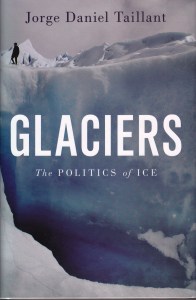
GlaciersI don’t think much about glaciers. At least I didn’t. Now they keep me awake at night. Literally. I just finished Jorge Daniel Taillant’s Glaciers: The Politics of Ice. Never have these ice sheets ever seemed to have so much personality before. I don’t live near glaciers, but I have seen a couple. A number of years ago I visited Glacier National Park in Montana. It was summer and the one glacier that was right by the road (Highway to the Sun) was melting. It was the first glacier that I knowingly saw, and I went my usual way, not thinking any more about them. Taillant’s book, however, indicates why everyone should be concerned about ice sheets. Not only is global warming a reality, our ice caps are melting on what appears to be a runaway timetable and we are not likely able to reverse the process until the damage is done. Not only our ice caps endangered, but our glaciers as well.

Why should anyone care about glaciers? For purely selfish reasons, I might point out that they are crucial to supplying drinking water for much of the world. Looking at the globe, it seems there is plenty of water to go around. Only about 3 percent of all water on the planet is fresh water, however. And of that 3 percent about three quarters of it is locked up in glaciers. Glaciers are the only source of fresh water in dry climates during years of drought or excessive heat. Whatever water isn’t used as these ice giants melt flows into the ocean, becoming part of the salt water majority. When the glaciers are gone, they’re gone. They are part of the fine balance that makes life on earth possible. The politics enter the picture when Taillant reveals that large mining interests, particularly in South America, have been destroying glaciers to get at the gold underneath. They block legislation and provide disinformation, all in the name of wealth. When they destroy glaciers, they destroy future prospects for life in the regions they mine. It’s an issue of social justice.

On our little planet that seems so big, we don’t often stop to consider that we didn’t really show up here by accident. We evolved with the features that our planet gave us—notably water—and we have continued to thrive only in the presence of water. It has often been said that future wars will not be fought over petroleum, but water. We can live without oil. We can’t survive without water. And our industrial action is blithely wasting away the largest reserves of drinkable water on the planet. I don’t live near any glaciers. I’ve only seen one or two in my lifetime, but I now worry for their health. Their future is, in many respects, our future. And that makes me want to pour a glass of water and reflect.


Thinking about Thought

The history of thought can be compared to a slow-moving pendulum. At other times it can be more like a ping-pong game. Acceptability for ideas can take time, but sometimes the perceptions change rapidly. Having been raised in a small town in a Fundamentalist setting, it is difficult to assess where exactly the “status quo” was when I was growing up, but by the time I had reached college it was pretty clear that the challenge science posed to my particular brand of religion was pretty firmly entrenched. Materialism—in the philosophical sense—had obviously gained several champions. B. F. Skinner and his followers applied this template to human beings, and it became fairly common to hear that we were basically automatons. (Ironically, double predestination in the Calvinism I was learning about taught pretty much the same thing.) Today there are even more vocal heralds proclaiming that all that is, is material. If it can’t be measured empirically, it can’t exist. The pendulum, or ping-pong ball, has come to one side of the table, or arc, awaiting rebuttal.

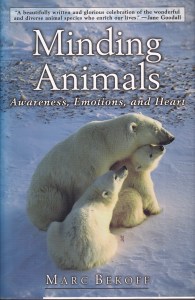
An article in Scientific American from two years ago (my personal pendulum sometimes moves slowly as well) asks the question “Is Consciousness Universal?” The article by Christof Koch describes panpsychism, the theory that anything beyond a certain level of organization is conscious. Koch begins by discussing dogs. Those of us who’ve spent time with dogs know that they are clearly conscious, although a materialist would say they are just as much dumb matter as we are. But panpsychism goes beyond dogs and horses and other “higher” mammals. Anyone who has taken the time to study any animal in depth, particularly those that are obviously mobile and can seek what they wish to find, knows that animals have will, and intension. The loss of meaning only comes with materialism.

Integrated information is the term Koch uses to describe the baseline of consciousness. Of course, this would need to account for more than the merely biological. Computers may be sufficiently complex, but the information they “possess” is not integrated, thus keeping them from being truly conscious. I’m not enough of a scientist to understand all the technicalities, but I do know that something as simple as common sense suggests that consciousness is part of all animals’ experience of life. As some scientists have long realized, feeling, or emotion, is integral to the thought process. Only when we realize that we share this world with a great variety of conscious creatures will we begin to make any progress toward understanding the difference between mind and mindfulness.

DSCN5295


Illusions

While out driving one winter evening, the sun was setting below a distant horizon that I couldn’t see. Trees lined the sides of the road and, while creating not exactly a tunnel, they blocked the actual view of the orb itself. The day had been partly sunny with cloud forms shifting between layers of the atmosphere. Even though I had studied weather pretty intensely for a number of years, I couldn’t readily identify the cloud types. Thin, smooth lengths of cloud seemed to be suddenly rising up into cumulus banks, heavy with snow. Not far away, the sky was clear. As the sun was going down, these dramatic clouds were lit with the colors of fire: yellows, oranges, and reds. Further to the west, a high, broken bank of clouds glowed a rosy red against a twilight sky. Since the highway we were on was straight, I had a fairly consistent view of the warm tones of the sun highlighting the impressive clouds. My camera couldn’t hope to catch the intensity of the palette revealed to my eyes. When the sun finally fell beyond the range of the clouds, they appeared gray and prosaic against a darkening sky. They had been alight only moments ago, and now they were dull, and not even white.

IMG_2657

What I’d learned of physics reminded me that even these colors were not inherent to the clouds—colors are simply reflections of light rays and the range that we see depends on our eyes. An object’s color, in other words, is a kind of illusion. It’s an illusion we share, and although some people are color-blind, we make the conventions of color part of everyday life. Red means stop, and green mean go, for example. Objective reality is simply the fact that objects reflect different wavelengths of color. Depending on the light source, they appear a specific color to us. While we take colors for granted, they are actually a way of conveying meaning that isn’t entirely real.

Ancient people looking at the colors in the sky could only understand them as caused by the activity of the gods. Bright hues in the clouds suddenly diminished to gray could be the basis for a myth of heavenly conflict. A rainbow, according to Genesis, is a sign that such a conflict is finally over. I don’t know what the gods might have been doing overhead that night, but as the sun disappeared and a full moon rose, throwing soft, but pervasive light from the broken clouds that have only moments before had appeared red, another reality seemed to be taking over. I suspect that we have lost much by no longer watching the sky. My daily work generally involves sitting in a windowless room, and in Midtown the sky is occluded with human attempts to climb to heaven. When I can see the sky for an extended period of time, it seems that the gods are putting on a show, if only we’d watch.


Storm Watch

Nothing encourages sleeping in like a blizzard. Although it’s a talent I’ve largely lost over the years, hearing the bellows of the wind and seeing the white reflecting through the blinds, and being a Saturday morning form the perfect recipe for letting my brain relax enough to fall back asleep after I’ve awoken. It’s a guilty pleasure that I had, quite honestly, nearly forgotten. Unlike several winter storms predicted last year, this one has actually come to pass. Prediction of the future may be one of those “God-of-the-gap” things, but meteorologists are modern-day prophets. In a society driven by work uniformity, days off are unwelcome, so a weekend blizzard might just seem to come from God. The highly anticipated list of school closings simply doesn’t apply. Many businesses still recognize the sanctity of the weekend, and we can just roll over and go back to sleep.

In ancient times the weather was anything but natural. The sky—so large and so far away—was purely the realm of the divine. The only way to impact it from down here was to pray and sacrifice and hope that it would behave. Getting back to that view of the world is nearly impossible here in the twenty-first century. We are so accustomed to natural causation that it is just one of those “butterfly effect” things. In truth, though, we know that human activity also has to share some blame with the butterfly.

Winter storms in January are not uncommon in the northern hemisphere, of course. January hurricanes, however, are. And as political rhetoric heats up and we once again ponder what it would be like to have another clown in the White House, global warming is dismissed as just another bad joke. As a nation we’ve been enamored of those who can provide the most entertaining gaffs and still claim they know enough to lead the nation. I have a hard time believing those who voted for Reagan had any success at separating fiction from fact. I still can’t convince myself that W was legitimately elected. The second term of both of these actors freezes me as much as the chill draft making its way through my apartment. The meteorologists nailed this one with their predictions. I’ll stay inside and huddle under my blankets until the all clear. And that may not be until well after November.

DSCN6166


Swamped

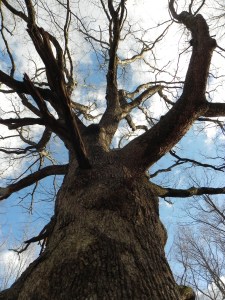
The word “venerable” is often applied with the connotation of age. Although the word in its own right really means to “adore,” or “worship,” objects of extreme age evoke that response. Perhaps the fact that “time-honored” is used as a synonym helps create that impression. As human beings, many of us experience an awe at being in the presence of something much older than ourselves. When I read about the Great Swamp Oak, then, I knew I would eventually need to see it. Reliable indications of a living tree’s age are difficult to assess for a non-botanist. Websites don’t give much thought to checking out the oldest tree in the state (although I did discover The NJ Big Tree Registry), but there are those who give that honor to the white oak of Basking Ridge, not far from the Great Swamp Oak. Others seem to indicate that the swamp denizen is older—somewhere in the range of 700 years. In the state of New Jersey, where things are constantly being reinvented and reconstructed, it is a source of comfort to find something so old leaving peacefully in a swamp.

DSCN6148

Now that I’ve used the words “tree” and “worship” together, I am inevitably brought back to the conceit of Asherah. As my academic writings have adequately demonstrated, I have doubts about the goddess’s association with trees. Nevertheless, there is something venerable about an ancient tree. If the Great Swamp Oak is 700 years old, it was already alive well before the “Age of Exploration” began. The only people to know of it, when there was as yet nothing to know, were First Nations inhabitants of the region. It was a time when, to American Indians, Europe did not even exist. Meanwhile across the ocean the plague could have been raging. A century or two later, Europeans would bring their plagues to these shores, forever changing the landscape. And not in a good way.

Trees, without human interference, can have tremendous life spans. In our short-sighted way, however, we have often understood them as nuisances in the way of some great shopping mall or industrial site. The “lungs of the planet,” trees have been wantonly destroyed in the name of progress. It is amazing that, especially on the East Coast, a few of them managed to avoid the axe and saw. Looking up into the branches of this great oak, I marvel at the changes that have taken place that, in its own way, this tree has “seen.” The world outside this swamp would be completely unrecognizable. Whether an asherah or not, I find myself reacting to the venerable nature of this sentinel of the ages. If only we could learn to keep our hands off young trees that nature plants, who knows what wonders future generations might experience in places even more unlikely than a swamp.


Local Lore

SomersetOne of the true joys of having more than a day off work at a time is the privilege to spend days reading. Although I read on the bus as a matter of course, it is a defined time, and editing isn’t as much reading as most people think it is. While doing research for my Sleepy Hollow paper, the question naturally arose: where did Washington Irving get the idea for the headless horseman? According to Irving’s biographers, the story was not an uncommon one. Headless ghosts are not unique, and he wrote the story while living in Europe as part of the serialized Sketch Book of Geoffrey Crayon, Gent. There is no practical way to know where he first heard the story. During my research I heard of a local source: Legends and Lore of Somerset County (New Jersey), by Michael Haynes. In this little compendium of stories of my current county, there is a claim that Irving learned about the story right here in New Jersey, where a traditional headless ghost rides. Again, it is impossible to say where he got the idea, but people like to feel that their local traditions are important enough to engage a major writer’s imagination.

Haynes presents several other regional tales that may rival the Jersey Devil and give ghosts a location just down the road. I suspect most places have tales of ghosts and mysterious beasts. It is always interesting to find out about those lurking in your own neighborhood. Scholars are now beginning to turn their attention to the sanctity of space. Location is very important to mobile beings like ourselves. The place where we find ourselves becomes “our place” and with the patina of time, often a personally sacred space. Tales of what happened here often take on the cast of the supernatural.

Local history has always held a deep fascination for me. Any region that I know, in a sense, intimately, is a region that has become part of my personal history. My region of Pennsylvania, for example, defines me although neither of my parents, or their parents were born in that state. And Massachusetts, Michigan, Scotland, Illinois, Wisconsin, or New Jersey, places I’ve lived, have become somehow alive with history. Legends and Lore of Somerset County contains tales that are not always believable in the workaday world we inhabit, but that’s the beauty of sacred space. Going beyond the mundane is entirely the point. Although Washington Irving may or may not have first heard of the headless horseman here, we have that legend, and there’s only so much that history can do to remove such a claim.


Books of 2015

Screen Shot 2015-12-28 at 3.38.16 PM

It’s the end of 2015 and looking at my records on Goodreads it looks like I read 100 books this year. That tends to be my goal mark, but after twelve months of reading I like to think back over which were the books that have made the biggest impact on me over the year. Joe Bageant’s Deer Hunting with Jesus remains on the most important list. It is joined by Andrew Newberg’s How God Changes Your Brain, Spencer Wells’ Pandora’s Seed, Alice Dreger’s Galileo’s Middle Finger, and Paul Levy’s Dispelling Wetiko. Bageant, Dreger, and Levy especially address some of the root causes of social ills and even make suggestions about how to address them. Newberg offers advice on how to improve brain functioning and Wells taps into the ever-important issue of care for our planet. I read some good academic titles as well: Diana Walsh Pasulka’s Heaven Can Wait, Darren J. N. Middleton’s Rastifari and the Arts, and Ronald Hutton’s The Triumph of the Moon.

Screen Shot 2015-12-28 at 3.37.33 PM

Being a religionist, books with supernatural themes are always of interest. Among these I found intriguing Michael Murphy’s The Future of the Body, David J. Hufford’s The Terror that Comes in the Night, Ardy Sixkiller Clarke’s Encounters with Star People, and Jeannie Banks Thomas’s Putting the Supernatural in Its Place. It seems important to have reasonable people address unconventional issues. These are related to books on monsters, noteworthy among which were: M. Jess Peacock’s Such a Dark Thing, Kim Paffenroth’s Gospel of the Living Dead, Brenda S. Gardenour Walter’s Our Old Monsters, and Lisa Morton’s Ghosts. Long ago I realized that I no longer needed to justify including monsters or the supernatural categorically with religion. They share too many roots to be separated out artificially.

Screen Shot 2015-12-28 at 3.36.54 PM

Finally, it was also a year of novels. Pride of place here goes to Robert Repino’s debut, Mort(e). I am compelled to mention Margaret Atwood’s MaddAddam, John Green’s Paper Towns, Shirley Jackson’s We Have Always Lived in the Castle, and Valerie Martin’s The Ghost of the Mary Celeste. Although I’m not much of a fantasy reader, Tod Davies’ The Lizard Princess has stayed with me since reading it. For any of these books you’ll find an individual blog post from this year. That’s not to say that other books I read weren’t good. Nearly every book I post on Goodreads has a write-up here. I tend to like most books I read, although I’m occasionally disappointed when a book does’t reach its full potential. 2015 was a rich year of reading and I’m looking forward to a very literate 2016.

Screen Shot 2015-12-28 at 3.35.38 PM


Imagine the World

Biblical CosmosRobin A. Parry’s, The Biblical Cosmos: A Pilgrim’s Guide to the Weird and Wonderful World of the Bible is a fun trip through territory already familiar. Familiar, that is, to anyone who has studied the biblical world on its own terms. Fundamentalists, I think, would benefit from taking this guided tour seriously. The fact is, most people have no real sense of how mythology might inform a scientifically inclined world. Not that Parry will convince everyone, but the dangers of literalism are best disarmed by a believer. This little book endeavors to demonstrate just how odd a world produced the Bible we still use today.

Although the point of the book may not be what I took away from it, I would suggest that the most important aspect is that times change.  A biblical worldview, unless one is mentally able to hold two realities simultaneously in mind, is simply not possible today.  I told generations of students that the world described by the Bible does not exist.  It is a flat world, held up by pillars and with a solid bowl inverted over it for a sky.  At the same time, those who lived in the biblical world were not simpletons.  The basics of science were well understood and their engineering capacity easily bypassed that of the current writer.  It was a world based on different assumptions than ours.  The problem occurs when people who know better (i.e., anyone born since about the time of Copernicus) try to pretend that the Bible can be taken literally.  It is disingenuous to say so.  The Bible, regardless of divine status, is a document of its time.  No dinosaurs had been discovered.  The processes of geology were understood only in the most rudimentary of ways.  Stars were not millions of light years away.
 
So what are we supposed to do with this information?  Parry concludes his book by describing ways in which the biblical view of the cosmos might fit, conceptually, into a modern theology.  For many of those starting out in the academic study of the Bible such a demonstration can be quite valuable.  Those who’ve been at it a while will surely have come up with their own systems.  When books become sacred, in the minds of the believing community, the “truth” attributed to the book is the truth of that era.  As any scientist or historian will attest, truth is contingent.  We haven’t learned everything yet.  Given the limitations of the human mind, we likely never will.  We should accept our universe with a little mystery.  Humility can be a good thing, and it is more effective not having to make excuses for what will surely become outdated information sooner than we think.


Think Bigger

PlanetRagesI’ve spent a lot of time with academics. Having been one myself, I know something of their habits. Getting through a doctoral program involves, at least in some fields, becoming the specialist on a very tiny piece of information. Since people have been thinking about things for millennia, finding something new to say can be a challenge. Often, by the time they’re done, newly minted doctors know an incredible amount about a very specialized topic. This is, in many ways, simply an intensification of the human experience. We think small. Part of the problem is that our brains haven’t evolved to think big. Having learned an awful lot about the weather in the book on Psalms, I have instinctively taken an interest in natural disasters. Charles Officer and Jake Page share this interest, as is evident in When the Planet Rages: Natural Disasters, Global Warming, and the Future of the Earth. This, however, is a big idea book. Globally big.

Throughout the first two sections of the book, which deal with humans in the face of nature, God often comes up. As scientist and science writer (respectively) Officer and Page simply reflect common beliefs. Nowhere do they advocate invoking God, but they note that throughout history, in the face of just about any species of natural disaster, people have. Many people still do. Disasters and God. What a team! We worship what we fear. Once Officer and Page reach the third section of human impacts on nature, however, God drops out of the picture and the fingers are pointing solely at us.

When I read about what we’ve already done to this planet, I, as a colleague once said, start seeking another species to join. We have destablized the atmosphere so throughly that it will take at least ten-thousand years to return to it’s pre-Industrial Revolution state. Ten-thousand years. At the same time, the largest industrial pollutor (the United States) has jury-rigged politics so that only the wealthy can attain high office. Votes can be bought and we simply won’t sign the Kyoto Protocol. Those who knowingly doom their children are the smallest thinkers of all. We have changed the course of the biosphere well beyond our share of time, and even those scientist who deny global warming know that it is true. You don’t bite the hand that signs the pay check. After all, specialists have a tendency to be very small thinkers.


Inventing Concepts

A neologism is an invented word. Of course, it is impossible to be certain about the origins of many words, and even the many neologisms attributed to William Shakespeare may have been overheard by the bard at the local pub. Still, one of the things I sometimes dream of is inventing a word that will come into wide circulation. I think it must be easier to do in fiction than in non-fiction writing. When I first wrote my book, Weathering the Psalms, I chose what was, at the time, a neologism for the subtitle. “Meteorotheology” was a word I’d never read or heard before and, quite frankly, I’m not sure how to pronounce. Although the world-wide web existed when the book was written, scholarly resources were still few, and tentative. Amazingly, that has changed very rapidly. Now I’d be at a loss to find most basic information if I were isolated from a wifi hotspot. In any case, the web has revealed that others beat me to it when it comes to meteorotheology.

I suppose that some day, when I have free time, I might go back and see if I can trace the web history of the word. It is used commonly now to refer to God taking out wrath on people through the weather. For example, when the Supreme Court decision on the legality of gay marriage was handed down this summer, there were various websites—more popular than mine!—asking a “meteorotheological” question: when was God going to send a hurricane to punish the United States for its sin? These were, as far as I can tell, all tongue-in-cheek, but there can be no question that some people treat meteorotheology that way. It is a sign of divine wrath. My own use of the word had a wider connotation. When I was invited to present at talk at Rutgers Presbyterian Church in Manhattan a few weekends ago, I was reminded of my line in the book: “To understand the weather is somehow to glimpse the divine.”

That’s an idea I still stand by, but it is difficult to move beyond. What exactly does the weather say about beliefs in the divine? There’s plenty of room for exploring that. I know that when I walk outside to fetch the paper on a clear fall morning when the moon and stars are still out, I know that I’m experiencing a kind of minor theophany. The brilliant blue of a cloudless October sky can transport me to places unlike any other. What exactly it is, I can’t lay a finger on. That’s why I came up with the word meteorotheology. I many not have been the first person to use it. I may even be using it incorrectly. But the weather, in my experience, has many more moods than just anger. Any autumn day is enough to convince me of that.

DSCN6011


Nature of Religion

HerHiddenChAutumn is a moody time of year. Dolorous gray skies hang low one day, and the next a sky of such incredible blue stretches unbroken out into space itself. Nights are definitely longer now; I climb onto the bus in the dark in the morning and get off in the dark in the evening. And thinking about nature’s cycles leads me to thinking about nature religions. Wicca has often been presented as a nature religion, but it is somewhat more complex than that. Her Hidden Children: The Rise of Wicca and Paganism in America, by Chas S. Clifton provides a rare academic look at various pagan religions from the inside. Analysts of New Religious Movements have long classified religious witchcraft as a modern religion. Although Gerald Gardener made claims of being initiated into an ancient British coven when he began what was to become Wicca, it is recognized that this claim was unsubstantiated and that Gardener, in true prophetic form, was inventing a new religion.

I’ve read quite a bit about witches over the years, but I’ve always found contemporary paganism somewhat confusing. As Clifton points out, there are many branches of this relatively small religion, and there is no single leader or head of the movement. In fact, various groups, just like Christian groups, seem to splinter fairly easily. Many revival religions exist, also claiming the name pagan. You can join those who worship Egyptian gods or Norse deities. Or those who find nature itself divine. Pantheism, panetheism, or just plain paganism. Religions come in endless varieties. In a world committed to allowing individuals to follow their own religious conscience, there are bound to be varieties of religious experiences.

Clifton offers a brief history of these fairly recent groups. Paganism began to reassert itself only last century. There had been a social stigma with lying outside the territory claimed by church, synagogue or mosque. Many Americans only learned that religions such as Hinduism and Buddhism existed at the very end of the nineteenth century. What most people don’t realize even today is that a large, and increasingly expanding, variety of religious options exist for the seeker. Not all Wiccans see themselves as believers in a nature religion. Not all pagans call themselves Wiccans. Although Clifton makes no claims to an exhaustive tome, which would have to be far larger, he is a helpful guide through many of the groups that have existed over the past decades and some of which continue to this day. By learning about them we learn some basic truths about the very human urge to connect with something larger than ourselves.


Rutgers Presbyterian

It is indeed an honor to be invited to address a church group on topics that matter. While I didn’t directly address global warming in my book, it was in my mind as I wrote it. Early in my teaching career, I wasn’t sure how to cinch up the gap between the lexicography I was attempting and the real world issue that it should address. The seminar portion of yesterday’s program focused on topics associated with the weather, and I was gratified to hear that many of those present felt that a profound weather event had made an emotional impact upon them. Weather has a way of reminding us that we’re small and that forces beyond our control still exist. I’d forgotten how nice it is to while away a few hours with intelligent people who think about the world we all inhabit. I only wish I could have recorded all the wisdom I heard. We tend to think if someone’s not speaking to us from a major media outlet they’re not worth listening to. I am glad to be reminded that this is not so.

IMG_2515

During our discussion of global warming, the question arose as to what we could call “climate change” to make it appropriately terrifying. Various suggestions were made such as poisoning the sky, suffocating the earth, and old-fashioned, and to-the-point air pollution. We are a species that seems bent on its own destruction. The atmosphere is so incredibly large, but, as our host reminded us, so very thin. Life is supported only in what might be considered, in his words, a thousand-story tower. Beyond that, life runs out. We need to take the limited nature of this small envelope of gas surrounding us seriously.

I’ve come to realize that my fascination with the weather largely derives from looking at the sky. Such an activity is so basically human and so profound, that we simply overlook it most of the time. The sky is superior to us. It was, for most of human history, far out of reach. We have stretched our hands up to the realm of the gods and smeared it with our industrial filth. Many of those present, although not Catholic, applauded the Pope’s insistence that the world must be view holistically and that we must stop polluting our home. Pollution used to be an ugly word, but we have been taught to change our language to add ambiguity. “Climate change” is so neutral, with no one to blame. But it’s not at all accurate when it comes to the real costs. We’ve already impacted the weather for a millennium into the future at least. And I, for one, left our session optimistic that intelligent people cared enough to spend a beautiful Saturday afternoon discussing it.


Pontificating

I’ve been in a few New York crowds, but this one seemed on its best behavior. I was in the city later than usual since I’m giving a talk today at a friend’s church in the Upper West Side. My wife came to meet me and, knowing the Pope was going to be saying mass at Madison Square Garden shortly after her train arrived at Penn Station (for out-of-towners, Madison Square Garden sits atop Penn Station) we decided to meet at Herald Square and avoid the other kinds of masses. I walked to the square from work and realized my mistake—34th Street was barricaded and there were crowds already beginning to form. The Pope had a procession through Central Park, but I neglected to check on the remainder of his route. My wife arrived and, taken in by the rush of the moment, decided to stay and see what we could see. We were literally one person back from the road. The police kept saying that they couldn’t confirm he was going to come this way, but the helicopters hovering overhead seemed to tell a different story.

The crowd was so well behaved. No pushing or shoving, and even loud talking was mostly absent. It was, believe it or not, kind of reverent. Sure there were people with placards suggesting that one should get right with Jesus, and the occasional pedestrian saying, and I quote, “Why is there so much people here? The Pope? You’ve got to be kidding—can’t we cross the street?” By and large, however, there was good will. One of my coworkers had emailed during the day saying she’d gone by Saint Patrick’s the night before, but couldn’t see him. The crowd, she commented, was kind spirited. Perhaps that’s what having a kind-spirited Pope will do. After we’d stood for nearly an hour, I was beginning to wonder if the motorcade had taken another route—7th Avenue was closed as well. Then the cheering began.

Pope Francis rode by, the window down, waving at the crowd. My glimpse was only a fragment of a second, but it was clearly him. I’d met an Archbishop of Canterbury or two in my time, but here I was, no more than thirty feet from the Pontiff, if only for a second to two. And it was all pretty much by accident. Life surprises us that way sometimes. Reading his words about climate change to the leaders of the world, I can’t help but think we’ve needed a leader like this man for a long time. He’s as human as the rest of us, and he knows that we have only one world and in that one world are millions of people in need. And global warming will hit them first and hardest. And the God of the evangelicals who say the planet is ours to destroy is not the God he recognizes. He’s just one man, but he is able to bring the largest city in the country to a halt, even if just for a second or two. This could be saying something important for those who have ears.

IMG_2488