Remember This

Have you ever had one of those days?  You know the kind I mean—a day when you feel like you’re forgetting something.  Wednesday was like that for me.  You see, the first full week back to work after a long weekend (Martin Luther King Day) seems to stretch out like a desert road whose end you can’t see.  It always hits me on Wednesday.  The previous week the third day of work was the day before Friday (and I mean “Friday” metaphorically, as the last work day of the week).  The first full week you’ve been at it three days and on Wednesdays I realize, “I’ve got two more days to go.”  So, although it was sunny around here, I sulked all day feeling like I’d forgotten something.  I had.

I post on this blog every day.  I have for many years.  The way this works on WordPress is you get your post ready and you’re given an option to publish.  I get my post ready before going to work (which in my case means going upstairs to my office).  I delude myself into thinking I have regular readers and that they will be looking for the post at its usual time—around 6:30 (I start work early).  Wednesday I finished my post even earlier than usual and I thought, “I’d better not publish now, or my readers won’t see it.”  I trudged upstairs, however, and began to work.  Once work starts, all bets are off.  Even with the sun warming my chilly bones, I had a nagging feeling I was forgetting something.  I’d forgotten to click “publish.”  My post, which had been waiting patiently for publication (I know how that feels!) never got launched.  I didn’t discover this until Thursday.

You see, we’re not supposed to use social media at work.   Although I work remotely, unlike Republicans I play by established rules.  So I went through my day feeling I’d forgotten something, but not knowing what.  It’s not that I forgot you, my dear readers, I just forgot to click “publish” before heading up to work.  At the end of work, after staring at a computer screen all day long, I tend not to go online.  Most days I read a book, or get supper ready.  So I awoke on Thursday to find Wednesday’s post, well, unposted.  Some of us aren’t constitutionally compatible with the nine-to-five schedule.  My mind goes lots of places during the day.  Often those places are reminding me how many more days I have to do this before a break comes.  And some weeks, it seems, it never does.  If I recall correctly.


The Reading Bug

With the sunshine coming in my office can feel pleasantly warm in winter.  I chose this location not because of its southern exposure, but because it is a small room and it’s a good place for books.  Although it’s January, the sun brought a shield bug to life the other day.  At first I didn’t know what it was.  I’d hear a loud buzzing followed by a rather obvious crash, but I saw no insect.  Since we had a string of sunny days it kept reawakening in the mornings, warmed by sunlight on my windowsill and spent the days climbing on and sometimes attempting to fly through the glass.  I identified the beetle quickly once I saw it.  As I watched the poor creature’s progress (or lack thereof), I was sorry that I couldn’t release it outside.  It was still quite cold out, and I didn’t think it would survive.

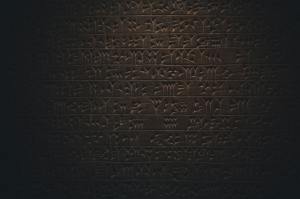
Spending long hours in the same room with my perplexed insect friend, I came to ponder what its experience of life was like.  I’m no Franz Kafka or Thomas Nagel, but I had to wonder when it chose to spend the night on a clay replica I had made of an Ugaritic abecedary.  I’d made this clay model when I was teaching, and I used it as one of several visual aids to help students understand how writing had developed.  (I had even ordered authentic papyrus to pass around, and the single sheet of vellum cost more than an entire book in those days.)  My doctoral work largely focused on Ugarit, and in the 1990s it looked like that sub-specialization might be on the ascendant.  We often live to have our mistakes rubbed in our faces.  But why had the shield bug picked this very spot to roost?  It looked as if it were trying to learn to read cuneiform.  It needn’t bother.

Although I habitually awake quite early, it isn’t easy getting out of bed.  Especially in a cold house during winter.  My entomological friend, of course, had to wait for the sun itself to come back to life.  Night on the windowsill can’t be comfortable, especially when the radiator is under the other window in the room.  No matter how much I try, I’ll never know if I’ve succeeded in understanding the experience of that bug.  How it is enslaved to the sun, and how it keeps on climbing, even after it falls, raising a tiny geyser of dust.  How it flies full speed into a barrier it cannot see, and then tries again.  I may not be able to understand this beetle sleeping on my Ugaritic alphabet, but I do think there’s something here to learn.


Atlas

The other day I had a hankering for Religion Index One.  I don’t think it exists anymore, at least not in the format I once knew it.  RI1 was a print volume produced by the American Theological Libraries Association, or ATLA.  This tome was an indexed list of journal articles that had come out on any given topic in the past year or so, and it stretched back to the 1940s.  The idea was that it was as close to “one stop shopping” as a scholar could get for finding publications while doing research.  I suspect it’s all done online now.  One of the tricks of the trade I’ve learned from not being part of the academy is that if you maintain membership in one of the larger bodies—the American Academy of Religion, or the Society of Biblical Literature—you can find out who’s working on what by searching the programs of their annual meetings.

This may sound like a terribly geeky thing to do; admittedly it is.  Nevertheless, I’ve uncovered lots of information by doing just this.  If you want to know who’s been researching a topic, look for who’s presented a paper on it over the past few years.  It’s not failsafe, of course.  Some of us aren’t really encouraged to give papers on company time anyway (and what time isn’t company time?) but we nevertheless research anyway.  All the journal articles and book chapters that I’ve contributed over the past six years or so have been invited submissions, with one exception.  Ironically, I taught and published full-time for nearly 15 years with no outside invitations made.  Once I was no longer in a position to access RI1 people started to invite me to submit papers.  It’s pretty difficult to do in current circumstances.

With the continuing factories churning out doctorates in religious studies—itself a stagnant job pool—there’s plenty being published.  Online sources mean even more venues to get things “in print.”  There really is no clearinghouse to find it all, beyond Google.  ATLA still exists, and they now produce a searchable database.  Like JSTOR, however, it’s only available to the traditional academic and the occasional wealthy bystander.  Since the AAR and SBL programs are open to the public for searching, even sorts like me can gain access to a small wealth of knowledge.  Or at least a wealth of papers and publications, which may not be the same thing.  Still, in quiet moments I reflect on walking to a physical library and thumbing through a book made of authentic paper, and feeling, at the end of the day, as if I’d accomplished something.


Geocheating

So, we geocache.  Not as much as we used to, but over 15 years ago my family and I began the sport and really got into it for a while.  Geocaching involves using a GPS to find a hidden object (“cache”) so that you can log the find.  It’s all in good fun.  The organization that hosts the website also offers the chance to log “trackables”—these are objects with a unique identifier that you sometimes find in caches and you get credit for logging your find.  There are no prizes involved.  We started several of these “travel bugs” ourselves, years ago.  If you started one you got an email when someone logged it, and you could see how far around the world your little bug had gone.  For many years we’ve not heard much about any of ours and assumed them to be MIA.

Recently I started getting several email notices about a resurrected travel bug.  It was as if someone had finally found a cache somewhere deep in the Sahara where it’d been hidden for a decade.  Then I had an email from a fellow cacher, in German.  I figured it must be serious.  The message was that a Facebook page was publishing trackable numbers so that anyone could claim to have found them.  One of ours was on that list.  I went to the page to look.  It said, “Let’s face it, it’s all about the numbers.”  And they proceeded to list hundreds of numbers so that you could claim to have “found” the pieces with your posterior solidly sunk in your favorite chair.  This is annoying not only because we had to pay for the trackable dogtags, but also because it was cheating.  I said as much on the page only to have my comment blocked.

How sad is it when people cheat at a game when there’s no gain?  All they do is claim to have done something they haven’t, for no prize or recognition.  A fun family pastime falls victim to the internet.  Ironically, geocaching was really only possible because of the internet.  It required a place where players could log their finds in a common database.  Facebook, continuing its potential for misuse, allows someone to spoil it.  I, along with my unknown German counterpart, reported the page to the powers that be.  But since we live in a world where the powers that be don’t recognize any rules beyond inflating their own numbers, I shouldn’t be too optimistic of any results.  I guess this is how Republicans play games.


Social Madness

I’m reading a book written in the mid-1980s.  (All will become clear eventually.)  The author notes the connection between social madness and personal mental illness.  He cites the alarming rise of teen suicides.  This was over three decades ago.  Suicide rates have continued to climb, and this particular author got me to thinking about something that troubled me even as an undergrad.  Although I went to college intending to be a minister, I ranged widely in the subjects I studied.  (Being a religion major in those days allowed for quite a bit of flexibility.)  I took enough courses in psychology to have minored in it, if I had declared it.  Since my mind was set on church work I saw no reason to make said declaration.  The thing that troubled me was I had also taken sociology classes.

Like most people who grew up in uneducated households, I suspect, sociology was something I’d never heard about.  Asking what it was, in college, someone answered along the lines of “psychology of groups.”  My own experience of it was that it involved math and graphs—it was a soft science, after all—and now I read sociologists who say that such numbers can be made to declare what the sociologist wishes.  In other words, psychology.  The point of all of this is that the book I’m reading suggests societies exhibiting illness cause individuals to be sick.  Sociology leads to psychology.  In times of national turmoil, individual mental illnesses rise.  I had to pause and put the book down.  The eighties weren’t a picnic, but the national madness of the Trump era bears no comparison.  We are a nation gone mad, and when society can’t project health, the many who stand on the brink of individual mental illness simply get pushed over.  That sure makes sense of what I’m seeing.

Looking back, I often think I should’ve probably declared that minor.  Raised in a strong biblical environment, however, I wanted to learn as much about the Good Book as possible.  I was teaching Greek by my last year in college and in seminary I specialized in the Hebrew Bible.  It would’ve been a natural place to continue studying psychology.  By that point I’d decided to go on to a doctorate, and psychology required medical training.  For a guy as squeamish as me that wasn’t possible.  Ancient languages, though, they were something I could handle.  It’s rather frightening that those writing at that time already saw America (in the Reagan years, I might add) teetering towards national insanity.  We’ve gone far beyond that now.  And a society that doesn’t know it’s ill will sacrifice many individuals who realize that it is.


United, We Divide

I was a teenage Methodist.  Or, I should say, a teenage United Methodist.  My family had moved to a town where there were no Fundamentalist churches.  Indeed, the only Protestant church was the UMC.  Although very aware of religion, I hadn’t studied it deeply at that point—I’ve come to understand a bit better the marketplace of Christianties and how it works in a capitalist society.  The thing is, the more I learned about John Wesley and the Methodist movement, the more I saw how well it aligned with my own thinking and experience.  I became an Episcopalian largely because John Wesley never left that tradition and urged his followers in the same direction.  Of course, the “United” in United Methodism was due to mergers during the ecumenical period when Christians were learning to overlook differences and a strong base remained from which to draw.

The news has come out that the United Methodist Church has decided to split over the issue of homosexuality.  Most major Protestant denominations have made their peace, albeit uneasily, with the issue.  They recognized that while a source of guidance in spiritual matters the Bible’s a little outdated on its scientific understanding.  If God had revealed evolution to good old Moses things might’ve been a bit different.  We now know that homosexuality isn’t a “choice”—it is found in nature, and not rarely.  Homo sapiens (if I’m allowed to use that phrase) have developed in such a way that sexuality is a main preoccupation of religions.  Some animal species are monogamous and in our case many cultures adopted this as conducive to an ordered society.  Then it became codified in some sacred writings.

While homosexuality is mentioned in the Bible, every book of that Bible has a context.  Like it or not, close, serious study of Scripture raises questions you just don’t get if you read only authors who think the same way you do.  It is far easier to do that—who doesn’t like being right?—but thinking seldom gains credibility by never being challenged.  Iron sharpens iron, someone once said.  The emotion behind the issue, I suspect, is driven by a couple of things: fear of that which is different, and the inability to see the Bible as anything but “da rules.”  In those cases where the rules contradict one another you just have to choose.  At least in Christianity.  In Judaism they ended up with the Talmud.  In any case, we’re now seeing the fracturing of society based on party lines.  We could always use a few more choices, I guess, for competition is what spiritual capitalism is all about.


New Year Reading

Childhood has a powerful draw.  I first started reading Dark Shadows books when they were published for (I kid you not) 60 cents.  I got them for cheaper than that at Goodwill.  Every time I read one I wonder what my young imagination found so compelling in them, but in an effort to trust my younger self I keep on.  So I read Marilyn Ross’ Barnabas, Quentin and the Witch’s Curse.  The book doesn’t really say anything about a witch’s curse, providing as it does some of the backstory for Quentin.  If you aren’t familiar with that background, and you want to be, Barnabas is a vampire and his cousin Quentin is a werewolf.  Both were made so by curses, a plight the Collins family has long faced.  

In recent years I have read the 19 volumes in the series preceding this one.  They tend to be formulaic, and often show the signs of having been written quickly.  W. E. D. Ross is sometimes listed as the most prolific Canadian author ever.  He wrote over 300 books, mostly in genre fiction.  It’s no wonder many of them sound the same.  Still, I have to admit that both from watching Dark Shadows and from reading these novels as a kid, I liked Quentin.  Yes, he was smug and self-confident, but as a werewolf he had the ability to become someone else.  Unlike other books in the series, this one focuses on Quentin and points a pretty heavy finger to him being a Satanist.  That seemed pretty harsh to me.  There’s a difference between being the victim of a curse and being a Devil worshipper.

Now I know I shouldn’t take this as belles lettres.  Ross is not remembered as a great stylist, master of character development, or for being all that creative.  Dark Shadows was a soap opera—one of the more intelligent of the genre—and there’s only so much you can do with it.  Satanism was a cultural concern in the 1970s.  In the following decades it would bloom into an outright panic.  I’m pretty sure that I never read this particular volume when I was young.  Even now as a relatively mature man I found the implications somewhat disturbing.  The Scooby-Doo ending doesn’t do much to ameliorate the undercurrent of evil.  Quentin always seemed like such a sympathetic character to me.  Maybe it just goes to show what happens when you go for a quick read rather than choosing a book of substance.  Childhood can be that way.


Seaing 2020

It’s funny what sticks in your head.  As a ten-year-old 2020 seemed impossibly far in the future.  And it was very wet.  Not because of global warming, but because of a Saturday-morning cartoon called Sealab 2020.  Suffering from thalassophobia, the idea of living under the ocean was both intriguing and terrifying to me.  I recall that these underwater scientists had “aqua-gum” that they could chew so they’d be able to breathe and talk when not in the giant domes of the lab itself.  While checking out the series online, I was surprised to learn it only had 13 episodes and lasted but three months.  I’ve been thinking about it for over 40 years now, silently waiting to see if we would have such places as the deadline drew near.

This image is protected under copyright by the owner. It is reproduced here under the fair use doctrine, in low resolution. From Wikimedia Commons.

Instead in 2020 we have a record low of scientific projects being supported by a science-denying government.  Ironically the sea levels are rising because of global warming.  We haven’t done our homework and we’re pouting that things aren’t turning out the way we wanted them to.  Ours is no longer an evidence-based reality, but one where a tweet of “fake news” is all we need to make the truth a lie.  And as the water laps our ankles my thalassophobia starts to kick in.  The thing about Sealab is that they had kids there too.  Kid scientists.  Even more ironically, Richard Nixon was president.  His downfall was Watergate—coincidental?—and now we have a president caught red-handed (very Red-handed, even) in crimes while in office and Nixon’s beginning to look like a saint.  When did the water get up to my knees?

They wore wetsuits and swim fins quite a lot in the show.  Moving under water looked so natural—unlike my flailing when I attempted to swim.  It was all about not being able to breathe, in my case.  They showed us all kinds of strange animals under the water in Sealab 2020.  Animals that we could drive to extinction, it seems, if they got in the way of unbridled greed.  I have to admit that I’m a bit disappointed that Sealab misled me.  We were heading for an optimistic future back then, even with Nixon justifying the Vietnam War and spying on his political opponents.  People were still able to look forward four decades ago, in hopes of a better future.  For all these years I’ve been awaiting 2020 only to find the world back behind where it was in 1972.


Hereby Resolved

Photo credit: chensiyuan, Wikipedia Commons

New Year’s resolutions have never been my thing.  Having had a good Calvinistic upbringing, I’m a natural self-corrector.  If I’m aware I’m doing something wrong, I attempt to change my behavior right away.  This makes annual reviews at work exceptionally uncomfortable for me.  I’d much rather have my boss point out foibles as they happen so that I can stop doing them right away.  I realize my mindset here may be weird to those who were raised in more normal ways, and employers love process.  So I sit here in Ithaca on New Year’s day, preparing to drive home to face all kinds of unfinished business from 2019.  I’m still doing research for Nightmares with the Bible, thus it’s not ready to go back to the publisher or series editors yet.  I’ve started a new round of queries to agents about one of my novels, but I haven’t sent them yet.  And don’t even mention projects that need to be done to the house.

Life is busy.  I’ve taken on some new duties at the church I attend, exemplifying that old saw “If you want something done, ask a busy person.”  As the pressures from that obligation mount, I start to think that most people don’t have any idea just how all-consuming writing a book can be.  I work long days and although I don’t commute much any more, most of the rest of each day is taken up with writing and reading so as to write some more.  I hesitate to call myself a writer since I make laughably little lucre from it.  I can’t stop myself from doing it, though.  And although it’s the season for resolutions, I don’t plan to stop.  I know from work that graphomaniacs can be a problem.  Anything can be overdone.  On days when I don’t have to work I have to be pried away from my computer.  Otherwise I’ll write all day long.  It’s an issue, I know.

Perhaps because life on the national scale is so depressing, writing about things like horror movies is a great release.  I’ve been so busy lately that I haven’t had the chance to write pieces for venues like the excellent Horror Homeroom.  I used to contribute to Religion Dispatches.  That time has been sucked into getting my books that nobody will read finished.  Having written that self-disparaging remark I have to remind myself that one of my alumni magazines published a notice about Holy Horror without me having to send said notice personally.  That self-disparaging thing requires some fixing, I guess.  And were I not too busy already in 2020, I’d start on it right now.


2019 Books

  Goodreads is always a little eager to put the tally on a year’s worth of reading.  This year, however, since I’ve been engaged in some larger books, they may be on target.  According to their count I’ve read 71 books this year.  (I re-read two, so my personal count is 73.)  New Year’s Eve, for me, is a time to reflect about what I’ve learned in the past year.  Much of that involves books I’ve read.  A good deal of my reading has been for Nightmares with the Bible.  To write a book you need to read books.  Frequently it means taking them on regardless of your mood—and I tend to be a mood-driven reader.  So what books stand out from 2019?  (They all have individual posts on this blog, in case you missed them.)

My first nonfiction book of the year was Christopher Skaife’s The Ravenmaster.  Animal intelligence always makes for good reading and this was reprised in Jennifer Ackerman’s The Genius of Birds.  I’ve fallen behind in my Frans de Waal reading, though.  Of the many research books on the Devil and demons, Jeffrey Burton Russell’s Mephistopheles stands out.  Russell’s clear thinking and wide view make him a pleasure to read even on unpleasant subjects.  Other books in that category didn’t quite rise to his level.  Monster books, on the other hand, rocked.  I loved James Neibaur’s Monster Movies of Universal Studios, Mallory O’Meara’s Lady from the Black Lagoon, and Kröger and Anderson’s Monster, She Wrote.  These were all excellent.  Tipping toward the unusual, Guy Playfair’s This House Is Haunted and Jeffrey Kripal’s The Flip gave me pause for thought.

Perhaps because I was reading longer books, this year didn’t have fiction in the numbers I usually strive for.  Most of it was quite good, though.   David Mitchell’s Cloud Atlas was memorable and Italo Calvino’s If on a Winter’s Night a Traveller (strangely similar to Mitchell) became an instant favorite.  My young adult fix came through Christy Lenzi’s Stonefield and Lois Lowry’s The Giver.  Victor Gischler scored with Vampire a Go-Go and Cherie Priest made a fine impression with The Toll.  I mentioned Neal Stephenson’s Fall yesterday, but it will stay with me into 2020.

A couple of memories/biographies also made deep marks on my mind.  Anne Serling’s As I Knew Him brought me close to Rod Serling and Barbara Taylor Brown’s Learning to Walk in the Dark found me where I live.  America’s Dark Theologian by Douglas E. Cowan isn’t really biography, but it was thought-provoking (as his books always are) and increased my resolve to read some more Stephen King.  The books I read make me more myself.  At the end of each year I think back over it all.  And this year I pondered what got me through a difficult 2019.  I have ended the year more myself than ever, I suspect, and I looking forward to a reading through the new decade.


Fearful Faithful

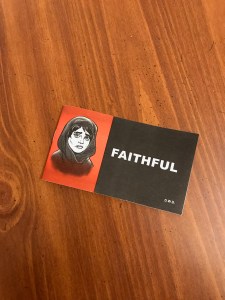
It’s sitting on the table next to my chair and I’m afraid of it.  It all started during the Easton Book Festival.  I feel sorry for those people who have to stand on the street corner and pass things out for a job.  In Manhattan I used to see them being completely ignored by swarms of people passing by.  They’re only doing their job.  I made a habit of accepting their chits, and even if they didn’t mean anything to me, I felt that the person handing them out might have experienced a small measure of satisfaction that someone accepted what they were offering, and had said “thank you.”  In Easton back in October, my wife and I were heading to one of the venues to hear an author talk and a guy was passing out paper, and I accepted one as a matter of habit.

It was a Chick tract.  If you’ve been reading this blog a while you’ll have run across the concept before.  Jack T. Chick was a cartooning evangelist.  He drew hundreds of tracts and comic books that formed a steady diet for me, growing up.  Although they looked like cartoons, these intolerant, Fundamentalist tracts were quite often very scary.  Especially to the young.  More than once I’d spiral into a childhood depression after reading one.  Although it seemed simple—say the prayer at the end and you’d be saved—how could you be so sure?  The disturbing contents stayed with me long after the sixteen pages were done.  Now, as an adult, I was being offered a road back to a childhood I fervently wished to avoid.

I stuck the tract in my pocket and forgot about it.  When I got home I emptied my pockets and found it again.  Curious, I was tempted to read it.  I know, however, that doing so will only drag me back to a memory of younger days when a kind of terror permeated my days.  And nights.  My theology, which was formed of a mosaic of these tracts (what child really listens to sermons?), was a scary one indeed.  It was populated by demons, Catholics, and servants of the Antichrist.  Anyone who wasn’t straight and pretty waspish was a threat to my eternal salvation.  Is that somewhere I want to go again?  The tract sits, unread, on my table.  It reminds me of the abuses to which religion might be put.  And I’m thinking I might start refusing free handouts on the street once again.


Job’s Jobs

Many years ago, after Nashotah House decided it no longer required my unique outlook, I bought a book.  (That’s my default reaction.)  This book was on how to write killer cover letters.  I don’t remember the title or the author, but I followed the advice, well, religiously.  It got me nowhere.  Business tricks, at least historically, don’t work in academia.  Sitting at home, pondering my sins, I flipped to the chapter on advice to take if none of the rest of this was working for you.  Here’s where the human side began to show through.  Have you been eating onions or garlic before your interviews? it asked.   Do you need to lose weight?  Try dressing nicer.  It occurred to me that the business world lacks the imagination required for denying jobs.  And besides, who was getting any interviews before which I shouldn’t eat garlic?

Business advice is, in a word, shallow.  It assumes that if you’ve got the goods there’s no reason you won’t get hired.  Reality is a bit more complex than that.  I often ponder how people simply go for what they want.  They reach for the biggest piece without pondering the repercussions of their actions.  I see it in my small world of publishing all the time.  Those who are “hungry” (read “greedy”) succeed.  Those who wait behind to help others simply can’t compete.  So the cover letter book did get that part right.  Is it possible, however, to devise a society where everyone fits?  Not all are created equal, perhaps, but do we have to reward those who seem to care only for themselves?  Let them eat garlic.

The cover letter book, in the end, never really did me any good.  I found my way into publishing by being willing to aim low.  I’ve written many cover letters since leaving Nashotah House, and only two ever led to a job.  Those who work in business, what with their concerns about readers’ aromas and weights, seem never to have considered the intricacies of the intellectual job market.  What strikes me as particularly odd is that there are plenty of smart people out there, and yet they haven’t organized to offer alternatives to the greed-based structure on which our work lives are based.  They can’t, it seems, gaze beyond capitalism as a mechanism for helping individuals lead productive lives.  Business operates on the principle of replaceable parts, many of which happen to be human.  And even those who know how to write can’t hope to compete against those who prefer cogs that know to avoid onions.


Steel and Snow

I sometimes feels I need to pause before launching back into my usual reflections.  Commercialism tells me the holiday season is here (I noticed while watching Macy’s Thanksgiving Day Parade that the real highlight is Santa and the official start of Christmas).  Please don’t misunderstand—I love the holiday season and look forward to it every year.  It’s not that I want to get things or spend lots of money.  For me the holidays are about rest and respite from the constant stream of work that never really gets done.  I need to retreat once in a while.  Ensconce myself in a quiet room and not have to worry about the next crisis facing me as an editor or the publishing industry as a whole.  I do love the holidays, but I often wonder about how we’ve let their symbols become the main point.

Now that we live near “the Christmas City,” we attend the Christkindlmarkt in Bethlehem while family is home.  One of the more stark symbols of this festival is the juxtaposition of a Christmas tree against the now silent and rusting steel stacks of what used to be Bethlehem Steel.  The evergreen, of course, was a Teutonic symbol of life continuing in the midst of the shutdown of the growth season.  Nature hasn’t really died, although it may appear to have done so, but we feel that difficult times with short days and cold temperatures will now dominate our existence.  Our industrial efforts participate in this slowdown too.  What once identified one of Pennsylvania’s two steel cities has ceased an Bethlehem has had to adapt.  We see the change and wonder.  I grew up just north of Pittsburgh when it was a very large industrial city.  When I was in high school it was the 16th most populous city in the country.  Currently it’s 66th, with Charlotte, North Carolina holding its former place.  We adjust to changing seasons.

Christkindlmarkt is a lively place with four large tents dedicated to symbols of the season.  Christmas merchandise is a large part of it, of course.  Small business vendors, however, take advantage of the fact that crowds throng in.  Food, naturally, comes to hold a place of some significance as your blood sugar drops after spending a few hours on your feet.  Music is in the air and people don’t seem to mind the masses of others who all had the same idea.  I never purchase much at the event, but I enjoy being among those inspired by it.  Some of us are the rusty towers in the background, and others are the lively, decorated tree that stands before them.  The season has begun, and the symbols are open for interpretation.


Mad Dog

Like those who write long books, those who write very many books ask for some level of commitment from their fans.  I’m sure I’m not alone in wishing I had more time to read.  I tend to be driven to Stephen King’s novels by the movies made around them, and there’s nothing wrong with that I suppose.  I decided I wanted to read Cujo some years back when I was on a werewolf kick.  I knew it wasn’t a werewolf story, yet as one who suffers from cynophobia even a large household pet will do.  I didn’t know the story in advance, and I had no idea how it ended.  It’s good to read novels like that sometimes.

I took it with me to San Diego and read most of it on the plane, finishing it somewhere over the mountain west.  It is a bleak story, one of King’s more drawn-out and wrenching tales.  It’s made more so by the fact that it could happen, at least in the main storyline.  Or could have happened.  Maybe I waited too long to read it, but I kept thinking as I was going through—today we have cell phones.  A large part of this story unfolds because of Donna Trenton’s inability to contact anyone while a rabid dog keeps her trapped in her car during a record-breaking heat wave in Maine.  I suspect it’s kind of a story about redemption, but I really need some time to think about it before rushing to such conclusions.  There’s not much you can really consider religious in this particular tale, and perhaps it’s because Cujo is a very natural kind of monster.

I saw my first rabid dog when I was maybe five.  My brothers and I reported a dog acting strange to our mother, after which she kept us in the house.  That wasn’t the origin, I don’t think, of my cynophobia.  Two of my brothers were bitten by a family dog when I was little, and I was once chased by a dog about as big as I was, certain that it was going to eat me.  At the same time, we had dogs as pets, and apart from the one that liked to bite, they never gave cause for fear.  Cujo tapped into those memories and made me reflect on what it means to befriend wolves.  It won’t be my favorite King novel, but it did help to pass the time from coast to coast.


Post Facto

“Yea, though I walk through the valley of the shadow of death,” Psalm 23 asserts, “I will fear no evil.”  Nor should one fear evil when flying over Death Valley, as I did coming out of San Diego, but I did.  There are perhaps not too many national monuments that can be appreciated from 30,000 feet, but the only way I’ve seen both the Grand Canyon and Death Valley is by plane.  My flight home from AAR/SBL had me sitting over a wing, so a photograph of the famed graben would simply show mostly wing and a bit of Death beyond.  This valley holds the record for the hottest ambient temperature recorded on the surface of the earth (134 degrees) and is famed as one of the filming locations for Star Wars.  Still, from the air the juxtaposition of mountains and salty, flat dearth was impressive.  I had no one with whom to share my excitement; the kid next to me was watching a movie on his phone and I had no idea who he was or if he’d be interested.

Disneyland, they say, is the “happiest place on earth.”  While I have my doubts about than endorphin-laced claim, I do know one of the opposite locales.  The hotel in which I stayed, the Grand Hyatt, San Diego, hosted the AAR/SBL Employment Center.  The hotel is not to be blamed for holding the most unhappy place on the planet, but as I looked at the booth I wondered if this was truth in advertising.  Should it not read “Unemployment Center”?  That two-letter prefix would make this at least honest, if not cheery.  I have spent some of the most miserable hours of my life in the employee hopefuls’ lounges at past conferences.  Hours and hours wasted, waiting to see if anyone, anyone at all was willing to grant you an interview.  I saw more than a few tears shed in that horrid place.  Some of them mine.

Now I’m high over Death Valley.  It feels far too sanitary to experience it in this way.  The professorate, which seeks to improve the world, is generally a powerless lot.  Signs scattered throughout the Convention Center and hotels asked such things as Does your school have over 50% contingency faculty?  And statements like Tenure track is not the norm.  The psalmist, it seems to me, got it right.  If you want to face the valley of the shadow of death and not fear, you have to walk through it.  The more people who do, the better the hope that we’ll land this plane with some kind of resolve to do be open to visions and to act upon them.