See Around Us

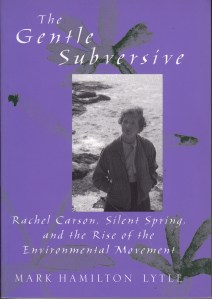
There aren’t too many people that I consider personal heroes. Those that I do have earned the sobriquet in odd ways, I suppose. That makes them no less deserving. Rachel Carson became a hero because of The Sea Around Us. Published over a decade before I was born, it was a book that I treasured as a teen—or even as a tween, had the word existed then. I was no literary critic, but her style and lyrical writing drew me in and my own love of the ocean I’d never seen was kept alive through her words. Mark Hamilton Lytle, I think, shares my evaluation of Carson as a hero. The Gentle Subversive: Rachel Carson, Silent Spring, and the Rise of the Environmental Movement brought out much of what I admired, and still admire, about her. A woman in a “man’s world,” she became a scientist with a gift for literary finesse. She struggled, she believed, and she died far too young.

Lytle’s book builds up to the publication of Silent Spring, which appeared just two years before Carson’s untimely death. I picked up Silent Spring as a tween as well, but only read it within the last few years. I knew this book had nearly singlehandedly launched the environmental movement, but as the shame of modern life constantly reminds me, I’d been too busy to read it. Born the year it was published, and not terribly far from where Carson herself was born, I had an affinity with the book that strangely kept me from it. It isn’t easy to read, even today. Especially today. With a government ignorantly rolling away all the environmental safeguards that six decades of careful thought have put into place, we need Carson now as much as we did in the 1960s. Her modern critics, as might be expected, tend to be men.

Carson showed that a woman can change the world. Those who disparage her stunning work claim that her following is a religion, not science. Carson was a rare scientist who saw that everything is interconnected. There may be some mysticism to this, but for those willing to admit it, we feel it to be true. On the eve of environmental degradation that will, in a perverse kind of justice, possibly wipe us out, we need to return to the fine words and clear thinking of one woman who took on industrial giants to give a voice to the people. We do have a right to determine what happens to our planet. Lytle makes the point that Carson was like a prophet. For me the comparative preposition can be removed altogether.

Taking Time

Good writing is hard work. One of the mixed blessings of the internet is that it makes publication so easy. Get yourself a blog and nobody has to approve anything! Ideas come tripping across your fingers onto some electronic substrate and, viola! You’re an author! The problem is that being an author’s not the same as being a good author. Writing well (and I make no such claim for myself—after all this is just a blog) is hard work. A piece has to be written, and then read again and again. I’m reminded of the story of a convicted murder whose name I’m forgotten (call it a defense mechanism). This was early last century. The murderer was caught, initially after having been found wandering, disheveled, in public. As a respectable man (he was a doctor, I think) part of his defense was that he’d never have left his house without being presentable. He would have on a collar and hat. People would see him, and he had to convince them of his presentability every single time he walked out that door. (This isn’t an affliction that I share, by the way.) Writing for publication is like that—you need to take care to look respectable every single time.

I can’t speculate about how other writers do their thing, but for me the main requirement for this is time. Any piece that I want anyone else to see, has to be written. Read. Edited. Re-read. And probably edited again. All before the public sees it. This is just for the informal stuff. I’m currently writing a book (which is pretty much a constant state with me). The draft was finished months ago. I started thinking about a publisher. Then I read it again. I couldn’t believe I’d ever thought it was ready for a publisher. Several rewrites followed. I’m in the midst of another one at the moment. I think of it like my ill-used rock tumbler. You want shiny rocks, you’ve got to send them through with finer and finer grit. If you do it right, they’ll come out looking like they’re wet, and they’ll stay looking that way. Polished writing takes time.

Some things can’t be hurried. As a middle-schooler I had a summer job with the school district. One of my assigned tasks was painting bus shanties. Many of these were, as you’d expect, way out in the middle of nowhere. I’d be dropped off with a couple other teens and we’d paint the shelter inside and out. One day I got tired of the constant, boring, and repetitive task of filling a paint pan with white paint, carrying it into the shelter, using it up, and then doing it all over again several times. I decided to pour the paint directly on the plywood floor of the shelter. All I’d have to do would be to roll it out and who’d be the wiser? I only did it once. Little did I consider that the best painting, like the best writing, is a thin layer over the substrate. You need to go over it more than once, leaving time between layers. More importantly, I didn’t realize that you can’t gauge how much paint you need this quick way. The best thing is to run out and refill. Then you can pour the remainder from the pan back into the can. The floor took hours and hours to dry. Not only that, but the top surface dried first, so when I stepped in, I pulled up a thick layer of paint off on the bottom of my shoe. Tom Sawyer I was not. I had to redo it. What I learned that day, though, was a lesson about writing. Take your time. But you don’t have to take my word for it. I just write a blog.


Weather Vain

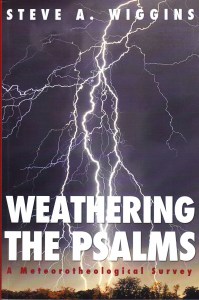
The other day I was awakened by a severe thunderstorm. It’s been quite a while since that’s happened. Unlike when we lived in the Midwest, thunderstorms in New Jersey tend to be widely scattered and somewhat uncommon. (It’s all a matter of perspective, I know.) My basis of comparison is how often I notice such storms. I’ve never been able to sleep through one. Thankfully this one came at around 4:30 a.m., past when I’m usually awake on a weekend. I’d forgotten the raw power of just how loud and bright such a storm can be. Danger seems all around. The feeling is primal and urgent. As I got out of bed and walked into the dark kitchen, windows filled with electric blue followed by and tremendous blast, I thought once again of Weathering the Psalms and the story behind it.

By the way, when I speak to young scholars about publishing I tell them this isn’t the way to go about finding a topic. That having been said, my book was born in the Midwest. Life at Nashotah House revolves around required chapel twice daily. Weather does not stop it. In fact, holding the daily office by candlelight because a storm had knocked out the power was not uncommon. Morning and evening prayer—indeed, all of the canonical offices—are built around the recitation of the Psalms. Reading the Psalter in slow, stately tones while thunder raged outside, rattling the ill-fitting stained-glass windows, left an indelible impression. It was only natural in such circumstances to notice how often the Psalms mention the weather. Thus a book was born.

I’m currently at work on a new book. I can’t say the topic just yet because someone might be able to beat me to it. (Knowing the way I come up with book ideas, however, I doubt it.) Sitting in my darkened living room, in my writing chair with the fury just outside, I was strangely inspired by the storm. Then it was over. Silence followed by birds singing, just like in Beethoven’s sixth symphony. The thunderstorm is one of nature’s psalms. As at Nashotah House, in the Midwest we had perhaps too many of that particular kind of psalm. Nevertheless, in the silence that followed I was left strongly in touch with my muse. These are the states that lead to poetry and song. Every great once in a while they might even lead to a book idea. As I tell students, just don’t expect that anyone else will get it.


Blood Brothers

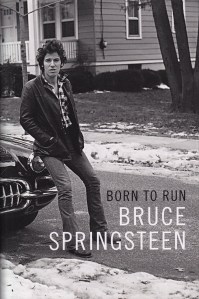
Every once in a while I take a chance and write about music. I don’t do this too often since it’s a very personal thing, and as open as I may be on this blog, I’m not as accessible as I seem. We all need a place to retreat in this world, and Bruce Springsteen’s music is one of those places for me. Late last year, just after it was published, Springsteen’s Born to Run—his philosophical and revealing memoir—sold briskly for several weeks. Since it made its way into my stocking I’d been intending to read it since then. And putting it off. There’s something disillusioning about finding out your heroes are only human. The best among mine are heroes precisely for that reason. Gods need not apply. Overcoming my fear, I dove in.

Two things stood out in this autobiographical account: religious imagery looms large, and depression mingles liberally with it. I recall reading an early review where the writer expressed surprise that the Boss suffers from depression. I responded (perhaps out loud), “have you ever listened to his songs?” I became a Bruce fan because he sang about working class people. Bruce and I share that background. He knows that your roots never let you go. Indeed, roots are what keep you grounded. Many of my academic colleagues, I learned, were simply carrying on the family business—and a privileged business it is. Those of us who had to overcome poverty to get in the door were never really welcome in the ivory tower. You can’t help where you’re born, but you can sure be punished for it. Bruce understands that.

I’ve never been to one of his concerts. I don’t even like to listen to his music when someone else is in the room. There’s something deeply personal about communing with someone you feel understands you. Of course I’ve never met Bruce Springsteen. I probably never will. He won’t know the kind of influence he’s had on my life and I feel that I’m risking an awful saying so here on this blog. There aren’t too many heroes in my life. I’m not inclined to idolize people. In this memoir, however, Bruce won’t let himself become an idol. He’s not perfect and he takes pains to make sure that you know that. We were, nevertheless, raised in situations not dissimilar from each other. Unlike Bruce, I have no musical gifts. No, I’ll never likely meet him—and if I did I wouldn’t want it to be with other people around. Some things are just too personal that way.


Stamp Collecting

Like most awkwardly shy children, I used to collect stamps. Even today a bright one will catch my attention although it’s been years since I actively sought them in a household not really important enough to receive much more than bills. To make up for not getting our own mail, I’d go to the local hobby store (not Hobby Lobby, thank you) and get those cheap packages of cancelled stamps from countries I’d never heard of. Using special strips designed for introverts, I’d mount them carefully over their black-and-white image in my stamp album. Looking at those carefully engraved pieces of miniature art was a way of traveling for a kid in a lower-income family who considered a trip to Pittsburgh the big time. I’ll still save a flashy stamp although the album was lost decades ago.

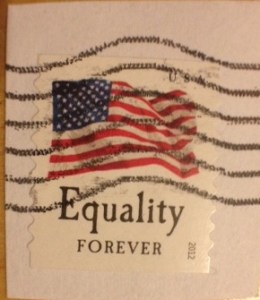
The other day I saw a Liberty forever stamp. Looking at the headlines, I think the stamp has been lying to me. The idea of liberty doesn’t seem to involve using “Nuclear Options” to stack the Supreme Court after illegally refusing a hearing for the lawful candidate our last true president nominated. Liberty doesn’t involve beefing up security so we can deport those we normally exploit and then firing our missiles at those we personally dislike. No, my philatelic informant seems to be sadly misinformed. Nothing is forever. Indeed, some of the stamps I purchased before the price went down are now more expensive than they need to be. We can always use the surplus to buy more missiles, I suppose. But wait, the price has gone back up! All reprieves are short-lived.

As I daily watch our government dismantle the freedoms we’ve so carefully built over the past two centuries, I glance at my liberty forever stamp and wonder what went wrong. When did hatred of others trump the desire to be free? When did the slimmest of crooked margins become a mandate? When did braggadocio become a sufficient substitute for intelligence? When you place “forever” as the value of a stamp, you no longer know just what it’s costing you. I was born in the age of the 4-cent stamp. Since 1885 the price had never gone over 3 cents. Stamps were more honest in those days. They didn’t say “forever” on them since, it seems, we all knew that nothing lasts forever. Not even liberty.


Russian Watchtower

From time to time I’ve good-naturedly poked fun at the Watch Tower Society members who used to visit with some frequency. I don’t belittle anyone’s belief system, however. Believers of any faith are generally sincere and certainly entitled to follow the dictates of their own consciences and reasoning. Still, as John Cale sings, “nothing frightens me more, than religion at my door.” Some of us prefer to keep our religious preferences private, while musing publicly about the wider world of religious diversity. The Jehovah’s Witnesses have come to mind again because of an article in the New Jersey Star-Ledger my wife clipped out for me. According to Amanda Erickson, writing for the Washington Post, Russia has now classified the Witnesses as religious extremists. She points out the irony since the Watch Tower Society is officially a pacifist group, opposed to any violence. It’s difficult to radicalize a pacifist.

I’m not at home enough any more to be here when the Jehovah’s Witnesses stop by. I know they still come because I can see their tracts. There is a Witness who occasionally stands outside my gate at the Port Authority Bus Terminal in New York. He stands, patiently smiling, next to the entrance holding up the Watchtower while anxious commuters and day trippers give him nary a glance. He seems like a nice guy to me. Always neatly dressed. One day I noticed him commenting to a New Jersey Transit employee that a particular denizen of the Post Authority was acting oddly. He was right, and, as a daily user of that facility, I know it takes quite a lot to earn that kind of notice. Ports, after all, bring in many with diverse outlooks on life.

What’s behind the Russian rage against the “extremist activities” of a peace-loving sect? I suspect the real problem has to do with the fact that Jehovah’s Witnesses are so typically American. And, like the Mormons, a fairly successful New Religious Movement. Religions, it seems, do grow a bit stale with age. Once in a while, something new comes along and revitalizes old systems of belief. Russia, however, is not the Port Authority. There is a repression there that is the envy of New Jersey Transit and every other carrier, I’m sure. Right, United? If only people would conform. Wouldn’t we all be happier if everyone else just believed like us? I’m not sure that history concurs on that point. Perhaps the safest alternative is to remain private. You don’t, however, grow a religion that way. If Russia wishes to inherit these States, they’ll need to learn a bit about the joys of religious diversity. Pacifism is a risk you have to take.


Ode to Hubris

One-hundred-five years ago today, one of modernity’s great achievements sank alone in the icy waters of the chilled North Atlantic. While the ultimate cause of Titanic’s demise may have been an iceberg, the proximate cause was surely much more common. Human arrogance, we’re reminded daily, never learns its lesson. Despite what elected officials tell us, arrogance at the top will always lead according to its surfeit of self-confidence. After all, there are no icebergs this far south so late in the year. It seems that we’ll never forget Titanic and the hundreds of needless deaths, but somehow we’re not very good at transferring the lesson to other media. Let me give just a small example.

Yesterday I was in New York City. My family came during the day to celebrate my wife’s birthday. One of the benefits of New Jersey Transit is that after 7 p.m. on a Friday, a monthly bus pass also works on the train. I can meet up with my family after work and we can ride home in comfort instead of taking the bus, such as I usually do. We didn’t know that at 3:30 that afternoon a train had broken down in one of the limited number of tunnels under the Hudson. (Governor Chris Christie had famously stopped work on another set of tunnels to ease the commute.) About twelve-hundred passengers sat for an amazing three hours with no lights, air conditioning, or announcements. No trains could make it into New York’s Penn Station. When we arrived, oblivious, just before 7 p.m. there were people pouring out of the station. Coats and clothing were strewn all over the steps, as if the homeless had been raptured. The police told my wife and daughter not to go down. A few minutes later they said, “Definitely no shots were fired.” When we got to the platform all the monitors read about half-past five. Discarded clothing was everywhere. It was only when we finally got on a train that we learned that in the anxious terminal where crowds were restless, Amtrak police had tazed a man. People thought shots had been fired, and panicked. The video taken by those in the station shows people running, dropping clothes, luggage, and shoes in their haste to flee. Just after this, we’d arrived.

Titanic, it seems to me, is about building something so massive that it can’t be controlled. Human arrogance is like that. This week we heard about United Airlines security beating up a passenger to make room for company employees who needed to be on an oversold flight. Just a couple weeks back another New Jersey Transit train derailed in Penn Station, disrupting for days the insane commute some of us undertake daily. Who’s the captain of this ship? Oh. But we don’t have to worry. There are no icebergs this far south this late in the year.


Publisher’s Breakfast

I recently had the opportunity to discuss publishing to a room full of academics. (Ooo, I can feel the envy rising already!) Although I discuss books quite frequently on this blog, I generally don’t discuss publishing much. One of the reasons is that publishing isn’t easy to tie into religion sometimes. Another—and this may be the bigger factor—is that publishing is work. This blog, which is technically a form of publishing, is more for letting my mind wander outside the paddock after being penned in at work for too much of my adult life. Still, I’m glad to give publishing advice for those who want it.

The focus of these talks (of which I’ve given precisely two) is how to get published. My main approach to this question is to point out that higher education and publishing are diverging rapidly. The reasons for this are complex, but simply put, publishers need to make money. Having been on the receiving end of tuition statements for a good deal of my life, I have no doubt that institutions make ready money. They may have trouble meeting the costs of all those administrators for whom they keep creating positions, like any good business, so each semester the bill creeps up a bit until suddenly you realize your bank account’s empty and you’d better get to commissioning some more academic books. After all, this is all about money, is it not?

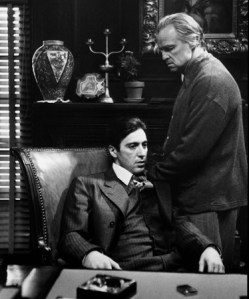
Like many in higher education, I courted academia as a hopeless romantic. I believed that love of subject and ardent devotion with ample proofs of said love would woo the academy into a permanent relationship. I’ve always been an idealist. Now I’m on the side of the desk where colleagues approach me to ask favors. It’s kind of like The Godfather, really. Only those who kiss Don Corleone’s ring tend to do so knowing that favors require some kind of reciprocity. The academy may not welcome you but would you mind helping us out now that you’re in a position to do so? No fear of horse heads here. Perhaps by now you understand why I don’t write much about publishing on this humble little blog. The focus of The Godfather, after all, is really young Michael Corleone and his devolution from an upstanding citizen (shall we say “academic”?) to a mafia crime boss. I’ll leave the other side of the equation blank. Trade secrets, after all, are worth money.


Radicalizing the Normal

Reading Orwellian headlines on a daily basis can wear you down. Think about it—we know because of the endless obfuscation that the Trump administration has deep entanglements with Russia. We know that Russians tried to sway the election toward Trump. We also know that the incumbent refuses to release his taxes or divest from his personal business interests and we can only infer that our tax-payer dollars are going into more personal pockets than ever before. We have on tape evidence that the commander-in-chief is a sexual predator who wants to remove the healthcare of millions so that his lackeys can get even more of that lucre. And when the White House speaks its message is that we, not they, are the problem. What used to be normal life in America is now radicalized. Fascism is the flavor of the term.

Photo credit: Bundesarchiv, Bild 146-1970-005-28 / CC-BY-SA 3.0, from Wikimedia Commons

I’m inclined to be philosophical about such things. After all, I lost my job at Nashotah House while doing things as I always had—the administration had changed, not me. Don’t get me wrong. I know that you have to be flexible and adaptable in the world these days. The policies I see being spewed from the corridors of power, however, are backward facing. Trying to make America as great as it was during the Depression. They call it the Great Depression, after all, don’t they? And the war before that, before it acquired an awful twin, was known as the Great War. Doesn’t everyone look back at those times with a rosy glow of nostalgia? The problem I’m having is trying to figure out what’s normal. You see, you’re born into life with no instruction book. If you’re from a working class family you’ll be told that an education will improve your job prospects. Who am I to question those who know better?

It used to be, back in the good old days, that you could count on the government looking out for your own best interests. You didn’t have to spend every day signing petitions and calling your congress-persons simply to avoid the next disaster. You didn’t spend your weekends at marches and huddles and organizing meetings. The little time you had for leisure has now become time we owe the government to make sure they don’t intentionally ram the iceberg straight ahead. What used to be normal—a drowsy weekend with time to work on your latest book—has now become a radical dream. Midterm elections, in my humble opinion, can’t come soon enough. I can’t wait to get back to normal.


Universal Growth

Maybe the universe isn’t expanding, maybe it’s growing. Always tinged with a healthy dose of pantheism, I’ve often opined to those who will listen that life might be more than animals and plants and microorganisms. But then again, I don’t have the numbers to back me up. These aren’t just the ravings of a guy who wanted to be a scientist but whose religion prevented him, they’re also pretty close to those of a scientist who became a religious guy. When more than one person sends me the same article I figure I’d better comment on it. Those who used to be professors can’t help but professing, after all. So I read Meghan Walsh’s Ozy story, “Jeremy England, the Man Who May One-up Darwin.”

England spent his education on science only to turn to religion along the way. That’s pretty unusual, according to the standard social discourse, but I suspect it’s more common than we’d like to let on. There’s no clause in science that says you can’t believe in anything. Even Richard Dawkins has beliefs. Many scientists have been suggesting, of late, that perhaps physics and religion are converging. (Some of us from the other side of the equation have been saying so for years, but who believes a religionist?) Before I’m misunderstood, I’d hasten to add that I don’t mean religion as in literal trumpets sounding as a white horse and rider descend through the atmosphere. Nor do I mean in the sense of the minutiae of the Talmud. What I mean is the symbol systems that religion has long used may have been in some sense in line with what science has been trying to tell us.

According to the story, England thinks that matter may be self-organizing. That means life occurs where matter exists. Before I become too close a friend with my sofa I have to remind myself that this doesn’t mean everything’s conscious. Although my reading of Thomas Nagel does have me wondering even about that. You see, religion has historically been one of those disciplines where imagination has had a valued role to play. Those who accuse it of being doctrinaire and evil need to talk to a few more people. Religion has always claimed there’s more to life than what the senses reveal. Science professionally limits itself to the inferences of those senses. And you can get away with paying religion specialists a lot less. What’s not to like about this situation? If the universe is growing, there’s room for us all.


Interior Theodicy

Photo credit: Richard from Canton, Wikipedia Commons

Speaking of theodicy, I have a dentist appointment today. Now, if you were raised with the Protestant guilt that used to be so pervasive in this nation, you’ll understand. I do brush my teeth twice a day. I even use floss and that mouthwash that burns away a layer of mouth lining every night. But there’s always more you could do. I’m not particularly good about visiting the dentist, though. Partially it’s a memory thing, partially it’s a pain thing, but mostly it’s a time thing. No matter how far back I jam the toothbrush, well beyond my gaging threshold, cavities seem to appear. And I don’t even have a sweet-tooth. What kind of deity allows cavities in a person who eats very little sugar and brushes so assiduously that last time the dentist told him to ease up a bit since he was scraping away the enamel? (People tell me I’m too intense.)

One of the real ironies of all this is that for all the trouble teeth give us during our lifetimes, they are our most durable parts after we die. Archaeologists find mostly teeth. In fact, it seems that Neanderthals might have practiced some primitive dentistry. I wonder what they thought of their neanderthal deity? So teeth are pretty useful, no matter whether the gray matter above them is dead or alive. I can explain this to my dentist, but he only seems interested in me as a specimen of carnassial curiosity. Maybe it all goes back to my belief that fillings were meant to last forever. Or all those root canals that seem to come in pairs that cost as much as a semester at a public university. Mostly it’s the memories.

In Edinburgh I had a tooth go bad. The Scottish dentist was surprised. “You’ve got a twelve-year molar erupting,” he said (you’ll have to imagine the accent). I asked if that was unusual. He owned that it was as I was a post-graduate student in his late twenties and the twelve-year molar was so precise in its timing that child labor laws used to be built around its presence. Years later in Wisconsin a different dentist asked about one of my fillings. I told him it was from Edinburgh. He called all the other dentists in announcing, “You wanna see a real Scottish filling?” Or maybe the fears go back to my earliest dental nightmares where the cheap doctor seemed unaware that teeth actually had nerves in them. I always left with a guilt trip. “You should brush —“ (more, better, longer, with a more gentle touch) you fill in the blank. I’m afraid of another kind of filling. And I know as it is with Protestant guilt, so it is with teeth. There’s always more you could be doing.


The Deal

Intellectual property is a concept that only arises where thought can be monetized. Think about that. (But don’t charge me, please!) It is a strange idea, when you ponder it. In any case, one of the problems with writing book reviews is that the reviews themselves become the intellectual property of the journal in which they appear. In a mental ménage à trois, everyone gets something out of it: the publisher gives away a book for free publicity, the journal gets copyright content of value to its readers, and the reviewer gets a free book. In the best of these encounters everyone goes home happy. I began doing book reviews when teaching at Nashotah House. Academic books are expensive and although professors make more than editors do, they are still hard-pressed to pay academic press prices. After my strictly platonic affair with higher education, I stopped doing reviews for a while, but now that I have hours on a bus to read, I’ve picked up the habit again.

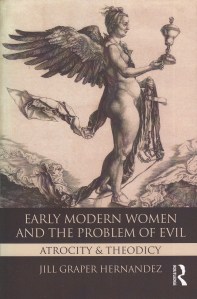
Most often I review books for the two societies of which I’m a member—the American Academy of Religion and the Society of Biblical Literature. There might, however, be a conflict of interest here. One of the main things I do on this blog is talk about books. Since I’m no longer a professor, but I still think like one, I figure it’s a compromise I can live with. The conflict arises because I post daily on my blog while publishers take weeks, or even months, to publish reviews. Despite technology, publishing is a slow business. That means that I read books I can’t really talk about until the review has appeared. That’s the case with Jill Graper Hernandez’s Early Modern Women and the Problem of Evil: Atrocity & Theodicy. I can’t say here what I say in my review since the review isn’t my intellectual property anymore. There’s another trade-off here: publishers get your name out there in return for owning your content—everything can come down to the level of business, it seems.

Still, I can use this post to reflect on theodicy—the justification of God in the face of evil. Since I don’t address this fact in my review I can say here that since Trump’s election it’s difficult to read a book about suffering without tying it to the current political situation. Many of the incumbent’s ardent supporters are coming to see that he doesn’t really care for them or their issues, and conservatives as well as liberals have four years of suffering to face. I was surprised how often in reading this philosophical treatise that our present national shame came to mind. Perhaps that’s inevitable in a book that discusses how women have been repressed in a world where they too have been relegated to the level of a commodity. Intellectual property seems less a concern when human beings are still trafficked as chattel. That’s not just bad business, it’s evil.


The Scofield Connection

While reading about Cyrus Scofield recently—and that book has stayed on and played with my mind for some reason—I ran across the conferences that he held in preparing his famous reference Bible. Although he claimed the sobriquet “Doctor,” placing D.D. after his name, like many a self-puffer Scofield has no university that will support the claim. (It’s amazing how many high-level CEOs and “important” businessmen pad their résumés with false degrees. Even some government wannabes do it, and then they want to defund education after they get into office.) Perhaps because he had no seminary training, and likely didn’t even graduate from college, Scofield might’ve felt a sense of insecurity when it came to a very large book originally written in languages he couldn’t read. There’s a reason “King James Only” Christians exist. In any case, he set up meetings in a couple of conspicuous places to go over his work. One of those places was Grove City College.

Now, like many small, Christian colleges, Grove City isn’t widely known. Most of the student population—at least when I was there—was fairly local. Pennsylvania, Ohio, and New York, for the most part. Still on the (admittedly rare) occasion when someone asks me where I went for my undergraduate work, they generally haven’t heard of Grove City at all. Even though I spent four years of my life there, I had no idea about the Scofield connection until I read Joseph Canfield’s book. That’s because not all Fundamentalists grow up with Scofield. I’m sure I heard about the Scofield Reference Bible but I didn’t own one and I wondered what the big fuss was all about. After all, the annotations were the work of a man, and I was interested in the words of God. Far more popular was the revision of Scofield known as the Ryrie Study Bible, but I never read that either.

The end result is that many people think that Scofield’s words are “the Bible.” As I used to tell my students, binding pages together within a book makes a statement. If you’re saying “this is the word of God” and part of “this” is Scofield’s annotations, most people can’t distinguish between text and commentary. I eventually acquired a Scofield Bible, not for valid information, but simply for information. I was amazed at how poorly executed it was. Nevertheless, a true believer reading through the first chapters of 1 Chronicles is ready to accept even minimal narrative as divine. So it is that many Americans have come to believe in a Bible that’s not biblical. Religion is full of paradoxes and in this case I’d shared sleeping quarters with one in my more formative years although the connection was unknown at the time.


Such a Happy Place

I fear anyone named Ronald. Being named’s something a kid can’t help, I know, but associations run deep and irrational fears are the flavor of the day. When a friend sent me a link to the original Ronald McDonald clown concept, I had to look. Now, I’m not one of those people who’s afraid of clowns. I know that perhaps puts me in the minority. In college I was introduced to, and even rebooted a club for, Christian clowns. Back in the days of Jesus Christ Superstar and Godspell, many were exegeting Paul’s phrase “fool for Christ” in a new way—the way of the clown. I’ve never been a particularly smiley guy, but I do research things before getting involved. Not only did I read about Christian clowns, I read about the history of clowning itself. It helped that this was before people started dressing up like clowns to assault others in imitation of cheap horror.

Clowns, it should come as no surprise, were originally peasants. The name itself means “rustic,” or “laborer,” even in classical languages, just as it does in English. The affluent have, it seems, always liked to laugh at the poor. The clods could be expected to goof up time and again and their brainless antics would humor the bored, but entitled classes. Buffoons becoming missionaries took a somewhat tortured path through a culture that cast religion in a rather stern, harsh tone. Children of the late ‘70s and early ‘80s were trying to say “lighten up,” laugh about your beliefs. Isn’t that what Paul said? Tertullian wrote, “prorsus credibile est, quia ineptum est”—believe by all means because it’s absurd— didn’t he?

In my greasepaint and mismatched clothes I joined a troop of unspeaking clowns, acting out stories of kindness and good will. We were, after all, made from dirt (the laborer tills the soil, and the word clown comes from the same root at “clod”). We like to think things might’ve evolved since then, but when we turn on the news we see that although it’s no longer Ronald, the antics of the plutocrats haven’t changed since my college days. What d’ya think of that Star Wars defense initiative? After all, we call “Mutually Assured Destruction” a doctrine, and doctrines have their origins in church councils. Ronald McDonald is recognized by his painted face. Beneath the makeup, however, he’s just a man. A clown has no business being leader of the free world. And yes, I’ll take fries with that. Supersize it, will ya?


Sell-by Date

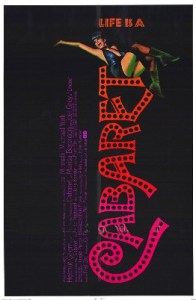
Labels give us the information we need to enact our prejudices immediately. Having been on the receiving end of great cruelty by “conservatives,” for example, I’m immediately cautious of anyone bearing that brand. A strange confession, perhaps, from someone who grew up in that camp. I struggle to remind myself that a label’s not a person. For example, I had a very good education at Grove City College, a conservative school. It wasn’t uniformly that way, of course. Now having a better sense of higher education politics I can see how this might happen—how a school committed to a doctrine might inadvertently challenge that view in the name of education. Quite a few things swayed me to broaden my view as a religion major at Grove City. One of those collegiate experiences was watching Cabaret.

Enough time has passed that I can’t recall the exact context of the film. I suspect it was a weekend entertainment required by some humanities intro course. For a kid from the sticks, seeing a ménage à trois on the big screen made a deep impression when I’d always thought of the world in binary terms. The larger message of the film was not lost on me, however, that those who are prejudiced will always find ways of expressing their hatred, if society will let them. Last night I watched Cabaret again. As a movie it hasn’t aged a day. Society, however, seems to have regressed back to those days when a Nazi could stand and proudly sing at a social gathering and others, distressed by economic hardship, would willingly  overlook the evil that lay in plain sight in the hope of change.

Back when the film was made I suspect the Vietnam War was on the public mind. We thought we’d safely gotten beyond the fascist threat. In the scene where the boarding house residents are complaining about conspiracies between “Jewish bankers and Communists” it became clear that people fall for the same tactics time and again. Rumors, fear, and economic disappointment are a dangerous combination in a democracy. The players have changed but the fact of fascism hasn’t. We can see it being enacted plainly, as it has been every day since 11/9. Accommodation is more deadly than conservatism. As the story opens Nazis aren’t welcome at the Cabaret. By the end they predominate there. Their hateful agenda had been accommodated, normalized by the press. And who can forget the song that could well be the anthem of the current administration, “Money Makes the World Go Round”? There’s an accurate label for that, I’m sure.