Before and After

Fresh from seminary with a head full of historical-critical theory competing against my immortal soul, I was lost in the Church of the Holy Sepulcher. I’d learned enough in class and in my own reading to know that the association of Jesus’ burial here only dates back to the fourth century. And also that the identification was made by a politician—Helena was the mother of Constantine—and not a archaeologist, or even a theologian (God help us!). The location was, in other words, hearsay. Three hundred years is a long time to keep track of where something happened. I sit on a bus trundling through Weehawken every day and ponder that we don’t really know where Alexander Hamilton was shot. Such are the ravages of time. I was young and, presciently didn’t know if I’d ever return to Israel, so I wanted to make sure at the time. It was holy confusion. Finally an elderly Coptic monk beaconed me into his edicule to touch the stone. He gave me a cheap rosary and asked for a donation.
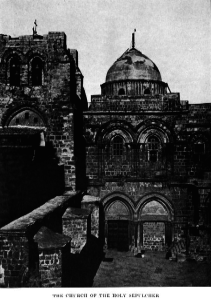
churchoftheholysepulcher1885

The scene returned to me when a friend sent me a story about the “discovery” of the actual chamber behind the build-up. The report by Fiona MacDonald in Science Alert briefly tells the background to the location and describes the hurried excavation. Still, we have no idea if, as Indiana Jones might say, “They’re digging in the wrong place.” Tradition has nevertheless hallowed the spot. For seventeen-hundred years some people have suggested this is where it all happened, and where many of the liturgical churches agree. Some Protestant groups, attuned to the Bible a bit more than tradition, have suggested The Garden Tomb is the correct location. The years ago when an academic future seemed in store, I stopped by there too, just in case. There were no crowds.

An enormous amount of effort was poured into building and maintaining the Church of the Holy Sepulcher. Crowded with tourists and various orders of clergy, I wondered how anyone might find such an experience spiritual. Territories are marked out between the various denominations seeking legitimacy in stone. Who wouldn’t want to own the spot where it actually happened? Wouldn’t that be the ultimate truth claim? So more money is being spent. More digging is taking place. Science, some believe, might come to the rescue of religion. From my experience, brief though it was, trying to make sense of the Holy Sepulcher, I have my doubts. But what do I know? I’m not even sure if Copts use rosaries.
Rule Book

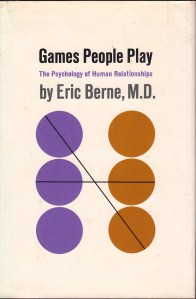
gamespeopleplayMirrors can be such deceptive things. In my head I’m a much younger man than the one I see staring at me. And I have to remind myself that other people see what the mirror sees, and not what I really am. Things age. A friend who aged so much that she’s no longer alive recommended to me years ago Games People Play, by Eric Berne. Of course I’d heard of it before—I wasn’t born yesterday. I do enjoy reading psychological books. Psychology like having a window in someone’s forehead. If you could really master it you’d understand so much of what seems a mystery to people like me. But it is an old book. When Berne casually cites the year he was writing it as the year I was born, I began to suspect that some of the data might be outdated. The guy in the mirror certainly seems to be.

We still play games, though. The hope Berne expresses in the last chapter is that we might get beyond this endless game playing to true awareness, spontaneity, and intimacy—the things psychological games are meant to mask. I also have to confess to recognizing myself at several points and then reading that games are played by disturbed people. “So that’s why I x, y, or z,” I found myself thinking. Disturbing thought. And these ideas are as old as I am. Probably older.

Reading this book from ‘60s, I noticed a strong sense of certainty that is now lacking. I can’t imagine too many psychiatrists or psychologists making quite so many declarative statements these days. I know it’s a classic in the field, and I know there are some valuable insights here, but we don’t call people “squares” any more, and a good deal of the analyses point to assumed gender roles that we now know are as much fabrications as the games themselves. I was looking for a game that my departed friend had pointed out to me. We both knew a man who was apparently picking fights because he wanted to leave his job but he couldn’t bring himself to do it. “Stamp collecting,” she called it. She may have been right, and I have to wonder if many of us really know why we do the things we do. Maybe I could use a window into my own forehead. Of course, I would need the mirror to see it. It’s a little game I play.


The Least of These

Despite criticisms to the contrary, the pre-Reformation church did have concerns about the average person. About the poor. In those days church offices commanded a good deal more esteem than they currently do among the populace, and being a priest was a position of power. The concern for the quotidian human—at least of the Christian variety—was demonstrated in All Souls’ Day. Although the date migrated around the calendar before settling on November 2, it came part of one of the very serious (days of obligation) annual celebrations along with All Saints’ Day, November 1. It was recognized that not everybody could be a saint, and all the faithful departed deserved a special day of commemoration. Through a complicated history this two-day celebration came to be associated with Celtic beliefs about the crossover day between worlds, samhain, giving birth to Halloween. It seems appropriate on All Souls’ Day to think about the poor.

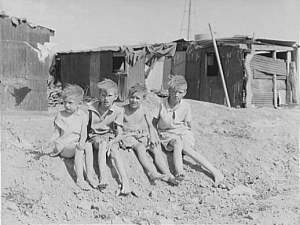
An article in the Washington Post reports on findings that poor children, in their words, “that do everything right don’t do as well as rich kids who do everything wrong.” There are indeed deficits that attend the poor all their lives. Those of us who began in such circumstances can sometimes break through in a system that favors the upper classes, but it is rare. Good paying jobs are reserved for friends of the wealthy or to those who might pay them back in some way. The poor have little to offer beyond their souls. Our system, the so-called “free market” deals in souls. The poor are, make no mistake, chattels. Even in higher education, where we’d like to think thinkers think, positions are granted based on privilege. The loftier music and liturgy is, after all, reserved for All Saints’ Day.

dorothealangemigrantworkerschildren

Like many raised in humble circumstances, I grew up hearing about the American dream. If you work hard you can succeed. But that really depends on who you know and how much they’re willing to help out. Stats are now beginning to back up what those of us who have lived experience in the lower register already knew. Having faced it throughout my career, I know I’m not alone. Just the other day I met someone else who grew up poor who’d hit the bullet-proof ceiling carefully installed by children of privilege. Not ambitious beyond desiring the basic comforts of a job that covers the bills and allows for some reasonable amount of surplus against lean times is, it seems, more than the wealthy are willing to grant. After all, All Saints’ must come before All Souls’, for even Heaven has its hierarchies.


Tis a Season

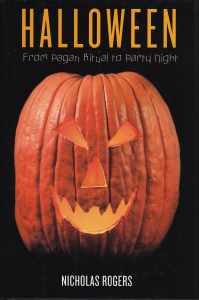
halloweenI always seem to be running late. Still, I wanted to be reading a book about Halloween on Halloween. If I might be pardoned for bleeding over into All Saints’ Day, I’ll share some thoughts this November on Nicholas Rogers’ Halloween: From Pagan Ritual to Party Night. Academic treatments of holidays, I fear, often suffer because of dispassion. Academics tend to emulate Spock in their writing, and I think that those who write about Halloween should really “get” Halloween. Oh, one can discourse about its quaint history in this ever so rational world, but one might just miss what the whole thing is about. To be fair, Rogers was writing his book during the trauma of 9/11. He wonders if Halloween may be fading. Nashotah House was suffering under an evangelical administration at that time, and the usual Halloween spirit was muted. Some fifteen years on it seems that Halloween earns yet more money and people admit that it’s hip to be scared.

Rogers gives a brief treatment of the early, but hidden, history of the holiday. The Celts weren’t much into writing about their festivals and invaders didn’t think much of their quotidian life to begin with. Trying to understand Halloween from modern times, piecing the puzzle together back over time, doesn’t really help much either. Treating the day in its British context, then in its American context, Rogers favors a thematic approach. His section on Halloween movies is interesting. Like most modern treatments of the holiday, his book makes comparison with el Dia de los Muertos, and the usual complaints of cultural imperialism. Maybe Halloween is just too much fun to pass up. It also means this post isn’t that outdated.

Nobody owns Halloween. It is taken as a serious holiday by some Wiccans, but liturgical Christians are far more intense about today, All Saints’ Day. It isn’t a national holiday and no national government decides the correct day for trick-or-treating. Perhaps prophetically Chris Christie cancelled Halloween the year of Hurricane Sandy, but did he really? Sitting in the dark for a few days with evenings lit by candles—some of them in Halloween holders—felt pretty spooky to me. Halloween may be a source of intellectual curiosity, but it is a holiday you either get or you don’t. October is its prelude, November is its aftermath. It is, as the Celts used to believe, when cold weather seriously begins to take over and light is a rapidly vanishing commodity. I may be a day late, but Halloween isn’t quite over yet.


Hallow’s Eve

img_2982

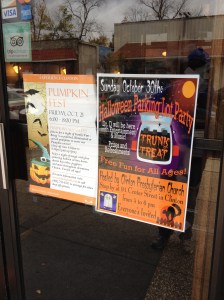
Halloween is finally here, and I’m on my way to work. Over the weekend I noticed youngsters about in costume, heading to a local business that was holding, apparently, some kind of ghostly do. For me it’s just another day—Halloween isn’t an official holiday in any government’s book. Business as usual. Still, I can’t think of Halloween without recalling Nashotah House. I began, and effectively ended, my academic career at Nashotah. Idyllically located in the woods, it was a seminary that knew how to celebrate Halloween well. We were expected—required, actually—to be in church for a good part of the next two days for All Saints’ and All Souls’ days. But Halloween night we were allowed to be afraid.

Gothic writers often used to focus on places like monasteries and churches for moody frights. Nashotah began its life as a monastery, but soon turned into a seminary. The stone buildings were old—for this country—and gothic in design. We had an on-campus cemetery with a bona fide black monk. Students reported seeing ghosts, and with such a small population of religiously devoted people the imagination grew like toadstools. One morning at around 5 a.m. the door handle to my apartment rattled loudly. I’m sure it was just someone trying to get into a forbidden chapel whose only access was through my rooms. Thunderstorms echoing through the kettle moraines that surrounded the Wisconsin campus could be impressive indeed. On Halloween the maintenance man drove a hayride through harvested corn fields and the cemetery where opportunistic ghouls would pop out to frighten the slow-moving, exposed riders.

Since those days Halloween has instead become just a day of work. No more the grandeur of All Saints’ Day being an actual holiday, holy day, followed closely by All Souls’. This is just another day except for the kids who can come around and get some candy if I’m not too tired to hand it out later. I suspect this is why I spend so much of October reading about monsters and ghosts and scary movies. I no longer have a Halloween to focus my energies. So here it is Halloween. It’s dark outside and I’ll be standing in that dark, waiting for a bus. When I climb off at the end of the day, I’ll be sharing the nighttime streets with children who are perhaps the only ones who celebrate holidays as they should be commemorated. Already a month ago I began noticing the Christmas displays in local stores. It was my first real scare this season.


Reveries of the Fall

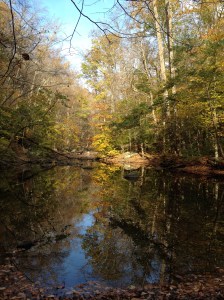
Just a quarter of an hour, studies show, of time in the woods can reduce stress. I suspect that if those fifteen minutes are spent running from a bear the opposite might result, but in general time in nature is an incredible solace. The weather hasn’t been particularly cooperative for October walks in the woods around here, but yesterday my wife and I managed to spend some time, along with many others, in Hacklebarney State Park, one of New Jersey’s gems. Living in the most densely populated state, to gather from the number of hikers we saw, encourages time in the woods. It was good to be reminded of the compelling scent of autumn leaves, the wonder of seeing their colors in the daylight when daily commutes begin and end in the dark. When work days are spent in the grayness of the city. Being out with nature, to borrow words from the Good Book, restoreth our souls.

img_2989

I suppose there’s nothing really logical about it. We’ve built civilization to protect ourselves from nature. Solid walls to keep predators out. Heat, running water, and electricity so that we can surf the internet without ever going outdoors. Permanent settlement always within reach of cell phone service and work email, we are the scions of civilization. Being unplugged just for an hour or two—even fifteen minutes—can feel like salvation. If that fifteen minutes is spent among rocks, trees, and the peculiar light that reflects off a lazy river. The internet will always wait, won’t it? Thoughts of work can be suspended until Monday, can’t they?

Hiking among the other expatriates of civilization in what used to be the Garden State contrasts so sharply with the image we project to the world. The Chris Christies and Donald Trumps who bluster that nature is there to be exploited. They may not say so with words, but lifestyles speak so much louder than syllables. Gaining wealth requires putting one’s own agenda first. We’re out here picking our way carefully over a rocky path. We have to stop frequently to let others go by the other way, or to let those faster than us pass by. But we’re all out here for the same reason. It’s a beautiful autumn day and spending it indoors feels wrong. I know that even getting online now feels like my time is being demanded by a million distractions. Unplugging, walking at a moderate pace, feeling the cool air and breathing the aroma of fall deeply into tired lungs, I can feel the stress draining away. If only for a day.


House of Unsure

DSCN0216

It’s that spooky time of year when nights have surpassed days and the chill in the air suggests an oncoming period of bleakness. Leaves are raining down off the trees and strange sounds fill the dark. So when a friend sent me an article on The Vintage News entitled “Website ‘Died in House’ can tell you how many people have died in your home & how” I had to look. At the story, I mean, not the actual website. You see, I’m not sure if I want to know too much about those who lived here before me—or died here before me. Like many people near a major city, we rent. I’ve never owned property (never had a job that paid well enough to do so) and as a renter you’re limited in what you know about your home. We’ve lived in our current situation a decade now. Of the four families in the two houses that make up the property, we’ve been here by far the longest. The house, however, has been here even longer. Has someone we’ve not met?

We live in a rational age, but we still fear ghosts. Belief in the lingering spirits of the departed goes back to the earliest written records and, we have every reason to suppose, far before that as well. We just can’t seem to shake that feeling, no matter what our rationality tells us. I didn’t go to the actual website, but Vintage News reports that it is a paid service. You want to check your address, you’re going to pay. And the results only go back to 1980. I don’t know about you, but to me it seems there’s a lot of years before that to wonder about. I mean, I was in high school in 1980 and there were lots of houses in my town that looked pretty old even then. If you’re going to pay to learn about ghosts, you want to be sure you’ve got the older periods covered as well.

I’ve lost track of the number of places I’ve lived. Some of them have been fairly old and some I have been curious about. Would I want to know if anyone had actually died there? I’m not so sure. One of the seminary houses I lived in had a spooky, neglected feel. I never saw anything that most people would characterize as a ghost, but I knew nothing of the history of the place when I moved in. It never occurred to me to ask. Now you can ask. A few keystrokes and a few dollars and you can learn if your house has “that kind” of history. The question is, with the increasing hours of darkness, and the wind whistling through the gaps around the windows, do you really want to know?


Colorful Leaves

Weekends, it seems, are incomplete without being among books. You might think that someone who works in publishing might want to get away from books in the off hours, but quite the contrary. I love a good walk in the woods in autumn. Especially if it’s followed by a trip to the local independent bookstore. It just feels right being among books. I realize that I’m in the minority by expressing such an opinion, and that the book buying (and book publishing industry) is (are) small compared to other forms of passing one’s time, but they are significant beyond their size. My wife and I have scoped out the various indie book sellers all around. When we have to take the car in for service, we drop it off, have lunch at a diner, and stroll down to the bookshop. It’s a pleasant way to spend an afternoon.

img_2984

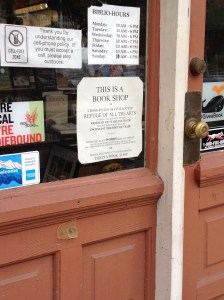
Here’s the sign on our Clinton indie. In case you can’t make it out, the legend says “This is a book shop. Cross-roads of civilization. Refuge of all the arts. Against the ravages of time. Armoury of fearless truth. Against whispering rumour. Incessant trumpet of trade. From this place words may fly abroad not to perish as digital waves but fixed in time. Not corrupted by the hurrying hand but verified in truth. Friend, you stand on sacred ground. This is a book shop.” I especially appreciate the sentiment of sacred ground. Indeed, sanctuaries of all sorts often house books. As libraries experience funding difficulties, civilizations are in the throes of collapse. Just to have books around me makes me feel secure.

Some months ago we had to have a refrigerator replaced. Our apartment has a strange, offset back door that makes getting anything of size in or out difficult. The front door is a fairly straight shot, but just beyond the entryway I had set up a bookshelf after we moved in. The appliance guys came in, jaws literally dropping. “I’ve never seen so many books in one place,” one of them said. They then complained and told me they couldn’t get the old fridge out as the landlord had said they’d be able too. “Your books are in the way,” they complained with accusatory tones. I had to unload the books from two shelves and move them while they watched. I, the lover of books, was duly chastened. I’m afraid my love affair with reading has only become more passionate since that day. The books are back on their shelves and they’ve been joined by more friends. What is a weekend without books but a wasted opportunity?


Signed, Sealed, Forgotten

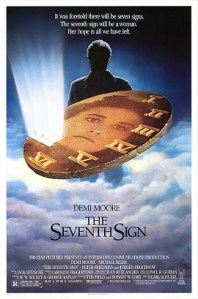
the_seventh_sign

I’m a little ashamed to admit it. With such a long list of moody horror movies out there, I gave in to watching The Seventh Sign again. 1988 was a momentous year. I had graduated from Boston University School of Theology the year before and had been functionally unemployed, as befits a future adjunct professor. I had joined the Episcopal Church, cutting off my chances of ordination in my previous United Methodist sect. I’d been accepted into doctoral programs at Oxford, St Andrews, Aberdeen, and Edinburgh but couldn’t afford any of them. I proposed to my future wife and by the end of the year had married her. In the midst of it all a friend convinced me to go see The Seventh Sign, then in theaters. A typical end of the world movie, The Seventh Sign was a “see once” movie to me, but I guess I’m weaker than I thought.

The movie got me to thinking about the end of the world. Not literally, but rather how we came to have such a strange idea. As creatures conscious of our own deaths, I suppose it’s natural that we think everything comes to an end. The mythical scenario of “the end of days,” however, is cobbled together from various pieces of the Bible, like some distorted, religious picture puzzle. The Book of Revelation doesn’t give a coherent story of the future. In seminary I learned that it was because Revelation is actually about what was happening in the Roman Empire in the first century, not about what would happen in the days when I happened to find myself conscious and eating Kraft macaroni and cheese, mixed with water instead of milk and working for Ritz Camera. I was sleeping on the floor of a friend’s apartment. That was my own kind of personal apocalypse, I guess.

The Seventh Sign is unusual in that a Jewish boy, Avi, and a lapsed Christian woman, Abby (who rents a room to the new incarnation of Jesus who lives, apparently, quite a lot like I did at the time) have to figure this out together. Tying in several other mythological motifs, the number of seals broken is, if I count correctly, only five. The world is saved by self-sacrifice, as is generally expected, and everyone ends up feeling let down. It is a downer of a movie, and not very scary for a horror film. What struck me was how many scenes I remembered so precisely. So I guess it did manage to impress me on some level, back in 1988. I selected Edinburgh University and now once again, find myself outside the institution I covet. I’m still waiting to see what happens with those two last seals.


Subterranean Homesick Blues

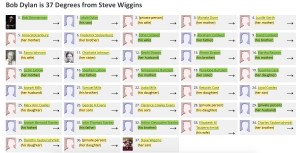
When Bob Dylan was changing American music I wasn’t really in a place to notice. I was too young, living in a small town, and the member of a church suspicious of that kind of music. We didn’t listen to the radio at home, so I only really discovered who he was when I was in college. I’d heard many of his songs by then, of course, I just didn’t know the persona. So when the news broke that Dylan had been selected for a Nobel Prize in poetry he stunned me yet again. As someone who has always wondered if he’s made any contribution at all, let alone a significant one, this seemed like one of those roads a man walks down before he’s called a man. A mensch. A person who matters. I was pleased, then, to learn that I’m only 37 degrees of separation from the great man himself.

It was probably something like this desire to be significant that led me to genealogy in the first place. My wife had done significant work on her family tree, and apart from a college project in anthropology I’d done little. While at Nashotah House I began to work on it. I managed to make some connections and take many of my lineages (pedestrian, all of them) back a ways. One of the results of this was I posted some information on WikiTree. I had intended to put much more there, but since leaving academia I also seem to have misplaced anything resembling free time. The loss of summer is the hardest to bear for a man whose very pulse is divided into semesters. In any case, I received an email from WikiTree this week with the following chart, showing how I’m attached to Bob Dylan.

screen-shot-2016-10-22-at-5-22-00-am

Now, I didn’t ask for this connection to fame. I received the email unsolicited, blowing in the wind, as it were. I’m not sure I’ll be able to handle all the hits that are sure to follow such a public revelation. Fame, I’m told, can be quite a burden. The one important thing this chart tells me, however, is that we’re all connected. I suspect there are some famous people much closer than 37 degrees from me. Melvin Purvis, “the man who shot John Dillinger” was married to one of my great aunt’s sisters or something like that. Some of my southern cousins even got to visit his gun-lined house. Fame, as it will, rests rather on the side of John Dillinger. And Bob Dylan. If we were to cast the net wide enough we’d see that we’re all related and therefore shouldn’t hate one another. I would say “we are family” but I think that might be a different artist’s song.


Silence Fright

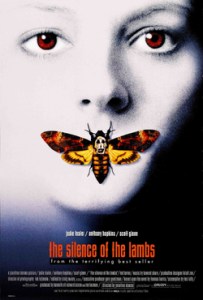
the_silence_of_the_lambs_poster

One of my first publications was a letter to the editor. The newspaper was The Scotsman, Edinburgh’s daily. We’d been hearing on the BBC that a new movie, The Silence of the Lambs, had inspired Milwaukee serial killer Jeffrey Dahmer in his gruesome habit of cannibalism. For whatever reason, the Dahmer case had a real fascination for the British. My letter, a rather young attempt to promote an important cause, suggested that such movies could be very dangerous. In the many years since then I’ve read quite a bit about horror films and their effects on people and have come to the conclusion that they don’t cause the crimes. The reasons are much more complex than simply watching a movie since most people who see them don’t “go and do likewise.” When I told friends in Edinburgh that I’d found a teaching job in Wisconsin they said “hopefully not near where that cannibal lived.” Of course Nashotah House is not far from Milwaukee.

My personal embargo of The Silence of the Lambs ran up against my current research project, which involves horror movies. Thinking it over in what I hope is a rational way, I decided that I needed to see my bête noire. Besides, while living in Wisconsin I had learned about Ed Gein, the local serial killer who’d inspired Psycho, a movie I had seen with no ill effects while in college. Movies are as much a part of life as cars and taxes and all kinds of things that impact our ways of thinking. I was surprised at how well done Silence is and the number of references it had spawned that I had missed for the past couple of decades. It won’t be my favorite film, but I’m not afraid of it any more.

The concept of relying on a criminal to catch a criminal is a classic theme, of course. And since the release of this movie some which are much worse have come across the silver screen. We play our anxieties out for all to see. Hannibal Lecter, the cultured killer, is an ambivalent character—a savior criminal. There’s a strange comfort in knowing he has the knowledge to save lives as much as he has the desire to take them. In fact, there’s an element of the divine in that. The capricious nature of a power that has the ability to give and to take is one with which religions constantly deal. Yes, The Silence of the Lambs is a scary movie. The reasons, however, lie more with implications than with imitations.


The Whole Truth

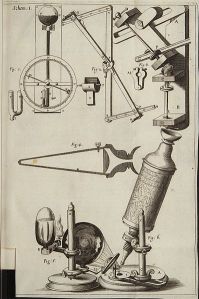
In a thoughtful piece on NPR, Adam Frank discusses “Are Scientific Truths Better Than Other Truths?(.)” He describes a Ivy League conference called to discuss this point, and although I get about as much attention as adults give Barney, I’ve been blogging about this topic for years now. If only I had an institution. Or an ivy leaf. But never mind that. The topic’s the thing, and indeed it is long overdue. Science works (at least most of the time) and so we don’t require any convincing on that point. The very title of the article, however, raises the specter of the question: are scientific truths better? There’s a lot of unpacking to do and I haven’t even left home yet. First of all, “truths.” Science provides the best explanation of phenomena that we have, given the data at the moment. Since science is, by definition, falsifiable, it doesn’t provide truths. As much as scientists must begrudgingly admit it, truths are spun out by philosophers and—God help us!—theologians. The scientists who want to give us truths should probably take philosophy 101.

microgaphia_schem_1_instruments

Then there’s that surprisingly difficult adverb “better.” Good, better, best. These are value words. Science cannot assess value. Gold is “worth” more than the lint in my pockets because humans have agreed that it is. Inherently, both substances are made of the same thing: atoms. The lint in my pocket may have more exotic elements than pure gold, but nobody’s going to pay anything for it. Value, as has been endlessly demonstrated, is in the purview of religion, ethics, and philosophy. If you have to you can add the dismal science to the mix, but even that is just a social science. No physicist can tell you if this meal is better than that. It’s a matter of perspective. If I value my beans enough, not even your pâté will tempt me.

I want to stick with this latter word “better” just a little longer. Perhaps because as an underemployed thinker I’m especially sensitive to the subject. In what sense is science “better” than humanities? Show me a scientist who’s never listened to music and I’ll show you a sad individual. When we come home from the lab we still want the creature comforts that people have devised whether through science, culture, or even religion. If you value that weekend, be sure to thank a monotheist. Science tells us no day of the week is any different than any other. In my experience there’s a world of difference between Saturday and Monday. For this inveterate and unrepentant humanities student, that’s the truth.


Twice Bitten

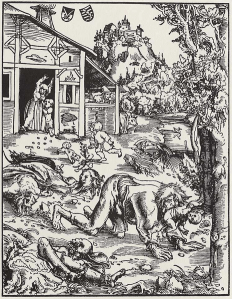
I should be aware of what happens next. I’ve seen it in movies often enough. Man gets bitten by a wolf, and he turns into a werewolf at the full moon. That gives me two days. And it wasn’t a wolf, but a pit bull. I fear what I might become. You have to understand that after a long commute—they’re doing construction along a stretch of a major artery where my route passes—and having been awake since 3:30 (a.m.) when I get off the bus I’m not always thinking clearly. I’ve done some calculating and it turns out that apart from work, commute, and sleep (or at least trying to sleep) I’m left with three and a half hours per day to do my own stuff, like write these blog posts, eat breakfast and supper, and pay bills. So when I get off the bus for my short walk home, my main concern is getting across a busy street where New Jersey drivers routinely ignore the state law that they must stop for pedestrians in a cross walk. But last night the dogs were out.

The sidewalks in my town are narrow. Nine days out of ten I meet no one on my way home. There’s one guy with a tiny dog that’s feisty and it is amusing how the little guy—just a puppy—growls and barks its tiny barks and strains to get at me. Dog owners around here pull their dogs off the sidewalk to let walkers pass. It’s a friendly town that way. Last night the young woman was no match for the two pit bulls she was walking. The street was unusually busy since two guys had just walked past me, one, commenting on the dogs, said “I don’t take my beasts out any more.” The woman pulled the dogs off the walk and they barked and snapped and as I walked past one lunged and bit me. Tore a good pair of pants. The woman they owned was aghast and offered to pay. I didn’t want her to know how cheap my clothes were. Besides, I couldn’t hear her over all the barking.

It’s been years since I’ve been bitten by a dog. This was really just a scratch and the frantic woman assured me the dogs had had their shots. But I’ve seen the movies. I know what happens next. Two nights from now I’ll be roaming the streets after dark, half human, half dog. The Hunter Moon (the official name for October’s full moon) comes on Sunday. I can’t blame the dog—it was only doing what aggressive dogs are bred to do. My commute, however, has a new hazard. Not only do we deal with construction zones, I now have to arouse myself to watch out for werewolves on the way home. It must be October.

Me, in two days.

Me, in two days.


Scary Thoughts

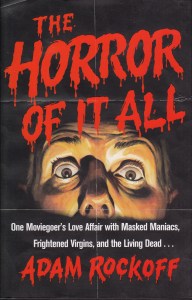
rockoffThose who know me personally—and not just through the internet—sometimes are surprised to learn that I watch horror movies. After all, I’m a pacifist, vegetarian, and a very caring person. Plus I’m squeamish and I eschew violence. Why, then, do I watch such things? I don’t have a good answer for that, but I might be a bit closer now that I’ve read Adam Rockoff’s The Horror of It All: One Moviegoer’s Love Affair with Masked Maniacs, Frightened Virgins, and the Living Dead. Now, I’ve never met Mr. Rockoff, but from reading his book I get the impression that he’s a descent human being and fun to hang out with. He’s also a family man and a sympathetic individual. The Horror of It All is an extended discussion of that troublesome question: why do some of us watch movies of this kind?

It’s pretty clear from this book that Rockoff is way ahead of me in the number of horror movies seen. I’m sure he doesn’t mention all of those he’s watched, but there are some I’ve seen that didn’t make this book and, in my own way, I hope, show that I’m no slouch when it comes to the genre. I’m not in the media like he is and those of us trying to be respectable ex-academics have to read weighty tomes to keep any street cred at all on campus. That having been said, it was fascinating to read how many of the same triggers are at work in not just Rockoff and myself, but in other horror watchers he’s known and interviewed. These films are, for the most part, not just degenerate trash. Many of them have redeeming value and an unexpected profundity. Academics and other society people don’t like to get caught watching what hoi polloi do, but just take a look at the box office take and you’ll see that horror sells. We are not alone.

Ultimately every horror viewer has to struggle with this monster him or herself. Why do we watch? While in grad school I had a sociology doctoral candidate interview me to explore just that question. Why? At the time, admittedly, I had seen only a fraction of the films that I’ve moved on to see since then. One thing I can definitively say—I’m looking for something. Life is plenty scary as it is. A world where a good job can be yanked away from you at will and the specter of a life on the streets leers, can be an intimidating place. In the horror movie you see how it could be even worse. So as my waking hours are increasingly spent in the dark, as if the sun itself is afraid, I see books like Rockoff’s as a kind of flashlight through this forest. If I run into monsters, I want to have prepared myself.


Only October

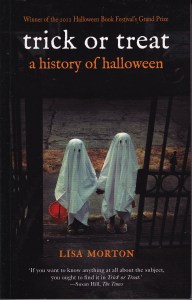
trickortreatComfort may be a strange word to describe Halloween, but it is accurate. I’m no specialist on the holiday, although I’ve read a few books on it—most recently Lisa Morton’s Trick or Treat: A History of Halloween. Growing up in what felt to me like an uncertain environment, holidays—and especially Halloween—have left me with positive impressions. Morton’s book explores this strange combination of fear and fun and suggests that many people of my generation do find comfort in its celebration. I grew up without a father in a conservatively religious home. Yet I loved the escape of putting on a mask and being someone else. Coming home with a bag of candy was a bit like that dream I still have of finding a penny on the ground and then realizing there are thousands of them just beneath the surface. There’s a security in that dream and I always find a tear in my eye when I awake from it.

Halloween is, appropriately, a chimera of holidays. It is solidly pagan. It is equally solidly Christian (specifically Catholic). Perhaps to placate those troublesome Celts, the Roman Church moved its commemoration of All Saints and All Souls to November 1 and 2, allowing for the Eve of what used to be called “All Hallows” as a holdover of Hibernian lore. Morton goes beyond the northern European fascination with the darkening of the year to explore other regions and how they mark the season. The southern hemisphere, obviously, doesn’t have the same pattern of autumn and spring, and the holiday has had less success there. The threat of the light never returning has to be real to make the fear stick. The warmest memories of my childhood seem to come from the days artificially lengthened by electric lights and the holidays they spawned: Halloween, Thanksgiving, Christmas. Comfort.

The air has begun to turn chilly around here. I’ve found myself shivering a morning or two while waiting for the bus. As I pull on my coat and step out into the pre-dawn dark, a stop sign creaks eerily on the deserted street. I’m headed to a long day in a city of stone and glass and warmth will be difficult to find. Halloween decorations get lost in the enormity of New York City and its constant quest for money. So I recall Halloweens of my small-town childhood. I tend not to go out at night, but I haven’t always been this way. When there was an unspoken comfort awaiting at home, no matter how frightening it could be at times, I would brave the dark and ask strangers for candy. Is it any wonder that Halloween still glows in a world somehow grown too cold?