Sacred Fear

Last week’s Time magazine ran a story about fear. I’m no stranger to this emotion, so long ago I decided to engage it creatively rather than run away. The article, “Monsters Inc., Inside the weird word of professional haunting,” by Lily Rothman, contains the laments of those who operate seasonal haunted houses. People are just getting too hard to scare. Some blame violence in the media and computer games, a large-scale desensitization to the suffering people might cause to others. CGI has made the most hellish nightmare realistic in the theater or on the small screen. If you can imagine it, it can be brought to life. Yesterday was Halloween, the day we’re allowed to be afraid. Of course, those who fear the influence of negative emotions on children have cute-ified the frights: bulbous air-filled creatures lit up from within billow harmlessly in front lawns, monsters of various sorts sport silly grins, and humor is liberally sprinkled in with the horror. One haunted house owner wanted patrons to walk through naked, so they could feel vulnerable. Today most people will wake up to just another day of work, while others will roll out of bed ready for All Saints’ Day and a rousing chorus of Vaughn Williams. Some of us will still be scared.
DSCN0216

Thrice I’ve had to face the highly secretive severance agreement offered by employers who know that people over forty have a difficult time rebuilding a career. I know that in this I’m not alone. If it hasn’t happened to you, here’s how it goes: you show up to work one day and begin doing whatever it is someone pays you to do. Depending on the size of the organization, either Human Resources or some level of supervisor will innocently invite you to the office. They will have solemn smiles on their faces. The door will be closed. You will be told that, for whatever reason they wish to give, your services are no longer required. In return for your silence you’ll be offered some kind of adult care package. You’ll leave shattered and stunned and willing to sign anything slipped under your nose.

The secrecy’s the thing. I’ve never revealed to anyone, under pain of prosecution, what any of those agreements said. What I have noticed, however, is the fear. The lawyer-instilled fear of bad press. Organizations want to be thought of as caring and concerned. They do not want any clandestine information released. Truth seems to be the greatest engine of fear in the corporate world. A few years back, before the Bush-whacking of the economy, I read about optimistic companies practicing “naked business.” Revealing vulnerability. I immediately admired the idea. Like walking through a haunted house in the nude, businesses could demonstrate that they have nothing to hide. But there’s real fear here. Like a ghost, truth can pass through walls. Like Godzilla, truth is indestructible. Like the invisible man, naked truth just can’t be seen.
Hungry Again

The_Hunger_film_poster
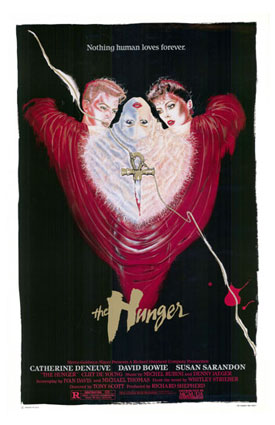
Vampires are on my mind. The funny thing is this often is the case when I’m unemployed. Feeling lost and alone, I settled down to watch the most depressing vampire movie I know, The Hunger. Miriam Blaylock, an unaging vampire, has made her way through history by taking lovers with the promise of eternal life. As she makes her lovers vampires, they survive centuries as young people, but then suddenly age and die within days. Terribly artistic (how could it not be with David Bowie as the male lead?), the film has a very heavy atmosphere and a calculating coldness as Miriam promises her lovers that they will live forever, knowing that once the aging begins, their decaying corpses will continue to live, weak, hungry, and wanting to die. I did say that it was depressing, right? The vampire, besides feeding off the essence of others, is concerned with eternal life. Religious symbols do not affect Blaylock and her ilk—in fact, they wear knives hidden within ankhs to stab their victims. The ankh, the Egyptian sign of eternal life, is the means of death. The only way to live forever is to feed off others.

Like many of those who pay attention to society, I have been fascinated by the enduring power of the vampire. When I was a child watching Dark Shadows on TV after school, I supposed vampires were things kids were interested in—the adults I knew had other things on their minds. As my generation grew, however, the vampire grew along with us. We had Interview with a Vampire, Lost Boys, Buffy the Vampire Slayer, Blade, Underworld, the Twilight series, I am Legend, Van Helsing, Priest, the Vampire Diaries, and on and on and on. Why are we so fascinated with a mythological creature? The vampire is profoundly religious and deeply symbolic. Evolution endows us all with a will to survive, the desire, if you will, of eternal life. The vampire is the symbol of that hope with no constraints. We are taught, and some of us even believe, that other people have the same rights as we do. The vampire’s urges, however, overwhelm even personal conviction and we are all potential victims.

Vampirism may be the ultimate symbol of our society. When future historians look back on the late twentieth and then the twenty-first century, won’t they see a world of profoundly deep inequality? Won’t they see multiple millions being sucked dry by the reassuring words that they are “middle class”? In The Hunger, daylight, crosses and mirrors do not dissuade the undead. Miriam needs her lovers, even though it will mean an agonizing unending end for them. Promises are made, and, when broken, the lovers are too weak to fight back. And her wealth increases with every generation. I lost my job at a very profitable company. Those who remain, on top, do not suffer fear of want. I look at Miriam Blaylock and wonder what it must be like to think that way.


At World’s End

“I am not a number, I am a free man” Number 6 plaintively cried on The Prisoner. Capitalism, however, has a way of making each of us quantifiable. A statistic. Not a guy with a kid in college. Not a human being with a sense of self worth and pride of achievement. From far above, in houses and penthouses owned by those who climb ladders made of other human beings’ hopes and dreams, those below are just means to an end. I’m sorry Number 6, you are wrong. Freedom is not free and the capital in capitalism is humanity, commodified.

It used to be that on the way to work I’d walk past the homeless in Midtown and wonder what could have brought them here. What could happen to a person to make them invisible—just a statistic waiting to die? What system could reduce a person to a number? Learning to count is, at times, a betrayal of our very humanity. It used to be that hard work was rewarded. It used to be when someone looked our way s/he saw a human being, and not a number. I’m terribly sorry, Number 6, I truly am. We don’t know your name. You are a number. So are we all.

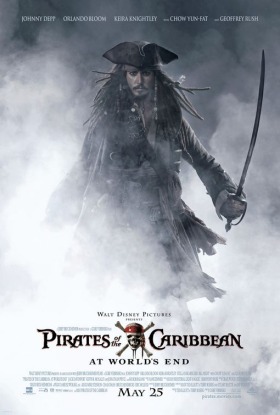
In the aptly named Pirates of the Caribbean series, the second installment complicated the story by introducing the unmoved Englishman Lord Cutler Beckett. Satisfied with nothing less than the control of the world’s oceans—some two-thirds of the planet, he secures the means to reduce all enemies to fish-food with no show of emotion beyond a shallow smile. In At World’s End, as the Flying Dutchman and the Black Pearl bombard the Endeavour, blowing the ship of unbridled capitalism to bits, Lord Beckett, bewildered, significantly climbs down the steps muttering, “It’s just good business.” Aye, but not Aye, aye. (There is a serious difference.) As the Endeavour sinks I think I hear Number 6 from the depths, and I desperately hope he’s right.

Pirates_3_AWE_Poster_International


Making Saints

Some places are inaccessible in the academic world. Or perhaps invisible. I couldn’t help but have Santa Muerte on my mind as I visited the Phoenix/Tempe area of Arizona. I knew from reading Andrew Chestnut’s Devoted to Death that the skeleton saint has a large following in that area. Having been raised in a working class religion in a blue-collar household, I also knew that such trappings might not be entirely visible around a university setting. Arizona State is a huge school and my minimal free time on the trip only permitted a wander-radius of a couple blocks from around the campus. Many universities are, because of their property-value-lowering non-profit status, on the edge of sketchy neighborhoods where work-a-day people live. It didn’t seem that way in Tempe. The areas I reached all seemed to have that adobe-solid middle-class feel to them. Not that I go looking for seedy neighborhoods when I’m traveling by myself, but I do like to see stores that aren’t part of a chain, and to get a sense of local culture. For most academics, the pedestrian devotion to Santa Muerte is below the radar.

The concept has haunted me ever since reading Chestnut’s study—why would people find appealing to death attractive? Santa Muerte has the trappings of a Catholic saint, but she is, plainly put, death personified. She is a favorite among drug lords and criminals, and that is somewhat understandable. Her Hispanic devotees, I realize, often live lives of desperate poverty. The well-heeled saints of conventional religion might not be able to see things from their perspective. Although the Catholic Church continues to make saints, many of the traditional saints predate capitalism. Capitalism creates its own insidious disenfranchisement. I realized this already as a child growing up in a setting where just about everybody I knew had it better than my family did. For some to prosper, others must suffer in such a system. I knew which end I belonged on.

As in my visits to Santa Barbara (a much more conventional saint, by the way), Austin and Houston, in Tempe the Hispanic population was evident mostly in the menial labor sector. The person who makes your hotel bed or brings the hot plate of food to you in the restaurant. The person who mops up your spills or picks up your trash. And they are the ones who’ve made it into the earning bracket of the minimum wage. Why not worship personified death? Does not Santa Muerte remind them that we all face the same rictus grin at the end of our days? Isn’t it best to be on good terms before we reach that inevitable place? It was clear that on my visit I wasn’t going to be able to get far enough from prosperity to see the skeleton saint myself. At Phoenix Sky Harbor airport, waiting for my 11:30 p.m. flight back to cloudy skies, all the shops were closed. I passed by a boutique with local art, and there I possibly glimpsed her. A small statuette, possibly just the grim reaper, among other Day of the Dead motifs. Was it inspired by Santa Muerte? I would never know, I pondered, as the Hispanic airport attendants, still at work around me, were busy emptying the garbage.

IMG_1080


Quack, Quack, Honk

HappyHappyHappy Although I’ve never hunted, there is an undeniable sense of power involved with shooting a shotgun. Maybe it’s the harsh kick against your shoulder as a clay pigeon many yards away explodes in mid-air and a trickle of gunpowder scent tickles your nostrils. It is a temptation, however, I think most people—present writer included—should avoid. I don’t own a gun and I don’t watch television. I suppose that makes me a kind of pariah in my own country, but when I heard about Phil Robertson’s book Happy, Happy, Happy: My Life and Legacy as the Duck Commander, I knew I would eventually read it. I’ve never seen Duck Dynasty, but like Phil Robertson, I grew up in a family that middle-class folks would consider poor. Even now, many decades and degrees later, I’m still playing catch-up, unable to afford a house. Worried excessively about college payments. So how did Robertson do it? How did he become a millionaire and find a publisher? According to his book the answer is simple: Jesus Christ.

Happy, Happy, Happy is an engaging memoir. While I disagree with most of what Robertson says, it’s hard not to like him. A simple, self-made man from humble circumstances. He hides his master’s degree well. Like Augustine, however, it was only after a misspent youth that he insists others don’t do the same. “God grant me chastity,” Augustine once quipped, “but not yet.” Robertson found Jesus, or the other way around, in his mid-twenties. He, not unlike many victims in recovery, gives the credit to God. His answers are simple: read the Bible, live by it, kill ducks, and everything will be fine. Interestingly enough, two of his four sons, raised on the Gospel, also went astray before seeing the light. This is not schadenfreude on my part: I have personal experience with family “on the wild side” and I would never wish it on anyone. It’s just that the law of averages isn’t so great here. For half the boys the Gospel wasn’t enough, at least at first. The darkness pushed them toward the light. Simple fixes almost never lead to viable long-term solutions.

Phil Robertson is another of those reality TV phenomena of the “plain folk” that so fascinate media types. They can’t seem to get enough. Some of us authentically paid that price below the selective eye of the media. For some of us, the answers are much more complex, if not distressing. Hard to put that up on the screen and guarantee your advertisers that people will watch. We only want complexity knocked down. Even the fun Big Bang Theory wouldn’t be nearly so popular if the smart guys didn’t get their comeuppance week after week. I am moved by Robertson’s story. His devotion to the Gospel is admirable and it is clear that it makes him happy (happy, happy). If I ever met him I would probably nod politely in agreement, although my experience has diverged from his. We would probably have to eat at separate tables, despite my good will. The fact is, he has lots of guns and I have none.


Cave In

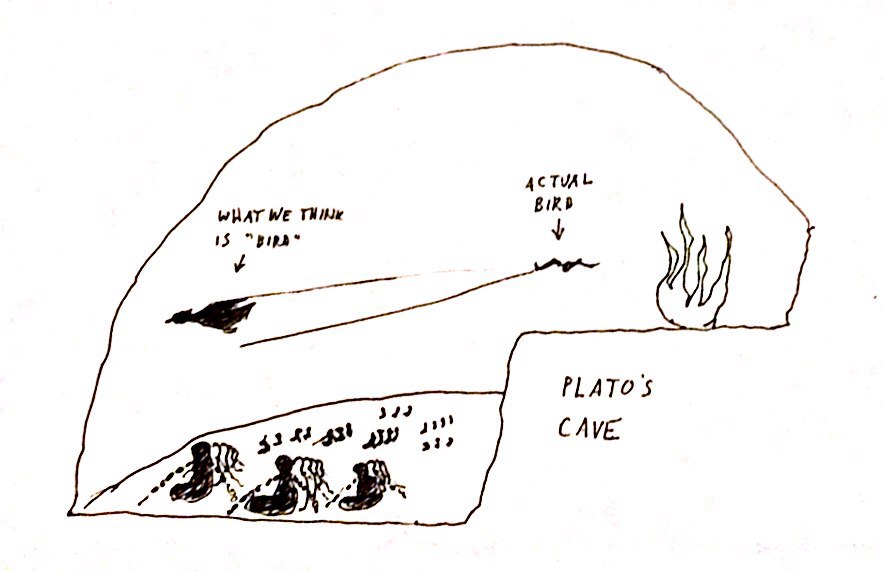
The conversation began, as conversations often do, with Plato’s allegory of the cave. The nature of reality was the topic of a chat I had with a very intelligent undergrad the other day. Plato believed in a realm of ideal forms. What we experience in life is not the actual forms themselves, but a reflection of them sufficient to alert us to what it is we encounter. Humans are sitting, as it were, in a cave. We are chained so that we face the inside wall of the cave and can’t look around. Behind us there is a fire and the ideal forms pass between the fire and people, throwing their shadows on the wall. Not having ever been outside the cave, we suppose the shadows are reality. We are, however, deceived. This led, naturally enough, to a discussion of Aristotle’s counter-argument that the “essence,” or entelechy, of things is something inherently within it. No need for an alternate realm of reality. And so, I asked, what is reality? What is truth?

PlatosCave

My young interlocutor said that reality is what we perceive. It is different for every person, and therefore there are a multitude of realities. Truth is simply the term we apply to our experience of reality. I began to feel as old as Plato. When I was young I believed, not exactly in a realm of ideal forms, but in a universe that contained abstracts. Abstract concepts objectively existed, and in a kind of neo-Platonism, we recognized them when we encountered them. Love, for instance. We may not be able to define it precisely (although materialists claim it is just a pretense to get sex), but we sure know it when we feel it. Or consciousness. What is it? No one reading this doubts, however, that it exists. And truth. I had always assumed that there was Truth with a capital T, objectively floating around out there. Perhaps, if the undergrad is right, there are multiple truths around. We chose the one that fits our experience of reality. Q.E.D.

C.Q.D.! C.Q.D.! Worldviews are in the process of changing. I tend to think the internet has democratized truth. Religions have tended to play their trump card—revelation—at this point. The unambiguous input from the divine should end all questions. But it only requires a moment’s reflection to realize that there are multiple religions and multiple revelations. Which one are we to believe? Some scientists claim there is no need for philosophy, religion, or the humanities. Objective facts, however, are interpreted subjectively. To privilege one reality above others is a kind of intellectual fascism. Perhaps my reality is different. We all sit in the same cave watching the same shadows play in front of us. We then decide what is real. Perhaps we need to get outside for a breath of fresh air. Even Plato knew, however, that that is against the rules.


More Fun than a Barrel

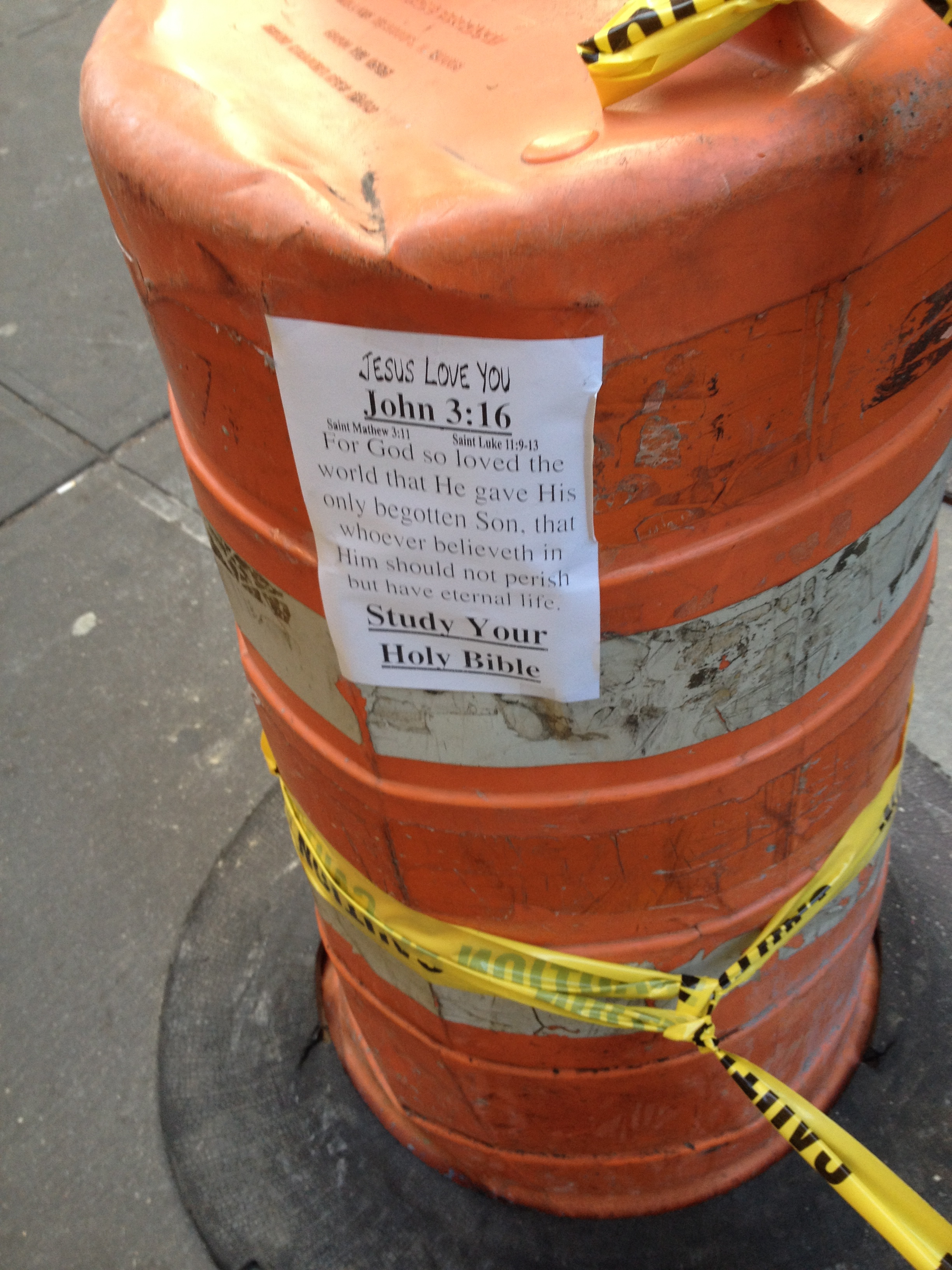
To mere mortal eyes, a traffic barrel on a Manhattan street might seem like a pretty gritty object, hardly worthy of religious veneration. Seeing leaflets advertising eternal life taped to these barrels might suggest a profound disconnect—what hath Heaven to do with traffic control?—unless one is familiar with the ardor of religious devotion. And besides, many construction sites in Midtown bear the infamous “Post No Bills” warning. When I spotted a few of these informal fliers over the past few days, however, I couldn’t help but think about religious conviction. As someone raised in an evangelical tradition, it is difficult to convey the fear in which I found myself living. Hell seemed like more of a constant threat than Heaven was ever a promise. And my young experience in a blue-collar setting had taught me that you seldom get what you hope for, no matter how hard you work for it. Somehow, no matter how good I tried to be, Hell seemed more likely than Heaven. And the Bible does suggest that if you don’t try to tell others, you’ll be held eternally responsible.

IMG_1024

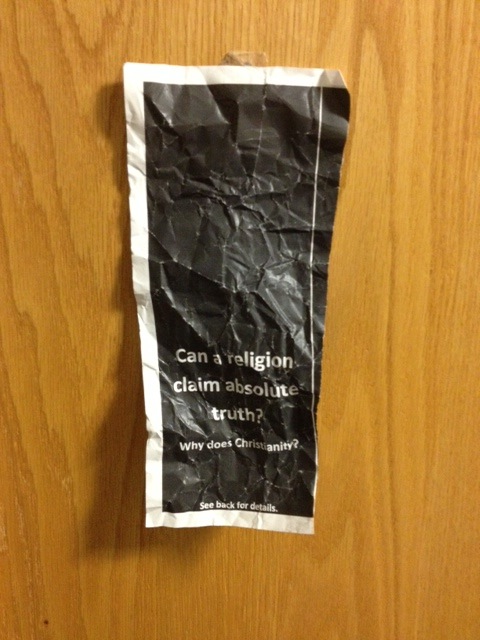
Religious conviction and fear are not far apart. I recently spoke with a Roman Catholic believer who suggested that the fear of God has been under-emphasized of late. I do suspect that it has been parodied quite a bit, but it is difficult to assess if it has truly gone underground. Perhaps among theologians it has. Like most people, I don’t read theology. For the average believer, however, fear probably plays some part in the equation that keeps her/him coming back week after week to hear the same message over and over. My daughter sent me a flier that has been appearing all over her college campus. It is a bit ambiguous, but from my own college days I recall that the young are especially vulnerable to religious coercion. Conviction is like that.

religiontruth

From my own college days I recall the earnest discussions about how far one should go to convert others. The underlying motive was always fear. Getting into Hell is so easy—we were born to it, according to some. If you just live you life as a good person, helping others and trying to improve the world, you’ll still end up there. Such is the power of eternal punishment. One of my friends, when he went to restaurants, would leave a religious tract instead of a tip for the working-class waitresses. “It’s far more valuable,” he explained, without a trace of irony. I wouldn’t be surprised to find one of those tracts taped to a dirty old traffic barrel these days. Sometimes the ardor with which we approach religion simply overlooks the more obvious implications.


Twilight Zones

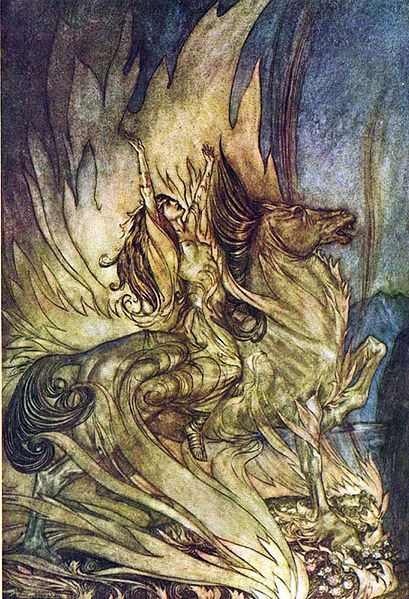
It was twilight last night when I drove into Binghamton. My thoughts naturally turned to The Twilight Zone since one of my childhood heroes, Rod Serling, had grown up here. Binghamton University was also the professional home of novelist John Gardner, of Grendel fame. Seeing the colorful leaves fading to the gray of a falling evening, I thought of how evocative a word “twilight” is. We are creatures with an in-born fear of the dark and twilight is our last hope of light before the night settles in. Maybe it was having just so recently read Grendel, but twilight and gods together brought “the twilight of the gods” to mind (it might have helped that a sudden thunderstorm broke out at the moment). When I first saw the word Götterdämmerung, in junior high school, I thought it must be a potent swear word, what with all those doubled letters and umlauts. My German teacher calmly explained that it was the fourth and final cycle of Richard Wagner’s opera, Der Ring des Nibelungen and it translated to Twilight of the Gods. It is itself a translation of the Norse word Ragnarök, with its single umlaut. Even though it wasn’t swearing, the concept sent a shiver through me anyhow.

I’ve never sat through a performance of The Ring, but I have heard the music with its famous Ride of the Valkyries. Based on Norse and Germanic mythologies, The Ring has deep roots in a pagan mythology where night plays a prominent role. Although J. R. R. Tolkien denied having been inspired by Wagner’s work (there was a certain political incorrectness to it, along about the early-to-mid-1940s), both four-part cycles draw on the Norse mythology that continues to fascinate us with movies like Thor and The Avengers. What impacted my young mind the most, however, was the very concept that the gods could be defeated. How was such a thing even possible? We were raised to believe good conquers evil. How can the gods—even pagan ones—lose? It was a world-distorting concept for someone yet to face high school.

Last night I was literally in the twilight zone. Having driven through the Endless Mountains region where autumn’s reds and yellows inspired me with just how colorful death can be (a European friend once confessed to me that driving along a wooded road in Pennsylvania his first autumn here he had to pull over and weep for the beauty), twilight was already on my mind. October fades into the twilight of the year. The mythologies of the northern races, the Norse and the Celts, seem almost obsessed with the ominous, growing darkness. There is a beauty to it, but also an abiding fear. Are the gods powerful enough? It was a question first raised when my eye fell on that striking word Götterdämmerung that somehow became a part of me.

409px-Ring63


What’s a Sukkot?

It’s not every day you see a lulav and etrog, even in Manhattan. You can tell life’s too busy when you miss that it’s sukkot. Not that I’m Jewish, but I have been invited to sukkot a time or two by a friend, and it was always a fun, relaxed occasion. A festive little booth in the back yard, sweet wine and cookies. Running the rat race in New York City it is sometimes easy to forget. On my hurried footrace to some place or another, I noticed a group of Orthodox Jews standing along East 42nd Street with lulav and etrogs in hand. So distracted was I that I only vaguely wondered, “why are they holding those at this time of year?” Several blocks later, entering the Port Authority Bus Terminal I saw a man just standing as the crowds parted around him like the Red Sea. In his hands lulav and etrog. Finally it dawned on me: sukkot. It is fall, the time of year when I used to be able to enjoy the bounty of nature and the good-natured holidays. A time before when.

800px-EtrogC

The Hebrew Bible prescribes a set of three pilgrimage holidays: sukkot, shavuot (pentecost to the Greek, or Christian), and passover. Of the three, all associated with the exodus from Egypt in some traditional way, sukkot is the most lighthearted. The command to live in booths is said to be a reminder of the dwelling in tents during the wilderness wandering. Anthropologically speaking, it probably goes back to an ancient tradition of living in huts during the harvest when you don’t always have time to go home and tuck yourself comfortably in every night. Combines hadn’t been invented, and harvesters had to work long hours to ensure that the crop was gathered in. Eventually it became a celebratory occasion. Nice of Moses to allow a bit of festivity here.

Back while at a certain seminary in Wisconsin, a local Jewish friend used to invite my Hebrew Bible class to sukkot. Numbers were small, and invariably wary—were they going to be proselytized by the other? No, but they were invited to shake the lulav and etrog, sip a little wine, and chat about Leonard Cohen. A bit of a cultural exchange in the midst of prolonged indoctrination. I often wonder if my friend continued the tradition after I was asked to leave. The Christian school never made any reciprocal invitations, of course. Ecumenism is often a one-way street. So I stopped a moment at smiled at the stranger in the bus station, solemnly holding lulav and etrog aloft. Life is a bit too busy when we can’t even take a moment to consider all the things we take for granted every day.


Civil Lies a Ton

Often I began my classes by asking a basic question: if something pervasive, invisible, and very powerful were affecting you daily, in all aspects of your life, would you want to know about it? I don’t recall too many sleepy shoulders shrugging. We want to know what it is that is impacting us on a daily basis. Of course, I meant religion. Our secular society has a peek-a-boo affinity with religion; if we close our collective eyes, it will go away. Time and history have long put the lie to this idea—religion is a deep and pervasive force in society, and it is not about to go away. In our one-size-fits-all culture, however, we like to think that the bottom-line of greed and personal promotion will satisfy everyone. Statistics, however, seem to indicate otherwise. Not just America, but the world is a pretty religious place. I have always wondered at the strange elitism that considers itself above the influence of hoi polloi (in the literal sense). “If I’m not religious,” so the reasoning goes, “then no sensible person can be.” And we ignore religions until they explode and then go on ignoring them some more.

Although my career hasn’t turned out the way I’d hoped—I am an academic through and through—I still believe in the conviction that got me started down this rough and tangled trail. Religion is important. It is important to understand because it is very much a part of what it means to be human. Even those who are not religious have had to switch off an instinct that every child feels during a thunderstorm, and every adult feels at a time of deep, existential crisis. We may not believe, and yet we believe we believe. Religion is part of us. If we ignore it, we become strangers to ourselves.

I often look at our insipid culture. Sure, the internet provides hours of entertainment, and even some bits and pieces of knowledge. We have, however, consistently devalued those things that make us civilized. Art, music, literature, and yes, religion, all played a part in the very founding of what we consider civilized existence. Prior to that we were hunter-gatherers, roaming after the necessities of daily life. While our institutions of learning struggle to make entrepreneurs believe they still have value, we train our children to hunt and gather. It may not be food, but it is something not so different from food. Only money truly satisfies. If there were another way of being in the world, it might imply—why, it might imply that there is something more to be gained from life. And since that idea is a religious one, it is safest to ignore it and pray it will go away.

IMG_0558


Com-Passion

I suppose it is always premature to hope that ancient institutions are likely to improve. Like many other followers of developments in religion, I was pleasantly amazed to read reports of Pope Francis declaring that, in my vernacular, that the church should not be so stuck in the rut of doctrinal abstemiousness that it forget mercy and charity. How sad to see that hours later he was forced, Galileo-like, to recant somewhat. The forces at work are far more powerful than the vicar of Christ. In some minds religion is doctrine. I know whereof I speak. For several years of my professional life I worked for a doctrinaire institution where any hint of mercy was considered a kind of Protestant mewling before a God who would’ve made even Jonathan Edwards tremble. Although officially released “without cause,” I can’t help but think that my own pastoral sensitivities were at fault. I don’t believe that religions thriving on condemnation deserve the title.

Ironically, I was at Notre Dame University when headlines about the Pope’s declaration that the church should not obsess about homosexuality and abortion appeared in the papers. It was with a kind of wonder that I heard an academic say, “the Pope is sounding more Lutheran all the time.” I’m not naive enough to suppose that the pontiff is suggesting a change in doctrine—there are rocks so heavy that the Almighty himself can’t lift them—but that the leader of the world’s largest church was suggesting mercy and compassion outweigh legality felt as if Amos or Micah had just walked into the Vatican. The next day the Pope had to come out and strongly condemn abortion. Politics, it seems, will always trump human understanding.

IMG_0996

We live in an era of iron-willed religions. The human element often vanishes beneath a frowning providence that wishes for clocks to be turned back decades, if not centuries. These religions have no place for improving the human lot in this sinful world—it is much easier to condemn than to contemplate compassion. Religion is hard, for people find forgiveness a difficult doctrine to accept. Jonathan Edwards dangled his spider over the eternal fires of hell, but ecclesiastics today suggest that swift shears taken to that silken web would solve all the problems. Time for change? Not in this century. Religions, too, evolve. But evolution doesn’t equal improvement. Many an agnostic has become so because of the reality of “nature red in tooth and claw.”


A Certain Man Went Down

Among the progeny claimed by Wabash College is Dan Simmons. I’ve read a couple of Simmons’ ghost novels, although in reverse order. I read A Winter Haunting, which I quite liked, and followed it up with Summer of Night. Having lived in the Midwest many years, it was easy to visualize the scenes. Then came the time for my trip to Crawfordsville, Indiana. I started the day in South Bend, finishing up my meetings at Notre Dame. I’d noted on the map that, as is often the case, the places I need to get to just aren’t connected by anything resembling a direct route. Although the forecast said “30 percent chance of rain,” I’d awoken at 4 a.m. to a thunderstorm and it had been pouring all morning long. I could swear they were making plans to convert the great Notre Dame stadium into an ark. Perhaps I’d forgotten just how persistent Midwestern storms can be. Soaked, I crawled into my rental car to tool down to Crawfordsville. At least the rain had finally stopped.

On one of those highways in the middle of corn fields as far as the driver’s eye dares look, the low tire pressure light came on. I dutifully pulled over and called Hertz. The suggestion was to find a gas station and put some air in the offending tire. Someone could be there in three hours. Looking about me at the amber waves, I thought of the spirits of Dan Simmons’ stories. A car breaking down in the heartland. No one around to offer assistance. The illusion allusion was shattered when a stranger pulled over and asked me if I needed help. I recall a priest friend once tearfully confessing to me that he had, on a rainy night, refused to stop to help someone with a flat because of fear for his safety. I understood completely—it can be a scary world out there. “And likewise a Levite, when he was at the place, came and looked on him, and passed by on the other side.”

With multiple stops to put air into my slowly leaking tire, I limped my way from town to town, reaching my destination after dark. Along the way a fierce rainbow appeared to the east as the sun began to set. Once you’ve abandoned the interstate in Indiana, there’s no going back. I began to notice just how many churches dotted each little village through which I drove. Samaritans, I thought. As I write this in Crawfordsville, I think of the corn, sorghum, and soybean fields that inspired Dan Simmon’s ghosts. I think of a stranger, a woman of minority demographics, stopping to see if I needed help along a lonely highway. She was among those our society would deem vulnerable, and yet she was the only one who stopped. And I think of parables. “But he, willing to justify himself, said unto Jesus, And who is my neighbour?”

IMG_0988


Just Binghamton

I seem to find myself in Binghamton again. The town, while clearly economically depressed, still retains a bit of its 19th-Century charm with some beautifully restored downtown buildings and a sense of history. While too many store-fronts are still vacant and too little money exists to improve the area sufficiently, I happened upon a warm and cheerful independent bookstore—River Read—and that always gives me hope in such circumstances. Bookstores such as this are like seeing the first crocuses after a long, harsh winter. There is some life in this seemingly dead planet yet. Outside the bookstore stands a statue of Martin Luther King, Jr., backed by a sluggish river and yet more vacant windows. I think of justice and all that it means.

IMG_0969

My own hometown (not Binghamton) is virtually a ghost town. It is a feeling difficult to describe, visiting a place that served as your first secure setting in the world only to find it crumbling under an economy with so much wealth with so little reach. Where is the justice in that? Binghamton, near the founding location of IBM, ironically began suffering at the decline of the Cold War. Manufacturing has gone for pastures of a different kind of green, leaving a sometimes sad and forlorn city in its wake. Binghamton sheltered a young Rod Serling, a man who would give the world the Twilight Zone and its endless spinoffs. It is home to a first-rate university. And a wonderful bookstore.

While in River Read we heard some locals talking, in almost Springsteenian fashion, of local civic traditions that had disappeared. Times have changed. Cities like Binghamton don’t draw in the curious or those with liberal purse-strings. Endicott Johnson, the shoe manufacturer, developed a strong sense of welfare capitalism in the city last century—capitalism with a heart seems to have gone extinct these days. The idea that those with the means to create jobs and livelihoods should care for their employees would seem to be a matter of common sense. Instead, common cents have come to rule. Binghamton University is investing in the town, and a sense of cautious optimism dares to suggest itself. Justice is a matter of distribution rather than entitlement. And that’s why I’m standing out here under gray September skies, staring at the statue of Martin Luther King, Jr.


Arduino Anything?

Before my daughter enrolled in college I’d never heard of an Arduino. Since her high school robotics team leadership has now passed into more able hands, I figured that I’d go back to my naive days of not thinking about automated mechanical devices, devoting my gray matter to grayer matters. Still, over the past several weeks robots keep seeking me out. A spread in Delta’s in-flight magazine for July featured robots, as did an alumni magazine for August. Now the issue of Time for September has a story about robots. When my daughter sent me the Arduino video, by TED, I knew I’d better try to pay attention. Technology will change us, whether we want it to or not. It seems that from the first knapping of flint our destiny was set to manipulating our world and making it into something we create. Robots make us gods.

Arduino_Uno_-_R3

The real issue, however, in the TED video is that Arduino is open-source. Open-source means that the designs, instructions, and application of the device are voluntarily not held under copyright. Academics throughout the world are increasingly favoring open-source material—not just software and hardware, but the knowledge behind them. In my work at a for-profit (i.e. “commercial”) publisher, I know that open-source is a huge concern. It used to be that open-source, that is, free—information, was considered inferior. Like the early stages of recycled grocery bags. Arduino puts the lie to that supposition. An international team has made a device that is extremely flexible in application, and is giving it away. Many academic journals, traditional cash cows for the publishing industry, are now going open-source. Those of us who research and write don’t often do it for money—we just want our ideas shared. Commercial interests, however, are heavily vested in turning a profit from information. It is a clash of worldviews.

Never one of the great capitalists, I find open-source an intriguing concept. The problem is that those who think need to find a way to make a living in a society over-awed by spending. Universities charge tuition because professors have to be paid. Publishers charge a week’s wages for textbooks because editors have to be paid. Knowledge—the most valuable commodity people possess—fits uneasily with entrepreneurial ideals. This blog is open-source. Maybe that is why it has never garnered much attention, like a first-generation recycled paper bag. These same ideas, however, when presented in the context of university classrooms were subject to fees of thousands of dollars. Registration filled up every semester. The source is the same, a guy with a Ph.D. from a major research university making observations about how religion impacts each and every one of us, often in unexpected ways. Some things you can’t even give away. Well, if trends continue I shouldn’t be surprised if someday even this is taken over by a robot. Right, Mr. Čapek?


Instant Education

Among the “non-essentials” upon which I spend my earnings, books hold the top spot, if not in value, certainly in quantity. Reading is more than a pass-time—it is perhaps the most basic aspect of who I am. I love books. While reading a New Jersey Star-Ledger piece by Allan Hoffman entitled “Learning by the book,” however, an uncomfortable truth dawned on me. Hoffman gently laments that the search for information has gone almost wholly electronic. As a person who currently works in the book industry, I know he’s right. More than that, I know it from my own life. I can’t remember the last time I opened a phone book, other than to retrieve a pressed leaf I’d inserted between its pages for pressing. If some bit of information about a religion or a biblical passage escapes my distracted brain, a few keystrokes work better than shuffling to the shelf, pulling off the reference books, and thumbing through until I find the datum. No, we are all addicted to speed.

Despite the best effort of Google books, much material necessary for research in many subjects remains sequestered in actual books. The problem is, for contemporary knowledge, book production is slow. In my editorial work, and as an erstwhile author, I know that the five years I spend researching and writing a book, the submission time to a publisher, the eventual decision, and then the year or longer production time, all equate to immediate obsolescence. Any non-fiction book is outdated by the internet even before it is shipped from the warehouse. New truths are born at the speed of light while books take years to make. I agree, Mr. Hoffman, we’ve lost something in our idolatry of the instant knowledge. If you need urgent info (What do I do about a snake bite? Where is the nearest Starbucks?) the internet is your up-to-date databank.

I have long known that the study of religions is often the study of texts (most of which are online now). Believing some ancients knew more about the ultimate realities of life than we do, either by dint of divinity or enlightenment, we search the texts about them or by them in hopes of joining them in a knowledge beyond knowing. Now in the age of the internet, new messiahs arise almost daily, proclaiming their truths across the world-wide web of wisdom. I have a feeling there is a dissertation or two in there. Of course, it will take a few years before you’ll see them in print.

IMG_0966