It’s All Gonna

When I first got married, I was distressed to learn that my wife was an organ donor. Still fresh from seminary, I had yet to outgrown the theological willies concerning earthly remains. Then she told me that she would prefer cremation to burial. My existential angst spiked. Scripture indicates a bodily resurrection, so what about those who are cremated? Obviously I hadn’t thought through the implications seriously. Even for those who are biblical literalists, all kinds of things have happened to Judeo-Christian bodies over the millennia. People have been eaten by wild beasts, fallen off boats, and been cremated without the benefit of being dead first. If the movies I’d watched growing up were to be believed, some might have even fallen into huge vats of acid like they have sitting around laboratories all over the mad scientist world. This week’s Time magazine has demonstrated, however, that my early angst was not a singular one.

In a story about the rise in popularity of cremation Josh Sanburn (with an ironically appropriate surname) addresses the religious objections head on. The reason America has been slow to adopt cremation has been largely religious. Apparently the factor that has turned up the heat on this motivation is financial. Let’s face it: money talks. Cremation costs much less than standard burial, and as much as I like a moody, whimsical cemetery, it just makes better sense. If you can get over the religious objections.

Resurrection has a powerful draw. Movies just wouldn’t be the same without it, whether it is a horror villain whose body disappears to come back in a sequel, or ET rising from his tomb to tell us all to be good. We want to keep it going forever. Life, that is. Funnily enough, resurrection is a miracle. A God who can raise the dead can surely reconstitute the parts, no matter how scattered or charred. Anyone who’s actually looked at a decayed body knows that bringing that thing to life would take a miracle, especially if other newly resurrected bodies want to hang out in the same room with it. As my critical faculties began to grow, I lost my fear of cremation. Maybe even having your ashes mixed with those of your spouse would be a very fitting symbol. Chances are, you won’t have much to say about it in any case. When I went back to the DMV to renew my license, after my wife talked some sense into me, I came out with an orange organ donor sticker affixed to the back. Perhaps life will go on, after all.


DSCN3300


Time in a Bottle

Portmann On of the intangible tangibles of my humble job is seeing a book move from an idea to a published product.  A little bit of joy rained down on my day yesterday as my first Routledge book appeared.  It also helped that this is an important book and no matter what the reader feels about the conclusions, it will be crucial in getting the question out in the open.  John Portmann’s The Ethics of Sex and Alzheimer’s places a face squarely on an issue that will only increase as time without a cure for Alzheimer’s grows.  As a culture, we don’t like to acknowledge aging.  We know it’s happening constantly, but we somehow think if we avoid it long enough, it might somehow, miraculously, disappear.  Portmann, an ethicist and religious studies scholar at the University of Virginia, puts the question boldly: what happens to marriage when one of the partners no longer recognizes the other?  This is a thorny issue.  And that’s an understatement.  We are conditioned to assume that wedding vows, with their origins in an era before people lived long enough for Alzheimer’s to become a plague, must still apply.  Portmann isn’t so sure.

I won’t spoil the book for you by giving away the conclusions of his carefully argued case, but I would like to consider for a moment the importance of ethics.  The religion in which I was reared knew little in the way of uncertainty about right and wrong.  Gray areas were scarce, and often diabolical.  I’ll never forget when I took my first ethics course as a religion major.  It was if someone had thrown open a door to a sunny Arctic day while I was seated in a warm, dark den.  It was blinding.  And disorienting.  I hadn’t thought of issues in that way before.  Simple answers wilted and died by the thousands.  Figuring things out, ethically, was costly and required an awful lot of mental energy.  No matter which answer I chose, there was a good case for an alternative choice to be made.  Morality is seldom black and white.  That’s why when Dr. Portmann pitched me his book, he had my attention from page one.

Ethics is the process of trying to figure out the best way to decide on the right course of action, given any alternative.  Little ethical issues crop up constantly: should I pretend I didn’t see that homeless person stealing an apple?  Should I tell that person who got the job that I wanted when he’s got a mustard splotch on his beard he can’t see?  Should I hold the elevator for that woman down the hall when I really want to get to work a few seconds early today?  Issues-issues everywhere!  Alzheimer’s forces the issues.  We know it is right and good to continue to care for the sufferer.  It’s no sin to forget who you are or when you are.  But what of the partner who’s not ill?  Immediately our moral sensibilities kick in.  And with a population rapidly aging (I know I’m doing my part in that department) the question will likely continue to press on our collective consciences.  Ethics reaches its fingers into those dark spaces we’d rather not put our hands.  There might be spiders in there, or bugs.  It might be something far worse.  Not everyone will agree with Portmann’s answers, but I think we can all agree that he has raised a very necessary, if prickly question.


Lower Education

Many people have asked me, as a former professor, why universities are so expensive. Ironically, many of these people are in flourishing businesses where the story ought to be as tired as the excuse that’s usually trotted out: faculty are paid too much, mismanagement, etc., etc. The truth is much more insidious and it begins with governments and corporate executives who can’t handle the sharp sting of criticism. I have experienced this firsthand, and unlike many academics, I have an authentic blue-collar background so that my perspective is unclouded by generations of privilege. I recently found this post on The Homeless Adjunct, and I was glad that someone is actually willing to write the truth. The high cost of higher education is because a subtle series of changes—often deliberate—that have been instituted since the 1970s to change colleges and universities into engines to power capitalistic ventures rather than to educate potential critics. Those who have a hard time accepting conspiracy theories may be disturbed by how well documented this development is.

I realize that I am a mere proverbial voice crying out in an even more proverbial wilderness. The fact is, this change in higher education, implemented since the era of protest that was the 1960s, goes on without the knowledge of by far the majority of university faculty. They still tell their promising students to continue on to graduate school, that the bottleneck that has been holding up new, or even replacement, jobs is bound to burst. Things will get better. Not. As the Homeless Adjunct points out, corporate interests now run the universities, sucking up their prestige like bloated vampires, while endorsing their own manipulative interests. How can “educated” people believe global warming is a myth? Get corporations who “oppose” global warming to fund science programs and see what happens. The truth becomes quite malleable when lucre is involved.

Even more chilling, as our brave adjunct reveals, this model has begun to filter into high school, and down to Kindergarten. The way that educational decisions are made is based only, always, and ever on the bottom line. Not for our children, but for corporations that decide what our children can, and more importantly, can’t do. Their future is being undermined.

catalog

As a former adjunct who went blindly through the system, ending up with a doctorate from a major European research institution only to fall afoul of a thickly entrepreneurial administration, the clouds were wiped clean out of my eyes. I believe in higher education. And I believe that those of us with any moral sense are obligated to take it back. We will likely be destroyed in the process, since money is the only value our society recognizes, but if we want a world where our children can thrive, education must be true education.


Whatever Happened to Whimsy?

American Gothic is one of my favorite paintings. I’ve never seen the original, and I know of no other paintings that Grant Wood produced, although I’m sure there are some. The mood in what has been called “the most famous American painting” is unsettled. There’s something not quite right here. When one of my authors wanted to use the image on a book cover, it led to quite a bit of serious discussion. I was a bit surprised by the negative impressions—not of the painting, but of its use on a serious academic book. The discussion seemed to turn on money rather than on wit and whimsy. I confess to being a dreamer, and I admit that the aspects of life that truly inspire me are never financial. When I crave wealth it is so that I might free up some time for creativity. That’s not the way business works.

Sometimes I feel a stranger in my own country. The unquestioned triumph of unbridled capitalism means that you can go from city to city to city and not really be able to tell much of a difference. If you want to buy a bit of tubing or a piece of wood, it’s Home Depot or Lowe’s for you. Office supplies—Office Max or Staples are your only choices. If you want to buy intelligent books, well, you’re just plumb out of luck unless you go to Amazon. The big financial corporations have won. Just admit it. Every time I visit my hometown I come away depressed at all the vacant stores and lost hopes of the small businesses that offered something just a little different. Something to tickle my fancy. Something to tempt me to wonder. Something with a tinge of American Gothic.

AmGoth

The messages we receive from every angle echo Madonna’s hit song, “Material Girl.” Only this includes all genders. Reductionistic materialism tells us that we’re just proteins walking. Mind is an illusion. Soul is a myth. I work a job where the money I’m paid is transferred electronically and if I want to see some of it in paper form I face a robotic ATM rather than a human face. I went to the mall last night and wept. Call it a mid-life crisis if you will. Say nostalgia has no place in a forward-looking society. I just want a few more options besides the plastic, the smart-chipped, and the sterile. The world needs more whimsy. Maybe that’s why I insisted on American Gothic on the cover of the first book I put under contract.


Scholar Universe

One of the resources that editors use to find scholars of obscure fields of study is a website called Scholar Universe. Now, before you all rush to the site and crash the system, I should warn you that you’ll need to purchase an account and get a password to use it. Frankly, for our society it really isn’t worth the effort or expense for most people. The information on Scholar Universe is often outdated, and not always accurate. Once, when searching for who’s who in classical mythology, I was surprised to find my own name. I did teach classical mythology at Montclair State University for three semesters, but my longer and more complete career of teaching biblical studies was nowhere to be found. How quickly our contributions, meager though they be, disappear. In any case, when a contact breaks down, the website lists the position of a scholar as “Last Known.” More than once I’ve searched for a more updated record to find “Last Known” as a circumlocution for “deceased.” There are a few things I think I’d like to ask some dead religion professors.

I recently came across a couple of academics who had, in separate instances, been murdered. One, rather gruesomely, attacked with a hammer as he walked home from the train. We tend to think that education will somehow protect us from the vicissitudes of a world caught up in its own madness. Some of us came to this profession grasping for some sort of immortality. Higher education, while based on great ideals, is nevertheless just as susceptible to taint as any human enterprise. I have been watching as higher education has followed after the role model of business for the past few decades. There was a time when learning was thought to be worth the investment, no matter what the cost. Now a pleasant deception will do, thank you, as long as there’s cash in it.

The history of higher education has been, from the beginning, tied up with religion. The earliest universities coalesced around theological faculties, while others studied law. The two are never far apart. Even in the “New World” our early universities were formed, initially, in the service of the church. Harvard, Yale, Princeton, William and Mary, and many other colleges and universities were founded with the ideal of theological education firmly in mind. Concerns for the affairs of the world, however, inevitably came to preoccupy higher education. Secular schools have little time to study real world phenomena such as religion and spirituality. Unfortunately, those are the areas, our news sources often inform us, that would benefit the most from a bit of sensible learning. But not as long as there is money to be made elsewhere.

IMG_0684


Oklahoma

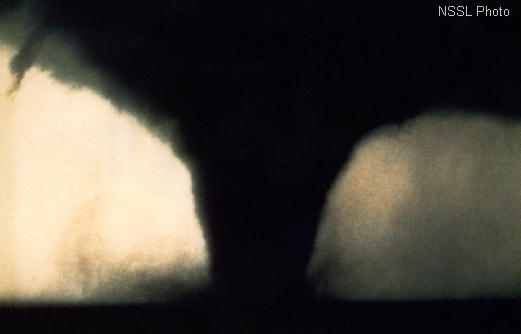
The tragedy outside Oklahoma City transcends petty human differences. Tornadoes, no matter how we dress them up, look like the wrath of God incarnate. The fifteen years I spent in the Midwest were filled with literal nightmares of tornadoes and even a few hours spent cowering in the basement. Such phenomena remind us that we are quite small in the face of nature, and the news reports are full of religious sentiment as people want assurance that God hasn’t abandoned them. Nature doesn’t favor humans over anything else that happens to be in the way of whirling 200 mile-per-hour winds. Even one’s belief might get blown away. Yet it doesn’t.

Although a tornado hit New York City last year, my terror of the storm evaporated when we moved back east. In the Midwest, although there were hills, I felt so exposed under the open expanse of the heavens. In the utterly flat part of central Illinois, I recall some truly awe-inspiring storms. The sky was so ubiquitous and overpowering, and you could see clouds towering thousands of feet over your head, throbbing with constant lightning. It was then I began having the idea for my book on weather terminology and the book of Psalms. Humans helpless in the face of nature. This is the raw material of religion. Like children we pray to God to make it go away. Storms do not obey prayers.

TornadoBlack

By their very nature tornadoes are capricious. We like to believe the good are spared and the evil punished, but as schools are destroyed and children killed we have to face the cruelty of nature. What happened in Oklahoma was a random act of nature, as much as hurricanes Andrew, Katrina, and Sandy were. We can’t help, however, any more than the people of the Bible, supposing that God must somehow be behind the weather. We may influence it, as global warming has repeatedly demonstrated, but seldom for good. And when we look for the divine in the fierce winds, we will end up facing tragedy.


Heaven Forbid

Cars can be a nuisance—they consume resources, pollute the environment, and have a habit of being very expensive to repair. We’ve been pretty good about taking our car in for its regularly scheduled Toyota check-up. Since the garage is several miles away and my wife and I both work, it is often a matter of the one who can most easily work from home the day of the car doctor appointment taking it in. Our Toyota dealer has in-store wifi for those who can’t live without the internet. For some of us, work is almost exclusively internet. So it was that I drew the short straw and dutifully drove out to the dealership. I was pleased that my VPN connected so easily; this was going to be a snap. I was working happily away when I had to find somebody on a university website. I googled the name and clicked. I received a forbidden website message (copied below) explaining tersely: “Block reason: Forbidden Category ‘Religion’.” I tried again on the Society of Biblical Literature website—same message.

ForbiddenReligion copy

Now I can understand workplaces blocking pornography sites, and even Facebook (I found the latter to be blocked at Toyota some time ago, but I’ve never tried the former), but religion? I am a religion editor. How am I to work when I can’t access websites that contain the word “religion”? The more I pondered this—I could still check my email, and do VPN-type work with files from the office—the more it bothered me. On the television in the background inane daytime talkshow hosts were interviewing someone who’d written a book about God. How many more businesses out there are biased against internet religion? That means my blog is blacklisted along with the scantily clad and overly chatty. I fully support the disestablishment clause, but I also subscribe to the freedom of religion. Smirks aside, there is a serious undertone to all of this.

I have no desire to be proselytized at work. I also agree that it is the right of others to expect the same. Sometimes, however, a little religion might help work go down like a poppinian spoonful of sugar. One time when I worked for Ritz Camera in Brookline, Massachusetts (I seem to have a knack for working for businesses that are on the way out), I had a tough day. Some of our customers could be quite abrasive, and since the customer is always right, we had to take personal insults with a smile. One lunch-hour I told my manager that I needed to recoup my moxy (I didn’t use those words). I ducked out the door and stomped to the first church I could find and asked if I could just sit in the pew for a few minutes. The church secretary, a complete stranger to me, said “of course.” Ten minutes later I returned to work collected and able to face more unreasonable customers for the rest of the afternoon. Maybe it wasn’t religion, maybe it was only the calm of sitting in what some believed to be a sacred space, but my capitalist company got better performance out of me that day because of it. Ironically, at Toyota, my religion editing is cast in with the tax collectors and prostitutes. Only the tax collectors, I’m pretty certain, are always permitted to work.


Is Golden

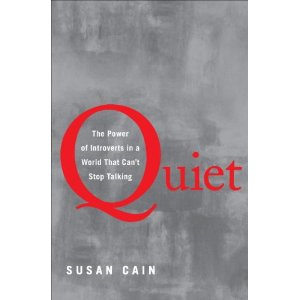
quiet When I grew up I sometimes thought I’d join a monastery. It’s a funny idea since I’m not Catholic and I am happily married. I think what appealed to me most about the idea was the quiet. We don’t choose jobs any more than we choose our own names. My first “real job” was teaching at Nashotah House, a seminary founded on the principles of a monastery—once all male, meals eaten together, and lots and lots of quiet. Many parts of life on campus drove me crazy, but I liked the silence. Yes, I am an introvert. Anyone who knows me knows that. Until I read Susan Cain’s book Quiet: The Power of Introverts in a World That Can’t Stop Talking, I had figured there was just something wrong with me. I put the book down feeling strangely ebullient, as if I’d just read my own biography and it turned out happy. Here was someone finally speaking up for the quiet among us. The world wasn’t quite so lonely any more.

My only fear about Quiet is that not enough people will read it. Here I learned that a large part of the population, although still a minority by a considerable margin, is introverted. The label is often used like a swear word. How many times have I been told at work that I must assert myself more, make more noise? How many times have I been made to feel shame at being what I am? I lost count years ago. Ironically, I have no fear of public speaking. Teaching (and once upon a time, preaching) came as naturally to me as breathing. But don’t expect me to get in somebody else’s face. I don’t do cold calls. I like to think things through. I can’t praise the insights of Cain’s book enough.

In addition to my natural disposition, I also grew up believing the world owed me nothing. We lived in humble circumstances, and I tried hard not to make more noise than necessary. Sure, as a young child I “rared” with my brothers, but I preferred the quiet play even more. Religion taught me that silence is a special kind of gift. Most days I arise at 3:30 a.m. to spend the first two hours of the day in quiet contemplation. I write, I think. I live. For me the day has already begun to slip into chaos as soon as I climb onto the roaring bus. I silently read my book, but conversation picks up around me as more and more people stomp on. By the time we reach Manhattan, the peace is gone for another day. I felt strangely empowered holding Quiet before my face on the bus. For once, it seemed, someone approved of a silent man and welcomed him to the human race.


Duck and Cover

Although it is the twenty-first century, I’ve never had cable television. From my youngest days watching muddy black-and-white that sometimes revolved in a dizzying array up and down the screen, I’ve always considered television as a basic, constitutional right. You shouldn’t have to pay for it. Not far from New York City, even before digital boxes were required, analogue signals were so weak and unreliable that I just gave up on television all together. Except when I stay in a hotel. After a day out doing whatever a family does when not at home, we’ll stumble into a hotel room and flip on the TV. I am amazed at home many uncouth, self-made individual reality shows are on. Last hotel stay, I watched a show about heavily bearded guys in the Yukon trying to catch some lampreys so the dogs wouldn’t starve that winter. When they were about to shoot a moose, I switched channels to watch a family of over-fed, heavily bearded bayou store owners making turtle soup and sipping it from the very shell of the martyred terrapin. Manhattan felt like a slap in the face Monday morning.

200px-Duck_Dynasty_Promo

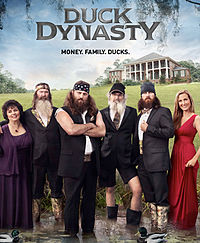
All of this is preamble to the fact that I’ve never watched Duck Dynasty, a show featured in this week’s Time magazine. Another heavily bearded family (I’ve had a beard since 1988 and it hasn’t landed me a reality show yet; how about Unemployed PhDs in the Land of Prayer?), now rich off of making duck calls and a reality show, are apparently one of the highest rated programs on the binary airwaves. The article, by Belinda Luscombe, makes the point that the Robertson family is a born-again clan whose religion is almost as important to them as shooting ducks. She notes that patriarch Phil grew up in extremely humble circumstances, and that his faith in the Lord doesn’t waver. People across the country are fascinated. The ducks, I presume, are nervous.

I am fascinated by this national obsession with hard-time, simple folk. From Ice Road Truckers to Dirty Jobs (not done dirt cheap), this country of sitting-behind-a-desk-staring-at-a-numbing-computer-screen culture is hungry for the authentic. The lived existence of those who face difficult times and get out of them with homespun ingenuity. The duck hunters whistle all the way to the bank. I grew up in humble circumstances, and to my recollection it was anything but glamorous. I’ve never seen Duck Dynasty, but Luscombe’s article reveals the hidden demon in the room as Phil Robertson laments his children building bigger houses and moving away from the Sears and Roebuck-toilet paper ways of his youth. The internet doesn’t help you much when you’re in the outhouse and the last catalogue arrived a decade ago. I wonder what would happen if more of us led meaningful lives. Would we still need the television to remind us that out there, far from the urban centers that define our civilization, godly duck hunters haunt the swamps of Louisiana? Would we even need television at all?


Fracking Insane

Do yourself a favor. Watch this video:

I have spent most of my lifetime living the fantasy of the helpless victim. Raised in a faith that insisted I really deserve Hell, and that if I manage to escape it will literally be a miracle, I guess I just internalized it. That kind of “Christian” thinking gets reflected and refracted through the lens of experience, and soon I was reading everything in its light. My parents’ divorce? Deserved. That move at the vulnerable early teen years? Inevitable. The verbal abuse of an overly stressed step-father? It should’ve been worse. Add to that the numerous rejections after professions of true love, and being fired from two jobs for no discernible cause—you start to get the picture. So when I learn that fracking is going on all around me, it seems like this is the fate of the perpetually sinful. Destroy the planet. Do you think you deserve better?

Life-denying religions walk a very thin line. When, like Siddhartha Gautama or Rishabha, the denial is a decision made after serious, personal reflection, this may be called enlightenment. When it is cast at you by a non-negotiable, self-despising cleric freely dispensing divine damnation to those incapable of much reflection, it is quite another beast. Children, although possessing freer minds, are easily impressed by authoritative adults. If that adult talks to God, you’d better sit up at the table and listen. So it is that generations are taught that “God” gave humans—let’s be literal here—man dominion over the earth. Pillage and plunder are part of the fracking package. If it’s down here below heaven, God wants you to use it up. After all, the sign on the door says “Back in Five Minutes.” (Dated 33 C.E.)

In a moment of weakness, I must confess (and I am told by religious experts that it is good for the soul), a few weekends ago I found Jesse Ventura’s Conspiracy Theory on YouTube. It was like eating Lays; you can’t stop at one. By the end of the afternoon, besides a nasty headache, I had a noggin full of improbable scenarios, courtesy of Jesse, “the Body,” Politic. Although a good night’s sleep at the rationality of another unapocalyptic dawn washed away his most outlandish claims, fracking is more frightening than a conspiracy. It is legal, it effects everyone who lives on earth where it is being done, and its record speaks for itself. I’m not proud of having wasted a few hours on humanzees and Bilderbergers reducing the world population to 500 million. But I am afraid that, if left to its own devices, however, “dominion over the earth” may be more than even the literalists bargained for.

Yes, that looks like a good idea...

Yes, that looks like a good idea…


Heavy Metal

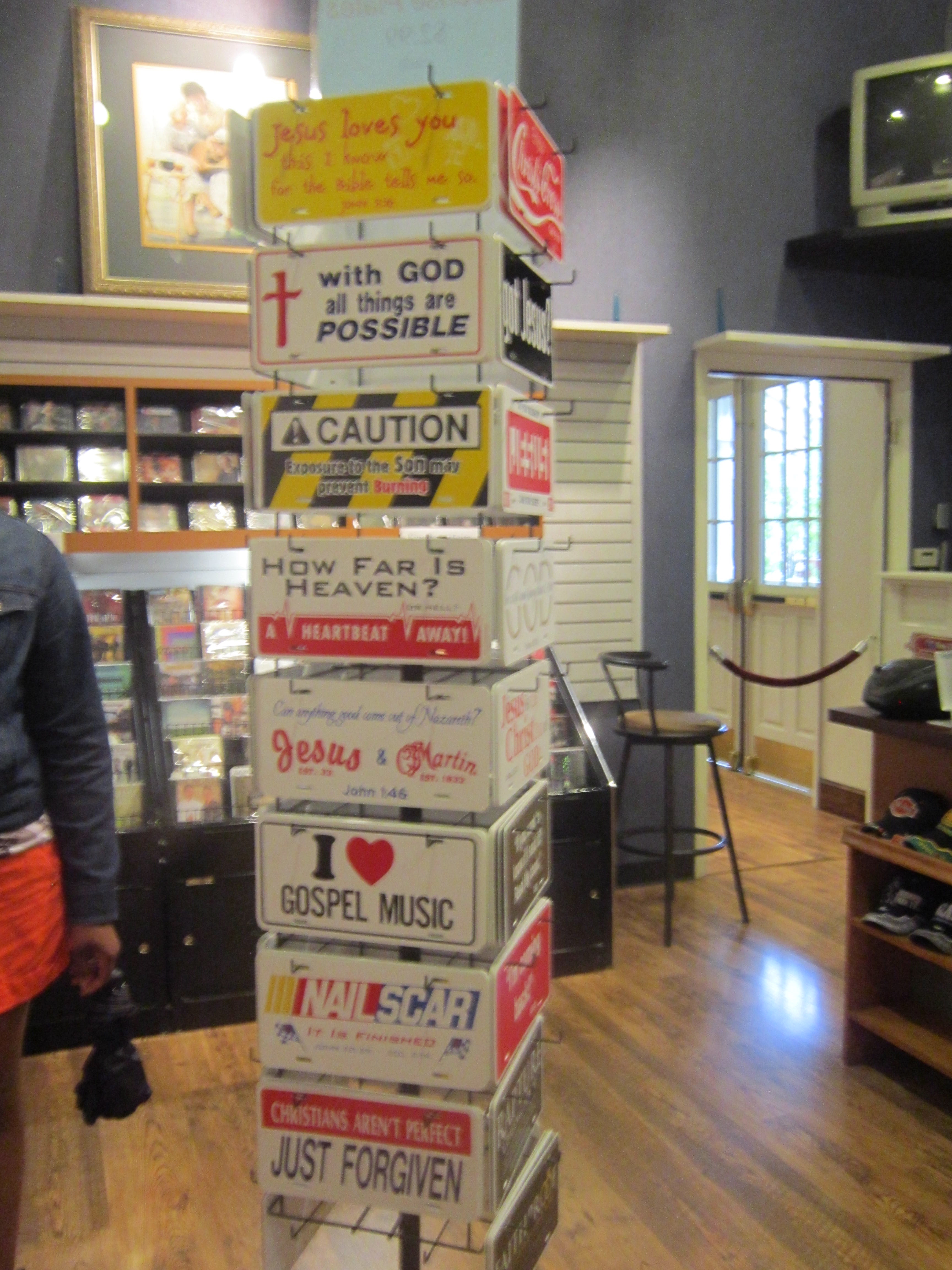
“I drive my car, it is a witness. My license plate, it states my business.” Only the hardcore may be able to place this quote from Daniel Amos’s impressive 1984 album Vox Humana. Even when I moved away from Christian rock after college, I kept Daniel Amos in my head—this is truly inspired artistry. Pop culture and religion courses have become a standard offering in religion departments over the past few years. We are, even as secular as we may be, a very religious society. When my daughter’s high school music program went off on its biannual concert tour, this year they headed south. On the itinerary: Dollywood. I came near to Gatlinburg, Tennessee on the trip I made to South Carolina to see my father for the final time, but I did not stop. I am told, however, that Dollywood is something to see. In one of the gift shops, my daughter snapped a couple of photos for my blog that draw all these disparate thoughts together.

IMG_1213

What we put on our cars is what we want the world to know about us without ever seeing us. This makes cars a perfect evangelistic tool for both the shy and the aggressive. The car becomes a tract. A statement that this vehicle is driven by an evangelical. I’m not sure it makes me feel any safer on the road. How many times have I been rudely cut off in traffic only to find a Jesus fish winking at me from the bumper of the offending car? Sometimes swallowing a Darwin amphibian. Religion speaks more loudly behind the wheel than it does from the pew. In the stress of traffic, what do we really believe?

IMG_1215

Cars are also the ultimate tools of self-assertion. Human beings, with little natural armor or predatory equipment, surround themselves with metal and accelerate themselves at velocities that nature never intended. We feel godlike behind the wheel. That metal box in front of us, driving too slowly, or having just pulled some stupid maneuver, is not a person. It is a thing. And those who choose to declare their faith on that object are under constant judgment. Well I know the evangelistic pressure to witness—fundamentalists are expert at manipulating guilt. Put these plates on your car and the world will know what you really are. But be careful. It’s not how you say, but how you play that will express what you truly believe.


Ancient of Days

I’ve never been one to deny my age. I think of myself as a rather young 50 since my brain still reacts like an 18-year old’s much of the time. I try to keep as fit as my job allows, and the only thing I really overindulge in is books. But I am 50, and that means the AARP has had me in their cross-hairs for the last couple of years. The phone rang the other day and I was foolish enough to answer it. The young man on the other end of the line asked me if I could hear him okay. I almost hung up; if someone doesn’t identify him or herself in the first sentence, I know they’re wanting me to contribute to something. Instead, I tried a new tactic: “you’re not coming in very clear,” I fibbed, hoping that he would offer to call back and I wouldn’t answer. Instead, he adjusted the volume. It was the AARP calling with a survey. My hearing is still pretty keen—without it, walking across Manhattan in rush hour everyday would be downright dangerous. Nevertheless, my encounter with AARP made me think of a recent conversation I had about death.

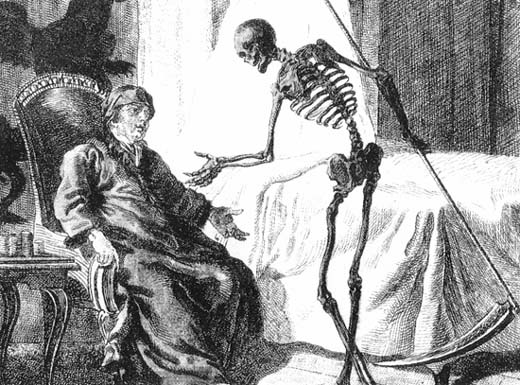
I am not afraid of death. As long as I can remember, I have never really feared it. Not that I want to go anytime soon, but perhaps because of my childhood fears of Hell, I believe I might have contributed enough to the treasury of merit (like the AARP, or Social Security) to get me out of a few scrapes. I attended mass nearly every day for twelve years at Nashotah House—that has to count for something! My conversation partner the other day was incredulous; “how can you not be afraid of death?” I’m not sure what comes after, if anything, but I’ve always tried to keep on the good side of the divine. Those questionable things I’ve intentionally done were all executed with good reason, or so it seemed at the time. If they were truly naughty, I’ve asked for forgiveness. And if there’s nothing after life, well, I feel like I could use the good long sleep of annihilation for a while.

Several books I’ve read recently have been advocating reincarnation. I’m not sure that it makes sense, but sometimes I wonder. The idea is a bit more frightening than death itself, in many ways. So many things I don’t want to go through again—sorry Friedrich, but I guess I’m one of those who says no to exact repetition—so much physical pain and mental anguish. I can see why Buddhists want to break the cycle. Although, if I’m reincarnated as a human being, and a literate one, I might be able to get a few more books read next time around. Perhaps that’s the silver lining. Or perhaps that’s why I should just hang up the phone if the caller doesn’t tell me who it is in the first sentence.

"I'm not quite dead yet..."

“I’m not quite dead yet…”


Book Friends

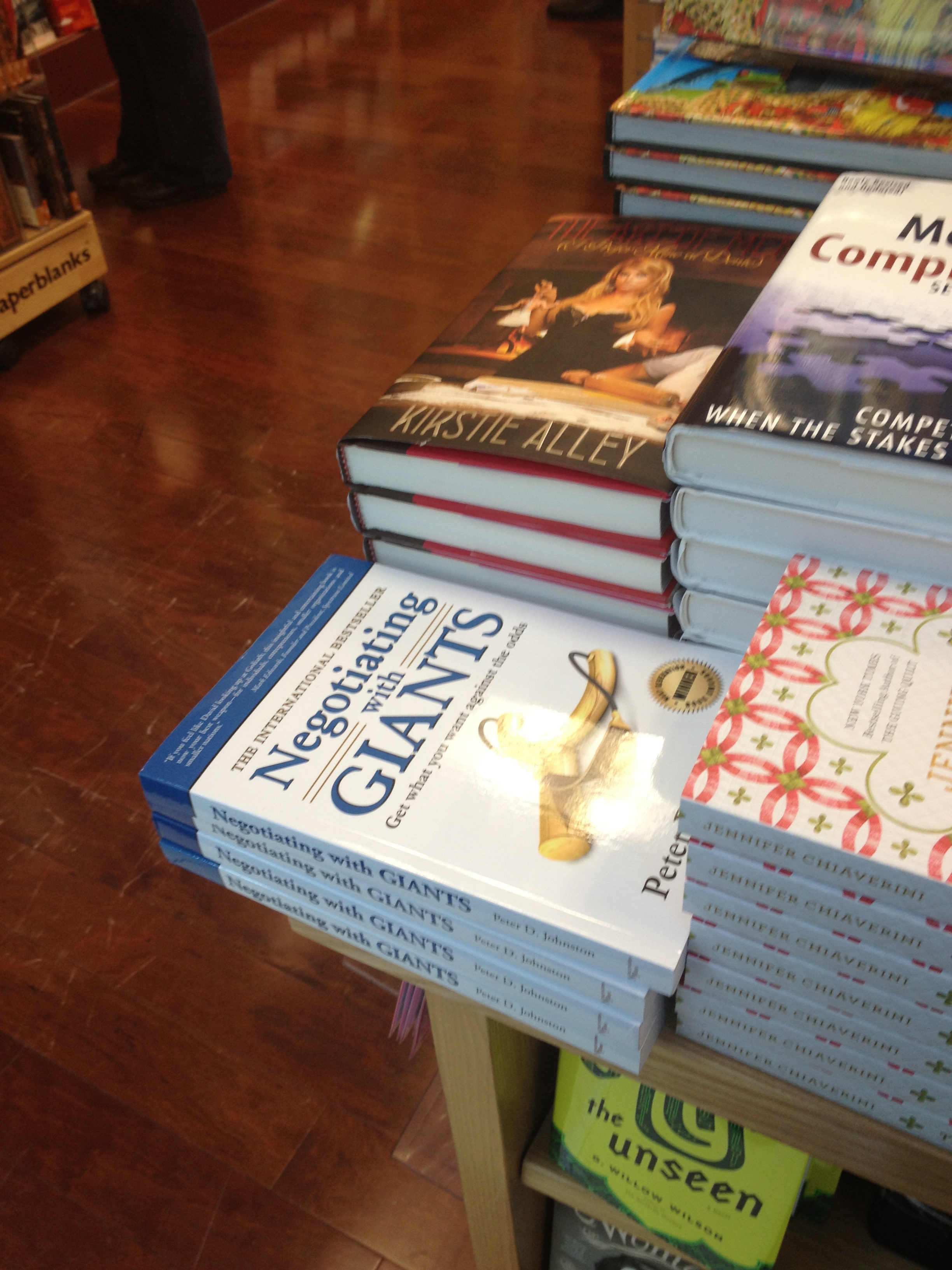
Along highway 12 in Hunterdon County, New Jersey stands an armory with an obtrusive tank stolidly facing the road. Over the weekend the tank was draped with a banner proclaiming the Hunterdon County Library book sale. I wished I’d had a camera. It had been a few years since I’d been free on the book sale weekend (it often classes with robotics competitions), so I decided to visit on Saturday. No, they usually do not have much in the way of academic books, or even the books on my extensive wishlist. The books are not in pristine shape, not alphabetized, and sometimes miscategorized. But still I love to go and browse around. It is always crowded. I feel like a babe in its mother’s arms around so many people who want to be near books. Although the vast minority of the American population, book buyers are of a kind. We get along.

The event is so large that parking is off-site and a shuttle bus is hired to ferry people the extra mile down the highway to the armory. I emerged with a small bagful of guilty pleasures and waited for the shuttle behind three elderly gentlemen. On the bus they lovingly pulled out their special finds to share with one another, smiling and quietly praising the virtues of each one. When I was checking out a few minutes earlier the elderly lady counting the books asked me if I recycled them back into the system when I was finished. I had to confess that I keep most of them. There are books in every room of our apartment except the bathroom. You can read in bed, in the kitchen, or in front of the television. I couldn’t live any other way. “It’s a good problem to have,” she affirmed.

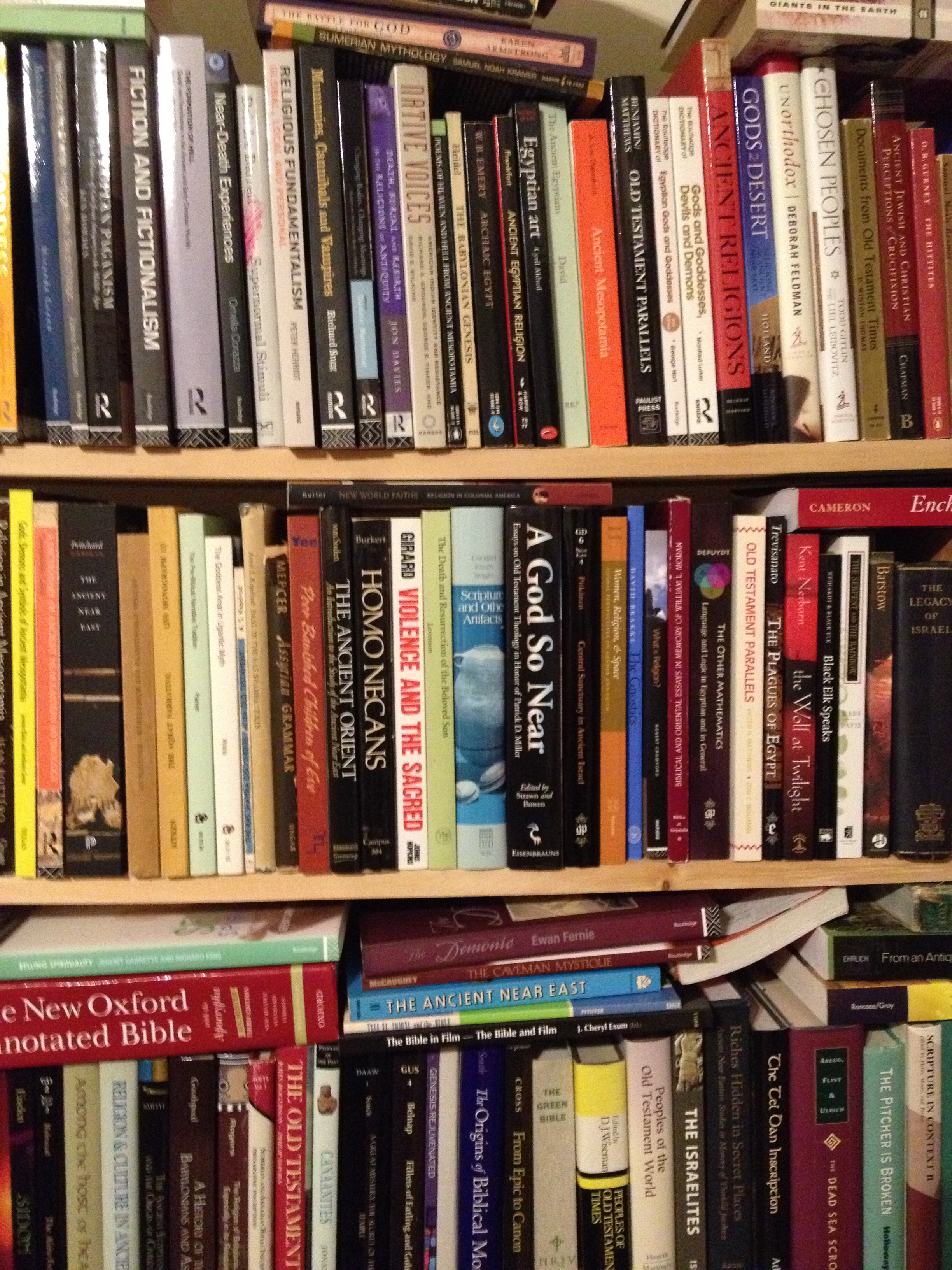
A few weeks back our refrigerator died. For the third time since Hurricane Sandy we had to throw out all our refrigerated goods. Our landlord magnanimously agreed to replace the derelict cooler. I worked from home that day to let the delivery guys in. Their faces fell. “We’ll never get it in past all those bookshelves,” they lamented. The doors on this older building are offset, and we do have bookshelves covering much of the wallspace. So I began pulling down books. The piles grew and eventually I freed a shelf enough to move it from the wall and to get the oversized appliance in place. On the way out, one of the movers stopped by an unraped bookshelf and stared for a moment. “You read interesting books,” he said. Perhaps he just pronounced my epitaph. He read interesting books. I can’t think of a better compliment in this world where reading for pleasure is an endangered species.

"Interesting reading"

“Interesting reading”


Chick Trick

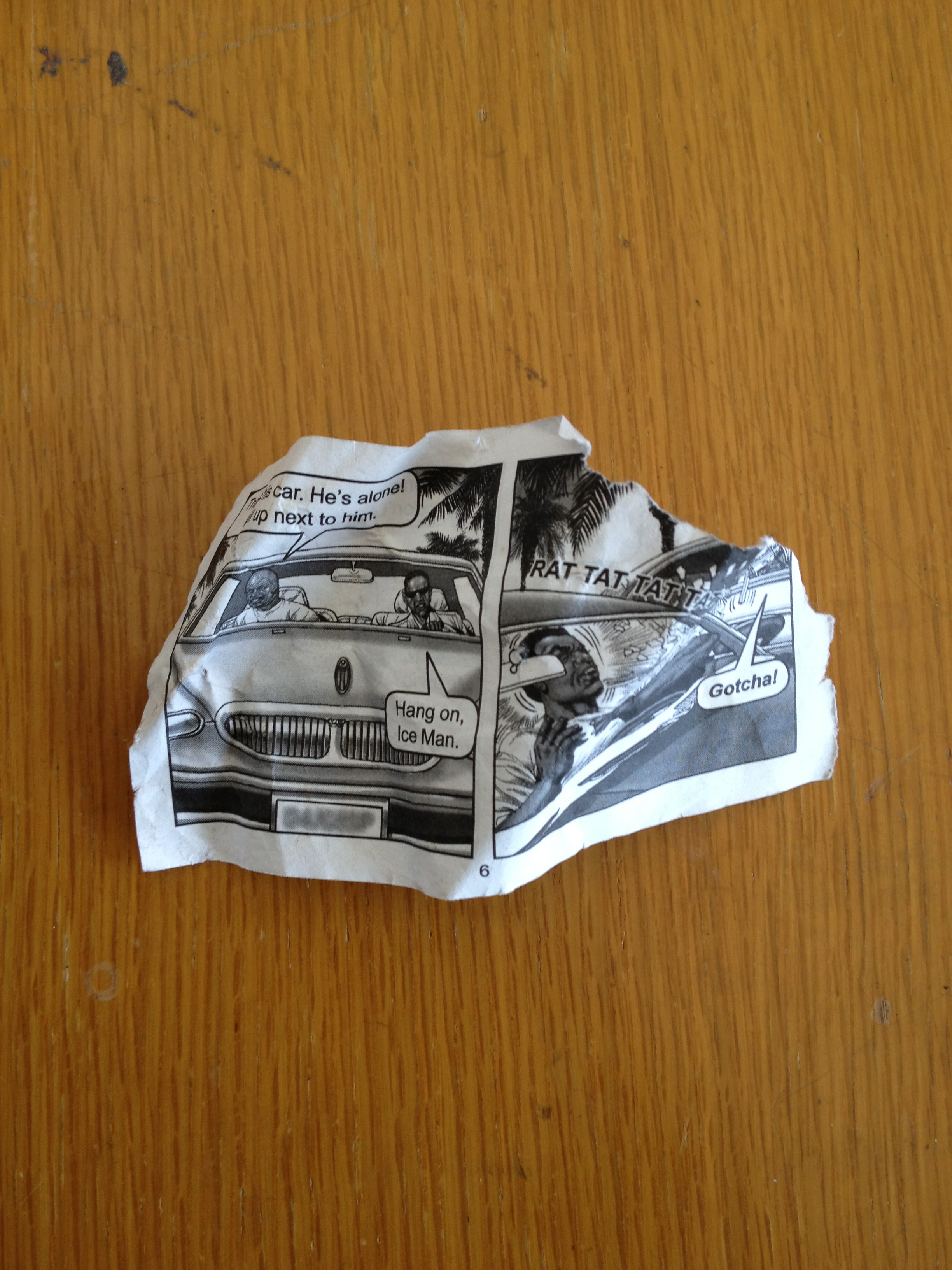
Yesterday was our local town’s Earth Day clean-up day. I have always thought we lived in a clean town, and generally it’s true. When you look closer, however, the litter becomes all too obvious. Now, I know the purpose of this exercise is to get rid of pollution—my family filled five trash bags in the morning’s jaunt. As I reached for a bit of paper, I instantly recognized that I had found a half-torn page of a Jack T. Chick tract. Jack Chick is an old school Fundamentalist who draws some of the scariest cartoon evangelistic tracts imaginable. He is personally responsible for many of my childhood nightmares and phobias. Even as an adult, I still find myself believing, at some level, the tripe he serves up at the food of salvation. Children, you see, are extremely vulnerable to suggestion. Chick unremittingly claims we all deserve to burn in Hell, literally, and that only those who buy his version of Christianity can avoid it. He scares me. Instead of putting the torn comic strip in the trash, it went into my pocket. I needed to exegete it.

As a child I purchased every single Chick tract available from our local Christian bookstore. I was terrified of Hell and absolutely wanted to make sure I had double-covered every single base. A Chick tract can be read in a matter of minutes, but they can stay with you for decades. The one I found yesterday was one I’d never read. It consists of part of pages 5 and 6 of a black-on-black violence story involving a seriously looking tough guy called Ice Man. As the story opens, in media res, a photograph of “the preacher’s boy” is on a cell phone. Ice Man is seriously pissed off, and on page 6, in a drive-by shooting with an assault rifle, blows the young man away. His death, as in most Chick tracts, is violent, but bloodless. Chick spares most of the blood for the cross, where, sometimes it trickles eerily down over the repentant sinner.

IMG_0669

If I might be forgiven for some textual criticism, in which I might be guilty of a modicum of eisegesis, let me guess that the preacher’s boy had been suggesting that Ice Man change his sinful ways in the previous lacuna. In a fit of Icy rage, the PK becomes a sacrificial victim. Most likely, by the end of the pamphlet, Ice Man will have come to realize the evil of his ways and will end up on his knees. Depending on Chick’s mood that day, he may even end up dead. One thing is certain, the story will attempt to scare a youngster to a life of righteousness. The area where we were gathering trash is on the relative “wrong side of the tracks” for my little town. Some real violence does occur here, but it is mostly out of sight. Having grown up with Chick tracts guiding my every thought, I wonder if somebody got the message before it was too late. I see this torn page as a small sign of hope.


Just Books

It’s very difficult to make your voice heard in this world. I’ve been talking for nearly half a century, and most of the time it’s like nobody’s listening. For those who follow the Chronicle of Higher Education, the fact that Herbert Richardson, the founder of Edwin Mellen Press, is threatening to sue some librarians for comments made on various blogs, is not really news. When the Chronicle ran a story this week on Herbert Richardson’s career, I gained a renewed appreciation for what he’s doing. I say “renewed” because I remember the days when I was very poor. My first year of teaching, with my wife in a university program and my own student loans due, I was paid a measly ten grand for a salary (this was in 1992). Despite these privations, my wife and I attended the Society of Biblical Literature annual meeting on a very tight budget. For those of you who’ve not been, SBL offers a book orgy for scholars. Publishers of all descriptions offer books at a discount, but even so, many titles are out of reach. My wife was researching Methodist hymnody for her thesis, and Edwin Mellen Press had a resource that she needed. We simply couldn’t afford it. Herbert Richardson saw our earnest discussion at his book stall, walked over, picked up the book, handed to my wife and said, “Take it.”

Although Herbert Richardson would not recognize me, he has on other occasions, shown me unsolicited kindness. Reading the Chronicle account, I learned that he is a Presbyterian minister and that he had taught at Harvard Divinity School. He is unconventional in some respects, but he also enjoys bucking the trends. Edwin Mellen Press publishes good research that mainstream publishers pass up because their eyes are always on the prize. The bottom line. I never published with Mellen, but I have had snooty presses turn down very careful scholarship of my own. My sympathies are with the underdog, and with the guy who tries to help the underdog. Academia is a cruel world. Some of us have received nothing but backhanded salutes from “established institutions” for all of our adult lives. It’s hard to feel sorry for them. What are the needs of one man in a machine so vast? Not much, apparently.

I’m not the litigious sort. Lawyers have generally caused mostly grief, in my experience. But I don’t castigate the important work Herbert Richardson is trying to do. It might be easy for those lucky enough to be welcomed by academia to forget just how lucky they are and noses are easily looked down towards those of us who never received a chance to shine. No, I wouldn’t sue those who bad-mouth me, and I’m sure there are plenty, but I think Herbert Richardson’s heart is in the right place. As a guy who would happily work for books if food, shelter, and healthcare could somehow be had, I know what it is to covet a book and not be able to afford it. I know what it is like to feel want. Herbert Richardson, based on my encounters with the man—we continue to cross paths from time to time—understands those who love books. That is a principle I can live by.

IMG_0506