Loneliness of Long-Distance Runners

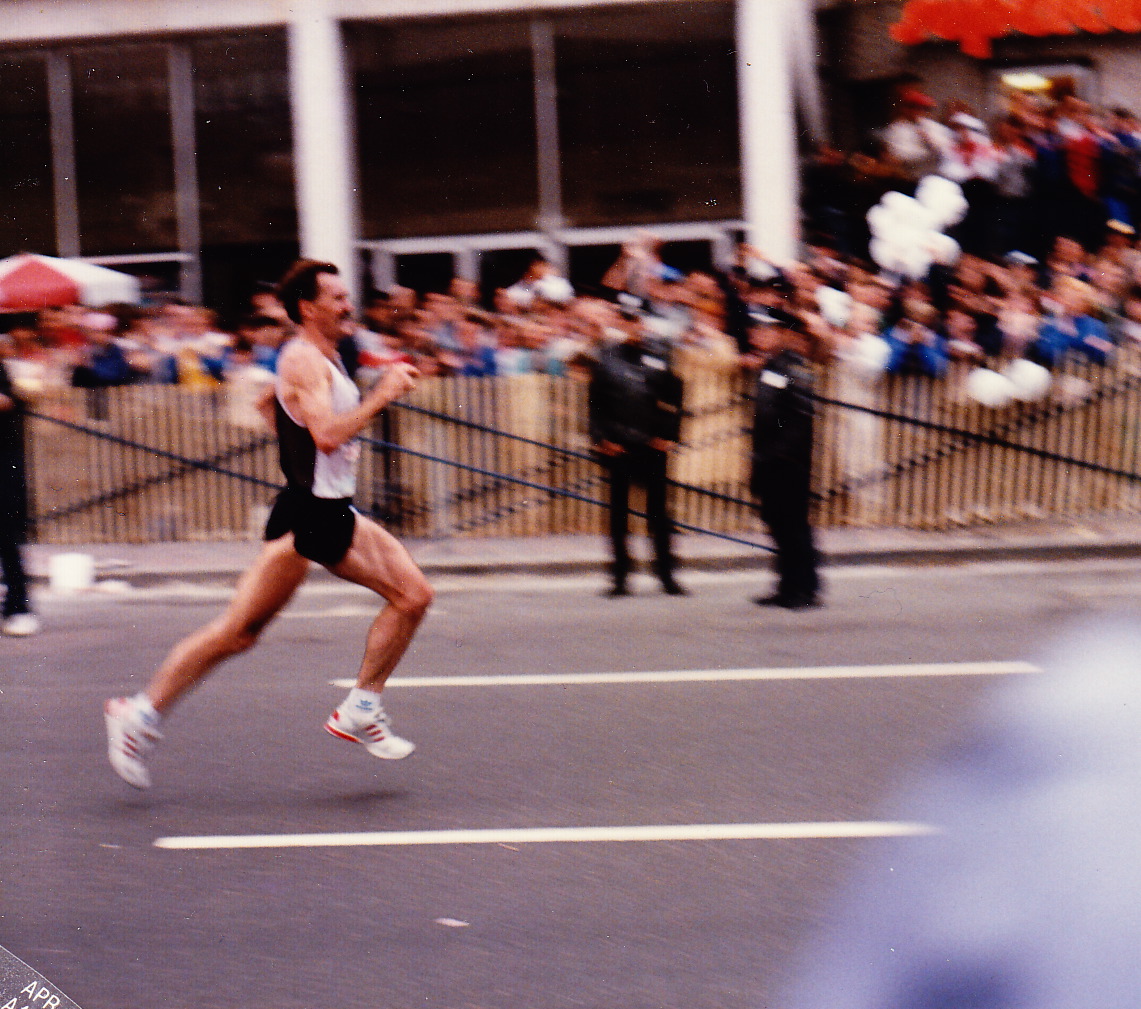
1988. I was standing along Boylston Street, in Copley Square, watching the Boston Marathon. As the weary first place runner trudged by, I somehow neglected to take a photograph. I did snap one of the number two winner. I always have had an affinity for those who don’t win. Those who try, only to be beaten by others. His name didn’t stay with me, but I still have that photo, a moment in time, when everyone was excited about the culmination of a long tradition. When I heard that there was a bombing at the marathon yesterday, I experienced a different kind of culmination. I wondered what kind of people we had become. The Boston Marathon, a long-time symbol of endurance and pushing oneself to the limit, came to a crashing end. Along with another chapter in the innocence of a world gone mad. Just last October, I posted a photo on this blog that I had snapped near where one of the bombs went off. As I write this nobody has a clue as to who was responsible or what they were trying to prove.
BostonMarathon

The NRA gun barons were not on hand to stop the terrorists, I note. Funny how they always show up too late. Perhaps we should all start carrying hand-grenades. We all have a choice whether to do more good or evil in the world. To leave behind a better place or a worse one. The Boston Marathon is an international event, with long-distance runners from around the world competing. More against themselves than against anyone else. Just to finish the grueling course. Who would want to hurt just anyone, including several children—those who love to race and dream and hope for a better tomorrow?

The news saddens me, for we like to think we live in an enlightened nation. Maybe a little soft around the middle, but generally a congenial place. We hold events like the Boston Marathon to celebrate human achievement—those who push themselves to the limit but then keep going. Standing in the crowd in 1988, I remember how we clapped for those who seemed too exhausted to trudge those last few yards to the finish line. We wanted them to succeed. I couldn’t tell you one of their names, but we were all wishing the best for them. That is the human spirit. It takes a coward’s coward to plant bombs amid crowds and then not even claim your own evil victory. Terrorism, already heinous, without even trying to make a point. And yet the runners run on. Like the marathon itself, we must keep believing that we can reach that ribbon and that the vast majority are hoping for our success.


Parochial Education

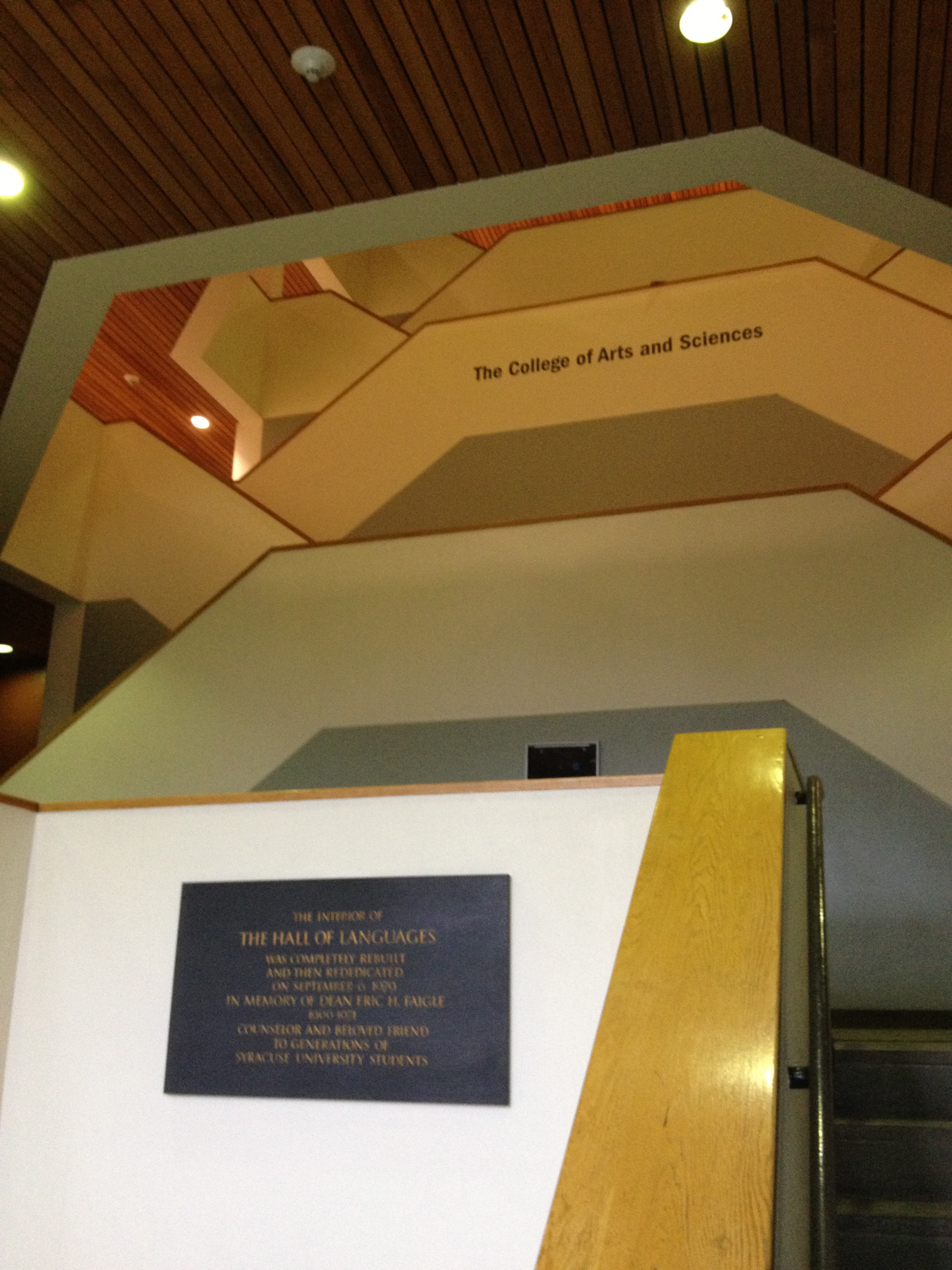
I’m sitting in King David’s Restaurant in Syracuse, New York. I’ve spent two days speaking with a wide diversity of religion scholars, and I’m realizing religion is not yet dead. A few days ago I wrote about the Burnt Over District and the Second Great Awakening. It occurs to me as I climbed the hill to the Religion Department in the rain, that I am on the trail of that Great Awakening. Syracuse University began as a Methodist school. Today, although affiliated with the United Methodist Church, it considers itself non-sectarian. Yet without those abstemious Methodists, they wouldn’t be here. The Methodists, now primarily represented by the United Methodist Church, owe their explosive growth to the Second Great Awakening. Out on the frontiers—for America was a rural nation—the revivals became showcases of the social, the supernatural, and the salacious. The Methodists and Baptists, in terms of numbers, benefited immensely.

With their enviable population base, the Methodists invested in higher education. Syracuse University, just up the hill, Adrian College, Boston, Central Methodist, Drew, Duke, Emory Universities, Florida Southern College—you could go nearly through the alphabet and not exhaust their schools—all owe their beginnings or present stature in part to those thrifty Methodists. Believers in an educated clergy, they reached out to embrace an educated laity as well. Although many of these institutions grew up and left their religion behind, the Methodists have impressed their stamp on American higher education unlike nearly any other denomination. Even when numbers in the pews decline, the Methodists will have left a legacy on the wider culture through their belief in education. About the only other Christian group invested so heavily in higher education has been the Catholic Church. Even so, the Methodist academic reputation climbs a bit higher.

I spent many happy years among the Methodists. Their way of looking at life, officially, anyway, isn’t extremist. Some aver that John Wesley was an extreme evangelist. Today he’d be snowboarding down the Alps to seek the unsaved, a Red Bull or two in his belly to stoke that restless fire. His followers, via media Methodists, eased into the mainstream—in some ways defined the mainstream. Methodism was good for a kid who needed to fit in. So as I sit in King David’s Restaurant, reflecting over my past that has landed me in this most unusual place, I am thinking about my Methodist roots. I’ve failed to impress those Methodist institutions where I was once courted for a circuit riding future. Now I watch as they educate other people’s kids. It is a safe guess that King David wouldn’t even be here if it hadn’t been for John Wesley and his personal need for assurance. If only more churches took education so seriously.

Climb that hill

Climb that hill


Adjunct Values

Well, the internet seems to have discovered adjunct Hell. Naturally, I’m too late to be part of the statistics, but I never rule that out as a future fate. This week I’ve seen several stories, some of them on major news network sites, shocked and indignant about the conditions under which adjunct instructors live. There’s quite a lot of hand-wringing and finger-pointing, but journalists and academics alike are tip-toeing around the blue whale in the room. Our society does not value education. Yes, we insist on educating children to the point of basic competency, but do we really, as a society, value that education? Ask just about any teacher. These people pour out their talent and efforts to give other people’s children the boost they need to get along in life. And many of them have to work second jobs just to make ends meet. Do we expect any less of higher education? We want it cheap and dirty with guaranteed jobs when it’s done. Universities want star faculty who publish all the time. You can’t do that when you’re busy teaching all the time. And we’ve got a glut.

The glut is PhDs. We’re cheap. More accurately, we’re broke. One of the things they don’t tell you when you apply for doctoral programs is that you are signing up to be ungainfully employed for your best earning years. Universities won’t tell you that because they need the money that graduate students bring with them, mostly in the form of student loans. News flash, America: education is not cheap! Another news flash: we are fast falling behind other cultures where teachers are respected, well paid, and even venerated. Gasp! Do such fantasy lands exist? Yes, they do.

Try a little experiment: think where you would be without your teachers. You certainly wouldn’t be reading this blog, and probably not reading at all. Your employment would likely be manual labor. Your math skills would be such that you’d be easily cheated of your wages. You would probably believe in a myth about the earth being created in six days and think that was science. When I read about the societies advancing the swiftest, America does not top the the list any more. When I learn more about those societies where the cutting edge is measured by Singapore or Beijing, I find out they highly value their teachers. They are paid well. They are respected. Here, in the US, chances are that the person teaching your kids in college makes a poverty-level salary and may be surviving by food stamps. Three quarters of our higher education teaching force consists of adjuncts. Three quarters. And these people are no slouches. They’re simply the victims of a society that doesn’t want to pay for education. Listening to administrators attempting to justify their decisions makes me squirm. How much did you say that Greg Schiano, Brady Hoke, or Bo Pelini “earn(ed)” in a year? Where your treasure is, there will your heart be also.

Any old school will do

Any old school will do


Buy Their Fruits

A lot of things get thrust at you in Midtown Manhattan. Many of them are religious. As I was out on my lunch break, a Buddhist monk walked up to me on Second Avenue. He thrust out a pretty token that looked like those skinny cards that used to come in with Sugar Daddies. I get a lot of things held out at me, and since I can imagine how dispiriting it must be to have people ignore you all day long, I have taught myself to take their chit as a matter of reflex. The monk looked pleased. We were outside 815, the headquarters of the Episcopal Church in the United States. I reached out my hand and he said “Buddha peace.” That was nicer than most of what I’d heard from the people who worked inside the church to which I’d dedicated years of my life. Without a beat my Buddhist friend continued, “temple donation.” I had to wave him off with a smile. Religions, no matter how placid, are out to earn a buck.

In the neighborhood of my office lurks a psychic named Sharon. I wouldn’t know Sharon if I ran into her, but I suppose the reverse wouldn’t be true. Actually, I have no way of knowing if she’s really psychic or not. She has guys. These guys hang out on the four corners of my block and hand out fliers for Sharon’s psychic readings. The guys with the leaflets aren’t psychic, I take it, because a walk around the block, on which I recognize each and every one of them, always lands me back in the office with a pocket full of psi. I see that Sharon is a third generation psychic and that she is adept at foreseeing negative energy. I would advise her not to walk past 815. If I bring in my slips of paper I get five dollars off a reading. I don’t know how much Sharon charges, but I do know that I don’t need anyone to foresee negativity in my life. I’ve got a hard enough time dealing with it when I don’t see it. And I save five bucks each time.

I sometimes wonder, as I walk past 815 Second Avenue, if anyone in there knows how badly one of their faithful was hurt by priests and bishops who had the blessing of the church. No one from the central office ever consoled or tried to comfort a person whose career had just been lifted off the rails and flung off the cliff by the machinations of some of their own. Even now those who go in and out the doors as I stand there have no idea what was done to a lonely guy on the street. In the name of the church. I think of the hollow sound of coin ringing in the coffers. I think of Judas trying to return his thirty pieces of silver. I think of money lenders’ tables being overturned. I think of Buddha peace. One hand holds out a medallion for me. The other is palm up, waiting for a return on the sacred investment.

you shall know them

you shall know them


Good, Friday

Riding public transit sometimes turns into a religious experience. Various bus drivers will wish passengers a “blessed day” as they pull into the Port Authority Bus Terminal—not that I can blame them, after the traffic they face daily, for taking a spiritual breather. Lately, though, I have been wished a happy Easter by the driver. Ironically, I must note, because people of many faith traditions ride the bus. Not all are Easter riders. Just yesterday a Rastafari stood before me in line. I’m regularly joined by Hindus, Jews, and maybe even a Mormon or two (who can tell?). Holy Week in New York is a surreal experience. I chatted with some co-workers where the topic changed effortlessly from their experiences of Passover to others’ experiences of Easter. Religion is alive and well in the Big Apple, but it is mostly an afterthought to the real business of making money. That’s what we’re all here for, after all.

Money, according to the good book, is inimical to the lifestyle of faith. I must have a little too much faith, I guess, since I have so precious little money. Nothing throws that into such sharp relief as looming tuition bills. You see, I tried “to fight the good fight” only to learn that there’s no way to win it without playing by the entrepreneur’s rules. Filling out the FAFSA over the smoldering ruins of my “earning years” was a distinctly sobering experience. I went into higher education because I believed in it—there’s that pesky faith again. The things you believe in, however, have a way of turning on you. I suppose that’s an appropriate reflection for Good Friday.

It’s hard to be an idealist in a world where people say, “you just need someone to give you a chance,” and then turn their backs on you. So as I’m walking across town, thinking about my blessed day, I notice that we’re all in this together. Except some of us. In the idealist world, those who want it the most sometimes win it. Those who play by the rules. I had no Harvard aspirations, just a reasonable job in a little college would suit me fine. A place to think that doesn’t have wheels and aluminum sides and seat forty-nine other lost souls. But for those who have less, even the little they have will be taken from them. That’s biblical too. Higher education is one of the greatest gifts we can give our children, but it easily joins hands with Judas Iscariot. It is Good Friday, according to some. Others just call it a blessed day.

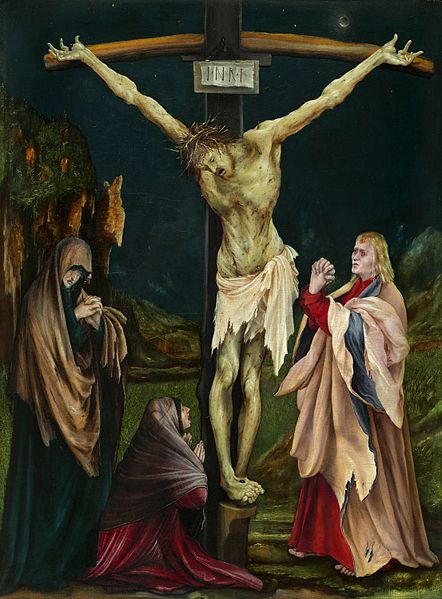
Mathis_Gothart_Grünewald_007


RoboStop

Although few objects are as soulless and mechanistic as robots, I still feel strangely emotional about them. Had my daughter not been interested in them, I would never have become involved with FIRST Robotics, even serving for a year as an officer in the Team 102 foundation to help raise the thousands of dollars needed to run such a club. Like most people with a background deep in the humanities, I would’ve not pondered too deeply how much of ourselves we put into our machines. Right now I’m reevaluating that hypothesis.

No one doubts that an artist or musician puts her- or himself into her or his work. Those who do it best are most highly valued (after we let the artist die off, usually, after having lived a difficult life). We admire those who are able to catch the human spirit in such forms of expression while many scientists inform us that there really is no spirit at all—it is just chemical reactions and electrical circuits in the soft tissue of our brains. When we see the Mona Lisa, or hear Beethoven’s Seventh, however, we know they must be wrong. What we make becomes part of us. And I’m thinking that may apply to robots too.

I’ve just attended my last FIRST Robotics competition. It is difficult to convey, if you’ve never been, what such an event is like. Hundreds of screaming high school students excited about engineering and the thrill of competition. A playing field is constructed to exacting specifications and six teams in two alliances facing off their creations to emulate human—sometimes superhuman—behavior. All the while the thumping rock beat of loud music and the play of colored lights give the event the emotional charge of a football game and homecoming dance rolled into one. Only you really don’t have to move very much at all.

I’m not a robot designer or builder. It is difficult to imagine anything further from my training (except perhaps accounting). Still, I’m a little let down after my last FIRST competition. Four years ago it seemed so novel, and there have been some difficult moments along the way. I’ve seen kids build robots that play soccer, hang inflatable tubes, play basketball, shoot frisbees, climb towers, climb poles, and do many other seemingly impossible tasks. I’ve been up before dawn to ride a chilly school bus across the state to compete, coming home in time to fall in bed to get up early for work the next morning. But most of all, I’ve seen kids putting themselves into more than machines. I’ve seen them putting themselves into a team. Although we didn’t win this year, and next year I probably will be consumed with other concerns, I am proud to have been, in my small way, a part of Team 102. Way to go, Gearheads! Maybe robots do have souls after all.

Team102FinalAlliance


A Goy in the City

Getting across Midtown Manhattan quickly during rush hour involves a kind of algorithm. That means my route to and from work each day changes depending on whether I catch that light at Eighth Avenue or Third Avenue. This past week my algorithm took me down 42nd Street on the way home. As I walked past a group of Orthodox Jews handing out leaflets, they singled me out and stopped me to ask if I was Jewish. I said “No,” but took their literature anyway. At first blush, it may seem odd to be mistaken as Jewish by some local experts (New York City has its fair share), but then again, maybe not. My brother tells me he gets asked the same question. Our great-great-grandparents left Germany in the 1820s and bore the ambiguous surname Tauberschmidt. By my great-grandparent’s generation they seemed to have been Lutheran, but before that? Hey, maybe this could explain a lot. Not to stereotype, but I do have the incessant angst that many Jewish characters exhibit in Woody Allen movies. Probably it’s my imagination. I thought it was cool to be mistaken for a “minority.” I felt, for a moment, like I belonged.

Reflecting on this incident (which made my day, by the way), I ask myself what it means to be part of a religion that has become a culture. The academic lingo for this is “cultural Jews” (in this case), but there are definitely “cultural Christians” as well. I suspect most religions have their cultural commandos. Part of the dynamic at work here is that although the world is very religious, it’s not really that religious. Most religious folks have an emotional connection to their tradition that may be, in fact, cultural rather than, for lack of a better word, spiritual. A person who is deeply religious often runs afoul of life in the everyday world. There is a sinful plethora of distractions. Those truly concerned about their religions often find themselves employed by them.

Cultural religions give the world a great deal of color. People flock to St Patrick’s Day parades when rivers are dyed green and everyone wants to be part Irish (and there is a genetic bit of this in my personal mix as well). Where would December be without Christmas and its attendant holidays? Even bunnies like colorful eggs in the springtime, so I’m told. Do any of these things make people religious Christians? I suspect few would argue that they do. I’m stretching Rousseau‘s concept of civil religion a bit tight here, but degrees of religiousness fall along a continuous spectrum rather than appearing in sharply distinguished colors. Cultural faiths are generally accidents of birth. It’s up to the individual how seriously to take it. And sometimes even the faithful misidentify one of their own.

Happy Passover to my Jewish siblings!

Happy Passover to my Jewish siblings!


Free Think Ing

It is not exactly pride that I feel when I see my undergraduate college featured in a Chronicle article entitled “Group Aims to Help Conservative Parents Counter ‘PC Indoctrination’ at Colleges.” I almost feared to scroll down the page. Yes, good old Grove City College has to thrust its manly credentials into the face of reason once again. The problem is that what such conservative groups decry as “indoctrination” is, in reality, critical thinking. It took me a long time to learn this distinction. I grew up in a conservative family, but I didn’t choose Grove City because of its flaming commitment to sixteenth-century values. I chose Grove City because it was a selective, intellectually honest school close to home. Being a first generation college student, I had no family tradition on which to draw. Guidance counselors didn’t know what to do with a religious kid who seemed to have some smarts. Other colleges seemed so far away. I didn’t even know what I wanted to study. You see, being raised in humble circumstances you learn to react to the many unpleasantries that life throws at you and there really isn’t time to plan out a future. It never works out that way in any case. I felt driven, but I didn’t know where I was going. Some day I hope to find out.

In the meanwhile, Grove City College has grown even more reactionary than when I was there in the 1980s. The Chronicle article states that “Conservatives have long complained about a perceived liberal bias in higher education,” and that Jim Van Eerden, an “entrepreneur in residence,” (shudder!) at Grove City has started the ironically named “FreeThinkU” to counter the liberalities students receive in school. Talk about your mixed messages! I wonder if Van Eerden has ever considered that Free Thinking has a long association with the very progress he abhors. Free thinkers gave us the gifts of evolution, rational thought, and for a while anyway, free love. Free thought gave us Kate Chopin, J. D. Salinger, and Margaret Atwood. They literally gave us the moon and have landed our probes on Mars. Somewhere lost in space a metal plaque is spinning in infinity with a naked couple and directions to planet Earth. I think the mis-named FreeThinkU might be better rechristened as Don’tUThink.

Higher education has a long, long history with religious thinking. Early universities were often outgrowths of theological colleges. Over the centuries, as our thinking matured, the ways of the past were recognized for what they were—outdated, short-sighted, unchanging for the sake of being unchanging. The reality that meets our eyes through the lenses of logic sometimes claims beehive hairdos and horn-rimmed glasses and greased back business haircuts as its victims. The earth is warming up. We did share a common ancestor with the apes. Our universe is even larger than we ever thought. And yet “FreeThinkU” suggests that we need to set the clock back a little. Maybe just a couple of centuries, but enough to hold our kids in the twilight of misperception. Progress has to be more than raping the earth and getting rich. Free thinking has to be a willingness to use the minds we have. I wonder what the aliens will say when they land here, our Pioneer 10 plaque in hand. If they land in Grove City, I suspect, they might feel they were sold a false bill of goods.

From the alumni mag; think about it...

From the alumni mag; think about it…


Flight of Fancy

I’m about fully recovered from my recent visit to Texas. Travel is perhaps the greatest form of education. After having my regular government pat-down, and hearing the airport loudspeakers warning me not even to joke with a TSA official, I was in a subdued mood as I awaited my flight. Airlines have learned to fine-tune human vanity. I know they are hurting for money, as many deregulated industries are, and there must be a marketing trick to get people to pay different prices for the arriving at the same destination at the same time. One of the most ridiculous is that of United Airlines’ Priority Access. Don’t get me wrong, I like United Airlines well enough. Their service has generally been on time, and they make being a human sardine as comfortable as possible. Some of the in-flight snacks, if you can afford them, are actually pretty tasty. But first you have to get onto the plane.

Of course, active duty military are free to board at any time. Tree-hugging pacifists, wait your turn. The part that really gets to me is that those held in special esteem by the Airline (i.e., those who can afford to pay more) are invited to board via the “Priority Access Lane.” This “lane” is created by laying a ratty carpet on the left side (or right side, for some gates) of an imaginary line composed of a couple of those retractable belt stanchions. To the left, sheep. To the right, goats. (Or vice-versa. We’re pretty hard to tell apart.) I’ve written about this before, but what caught my attention this time around was that a seeing-eye dog was boarded along with his human, via the “Priority Access Lane.” As I watched my canine brother sauntering towards the jetway, I was lost in thought. Not one sparrow falls to the ground. The privileged are boarding with a dog.

On my return trip home, at the ironically named George Bush International Airport, every few minutes a public announcement was broadcast about the interfaith chapel. Passengers were told that it was available 24 hours a day, and were given its precise location. Over the past couple of years I’ve had to fly a lot. I always notice the airport chapels, and I feel for those who are anxious about flying. I’ve never heard such a p-a announcement encouraging use of these chapels before. Perhaps I’m too fixated on how I never get to walk down the “Priority Access Lane.” I know my place; I was born among the working class, and when the plane goes down, I’ll be among my own kind. But I do feel sorry for the dog. He has no choice but to be classed with those who are, in the airline’s opinion, of higher priority than the common citizen. Next time I think I’ll just wait in the chapel, contemplating how god spelled backward is dog.

IMG_0558


Beg Your Martyr

Despite the extreme antipathy shown toward religion by the educational establishment, the Chronicle of Higher Education doesn’t shy away from the topic. In the March 1 edition of The Chronicle Review, a piece by Candida Moss presents one of the uncomfortable facts of religious history to the academic world. Many of us who are “specialists” have known for quite some time that the record for mass persecution among early Christians is sketchy at best. In “The Myths Behind the Age of Martyrs,” Moss reveals that historical documents don’t present the first few centuries of Christendom as quite the blood-bath that early hagiographies do. It is true that perceptions vary depending on one’s point of view. If your auntie were thrown to the lions, it might look like everyone you knew was being persecuted. If you were a Roman historian, the numbers might seem small in comparison with, say, those pesky Carthaginians, heathens the lot of them. Still, it was this persecuted self-image that left a lasting imprint on Christianity. Until Constantine, anyway. When Christianity became imperial, it didn’t hesitate to get medieval on a few posteriors.

As Moss points out, early Christians (as well as Jews and those of other bookish traditions) rewrote their stories over time. Even altering the Bible—not yet the Holy Bible—was fair game. The whole discipline of textual criticism grew up to answer the question of what the original Bible likely said. As soon as believers take their writings as factual, however, the story will change. Were early Christians persecuted? Almost certainly. By the tens of thousands that tradition asserts? Less likely. The Romans were practical. Like most domineering classes, lording it over someone isn’t nearly as satisfying when your subjects are dead. You want that superior feeling? Keep the masses in servitude. But alive. That’s not to say that it didn’t feel like everyone you knew was being murdered for trying to do the right thing.

When I was little, I was taught that it is more important to put others’ needs and wants in front of your own. It is a basic Christian teaching. Somewhat naively, I approached the academic empire with that simple basis deeply embedded in my mind. I didn’t realize just how often others would use this trait to their own advantage. Other Christians as well as the non-religious are happy to take from the willing giver. This didn’t prepare me well for life in the business world where, I am learning, the delight in taking from the giver has only grown stronger over the centuries. So I end each day spent and weary and feeling like I’ve been thrown to the lions. Not literally. Still, I believe in the plain idea that if we all treated others’ needs before our own the world would be a much better place. I’ve never outgrown my idealism. Until others join in, however, I’m sitting in the stands trying hard not to watch what the lions are doing down below.

800px-Jean-Léon_Gérôme_-_The_Christian_Martyrs'_Last_Prayer_-_Walters_37113


Guidance

My relationship with Shiri is a love-hate relationship. Shiri is what I called my “Neverlost” GPS in my rental car in Texas. My iPhone has a female voice called Siri, so I figured my talking navigator must be her electronic kin of some sort. Finding my way around has been a lifetime vocation, but it is job most of us are never paid to do. I learned the trade using maps and the occasional compass. What a God-like feeling to look down at a map and visualize it from way up in the sky—it’s a kind of power-rush. Seeing the country, state, or city laid out below you, knowing that you want to travel particular roads based on traffic, tolls, or scenic beauty. Shiri and I had our first argument just after I disembarked in Houston. I’d never been to Houston before, and, being parked in a concrete bunker of a parking deck, Shiri was a little groggy and unclear about where she was when I spelled out that I wanted to go to Austin, avoiding major highways and tolls. Do I turn left or right out of the garage? She still hasn’t decided.

Shiri likes highways. Not a fan of urban driving, I’ll take a smaller road if possible. My first appointment wasn’t until the next day anyway. I can’t help attributing personality to Shiri. Was that a hint of disappointment in her cheerful voice as my driving made her recalculate the route yet again? Shiri has trouble determining if I’m on an interstate or a parallel access road. She sometimes sees roads that the naked human eye can’t discern. We fight, but she does eventually get me there. I have a feeling that she crawls into the back seat and weeps when I lock the doors and stagger to my hotel. It’s not that I don’t love Shiri, but she doesn’t respond quickly enough to real life conditions. A “slight left” across four lanes of rush hour traffic is purely academic to her. To me it is impressions of my fingers deeply embedded into the plastic of the steering wheel.

Shiri doesn’t understand that Houston’s many toll roads only accept EZ Tag and, being a visitor, I don’t have said tag. On the way to the airport—do I really have to see George Bush again?—she keeps trying to steer me onto roads that state “EZ Tag Only.” Texans are swearing at me as I suddenly change lanes and Shiri doesn’t help by repeating “At soonest opportunity, make a legal u-turn.” Shut up! Shut up! Where is the airport? I should be able to see it by now. Did I really leave the hotel two hours ago to travel this forty miles into… where? Is that a tumbleweed? When I see the Hertz rental return sign I break into spontaneous prayers of thanksgiving. I poke Shiri’s power button and leave without saying goodbye.

But now, a thousand miles away, secure in my own home, I miss her electronic voice.

IMG_0590


Persistent Idealism

Few spans of human life are so idealistic as our college years. There we meet many people from beyond our hometown, and we learn the treasures of diversity and different ways of doing things. Ideas mix and blend, and with professors who’ve learned so much telling us all the places we can go, the possibilities seem endless. I find the idealism of college kids refreshing. That’s one reason, I suppose, that I enjoyed teaching them so much. At work you’re far more often told why things won’t work and how they can’t be done. And I find myself thinking back to college and wondering when people lost their sense of vision. When did idealism die?

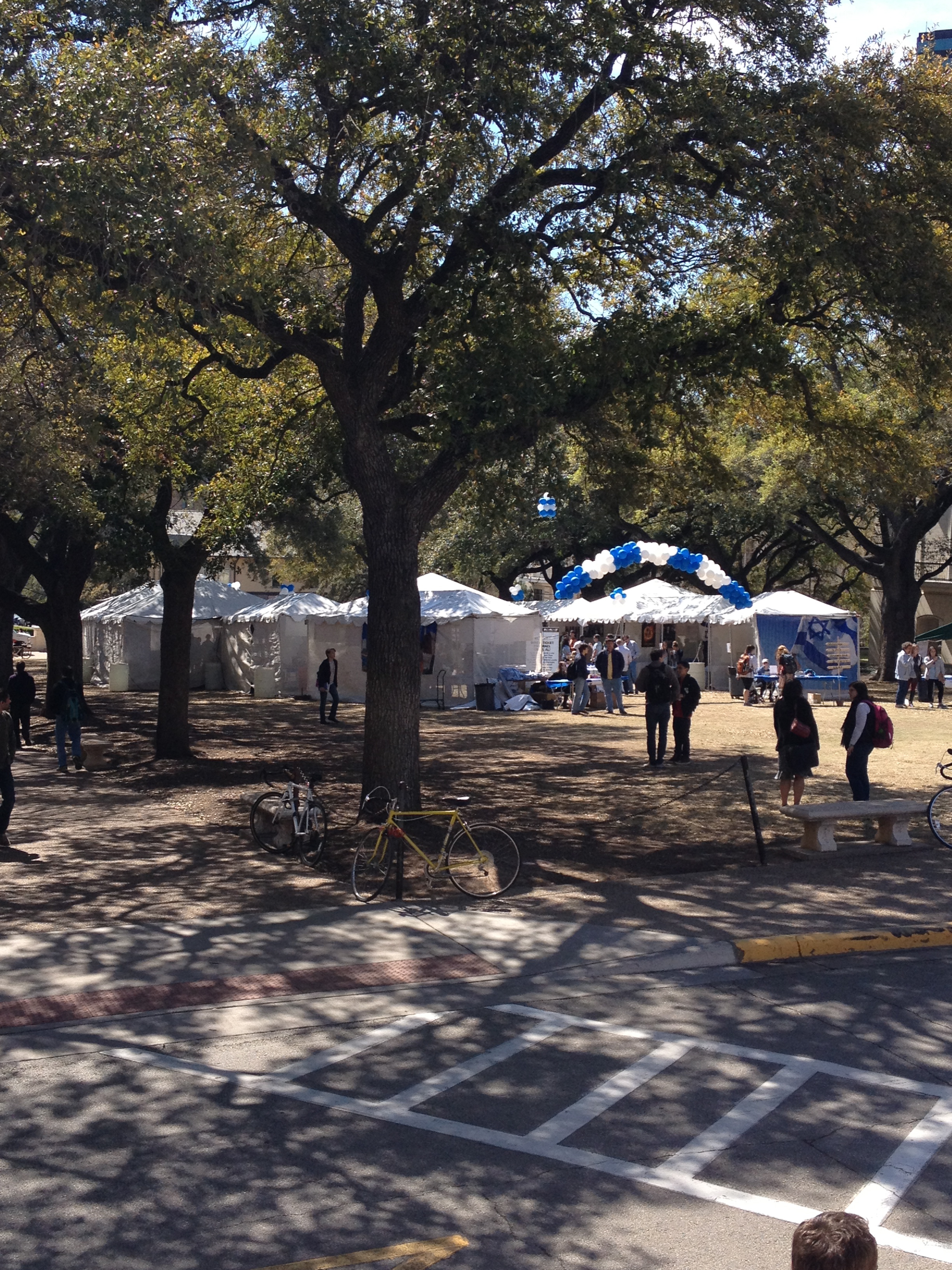
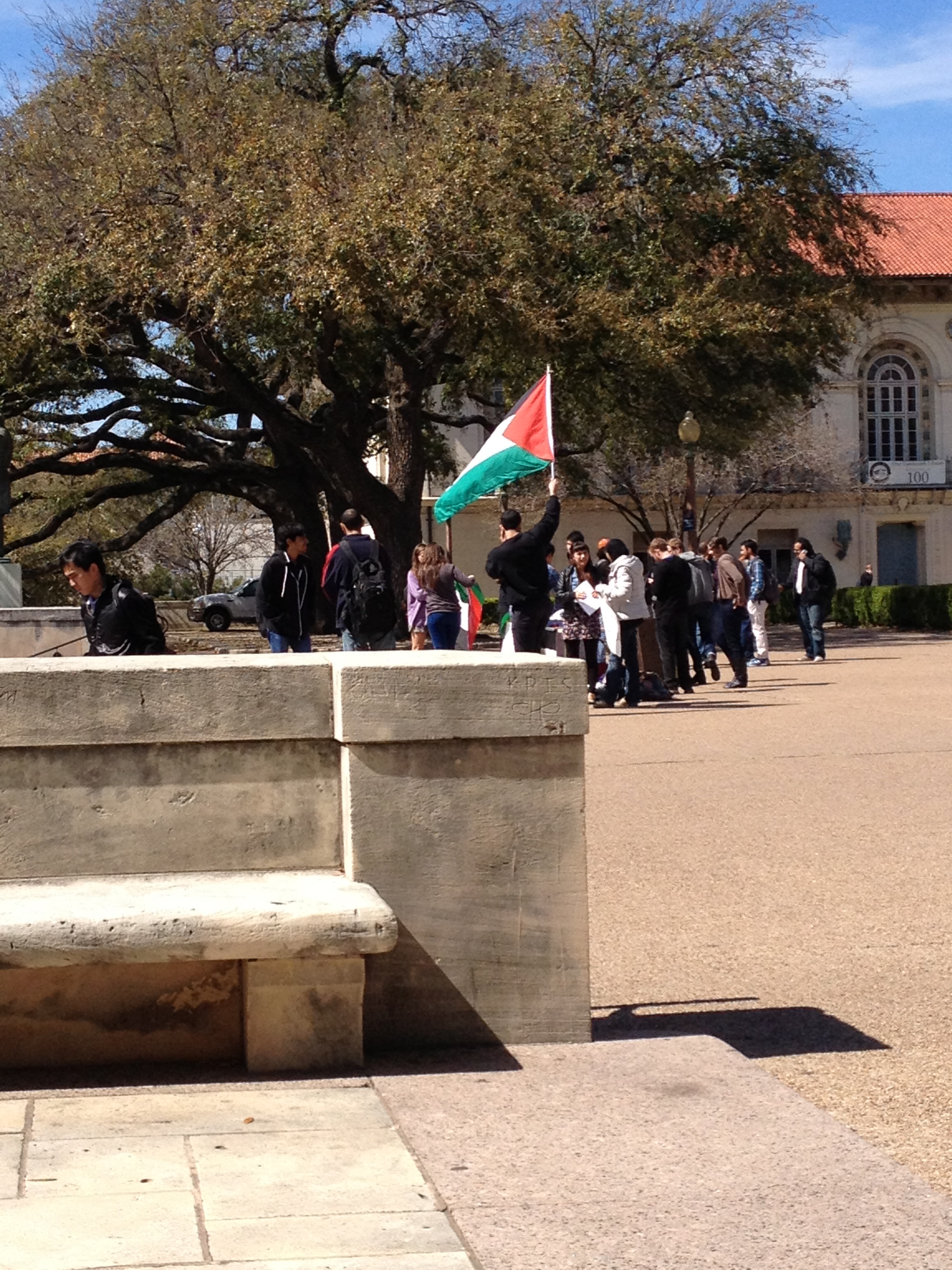
Yesterday I spent on the campus of the University of Texas at Austin. Between appointments I was crossing a quad area and noticed a bunch of blue and white balloons. We’re all still kids inside when we see balloons. I stopped to look. Then I noticed, across the street (in which sat a very obvious police car) a small group of students waving a Palestinian flag. Several police, frankly looking bored, stood between the two peaceful groups.

IMG_0581IMG_0580

Looking back to the balloons, there were a series of tents set up and a sign read “Israel Block Party.” Obviously this had been a carefully planned event, and we all know the heinous story of the constant persecution of the Jews throughout much of “civilized” history. The simple table across the street bore the sign “Free Palestine.” Less than ten students stood around, handing out literature, peaceful, yet literally flying their flag. Yes, the Palestinians have also been oppressed for much of their history. If only adults could live so peacefully as these students. My heart went out to them.

The issue of Israel and Palestine is one of the deepest scars in our collective human psyche. Indirectly, that conflict is responsible for many tragic terrorist acts, including the attacks of 9/11. And it is so frustrating because both sides (and there are actually more than two) are victims. We like our good guys in white and our bad guys in black. I’m still an idealist, after all. Yet in Israel/Palestine we have two historically oppressed groups vying for the very same land. And in the middle of this maelstrom, the Bible. The very book that can be read as an eternal promise by God that the people of Israel should own this land. By 1947, however, we’d stopped relying on God and began relying on guns. And atomic bombs. And life has never been the same since.

Images of the wall going up between Israelis and Palestinians just after the wall went down in Berlin reminded me of Bush’s proposed wall between Texas and Mexico. Here in Texas just about everyone in the lower paying jobs I’ve met is hispanic. And friendly. Grateful in a way that many of us wouldn’t emulate in such low stations. We are all people. We all experience the same feelings, needs, and desires. Why not tear down the walls and let us look at one another? Take a good, long look. And my idealistic self says, if we face another human being with love everything will be all right.


Continental Drift

So this is the way epiphany works. (I know it’s Lent, but I’ve got bigger fish to fry.) I sat down to check my personal email after a horrid day at work, and since I have a Verizon account, I can’t help but see the news headline that’s on the page when I open it. When the headline said something about a new continent discovered by scientists under the ocean, I’ll have to admit that Atlantis sounded better than anything I’d heard in the office. So it was worth a click.

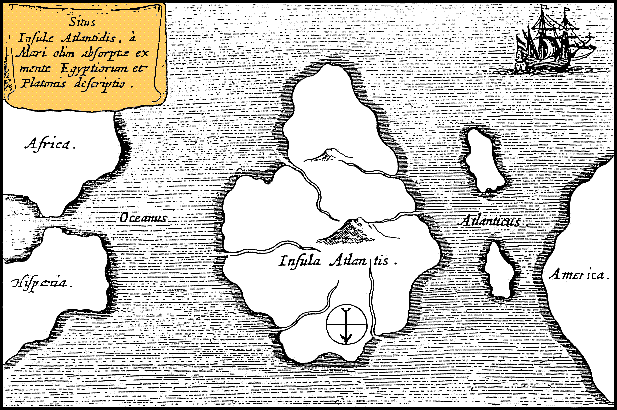
Athanasius_Kircher's_Atlantis

Turns out that this isn’t Atlantis at all—I have this habit of making naive assumptions—but a continent just north of Madagascar that sunk some nine million years ago. No happy lemurs or Homo sapiens around then. So when this Atlantis sank, there was nobody around to see it. At least not Plato.

The story was broadcast by Newsy and it made mention of Science World Report. Here’s where the epiphany piphed. I’d never heard of Science World Report. When I went to their site, the wonders of the universe spread out before me. “Dying Stars Reveal the Clue to Extraterrestrial Life: Earth-like Planets Unmasked” read one headline. “How Dinosaurs Evolved the World’s Longest Necks While Giraffes Fell Short.” These are the things I need to brighten me after a rotten day. A world with wonder in it. A world where money is not the sole, or even the highest good. A world where an intellect need not go to waste.

“Human Language May Have Evolved from Birdsong: New Meaning for Communication.” This website is like my eternal monologue in headline format. I’m not naive enough to suppose this website will be the nepenthe for all my workaday woes. But it does serve to remind me that science and religion are not always foes. A religion only becomes belligerent when it takes its truisms too seriously. We evolved in a world of wonder, but we’ve taken great care to remove the wonder from it. As if joy and delight were puerile phantasms with no place in the serious adult world of finance and industry.

I became an educator because I’ve always been in love with ideas. I lost my job in education because I was an idealist. Yes, continents do indeed sink. And while it may not be Atlantis down there, a simple click led me to a world of wonder. And that is, if anything can be, cause for hope.


In Touch with History

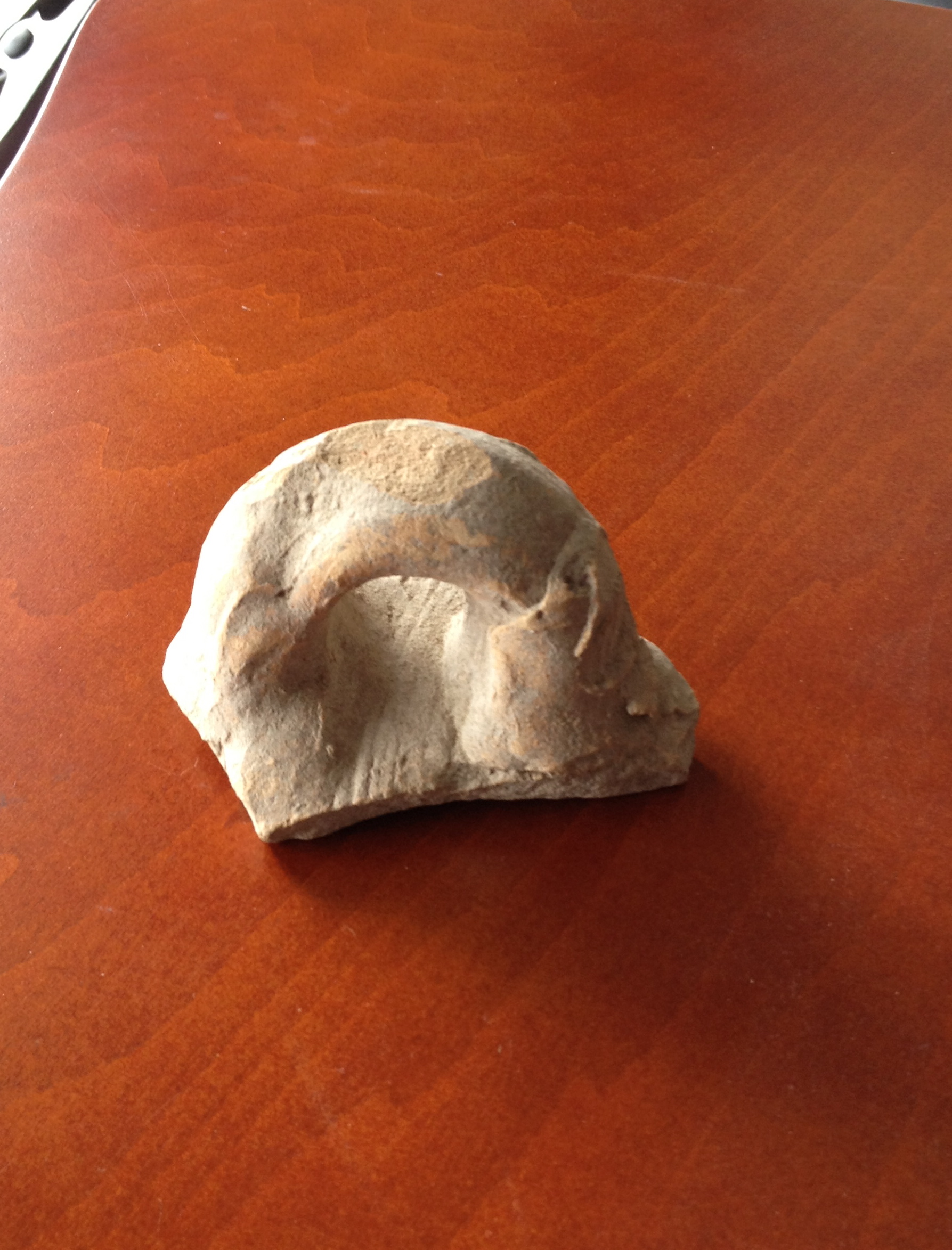
A friend recently sent me a package with a Roman jar handle from Caesarea Maritima. It’s not everyday that I receive 2000 year-old artifacts in the mail. Holding that ancient jar handle reminded me of my short stint as a wannabe archaeologist, not far from Caesarea at the site of Tel Dor. There’s no thrill like unearthing an artifact that has been buried for millennia, knowing that you are touching something a fellow human being dropped for the last time back in the days of the early Roman Empire. It is a humbling experience. In all probability the final touch was a heave into the dump, since clay jars are easily broken. But as I finger this ancient piece of useless junk, I can plainly make out how fingers like mine twisted the clay and pressed it on the jar body, much as I once did in art class, decades ago. I am connected with a stranger over the millennia by this simple bit of clay. We are united in an ancient family.

IMG_0555

Archaeology began as a biblical venture. Anyone who watches Raiders of the Lost Ark with archaeological sensibilities, after rolling their eyes (yes, it’s deserved) can’t help but realize a kernel of truth is buried here. Archaeologists don’t search for the ark, but it was religion that gave them the idea in the first place. Travel to the Middle East and begin digging up the places mentioned in the Bible. Those early archaeologists wanted to prove that the Bible story happened just as it was laid out. Only it didn’t. Archaeology soon began to reveal a more complicated picture. Jericho was uninhabited in Joshua’s day. And was there even a historical Joshua? What began as a charge to demonstrate that the Book of Books never gets it wrong transformed into a science with its immutable commitment to objectivity. And objects.

The desire for historical proof meets a deep need in people. We want to know what really happened. This simple jar handle before me tells a mute story of a person like most of us—never famous, never noticed in the noise of first century Palestine. Just some Jane or Joe throwing out the trash. That is the story of archaeology. That is the story of human life.

Every once in a while I ponder how insignificant we are. The vast majority of us will be remembered only a few years or decades beyond our demise. What will our artifacts say about us? One of the relics that will be found in the rubble of my life will be a Roman jar handle from an even earlier age. Long ago deemed junk by a person so different, but not so very different, from me. It was discarded two millennia ago. When it was found in the twentieth century it was a treasure. Thanks, Susan, for putting me in touch with history.


Wolves and Sheep

A state of the university address might not be a bad exercise.  If I might be so bold, as an inveterate outsider who nonetheless has tried to play by the rules, I have been cast in a supporting role—I think a few of my observations might be valid.  Some of my more pastoral colleagues try to reassure me that editors influence more people than professors, but in fact, the professors are the ones with the luxury to write books.  I get to sit on the bus and read them.  I do read many proposals before they become full-fledged books, and, interestingly, I get to discern how someone becomes an “expert.”  I worry a little about this latter point.  When it comes to religion, there are a few too many experts and dreadfully too few places for them to find gainful employment.  This is a volatile mix. I often run across religion experts who have professorships because they are of the right brand.  In a way that is almost inconceivable in any other profession, schools where religion is taught are actually allowed to discriminate.  This fact may even stretch out, in the case of some religions, to more objective fields.  Some religions teach that illness is spiritual rather than physical.  Some of them have medical schools, staffed by believers.

This comes back to the privileging of belief.  We all believe things, and most of us (if not all of us, when the lights are out) include some irrational things in that realm.  Beliefs can change, but not easily.  In the case of religions, most often we are taught our beliefs.  Sitting back and thinking about those truisms is the ultimate of academic enterprises, and yet few matters have a greater impact on society as a whole than the belief structures of people.  If you want to start a university for your brand of religion, after all, the law protects you if you keep your biases on your sleeve.  These people get to write books with the credibility that pathetic posers, like the current blogger, are doomed to lack.  You see, if someone is an expert, they have to have an institution to prove it.  That’s the way higher education works.

I read lots of stuff.  I sometimes think maybe I read a little too much because the ideas begin to affect my beliefs.  Nevertheless, it is a risk I’m willing to take.  It seems to me that if a religion is really as secure as they all pretend to be, you’d be willing to invite a few interlopers in your doors—a few wolves in wolves’ pelts.  If the sheep have to run, think of it as a chance to test their belief systems.  If the sheep overcome the wolves, then they will have earned the stars in their crowns.  Sometimes I am criticized for my liberal approach to things.  One thing my training has taught me, however, is that systems carefully reasoned through don’t shy away from challenges.  That’s a major difference on many belief-based structures.  Beliefs do not appreciate being challenged.  They want to be right.  But then, don’t we all?  It seems to me that the time for allowing prejudice against other religious views has outlived its usefulness.  If the truth is the truth, after all, it will be able to stand any fright that the wolves might bring.

Dore_ridinghood