Grown up Fish

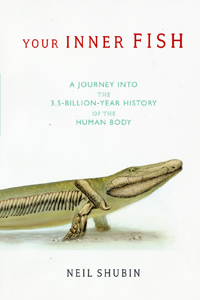
InnerFishEmbryonic recapitulation. That’s what it used to be called. I didn’t learn about this in biology class, but rather in the Creationist literature that challenged the very concept. I suppose those deep evolutionary roots are what led me to read Neil Shubin’s Your Inner Fish: A Journey into the 3.5-Billion-Year History of the Human Body. Not that anyone who’s considered the facts can question evolution, but this book nevertheless took me back along my own evolutionary descent from Fundamentalism to a reluctant rationalism. I recall the frequently repeated Fundie catch phrase, “no transitional forms.” Probably what they were looking for was a mermaid-like creature that was half reptile and half bird, divided down the middle. Even at a tender age, while accepting their rhetoric, I wondered why archaeopteryx didn’t qualify. A flying feathered lizard? Sounded pretty transitional to me. Shubin opens his fascinating account with the discovery of Tiktaalik, a transitional form in every sense of the word. Here is a fossil that shows the tell-tale limbs and organs of moving from fish to amphibian. Yes, Virginia, there is evolution.

Shubin doesn’t stop there, however. He traces the various features of human bodies back to our piscine ancestors. From gills to gonads, we are bipedal, air-breathing, mammalian fish. No surprises there, really. One gets the sense that Shubin’s book wouldn’t be such a wonder if there weren’t organized Creationists out there constantly challenging the obvious. All living things on this planet are clearly related. Some of the cousins may be very, very distant, but we are all part of the same family. This threatens Creationists and others who need to feel different, special. People are related to God, they suppose, in ways that mere animals are not. Biology gainsays that concept, so no matter how much evidence we might marshal, the Fundamentalist is duty-bound to reject it. We’re trying to break up a personal relationship here, after all.

While Shubin does a wonderful job of explaining whence our biological features, I was nevertheless heartened to read him referring to the essence of being human. Some scientists reject “essence” as a vague concept that can’t be examined in a laboratory. That may be true, but we all know what an essence is. As a concept it too has explanatory value. It would be very difficult to read Your Inner Fish and come out doubting evolution. At the same time, Shubin realizes that people write books, and fish do not. That’s not to say that we’re superior to our fishy family, but that we are different. We have our own essences. That doesn’t mean we were created this way—maybe we’ve just evolved with them. Either way, Shubin is charming romp though 3.5 billion years of our history.

Moocher Man

Influenza seems to be going around. Since I spend at least three hours a day on a crowded bus I get to observe all kinds of uncouth behavior. Not that I’m always Mr. Manners (New York has a way of doing that to you), but I do cover my face when I cough or sneeze and sometimes I feel that I’m in the minority. My wife, concerned with supplies dwindling, made an appointment for me to get a flu shot at the local clinic. I went in and took a number. I guess I’ve been cursed with good health, and that may be a good thing. For my first five years in New Jersey I couldn’t afford health insurance—this was known as Bush Care—and hadn’t needed to see a doctor. Yesterday was my first time in the clinic. Although I had a confirmed appointment, a kind of argument broke out in the office (this is, after all, New Jersey) because non-patients weren’t supposed to be given the inoculation. Or they were, but they had to pay for it. Or their insurance would be charged and they could get the shot as long as they had insurance. Or why didn’t people just go to Walgreens instead. In the midst of the melee, a nurse called my name and a few minutes later I was being jabbed and sent on my way.

In all of this, one of the largest ethical issues of this country is highlighted. Who has a right to basic medical care? Among the conservative crowd that even includes some who can’t afford insurance, there are those who decry moochers. I grew up without health insurance. My mother relied on welfare to help raise three boys whose father had disappeared and our medical care was very, very basic indeed. Maybe people just didn’t say it in front of kids back in the 60’s, but I never heard anyone grousing that the poor should be left to fend for themselves. That took Reaganomics. In any case, working as hard as I could to break out of that lower class, I earned a Ph.D. only to be turned out of a job by a devout worshipper of George W. Bush. No medical insurance. Again. Now with a child of my own. What I’ve heard since the new millennium is that for those who can’t afford insurance—too bad! Just get a job, bum!

JesusHealing

I often think about those who make such statements and how they valorize the Bible. If I recall correctly, Jesus handed out free health care. Socialized medicine existed in his corner of the world twenty centuries ago. And we in one of the most prosperous nations on earth argue about who can get a flu shot. In the end, I paid for it; I’d even taken my checkbook along with that intent. Nobody thought to ask me. But as I sat there within full view and certainly full conversational distance, I was objectified by the medical system. I wasn’t a guy who sits on a crowded bus with people who don’t cover their mouths. I was a moocher. A liability. In the waiting room around me I noticed patients tucking away passports and green cards. This is New Jersey, after all. For many, however, despite the cold we’re experiencing, it might feel like a much, much hotter place indeed. A place where, the Bible intimates, nobody cares about anybody else and the flames never die.


Deep Things

Religion concerns itself with the big issues. The biggest. As a child, I remember wondering how anyone could be concerned with less than the ultimate. No, I wasn’t a nascent Tillichian, I was just someone who saw things in what I supposed was a practical light. If you’ve got the temporary, the fleeting, the insubstantial over here, and the permanent, immortal, supreme over there—who wouldn’t go for the gusto? I suppose by my reasoning that all people would end up clergy of some sort, we would all be fixated on why we’re here and what our purpose was. You’ll still find pockets of theologians here and there who debate these kinds of issues, but our existence has grown comfortable enough that, for some people at least, if this ends up being all there is then, gosh, it’s been a fun ride thank you very much. But I don’t want to get out of the train just yet. I wonder if there’s more than the ultimate. It is a religious question.

For a while I grew enamored of the trappings of religion. Ceremony, ritual, strong rhetoric in sermons—these things can move you, and become beguiling. Somehow, knowing there’s an infinite universe just outside the church doors gives me pause for consideration. The ultimate must be very big. Walking through a large city helps to provide some perspective. I find myself next to buildings that cause me to tremble when I consider the implications. Next to those tons and tons of stone, steel, and glass, I am the smallest spark. But those buildings are dwarfed by the city that contains them, and that city a mere pinpoint on a map of the country. Even the planet is less than an atom in the universe of infinite size. Who can help but to be concerned about the scope of it all? Ever since I was a child I’ve worried about this.

In the media today, religion is all about hypocrisy and whose pants are at what latitude vis-a-vis whom. While matters of love are ultimate in their own way, we, as people, have a much larger space with which to concern ourselves. Science has stepped up to the dock when it comes to sworn testimony about the universe we inhabit, but even scientists shrug once we get back before the big bang. Time is even more inexorable than space—there’s always got to be a time before time. Like any child we can always ask, and what happened before that? Perhaps time is the true ultimate. Thank you for spending a bit of your ultimate reading this. It’s time for me to catch the bus, but work will never inspire me the way the rest of the universe does.

Hubble's eye view

Hubble’s eye view


2014

IMG_0542

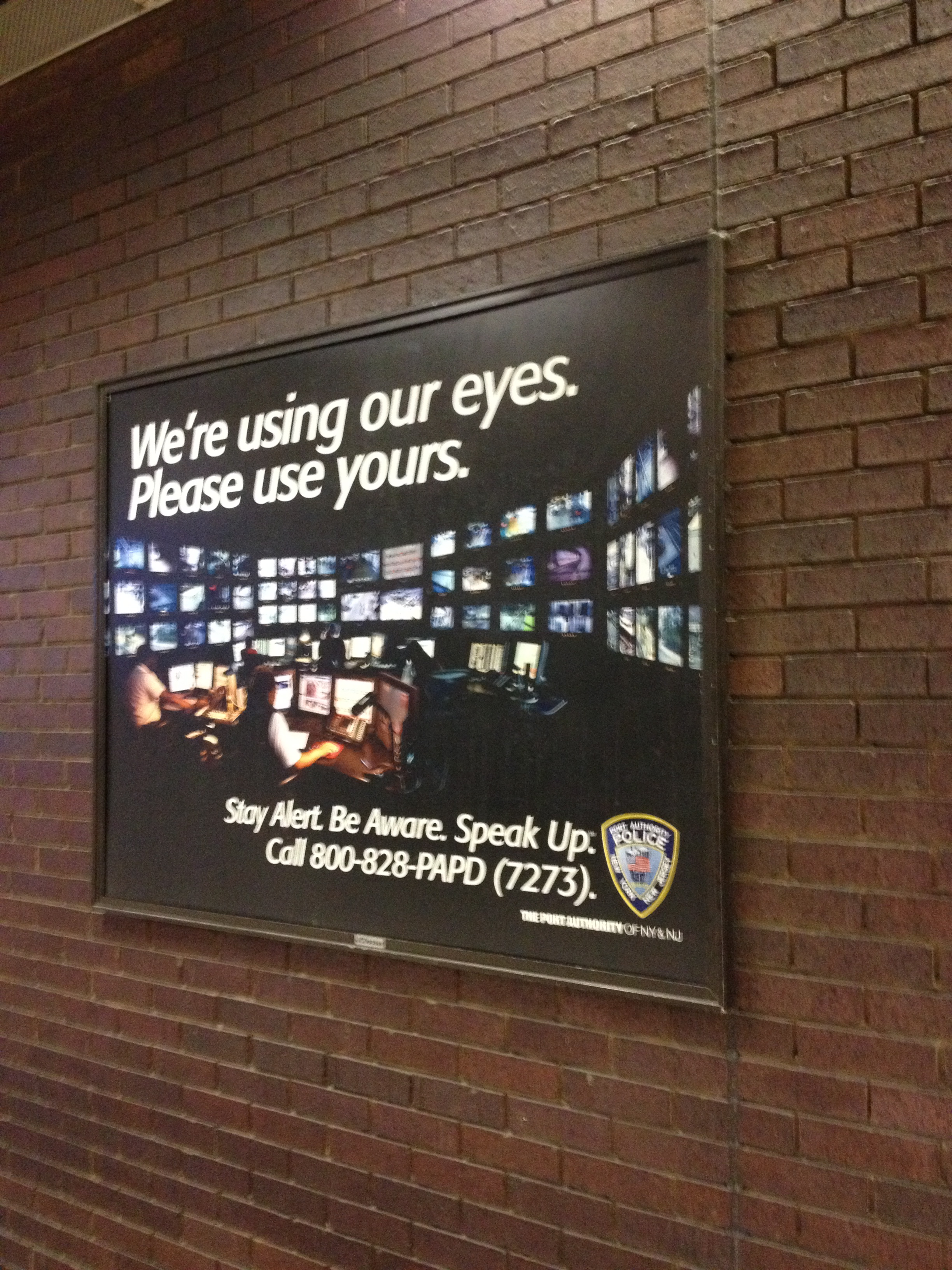
New York City, in a public place—I dare not say where—I see this sign. A certain Orwellian chill shivers my mind as I think back to 1984. Posters everywhere; you are being watched. If you see something, say something. NYPD Security Camera in Area. We have let our fear drive us into the arms of Big Brother. The problem with principle is that it requires a fair amount of spine. Who can stand in the face of possible, if remote, terrorist attack? Is it not the large, amorphous, faceless government that we, along with millions of strangers, have elected? I’ve read about their behavior; I’m not sure I want them watching me.

We have let fear define us. How far we have come from FDR’s admonition that the only thing we have to fear is freedom itself. Don’t get me wrong—I don’t approve of terrorists or any other cowards. If our response, however, is to cower in the many corners of our crowded cities while our own military patrols the parameter, well, the last place I recall like that was my visit to Jerusalem just months before the First Intifada. Even the bus drivers wore pistols. The heat from that burning car beside the road was worse than anything the Judaean Wilderness could throw at you. And still they long for peace.

Differing political and social outlooks need not come to blows. I’ll admit to being a shameless idealist if you’ll lay down your guns. Even if you won’t. It seems to me that we’ve forged ourselves a chain that reinforces outmoded associations. We can create the most intelligent weapons imaginable, but we can’t figure out how to cut a simple chain. Yes, I eye each jet flying a little too low with suspicion, and sometimes I walk a little too swiftly through the crowds at Times Square. I’d like to pretend I’m free, but ever since I read 1984—and it was close to that time—I’ve noticed that Big Brother looms taller than any tower in a world where inequality persists.


Soul University

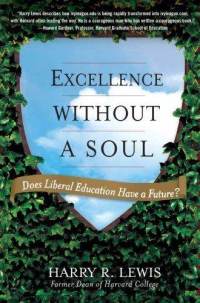
ExcellenceWithoutSoul Cambridge, Massachusetts is a likable town. As students at Boston University my friends and I would occasionally take the red line to Harvard Square and shuffle through the leaves of that venerable institution that gives the square its name. One of the treats was stopping in The Coop, the Harvard bookstore that made us all feel smart. While at Harvard last year, The Coop was part of my professional, editorial remit. I spied a book entitled Excellence Without a Soul: Does Liberal Education Have a Future?, by Harry R. Lewis. I have often thought about how higher education has slipped its moorings these past few decades, and wondered what an erstwhile Harvard dean had to say about the matter. The leaves on campus weren’t so abundant last October, but I felt that same inferiority complex that being on the Harvard campus always gives me. Of course, I had received an acceptance letter from Harvard Divinity School when I considered transferring there, but it was easier to stay at BU and complain.

Lewis’s book is a somewhat nostalgic consideration of how Harvard has evolved from a seminary to a powerhouse university—the powerhouse university—in the new world. There is no doubt that Harvard is our oldest institution of higher education, and there is no doubt that it has the money to be “the best.” But by what measure? This is one of the questions Lewis asks, repeatedly. Still, the assumption is always lurking in the background that Harvard is the best, but as Lewis notes in the book, there is no one best doctor just like there is no one best book. Harvard is good, but so are many other schools. They all suffer from the same indifference in a society that takes education for granted. The real problem is that we like simple solutions. Take a look around you—you’ll see what I mean.

It is difficult to feel sorry for Harvard. The elite of the elite, it has that time-honored patina that antique specialists love so much. What it doesn’t have it can afford to buy. There is no doubt, however, that as Harvard leans, so tilt the other universities of this country. In my professional field I’ve seldom met an unemployed Harvard Ph.D. Those of us who attended even older universities (yes, the Europeans came up with the idea first) with even more recognizable alumni—has anyone heard of Charles Darwin or David Hume? Adam Smith?—are used to being passed over for positions while Harvard writes its own checks. Elitism may be at the heart of the problem. It’s not that I wish hard times on Harvard, it’s just that I wish we’d be honest about the academic enterprise. Has higher education lost its soul? To find the answer we’re going to have to look beyond Cambridge, Massachusetts. But the leaves in autumn are certainly pretty, if not so abundant as they were before.


Without a Hitch

I’m not really afraid of dying. All those years of being taught that “to die is to gain” have obviously done their work. At the same time, it is a poignant exercise to read the posthumous memoirs of a dying man. I remember my first funeral. Although I don’t recall the name of the poor, deceased honoree, I still see the reactions of the living vividly. I was under ten at the time, and the funeral home in Franklin, Pennsylvania was in a very somber mood. The man, who had been a friend of the family, “was not a Christian.” Having been buffed and rubbed in the Fundamentalist tub from my earliest days, I didn’t realize that what was meant was actually that he hadn’t been an active member of our particular church. Nevertheless, as a child, you get deeply impressed with these kinds of things. “I’ll never go to the funeral of a non-Christian again,” I remember my mother telling a friend. “The minister couldn’t find anything comforting to say.” While funerals are sad occasions by definition, this one left a crater that is still fresh over forty years later.

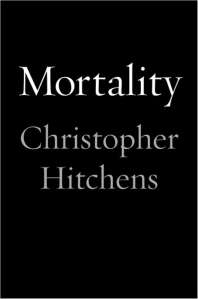
MortalityChristopher Hitchens is someone I found through his book God is Not Great. I don’t have time to read magazines, and I hadn’t read any of his previous works, but he raised some extremely valid points in this diatribe. My wife recently bought me his final oeuvre, Mortality. I felt as if I were back in that funeral home. It is not that I still hold to the odd belief system of Fundamentalism—of this my regular readers will have no doubt—but it is the forlorn feeling of reading the words of someone dying who hopes for nothing. Yes, it may be Stoic, and even noble. Certainly it seems far more worthy than visions of living in opulence with lots of available virgins with whom to toy while angels strum their harps overhead, but the certitude that one’s final days will be nothing but prolonged suffering—ouch! Maybe there isn’t a heaven, and if there’s a hell there’s something morally wrong with the universe, but doesn’t some residue of a human life remain? Even if it’s just the memories, the marks that we’ve made on others’ minds, don’t we somehow survive? Dying without hope nevertheless feels like milling about in that doleful crowd of specific Christians years ago.

Hitchens does offer a chapter in his final words devoted to those Christians who responded to his cancer with an unholy Schadenfreude, trying to torture the thoughts of a dying man with the promise of an eternal hell after experiencing a temporary hell of cancer treatments. This chapter made me sick. Anyone who so completely misses the message of compassion that suffuses the Gospels can hardly claim the designation Christian, I would insist. No one, no matter what their eternal plans, has the right to try to fracture anyone’s tenuous tranquility to make their own crown shine a little brighter. Such weekend warriors likely imagine that they are defending their fragile God, but in reality they are demonstrating that some of the criticisms of Hitchens were very well placed to begin with. No religion will live up to its full potential until it succeeds in the most basic practice of all—treating all people with respect and dignity. Until then, death has the final word.


The Best Gift

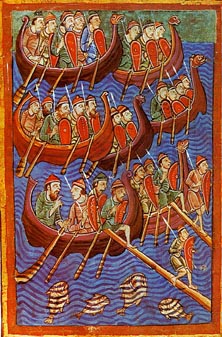
Standing outside the footprint of a circular chapel next to the ancient ruins of a drinking hall in Ophir, the Orkney Islands, with friends. We’re quoting from the memorable scene in the Orkneyinga Saga where Svein Asleifarson leapt out and killed Svein “Breast-Rope” as drunken vikings staggered back and forth from the Earl’s Bu to the chapel one Christmas season some nine centuries ago. The Orkneys used to belong to Norway and had a close connection with Iceland, which, all things considered, is not that far off. While working on my doctorate in ancient Syrian mythology, I experienced a fascination with Icelandic viking sagas and read several of them (in translation, of course). Traveling to the Orkney Islands was about as close to Iceland as we’d hope to get on a student’s budget, and the atmosphere of these historic islands does not disappoint. We were standing on the actual site of this historical incident one violent Christmas long ago.

VikingsImagining, however, is not the same as condoning. Nearing a millennium later, Iceland celebrates Christmas with “Jolabokaflod,” the Christmas book flood. Armed with books rather than broadswords, the folks of Iceland have built a considerable literary reputation. According to an NPR story my wife and traveling partner sent me, Iceland publishes more books per capita than any other country, and giving books at Christmas is a national tradition. Reykjavík is a UNESCO-designated City of Literature. Unlike the United States, a large proportion of the population of Iceland buys books, according to the story, and I can’t help but wonder if this isn’t related to two other Icelandic phenomena as well. Iceland has very little gun violence and it is one of the most ecofriendly countries on the planet. While it is only a feeling, I believe that widespread reading makes a better society.

I remember the experience of growing up and hearing other kids complaining bitterly about assigned reading. Here in this wild west corner of the world, we’re too full of dreams of action to spend quiet hours improving our minds. Guns are easy to acquire and too easy to use against the innocent. We could sure use a Jolabokaflod, it sounds like to me. Towards the end of each year I like to tally up an approximation of how many books I read in the previous twelve months. Although some are definitely better than others, each one is its own gift, a glimpse into someone else’s worldview. And such glimpsing aids in understanding. I may not agree with you, but I know where you’re coming from. And as we enter that long, cold stretch of January and February I feel ill-prepared if I don’t have a stockpile of books to get me through the darkness of this time of year. And one of my fantasies will be a world that can see from the blood-stained ground of Ophir all the way to Reykjavik.


No Song for Old Men

Succoth in Waukesha, Wisconsin. A pillar of the local synagogue had invited me to come to his booth with some of my seminary students to let them celebrate an ancient tradition and talk to a Jewish believer about it. We were all having a good time, and someone mentioned Leonard Cohen’s song “Hallelujah.” One of the seminarians, brash as always, spoke up and admired “Rufus Wainwright’s cover in the movie Shrek.” Although I’d corrected many students before, I let this faux pas ride. Music is very personal to me, and the cover played in the movie Shrek was John Cale’s version, although the soundtrack substituted Rufus Wainwright’s cover of John Cale’s cover. And this student was far too young to have appreciated the Velvet Underground. I was a little surprised, then, when my wife pointed me to a CNN story this week about the thriving popularity of the song. Instead of putting my paltry words out there on CNN for all the world to see, I decided to address them here, to my private audience.

Velvet_Underground_and_Nico

Leonard Cohen has been described as a man who writes songs with a prayerbook in one hand and a picture of a naked lady in the other. He has spent time in monasteries and his lyrics have a very serious edge to them. What the many self-proclaimed experts commenting on CNN seem to have missed is that Cohen’s song is a song for old men looking backward. Yes, it is rife with biblical imagery, but no, it is not a religious song. Not in the sense that it is often used today. John Cale got that. When I hear his early work with Lou Reed or even his first cover of “Hallelujah” that managed to capture something even Cohen hadn’t (no mean feat, that), I can hear the aging Cale casting a glance back to the same place that Cohen saw. We are all aging and we all remember the vitality of those years when possibilities seemed endless. No, it takes decades for a hallelujah to become broken. All the versions by popular artists trying to breathe soul into a tragedy have missed the point. It’s a cold and it’s a broken hallelujah.

I only listen to this song when I’m alone, preferably with John Cale. When Leonard Cohen sent him the lyrics there were 15 pages of them. The CNN report cites the 75 or 80 verses that Cohen wrote. That’s because the song is a life. The biblical images of the song first captured my attention, but I also realized that it was a song about something that’s gone and that’s never coming back. Not for guys my age. Not for guys who can still remember being eighteen and feeling like life hadn’t even begun yet. Now I look back over five decades. I hear “Heroin” seeping from my brother’s room, somehow knowing the dissonant chords would stay with me for the rest of my life, although I have never personally used drugs. There is a longing there, a longing for something that life offers maybe once, for a few short years. Age and inevitability catch up with everyone, and breathy young artists think they’re chic when they cover a song that is meant for old men who remember what glory used to feel like. Only those with experienced ears can really hear Leonard Cohen’s hallelujah.


Umbrella Apocalypse

Broken ribs and twisted, tortured limbs hanging useless under a leaden sky. It was a scene of carnage. I knew the world was supposed to end yesterday, but I didn’t believe I would experience it, but the evidence was indisputable. It was the apocalypse. For umbrellas. Winter storm Draco had melted by the time he reached the East Coast. I awoke to the apartment shuddering in the wind, and I could hear the rain pelting the windows. I had one more day to go to work before two things: the end of the year and the end of the world. And I would be relying on New Jersey Transit. The very thought makes me want to cower in the closet. My bus stop has no shelter—it’s just an exposed street corner, not far enough away to justify a drive. I stood in the rain, faithful umbrella held like a shield in the blast of Draco’s breath. The bus, of course, was nearly half an hour late. I stumbled up the stairs, glasses dripping, and decided that today, only today, I would take the subway across Manhattan. After all, the world was ending.

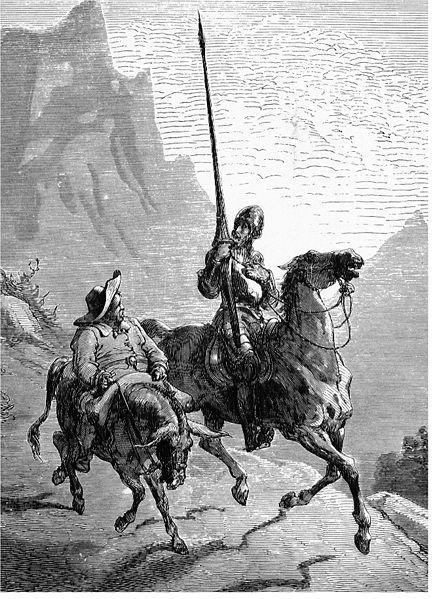
The lines from the Port Authority to the bowels of the subway are like those old documentaries of massive lemming migrations off a cliff. My turn. The card reader said “Card Already Expired.” Metrocards don’t expire; you charge them up and recharge them when they’re empty. I still had money on my account, but with other lemmings close behind, and rush-hour grade lines at the recharging machines, I decided to fight the dragon on the streets. It was with a certain Cervantesque tilting at the wind that I made my way across West 41st Street, umbrella forced into a tiny cone by Manhattan’s famous wind tunnels. Twice I was blown off the curb. Then at 5th Avenue the wind defied both the laws of physics and the agreed conventions of meteorology and slammed me from north and south simultaneously, my umbrella bucking in my hands like a terrified stallion. It sustained two broken ribs, metal twisted in opposite directions, flesh flapping uselessly. By the time I reached Grand Central, it couldn’t close, so I dumped my companion into a garbage can with other umbrellas and went on alone.

When I got to the office I discovered my hat was missing. While it would be more dramatic to say that a stocking cap blew right off my head, the truth is that it must’ve fallen out of my coat pocket. I was wet, buffeted, and without two items with which I began the day. The sky was still black as I looked out on the scene of the final battle from The Avengers movie. It had been an apocalypse all right, for the umbrellas. Chicago may be the Windy City, but New York is the Umbrella Killer. When I made it home as early as 6 p.m., I knew the world had ended for certain. I read the Cajun Night Before Christmas and went to bed, thinking of all those poor, dismembered umbrellas. Today is the day after the end of the world, and I am huddled here waiting for the dawn.

Don Quixote rides out of Manhattan yesterday with Sancho Panza wondering at his denuded umbrella.

Don Quixote rides out of Manhattan yesterday with Sancho Panza wondering at his denuded umbrella.


A Big Joke

On the evening table my wife left a token of hope for me to read in this hopeful season. New Jersey “Transit” claimed that the very next day riders of the extensive bus system would be able to track buses precisely on their smart phones. No more wondering “has the bus already come, or is it late (again)?” I laughed when I read this because that very evening in the Port Authority my bus never came. The frazzled and apologetic dispatcher said nobody knew where the driver was. Did anyone think to drag the East River? I wondered. As other buses pulled to the gate, drivers refusing to switch routes, the line grew and grew. The bus scheduled for the next half hour did not show. My daughter was waiting for me to fix dinner. On a good day I’m home by 6:30. This was not a good day. I laughed ironically at the article and went to bed. My morning bus leaves, in theory, before 6:00 a.m. A day later, in the Port Authority. My bus, which can now be tracked with precision, precisely failed to show up. I’m sure you know the dispatcher’s chorus—please join in—”nobody knows where the driver is.”

So what is a diatribe like this doing on a blog about religion? I’m as mad as Hell about this, that’s why! Every month I pay hundreds of dollars for a bus pass. I think the least New Jersey Transit could do is the courtesy of sending a bus. In case anyone from NJ Transit is reading this, a bus is a large vehicle that seats about 50 adults and generally runs the same way every day. It’s called a “route.” People use it to get to and from work. Of course nobody expects the executives of a company that services over 19,000 bus stops to take a bus to work. They probably have to be on time. I take the earliest possible bus from my town to New York City. Most days it is late and consequently so am I. For this I spend over three grand a year.

This is not about Hurricane Sandy. Buses have been back on schedule since Thanksgiving. What it comes down to is the fate of most capitalistic ventures—the working person butters the bread of the Executive Director who earns more than $260,000 a year. Last night I toyed with the idea of getting other disgruntled commuters to link arms and stand across the exit ramp, or to lay down in front of the buses until a bus for my route was sent. I suspect, though, that they realize as well as I do that Tiananmen Square doesn’t take much to morph into Times Square when an individual stands in the way of corporate gain. Tonight I plan to wear my good walking shoes. After all, I paid good money for them too. Unless, of course, anybody out there would like to drive this bus?

Ghost bus

Ghost bus


Rock Hard Cafe

IMG_0518

At first glance it may not appear to be much. A small chunk of rock, probably limestone. Hardly large enough to be used in a sling against a giant in a pinch. Still, it is special. What makes this rock special is the context from which it was removed. A friend has recently returned from Israel and he brought this rock for me. It is from the Mount of the Temptation, atop which sits a lonely monastery cared for by a single, elderly monk. The thought of someone thinking of me in such a (literally) God-forsaken wilderness is touching. My brief travels through the desert of Judea offered plenty to occupy my restless mind. I’m pretty sure we zoomed by the base of the Mount of Temptation in an air conditioned bus one day on our way to somewhere less desolate. Or more. The sharp-voiced little skeptic in my head immediately kicks in: if Jesus was alone when tempted, how could anybody possibly know where it happened? I can’t picture him leading a tour there later—“and this is where I almost turned stone to bread; don’t those pebbles look like challah to you?”

But then, it’s not about historical accuracy. This little stone in front of me is a symbol. Broken off of the karst geography of the rocky spine of the Holy Land, this shard is meant to remind me to avoid temptation. A nearly identical piece of stone from Israel sits among my teaching trinkets. One of my students went to Israel back in my days at Nashotah House and returned with a bit of limestone for me. She said, “you can keep it as long as you put it on top of my gravestone when I die.” This was a custom I’d observed long before I’d even heard of Nashotah House. Long before religion grew flinty and unyielding. Stones bear remembrance. Although Israel is not as arid as many people believe it to be, rock is a natural resource of uncommon abundance. We age and die, but the rock remains. The rock remembers.

My six weeks in Israel were spent among the rocks of an ancient settlement known as Tel Dor. Archaeology, I learned, is mostly just removing the dirt from the rocks in the ground—at least at the entry level. Those stones tell a story. They were once a city, a district administrative center. Now they lie in dusty profusion, and only the most ardent of Bible readers will recall ever seeing Dor’s name in the pages of Holy Writ. Built by Solomon, the Bible grandly claims. Now all is ruins. The grandeur of a king toppled with the passage of time. My mind is drawn back to a treeless stretch of a mountain devoid of even the hardiest plants. A person can grow mighty hungry there. Mighty hungry indeed. Temptation comes, unbidden. Life is an unbroken chain of temptation, for those willing to be honest in the desert. That little stone is, in truth, bread.


The Last December

December 2012—it is supposedly the last month in the world. Yesterday did dawn with the date being 1212012, but since the local tree farm opened its gates yesterday, my family set out to select a tree anyway. As we wandered amid the pines it was clear that for many the iconic sign of Christmas is the tree. We learned on our first year in New Jersey that you’d better not wait until reasonably close to Christmas to pick out a tree—we visited this very lot then only to discover that precut trees were all that were available (and they were from Pennsylvania) and we had established a tradition of picking our own. Getting to know the tree first. Walking around and looking from all angles, trying to learn if it was healthy or too dry. Were there any gaping gaps that would be an obvious problem? Hard to tell when the tree is wrapped up in fishnet plastic and tucked into a corner like an old umbrella. Here, so close to the Big Apple, you need to claim your tree early. If you don’t want to cut it down right away, you can tag it—claim it as your own and come back later to chop it down. We weren’t the only ones taking great care in selecting.

IMG_0514

Tree farming is a business with a long view. Trees don’t mature overnight. When it’s the last month of the world, one must take these weighty things into consideration. Even before this terminal date, you would need to make an awful lot of money in just one month of the year to keep the business going. Maybe they need a green Christmas. Of course, greenery in winter symbolizes life in the midst of death. The germanic originators of the tradition were keeping a very appropriate pagan idea alive when they dedicated their trees to Christmas. Last year when we couldn’t have a real tree, it felt like we’d lost a friend. Our tree farming friends know that feeling very well.

The “Keep Christ in Christmas” signs and bumper stickers have begun sprouting up in yards and on bumpers in their annual exuberance. Funny thing is, Christmas has its base in ancient pagan customs. To hear the Bible tell it, Jesus’ birth was an understated event. The only people who had an angelic concert were some shepherds (we don’t know how many) on the hills outside of a small town. And, as far was we can tell, it would have probably been in April. As the days grow wearily short, however, we need a little light to keep us going. That was the pagan wisdom behind the Yule Log and various festivals of light to encourage nature to bring some brightness back. These short days can be difficult enough even in the age of artificial light and constantly glowing electronic screens. And knowing this is the last month of the world, we want to festoon our trees with tiny pinpoints of expectation and hope that nature somehow gets the message that we’ve had enough of darkness and wish for a 2013 redolent with light. But we’ll just have to wait and see.


Phantom Prayers

Religion and theater have much in common. I suspect that this is one reason several religious traditions initially protested against the secular theater. Morality plays were one thing, but dramas about purely human matters are quite another. Being given the very generous gift of tickets to the Phantom of the Opera, I recently had the opportunity to experience Broadway’s longest continually running show. It occurred to me that theater can often, if done right, draw in huge crowds—the line to get in was certainly impressive—while other than megachurches and very conservative religious movements based on reaffirmation of one’s superiority, many religious houses struggle to draw people in basically for free. It could be argued that secular entertainment requires less of an attendee than a religious service, but I wonder if that’s true. To receive your money’s worth for a show, you must be willing to put yourself into it.

While Andrew Lloyd Webber has never been afraid of religious themes—think of Jesus Christ Superstar and Joseph and the Amazing Technicolor Dreamcoat, or even Whistle Down the Wind—Phantom of the Opera is loosely based on the early twentieth century novel by Gaston Leroux, the story of a hideously deformed musician who falls in love with a beautiful opera star. Although characterized as “a monster,” the Phantom is, after all merely human. Lloyd Webber’s adaptation leaves much of the story undeveloped, allowing the imagination to chart its own course. This is precisely where theater diverges from religious performance—imagination. Religions frequently claim to possess all the answers and questioning or imagining new approaches to age-old dilemmas is often discouraged. Unless, of course, the dilemma is how to draw more people in. Those who run megachurches learned the lesson of theatrics long ago.

For all that, Phantom of the Opera is hardly devoid of religious sensibilities. In one moody scene where Christine visits her father’s grave for solace, and perhaps advice, the first set piece visible is the cross atop the tomb. It is from this cross that the Phantom in the guise of the “angel of music” comes to her. Having the representation of death emerge from a cross is a powerful enough symbol. During this scene Christine’s plaintive cries to her father sound like a prayer. The prayer is heard, however, only by a phantom. The end of the story is ambiguous, something religious performance simply cannot tolerate. And yet, as I was being pushed and propelled down a crowded Broadway after the show, amid a flood of humanity that had emerged from many theater doors, I wondered if this “secular” experience might not be religious after all.

Religious tracts?


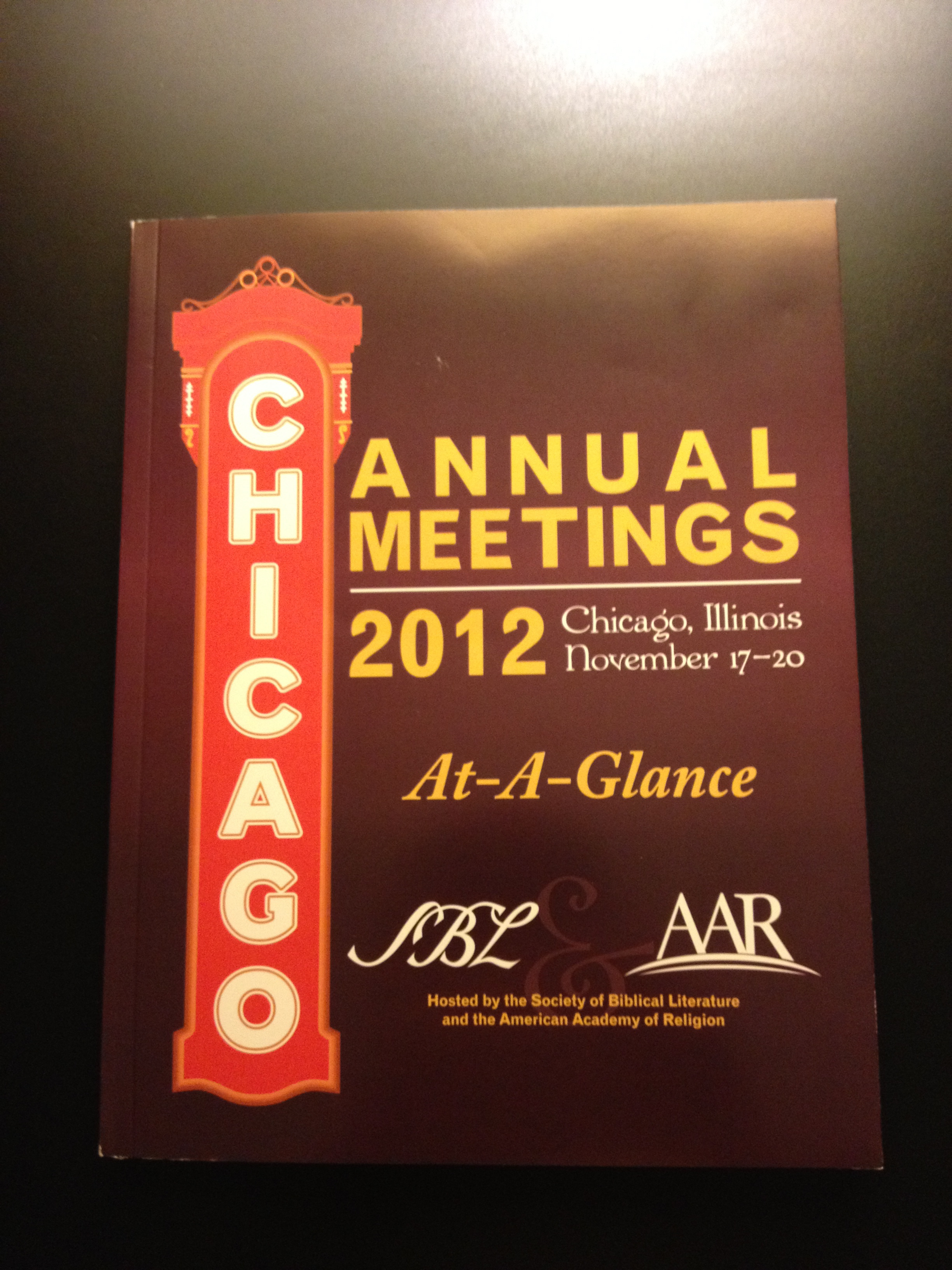
AAR/SBL Chicago

On just about any playground you’ll spot the kid who’s watching from the side, instead of playing with the others. That’s me. I don’t suspect that anyone starts life wanting to be left out, but some of us—attuned to the subtler messages of life—become aware that we’re not really invited or welcome. That sensation bathed me in its eldritch light once again while waiting for my flight to Chicago for the American Academy of Religion and Society of Biblical Literature annual meeting. I’ve often wondered what it must be like for those innocent aeronauts not clued in that the Friday before Black Friday (the real holiday, I’m led to believe) that flights to a specified city will be choked with crusty professors of religion. Sitting in Newark Airport and hearing the word “Ugaritic” from the seat behind me, I knew it had begun. I turned around. No flash of recognition. If was as if I hadn’t spent years learning that obscure language and publishing in the main journals. The invisible man.

The airport before the AAR/SBL annual meeting is a theological locker room where the guys gather to compare the size of their, um, theses. It’s pretty hard not to overhear, once you’re tuned in to your specialization, as colleagues lay out their publications, invited papers, international travel plans. I’ll admit to being jealous. They’re living the life for which I trained. I had taught for nearly twenty years and was never really invited to play. Now here I sit, knowing what Ugaritic is among the perplexed business travelers, but I’m not one of the big boys.

I realize that outside the rarified world of higher education Ugaritic matters even less than the homeless unfortunates shivering in the streets of Manhattan or Chicago. Back in the brief days when I tried to be a player, I remember attending an Ugaritic conference here in Illinois. Crowded into an elevator with renowned colleagues, one of them joked, “If this elevator falls, the field of Ugaritic studies may never recover.” An exaggeration, but not by much. Present company excepted. Of that august group, only one was asked to step off into the void. His exit was barely noticed. Ugaritic studies thrives. The poor beg for alms. And one kid, even though he now understands the rules of the game, still watches from outside.


For Saints, All

The year without a winter has also become the year without a Halloween. As the first surge of Sandy made herself felt, we were among the 5 million households in New York, New Jersey, and Connecticut without power. To put things in a little context, I have training in wilderness camping, having learned to survive outside with little more than a ball of twine and a pocket knife. Still, when Sandy knocked out our lights, heat, and most importantly, Internet, for three days I found myself in a new kind of wilderness. Each night, buried under blankets, in one room lit with candles (incidentally, candles that we made ourselves nearly a decade ago on a candlemaker spree in Wisconsin), we sat around a card table and played games, read, or just pondered the imponderable. I actually took to working on a blanket I’ve been making, but had set aside for a few years. If it weren’t for wondering if I had to go to work the next day until evening every night, I might have actually enjoyed it.

And the experience has made me a little leery of what I’ve become. Less than hour after the power came back on, everyone in the family was on the Internet. I confess to feeling that missing my blog was among the most disjointing aspects of the power outage. With no way to charge my laptop’s battery, and no router to connect me to cyberspace, I jealously conserved my iPhone power to get the text message that told me if the office was open the next day and if New Jersey Transit was running so that I could get there. My dreams all week were nightmares. Mostly about missing work. Another perspective: my grandfather was born on a farm. He built his own house and raised five kids while traipsing from New York to Montana and Virginia before settling in western Pennsylvania. He didn’t go to college but he kept his family well. He never lived to see a computer or an email.

So 2012 is the year without a Halloween. The lights came on on All Saints. To me those saints are the men and women of PSE&G who finally got our power back on. I’m sure they’ll understand the darker tones my thoughts took about the company as I trimmed wicks and recharged candle holders for the third night in a row when darkness fell on All Hallows Eve. Here I am, feeling decidedly wimpy and not a little disingenuous, posting on Sects and Violence in the Ancient World once again. I managed to update my blog while on the road in England, and from hotel rooms across the country as I’ve traveled for work. I can’t help but think how this reflects on my atrophied survivor skills. Maybe I’m beginning to feel what idol worshippers experience when they neglect their gods. I wonder if there will be nightmares tonight or work tomorrow.