Halloween All Year

Despite the obvious consanguinity with the Dawn of the Dead, I am not a mall person. Last week, however, I had a job interview and I discovered that most of my white shirts would be appropriate garb only for the undead, so my wife forced me to look around the local mall for some new apparel. As we walked down the interior boulevard crowded with people younger than us, we couldn’t help overhearing the conversation of some young women behind us. “Yeah, it’s so cool! He’s a vampire; he’s got fangs and everything!” And they weren’t discussing Edward or Lestat, but a (presumably) flesh-and-blood beau one of them knew. Yes, Halloween season is upon us again.

An early Celtic turnip Jack-o-lantern
(An early Celtic turnip Jack-o-lantern)

I loved Halloween when I was growing up. Despite the innate conservatism of my family, we always enjoyed dressing up, trick-or-treating, and being just a bit scared. When I reached college, however, I discovered that Halloween was perceived by many to be satanic, and I had to dig deeply into the past to argue that it came from Christian tradition and was, itself, nothing to be afraid of. Still, my friends looked at me askance. When I reached Nashotah House, a perfectly Gothic setting for the twilight of the year, I discovered that despite the theological conservatism there, Halloween was a time-honored tradition. My first year there while driving home after picking my wife up from a conference in Madison, I drove the familiar road into campus only to see a single, ghostly white face float across the road in front of us. I was so astonished I pulled the car to a stop to look back and could just make out several of the students I knew, dressed fully in black cassocks and cappa negras, only their faces showing, painted white. They stood alongside the lonely road and “floated” across it as slowly approaching cars rounded the bend. (I guess that, being potential priests, they were not too concerned with eternal consequences of metal meeting mere flesh in the dark of night.) On the campus, until the takeover by a Fundamentalist administration, All Hallows Eve was a bone fide sacral event.

The reason for Halloween’s popularity, I believe, is that deep down people really are frightened. At some level we know that we aren’t really in control of our lives and we seldom have a say about them ending. Halloween, with its dark Celtic origins, is the acknowledgment that it is acceptable to be afraid. Each year as more and more elements appear beyond our control, our pantheon of Halloween specters grows. One of our neighbors’ houses has a fake cemetery in its front yard. One of the headstones reads “The Stockmarket / 2008.” Even with the economy dipping and reeling like a drunken bat, lawns sport larger, more expensive and expansive Halloween displays. Halloween represents the pulse of fear than animates religions. We should all be afraid!


Sonoco

sonoco2

What do God and great pools of gooey, flammable, decomposed ancient biomass have in common? Quite a lot apparently. A picture in this morning’s paper of a Caribbean Petroleum Corp. storage facility explosion took me back to my childhood. I was born in the same place as the oil industry, although I think it was in different hospitals. Northwestern Pennsylvania is where the industrial use of oil was discovered (ancients had learned that the stuff was extremely flammable and used it for cruel weapons, but never figured how to grease an axle with it). One day my brothers and I were playing outside and noticed flames jetting up from an adjacent hillside. We saw giant ashes, some nearly the size of dinner plates, floating down on a summer day and it seemed like a strange gray snow was falling. A funny smell was in the air. That night on the news we learned that a local oil refinery had exploded and when we went to the site to gawk, it was amazing to see colossal storage tanks melted like so many ten-ton candles. It is an image I’ll never forget.

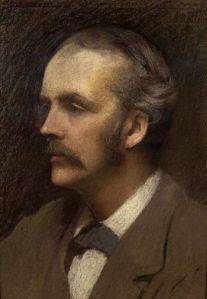
Lord Balfour envisions chariots of fire

Lord Balfour envisions chariots of fire

My wife’s favorite historian is Barbara Tuchman. We’ve read most of her books. Bible and Sword, however, was especially eye-opening for me. This book describes, step-by-step, how the British Empire forged its alliance with Israel. Tuchman is a meticulous historian, noting minute details that add understanding to the overall picture. One of the key motivating factors that led Lord Arthur James Balfour in his support of a homeland for the Jewish Diaspora was his belief that a physical Israel was required before the Second Coming of Christ could take place. This is a sentiment that has been shared by some recent, very highly ranking American politicians.

Enter Col. Edwin Drake. Drake was the first person to have the idea of drilling for oil. Several local prospectors scampered through the hills of Pennsylvania looking for oil streams where petroleum could be skimmed off the water and refined into kerosene. As an alternative to whale oil, petroleum was much easier to collect and didn’t involve peg-legs spearing great white whales — oh wait, wrong story. As an alternative to whale oil, petroleum made a market impact and soon other uses were descried. There was an oil boom near Titusville, Pennsylvania when Drake hit oil, and soon the industry that give birth to Quaker State, Pennzoil, and Enron was up and running. As uses for petroleum multiplied demand shot through the roof. Drake died in poverty and the industry he helped found rolled ever forward.

Col. Edwin Drake envisioning a drink

Col. Edwin Drake envisioning a drink

After the Second World War, vast oil beds were discovered in the Middle East. Israel was declared a nation, and world-wide demand for petroleum was astronomical. Not all nations of the former Ottoman Empire welcomed the sudden interest in their natural resources or the presence of an allied nation in their midst. Although the roots go deeper and are much more complex, the scenario was set for a crisis that has lasted for my entire life and shows no signs of slowing down.

So what does God have to do with a complex mix of hydrocarbons and other organic compounds? The unbelievable wealth generated by petroleum products has been under-girded with a religious gullibility and deeply held faith that Jesus needs some help in returning. As long as we’re waiting, we might as well get filthy rich. Politicians with connections to Big Oil and the Big Guy have it all figured out. Take all that you can and wait for the God who has blessed you so richly to come home. I still remember that refinery explosion, and some childhood memories have become paradigms and parables that have as many applications as petroleum itself. When the oil beds run dry, what will grease the axles of Kingdom Come?

Mechanical worshiper bowing down to a subterranean god

Mechanical worshiper bowing down to a subterranean god


Bes Leave It Alone

One of the constant enjoyments of teaching is the interactive learning that takes place. I tell my students that I learn from them just as they learn (hopefully) from me. One place this has been happening regularly is in an Ancient Near Eastern Religions class I teach. Students have to provide weekly class reports on somewhat obscure deities that I chose for them to research. One of the groups was assigned Bes, the minor Egyptian protective deity, and their research had uncovered the suggestion that Bes may have originally been a cat-deity. As Halloween approaches with its plethora of black cats, I found this connection to be fascinating.

The Egyptians domesticated the cat, and revered it. The nimble catcher of vermin (although, in all fairness, vermin are only doing what vermin have evolved to do), the cat was seen as a protector. When in need, why not call upon a deified cat, an everlasting cat, if you will? It makes sense that Bes with his stubby proportions and bewhiskered face, often portrayed poking his tongue out, might have evolved from a feline original. His iconography often features leonine imagery as well. We may never know his true origins, but Bes was widely recognized in the ancient world as an effective protector.

Bes

Back in 1987 I volunteered as a digger at Tel Dor in Israel. This was my first exposure to archaeology, and I loved every bit of it. The digging, the expectation of discovery, the honest physical work, the endless bouts of Herod’s revenge — well, some parts were better than others. One of the artifacts I discovered was a sky-blue faience head of Bes intended, apparently, to be worn on a necklace (there is a hole drilled through his head). I also found two bronze seed-beads that went with the necklace in the same matrix. Often I have wondered who, in an Israelite context, wore that amulet of Bes and what fate befell the wearer nevertheless. Bes is paradigmatic of our trust in help from beyond, but every once in a while even Bes ends up being dropped in the dirt only to be dragged out again by some future cat.


Who Inherits What Now?

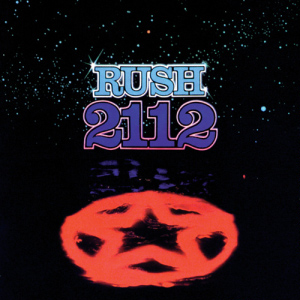
Grading exams is not my favorite activity, so when forced into it by psychopomp and circumstance, I attempt to select appropriate axe-wielding music to accompany the venture. My music collection is modest, so often I have to go back to the classic eras of rock for something that fits the mood. Recently I selected Rush’s 2112. I have a long, if tangential connection to this album. Afraid of its pentagram imagery and heavy metal sound (to my young ears) when it came out in the mid 70s, I only listened to it when my older brother put it on the stereo, and then only furtively enjoying it. Looking back now, I often wonder how any of us survived the 70’s styles and outlook — they feel dingy and hopeless in many corners, while sloppy and simplistic in others. Some of the music, however, has proven timeless.

Rush

After the instrumental prelude, the first words on the album are from the Bible: “the meek shall inherit the earth.” This particular statement is among the most easily ignored in the Gospels, just as the meek are easily ignored on the earth. With all the trumpeting and bellowing that sound from self-righteous commentators beating their religion beneath them like an over-taxed war-horse, it is plain to see how the meek might simply get in the way. This particular verse from the Sermon on the Mount, however, is one of the reasons that I cannot give up all faith in traditional religions. It sets the perfect juxtaposition between greed and selflessness out in full light for all to assess. Thus say the priests of the temples of Syrinx.

There was a time when rock became self-righteous to the point of caricature; but Rush’s 2112 was not such a place. The meek inheriting the earth is sticking it to the man unlike any other biblical dart can. And it is probably a good thing to queue up when I’m having to face the onerous task of grading exams once again.


I’ve Been Meming to Tell You . . .

There’s a tag game going on among the blogging community in an attempt to get a new meme going. Perhaps in payback for my researching memes for years, I was tagged by Dr. Jim of Dr. Jim’s Thinking Shop to reveal something about myself you wouldn’t normally guess. Now, I’m not much of a tag player, but I am a good sport, so I’ve been trying to think of something I wouldn’t mind letting the world at large know.

A little background first: I am a pacifist. When I had to register for the draft back in the Dark Ages I learned how to sign on as a conscientious objector. I don’t kill bugs in the house. Even the scariest looking ones I capture in a jar and release in the wild. In Wisconsin we used humane mousetraps and any captured rodents received a complementary automobile trip across a river a few miles away so that they couldn’t tunnel their innocent way back into our kitchen. I believe life is a good thing.

So far anyone who knows me could have guessed most of that. The new meme to be added is this: I am a good shot. With guns. I am not some gun-slingin’ ranger, but on the occasions when I’ve been invited to heft a sidearm and let fly, I’m not a bad shot.

melvin-purvisHow far back does this go? It’s hard to say. I am related to Melvin Purvis, J. Edgar Hoover’s “Little Mel,” probably the most famous FBI operative in history. Purvis was responsible for tracking down such characters as Baby Face Nelson, Pretty Boy Floyd, and John Dillinger. Less famously, he married my father’s aunt. My cousins who saw his house before he died (apparently shot himself accidentally while cleaning a gun) tell me that it had a grand entrance hall lined with guns. Well, I’m related by marriage, and as much as I’d like to blame my short stature on him, it just won’t wash.
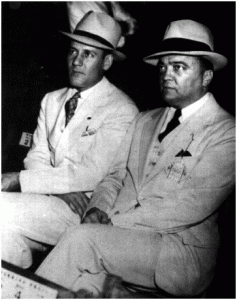

Little Mel with J. Edgar Hoover

Little Mel with J. Edgar Hoover

Probably more to the point, I grew up in redneck territory. The first day of deer season was a school holiday (not kidding here), and my high school had a rifle range in the basement. This latter point is unbelievable in the shadow of Columbine, but it is true. When I worked as a janitor in the school I saw the (by then disused) range with my own eyes. All boys were required to pass a course on gun safety before going to high school. Every week we sat in the Junior High School auditorium with Mr. Meade, the very masculine gym teacher, while he lectured about the parts of a gun, how to use one, and general safety issues. I shot my first rifle before I was twelve.

A typical day in seminary

A typical day in seminary

Well, there you have it. A pacifist who knows how to shoot. Now, I’m not sure if anyone on my blogroll plays tag or even if most of them read my humble attempt at a blog. If you’re out there reading this, I would tag my following colleagues: Wulfila of the Lonely Goth’s Guide, Alan of Feeling Finite, James of Kethuvim, Stephen of Biblische Ausbildung, and Daniel of O. McClellan. Let the meme-pool remain ever refreshed.


The Life Is in the Blood

Finally, after a couple of decades, I got around to watching Francis Ford Coppola’s Bram Stoker’s Dracula. As viewers know to expect of a Coppola film, the cinematography is stylish and artistically exaggerated. It has been even more years since I’ve read Stoker’s novel, the book that gave birth to the modern vampire, but I am pretty sure that the many oblique references to the Bible count among the film’s innovations. Coursing like an artery through the movie is the phrase “the blood is life,” taken from Leviticus 17. I’ve posted earlier concerning the biblical outlook that life is equated with breath, and so it is. The Bible does not always remain consistent on this point — natural enough for a book with multiple authors living centuries apart. Blood and breath obviously share crucial functions in maintaining life.

Stoker

Ancient peoples believed in a world peopled with unusual, quasi-supernatural beings, including blood-drinkers and nocturnal baby-snatchers. Theirs was a world of harsh realities where death was more closely observed than it tends to be in many parts of the world today. The fascination, often coupled with religious underpinnings, continues to engage our imagination today, as can be seen in any given Halloween season or on el Día de los Muertos.

Whether el chupacabra or Bela Lugosi, the fascination with mythical creatures of the night that thrive on the life-source of others is a concept never far from religionists. No matter how many stakes we pound through undead hearts, the unholy bloodsuckers continue to show up in our theaters and on YouTube. A childhood penchant for Dark Shadows books has recently been reactivated in the restless gray-matter in my head. As the days grow shorter and shadows become an increasing element of daily experience, I marvel at how the human imagination parodies our daily experiences, dressing them up in fanciful garb to parade about with the other ghosts of October. What is perhaps even more unusual is that money is still to be made in this business of selling the parasite. How else can we explain Buffy and all her cohort? The life is indeed in the blood.


Into the Great Beyond

It is a sobering moment when one of your advisors shuffles off the mortal coil. Just a year after my master’s degree, Harrell Beck, my program advisor passed away amid a flurry of unusual happenings. Just a few years back, Simon Parker, his colleague and an Ugaritologist who befriended me, also slipped into the netherworld. I just received the obituary of John C. L. Gibson, my doctoral advisor from Edinburgh, reminding me that my obvious concerns with death and religion in this blog have a very practical application. We all have to face it sometime, and hopefully our legacy will be a good one.

Professor Gibson was best known for his revision of outdated but valuable reference materials. His work as a Semitic linguist was highly regarded, but he didn’t wander too far from convention. As a clergyman in the Scottish Kirk, he had natural constraints. He also had a clever way of turning a phrase. Late in my time at Edinburgh University, I started to keep a list of his aphorisms. If I’d started earlier I might have some more nuggets to lay out here, but I thought it a fitting tribute to a fine gentleman scholar who always took a dram with his breakfast to pass along a few of his choice quotes in this post. You’ll have to do your best to imagine the Scottish burr —

“Don’t lead with your chin” (this was in the context of taking on academic debate).

“Skullduggery is just around the corner in archaeology.”

“Archaeologists and epigraphers shoot each other on sight” (this was in reference to Ebla).

“In Job the daring word is often the right one.”

“If you want to stand against him, do so. But get your armor on first!” (This remark came after I challenged a time-honored thesis by the late James Barr, while he was still early.)

“Every word in Arabic refers to a part of a camel as well as something else.”

“Inscriptions like Ajrud, they’re a nuisance; they shouldn’t be there.” (Kuntillet Ajrud is the site of one of the famous “Yahweh and his Asherah” inscriptions.)

“Who is Asherah and what is she doing here with Yahweh?” (In the same conversation as the previous comment.)

“Turning pages is a major activity of scholarship.”

There were, of course, many more. Professor Gibson will always remain a large part of my Edinburgh experience. Sitting in his pipe-smoke during one of my sessions, I noticed he had no computer. “Ach, aye, they offered me one, but I wouldna used it,” he explained. He didn’t even own a typewriter. In my mind, his passing is like the passing of old school scholarship itself.

J. C. L. Gibson, a cipher, and Nicolas Wyatt

J. C. L. Gibson, a cipher, and Nicolas Wyatt


The Hardest Job

Being a religionist is the world’s hardest job. That’s because you are trying to peddle something that everyone gets for free – their own religious opinion. No other professional field has such universal competition. From the time our parents mutter their first bedtime prayers to us, we begin to become masters of religion. With an entrenchment deeper than any wisdom tooth, we know, on a sub-atomic level, that we are right. We consult lawyers about the law and physicians about aches and pains, but on the level of religion, we already know we are right. We seek houses of worship that agree with our way of looking at things, and if the minister strays too far from our views, we go shopping again. Never try to make a career out of studying religion – it is a dead-end street.

I bristle whenever someone calls me a “theologian.” I am not. I have spent my life studying religion, sometimes participating in it, sometimes sitting back and watching it, but always analyzing it. Theologians deal with abstract concepts that can never be verified or falsified. The unquantifiable is their realm, and their rarefied debates seldom touch those of us of less exalted mental energy. And they are also never wrong. Those of us in religious studies watch how people’s religious outlooks impinge on the real world. Put your tin cup on the sidewalk in front of you. Everyone knows the answers already.

For some 25 years I have been specializing in religious studies, and I still assert that it is the most important, yet neglected academic field in the humanities. Twice I have been released from a living in the field by religious folk with less theological acumen than Cal Meacham. (If you don’t recognize the reference please educate yourself!) Not even eight years of a brutal Bush administration could convince university folk that the study of religion should be given priority. The most powerful nation on earth run by a recycled fundamentalist, and we don’t care to understand, thank you. Everyone is an expert. As we watch religious leaders of “foreign” nations posture with their weapons and rhetoric, we can sit back and be assured that even if they start a nuclear war, we were right about religion all along.

Better burn than learn

Better burn than learn


God and the Boss

I seldom gush, nor am I given to great displays of emotion. Although I appreciate great accomplishments in others, I have never considered a living person a hero. Only Bruce Springsteen. An article in the newspaper yesterday described the first academic conference on the Boss’s music, held right where it all began — New Jersey. Unfortunately unable to attend, I relish the fact that others see in Springsteen what must be something like I see.

Last year at the Society of Biblical Literature Annual Meeting in Boston, I picked up a copy of a new book, The Gospel according to Bruce Springsteen, by Jeffrey Symynkywicz (Westminster John Knox, 2008). I am not a fan of “Gospel according to —” books, but there is a trenchant depth of struggle with religion embedded in Bruce’s songs that transfixes me almost as much as Melville’s Moby Dick. Now, this is deeply personal with me. I don’t discuss my amazement that borders on worship of Springsteen with anyone. Coming from a decidedly blue-collar background, and having wrestled against circumstance for everything I’ve earned, including my degrees, I hear resonances of empathy throbbing through what Bruce sings. He is not an icon; he is an authentic human being. And his music is a gospel.

Boss

I haven’t read Symynkywicz’s book yet. Whenever I’ve tried to read the popular bios of the Boss I soon become frustrated at how trite they all make it sound. Having survived (barely) the Reagan-Bush era with its utter lack of sympathy for the condition of most Americans, sometimes I just need to crawl into the corner alone, slip on the headphones, and listen to Nebraska over and over again.


Harry Potter and the Evangelical Emperor

There’s a chill in the air this morning that warns of impending winter and the visceral melancholy of autumn’s graceful death. As I try to warm up like a lizard awaiting the ascending sun, I think that maybe I’d better write this post before everyone forgets Harry Potter completely. It is the beginning of the witching season as sometime late tonight fall officially begins and people in temperate climes are permitted to show their fears as the barrier between seasons becomes effaced and the darkness slinks in. A few Harry Potter novels ago, a local town in Wisconsin sponsored a downtown release party for the book with a street-fair sporting a feel of general bonhomme. While sauntering down the incongruously sun-lit streets, enjoying the sense of people just having fun, I spotted this man with a placard across the street.

No caption necessary!

No caption necessary!

The truly scary part of this scenario is that I knew exactly where this fellow was coming from: the Bible says it, I believe it, that settles it. Black and white. Right and wrong. Good and evil. Strangely enough, there was no such dividing line for fact and fiction. Yes, I knew that the Bible condemns witchcraft, but I also knew that J. K. Rowling was a fiction writer. I had read the Bible enough times to know that it contains no commandments about what genre of fiction is permissible and to know that some biblical heroes were deeply flawed characters. Jonah and his big fish. David and the giant monkey on his back. Hezekiah and his doubts. I can’t pretend not to know the searing sting of needing a clear answer, and yet I had already discovered the infinite shades of gray that reside between pure white and absolute black. Bible covers should all be gray.

That very year a conservative evangelical administration had axed a highly praised job of over a decade’s duration, believing it to be in the name of righteousness. A conservative evangelical president was unleashing hellish terror on a country that had the misfortune of being the victim of a bloodthirsty dictator. And this man with a placard felt he had to underscore that even a flight of fantasy on a broomstick over a quidditch field of imagination was evil incarnate. Once again my mind turned to Molech, the perhaps fictional Canaanite deity who is never satisfied. In the Bible it was enough simply to believe that people were sacrificing their children to the fiery Molech. “White and black,” I could almost hear the tremulous author whispering as he penned his horrid fiction. History tends to paint a different picture, but then, historians make liberal use of the myriad shades of gray.


Intelligently Deceived

One of the most difficult things about the life of the academic gypsy is having tons of books. Literally tons. Having been cast from institution to institution in search of that mythical full-time teaching post, we’ve put books in storage and sometimes even forgotten that we’ve had them. So it was that when I was looking for a copy of Great Expectations for my daughter’s English class assignment, I was in the dusky attic, hoping the upstairs neighbors didn’t burst in on me, up to my armpits in boxes of books, that I rediscovered a treasure. Taking a leaf from Dr. Jim’s Thinking Shop, I decided I would review a few of the Creationist books I grew up with. Fortunately I had the presence of mind to keep them although I’d long dismissed their facile, often juvenile, point of view. They have provided great entertainment and even some poignant instruction in the ways of manipulating the minds of the young. Fear of Hell is a great motivating factor to a kid who sees ghosts in every corner and finds bats on his pillow!

So, without further ado, I present the top 5 creationist books of my youth. (Those that I purchased as an adult I bought from used bookstores so as not to add any royalties to the fundamentalists’ already bursting coffers.)

Textbook

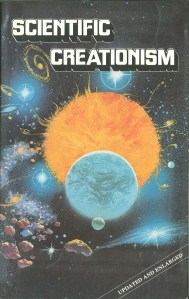
We’ll begin with the textbook. Scientific Creationism makes no pretense, such as the “Intelligent Design” school does, about being non-(necessarily-but-we-all-just-happen-to-be)Christian specific. Here Henry Morris begins with the assertion “the Bible and theistic religion have been effectively banned from [public school] curricula” and offers the present book as a corrective to the situation. A better title for the content, however, might have been Scientific Fiction.

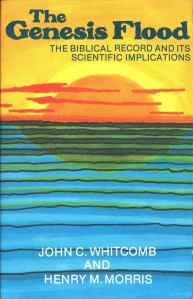
GenFlood

The work that really opened the flood-gates, so to speak, was The Genesis Flood. This craftsterpiece was penned by Henry Morris (again) and his compatriot John Whitcomb. Both proudly proclaiming themselves “doctors” they point out “evidence” designed to confuse the unsavvy into believing that there is a physical way the world could be entirely flooded. They even make room for dinosaurs on the ark, noting that they would have been juveniles of the various species. I’ve been in academics long enough to know that a Ph.D. does not guarantee credibility (or even sanity) on the part of the holder. The fact that Whitcomb’s doctorate is from Grace Theological Seminary ought to speak quite plainly as to its objectivity.

Gish

Written by Duane “the Fish” Gish, Evolution, the Fossils Say No! is an attempt to demonstrate that since not every single phase of the fossil record has been uncovered, the whole theory of evolution is in shambles. Gish, one of the few authentically scientifically credentialed Creationists, should have been able to see that his “back-and-fill” technique was going to fall on hard times as new fossil forms were discovered. As the fossil record grows more complete each year his book becomes more and more outdated.

EvolutionHS

Evolution and the High School Student terrified me in my delicate years. This booklet intimated that when I reached high school the unending assaults of the atheistic non-believers would be unrelenting. I feared for my very soul. Instead, in high school I found nose-picking, pocket-pool playing, and chalk-print-on-the-pants-seat teachers were among the openly committed Christians. Some even kept Bibles on their desks. (This was a public school.) The book lost its teeth.

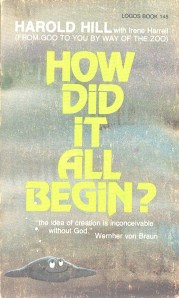
GooZoo

My personal favorite is How Did It All Begin? (or From Goo to You by Way of the Zoo) by Harold Hill (obviously when he was not out swindling River City, Iowa folk of their hard-earned cash to start a bogus boy’s band). This booklet, complete with cute, cartoon drawings, convinces grade-schoolers that evolution answers no questions at all. He had me going as a kid, until I got to the part where he claimed scientists had invented a machine that could indicate if you were “saved” or not. Even as a gullible child I couldn’t buy that.

The efforts of the Creationists are tireless. Even this brief survey of books that I happened to chance upon is nowhere near a comprehensive survey of what is out there. What it does serve to demonstrate is that all reasonable people should be wary. After all, even Jesus knew that a person in the wrong, if persistent enough, could convert even a hard-hearted judge.


Lost and Found

As a young lad I was fascinated by the supernatural. This may explain, but in no wise excuses, my choice of a career in religion. As I grew in years and skepticism, this interest began to feel like a security blanket in a college dormitory — an embarrassment to be jettisoned as quickly as possible. Along the way, of course, I’d given away what I thought to be the detritus of childish fantasy, including my collection of cheap, pulp fiction, tending toward the Gothic.

As I grow more ancient, and more observant, I see that sometimes the impetuousness of youth cradles a profound wisdom. Sometimes we do get it right the first time. I still haven’t figured out if that’s the case with me, but it seems to be a hypothesis worth the exploration. Part of my current search for reality is the reassessment of my childhood learning in the school of classical Gothic fiction. The books are no longer as cheap as they used to be, and when I take them out in public I hide them inside a larger, more academic book so that no one really knows what I’m reading. As a friend once observed, people think that those of us who hang out in the religion sections of Borders are immediately suspect. More so the adult toting a beaten-up paperback written for a teen readership a number of decades ago.

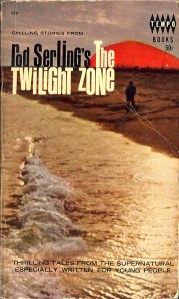
One of my lost memories was a juvenilized version of Rod Serling’s Stories from the Twilight Zone. I had shoveled my copy off to Goodwill along with many other shards of my childhood when I “grew up.” The memories of the angst that the very cover generated in me led to a frantic online used book hunt a few years back. Inside the stories seemed flatter than I’d recalled, but the larger ideas they generated were still worth paying attention to. Perhaps the real lesson is that childhood should not be dismissed as wasted time playing and indulging in carefree amusements. Our childhood proclivities, it now seems, preset the trajectories for our lives. So I still have a quasi-career in a religion department, and I have a copy of a book that started me asking the bigger questions.

Anybody else remember this?

Anybody else remember this?


Six-Word Memoirs

The story is told of Ernest Hemingway who once wrote a six-word novel “For sale: baby shoes, never used.” The beauty of this anecdote, whether factual or fictional, is that the mind fills in the rest, blooming full of ideas either tragic or hopeful, supposing what led to this circumstance or what might have happened after. The idea of extreme conciseness has caught on in many aspects of our society; in advertising and marketing it is called a hook, on television it is a sit-com, and in my classes it is a term paper. There is now an industry developing in six-word biographies — publishers print books full of them — and it seems there will be no end to conciseness. (My favorite is Larry Smith’s Not Quite What I Was Planning: Six-Word Memoirs by Writers Famous and Obscure, now available in a revised and expanded edition! Exponential conciseness!) My problem is there are too many six-word biographies that suggest themselves. Life seems to be made up of them. A while back my wife challenged me to come up with one. Slightly missing the concept, I came up with six:

Missed the first day of school.

Spit that out of your mouth!

The B-I-B-L-E.

The position has already been filled.

Please help; will work for books.

Can’t count either.


Who We Were

Once upon a time there was no world-wide-web. The only computers in existence were industrial-sized military and research-based units that kicked off enough BTUs to heat Bar Harbor. Those of us interested in religion found our information by stalking shadowy library stacks and clawing through ancient tomes of arcane information. If someone wanted to find you, they shoved a letter in the postbox and trusted that the U. S. government knew where you were. I never used a computer regularly until I began my Ph.D., and then it was only a glorified typewriter, qwerty on steroids.

Suddenly I found myself in the technological age. Jobs were announced online and the preferred method of communication was email. Cell phones hadn’t hit big yet, but you could search for someone online using search engines that weren’t really engines at all. And then the information could be displayed in color, for those who could afford it! Pictures could be uploaded, but this took about an hour per shot on dial-up. Within a decade everyone trusted internet information like their best friend. Somewhere along the way I searched for my own name, figuring Wiggins to be somewhat unusual. To my surprise, I found another Steve Wiggins, and one involved in religion, no less. To my horror, he turned out to be a Christian rock musician! Now I began to wonder, as my career bumped along the bottom of the academic deep-ocean floor, never finding that fabled full-time teaching career that is said to exist, if I might be the victim of mistaken identity. Have deans and department chairs searched for “Steve Wiggins” and brought up my internet Doppelganger?

Not me! Notice the fancy hair, brown eyes and lack of a serious beard.

Not me! Notice the fancy hair, brown eyes and lack of a serious beard.

Technology has changed even the way we practice religion. It has changed the way we perceive reality. As I sit here blogging away, still seeking that mythic fulfillment of an academic job that will pay the rent, I wonder what the other Steve Wiggins is doing. Has his career suffered from being cross-wired with that of a liberal ex-professor who has an interest in ancient goddesses? Maybe miracles do occur after all!