
A few weeks back a friend pointed me to a Facebook-style website someone in my high school graduating class had put together. In high school I was awkward, shy, and a little too obvious about my religious beliefs, so I was a bit timid to join. Nostalgia eventually got me in a headlock, just like in gym class, so I signed up. One of my classmates helped me to find one of the people who had a profound impact on my life. Although I never had him for a class, Mr. Milliken was my Creative Writing Club advisor, and a person I utterly respect and admire. I’m not normally a hero worshiper, but Mr. Milliken had been through more suffering than many men his age and had come out of it a sincere, caring, and thoughtful individual. When I found out that he had published a brief collection of his poetry about his time in Vietnam, I immediately ordered it.
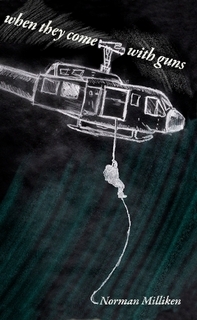
Available from Lulu.com
War has always haunted me. Perhaps it was partially because of the tales Mr. Milliken sometimes told, or because of my macabre reading about the terrors of twentieth-century conflicts, but whatever the cause for my fear, it was real. War has been with humanity for as long as its more docile cousin, civilization. Being rational creatures, there seems to be no reason that we should not be able to reason ourselves out of armed conflict, but we don’t. Knowing that one of my most respected high school influences had nearly died in Vietnam chilled me. Reading his poetry, I shiver once again.
While justifying it on theological grounds, the Hebrew Bible takes a fatalistic view of war. Killing of enemies who stand in the way of god’s plan is sanctioned, commanded even. The victims, however, are humans just like the victors.
When I get caught up in the complex web of difficulties my own life has woven into, I find it easy to complain. Reading when they come with guns, however, reminds me that many have had it much worse and have come out as superior human beings. For those who are victims of war, we can only hope that forgiveness will somehow descend on those of us who have not yet put an end to it.





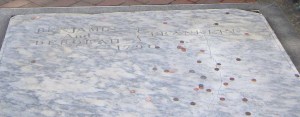
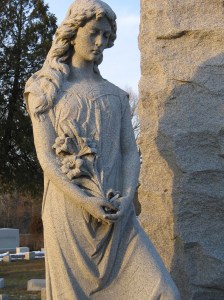 The specific form of penny offerings seems to go back to Benjamin Franklin’s burial, at least in America. A few years back while in Philadelphia, I saw for myself that people still leave pennies on Franklin’s grave in Christ Church Cemetery.
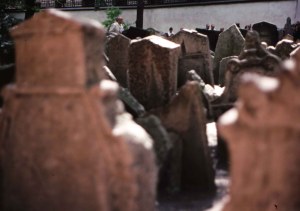 I recalled having seen stones on tombs outside Jerusalem some years back, and I even had a student bring me a stone from Israel to keep as long as I promised to put it on her grave after she died. This practice in its recent form is associated with Judaism, but again, it has ancient roots. The building of cairns, or piles of stones, is often associated with the Celts or the pre-Celtic inhabitants of the British Isles. On our many wandering through the highlands and islands we saw several Neolithic examples in Scotland, particularly in the Orkney Islands. The practice of putting stones atop the dead also goes back to ancient times. One plausible suggestion is that it was intended to keep the dead in their graves. A more prosaic conclusion is that digging deep holes takes more work than hauling over a pile of rocks.

