Into the Great Beyond

It is a sobering moment when one of your advisors shuffles off the mortal coil. Just a year after my master’s degree, Harrell Beck, my program advisor passed away amid a flurry of unusual happenings. Just a few years back, Simon Parker, his colleague and an Ugaritologist who befriended me, also slipped into the netherworld. I just received the obituary of John C. L. Gibson, my doctoral advisor from Edinburgh, reminding me that my obvious concerns with death and religion in this blog have a very practical application. We all have to face it sometime, and hopefully our legacy will be a good one.

Professor Gibson was best known for his revision of outdated but valuable reference materials. His work as a Semitic linguist was highly regarded, but he didn’t wander too far from convention. As a clergyman in the Scottish Kirk, he had natural constraints. He also had a clever way of turning a phrase. Late in my time at Edinburgh University, I started to keep a list of his aphorisms. If I’d started earlier I might have some more nuggets to lay out here, but I thought it a fitting tribute to a fine gentleman scholar who always took a dram with his breakfast to pass along a few of his choice quotes in this post. You’ll have to do your best to imagine the Scottish burr —

“Don’t lead with your chin” (this was in the context of taking on academic debate).

“Skullduggery is just around the corner in archaeology.”

“Archaeologists and epigraphers shoot each other on sight” (this was in reference to Ebla).

“In Job the daring word is often the right one.”

“If you want to stand against him, do so. But get your armor on first!” (This remark came after I challenged a time-honored thesis by the late James Barr, while he was still early.)

“Every word in Arabic refers to a part of a camel as well as something else.”

“Inscriptions like Ajrud, they’re a nuisance; they shouldn’t be there.” (Kuntillet Ajrud is the site of one of the famous “Yahweh and his Asherah” inscriptions.)

“Who is Asherah and what is she doing here with Yahweh?” (In the same conversation as the previous comment.)

“Turning pages is a major activity of scholarship.”

There were, of course, many more. Professor Gibson will always remain a large part of my Edinburgh experience. Sitting in his pipe-smoke during one of my sessions, I noticed he had no computer. “Ach, aye, they offered me one, but I wouldna used it,” he explained. He didn’t even own a typewriter. In my mind, his passing is like the passing of old school scholarship itself.

J. C. L. Gibson, a cipher, and Nicolas Wyatt

J. C. L. Gibson, a cipher, and Nicolas Wyatt


The Hardest Job

Being a religionist is the world’s hardest job. That’s because you are trying to peddle something that everyone gets for free – their own religious opinion. No other professional field has such universal competition. From the time our parents mutter their first bedtime prayers to us, we begin to become masters of religion. With an entrenchment deeper than any wisdom tooth, we know, on a sub-atomic level, that we are right. We consult lawyers about the law and physicians about aches and pains, but on the level of religion, we already know we are right. We seek houses of worship that agree with our way of looking at things, and if the minister strays too far from our views, we go shopping again. Never try to make a career out of studying religion – it is a dead-end street.

I bristle whenever someone calls me a “theologian.” I am not. I have spent my life studying religion, sometimes participating in it, sometimes sitting back and watching it, but always analyzing it. Theologians deal with abstract concepts that can never be verified or falsified. The unquantifiable is their realm, and their rarefied debates seldom touch those of us of less exalted mental energy. And they are also never wrong. Those of us in religious studies watch how people’s religious outlooks impinge on the real world. Put your tin cup on the sidewalk in front of you. Everyone knows the answers already.

For some 25 years I have been specializing in religious studies, and I still assert that it is the most important, yet neglected academic field in the humanities. Twice I have been released from a living in the field by religious folk with less theological acumen than Cal Meacham. (If you don’t recognize the reference please educate yourself!) Not even eight years of a brutal Bush administration could convince university folk that the study of religion should be given priority. The most powerful nation on earth run by a recycled fundamentalist, and we don’t care to understand, thank you. Everyone is an expert. As we watch religious leaders of “foreign” nations posture with their weapons and rhetoric, we can sit back and be assured that even if they start a nuclear war, we were right about religion all along.

Better burn than learn

Better burn than learn


God and the Boss

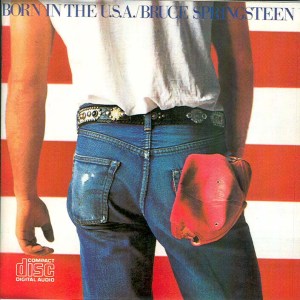
I seldom gush, nor am I given to great displays of emotion. Although I appreciate great accomplishments in others, I have never considered a living person a hero. Only Bruce Springsteen. An article in the newspaper yesterday described the first academic conference on the Boss’s music, held right where it all began — New Jersey. Unfortunately unable to attend, I relish the fact that others see in Springsteen what must be something like I see.

Last year at the Society of Biblical Literature Annual Meeting in Boston, I picked up a copy of a new book, The Gospel according to Bruce Springsteen, by Jeffrey Symynkywicz (Westminster John Knox, 2008). I am not a fan of “Gospel according to —” books, but there is a trenchant depth of struggle with religion embedded in Bruce’s songs that transfixes me almost as much as Melville’s Moby Dick. Now, this is deeply personal with me. I don’t discuss my amazement that borders on worship of Springsteen with anyone. Coming from a decidedly blue-collar background, and having wrestled against circumstance for everything I’ve earned, including my degrees, I hear resonances of empathy throbbing through what Bruce sings. He is not an icon; he is an authentic human being. And his music is a gospel.

Boss

I haven’t read Symynkywicz’s book yet. Whenever I’ve tried to read the popular bios of the Boss I soon become frustrated at how trite they all make it sound. Having survived (barely) the Reagan-Bush era with its utter lack of sympathy for the condition of most Americans, sometimes I just need to crawl into the corner alone, slip on the headphones, and listen to Nebraska over and over again.


Harry Potter and the Evangelical Emperor

There’s a chill in the air this morning that warns of impending winter and the visceral melancholy of autumn’s graceful death. As I try to warm up like a lizard awaiting the ascending sun, I think that maybe I’d better write this post before everyone forgets Harry Potter completely. It is the beginning of the witching season as sometime late tonight fall officially begins and people in temperate climes are permitted to show their fears as the barrier between seasons becomes effaced and the darkness slinks in. A few Harry Potter novels ago, a local town in Wisconsin sponsored a downtown release party for the book with a street-fair sporting a feel of general bonhomme. While sauntering down the incongruously sun-lit streets, enjoying the sense of people just having fun, I spotted this man with a placard across the street.

No caption necessary!

No caption necessary!

The truly scary part of this scenario is that I knew exactly where this fellow was coming from: the Bible says it, I believe it, that settles it. Black and white. Right and wrong. Good and evil. Strangely enough, there was no such dividing line for fact and fiction. Yes, I knew that the Bible condemns witchcraft, but I also knew that J. K. Rowling was a fiction writer. I had read the Bible enough times to know that it contains no commandments about what genre of fiction is permissible and to know that some biblical heroes were deeply flawed characters. Jonah and his big fish. David and the giant monkey on his back. Hezekiah and his doubts. I can’t pretend not to know the searing sting of needing a clear answer, and yet I had already discovered the infinite shades of gray that reside between pure white and absolute black. Bible covers should all be gray.

That very year a conservative evangelical administration had axed a highly praised job of over a decade’s duration, believing it to be in the name of righteousness. A conservative evangelical president was unleashing hellish terror on a country that had the misfortune of being the victim of a bloodthirsty dictator. And this man with a placard felt he had to underscore that even a flight of fantasy on a broomstick over a quidditch field of imagination was evil incarnate. Once again my mind turned to Molech, the perhaps fictional Canaanite deity who is never satisfied. In the Bible it was enough simply to believe that people were sacrificing their children to the fiery Molech. “White and black,” I could almost hear the tremulous author whispering as he penned his horrid fiction. History tends to paint a different picture, but then, historians make liberal use of the myriad shades of gray.


Intelligently Deceived

One of the most difficult things about the life of the academic gypsy is having tons of books. Literally tons. Having been cast from institution to institution in search of that mythical full-time teaching post, we’ve put books in storage and sometimes even forgotten that we’ve had them. So it was that when I was looking for a copy of Great Expectations for my daughter’s English class assignment, I was in the dusky attic, hoping the upstairs neighbors didn’t burst in on me, up to my armpits in boxes of books, that I rediscovered a treasure. Taking a leaf from Dr. Jim’s Thinking Shop, I decided I would review a few of the Creationist books I grew up with. Fortunately I had the presence of mind to keep them although I’d long dismissed their facile, often juvenile, point of view. They have provided great entertainment and even some poignant instruction in the ways of manipulating the minds of the young. Fear of Hell is a great motivating factor to a kid who sees ghosts in every corner and finds bats on his pillow!

So, without further ado, I present the top 5 creationist books of my youth. (Those that I purchased as an adult I bought from used bookstores so as not to add any royalties to the fundamentalists’ already bursting coffers.)

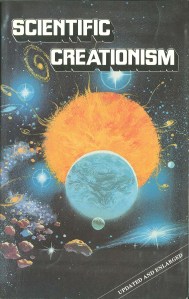
Textbook

We’ll begin with the textbook. Scientific Creationism makes no pretense, such as the “Intelligent Design” school does, about being non-(necessarily-but-we-all-just-happen-to-be)Christian specific. Here Henry Morris begins with the assertion “the Bible and theistic religion have been effectively banned from [public school] curricula” and offers the present book as a corrective to the situation. A better title for the content, however, might have been Scientific Fiction.

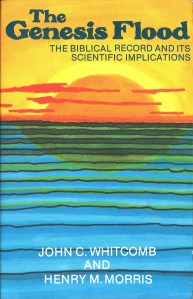
GenFlood

The work that really opened the flood-gates, so to speak, was The Genesis Flood. This craftsterpiece was penned by Henry Morris (again) and his compatriot John Whitcomb. Both proudly proclaiming themselves “doctors” they point out “evidence” designed to confuse the unsavvy into believing that there is a physical way the world could be entirely flooded. They even make room for dinosaurs on the ark, noting that they would have been juveniles of the various species. I’ve been in academics long enough to know that a Ph.D. does not guarantee credibility (or even sanity) on the part of the holder. The fact that Whitcomb’s doctorate is from Grace Theological Seminary ought to speak quite plainly as to its objectivity.

Gish

Written by Duane “the Fish” Gish, Evolution, the Fossils Say No! is an attempt to demonstrate that since not every single phase of the fossil record has been uncovered, the whole theory of evolution is in shambles. Gish, one of the few authentically scientifically credentialed Creationists, should have been able to see that his “back-and-fill” technique was going to fall on hard times as new fossil forms were discovered. As the fossil record grows more complete each year his book becomes more and more outdated.

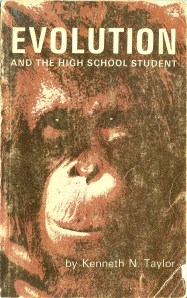
EvolutionHS

Evolution and the High School Student terrified me in my delicate years. This booklet intimated that when I reached high school the unending assaults of the atheistic non-believers would be unrelenting. I feared for my very soul. Instead, in high school I found nose-picking, pocket-pool playing, and chalk-print-on-the-pants-seat teachers were among the openly committed Christians. Some even kept Bibles on their desks. (This was a public school.) The book lost its teeth.

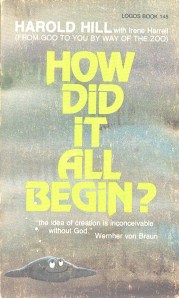
GooZoo

My personal favorite is How Did It All Begin? (or From Goo to You by Way of the Zoo) by Harold Hill (obviously when he was not out swindling River City, Iowa folk of their hard-earned cash to start a bogus boy’s band). This booklet, complete with cute, cartoon drawings, convinces grade-schoolers that evolution answers no questions at all. He had me going as a kid, until I got to the part where he claimed scientists had invented a machine that could indicate if you were “saved” or not. Even as a gullible child I couldn’t buy that.

The efforts of the Creationists are tireless. Even this brief survey of books that I happened to chance upon is nowhere near a comprehensive survey of what is out there. What it does serve to demonstrate is that all reasonable people should be wary. After all, even Jesus knew that a person in the wrong, if persistent enough, could convert even a hard-hearted judge.


Lost and Found

As a young lad I was fascinated by the supernatural. This may explain, but in no wise excuses, my choice of a career in religion. As I grew in years and skepticism, this interest began to feel like a security blanket in a college dormitory — an embarrassment to be jettisoned as quickly as possible. Along the way, of course, I’d given away what I thought to be the detritus of childish fantasy, including my collection of cheap, pulp fiction, tending toward the Gothic.

As I grow more ancient, and more observant, I see that sometimes the impetuousness of youth cradles a profound wisdom. Sometimes we do get it right the first time. I still haven’t figured out if that’s the case with me, but it seems to be a hypothesis worth the exploration. Part of my current search for reality is the reassessment of my childhood learning in the school of classical Gothic fiction. The books are no longer as cheap as they used to be, and when I take them out in public I hide them inside a larger, more academic book so that no one really knows what I’m reading. As a friend once observed, people think that those of us who hang out in the religion sections of Borders are immediately suspect. More so the adult toting a beaten-up paperback written for a teen readership a number of decades ago.

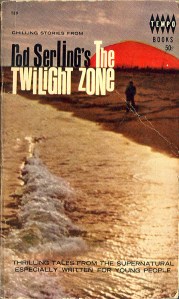
One of my lost memories was a juvenilized version of Rod Serling’s Stories from the Twilight Zone. I had shoveled my copy off to Goodwill along with many other shards of my childhood when I “grew up.” The memories of the angst that the very cover generated in me led to a frantic online used book hunt a few years back. Inside the stories seemed flatter than I’d recalled, but the larger ideas they generated were still worth paying attention to. Perhaps the real lesson is that childhood should not be dismissed as wasted time playing and indulging in carefree amusements. Our childhood proclivities, it now seems, preset the trajectories for our lives. So I still have a quasi-career in a religion department, and I have a copy of a book that started me asking the bigger questions.

Anybody else remember this?

Anybody else remember this?


Six-Word Memoirs

The story is told of Ernest Hemingway who once wrote a six-word novel “For sale: baby shoes, never used.” The beauty of this anecdote, whether factual or fictional, is that the mind fills in the rest, blooming full of ideas either tragic or hopeful, supposing what led to this circumstance or what might have happened after. The idea of extreme conciseness has caught on in many aspects of our society; in advertising and marketing it is called a hook, on television it is a sit-com, and in my classes it is a term paper. There is now an industry developing in six-word biographies — publishers print books full of them — and it seems there will be no end to conciseness. (My favorite is Larry Smith’s Not Quite What I Was Planning: Six-Word Memoirs by Writers Famous and Obscure, now available in a revised and expanded edition! Exponential conciseness!) My problem is there are too many six-word biographies that suggest themselves. Life seems to be made up of them. A while back my wife challenged me to come up with one. Slightly missing the concept, I came up with six:

Missed the first day of school.

Spit that out of your mouth!

The B-I-B-L-E.

The position has already been filled.

Please help; will work for books.

Can’t count either.


Who We Were

Once upon a time there was no world-wide-web. The only computers in existence were industrial-sized military and research-based units that kicked off enough BTUs to heat Bar Harbor. Those of us interested in religion found our information by stalking shadowy library stacks and clawing through ancient tomes of arcane information. If someone wanted to find you, they shoved a letter in the postbox and trusted that the U. S. government knew where you were. I never used a computer regularly until I began my Ph.D., and then it was only a glorified typewriter, qwerty on steroids.

Suddenly I found myself in the technological age. Jobs were announced online and the preferred method of communication was email. Cell phones hadn’t hit big yet, but you could search for someone online using search engines that weren’t really engines at all. And then the information could be displayed in color, for those who could afford it! Pictures could be uploaded, but this took about an hour per shot on dial-up. Within a decade everyone trusted internet information like their best friend. Somewhere along the way I searched for my own name, figuring Wiggins to be somewhat unusual. To my surprise, I found another Steve Wiggins, and one involved in religion, no less. To my horror, he turned out to be a Christian rock musician! Now I began to wonder, as my career bumped along the bottom of the academic deep-ocean floor, never finding that fabled full-time teaching career that is said to exist, if I might be the victim of mistaken identity. Have deans and department chairs searched for “Steve Wiggins” and brought up my internet Doppelganger?

Not me! Notice the fancy hair, brown eyes and lack of a serious beard.

Not me! Notice the fancy hair, brown eyes and lack of a serious beard.

Technology has changed even the way we practice religion. It has changed the way we perceive reality. As I sit here blogging away, still seeking that mythic fulfillment of an academic job that will pay the rent, I wonder what the other Steve Wiggins is doing. Has his career suffered from being cross-wired with that of a liberal ex-professor who has an interest in ancient goddesses? Maybe miracles do occur after all!