Rumblings

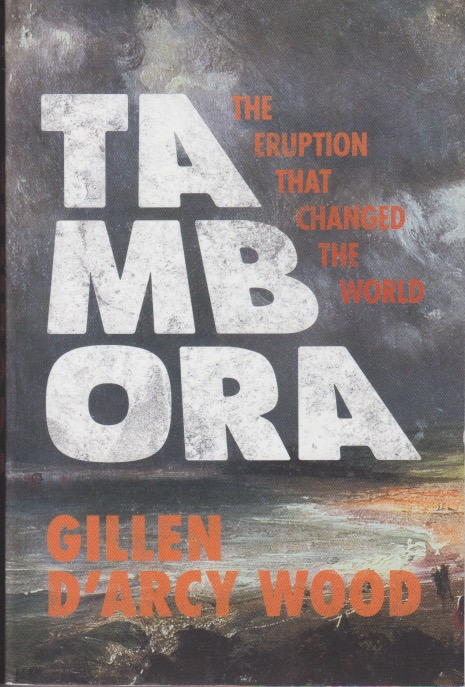
Despite the many books on Tambora, it surprisingly gets little press.  Of the volumes on the volcano I’ve read, Gillen D’Arcy Wood’s Tambora has been the best.  He, like many others, makes a case for the world-changing impact of that eruption that led to “the year without a summer” in 1816.  Knock-on effects remain with us to this day.  Wood also throws in a good bit of concern about our current climate crisis.  As he points out, the volcanic aerosols of Tambora remained in the stratosphere for three years (leading to three chilly summers), but our current carbon emissions, on-going, have no end in sight.  We all already know that weather has become more extreme.  As I write this, family members in Europe are experiencing 100-degree temperatures that used to be unheard of on that continent.  We’ve seen hurricanes increase in intensity, and have had our own erratic weather for a few years now.  The atmosphere’s too large for us to predict just who might receive the God-like wrath of the weather.

Wood uses Mary Shelley’s Frankenstein both as an illustration of the year without a summer and as the atmospheric monster we’ve created.  He also narrates other historical events brought on by the temporary change in climate in the eighteen-teens.  One of them was the breaking up of Arctic ice that led to the ill-fated Franklin expedition many years later.  (I was unintentionally also reading Dan Simmon’s The Terror even as I read Wood’s chapter about the expedition.)  More than that, this book describes the typhoid outbreak and pandemic that followed on from erratic weather in South Asia.  And deadly changes in parts of China.  The disaster of the breaking of the Giétro glacial ice dam, and an earlier famine in Ireland fueled by British hostility toward the Irish, as well as Tambora’s weather.

The developments that grew out of the human response to the changed climate caused by Tambora led to many institutions still with us.  Governments, slowly, of course, realized that disaster preparedness and care for the working class were necessary for any nation to remain strong.  The privileged lose said privilege when there’s nobody else left to compare it with.  (Capitalism has blood all over its hands.)  Overall, this is a provocative book making the case that the world we recognize today evolved this way largely in response to an environmental crisis that occurred before steam engines had been invented, when sails drove shipping and horses drew vehicles.  When a single volcano changed everything.  And although we should learn from such things, being what we are, we tend to overlook that largest volcanic eruption in recorded human history.


Long Winter

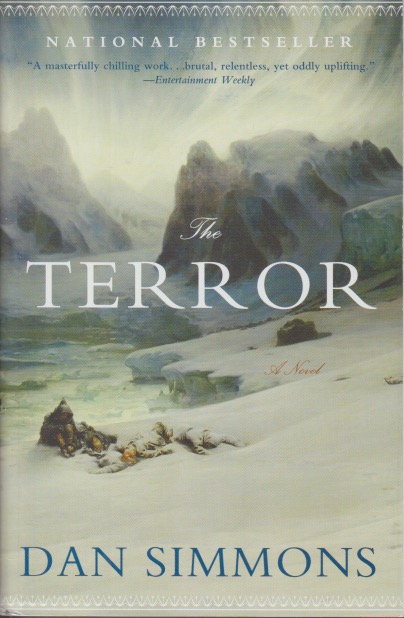
I have to confess that I often feel uncharitable towards very long books.  Mainly, I think, that is because one of my main blogging topics is books and when it takes a long time to read one I have to come up with other things to write about.  Still Dan Simmons’ The Terror had been strongly recommended.  I found it in an indy bookshop on independent bookstore day and began reading it sometime back in May.  It started out strong, but about three-hundred pages in began to feel a bit tedious and self-indulgent.  (I’ve done that myself with my fiction, so this criticism is also aimed at the one writing this reflection.)  In case you haven’t read it, the Terror of the title is HMS Terror, the ship captained by Francis Crozier under the command of Sir John Franklin, captain of HMS Erebus.  Both ships, seeking the northwest passage, froze in the Arctic ice in 1846 and their combined crews of 129 died without ever being found.

That’s a strong basis for a horror novel.  Your mind can’t help but wonder what it’d be like to be stuck in the dark, sunless winter, temperatures well below what most of us could survive, and realizing that you were never going to get out.  Simmons traces the story arcs of several of the crew that historically populated the ships.  Since there were no survivors, just about anything is fair game.  Including creating a monster to attack them.  Even as I began to warm to the book in the last hundred or so pages, it seems that some of this could’ve been trimmed and the same sprawling majesty been preserved.  Maybe I’m just jealous because none of my novels have been published and I keep being told you have to keep things short to get any traction.

In any case, by the end of the book I was really drawn in.  This was after the villain got his own, and Crozier starts to recognize the indigenous Arctic people for their truly remarkable survival skills.  (Not vegan friendly, of course, since vegetation doesn’t thrive in ice-bound conditions.)  It comes to a remarkable conclusion and I gradually found myself letting go of my petulance for having to invest so much time in one book.  I’m a slow reader with a very large pile of books yet to read.  In any case, Simmons won me back.  I quite enjoyed his Night of Summer and A Winter Haunting many years ago.  If you’re not afraid of big books, and you’d like to read about what can go wrong with a group of men trapped in the Arctic, then The Terror may be for you.


Spliced

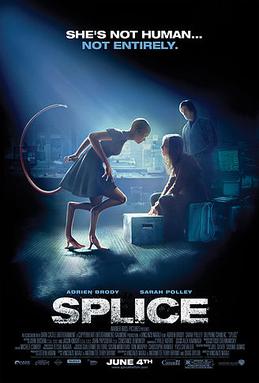
Predictably, I watched Splice again after reading the novelization by Claire Donner.  It is, as I indicated in my post on the book, a sad story.  During this rewatch, a few things stood out.  First and foremost, how many times you must rewatch a film to pull off writing the novel.  Either that, or hit the pause button constantly.  When I was writing Holy Horror I did both of those things quite a lot.  A detail you want to catch, and you have to see what’s on the screen.  I’d pause a scene and put my face right next to the screen, seeing individual pixels.  You have to know your stuff.  Another factor is that actors really do have influence on your understanding of character motivation.  An ambiguous look for the camera comes away pregnant with meaning in the novelization.

The emotional life of the characters is really filled in, in print.  The movie felt like it was going too fast.  That’s a finger on the pulse of reading a book versus watching a movie.  For a writer a movie deal can be a real boon but often you read about how they dislike the results.  That’s really no surprise.  A book takes time to read and you reflect as you go.  Movies hit you with constantly shifting images.  Both can be powerful media, but in different ways.  Another thing I noticed (I hadn’t seen the movie for thirteen years before reading the book) is that the mental image I’d formed of the characters was quite different from what the actors looked like.  

In the introduction to the novelization, screenwriter and director Vincenzo Natali notes that he likes how Donner explores Dren’s inner life.  Dren, in case you’ve not read or watched, is the hybrid.  Indeed, that is an element largely missing from the movie.  Some critics suggested that it should’ve explored that more.  For many of us, emotion is a major motivating factor of life.  We are frequently driven by our feelings, and, despite what AI says, they are integral in our thought process.  What was going through the mind of a creature, part human, with no parents?  I know that having grown up not really knowing my father left deep impressions, voids, in my life.  The novelization explores these kinds of things for all the main principals.  In my opinion, reading the book enhances watching the movie.  Of course, I’ve always been on the book side of the equation to begin with.  


Novelization

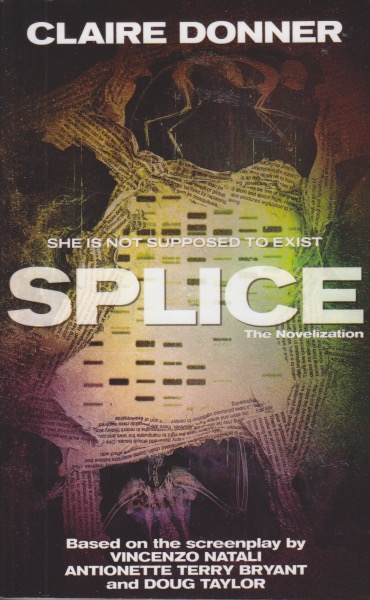
I watched the sci-fi horror film Splice a few years ago.  Long enough that I don’t recall many details.  When Claire Donner, a friend of mine from Miskatonic Institute of Horror Studies, told me she’d written a novelization of Splice, I knew I had to read it.  If you’ve seen the movie then you know the story.  If you haven’t, you can read it in her book.  I don’t often read novelizations—I read the one for Tim Burton’s Sleepy Hollow, and as a young person read the original three Star Wars novelizations.  Such books really only apply to movies not already based on a novel, of course.  They give the reader a path into the inner lives of the characters.  Naturally, now I have to watch Splice again to see it through Donner’s lens.  The basic idea, if you want some encouragement, is that a couple of scientists add some human DNA into a gene-spliced animal being lab grown for enzymes to fight disease.

In the rawest sense, this is the story of Frankenstein for a more technological crowd.  Like Frankenstein, it is a sad story.  And like said sad story, it involves reproduction without two human parents.  The real builder this time, however, is Elsa and Donner gives considerable development to her motivations and thought process.  (I’m very curious to know if I can see that in the movie or not.)  Clive, her partner, isn’t aware of the source of the human DNA.  The spliced creature grows into the passably human Dren, who finds herself asking the questions Frankenstein’s creature asked about his own existence.  Like said creature, Dren has to be hidden away, and controlled.  At the same time, she is evolutionarily superior to her maker.  There’s a lot to see here, folks!

Having written a fair bit of fiction in my time, I do wonder what it might be like to do a novelization.  I suspect most of us, if a movie is well made, decide on the motivations of characters but how often do we delve into their inner lives?  I’m not sure that I do that most of the time.  When I write fiction I do it all the time.  I want to know my characters and why they are the way they are.  Sometimes they remain mysteries to me, but that doesn’t prevent me from trying.  This novelization is deftly done, and approved by the screenwriter/director.  And the deep motivations make the scenario plausible.  If you haven’t seen Splice you might enjoy doing so.  And then read the novel.  Or the other way around.


Folk Exorcism

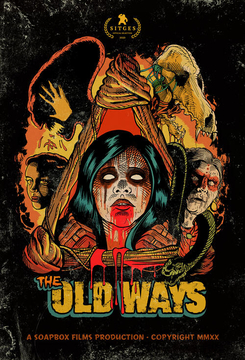
The consensus seems to be that The Old Ways is pretty good.  This folk horror, demonic possession film didn’t impress me too much, however.  The premise is good: there is a ruin in Mexico that explorers leave having been possessed.  They don’t know it.  At the same time, it seems that the possession of Cristina, the protagonist, came from her mother.   And she also visited the ruin.  Most of the movie takes place in a room where a bruja and her adult son attempt to exorcise Cristina while her cousin Miranda watches.  Things are a bit more complicated than that, however.  Cristina has returned to her hometown with the intention of dying via a heroin overdose.  Apparently the demon was luring her there to finish her soul.  In any case, it felt quite confusing to me.  

The story actually begins with Cristina finding herself held captive by a bruja named Luz.  She insists that Cristina can’t go until the demon has been destroyed.  Cristina feels fine, though, and doesn’t believe there is a demon.  Meanwhile she’s able to smuggle in her heroin and uses it at night.  But she also starts seeing what seem to be demonic entities.  She escapes but finds that she can’t cross a line of salt.  She’s forced to admit that she does have a demon and submits to a painful “old way” extraction.  Luz performs the ritual—nothing like Exorcist style—and even performs surgery on Cristina with her bare hands.  In the end, the exorcism leads to Luz’s death.  Cristina prepares to go back to Los Angeles, but then discovers the demon has taken possession of her cousin Miranda.

Becoming a bruja herself Cristina performs the ritual on her cousin.  The results are less dramatic but lead to a confrontation with a particularly nasty demon.  The cousins together are able to destroy it.  Meanwhile, Cristina’s boss has come looking for her and he too went to the ruin and has been possessed.  Cristina prepares to do another ritual, the old way.  There seems to be too much going on here and much of it is unfamiliar and therefore difficult to understand.  It is a good example of religion and horror cooperating and the use of folk methods for handling a demon felt fresh.  The eeriness of the situation is perhaps more uncanny than scary, but the biggest problem for me was that the origin of the possession kept shifting.  There is a character (a little boy) who’s not really explained, but who isn’t a good sign.  This isn’t a bad movie, but it made The Exorcist feel like old school.


Bad Boy

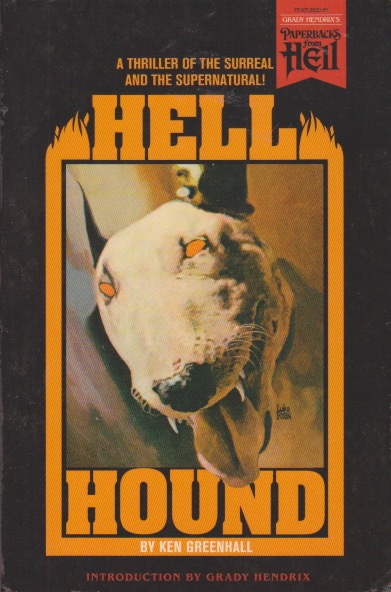
I’m still trying to figure out what I think about it.  The introduction by Grady Hendrix got me interested in the novels of Ken Greenhall.  The introduction was in Hell Hound and it described how Greenhall’s books whispered horror rather than shouted it.  That’s also true of the horror stories I write, and it’s clear I still have plenty to learn.  Baxter is a bull terrier whose thoughts are recorded for part of each chapter in this short book.  What we read isn’t terribly welcome.  Baxter is aware and intolerant of human weakness and he has a strong will.  So strong that he uses it to get people he doesn’t care for out of his way.  At the same time, as the story unfolds, you can’t see Baxter as evil.  He obeys his nature but he has morals.  Spoilers follow.

His first owner, an old woman with little joy in life, is his first victim.  He’s adopted by a young couple but they’re about to become parents and when they do his jealousy appears in the worst way.  They couple give him away to a young boy who aspires to be a Nazi.  A fan of Hitler, he appreciates Baxter for his power and his, as he thinks, killer instinct.  But Baxter doesn’t kill for the sake of it.  Misguided as he might be, his kills all have a purpose.  The boy is a bit different.  He demonstrates his callousness by trying to have Baxter kill another boy.  Then the Nazi kills the pups Baxter has sired.  The two face off and the story is written well enough that you find yourself hoping that Baxter will prevail.  But alas, opposable thumbs do give a fatal advantage.

It’s unclear by the final chapter how much, if at all, the boy has changed.  He knows how to manipulate others and his own interest is what guides his actions.  It’s kind of a bleak story in the end.  It is, however, well told and compelling.  Greenhall wasn’t known much during his life, but he did manage what’s rather difficult today—he had a series of novels published.  He died over a decade ago and is now starting to be recovered.  That’s often the sign of quality writing.  Those who make an impact are often overlooked in their own time.  Hell Hound isn’t my favorite horror novel, but it is a strangely affective and effective one.  And it shows that dread need not take place over many hundreds of pages to work.  I’ll likely be coming back to Ken Greenhall for more.


Things Seen

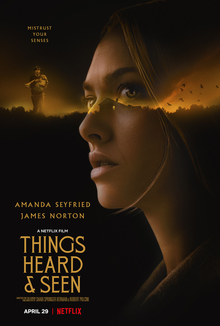
I disagree with the critics on this one.  Things Heard & Seen is a remarkable horror film.  That’s not to say it’s without its flaws, but it is quite engrossing for the right kind of viewer.  It has elements of dark academia, as well as ghosts and a respectful treatment of Swedenborg.  And it takes place in the Hudson Valley (the headless horseman is even mentioned once).  The Bible appears both visually and is quoted.  In short, it encapsulates many of my personal interests.  And it’s not badly made.  There will be spoilers here, but it’s difficult to discuss religion and horror without them.  George Claire married Catherine because he got her pregnant.  He has, however, finished his doctorate and been offered a post at Saginaw College, in the Hudson Valley.  It quickly becomes clear that George is an entitled, self-centered liar (sounds familiar).

As the story unfolds, both Catherine and their daughter Franny see ghosts.  George dismisses them but even at the college the head of his department is a Swedenborgian and tells him not to dismiss the spiritual world.  George’s true character starts showing through.  He cheats on his wife.  He forged his letter of support from his Columbia doctoral advisor because his work was substandard.  When a fellow faculty member finds out, he runs her off the road, putting her into a coma.  He drowns his department head while boating on the Hudson because he also learned the truth.  He even claims to have painted pictures done by his brother.  In other words, he’s a real piece of work.  The ghosts aren’t able to save his wife when he murders her, but his colleague comes out of her coma and spills the beans.

In the end, George sails away into a Thomas Cole painting where a Swendenborgian ending overtakes him.  The use of Swedenborg adds an etherial element to the film, figuring thoughtfulness to what otherwise might be just another story about an unhinged academic.  The department head’s advice about seeing death in a Swedenborgian way was also strangely affecting.  In other words, this is thoughtful horror.  And once again it demonstrates that religion can be crucial to understanding what we really fear.  I suppose some critics dislike the unambiguous use of ghosts and the supernatural breaking into “reality,” but that seems to be precisely the point.  I only learned of this movie because Netflix recommended it, but they hit on several major themes in my work over the past several years.  I would watch this one again.


Missed Movie

It has been years since I read H. P. Lovecraft’s “The Dunwich Horror.”  I’d never seen this original movie made from it, often cited as being a reasonable adaptation of a Lovecraft story to film.  The visuals are sometimes impressive, but it is a slow moving, plodding movie.  It does, as far as I can recall, follow Lovecraft in general terms.  This is one of those movies that would’ve fit into Holy Horror for two basic reasons: it begins with a quote from the Bible and it has its own alternative sacred book, the Necronomicon.  In one scene the latter is explicitly compared to the Good Book.  Since religion didn’t enter horror in any kind of direct way until about 1968, this movie is an early example of how the two interact.  It came before The Exorcist.

The point is made at several junctures that the religion of the Whateleys is the antithesis of Christianity.  Indeed, the point of all Wilbur Whateley’s shenanigans is to raise the old gods.  Lovecraft, famously an atheist, used gods to set up his cosmic horror.  He’s also notoriously difficult to capture in movie form.  While Roger Corman was the executive producer he was not the director, and that may answer for the pacing.  Daniel Haller, the director, had worked with Corman before on some of his Poe Cycle films and had directed Die, Monster, Die, also a Lovecraft adaptation.  Lovecraft wasn’t a terribly cinematic writer.  His stories contain ideas that feel like they might fit on film, but executing them well is difficult.

For this movie, the house used for the Whateley residence is fitting.  It helps create a sense of dread.  The basic idea of the flick is that Wilbur needs a virginal victim to help summon the old gods.  He lures Nancy Wagner to his house where she falls under the influence of drugged tea.  There’s an intriguing glass sculpture that is never fully explained.  As Nancy begins to lose her will, her friends come to find her, and one of them is killed by Wilbur’s inhuman twin that had also killed their mother during birth.  Once released, this monstrous progeny begins killing locals (the locals hate the Whateleys) and is poised to take Nancy until a guest lecturer at Miskatonic University bests Wilbur in spells recited from the Necronomicon, saving the girl and dooming the last Whateley.  The family line ends.  Until it is rather heavy-handedly shown that Nancy is pregnant by Wilbur, so the unwholesome Whateley genealogy continues.  The visuals aren’t bad, but the story is lacking.  Still, it’s part of the canon, so I needed to see it and it used religion to intrigue me.


Coming for You

Skimming through the freebies on a streaming service I came to Serpent’s Lair.  Having written a book about demons, I try to keep an eye out for possession movies I might’ve missed and that may add something new to the discussion.  This one turned out to borrow quite a lot from other films, most noticeably, The Omen.  Tom Bennett and his wife Alex buy a unit in a house that could’ve stepped from Rosemary’s Baby.  I kept wondering what the unnamed city was where they worked.  It turns out that the entire film was shot in Romania, so that’s why identifiable landmarks were missing.  In any case, their unit had been inhabited by a college professor who’d been dabbling in the dark arts.  Some of his stuff was left behind.  By the way, there is a lot of religious imagery in this film—maybe not directly Bible (so not Holy Sequel material), but plenty of religion.

Their kindly next door neighbor is a doctor who smokes a lot for his profession.  The couple adopts a stray cat in the courtyard.  The cat turns out to be a kind of conduit for a succubus.  Naturally, the cat takes a dislike to Alex, finally causing her to fall down the stairs and end up in the hospital.  When she’s out of the house the former resident’s sister comes to close his estate.  I don’t think I’m spoiling anything if I say she is the succubus.  While Alex is away, she coaxes the faithful Tom into a torrid affair.  Tom really loves Alex and is reluctant, but succubi can be very persuasive.  Meanwhile more cats move into the building.  When an archaeological colleague of the former tenant arrives, he notes that said tenant had no sister.  Research indicates Tom is dealing with a Bast succubus.  Of course, the colleague is killed.  Spoiler alert:

It turns out the the doctor next door is Satan himself.  The only way to get rid of a succubus is to set it on fire.  Alex has already left Tom, so the next time the demon shows up, he lights her up.  Satan, next door, sees the whole thing and laughs.  Roll credits.  While a low budget film for its time (1995), it isn’t a cheap movie.  Serpent’s Lair at least tries.  The story is a touch weak because much of this has been done before.  It takes advantage of something that had been discovered a couple of decades earlier—religion is a great setting and source for horror.  Even if the explanation doesn’t really satisfy.


Check for

If after Sleepaway Camp you’re still willing to go into the woods, beware of Ticks.  Actually, for a direct to video movie, Ticks isn’t bad.  It has some production values and a story that, although very far fetched, keeps you watching.  It all begins with a group of inner-city kids going on a wilderness enrichment project.  They don’t know that some cash croppers growing marijuana have been using steroids to enhance the growth of the plants nearby the cabin.  The steroids leak onto some ticks who grow supersized and are out for blood.  The kids and their chaperones know none of this as they try to get into nature and away from their unhealthy urban lives with its crime and entitled situations.  The local sleazy drug lord, however, doesn’t like them too near his operation, and keeps an eye on them.  One of the drug growers is the first to be attacked.

The mutated ticks start out about the size of a hand.  They first attack the dog of  one of the kids, draining it of blood and killing it.  Then they go for people.  Although there’s nothing really new here, other than using ticks as the monsters, it’s a somewhat fast-paced film that satisfies the monster itch.  Only one of the kids actually dies, although several are bitten.  In keeping with the tropes of many American films, though, the one Black kid is the sole victim.  This could’ve been thought through a bit more carefully.  The only other deaths are, however, three white men—all of them associated with the drug growing operation.  A bit of humor keeps things from getting too heavy, but the fact is that ticks can be scary and it turns out that making them bigger, as tenacious as they are, can work to make them scarier.

If you’ve ever been bitten by a tick (only once, that I know of, in my case) you know they can be frightening in that they carry diseases.  In the movie, instead of Lyme their bite is, or can be, hallucinogenic.  This isn’t applied evenly, however, sometimes the bites do this, and that is used to build some tension and to resolve some issues.  In the end, though, it turns out like many of the young-people-in-a-cabin-in-the-woods movies.  I won’t tell you how it ends since you may decide to see it, if you’ve cheap like me, and have been hankering for another excuse not to spend a week in the woods.  You’re generally fine if you do rent a cabin, but it is always best to check for ticks.


Spiraling

I’m not the world’s biggest manga fan, so when I post about it it’s a safe bet a friend lent me a book.  This happened a few years back with Kouta Hirano’s Hellsing series I blogged my way through.  (I don’t own the books so please don’t come knocking at my door.)  Another friend recently let me Junji Ito’s Uzumaki.  I lack the finer points of manga (or anime, for that matter) interpretation, but I see the appeal.  Both of these series are horror, and my friends know that I read and watch horror.  Uzumaki is fascinating in the sheer number of ways it involves both body horror and folk horror.  There will likely be spoilers here, so be warned.  It’s all about spirals.  At first I had difficulty seeing how they could be made scary, but there are some seriously disturbing images in this work, if you read through the entire collection.

The story follows Kirie Goshima and her boyfriend Shuichi Saito and their life in Kurouzu-Cho, a town infested with spirals.  The spirals become the vehicle of horror as some people go insane because of them, but others twist into spirals, or have spirals cut into their bodies, or become jack-in-the-boxes, or grow into snails with spirals on their backs, or turn into vampires because of umbilical cords.  The town is plagued with hurricanes and tornadoes.  The ancient lighthouse’s beam becomes an incinerating spiral.  There’s no way out of the town because all exits spiral back into it.  People who stay in the old houses in town twist into each other’s spiral bodies.  That kind of thing.  Kirie (and her family) and Shuichi try to escape but end up surviving until it becomes clear that an ancient spiral culture still has a grip on the town and it will never let go.

As a kid, much to my mother’s chagrin, I used to read American horror comics.  Some of them contained images frightening to a child.  I really wasn’t expecting that this could be replicated on an adult level, but I’m willing to admit I was wrong.  Uzumaki  is compelling as horror.  Creative and bizarre, the comic shows what can be done with a concept that is pressed for more and more ways of developing fear from something otherwise quite benign.  Junji Ito has an eye for horror and my limited exposure to manga makes me think I’d be open to borrowing more of it.  If I can fit it into my spiraling schedule.


Stone Children

I’m indebted to a friend for pointing out the folk horror nature of the 1977 UK children’s television series Children of the Stones, broadcast on ITV.  Folk horror is firmly tied to place and often involves ancient religions clashing with modern ones.  The term was coined to describe three horror movies of the late sixties and early seventies: Witchfinder General, The Blood on Satan’s Claw, and The Wicker Man.  Most discussions don’t go as far as to include children’s programming, but they should.  Children of the Stones consists of seven half-hour episodes which can be, thankfully, found freely on the internet.  Set in the fictional Milbury, but filmed in the actual Avebury, the story revolves around the famous stone circle located there.  Astrophysics Professor Adam Blake and his teenage son Matthew travel to Milbury for research but soon find themselves in a disturbing scenario.

Nearly all of the villagers are incapable of experiencing negative emotions.  What’s more, they can never leave the stone circle.  The stones possess a great energy and Matthew is psychometric—he can sense accurate knowledge of a place or time by touching an object associated with a person at that place and time.  His father, naturally, is skeptical, but when Matthew and his new friend Sandra realize their friend Kevin has changed—he is one of the Happy Ones and suddenly very good at higher mathematics—they piece together a cosmic mystery that involves the stone circle, an ancient religion, and astronomical events from long ago.  There are many horror elements along the way.  People are turned to stone.  Villagers are brainwashed.  Nobody can leave.  The soundtrack was deliberately disturbing as well.  The solution ends up involving time loops as well, so this is heady stuff.

Since the series clocks in at three-and-a-half hours, it really doesn’t fit movie length.  At least not comfortably.  And it contains fairly disturbing themes for children.  Then again, children tend to like scary things; parents are the ones to object to it.  Building on the mythology of the druids and the megalithic structures in and around Avebury, the series maintains a fascination for adults, even if the action is set at kid level.  I was able to get it watched in a week since the episodes allowed for natural breaks in the story.  If my friend hadn’t pointed it out to me, I’d probably never have discovered it on my own.  It’s a pity it isn’t discussed more by those who analyze folk horror.  It is, after all, fun for kids of all ages.


Jurassic Horror

We recently decided to watch Jurassic Park again.  When I was younger, I often wondered why Stephen Spielberg was passed over for academy awards.  His movies always seem to be popular and they’re well made.  I think now that I’m starting to get a better sense of the subtleties that award juries use.  In any case, Jurassic Park still holds up remarkably well.  The reason I raise it here, however, is that I was wondering if it could be considered a horror movie.  Casting about for weekend viewing, I see that various streaming services list the available Jurassic franchise films as horror.  And there are certainly horror elements to the original.  Dinosaurs in a modern setting have been used as a horror formula before, and a PG rating isn’t sufficient to disqualify a film as horror.  Is Jurassic Park horror?

It certainly has the Frankensteinian mad scientist element.  The decision to clone dinosaurs without sufficient consideration of how they might interact with/destroy modern humans and ecosystems has horror undertones.  More directly, a t-rex, and in the movie, velociraptors, are portrayed as monsters.  Don’t dinosaurs qualify as monsters, almost by definition?  The scenes of them stalking and pursuing kids, as well as adults, and the fear reaction shots suggest we’re going for the horror aspect of movies.  The film includes dismemberment, dark corners, and screams.  Typically it’s considered an adventure film, or science fiction.  The science in it, however, isn’t too far advanced from where things stood in the nineties.  Horror is a genre with indistinct borders.  Even as an adult who’s seen it several times, Jurassic Park still scares me.

The point of horror need not be to scare, of course.  I keep coming back to Edgar Allan Poe’s idea of effect.  It’s mood that makes horror, in my opinion.  One of those moods may be fear, but it isn’t necessarily the main, or even primary effect sought.  Believability is another of the moods.  I’m sure we’ve all seen movies that we simply can’t accept and that makes them less of whatever genre they happen to be.  Jurassic Park, apart from the usual leaps in any speculative story, is believable.  People do try to game the system.  As both the internet and AI teach us, people do release untested inventions on the public, sometimes with tragic results.  And while cloning remains controversial, is it difficult to believe that there might be scientists somewhere who wouldn’t love to clone dinosaurs, if they could actually get viable DNA?  To me this all says horror.


Failed Horror

In general I’m not one for stopping a movie, even if it makes me uncomfortable.  I have what is perhaps a bad habit of not reading about movies before watching them, and occasionally that leads to problems.  Combined with my interest in watching films that I don’t have to pay for (i.e. they stream on services I use, or commercial sites like Tubi) this sometimes leads to bad choices.  I started watching Maniac (2012—more than one movie has this title), but stopped about halfway through.  It wasn’t because I was too scared, but rather what I was watching simply wasn’t what I watch horror for.  I’ve long preferred supernatural themes to mere slashers.  Some slashers with that supernatural element (the biggies: Halloween, Friday the 13th, and Nightmare on Elm Street) still have an appeal, but for the most part more recent bloodbaths don’t really do much for me.

A few weeks after I attempted Maniac, I tried to watch Freaks.  This is an early film that I’d read about many times and didn’t really want to watch, but it was “free.”  In this case, part of a collection of movies I’d purchased on DVD some years back.  It turned out that the disc was damaged and got stuck in my player.  Now, weekends are a precious commodity.  I hate wasting time.  My wife was still asleep so I tried watching High Tension (2003).  I stopped about halfway.  One of the more extreme slashers, it also is a home invasion story, which I dislike.  It was predictable up to the point where I left off.  Then I decided to read a synopsis and learned it has a twist ending that may have made it worth finishing.  I’m no fan of torture porn, however.

By this point it was too late to start yet another movie.  It was light already and we had to go get groceries soon.  Finding time to watch horror movies, even on weekends, has been really tricky.  And I’m getting to the point where I may have to start reading about films before I invest time in starting them.  The problem is I prefer for movies to reveal themselves.  It doesn’t take a genius to know that “free” movies are often free for a reason.  Perhaps it’s time to start specifying “monster movies” for what I want to see.  Horror has wrongly been associated with mainly slashers for many years now.  Some of us prefer monsters, and preferably ones that won’t cost us an arm and a leg.

Photo by Stefano Pollio on Unsplash

Still Early

I’ve been thinking quite a bit about the history of horror movies of late.  Although they began being labelled “horror” in the early 1930s, the idea had been around for some time.  When I learned that the problematic director D. W. Griffith presented an early horror film based on Edgar Allan Poe in 1914, I had to see it.  Fortunately it’s easily found.  Long in the public domain, this silent film can be watched in its entirety on YouTube.  The Avenging Conscience is an adaptation of “The Tell-Tale Heart.”  The set-up is quite different, and it has a happy ending.  The characters aren’t named, apart from the sweetheart, who is called Annabel.  She’s taken from Poe’s poem “Annabel Lee,” which is also used in the film.  A young man owes his good fortune to his uncle, who raised him as an orphan.  When he falls in love with Annabel, the uncle objects.  The lad owes him loyalty.

The young couple decide to break up, so as not to upset the uncle.  The young man has been reading “The Tell-Tale Heart,” and thinks about killing his uncle.  He falls asleep in a chair and when he awakes decides to do the murder.  He is witnessed, however, by a passer-by.  He has to pay him off, but he is now free to pursue his love.  He walls the body up next to the fireplace.  A detective, alerted by the uncle’s friend, interviews the young man and the tapping of his pencil reminds the nephew of a beating heart.  He begins to see the ghost of his uncle.  His guilt eventually comes out and he begins a shoot-out with the detectives.  When he can’t win, he hangs himself, which causes Annabel to leap off a cliff in despair.  Then he wakes up.  The uncle is still alive, and has had a change of heart about the young lovers.  The couple marries and a weird coda involving Pan and some strangely dressed children, apparently a book the nephew wrote, winds things up.

The ghosts, insanity, and the murder mark this as early horror.  Although the actual deaths, except the uncle’s, take place off screen, they are still horror territory.  And, of course, horror properly didn’t quite exist.  Although The Avenging Conscience can’t really take credit as the first horror film, it is certainly an early one.  And it is based on Poe.  Silent, black-and-white, and not really scary at all, this movie has a place in the history of what we now recognize as horror. Watching it is to watch a bit of history.