The New Light

Sometimes you meet kindred spirits in books.  Barbara Brown Taylor’s Learning to Walk in the Dark has been waiting patiently.  It’s one of those books that I suspected would meet me where I live, and regarding this I was correct.  Brown Taylor, a former Episcopal priest and professor of religion (both of which I attempted but failed to achieve), has the courage and insight to suggest that darkness might just be a friend.  The darker half of the year settled hard on me this year.  As its black wings gathered about me I reached for this book.  I’ve been struggling with a question I’m sometimes asked: why do I let my thoughts linger in what must be considered darker corners?  I watch horror and write books and stories about monsters.  What’s wrong with me anyway?

One accusation may be fairly leveled at much of American religion is that it is shallow.  Light is uncritically accepted as good and dark becomes somehow evil.  There are biblical prooftexts that can be used to “prove” this, but they change color when you wrestle with them.  Learning to Walk in the Dark contains many ways of reflecting on realities which are inevitable.  Brown Taylor visits museums that give the sighted the experience of being blind in a safe environment.  She spends time in caves.  She stretches out beneath the stars and contemplates the dark night of the soul as well as the cloud of unknowing.  These latter two are, of course, spiritual classics.  There’s quite a bit that can be learned from experiencing darkness and listening intently.

My own predilections toward subjects called “dark” are forms of therapy.  My religion simply can’t be shallow.  I need enough water to swim.  And yes, I’m afraid of deep water.  Darkness perhaps comes more naturally to those of us who are awake for every sunrise.  If I move far enough north that may cease to be the case, but for the last decade or so my internal alarm goes off a couple hours before the first sliver of light creeps over the eastern hills.  And I seem to have assimilated to it.  As I read Learning I could imagine the accusations flying from my former Nashotah House context.  Looking at that patriarchal theology of sin and misery, however, I think there’s no question whence true darkness comes.  Without the dark we could never tell that it was light.  Since we need both, it seems wise to follow the sage advice here offered and get to know the dusky side a bit more intimately.


Flipping

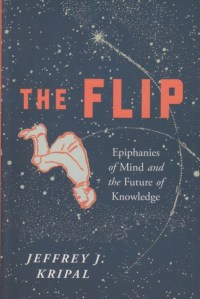
The mind-blowing book I mentioned last week is here unveiled.  I discovered Jeffrey Kripal’s work years ago, and have subsequently had a few conversations with him.  The Flip: Epiphanies of Mind and the Future of Knowledge is a challenging and necessary book.  In a way that only full-time academics can, Kripal examines the large picture.  When I say “large” I mean cosmic in scale.  He does so through the lens of the humanities and, especially, religious studies.  If anybody’s going to make religious studies cool, it is he.  The world is full of weird things.  If we’re honest most of us will admit to having had strange things happen to us.  Often we’ll filter them out or explain them away, but at other times we will stop, scratch our heads, and wonder what just went on.

The Flip is not a book of such anecdotes (and I, along with the author, am willing to take anecdotes seriously).  There is some strange stuff in here, but there is also a lot of science.  Historically the humanities, as understood by ancient Romans, included what we would call sciences.  Humanities, in other words, were attempts at understanding the world.  Today religious studies is among the humanities while science is separated out into STEM.  Kripal takes science seriously.  In fact, much of what he discusses here is the application of quantum physics to the macroscopic.  (I’m probably not explaining this well, but then, I guess you’ll have to read the book!)  In other words, science and the humanities need to come together again.  It’s not either/or, but both/and.

Holding out a hand across the aisle is uncomfortable.  Religion has done a great deal to disgrace itself of late, and it’s no wonder respectable folk want to keep their distance.  To understand what we are, however, requires a willingness to admit that humans are both deeply intellectually curious and deeply religiously inclined.  We can be both.  In fact, it is unlikely we can be any other way.  Anomalous occurrences aren’t generally welcome in religious studies any more than they are in the sciences.  That doesn’t stop strange stuff from happening.  This little book of big ideas uses that disjunction to lead the reader into spaces where the future might faintly be discerned.  Wide-ranging and provocative, this book needs to be read.  It is a strange world where two different approaches to knowledge so often decline to speak to one another.  Here they do, and their conversation is mind-blowing.


Book Magic

Something happens to you on a long bus ride, reading a mind-blowing book.  Part of the transport—literally—is that you’re captive for an hour or two and your book is your boon companion among snoring strangers.  Another aspect is the earliness of the hour.  Days like yesterday, when I have to commute to New York, involve awaking at 2:30 a.m.  The day is cast very differently when your timing shifts back by a few hours.  It’s almost mystical.  The largest portion of the transformative experience, however, is the book itself.  I’ve begun commutes with a book that I quickly realize is a mistake, but since I’m not a quitter, I soldier through it to the end anyway.  On yesterday’s commute the book was one of those that caught my imagination and flew it like a kite from the rear of the bus.  Arriving in Manhattan before six a.m. added to the feeling.  The city’s a very different place that time of day.

Not everyone enjoys reading, I realize.  My late stepfather once had a job as an elevator man.  Not the kind dressed in livery at a big-city hotel, but as an operator in an antiquated building in Oil City, Pennsylvania, where you had to pull the metal gateway  physically across the door and wait until the floor leveled before opening it again.  I didn’t get along with my stepfather, but one day I went to visit him in the elevator.  It wasn’t a busy building.  He sat on a stool, staring straight ahead.  For hours at a time.  Not a man prone to meditation, I knew he had to be bored.  I asked if I could bring him something to read, at least.  He declined for fear of missing someone’s call signal.  It was one of the most frightening scenarios I could imagine.

The clock in the Port Authority read 5:49 when we pulled in.  The day seemed full of possibilities.  I caught the 4:30 home, but the magic was gone.  The book had moved on to more technical things.  Traffic was bad, and there’s a world of difference between reading while the bus moves and trying to do so when it’s caught in traffic.  The commute out of New York City is normally a nightmare, and yesterday traffic didn’t flow freely until we were nearly through New Jersey.  My book was still my companion, but rather more like when a conversation ebbs after an intense discussion.  There was the worry of getting home, taking out the garbage, and trying to stay awake until a reasonable hour.  The book would still be there tomorrow, but I wouldn’t be the same.


The Holy

It’s perfectly natural.  Trying to make sense of things, I mean.  It’s been a little difficult in America for the past three years or so, given that nothing seems to add up beyond greed and narcissism supported by a senate majority.  Still, as I retreat into my horror films I realize that there’s a logic to it.  Over the past several months I’ve been attempting to articulate it.  You see, I have a couple of presentations to give on Holy Horror in October and one of the questions likely to arise is why.  Why bring together the sacred and the scary?  Those who’ve studied religion formally—and many who’ve not—are aware of Rudolf Otto’s classic The Idea of the Holy.  It’s outdated and I’ve been waiting for someone to write its replacement, but we’re past the era when one scholar corners the market.  Has nothing new emerged this past century?  Nevertheless, Otto’s main ideas still make sense, before he lapses into a Christocentric view.

Mysterium tremendum et fascinans isn’t an incantation, but with a little imagination the Latin makes sense.  The holy, according to Otto is a mystery that is both terrifying (tremendum) and fascinating.  To the laity in the pews this may be strange, but chances are pretty good that your minister has read this book.  In the monotheistic west, the divine is terrifying.  It’s not splitting hairs to suggest terror and horror differ, nor is it unreasonable to suggest they have much in common.  Horror seems more embodied—a working-class variety of terror.  Still, both have that element of fascinans.  We fear but we can’t look away.  I don’t have the time to sit and ponder that a Gilded Age academic had.  Otto didn’t have to keep up with Facebook and Twitter.

Although academia required far more than eight hour days, the time during those days wasn’t spent “on the clock.”  As one intellectual I admire once quipped, staring out the window is work.  Not as far as HR is concerned, however.  Productivity in an industry under stress is its own kind of mysterium tremendum, I guess.  It doesn’t really allow for unstructured hours to read, take notes, close your eyes, and read some more.  Work measures inspiration in terms of currency, which is one of the problems that stretches past beyond these last three years.  Struggling hard with an idea is like wrestling an angel until dawn.  You can’t win, and you can’t lose.  But when the sun clears the horizon it will be time to be at your desk and ideas will have to wait another day.


Digging Well

Having spent a good bit of the past week in waiting rooms in Ithaca, I fell to reading Tompkins Weekly, the free local community paper.  If you’ve spent any time on this blog you’re no doubt aware that I have an interest in the weird and unusual.  Although I got teased rather mercilessly for this as a kid, thanks to The X-Files such interest has become somewhat mainstream.  In any case, after fumbling with the crossword and finishing the sudoku, I read an article about dowsing.  Now Tompkins County is the home of both Cornell University and Ithaca College, so I was a little surprised in finding such a topic addressed at all.  What’s more, the usual ridicule expected with anything even approaching the paranormal was lacking.

Dowsing is the practice of finding water, or other underground resources, by using a crotched stick or dowsing rods.  A larger version of the quantum “spooky action at a distance,” dowsing is said to produce an effect on the twig or rods that will point to the hidden source.  Like ESP it is decried by mainstream science yet used by some governments when other methods fail.  As an example of “folk wisdom” dowsing occupies a similar, if less conventional, space to religion.  Scientism has taught us not to trust the invisible.  Scientists, however, are well aware that we can’t see everything.  We slide a finger around our collar, however, when something “unscientific” seems to work.  As the dowsers explain, however, there is a kind of science to what they do.  Problem is it doesn’t work for everyone.  Only some people can do it.

Now I’m not a credulous person.  I spent many years and even more dollars learning how to be a critical thinker.  Skepticism, however, leads me to ask how we know that dowsing can’t possibly work.  Have we discovered all there is to know in this infinite but expanding universe?  With finite minds it seems highly unlikely.  Duke and Princeton Universities once studied parapsychology in an academic setting, and the University of Virginia has left some related areas open to investigation.  The real problem is that we’ve been taught to laugh at anything we’re told to.  The US Navy, for instance, has recently revealed that it takes UFO reports seriously (unlike Project Bluebook).  We’ve been laughing so long it’s difficult to take even the military at face value.   Does dowsing work?  It’s difficult to say without all the facts.  Of course, I’ve been sitting in a waiting room, pondering what we don’t understand.


Mother of Stone

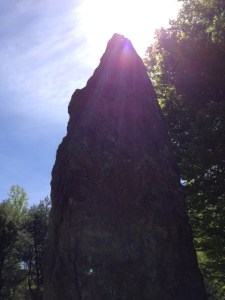
One thing we all have in common is mothers.  Whether it’s the mysteries of biology or something more spiritual than that, the connection lasts forever.  The thought occurred to me yesterday as we visited Columcille, one of those places that reflects a vision for a piece of land that transforms the ordinary into sacred.  Columcille Megalith Park is inspired by the standing stones of Celtic lands.  Open to the public for a suggested donation, the park consists of a stone circle and several menhirs (megaliths) arranged along paths through the woods.  Recognized by the Nature Conservancy as a sacred space and outdoor sanctuary, it draws thousands of visitors of all faiths with both recreational and religious rationales.  Throughout the park we found evidence of spiritual interaction with nature left on or near the stones.  But what has this to do with mothers?

One of the areas in the park is the Sacred Women’s Site.  As we lingered there yesterday, I reflected on the sacred nature of all women, and mothers.  That’s not to suggest that motherhood is for all women, but rather that our society has been slow to catch up with the idea that women show us the way.  Men have “had charge” for millennia now and look at where we are; cooperative ventures and peacekeeping efforts crumble as world leaders encourage the resurgence of exceptionalism.  We’d rather have an inveterate liar lead the nation than a politically able woman.  Britain wants to pick up its marbles and let the European Union disintegrate.  We seem to have forgotten that just a century ago a world war ended.  We need sacred spaces like Columcille.  We need to remember the sacred women.

One takeaway from our brief visit was that although there was also a grove for sacred men, that of the women was more peaceful.  The idea of standing stones making a site sacred goes back at least to the Bible.  Stone circles are found from ancient Israel to the far-flung Orkney Islands of Scotland.  Standing among them, whether modern like Columcille or ancient like the Ring of Brodgar, or yes, the more famous Stonehenge, there is a sense of sacred purpose.  Miles from Stonehenge stands Avebury, a town built around another stone circle.  There the megaliths were divided between female and male stones, with both required to make the ring complete.  Such places require a tremendous amount of work.  When they’re constructed, however, they give us places to think of mothers and the mystery of life.


Mystic Connections

Those of us who find rationalism a bit too constricting sometimes find solace in mysticism.  My reading of late, which is mostly research for Nightmares with the Bible, frequently touches on mystics of the past.  This isn’t a new fascination.  All the way back in college, as a religion major, I mentioned to one of my professors that I found it appealing.  A frown settled across his academic face.  “Mysticism is dangerous,” he said.  He went on to explain that churches (he was Presbyterian, and I Methodist) had belief systems into which mystics—those who experience the divine directly—didn’t fit.  A direct experience of the divine could cast doubt on church doctrine and nothing, as you might guess, is more important to true believers than dogma.

That discussion at such an impressionable age set me aback.  Here as we enter (for the non-orthodox) the Triduum, or “Great Three Days” the faithful are hoping for some kind of divine experience, I expect.  Many of us will spend two-thirds of it working.  In any case, if nothing mystical happens why do we bother?  Mysticism is equally deplored by science since it suggests something that doesn’t fit into rationalism’s toy box.  A universe where the unexplained—and oh so subjective!—direct experience with naked reality threatens to undo all the neat columns and tidy formulas that describe the entirety of existence.  Conventional churches tend to agree because you never know what God might do if you open that box.

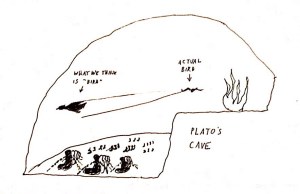
There are religions that welcome mysticism.  They recognize that human-built systems are only approximations—Platonic shadows, if you will, cast upon the cave wall.  Mystics are those who, temporarily unchained, dare to turn around and face the fire directly.  Who knows?  They might even catch a glimpse of the sun itself.  More conventional religions are run like businesses.  You come to a certain building at a certain time.  You perform prescribed actions on cue.  You place your money in this specific receptacle at this specific time.  Leave and forget it all until next week.  Our younger generations don’t find this engaging, just as they see through the lie of the inherent fairness of capitalism.  I can still see the frown of my theology professor.  The old systems are falling apart even as those not too weary after work will head to Maundy Thursday services for a slip of bread and a sip of wine.  The mystic, however, doesn’t know what might happen next.


Not-Quite-Normal Religion

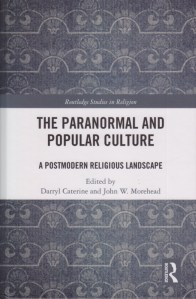
I’ve been thinking about categories quite a lot lately.  In a world connected by the internet, it seems that traditional categories don’t stretch far enough.  For example, I recently read The Paranormal and Popular Culture: A Postmodern Religious Landscape, edited by Darryl Caterine and John W. Morehead.  Published by Routledge, this is an academic study.  It contains some things, however, that many academics would find challenging.  I can’t summarize the entire book here since there are twenty very different essays included, but I can say this is a book that makes you think about categories.  Even the word “paranormal” means different things to different people.  To my way of thinking it has to tip the hat to Rod Serling and that place where fiction and fact begin to overlap.

That’s appropriate for this book: there are articles about what people perceive as factual encounters with all kinds of creatures and events, as well as studies of the decidedly fictional beings like Batman and zombies.  Our categories, in the modern world, tend to be inviolable.  Even scientists who handle Heisenberg know, however, that we are now in the postmodern world (as the subtitle indicates) and true objectivity is beyond the reach of all.  None of us stands outside the box looking in.  We’re all in the middle of it, and we look around ourselves trying to figure out what is real.  Another problematic category that, reality.  We don’t even understand what consciousness is yet, and how can we hope to know what is really real?  We all have dreams and some take them more seriously than others.

Reading books like this with an open mind is a truly po-mo experience.  After finishing more than one piece I found myself having to put the book down for a while at least so I’d have a hand free to scratch my head.  You see, we’ve been taught to laugh at those who believe in the paranormal.  It has been the only acceptable way that rationalists can deal with that which flies in the face of the system.  The internet, however, has put those isolated, ridiculed individuals into a community and the advent of reality TV (and what can be more real than what we see on the tube?) erodes the laughter factor little by little.  Plumbers can find ghosts but scientists can’t.  The average person relates more to the plumber, I think.  It all comes down to categories.  Making sense of them can, and will, impact our views of reality.


Yes or No

Reading about demonic possession is enough to scare you away from ever using a ouija board.  In fact, I’ve never played with one; growing up my strict religion would’ve prevented it in any case, and already as a child I’d been warned of the dangers.  During my research for Nightmares with the Bible, I’ve been reading quite a bit about ouija.  Originally a species of divination, the ouija, or spirit board, became popular during the growth of Spiritualism.  Spiritualism is a religion based on the idea that the dead still communicate with the living, ensuring believers that life continues beyond death.  It still exists, but not with the numbers that it boasted in the early days.  Among the solemn admonitions of Ed and Lorraine Warren (about whom I’ve posted much in recent months) was that ouija boards opened doorways for demonic entities.  Some of their stories are quite scary.

Image credit: Mijail0711, via Wikimedia Commons

Whatever else you can say about America, a fact beyond dispute is that if something can make a buck it will be marketed and sold.  So it was with ouija boards in the 1970s.  I remember seeing them on the shelf with other games at local department stores.  Even then I knew they weren’t a toy and I wondered how anyone could be promoting them for general consumption.  At Grove City College—that bastion of undergraduate conservatism—stories circulated about how students (usually coeds) were attacked in their locked rooms after playing with ouija boards.  This is, I was later to learn, a staple of collegiate urban legends.  At the time, however, I took it very seriously.  

Thus it’s strange when I find out that others my age were more curious about them.  Recently at a party with friends around Valentine’s Day, the question naturally came up of how some of us met our spouses.  One of the women mentioned that before she’d met or even heard of her future husband (who has an unusual surname) a ouija board spelled out his name.  She later met and married him, not on the board’s recommendation, but she remembered that years before she’d been given a hint.  Now these friends are not cheats and liars—they’re not even Republicans.  They’re people we trust.  On our drive home that night my wife mentioned she’d used a ouija board once, with friends, back in her high school years.  She asked the name of her spouse (long before we met) and came up with Sam.  I’m no Sam, but when we first met in grad school I was still going by my stepfather’s surname and my initials were S-A-M.  Coincidence?  Probably.  My future wife did not pursue me; indeed, it was the other way around.  Even so, there in the dark on the nighttime highway I felt a familiar frisson from childhood concerning a form of divination that seems to know more than it should.


Now Hiring?

In keeping with my recent theme of jobs you never knew you could have, I recently read a story a friend sent me from The Vintage News.  The story concerns a spiritual counselor who is planning to marry a ghost.  I didn’t know that spiritual counselor was an available job.  You see, I had taken enough psychology courses in college that I could’ve had it as a minor, but I didn’t declare it.  At the time I was destined, or so I thought, for a career in ministry and psychology seemed a good subject to assist with that.  Also, I naturally tend to try to figure out what motivates people.  Like most career options, not having a science background prevented me from pursuing psychology as a fall-back career.  But spiritual counselor?

The woman in the story lives in the United Kingdom.  Here in the United States, where unhappy people seek any opportunity they can find to sue someone, having a job as a spiritual counselor probably involves ordination.  Even if you’re ordained, as I learned from long years both attending and teaching in seminaries, you always refer those who come to you to a licensed psychologist.  Clergy can easily be sued for providing bad advice.  That’s why the counselor part of this job seems so odd to me.  That, and the woman the story features is only 27.  I suppose that’s time enough to finish a doctorate, for the truly ambitious, but apparently she doesn’t have a terminal degree.  Just a post-terminal lover.

Also, I learned that spectrophilia is a condition with a name.  The idea of intimacy with spirits is nothing new, of course.  The ancient idea of incubi and succubi reflect this concept, and a number of the stories in the Ed and Lorraine Warren oeuvre include sexual attacks by demons or ghosts.  What’s different here is that the young woman wants to marry a spirit she can’t see.  Unlike most such reputed cases of spectrophilia, she claims spirits are superior to physical lovers.  Despite the oddities that make such a story newsworthy (in a sense) a potentially important point could emerge from all of this.  Love is not a physical phenomenon.  We all know it when we feel it.  I suspect that other such feelings, like finding the perfect job that matches your skills and interests, are likewise intangible.  The problem is finding out that such jobs even exist.


Straining Credulity

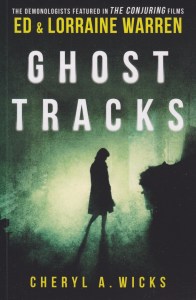
Ed and Lorraine Warren aren’t easy to figure out.  I realize that for someone who holds an actual doctorate from a bona fide, internationally recognized research university this might be something strange to say.  That’s because the standard academic response is simple dismissal.  Ed, at least, was known to have stretched the truth from time to time, but that’s not the same as never having reported weird things that actually happened.  This is why I’ve long advocated academics at least looking at the evidence—rare though it may be—before the simple hand-waving dismissal.  Part of the problem is that the Warrens’ books were written by credulous followers who don’t question things nearly enough.  Ghost Tracks, by Cheryl A. Wicks, may be the last of this strange genre of hortatory, biographical accounts “by” the Warrens written while Ed was still alive.

Skepticism is very important.  But so is listening to people.  What I find compelling is that similar weirdness—frequently dismissed out of hand—has been recorded throughout the length and breadth of history and across the entire globe.  The problem is that many of these things fall outside current scientific means of testing.  While perhaps not widely known, very reputable universities quietly explore these possibilities with actual science.  Part of the problem of the Warrens, as well as various other “ghost hunters” is that they use scientific equipment and think that makes them scientists.  It doesn’t.  Science requires deep engagement and many years of strenuous study.  And yes, skepticism has to be part of it.  The thing the Warrens have to offer is that they realize(d) that when science does engage the supernatural interesting things emerge.

Sensationalism, however, is the slave of capitalism.  Books sell better when they make extraordinary claims and declare they’re based on true events.  Trying to make a living investigating the paranormal led the Warrens, it seems, to tip the balance a little too far in the way of credulity.  Some of the stories in Ghost Tracks are more believable than others.  Some are just plain frustrating.  Ed’s interview with George Lutz (of Amityville fame), for example, is full of dropped balls.  A good question receives an intriguing answer only to have the subject immediately switched by the interviewer.  Even just a little skepticism and a follow-up question would have done scads to improve the believability of the story.  This is something a scientist would have known.  Someone as smart as Sir Arthur Conan Doyle, although his Sherlock Holmes generally found  ratiocination led to physical explanations, believed in the supernatural.  If only his Holmes might’ve been brought to this discussion we might possibly have learned something.


Hearing Nature’s Voice

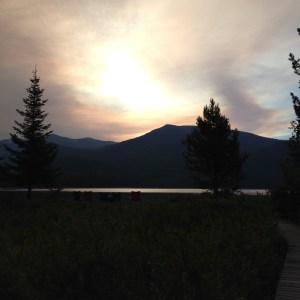
Silence is a rare treat.  I enjoy music and witty repartee just as much as the next guy, but silence is revelatory.  At home and in hotels I sleep to the sound of a white noise generator.  You can’t predict the sounds of neighbors, and my hours are askew from those of the rest of the world.  Here at the lake, things are different.  I awake early, hoping to catch the sun as it trips over the mountain tops across the way, lighting successive peaks before it reaches the near horizon.  It is utterly still.  Perhaps it’s the interference of humans in the habitat, but crepuscular animals seldom wander past.  The stillness is divine.  For some the lake means loud jet skis and buzzing motorboats.  I come here seeking silence.

Our daily lives lack peace.  Even when things are good there are always more things to be done.  We cram as much as possible into days impossibly short, giving at least eight out of every twenty-four to those who deign to pay us for our efforts.  Sleep is troubled and interrupted.  There are noises in the night.  You can’t hear your soul.  As the first rays seep into the valleys across the lake the birds begin to greet it.  Their conversation may interrupt the silence, but it doesn’t break it.  Silence is finding one’s place in nature.  Taking time to be still.  To listen.

Thirty years ago I first came to the lake.  My wife had been coming here for years already before that.  There have been many changes even in my short time here.  I can, however, hear eternity in the silence, for forever is a whisper, not a shout.  As I watch the morning mist arise, skate, and dance over the surface of the water as still as the very mountains that cradle it, I strain my ears to catch any sound.  The twirling wraiths are as silent as they are ephemeral.  They spin away the last minutes before the whine of an early morning fisherman’s boat begins its sleepy journey to the deep water in the middle of the lake, herald of other daylight noises to come.  I will await tomorrow’s unction of silence, and although the baptism may be secular it’s redemptive after all.  Nature knows far more about the human soul than any measurements might reveal.  You only have to listen to hear it.


Real Dreaming

I keep odd hours. Although we don’t live far from New York City, as the pigeon flies, public transit sets the schedule for my day. (I’m merely writing as a representative here, since I know others keep my hours as well.) Since I’m usually waking up around 3 a.m., I have to go to bed pretty early. One night recently I turned in around 8:00 p.m. and fell into a fitful sleep. When I awoke three hours later, it was as if my gray matter were a thunderhead. Ideas, worries, and memories flashing like lightning. Concerned, I watched the clock since I knew it was a work day. When three rolled around with no more sleep I hoped it would be like one of those rare days of interrupted rest when my conscious mind does just fine. Would it function that way on just three hours of sleep?

This incident brought home to me once again the mystery of consciousness. I had a meeting in New York I couldn’t miss that day, but by mid-morning (in real-people time) I was seeing things that weren’t there—an almost Trumpian dissociation from reality. Then I’d snap back to awareness and realize my mind was drifting off to steal some of the sleep it refused during the hours of darkness. Using the usual tricks I stayed awake for the workday and even for the bus ride home, with only brief momentary lapses where what had been reality had stopped making sense. Consciousness, it seems, functions best with a well-rested brain. A good night’s sleep put me back to normal the next day.

Reflecting back over that previous 24 hours, I thought how surreal they’d felt. Not to put too fine a point on it, but they were like an altered state of consciousness. Religions, some claim, began because of such altered states. They are strange and powerful. And fairly universal—almost everyone experiences them from time to time, whether by sleep deprivation, controlled substance use, or prayer and meditation. Even knowing the cause (going to bed with a lot on your mind when you have to wake early, for example) doesn’t change just how real the experience feels. This is one of the reasons that rationality doesn’t explain all of experience. In the same brain there are Jekyll and Hyde aspects to consciousness, interchanging with each other every few hours. As the movie Inception underscored, you don’t remember how you entered the dream. You’re just there. And when that world intrudes on the conscious, rationally ordered territory of wakefulness, the questions can become quite religious. Unless, of course, I’m still dreaming.


Russian Along

Living at Nashotah House—if you haven’t been, trust me—makes one curious about Rasputin. While on the faculty there, his name was used as a common slur. When Brian Moynahan’s Rasputin: The Saint Who Sinned came out in 1997 my wife and I bought it and read it together. Two decades on the details had become fuzzy and, having read about Aimee Semple McPherson and her faith healing reminded me of the famous Russian scallawag. For all his personal faults, Rasputin did seem to have genuine healing abilities. He was more shaman than orthodox, to be sure, and Siberia was the home of shamanism as well as Rasputin. For those who don’t know the story, in pre-Revolution Russia Grigory Rasputin rose from a Siberian peasant family to the most trusted advisor to the Empress of Russia, Alexandra Romanov. Her weak-willed husband, Nicholas, also gave credence to the mystic, despite the latter’s well known drunkenness and womanizing.

The fascinating aspect of Moynahan’s treatment is that it brings out the saintly side of this figure who’s grown such a notorious reputation. That’s not to whitewash his extreme lifestyle, but it is to acknowledge that he was far more complex than many critics make him out to be. He seems to have been sincere in his faith, and perhaps a little mentally imbalanced. He was kind to the poor, and charitable. He wasn’t a bigot, a sin quite common in his day. He was a working class mystic who took advantage of being inebriated with power. His influence over Alexandra was so strong that he could appoint Prime Ministers even in the midst of a world war. This is a fascinating personality.

Reading the book at this point in history, however, proved strangely unsettling. Many of us wonder how a rational, fairly educated and prosperous nation could tolerate the buffoons who inhabit Washington, DC. Daily we see insanity—with no exaggeration—on the level of the throes Tsarist Russia, or even of Rome under Caligula. Instead of taking steps to right the course, the Russian, excuse me, I mean Republican, Party does any and everything in its power to keep the illusion of normalcy alive. Even while foreign ministers of his own party tell the European powers to ignore their own president, American Rasputins just can’t survive without their daily power fix. The sad thing about that last sentence is that after writing it I felt as if I were somehow being unfair to Rasputin. And I lived at Nashotah House long enough to know what I’m talking about.


Heal and Farewell

What could Aimee Semple McPherson have in common with the devious Russian monk Rasputin? Apart from being contemporaries for a couple decades, they were both faith healers. Well documented cases exist for both of them, and the medical profession has started to come around to the idea that belief can, and does, heal. The stories of Sister Aimee’s healings, witnessed by thousands, make me fear being thought gullible just for bringing it up. That doesn’t mean it didn’t happen. Cases exist even today where healing inexplicably takes place before scientific eyes. Often it occurs in response to religious stimulus. We may have proof that it happens, but we tend not to believe. This is a curious state of affairs. We trust in reason to the point that it may prevent us from being healed by faith.

Some object, of course, to the theological element. It’s pretty tricky to believe God has healed you if you don’t believe in God. The thing about faith healing, though, is that it seems to work no matter the religion of the person healed. This, it would seem, suggests we should be applying our rational minds to understanding belief. Instead we use it to find new ways to make money or to build smarter weapons to kill one another more efficiently. The more we come to understand the physical world around us, the less we know. As our research institutions take on the shape of the businesses that increasingly fund them, interest in this phenomenon shrinks. Medicine, in all its forms, is big money. Living in central New Jersey you can’t help but notice the palatial campuses of the pharmaceutical companies, nor ignore the mansions on the hill they have built. If only we could believe.

Faith healing was this aspect of her ministry that propelled Sister Aimee to fame. She constantly underplayed it, not wanting to be considered a healer of bodies so much as a healer of souls. Rasputin, of course, had political motives. Both lived—not so long ago—when faith was taken very seriously. Judging from the posturing around the least religious president in decades, whatever faith is left has been sorely effaced. Maybe it’s our minds that have the capacity to heal, but even that well seems to have been drained with the leaky bucket of rhetoric. History can teach us so much, if we’re willing to invest in it. How does faith healing work? I have no idea. Nor, it seems, does anybody else. So it will remain until it becomes commodified.