Tale of Two Anarchies

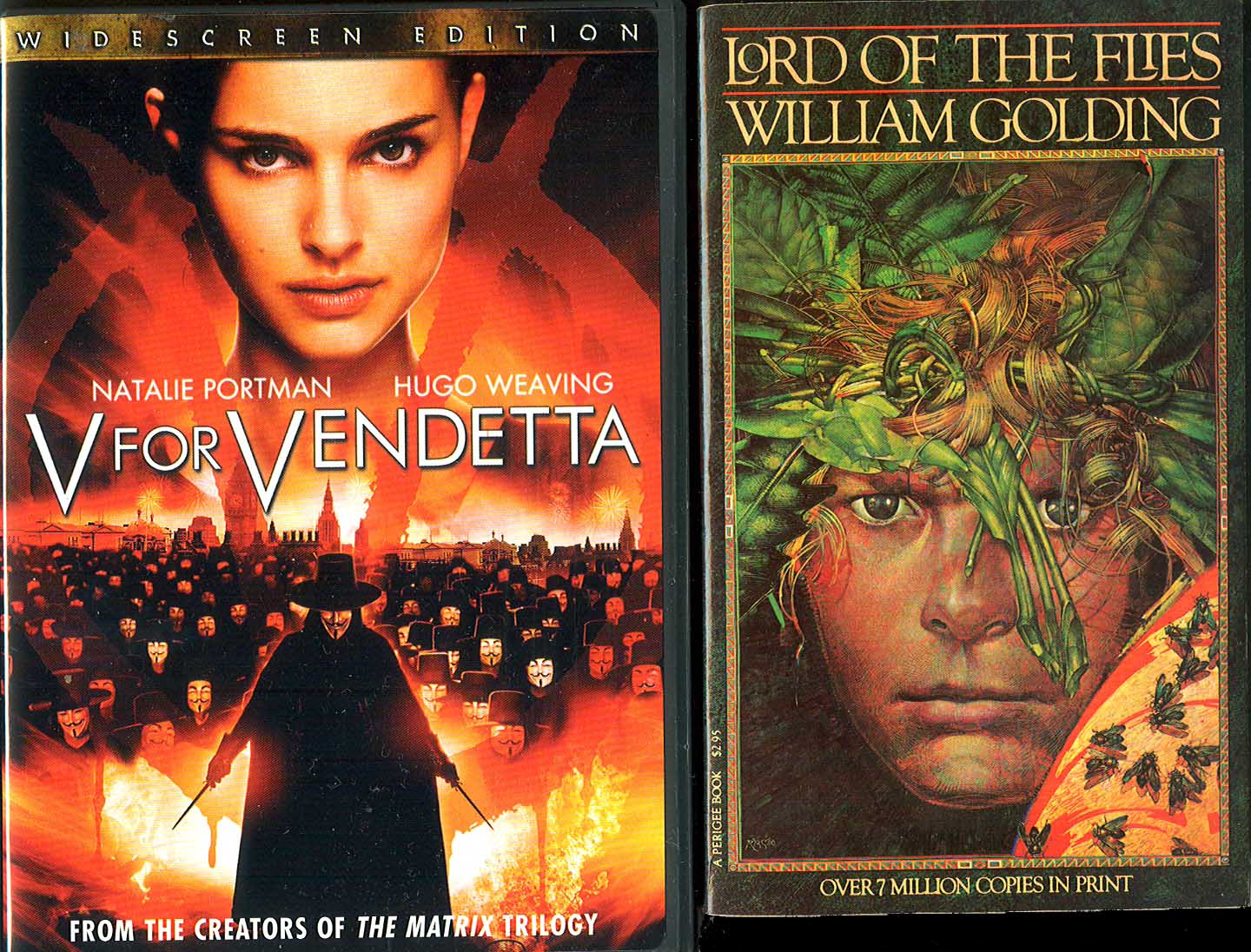
While snowbound over the weekend, I reread William Golding’s Lord of the Flies. I recalled a profound sense of awe from when I read it the first time in college, when students are invincible and optimistic. The second reading was still rewarding, but the message seemed darker, more true-to-life. Children on an isolated island devising their own schemes of democracy cannot repress the deep urge for self-advancement. When it comes to working together for the common good or promoting one’s own will, the latter wins out and seeks to destroy all dissenters. Anarchy becomes their natural state.

A few weekends ago I finally got around to watching V for Vendetta, the Wachowski Brothers’ dim and hopeful dystopia where individual conviction wears away at a conformity that benefits the privileged class. Recasting Guy Fawkes as a hero, albeit a tragic one, is a bold move in the post 9/11 world. The anarchy here leads to a rule by consent, the oppressed rising up as one to say “no more.” Even V is dead so there is no one to lead.
Better together?

Anarchy is a frightening prospect. Most people feel more comfort in the rule of law. One time I joined a discussion my brother-in-law was having with some friends on the rule of law. They were suggesting that if rule of law could be brought to bear on the Middle East then the seemingly continual crisis there might terminate. I disagreed from the far end of the table, not close enough to hear the whole conversation. My rationale is that the utter conviction of religion trumps the rule of law. Rule of law assumes all are equal, but religion in a monotheistic theater always assumes only one is right, and therefore superior. All others must submit. Problem is, many monotheistic religions feel the same way. We see it in the extreme power structure of the Religious Right in this country. Who is willing to say maybe the rule of law is superior to the rule of God? Watching the graceful anarchy of V, and reading the disturbing anarchy of Lord of the Flies, sometimes even the most stalwart free-thinker wishes everyone would bow to the rule of law.
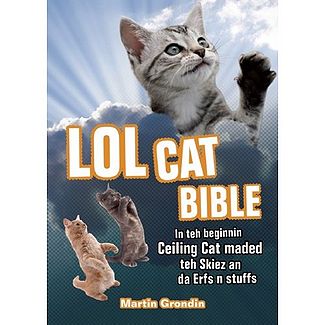

Im in ur blogz

Translation. The Bible as we know it would not exist without translation. Ours is a culture of convenience — Americans want divine revelation dished out in easy-to-swallow portions in their own tongue. Going through the rigors of learning new alphabets and grammatical systems, not to mention the eerie specter of textual apparatus, are enough to frighten off all but the most stalwart of truth-seekers. This is a good thing. We would never advance as a culture if we all had to spend our time learning actually to read our religious texts as they were written, only to find out that we have no original texts at all. So we trust our translators.

A few weeks back I posted an entry on Andrew Schlafly’s misguided (imho) Conservative Bible, devoid of liberal bias. Since then Stephen Colbert’s interview with Schlafly has been making its rounds on the internet and thousands of people are now aware of the project and its biases. I stand by my original objection that biased translations are unfair representations of the actual ancient texts. But it looks now like I’ll have to be eating crow. A new translation is scheduled to arrive in stores next month, and it looks like it may have a bias. Still, it is a translation that no internet-savvy reader can afford to ignore. Yes, the Lolcat Bible is nearly ready to pounce from the press.

The culmination of the Lolcat Bible Translation Project, over two years in the making, a Bible in Lolspeak will soon be available. Comparing what I’ve seen of the two projects, I think there is more truth in the Lolcat Bible than in the Conservative Bible. I’ve studied more ancient languages than any sane person rightfully should, but I do rely on my able research assistant (aka daughter) to help read Lolspeak. She suggested the title for this post, but the full text reads, “Im in ur blogz, postin mah wurdz of wizdum.” That’s straight from the mouth of Ceiling Cat!


Christian Movementarians

After a distressing day of job-hunting yesterday, I turned to the Simpsons for solace. Often the most intelligent program on American television, as well as being the longest running series, the Simpsons frequently hits religion with a few good-natured and well deserved whacks. Last night I watched The Joy of Sect from season nine. It has been a few years since I’ve seen the episode, and I was pleasantly surprised how it correlates with the overall theme of this blog.

Although the episode ends with a normalcy returning to Springfield after the appearance of a cult called the Movementarians, the parallels between the cult and Rev. Lovejoy’s church are numerous and poignant. This perhaps hits too close to reality for many religious believers — what separates a “cult” from a “church” is more a matter of perspective than a matter of practice or accident.

Even early Christianity had considerable connection to and similarity with Gnosticism. When religions collide, they must emphasize their distinctiveness to survive. Like biological organisms, those that meet the needs of their societies (“the fittest”) survive, while others go extinct. It seems to me that the main cause of religious violence is the need to claim exclusive access to the truth. People are not comfortable believing a religion that might be proven wrong. Like the Simpsons they wish everything will return to normal at the end of the day.

The very definition of normal


Special Babies

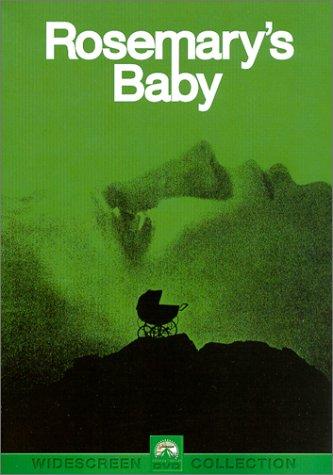
Roman Polanski has been in the news quite a lot lately. While I haven’t been following the story, his name is perennially associated with Rosemary’s Baby in my mind. In my youth I feared this movie and made no attempt to watch it until I reached my 40s. Like other works conceived by Ira Levin it features a threat to what we value most; the original Stepford Wives is still almost too scary to watch. While Rosemary’s Baby remains a good psychological thriller, the counter-Christmas theme became quite evident the last time I viewed it. I won’t worry about spoilers since the movie was released in the 1960s, but if you’re still waiting to watch it and want a surprise ending, you might want to turn to another post at this point!

The 1960s were times not only of a strong counter-culture but also a period of fear. Many popular evangelists were warning of the coming of the Antichrist and the Time article entitled “Is God Dead?” is featured in the movie itself. Although it is unclear until the end, upon first watching, who fathers Rosemary’s baby, the child-spawn of Satan is presented with many of the trappings of the first Christmas as Rosemary herself makes the discovery. In fact, Christmas comes as Rosemary is pregnant, and the film carefully accentuates the contrast between Mary and Rosemary. The suffering of the expectant mother still makes the film difficult to bear at points.

As Christmas nears in this very commercial and recession-ridden season, many lawns are sporting “Keep the Christ is Christmas” type displays. Isaiah is being taken out of context and the Religious Right continues its attempt to make Christmas a political petard. Babies represent new beginnings. And while Rosemary’s baby was born six months after (diametrically opposed to) the celebration of the birth of Jesus, in both cases the infant represents a radical change. Any human parent knows that babies are special and that knowledge demonstrates that a young Roman Polanski recognized a theme that would scare audiences for at least forty years.


Sunday Morning Football

There is a Baptist Church in East Orange, New Jersey that celebrates Football Sunday to draw the menfolk in. Complete with a tailgate party after the service, this event may boost numbers, but the winner of this divine gridiron has not yet been determined. Not being a fan of football (or any other sport — oh, the heresy!) this particular tactic would not appeal to me, but knowing that when guys get together the topic of sports always seems to come up, well, it just makes sense.

According to the canonical Gospels, Jesus never played football. (The Gospel of Judas, however, does mention a quarterback-sneak, I believe.) The few times I’ve watched games on television (generally under duress) I see a bunch of men trying their physical best to beat some other guys up. Rampaging after a pig-skin (definitely not kosher), they attempt to score and prevent the other team from doing so. This is my amateur analysis of what I am told is a very complex game.

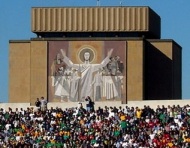
Rewind. Stop. Replay. The Baptist Church. Founded to protest against the vicissitudes of the Church of England, the Puritan-inclined Baptists wished to establish a church free from the constraints of the formalism inherent in the staid worship of either Roman or Anglo-Catholic England. Breaking from tradition was an honored principle here. Like our football heroes, they joined a team against the competition for that Super Bowl in the sky. Will the men stick around for the post-season slump? Maybe not, but as Notre Dame has always known, the divine man is a big fan of the Catholic team.

Notre Dame's famous Touchdown Jesus


Highway Homiletics

“Over the river and through the woods to grandmother’s house we go,” is an assertion to be taken literally in my case. Crossing the Delaware River and trekking through the forests of Pennsylvania are the only means to reach my childhood home from New Jersey. Each time I make the trip I am amazed at how strident the highway preaching along the way has become. Signs on both the interstates and the backroads announce the truths of a certain vociferous brand of Christianity that maintains that everyone must think that way or spend an eternity in hell. Having experienced this kind of fear-driven faith firsthand, I can’t protest too much without being labeled a hypocrite, but some of what I observed over the river and through the woods leapt out at me anew this Thanksgiving.

Firstly it seems that Jesus saves big rocks. Several large, obtrusive boulders worthy of the land time forgot bear the message that Jesus Saves. Locally this form of homiletics can be as persistent as the Trust Jesus notes spray-painted on just about every interstate overpass between here and Illinois. A religiously aware lumber company in rural Pennsylvania hosts a sign declaring, “Read, Heed, Live & Obey the Bible!” When I think of lumber, I think of 2-by-4s and of their standard use of knocking sense into others who look at things differently. This sign said more than its owner might have intended. A few miles down the road I read, “Why not try Jesus? If you don’t like Him the Devil will always take you back.” The assumption, naturally, is that anyone reading the sign is already devil’s food.

One of the great things about freedom of religion and freedom of expression is that such messages declare their writers’ fervent beliefs, but they hold no force beyond the rhetorical. Having met many sincere believers in other faiths over the years, I do wonder what kind of good news such non-negotiable advertisements really send. Some of the writers, I believe, are railing against the godless world they see around them (although the number of churches along these backroads would seem to testify to religion a-plenty) while others can’t accept any form of any religion that differs from their own, even if it be a different flavor of Christianity. Perhaps it is time I put up a sign advocating a vegetarian version of Thanksgiving — no turkey need die for anyone’s sins. In some religions such a message is considered trustworthy indeed.


2012

As the economy rolls along like a marble on a pebble beach and the stock market continues its own bumpy road to recovery, apocalyptic thought is again on the rise. It is when times are bad that apocalyptic comes in most useful. Individuals who feel that this world has run out of possibilities generally look to a new future world where things will be radically different. That’s why people flock to movies like 2012 and dream of a new day, a new era.

That’s the way it has always been. Jews being tortured to death under Antiochus IV Epiphanes, the Seleucid tyrant, looked for that day when Michael would take on the “Prince of Persia” and the new world would gush in and overtake this one. Almost two centuries later the early Christian movement, suffering at the hands of Roman emperors such as Nero and Diocletian, reveled in the visions of Revelation — the new world coming. Rental property is free in the New Jerusalem! The earliest exemplars of apocalyptic thinking appear to go back to the ancient Zoroastrians. This early Iranian religion (which may have originated in Afghanistan) took comfort in a dualistic world where good and evil constantly struggled until a cosmic conflict would result in the ultimate destruction of evil. It helped to explain why things could be so bad for good people in the here-and-now.

2012, however, derives from concerns that the Mayan calendar seems to have run out of space at that time slot just over three years from now. Otherwise intelligent people panic; this is an apocalypse of the secular kind! Experts on the Maya (among which I am not) explain that the Mayans use(d) many calendars (there are still Mayans around). Their large-scale, 5000 year calendar may run out on December 21, 2012, but that doesn’t mean the end of the world. In fact, that calendar only began on August 11, 3114 BCE, about 4.5 billion years after the creation of the earth. It was not meant as a road-map to the cosmos. The real apocalypse is in the minds of those suffering from their own private ills in this world. Ever since Zarathustra spoke, people have had an alternative, better future to anticipate.


The Call of Balu

After writing a post on Natib Qadish, a modern revival of Canaanite religion in the United States, I received some comments from Lilinah of Qadash Kinahnu, another modern Canaanite religion revival. These movements are a fascinating development in an overly technological era — both movements have online resources that include serious scholarly treatment of ancient religions of the Levant. Both appear to be sincere attempts to get in touch with what modern religions seem to have lost. Both have heard the call of Balu.

In a society where universities seldom offer programs to study the Ancient Near East, people are starved to know about it. I realize that the field of study will never bring in the money that the sciences or finance do, but obviously there is something deeply satisfying about it. And students are hungry for it. Not only appreciated by those who start revivals of ancient religions, many of those who read more recent popular treatments are intrigued. Neil Gaiman’s American Gods was a New York Times bestseller. Although much belatedly, H. P. Lovecraft’s Cthulhu Mythos has become a paradigm for many undergraduates I’ve met. I was reminded of this as I watched Stuart Gordon’s 2001 movie entitled Dagon. A relentlessly tense and macabre film, the Lovecraftian base assures a constant draw for those who hear the call of the ancient deities.

We love technology. I’m posting this entry on an internet where ideas are simply electrons forced into recognizable patterns. We can’t imagine what life was like before being able to communicate with people just about anywhere in the world instantaneously, and where we can live our entire lives without ever actually touching physical money. Over all the noise of technological progress, however, can be heard the distinct call of Balu — a call to a simpler era, pre-Christian, pre-Judaism, pre-Iron Age. It was an era when human destiny fell into the hands of ancient gods.


Sky God Redux

This week’s Time magazine includes the periodic feature of the 50 best inventions of the year. Flipping through the pages looking at techno-gadgets that leave me vacantly spinning in my office chair, I was surprised to see that invention number 49 is the work of our hypothetical sky gods. The undulates asperatus cloud has been receiving high profile attention of late, and now it is seeded on Time’s greatest inventions list! When I last posted on undulates asperatus, it had been written up in Wired. Prior to that I had seen a feature on the cloud in the New Jersey Star-Ledger some months back. Having written a(n unpublished) book on weather terminology in the Bible, I have had my head in the clouds for several years now. To find the humble collections of condensed humidity making the news is a strange but welcome validation of my work.

Undulatus_asperatus

Undulatus asperatus from Wikipedia, by Agathaman

Time resists bringing the divine into the description of the cloud, preferring the more neutral term “ominous” to describe undulates asperatus. After having spent several days under the blanket of a nor’easter here in New Jersey with its impenetrable gray clouds, I can appreciate how ominous thick clouds can be. The more I study ancient religions the more I am convinced that major gods primarily reflect the content of the sky. After all, gods were seldom seen in the fields and cities of antiquity, but the sky holds endless possibilities.

Perhaps some editor somewhere will stumble across my conviction that weather matters in the biblical world and will want to take a look at my book. If not, no worries. I’ll just be looking at the sky.


Death of the Gods

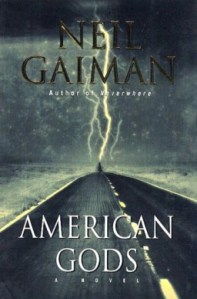
Americangods

Ancient gods surround me these days. Surely part of it is due to having recently finished Neil Gaiman’s American Gods (I know I’m a few years late on this, but novel-reading time is at a premium even when teaching only part-time). Gaiman’s not the first to have taken on the theme of “what if ancient deities still survived?”. As a child I read Lester del Rey’s Day of the Giants with its science-fictionalized version of Ragnarok, and even earlier H. P. Lovecraft had resurrected Dagon and Cthulhu. Gaiman’s treatment, however, is contemporary and is a barometer of how the old gods are faring these days.

Dark and witty, Gaiman’s treatment is a fun-house ride through the fanciful concept that old-time gods and folk-heroes emigrated to American with their believers. The resulting adventure brings a multi-cultural mix of supernatural powers that end up mostly focusing on the Norse mythological cast. Same was true of del Rey — the Norse mythology reflects a stark world of raw power, betrayal, death and resurrection, that resonates with northern European experience. Anansi and Chernobog also take starring roles in American Gods, although the only ancient Near Eastern deities with any prominence in the story are the Egyptian Thoth and Anubis in supporting roles.

Casting an eye over the American landscape, this assessment is perhaps true to life. Ancient Near Eastern deities seem so distant and unfamiliar. Gods long dead. Despite recent movements to revive the worship of Mesopotamian or Canaanite deities, their powers seem to have dissipated at the middle of the first millennium B.C.E. as Yahweh gained a prominence he has never relinquished, and the Greeks and Romans paved over the graves of Ninhursag and Yarikh with European versions of the more prominent West Asian gods. Universities reflect this lack of knowledge with slowly dying departments of Ancient Near Eastern studies. Like Gaiman suggests, America seems to have gone after the more modern gods suited to our present-day lifestyle.


Love the Craft

It is a cold, windy New England day in November. You find yourself in Providence. How can you not visit the gravesite of H. P. Lovecraft? I have mentioned Lovecraft before, in my podcast on Dagon, but that brief citation does not give credit to a man whose life provides episodes that feel strangely familiar to me. Barely known as a writer in his own lifetime, Lovecraft had difficulty finding employment and had a fascination with ancient gods. Indeed, I discovered Lovecraft while researching Dagon for a serious presentation and soon students were telling me about the Cthulhu (I would not dare attempt to pronounce) Mythos and how I had only scratched the surface of his writing.

Lovecraft’s fascination with ancient gods brought new life to forgotten entities. Dagon, despite being a major deity of ancient Mesopotamia, would likely have been completely forgotten by all but professors of arcane mythology had not Lovecraft resurrected him, albeit in a fishy form. His fascination with the protagonists of ancient myths, nearly forgotten deities, clearly influenced Neil Gaiman in his American Gods, and has preserved for the modern reader some of the fascination with powerful, ancient forces that show the insignificance of humanity. I found reading American Gods while in Providence a very humbling experience. Lovecraft also gave the world Arkham, the asylum of Batman fame, as well as Miskatonic University.

Along with Melville and Poe, Lovecraft deserves a place of honor in the pantheon of American literary explorers. The assortment of gifts left for him at his tombstone, including a small cairn, pennies, a pen, and even a note reading “thank you for the ideas,” attests his local fame. The prominence of his books at neighborhood bookstores assured me that I was not the only traveler to breathe in the air that Lovecraft exhaled. My visit also brought to mind a story that a friend of mine started to write some years ago. It had something to do with ancient gods coming back to life, although my friend had never heard of Lovecraft or Gaiman. Lovecraft’s spirit, it seems, may still be alive and well in Rhode Island and in the minds of other residents of Arkham.

Lovecraft


Our Myth of History

“Myth” is a difficult word to define. In the ancient world, however, reality, or truth, was expressed in terms of myth. Today we assume that myth is “untrue” or false. This dichotomy often leads to an unfortunate undervaluing of ancient texts and stories. At root the problem is that we are on the far side of a paradigm shift. This podcast addresses the question of how we might try to understand myth in a way that fits with the modern outlook. Since historical veracity is the modern paradigm, it stands to reason that history has become the mythology of present-day thinkers.


Picturing Genesis

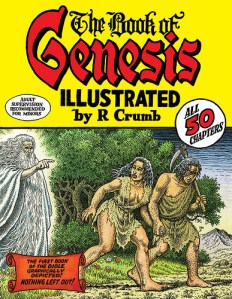
genesiscr

The book of Genesis is elusive and evasive, telling stories that have been read as both science and fiction, but never revealing its own deepest secrets. For over two decades I have been researching the book, never publishing my work since there is so much more yet to read on it. Many truly bizarre interpretations on the introductory section of the Bible have appeared with the proliferation of publication — Robert Capon’s Genesis the Movie and Harold Bloom’s Book of J come to mind — even by otherwise careful scholars. Nobody seems able to get to the essence of the book while everybody thinks he or she already understands it. As a piece of literature it is perhaps the most influential ever penned since it is the basis for so much of the world we’ve constructed around it. Maybe the reason we can’t understand it is that we don’t have it in pictures. Now that’s all changed: R. Crumb’s (serious) comic book version, The Book of Genesis Illustrated, is finally available.

R. Crumb is well regarded in the comic book world, but less recognized in the biblical academy. He is not the first to storyboard sacred writ, nor will he be the last, but he is grappling with the same material that defies definition. Creationists can’t live without the assertions of Yahweh’s creatio ex nihilo, that they read into Genesis (for those who are willing to read what’s there, chaotic water is pre-existent, not created), and many biologists wish that J and P had shown a bit more discretion and humility before setting the framework that dogs their each and every evolutionary observation. Those who take Genesis too seriously will likely be offended by a comic-book version, but the text is based on the revered King James Version and Crumb said in an interview that he had “no intention to ridicule or make visual jokes.” The problem is, the text is full of its own riddles and jokes, along with serious assertions of the superiority of Yahweh over Marduk and Baal and Teshub.

Unlike many Bible readers, Crumb does not stop his Genesis with the Flood or the Tower of Babel. Instead he takes his readers through the entire book where “iron-willed Old Testament matriarchs” are presented in his characteristic muscular style, perhaps recalling She-Hulk more than Sarah. The images may be unfamiliar and a little frightening, but I applaud Crumb for taking on the patriarchal chokehold over shy, hand-wringing wives wondering why they can’t seem to take the biological package their virile husbands send their way. The Bible was written in a man’s world, but it is now ensconced in a more enlightened age and it is ready to benefit from a new, and unfamiliar reading.


The Power of Pyramids

One of the benefits of teaching is the constant refreshment of ideas presented by students to air out the stuffy closets in minds that tend to close around academic orthodoxies. Each field of studies has its sacred shrines not to be disturbed, and none more so than the field of religious studies. That’s why I appreciate the openness of student minds. This summer I was introduced to the alleged Bosnian pyramid that I posted about some months back. Having reviewed the statements of both archaeologists and geologists it is easy to see how what looks like a pyramid might not be a pyramid at all. Some experts even theorize that the pyramids of Egypt took their inspiration from the shape of a natural desert mountain.

Wikipedia's photo of the "Bosnian Pyramid"

As we were winding up our classroom discussion of Egyptian mortuary cult and its awe-inspiring pyramids, another student asked me if I had heard of the Okinawa pyramids. I hadn’t. Back in my student days I recall a professor entering my Egyptian Religion course after having just read a book on the mystical power of pyramids wherein the author claimed that dull razors placed under a small-scale pyramid would come out sharpened the next morning and other such nonsense. We all had a good laugh and got onto the serious business of comprehending the fascinating world of Ptah and Atum. When I first heard the phrase “Okinawa Pyramids” I had to fight down the immediate flash of embarrassment of unrestrained academic laughter should I be found even considering such a proposal.

I have always, however, listened to those willing to ask about even the most anomalous incidents of history. Two years back I had a student share the “helicopter hieroglyphs” of ancient Egypt with me, despite a fully understandable reading of signs that can look like a helicopter to the uninitiated. The Okinawa Pyramids, however, were different. As the student whipped out his laptop and pulled the images up from the internet, I was intrigued. These were not pyramids, but rather monolithic blocks 60–100 feet below the surface of the ocean near Japan. My amateur study of geology has taught me that many species of rock naturally have squared fractures along various planes and facets, but the number of offset angles and the profusion of the squared edges forced my mind open just a bit. What is more striking yet is that there is no Wikipedia article on this formation at all, despite its discovery in the 1980s. Most intriguing of all is that the complex seems to have sunk at the end of the last ice age, thus predating even the pyramids of Egypt. Even the stepped pyramid of Djoser.

Is there evidence of a pre-civilization civilization under the coastal waters of Japan? I am not qualified to decide. I feel safe in saying that whatever is there is not a pyramid, but I am impressed by the photos and the relative silence about them even on the web. Since the best photos are copyright protected, I’ll provide a link for anyone wishing to creak open a dusty mind-closet and wonder about the implications.


Sonoco

sonoco2

What do God and great pools of gooey, flammable, decomposed ancient biomass have in common? Quite a lot apparently. A picture in this morning’s paper of a Caribbean Petroleum Corp. storage facility explosion took me back to my childhood. I was born in the same place as the oil industry, although I think it was in different hospitals. Northwestern Pennsylvania is where the industrial use of oil was discovered (ancients had learned that the stuff was extremely flammable and used it for cruel weapons, but never figured how to grease an axle with it). One day my brothers and I were playing outside and noticed flames jetting up from an adjacent hillside. We saw giant ashes, some nearly the size of dinner plates, floating down on a summer day and it seemed like a strange gray snow was falling. A funny smell was in the air. That night on the news we learned that a local oil refinery had exploded and when we went to the site to gawk, it was amazing to see colossal storage tanks melted like so many ten-ton candles. It is an image I’ll never forget.

Lord Balfour envisions chariots of fire

Lord Balfour envisions chariots of fire

My wife’s favorite historian is Barbara Tuchman. We’ve read most of her books. Bible and Sword, however, was especially eye-opening for me. This book describes, step-by-step, how the British Empire forged its alliance with Israel. Tuchman is a meticulous historian, noting minute details that add understanding to the overall picture. One of the key motivating factors that led Lord Arthur James Balfour in his support of a homeland for the Jewish Diaspora was his belief that a physical Israel was required before the Second Coming of Christ could take place. This is a sentiment that has been shared by some recent, very highly ranking American politicians.

Enter Col. Edwin Drake. Drake was the first person to have the idea of drilling for oil. Several local prospectors scampered through the hills of Pennsylvania looking for oil streams where petroleum could be skimmed off the water and refined into kerosene. As an alternative to whale oil, petroleum was much easier to collect and didn’t involve peg-legs spearing great white whales — oh wait, wrong story. As an alternative to whale oil, petroleum made a market impact and soon other uses were descried. There was an oil boom near Titusville, Pennsylvania when Drake hit oil, and soon the industry that give birth to Quaker State, Pennzoil, and Enron was up and running. As uses for petroleum multiplied demand shot through the roof. Drake died in poverty and the industry he helped found rolled ever forward.

Col. Edwin Drake envisioning a drink

Col. Edwin Drake envisioning a drink

After the Second World War, vast oil beds were discovered in the Middle East. Israel was declared a nation, and world-wide demand for petroleum was astronomical. Not all nations of the former Ottoman Empire welcomed the sudden interest in their natural resources or the presence of an allied nation in their midst. Although the roots go deeper and are much more complex, the scenario was set for a crisis that has lasted for my entire life and shows no signs of slowing down.

So what does God have to do with a complex mix of hydrocarbons and other organic compounds? The unbelievable wealth generated by petroleum products has been under-girded with a religious gullibility and deeply held faith that Jesus needs some help in returning. As long as we’re waiting, we might as well get filthy rich. Politicians with connections to Big Oil and the Big Guy have it all figured out. Take all that you can and wait for the God who has blessed you so richly to come home. I still remember that refinery explosion, and some childhood memories have become paradigms and parables that have as many applications as petroleum itself. When the oil beds run dry, what will grease the axles of Kingdom Come?

Mechanical worshiper bowing down to a subterranean god

Mechanical worshiper bowing down to a subterranean god