Trees, Please

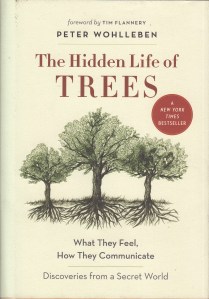
One thing we know about nature is that we don’t know much about nature. We can be a pretty self-absorbed species. Peter Wohllenben’s The Hidden Life of Trees is a good corrective for that. When we’re young we’re taught the difference between plants and animals. What Wohllenben shows is that such differences are more a matter of degree than we realize. Trees move, but slowly. Their timescale can be vast, compared to our brief, get-rich-quick outlook on life. It has been demonstrated pretty clearly that trees communicate with one another. They help one another, and they can, in their dendritic way, think. They cooperate with fungi to maintain connections between their root systems. Trees might even have what we would call personalities, were they fortunate enough to have been born human.

In a little like a medieval fantasy world, Wohllenben is a German forest keeper. He knows trees and their ways intimately. The trick, of course, is that we have a difficult time seeing things in timeframes that exceed our own. There are living trees that are 9,000 years old. That’s before the Sumerians ever showed up to invent writing. In human eyes, a lot has happened since then. And although we don’t know how to define consciousness, we’re sure that it’s limited to our species alone. Grudgingly we may admit some “higher” animals to the club, but our predilection for conquest of our world would be sorely diminished had we not other creatures to dominate. Looking at the world through a sympathetic lens, however, the fact that we’ve evolved these traits from the common ancestor we have with the animals should tell us something. As Wohllenben points out, animals diverged from plants at some stage, but we do ultimately come from the same stock.

Even on a practical level, we can’t live without plants. No matter how gourmet our foodies may be, our nutrition cycle begins with plants photosynthesizing food from pure light. There is perhaps a danger in recognizing our kinship with trees too closely. We depend upon them for food, shelter, warmth, and the oxygen we breathe. We might be inclined, as Wohllenben notes, not to use them at all. The key word here, however, is exploitation. We evolved along with plants and other animals and we all rely on each other. We are all connected. We should care for those with whom we share the planet. Trees have a much longer view than we do. When the desires of one species set the terms for all the others, we soon feel the pain of the trees.


Sense or Ship

I can tell I’ve been too busy when I haven’t planned for Banned Book Week. A kind of unofficial holiday since, well, it’s about banned things, the point of this observation is that we should be free to read. A fairly large portion of the fiction I read anyway, at one point or another, ends up on the banned list. Not surprisingly, most banned books have diversity content—racial or sexual minorities portrayed in sympathetic ways. Trump has shown us clearly how dangerous such thinking can be. It’s well known that such perspectives are allied with some evangelical Christian interests, or, perhaps I should say, lack of tolerance. There are lots of ways of looking at the world out there, and many of them aren’t evil. I should’ve planned ahead.

Censorship implies a certain arrogance. One way of looking at things is right and all others are wrong. Although we all know that any logical system runs up against its limits (we call them paradoxes) we’re reluctant to let go of that which we suppose, with or without justification, to be right. Banning is an effort to control minds. It’s no coincidence that many of the titles on banned and challenged lists are intended for younger readers. Those who favor censorship want to close the eyes of the young and pretend the real world will just go away. Yes, many of the banned books are fiction, but fiction tells us truths. Those who ban books are uncomfortable with such truths. That’s not to say all literature is created equal, or that all banned books are great literature. As someone who writes fiction, though, I can attest how difficult it is to get it published. That in itself tells us something.

It’s banned book week and here I am without a banned book to read. I’ve got some ideas, of course. My wife and I both take on book reading challenges each year. One of this year’s books (at least) was a banned title, but one that I read too far in advance. Besides, although we have too many books in our apartment already, I used Banned Book Week as an allowance to go to the bookstore. What better way to fight literary fascism than to buy a book? The problem is deciding which one. The lists are long and grow longer each year. Intolerance, it seems, knows no limits. I’m about to do my civic duty for this time of year. I’m about to go to a bookstore and buy a banned book.


Shipping Good News

Some say the infrastructure of this country is crumbling. It’s something I try not to think much about when I’m on the Helix or in the Lincoln Tunnel, but the concrete of those aging piers doesn’t look too healthy to me. So when I see a truck with a religious message, I guess I’m supposed to take comfort. On a recent drive along interstate 80, the great New York to San Francisco highway, we passed a Sam Kholi truck. You can tell a Sam Kholi truck because they declare “Jesus Christ is Lord, not a swear word” in bold letters on the side. The back has just the first part of the aphorism followed by “Almighty God the First and the Last.” A little research revealed that Sam Kholi is from Syria and now lives in San Diego. Many Americans, in these days of Trump, don’t realize that many “middle easterners” are indeed Christian. I got my start in publishing from a Syrian Christian. Prejudging is seldom a good idea.

Sam Kholi is combining his faith with his practice—something that harkens back to more ancient forms of religion. Lived religion used to be the only kind of religion. Once it was systematized, it became an academic pursuit. Knowing precisely what you believed became more important than what you did with it. Today’s religion, at least in these hallowed states, seems to be purely a matter of what you believe. Whether you live morally, treat others justly, or even pay attention to what the Bible says about caring for those in need, none of this matters as long as you believe the right thing. The result is people suffer. No matter, orthodoxy is secure.

Since our actions are more vocal than our words, I’m amazed and perplexed by what many evangelicals say. They are the ones who claim for themselves the literal truth of Jesus’ words. How they can deny the rights and needs of others based on race, gender, or sexual orientation is a mystery given the many passages in the Bible concerning forgiveness and love. When it comes to religion as how you live, apparently it is one size fits all. Driving, it seems to me, is one of the places where lived religion is put to its harshest test. Religion is how we live with others, and driving is how we show what we really believe. It takes a tremendous amount of faith to paint your belief on the side of a truck.


Doomsday, Again?

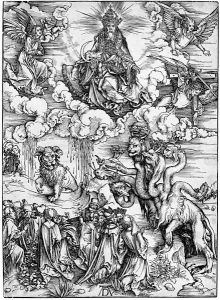
It’s hard to keep a good apocalypse down. Ever since Jesus of Nazareth did his best Arnold Schwarzenegger impression of “I’ll be back” some of his followers have obsessed when just when that will be. Sorry for the late notice, but the current prediction is for tomorrow. If you’ve got any weekend plans, you might want to rethink them. I know traffic in Jersey is already bad enough without white horses breaking through the clouds. An article my wife promptly sent me from NPR, “Is The Apocalypse Coming? No, It Isn’t!” by Marcelo Gleiser, addresses the documentary The Sign. No doubt about it, there’s some impressive astronomical gyrations here, but planets moving through constellations do not an apocalypse make. As Gleiser points out, the real question is why people believe such predictions so passionately.

Larry Norman’s song “I Wish We’d All Been Ready” captures the mood nicely. Growing up in a tradition that believed, as only literalists can, that this world is the center of the cosmos, Norman’s song haunted my teenage years. These were the heady days of Hal Lindsey and a very hot Cold War. I had to register for the draft. There was unrest in the Middle East. Sonny and Cher had split up. The signs were aligned, it seemed. As they had been nearly every year since about 30 CE. Paul of Tarsus was waiting. And John of Patmos. And Timothy LaHaye. True believers all. Conviction begets conviction. Seeing another fully convinced is a powerful incentive.

Even now, if I’m honest, I shudder a little when I hear such predictions. What if, by some odd chance, they are right? Raised in that tradition, it’s nearly impossible to jettison that private fear. Rationally I know that clever people can make all kinds of connections that have nothing to do with the Bible. I know that John’s Revelation isn’t about the end of the world. I know that the views of Paul were bound by the developments of his age. I know the Rapture was invented in the nineteenth century (CE). Still, the chill slithers through me when I consider how it felt as an uncertain teen on the brink of Armageddon. I could envision it clearly. Some who were utterly sure swayed me. Specific dates and times weren’t biblical, but the wait for any moment now was even more terrifying. Tomorrow will begin and end just as any other day on planet earth. And another apocalypse will enter the planning stages, coming soon to a universe near you.


Domesticity

One of the truly disturbing aspects of religion is its tendency to become domesticated. What I mean is that it becomes so much a part of the everyday scenery that you forget it’s there. I recently read a story about priests in the Church of England who don’t want parishes in poor neighborhoods. The reason given? They don’t want their children educated among the poor. That took me back a step. As someone with more than a passing familiarity with the Episcopalians, I wasn’t surprised that they didn’t want poor parishes. Of establishment Christianity, Anglicans are on the economical high end of the scale. I knew a few future priests like that at Nashotah House. Stylish worship and excess cash go together. But not to want your children educated with the poor? Is there fear of contagion?

I grew up poor. When I visit my hometown I’m reminded that although it featured in an X-Files episode, it will never be an affluent place. The people there, as a whole, struggle financially. I didn’t know any rich people growing up (I had to become an Episcopalian for that to happen) and I don’t think anyone rich lived in our town. Education, however, was a different thing. We went to school together and we learned. Some of us, despite not attending the finer establishments, managed to move through the educational system and on to college, seminary, and graduate school. Ironically, some of us even came to teach Episcopalians in seminary. A poor boy instructing the rich. But quite apart from that, it’s impossible to read the Gospels and not notice the concern for the poor in the founder of Christianity.

Image source: Julius Ejdestam: De fattigas Sverige, Wikimedia Commons

Early Christians weren’t Episcopalians. They were actually Jewish. Although a few of them had means, this new religion appealed primarily to the poor. As one of the earlier believers in the movement is said to have said, the rich receive their reward here. More and more Christians are coming to believe that this world is the locus of receiving rewards. Heaven isn’t so much on the radar anymore. We’ve been to outer space and it’s not there. Rather than put ourselves at risk among the poor, it’s better to blend in with the establishment. We can still rail aloud that the church is important and shouldn’t be ignored. But paying customers only, please. The poor? They’re a dime a dozen. And when we come to think of people that way, religion has become domesticated.


Voting Belief

No one knows the origins of religion. Before the advent of writing we can only guess, based on artifacts. Even in the era of scriveners, nobody jotted down the origin of belief until modern times, long, long after it began. Once writings about religious practice become reasonably clear, we find temples in the service of palaces, and vice-versa. Monarchs needed the validation of deities and priests required the support of the crown. Together they brought the two swords together and managed to keep the unruly masses in check. This isn’t cynical, not necessarily, since it reflects, the best we can reconstruct, how western organized religions began. Power was always part of the picture.

A recent Washington Post story, “The stark racial and religious divide between Democrats and Republicans, in one chart,” by Christopher Ingraham, shows the diametrically opposed pie-charts of self-identified white Christians (Republicans) versus non-white or non-Christian (Democrats) Americans. Such survey results tell us much about ourselves. We vote with our faith (or lack thereof) and not with our rationality. This has long been the piece of the political puzzle that Democrats have failed to comprehend. Not to take away from Barack Obama’s charisma, but people were afraid of Mormon Mitt Romney in 2012. Although conservative, white, and evangelical, Mormons have long been questioned as to their Christian identity by other evangelicals. It would seem, in the light of present circumstances, that understanding the “white Christian” mindset might be the only way out of the morass.

Typically self-defeating, academic institutions have shown little interest in understanding religion among hoi polloi. Long ago they bought into what Peter Berger admitted was his biggest blunder, the idea that religion was dying out. By the time he made that admission, academics had ceased to pay much attention to religion. It has, of course, come back as the ghost that haunts us. Or is it a zombie, once dead and now back to life? The fact is religion was never dying. It is as much of being a human as is driving a car or owning a cell phone. When times are uncertain, we turn to what is perceived as unchanging—religion. In truth, religion is constantly evolving to fit outlooks influenced by science, technology, and social progress. Worldviews change. Our culture is becoming more diverse. Republicans have a natural voting bloc that identifies itself by race and religion. Information about the former is readily available. You’ll need to look a bit harder to find quality information about the latter, no matter how important it may be.


Warnings Ahead

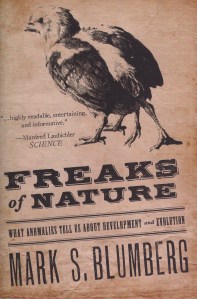
As a noun, “freak” is akin to a swear word. To refer to another person in such terms is often considered derogatory and degrading. Still, we all know what it means—an individual who doesn’t conform to expected models. I was a little worried about Mark S. Blumberg’s Freaks of Nature: What Anomalies Tell Us about Development and Evolution, then. It had the word “evolution” in the subtitle, and that sounded scientific enough. Besides, those of us interested in monsters know, deep down, that they are essentially freaky things. Indeed, Blumberg starts his book with teratology, the study of monsters. And monsters come from religious backgrounds. Their name is related to the root “to warn.” I’m a squeamish sort, though, and reading about freaks of nature requires a constitution I sometimes lack. Especially when it comes to science.

Yet I couldn’t put the book down. To begin with, the concept of developmental evolution (devo evo, for those in the know) is utterly fascinating. If you grew up, like I did, being taught that genes govern evolution solely, this book will surprise you. Evolution can happen at the level of the phenotype, based on environmental pressures. This is well documented and hardly a matter of dispute. Bodies can change according to what they need. Blumberg offers case after case where this dynamic may be seen. The idea that we are “programmed” falls, ironically, at the feet of biology itself. We, and all animals, are adaptive creatures. Humans may not be able to regenerate lost limbs, but many amphibians can. Sometimes it’s a matter of age, and sometimes it’s a matter of matter. I found such a quantity of astonishing stuff here that I overcame my queasiness to see what the next page might reveal. When I hit the chapter on reproduction I realized once again that nature does not agree that “man plus woman equals marriage.”

This must be one of the most threatening areas of science to Fundamentalists. The sheer variety of ways that “genders” interact in nature, and appear in human bodies, will have purists calling out for heavenly clarification. Reproduction, in other words, isn’t in the service of conservatism. Fish, for example, that change “genders” instantaneously after mating, taking turns being female and male with a mating partner, must surely call for theological justification of some sort. And female lizards that don’t require males to reproduce, but are helped along by being mounted by another female so as to jog some ancient reptilian memory, require us to rethink our rather simplistic terms of endearment. Not for the the faint-hearted, but amazing for those who dare, this book takes our appreciation for “life finding a way” to a whole new level. Even if it’s a little freaky.


Eating Earth

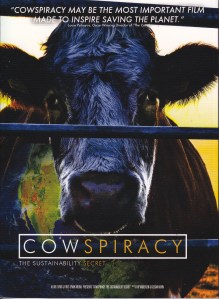
Some things are hidden in plain sight. That doesn’t make them any the less insidious. One such hidden truth is that the earth is of a finite size. Another is that, consequently, its resources are limited. Our species is easily led, as are most herd animals. Standing out can be embarrassing. Painful even. This is the recipe, along with a generous dash of greed, that has put us on the brink of worldwide catastrophe. We live in an unsustainable system, and some of the largest culprits are our appetites. As a fan of horror movies, I can honestly say Cowspiracy is the scariest movie I’ve seen in a long time. It’s a documentary, not genre fiction. Scientists had generally already thrown up their hands because we’ve passed the tipping point for global warming, and then we elected ourselves the stunning leadership of Donald Trump.

No one can predict exactly what form the collapse will take, but we’ve set the key factors in place. We’ve been warned for years. Cowspiracy demonstrates something we don’t want to admit—the agricultural lobby is extremely powerful and the least sustainable aspect of life on this planet is animal husbandry. In early civilization, where technology did not exist to support large-scale farming, meat was not a staple of the human diet. Families that could afford animals gained more value from their beasts alive than on the plate. And they had only a few. As mechanization increased in the last century, we made livestock valuable commodities. When I was a kid word on the street was you were even poorer than we were if you couldn’t eat meat every day. Humans were the absolute, if blind, masters of their own domain. Now agriculture is the single largest force of degradation of the environment on the planet. And nobody wants to listen.

Cowspiracy is not an easy movie to watch, even for a vegetarian of many years’ standing. So why watch it? Because our reliance on animal-based food is destroying our planet. Not slowly either. If this is true, why haven’t we heard of it? Kip Andersen and Keegan Kuhn spend an hour-and-a-half exploring that in this important film. While it can’t be fully summarized here, in a word it can be said: money. There’s huge money to be made in a business rightly called animal husbandry. Wedded to profits at the expense of the very soil that gives us life, we eat our way to the grave. And we do it even when technology has already offered viable alternatives. They are also hidden in plain sight.


The Name of the Game

I have a confession to make. I’m not a gamer. Just like everyone old enough to be aware in the 1970s, I was amazed at Pong. Television, which had always only been a passive producer of entertainment, could now be interactive. Slower than real table tennis, the game nevertheless easily consumed hours of life otherwise productively spent. I went off to college and left the burgeoning video game market behind. Then in the late 1990s Myst appeared. The new Macs of those days came loaded with action games about dinosaurs stealing eggs. My daughter was fascinated and so I played. Then I lost interest again. That had been family bonding time, so it wasn’t completely wasted. Now we live in a world where, writers tell me, the real money lies not in movie rights to your novel, but game rights.

Kids, developmental psychologists assure us, need to play. It’s how they explore their world. As the human world becomes more and more electronic, games become more a part of virtual life. Some even have plots and genuine character development. A friend sent me a link to a story on Mashable, “Jesus battles the Buddha in fighting game hellbent on offending.” Victoria Ho describes Fight of Gods where deities of all denominations duke it out for dominion. After posting about god novels recently, it seems to me that we’ve begun to enter a time when the divine world hasn’t disappeared, but has transmuted. In this new world while all gods are not exactly created equal, they all have a shot at supremacy. It’s a matter of who can hit hardest.

No matter whether one finds this offensive or not, there is an element of profundity here. Historically religions have made gods of the things we fear. Storms, diseases, wars, and death—all of these have been, and continue to be, represented as deities. Human insecurity is deeply rooted in our psychology. We’re afraid of things we can’t control. In periods of governmental chaos, phobias naturally rise to the level of personal panic. What can we do in the face of such forces? Especially when prominent figures tell us all religious belief is for the weak-minded and feeble? Don’t we have to strap on our virtual armor and hope some powerful divinities are on our side? In such times as this we need our gods, no matter their tradition of origin. For me, I fear I won’t be able to spin this dial fast enough and that strangely square ping-pong ball is going to get past my virtual paddle.


Self-Conscious

Cassini is no more. The Saturn-bound satellite was launched in 1997 when the earth was a very different place. As it’s four-year sell-by date passed, the little robot who could kept on snapping photos around the ringed giant and its moons. Remote controlled from three planets and an asteroid belt away, it was decided that the explorer had to be destroyed in Saturn’s thick atmosphere rather than contaminate one of the moons where life might someday be found. Yesterday the probe burned up on its way through Saturn’s perpetual cloud bank. This has led to many emotional tributes, even among scientists who believe Cassini was just a machine. It also shows us how little we really know about consciousness.

During the two decades that Cassini was in space, we’ve learned quite a bit about animal consciousness here on our own planet. Many are now finally becoming convinced that we share this strange quality we can’t even define with other biological entities. Well, at least the “higher” kind. And we can’t help but think that maybe our more intelligent machines possess it too. We treat them as if they’re alive and willful. That could be a case of our own consciousness projecting itself onto inanimate matter—that’s something consciousness is pretty good at too—but since we lack the ability to measure consciousness, we can’t know if it’s there or not. To hear the astronomers talk, we’re going to miss Cassini, a machine that outperformed expectations. Ironically, once we get machines off the earth they tend to do that, even without oil changes every 5000 miles.

Down here on earth we complicate consciousness with cash. Devising an elaborate economic system to demonstrate who can buy power in the White House and who can’t, we want to know who is more important than whom. It’s a simple metric. Bank accounts tell the truth, no matter what the level of consciousness—or even of sentience—that the account holder may have. And then we wonder why a nation that can send a satellite three planets away can’t even figure out that all races should be treated equally and fairly. Cassini was a collaborative effort. Different races, genders, and economic classes contributed to its remarkable voyage. Eyes around the country were moistened when its last image was projected to earth. We wisely decided to immolate our satellite before we could contaminate another world. Meanwhile on our own planet we’re barely conscious of what we continue to do.


Clown King

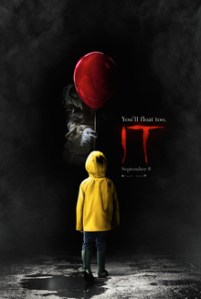
Like many people, I enjoy a Stephen King novel from time to time. King has a talent for drawing you into his tales, and whether or not they’re scary you feel a kind of relief when they’re over. A few years back I read IT. I was prepared to be scared because many people talked about fears of bathrooms after reading it, and, of course, of the terrifying clown. Not being a fan of serialized television movies, I never saw the 1990 movie adaptation. Besides, reading a novel that long is a serious investment of time, and since I like to hear lots of different voices in my reading, I spread out the wealth. In any case, the novel didn’t scare me beyond the neighborhood bullies (who’ve since moved to Washington DC) and I moved on to other things. The new film adaptation has people talking about IT again, and clowns, and clowns always remind me of college.

During the late 1970s and early ‘80s, it was fashionable for Christians to clown around. Taking cues from Paul’s one-liner about being fools for Christ, evangelicals began to experiment with clowns as a means of witnessing. I got involved my freshman year at Grove City College. I researched clowns. Where had they come from? What was the proper way to do it? Was there a deeper meaning? A friend recently sent me a video from Origin of Everything on the subject. I see a lot has been added to the history that I once studied. The idea of the circus clown is one of the more recent innovations of a character that was, in origin, a bit frightening. In classic horror movie style, heavy makeup functions like a mask and we rely on faces to know if someone is friend or foe.

We were taught, in our rudimentary training, that clowns do not talk. To express yourself you had to exaggerate gestures. I learned that makeup did indeed free you from social constraints. The Christian clown, however, had to be good. We weren’t meant to scare anyone into heaven. As nights are growing longer and people’s thoughts are coming to grips with the end of summer, clowns make good companions in the dark. IT may not be King’s scariest novel, but he did understand that bullies and clowns are fears that never go away. And when you combine the two, and move them into the White House, vaunting white faces and corrosive social values, well, maybe it’s time to go to the movies and try to have artificial fears for a while.


Reason to Believe

Gods, the experts say, are on the way out. Have been for some time. The loudest voices in this arena are the New Atheists who suggest science alone explains everything. Problem is, the gods won’t let go. My wife recently sent me an article from BookRiot. (That’s a dangerous thing to do, in my case.) Nikki Vanry wrote a piece titled “Dallying with the Gods: 16 Books about Gods and Mythology.” Most of what she points out here is fiction, and that makes sense because gods and fiction go together like chocolate and peanut butter. The first book she lists is Neil Gaiman’s American Gods—a book I read years ago and which has subsequently become an American phenomenon. There’s even a television series based on it now. Like Angels in America, only more pagan.

What surprised me most about this list is the books I hadn’t read. Or even heard of. After American Gods, I got down to number 10—Christopher Moore’s Lamb—before reaching another I’d read. Then down to 16, Till We Have Faces, by C. S. Lewis. There are, as Vanry notes, many more. Our experience of the world, as human beings, suggests there’s more to it than what we see. Not everyone would call these things gods, nevertheless there certainly does seem to be intentionality to many coincidences. Things pile up. Then they topple down on you all at once. Seeing such things as the works of the gods makes for a good story. At least it helps explain the world.

Many materialists do not like to admit that humans believe. Call it the curse of consciousness, but the fact is we all believe in things. Even if that belief is as strange as thinking fiction only comes from electro-chemical reactions in a single organ in our heads. Gods often appear in fiction. Frequently they’re in the background. Sometimes they’re called heroes instead of deities. At other times they’re right there on the surface. Such books carry profound messages about believing. It doesn’t matter what the authors believe. Believe they do. And such books sell. As a culture, we may be in denial. What we sublimate comes out in our fiction. There are gods everywhere. Singular or plural. Female, male, or genderless. Almighty or just potent. Reading about them can be informative as well as entertaining. We’ve got to believe in something, so why not gods?


Contemporary Scripture

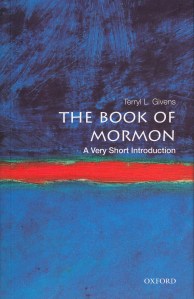
Being born into a religion makes all the difference. I say this as someone who was born into a family that would now be labeled Fundamentalist. That orientation stays firm unless a reason arises to question it. And that reason must be compelling. Many today wonder how, for example, Mormons can believe the narrative of golden plates told by Joseph Smith and that led to the Book of Mormon. Like many non-LDS members, I am curious. While this isn’t the main question in Terryl L. Givens’ The Book of Mormon: A Very Short Introduction, he does address it. The answer comes in the form of a community of belief. The idea is perhaps surprising in an age of individualism, but communal belief has been, historically, the mainstay of religion. A few individuals in any tradition dig deeply and ask questions. They rise into leadership roles, and steps along the way confirm their convictions. Most, however, are everyday believers.

The Book of Mormon is an interesting scripture. The idea of tribes from Israel colonizing the New World has its challenges. The Bible itself tends to go silent about what happened to the northern tribes (“Israel” proper) after the exile. This opens the door to all kinds of possibilities. Various cultures have claimed to be the remnant. Native Americans, of course, tend not to apply the idea to themselves. As Givens points out, the Book of Mormon states that the Israelites of the New World died out long ago. Probably when the Latter-Day Saints are few centuries older, it may happen that metaphorical views toward the Book of Mormon might become prevalent. It took over a millennium before “mainstream” Christians began to ask some pointed questions about their own Scriptures.

Scriptures are products of their own periods. No matter how sacred or inspired they are thought to be, they were written down in human time and human space. Hints are often left along the way regarding authorship, origin, bias, and perspective. The Book of Mormon is rare in having a known publication date, and that in the nineteenth century. Autographs—original texts—are available, even if the golden tablets are not. It’s a rare opportunity to watch a scripture come into being. We know who wrote the Book of Mormon, and when. Its printing history is known, as is its context in the Second Great Awakening. All that’s needed are a few more centuries for scholars to see how things develop. Those who study scriptures are inclined towards the long view anyway.


Hieroglyphs

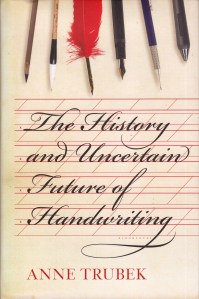
The word “hieroglyph” translates to “sacred writing.” If you’re like me, your first attempts to learn writing were probably not very sacred at all. Tongue pressed to the corner of my mouth, eyes staring fixedly at the paper flat in front of me, my hand going anywhere but where I wanted it to, writing was a burden. I soon grew to love it though, not realizing it was changing my brain even as I was assimilating how to do it. Anne Trubek introduces quite a few new angles to the story in The History and Uncertain Future of Handwriting. She begins at the beginning, cuneiform, not hieroglyphics, and offers a brief sketch of how handwriting developed into the phenomenon we know today. And how it is now becoming something very different than what it once was.

Trubek’s book is full of delightful surprises about the development of scripts and the technologies that attend them. Like most non-specialists in cuneiform suppose, she suggests handwriting is basically anonymous therein. In fact, it’s not. Molding clay into a smartphone-shaped tablet doesn’t seem like technology, but the process of writing took a leap forward when someone figured out how to do this. Those who work with cuneiform can learn to identify handwriting. In the Ugaritic corpus, the tablets “signed” by Ilimilku can be distinguished from those written by others, and not just by his name. Technology has been devised to measure depth and order of stylus strokes in the clay, the angle the stylus was held, and many other seemingly insignificant features. Handwriting was present from the very beginning.

Perhaps what is most striking about Trubek’s study is how religion enters the discussion at almost every stage. Very early on writing was identified as a sacred activity. This continued through the middle ages when monks were those who performed writing as part of their non-secular duties. Even those who piloted penmanship in the modern period often noted that a person’s moral, Christian disposition could be measured by how said person made their letters. Writing, as those who do it for a good while know, becomes a sacred activity. Most world religions have holy books. Many of those books were the reason for an interest in literacy in several cultures. Even a surprising number of secular writers have understood the activity to have spiritual dimensions. Trubek’s book gives bibliophiles plenty to ponder. She doesn’t see the rise of keyboarding as a threat to writing because even in the computer age, individuality comes through. And for those who truly understand hieroglyphs, all writing is sacred.


Not Devil’s Tower

The Sourlands, apart from being the setting of Joyce Carol Oates stories, are one of New Jersey’s characteristic features. Although the Garden State brings visions of heavy industrialization to many imaginations, there are also lots of outdoor options for getting back to nature. One is the Sourland Mountain Preserve. No one’s sure of the origin of the name—was it named after a person, or was the land poor for farming? Could it have come from another language? No matter what the source might be, these areas are today criss-crossed with hiking trails—some of them quite rugged. On a sunny September weekend my wife and I decided to take a walk. The sunshine and cool temperatures made the opportunity beguiling. Although it’s not far from where we live, we’d never been there before. Time to look at a map.

The most distinctive point listed was the Devil’s Half-Acre Boulders. Geonyms, or place names, can be quite evocative. New Jersey and Pennsylvania along the Delaware both lay claim to some impressive boulder fields. The Devil’s Half-Acre was clearly a place for rock climbing, as chalk dust on the trail indicated. It’s not territory that you can get through quickly. But why devilish? Across the Delaware may lie the origins of the name. Near another boulder field, Ringing Rocks, is the site of a tavern along the Pennsylvania Canal. Said to have been the locale of lawlessness, haunted by the ghosts of dead canal workers, the location earned the same diabolical sobriquet in the early nineteenth century. What we found on the Jersey side, however, was an impressive jumble of massive stone and a rather popular hiking path.

“The map is not the territory” Alfred Korzybski once famously wrote. His expression was borrowed and adapted by religionist Jonathan Z. Smith in a book that’s still required reading for those starting out in the field. The point of the saying is that a map is an abstraction. The experience down here on the ground is very different from that projected from a bird’s eye-view. We can easily adjust to the concept however, using maps to tell us what lies ahead. The difficult work of digging a canal, or the unyielding nature of boulders, may symbolically point to the devil. At several points on the trail we had to pull out our map to make sure of our bearings. Trails are hard to follow over rocks. There was no literal devil there, but territory might just help to explain the name on a map.