Peaceful Resolutions

It came as a shock.  Raised as I was in a nation enamored of weaponry, I did not realize that many countries in the world do not have armies.  In some places, such as Israel, service in the military is compulsory.  In approximately twenty nations, however, people are secure enough not to require armies.  It’s probably symptomatic that such nations are fairly small in land area.  The more you’ve got, the more you want to protect.  Without materialism would we even need militaries?  Yes, we fight over different religious beliefs, but those conflicts are tied to a sense of ownership as well.  This is “our land” and don’t “you” tell us what to do in it!  I can imagine a world where armies need not exist.  The key, it seems to me, is love.

In a Simpsonesque way, of course, hostile aliens might invade.  Could we not try to come to a peaceful resolution?  Or could we not learn to protect ourselves without having to be in a position to destroy those who might prefer a more socialistic lifestyle?  Those who might look different?  Those whose moral standards push us to think more broadly?  Like many people I’m dismayed at the unconscionable size of our military budget.  Killing the world once over is no longer enough.  Now we have to try to pollute space as well.  Where are those aliens when we need them?

The fact is nations exist on this earth without standing armies.  They don’t cause trouble and some of them are extremely bookish (no surprise there).  Can we imagine what our world would look like with an education budget swapping places with the military one?  Do we dare even think such dangerous thoughts as peace and mutual goodwill?  Is no-one big enough to stand up to Adam Smith (with kudos to Thomas Piketty for trying!)?  The wealth of nations could be applied to make well-fed security mostly a reality.  We lack the will.  Well, most of us do.  I draw comfort knowing that several small nations around the world feel no need to waste their budgets on weaponry.  Their rich may not own dozens of houses fit for dozens of kings, but they have perhaps a peace of mind that no amount of military might can give.  We don’t seem to understand that weapons cater to fear, and that, as one religious text says, “perfect love casts out fear.”   


Memories of Scotland

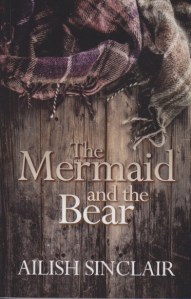
I admire those who follow their dreams.  I have been writing fiction for over forty years now, and although I’ve had some success placing short pieces my novels haven’t found much interest.  So when I see the published work of someone who obviously loves writing as much as Ailish Sinclair does, it warms my heart.  Her debut novel, The Mermaid and the Bear, is the kind of historical fiction tinged with a little fantasy, all set in Scotland.  Having spent three happy years in Scotland myself, I like to read native writers.  One of the categories in this year’s Modern Mrs. Darcy’s reading challenge is a debut novel, so all these things came together in this one little book.  There may be a little spoiler info below, so proceed with caution!

Sometimes I read a novel without knowing much about it in advance.  That was the case with this one.  I read Sinclair’s blog posts and appreciate the fact that she doesn’t compose long, rambling essays.  Her posts often make me stop and think.  Her novel follows a love story that turns into a witch-hunt.  Unlike that claimed by those who have the whole world watching them, this was a real one.  The historical notes tell a bit about the characters based on women actually tried in Scotland during those dark times.  In fact, when one of my doctoral advisors gave my wife and me a walking tour of Edinburgh early on in our time there, he pointed out where the witch trials had taken place.  Sinclair captures the rage and frustration of women who had no recourse once such accusations flew.  A religion only too ready to believe the worst about people, women in particular, showed no mercy based on what was only hearsay and jealousy.

It’s difficult to imagine what life would have been like in such times.  Castles and lairds make us think of fairy tales, but reality must’ve been somewhat harsher.  It’s fun to pretend about witches around Halloween, but there’s a sadness that’s difficult to escape as an adult.  That sadness is all the more profound for finding claims of witch-hunts on the lips of abusers and others who do their best to perpetuate inequality.  They dishonor those who actually did die so that men like them could feel smug self-satisfaction in the past.  The Mermaid and the Bear brought a number of these thoughts to mind.  Our society has made some strides towards treating all people as human beings but we’re yet a long way from where we need to be.  Books that remind us of that are always to be welcomed; dreams are worth pursuing.


Space Farce

Okay, so “Space Force” sounds like a gimmick that you’d see in a 1950’s ad geared to dungaree-wearing boys.  These boys, who’d be named “Dick” would show the girls, named “Jane,” just how it was done.  So as I read about the furor of dedicating a King James Bible from the Bible Museum as the official Bible for military branches aimed at the stars, I had to think how very small we actually are.  So 45 thinks, like Reagan thought, that we need outer-space defenses.  These guys need to read more science fiction.  Actually, some plain old science would help.  If there are most advanced civilizations out there—and such seems increasingly likely, given that our understanding of science is subject to change—we are nothing more than cosmic mosquitoes buzzing close to our own planet where we can wail on each other in the name of lucre.  And we call it “Space Force.”

An article on NPR points out the hypocrisy of swearing in the military on a Bible.  One guy in there, I’ve heard tell, was called “the prince of peace.”  He’s somewhere near the back.  The public loves a good warmonger, though.  We can send our tentative rockets into orbit where bug-eyed aliens laugh with bemusement, and say “Just you try something.”  Or we can make business deals with Russia with one hand while pointing our missiles in their direction with the other.  Is that a missile or am I misreading something, Dick?  I can’t ask Jane, because she just follows along.  Maybe we’re inheriting the consequences of those who grew up reading Dick and Jane.  Boys with their rockets, girls with their dolls.

Bringing religion into the military is nothing new.  German soldiers marched out into a couple of World Wars with “Gott mit uns” inscribed on their waists.  Millions died.  No lessons were learned.  So now we want to take conflict so far over our heads that we can’t even see.  Ancient people knew the gods were fighting far above.  That’s how they made sense of the world.  Some, like Erich von Däniken took those stories literally and thought our alien observers were the reason.  Now that we’ve got drones we have no need of UFOs anymore.  All that sci-fi I watched as a kid wasn’t wasted after all.  Only I grew up reading that Bible instead of swearing on it.  I was pretty sure that war wasn’t a good thing, as he rode on a red horse with his sword pointing upward.  Time to dust off William S. Gray and get back to watching Space Force. 

From NASA’s photo library


Bodies and the Fall

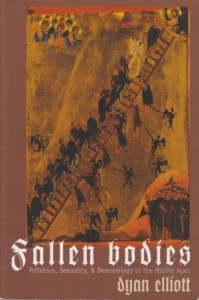
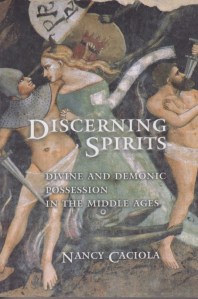
Less common than it once was, the term “Dark Ages” was formerly used to denote what in Europe was known as the Medieval Period.  We now know that the pervasive darkness ascribed to the time was only partial: science, legal thinking, and rationalism were well underway.  Nevertheless, the sway of the church was enormous, and even until and beyond the days of Isaac Newton, the supernatural was assumed to exist.  Dyan Elliott’s Fallen Bodies: Pollution, Sexuality and Demonology in the Middle Ages is a fascinating journey through this contradictory time.  Elliott explores how the mysteries of sex (nocturnal emissions and menstruation loom large among them) played important roles in the development of Catholic theology that ultimately led to the close association of demons and witches.  Concerns with priestly purity, largely due to concerns about transubstantiation, led to enforced celibacy and the (further) denigration of women.

It would be difficult to summarize this insightful book.  Although relatively brief, it packs a wallop.  Concerns about purity go back to the Bible and before.  Ancient cultures had recognized aspects of contagion and knew that some diseases spread by contact.  Their perception of biology was “scientific” according to their current understanding, but it lacked microscopes and knew no shortage of supernatural entities.  Demons had great explanatory value in such a world.  As Elliott shows, they often appear in disquisitions about sex.  How can spiritual beings engage in physical relations with human bodies?  What were they made of?  Were they all bad?  Although demons had explanatory value they also raised many questions.

Fallen Bodies draws correlations between the dismissal of priests’ wives and the evolution of witches.  As the Eucharist became more and more holy, stricter controls had to be placed on consecrating hands.  Sex was the great source of pollution, and the Virgin Mary became rather less human through her own miraculously sterile conception.  The implied misogyny may not have been so much intentional as a reflection of the struggle to understand what modern medical science generally explains materially.  We still grapple with the mystery of life.  Conception can be viewed clinically, and biological responses can be “explained” scientifically (anyone who’s been in love will admit to the mystery of it, though).  Denizens of the Middle Ages worked with the tools they had to make sense of a world often bewildering.  Even physics still has to deal with quantum realities.  History teaches by its unfortunate missteps.  Someday those who “govern” the world may learn to read it and exorcise demons now otherwise readily explained.


Truth, Justice, and

Martin Luther King, Jr. attended Boston University School of Theology long before I did.  We remember him today as a great leader, a man willing to die for what he believed in.  And all these years later we’re still struggling to find some semblance of racial equality.  We can’t seem to admit that race is a social construct and not a scientific category.  Indeed, the only race is the human race.  King saw that, and staked his life on it.  Today we’re ruled by politicians who, when faced with the truth immediately shout “fake news!”  “Liberal!”  They may stop short of using some words not because they don’t want to, but because they could cost them at the polls come November.  America is watching.  I’m sitting here thinking how Martin Luther King died when I was just five.  He’d started something righteous and just.  And millions were out marching in the cold on Saturday to say we still believe in justice. 

I didn’t pick Boston University School of Theology just because King was its most famous alum.  The other day a guy noticed my BU stocking cap and asked if it was “Boston University.”  This wasn’t an educated person, but I’m guessing that most school paraphernalia has to do with sports and the game was on in the background, so the question was logical.  I told him it was Binghamton University, a school with which I also have an intimate connection, one step removed.  He said, “Binghamton!  I saw your cap and thought Baylor?  No.  Must be Boston.”  But ironically he ended up with the right school for me, but the wrong school for what I was wearing.  I did pick BU because I realized that strong academics are nothing without social justice.  Of course, academia wanted nothing to do with that.

Recently I read how Republican resentment towards liberals has very solid roots in racism.  Oh, they will deny it—their “fake news” trigger-finger is very itchy—but the whole package is tied up with anger that an African-American was elected president.  Follow that up with an old, white racist.  How will history look back on this insane era?  I think we already know.  While the privileged are trying to build their own legacies, I ponder an African-American preacher with clear vision as the one we remember today.  I went to Boston University naive and full of hope.  I heard a lot about King when I was there.  I knew something of dreams and how costly they could be.  Today I sit here and cuddle the epithet “liberal” and think how it’s become a swear word for some, while its real meaning of “justice” continues to go unheeded.


Social Madness

I’m reading a book written in the mid-1980s.  (All will become clear eventually.)  The author notes the connection between social madness and personal mental illness.  He cites the alarming rise of teen suicides.  This was over three decades ago.  Suicide rates have continued to climb, and this particular author got me to thinking about something that troubled me even as an undergrad.  Although I went to college intending to be a minister, I ranged widely in the subjects I studied.  (Being a religion major in those days allowed for quite a bit of flexibility.)  I took enough courses in psychology to have minored in it, if I had declared it.  Since my mind was set on church work I saw no reason to make said declaration.  The thing that troubled me was I had also taken sociology classes.

Like most people who grew up in uneducated households, I suspect, sociology was something I’d never heard about.  Asking what it was, in college, someone answered along the lines of “psychology of groups.”  My own experience of it was that it involved math and graphs—it was a soft science, after all—and now I read sociologists who say that such numbers can be made to declare what the sociologist wishes.  In other words, psychology.  The point of all of this is that the book I’m reading suggests societies exhibiting illness cause individuals to be sick.  Sociology leads to psychology.  In times of national turmoil, individual mental illnesses rise.  I had to pause and put the book down.  The eighties weren’t a picnic, but the national madness of the Trump era bears no comparison.  We are a nation gone mad, and when society can’t project health, the many who stand on the brink of individual mental illness simply get pushed over.  That sure makes sense of what I’m seeing.

Looking back, I often think I should’ve probably declared that minor.  Raised in a strong biblical environment, however, I wanted to learn as much about the Good Book as possible.  I was teaching Greek by my last year in college and in seminary I specialized in the Hebrew Bible.  It would’ve been a natural place to continue studying psychology.  By that point I’d decided to go on to a doctorate, and psychology required medical training.  For a guy as squeamish as me that wasn’t possible.  Ancient languages, though, they were something I could handle.  It’s rather frightening that those writing at that time already saw America (in the Reagan years, I might add) teetering towards national insanity.  We’ve gone far beyond that now.  And a society that doesn’t know it’s ill will sacrifice many individuals who realize that it is.


United, We Divide

I was a teenage Methodist.  Or, I should say, a teenage United Methodist.  My family had moved to a town where there were no Fundamentalist churches.  Indeed, the only Protestant church was the UMC.  Although very aware of religion, I hadn’t studied it deeply at that point—I’ve come to understand a bit better the marketplace of Christianties and how it works in a capitalist society.  The thing is, the more I learned about John Wesley and the Methodist movement, the more I saw how well it aligned with my own thinking and experience.  I became an Episcopalian largely because John Wesley never left that tradition and urged his followers in the same direction.  Of course, the “United” in United Methodism was due to mergers during the ecumenical period when Christians were learning to overlook differences and a strong base remained from which to draw.

The news has come out that the United Methodist Church has decided to split over the issue of homosexuality.  Most major Protestant denominations have made their peace, albeit uneasily, with the issue.  They recognized that while a source of guidance in spiritual matters the Bible’s a little outdated on its scientific understanding.  If God had revealed evolution to good old Moses things might’ve been a bit different.  We now know that homosexuality isn’t a “choice”—it is found in nature, and not rarely.  Homo sapiens (if I’m allowed to use that phrase) have developed in such a way that sexuality is a main preoccupation of religions.  Some animal species are monogamous and in our case many cultures adopted this as conducive to an ordered society.  Then it became codified in some sacred writings.

While homosexuality is mentioned in the Bible, every book of that Bible has a context.  Like it or not, close, serious study of Scripture raises questions you just don’t get if you read only authors who think the same way you do.  It is far easier to do that—who doesn’t like being right?—but thinking seldom gains credibility by never being challenged.  Iron sharpens iron, someone once said.  The emotion behind the issue, I suspect, is driven by a couple of things: fear of that which is different, and the inability to see the Bible as anything but “da rules.”  In those cases where the rules contradict one another you just have to choose.  At least in Christianity.  In Judaism they ended up with the Talmud.  In any case, we’re now seeing the fracturing of society based on party lines.  We could always use a few more choices, I guess, for competition is what spiritual capitalism is all about.


Conversations

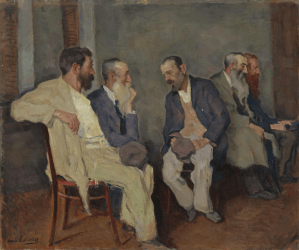
Arnold Lakhovsky, The Conversation, via Wikimedia Commons

While I tend not to discuss books on this blog until I’ve finished them, I realize this practice comes with a price tag.  Reading is a conversation.  Your mind interacts and engages with that of another person (or persons, for books aren’t usually individual efforts).  I find myself as I’m going along asking questions of the author—whether living or dead doesn’t matter—and finding answers.  Materialists would claim said answers are only electro-chemical illusions spawned by this mass of gray cells in my skull, only this and nothing more.  The realia of lived experience, however, tells us something quite different.  These interior conversations are shaping the way I think.  There’s a reason all those teachers in grade school encouraged us to read.  Reading leads to an equation the sum of which is greater than the total of the addends.

I’ve been reading through Walter Wink’s oeuvre.  Specifically his trilogy on the powers.  Although this was written going on four decades ago, I’m struck by how pertinent and necessary it is for today.  As he posited in his first volume, the embrace of materialism has blinded us to spiritual realities.  Wink was bright enough to know that biblical texts were products of their times and that simple acceptance of these texts as “facts” distorts what they really are.  He also convinces the reader that institutions have “powers.”  Call them what you will, they do exist.  Throughout much of western history the “power” cast off by the church has been somewhat positive.  Christianities has established institutions to care for the poor and for victims of abuse and natural disaster.  Orphans and widows, yes, but also those beaten down by capitalism.  They have established institutions of higher education to improve our minds.  Until, that is, we start objecting that our improved outlook demonstrates that the biblical base isn’t literal history.

Churches then often fight against those educated within its own institutions.  Ossified in ancient outlooks that value form over essence, many churches take rearguard actions that we would call “evil” if they were undertaken by a political leader such as Stalin or Hitler.  Those evil actions are justified by claiming they are ordained by an amorphous “Scripture” that doesn’t really support those behaviors at all.  I’ve been pondering this quite a lot lately.  Although I taught Bible for many years my training has been primarily as an historian of religions.  I specialized in the ancient world of the northern levant, for that culture provided the background of what would eventually become the Bible.  Reading Wink, I think I begin to see how some of this fits together.  I won’t have the answer—we many never attain it—but I will know that along the way I’ve been engaged in fruitful conversation.


First Christmas Parable

The Christmas story is full of surprises.  This year near Bethlehem, a parable occurred to me.  Like many parables, it raises questions.  A question for all you men out there: when’s the last time you were pregnant?  Was it because some woman—who can’t be responsible for her urges—didn’t take proper precautions?  Isn’t this the way God punishes people for having the sexual intercourse he created?  Since God gave you an anatomy just like his, you certainly have priority in the cosmic scheme of things, but this pregnancy of yours—what are you going to do with it?  Oh, and don’t look to Onan for answers to your own urges; God stuck him dead for that kind of thing.  But that troubling “what if”… What if Mary had had a choice?  According to the Good Book she did.  “Be it unto me,” Mary said.  She could’ve said “No.”  Many men in your *ahem* delicate condition did not.  The problem with virginal conceptions is that people will talk.

Many people don’t remember at this time of year that Mary and Joseph were immigrants to Egypt.  Had the Nativity occurred today in these States that follow God’s word, Mary, Joseph, and the baby Jesus would’ve ended up in separate cages.  Wasn’t he born in a cage?  Oh, cave!  That’s definitely an improvement.  One wonders how the Gospel might’ve gone from there.  And what of those annoying buzzing creatures overhead calling for peace on earth?  Shoo!  Trade wars!  Tariffs!  Nuclear threats!  These were the gifts of the three wise men, were they not?  Or perhaps we should get biblical and follow Herod’s mandate.  Killing two-year-old boys isn’t abortion, after all.  After giving birth they’re your problem, not God’s.  You’ve got to get them born—that’s the most important thing.  And since women can’t possibly know what it’s like to be pregnant what are you going to say when they walk out and tell you, “It’s not my problem”?  “Be it unto me,” said Mary.

Shepherds, it should be noted, were the poor.  Ironically that first Christmas the good news was first revealed to them.  Herod, half-insane, kept shifting members of his government around.  He had put away his previous wives—perhaps because they made him pregnant—and assassinated all his rivals.  Unless that’s fake news—the old fox was known for that.  So the immigrant family thought it was safe to return after Herod was removed from office.  Jesus grew to espouse the message of love and acceptance—extending it even to foreigners.  The state, believing itself established by divine right, had him put to death.  It’s Christmas, and we’ve seen all this before.  If only those with eyes would see.  But parables, it seems, have gone out of style.


The Truth Lies

I recently saw a Trump supporter claiming, unsurprisingly, that everyone’s lying except Trump.  Of course, I could be lying.  According to the Washington Post, Trump has made over 13,000 lying or deceitful statements since being in office.  For those who did their homework before he became the great protector of the unborn (ah, there’s one born every minute!) he was known as a crooked businessman to begin with.  With well over a thousand lawsuits against him even before being elected, we have no choice but to believe the entire legal system is lying, as well as anyone who’s had business dealings with him.  I’m just so glad that we have such a moral, upstanding paragon of Christ-like behavior in the Oval Office.  Never mind that all those witnesses in the impeachment case were speaking under oath—they all lie, but Trump.  Hey Donald, is that your real hair?

Ironically, some of the people making such claims hold the belief that divorce is not excused in the gospels (see Matthew 5:32, but Jesus could’ve been lying here—he’s not Donald Trump, after all).  It’s a matter of public record that Trump is twice divorced.  It’s a matter of sworn legal testimony that he paid hush-money to cover up affairs while married.  Well, that is if we believe this lying world rather than the one, solid, shining bastion of truth in the White House.  Someone once said (but he may have been lying) that it is easier for a camel to pass through an eye of a needle that for a rich man to get into heaven.  Just sayin’.

I have said before that all politicians lie.  It comes with the territory and only the most naive among us don’t accept that fact.  There is a difference, however, between the occasional mistruth and a lifetime, documented record of indiscriminate lying.  If it weren’t for the fact that all facts are lies (except those Trump makes up) we would see that the phenomenon of pathological lying is well known.  The presidency of the United States has never before tolerated a pathological liar.  But then again, they never had an incumbent more Christian than Jesus himself.  Now I think I remember who made that crack about rich guys.  He also said something about having no place to lay his head.  If he’d been born rich, though, you can bet the gospel message would’ve been very different.  Too bad the Bible lies.  If it didn’t such musings as this would hardly be necessary.  I could be lying, of course.  It is, after all, the new truth.


Shortest Day

This is it.  It’s here.  Today marks the winter solstice, the longest night.  Those who campaign to keep Christ in Christmas prefer not to acknowledge that the date of said holiday was an attempt to displace Sol Invictus, the Roman (therefore pagan) celebration of the invincible sun.  The Romans, like other ancient peoples, celebrated the return of light, albeit slowly, from darkness.  While teaching at Nashotah House a colleague mentioned being “almost pagan” in the eagerness for the return of light.  You can strike the “almost.”  Deep down we all look for signs of hope in dark times, whether Christian, Muslim, or Hindu.  “The people who walked in darkness,” Isaiah rejoiced, have seen light.  Sometimes light comes from an unexpected quarter.

There are two high circulation Christian magazines: Christianity Today and The Christian Century.  The latter is more progressive and was launched as an answer to the former.  One of the founders of Christianity Today was Billy Graham and its readership is largely evangelical.  Just yesterday Christianity Today ran an editorial stating the opinion that Trump should be removed from office.  If I were a card-carrying member of the Republican Church, I’d be trembling.  Long touted as “Trump’s base” evangelical Christians have found themselves besieged by the flagrant and constant contradictions their party has thrown them.  Fear of divorce was enough to keep at least one woman I know in an abusive relationship for years.  Now a thrice-married, philandering man who pays hush money to keep his affairs secret is upheld as the new Messiah.  Many of us who grew up evangelical were certain that their old tribe simply wouldn’t cotton onto a straw man.  But  cotton they did.  They’ve become the very lint in his miserly pockets.

Those encrusted with hardcore hatred, of course, will not be swayed.  They’ve found a poster boy who says it’s okay to claim white male supremacy.  They can pick their political issues (usually having to do with protecting the unborn or the right to shoot those already born) and they can be certain that this protean protestant will have their posteriors.  Their leadership, however, has begun to show itself clearsighted.  Christianity Today is no friend of liberal Christianity.  The editorial makes it clear that Democrats had it in for Trump from the beginning.  There is, however, absolutely clear evidence of his crimes.  Even as southern senators state outright that they have no interest in seeing a fair trial, their base is speaking up.  Tonight is the longest night of the year.  Tomorrow it will be a little bit lighter than today.  At this time of year we fervently hope that the light will continue to grow.


Fearful Faithful

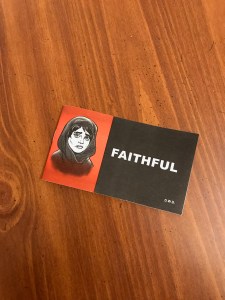
It’s sitting on the table next to my chair and I’m afraid of it.  It all started during the Easton Book Festival.  I feel sorry for those people who have to stand on the street corner and pass things out for a job.  In Manhattan I used to see them being completely ignored by swarms of people passing by.  They’re only doing their job.  I made a habit of accepting their chits, and even if they didn’t mean anything to me, I felt that the person handing them out might have experienced a small measure of satisfaction that someone accepted what they were offering, and had said “thank you.”  In Easton back in October, my wife and I were heading to one of the venues to hear an author talk and a guy was passing out paper, and I accepted one as a matter of habit.

It was a Chick tract.  If you’ve been reading this blog a while you’ll have run across the concept before.  Jack T. Chick was a cartooning evangelist.  He drew hundreds of tracts and comic books that formed a steady diet for me, growing up.  Although they looked like cartoons, these intolerant, Fundamentalist tracts were quite often very scary.  Especially to the young.  More than once I’d spiral into a childhood depression after reading one.  Although it seemed simple—say the prayer at the end and you’d be saved—how could you be so sure?  The disturbing contents stayed with me long after the sixteen pages were done.  Now, as an adult, I was being offered a road back to a childhood I fervently wished to avoid.

I stuck the tract in my pocket and forgot about it.  When I got home I emptied my pockets and found it again.  Curious, I was tempted to read it.  I know, however, that doing so will only drag me back to a memory of younger days when a kind of terror permeated my days.  And nights.  My theology, which was formed of a mosaic of these tracts (what child really listens to sermons?), was a scary one indeed.  It was populated by demons, Catholics, and servants of the Antichrist.  Anyone who wasn’t straight and pretty waspish was a threat to my eternal salvation.  Is that somewhere I want to go again?  The tract sits, unread, on my table.  It reminds me of the abuses to which religion might be put.  And I’m thinking I might start refusing free handouts on the street once again.


Aging Goddesses

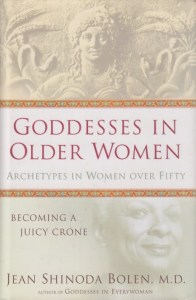
While not a woman, I am over fifty and I have both a personal and professional interest in goddesses.  Some friends recently asked how I came to write a dissertation on a goddess, and thinking about that has revealed some aspects about my outlook, but those will need to wait a little.  We read Goddesses in Older Women by Jean Shinoda Bolen because my wife wanted my opinion on it.  We read books together while washing dishes—we’ve been doing this since we married over thirty years ago—and despite my not requiring the subtitle, Becoming a Juicy Crone, I was game.  I have been curious about the experience of others since I was quite young.  Since half the others in the world are female, it makes sense to be in dialogue and to be willing to learn.

Bolen uses classical goddesses as Jungian archetypes to help post-menopausal women sort out their feelings and spirituality in what has been called the “crone” phase of life.  This is part of an antique triad that many would rather dismiss: virgin, mother, crone.  Still, Bolen embraces it as fairly common in women’s experience.  Men, although they can be elected to the White House while doddering old fools, don’t pass through such distinctive stages.  In fact, some never mature.  Women’s lives are defined by reproductive capabilities in ways men’s simply aren’t.  Instead of dismissing half of human experience as irrelevant, we should listen to the accumulated wisdom of women.  Bolen, who is an M.D., isn’t an historian of religion, but her remarks about the various goddesses explored (Asherah isn’t one of them) are insightful.  I listened as my wife read, and this was quite a learning experience.

We have, as a species, often failed our females.  Males, using that “might makes right” physiology and theology, have often assumed masculine agendas are the only ones that matter.  Look around the world today and see where that’s gotten us.  We’re killing our own planet in the name of greed and ignorance just so that nobody can be richer than me.  I think it’s time we let the women have a chance to run things.  Even though ancient mythologies often reflect the patriarchies under which they were written, many allow women more powerful and authentic roles than they currently have.  Even El, the head of the Ugaritic pantheon, could change his mind when approached by Asherah.  I learned much from this book, just as we learn so very much by listening to those who differ from ourselves.  And the goddesses, almost always, are the ones who possess true wisdom.


New Religion

Republicanism, it seems to me, has become its own religion.  It started off when the GOP married evangelical Christianity, but the offspring of that unholy union has become a religion all on its own.  It certainly doesn’t adhere to classical Republican principles (tariffs?  Really?).  Nor does it adhere to Evangelical standards (turn the other cheek?  Love thy neighbor as thyself?).  Like most blendings, this new religion has some elements of each parent and it has no lack of fanatic supporters.  The traditional Evangelical, for example, considered the Devil “the father of lies”—one of his biblical titles.  The Republican, however, considers pathological lying to be signs of messiahood.  There’s a tiny disjunction here, but it proves that what we’ve got is the birth of a new religion.

Books and articles have begun to appear on how Evangelicalism has changed.  I don’t believe it’s so much a matter of Evangelicalism evolving as it is Republicanism fulfilling the need for intolerant religion.  In every culture there are those who want to go back to the day of Moses and golden calves and stoning those you hate.  It’s a little more difficult these days, what with secular laws that protect the rights of others, but the GOP has found a way.  My heart goes out to old fashioned Republicans, it really does.  Fiscal conservatives have found themselves in church with a bunch of people with whom they agree on very little.  They have no choice, for their political party has been sanctified.  And the only thing worse than an Evangelical is a bleeding-heart liberal.  Next thing you know the Democrats will start quoting the Bible at you.

The lying thing really takes some wrapping my head around, though.  I’ve always said nobody believes in a religion they know to be false.  This new development challenges that, if it doesn’t challenge the very idea of religion itself.  Republicanism is a religion based solidly on bearing false witness.  Self-aware of it, even.  You can’t tell me that these educated white men don’t know a criminal activity when they see one.  That they can’t read, and reason, and trust their intellect (although it takes the back seat to their overwrought emotions).  Sound like a religion to you?  It sure does to me.  It’s been coming a long time, but it took the last three years (the tradition length of Jesus’ ministry, it’s often said) for this to dawn on me.  The religion of the lying messiah.  I’ve got to wonder what kind of future it’s got.  I smell the fires rekindling in the burnt over district and wonder who’s for dinner.


Armed Forces

You ought to feel safe with the U.S. Navy so close by.  The naval base at San Diego is the second largest surface base in this particular branch of our sprawling military system.  From my hotel room I can watch the ships chugging through the harbor and from the Convention Center you can see quite a spread of naval real estate.  Still, all this hardware doesn’t make me feel safe.  Perhaps because I’m a child of the sixties, I can imagine a world at peace where military budgets don’t literally take food from the mouths of hungry citizens.  The last time I was in San Diego for AAR/SBL I toured the USS Midway aircraft carrier.  It’s clearly visible from my room.  I was amazed at both the technology and the obvious expenditure for such a craft.  It can’t be easy to set a city afloat.

Whenever I experience things like this I can’t help but wonder what we might accomplish if we loved each other as a species and put our heads together to try to solve our problems.  Lack of water—perhaps ironically in this naval city—is a serious global issue.  Poverty is the ghost of civilization.  The grasping of power by the driven but inept is clear worldwide.  We build great, complicated war machines.  The noise generated by the helicopters charging overhead bespeaks their weight and weaponry.  Down here in the southwest there are places civilians just can’t go because our military is busy keeping us too safe to allow us to wonder what they’re up to.  Black budgets must be nice.  I stand here among religion scholars and dream.

Ironically religion often leads to the fear that leads, in turn, to militarization.  We want to protect our “way of life.”  We’ll follow the prince of peace into war any day.  Just give the signal and release the missiles.  It doesn’t make me feel safe at all.  One time on a family visit, we drove through Norfolk, Virginia.  We stayed at a cheap hotel, because, well, we’re cheap.  The metal door was heavily reinforced with a stolid steel lock.  Navy men, we were informed, didn’t always behave well while ashore.  The locks were to keep us safe from those protecting us.  We stayed only one night and left early the next morning.  So I while the annual meeting away under the watchful eye of our largest line item on the budget.  They’re keeping our bodies safe, but who’s keeping track of our souls?