Influential Brethren

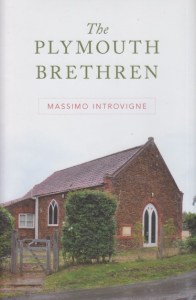
Outsized ideas from under-recognized sources always captivate me.  I have to admit that my own childhood fascination concerning, and fear of, “the rapture” still haunts me.  While our house isn’t large, the other day I couldn’t see or hear my wife anywhere when I knew she was home and my first thought was that she’d been raptured and I’d been left behind.  Please don’t try to console me with logic; I know very well the problems with this initial assessment and knowing the history of the idea of the rapture can’t stop the primal fear when it strikes.  So it is with religious ideas inculcated in the young.  That’s why I knew I had to read Massimo Introvigne’s The Plymouth Brethren as soon as I heard of it.  The Plymouth Brethren, and specifically one of their formative leaders, John Nelson Darby, were the inventors of the rapture.

Introvigne’s book doesn’t trace rapture history (other books do that), but he does narrate, in an admirably succinct treatment, whence the Brethren arose.  In the nineteenth century in the British Isles, some were very concerned that Christianity had gone off the rails.  Accommodating with secular society, it had become heavily doctrinal and, worse, political.  Breakaway groups were common, including those who went back to the “Bible alone” as the basis for assessing what being Christian truly was.  The Plymouth Brethren developed in this atmosphere and they still remain a relatively small Christian sect (I use that term completely neutrally).  Even though they themselves splintered over time, they were never a very large group.  They, however, invented the rapture.

John Nelson Darby, one of the founders of the movement, believed history was divided into dispensations, or periods, predetermined by God.  The dispensation in which we now live (and in which they lived two centuries ago) would include a dramatic rapture that would allow Darby’s understanding of eschatology to fall within the system he developed.  This idea was picked up by Cyrus Scofield and included in his enormously influential Scofield Reference Bible.  That Bible, although many evangelicals considered the Plymouth Brethren as a kind of “cult,” was used as the unquestioned roadmap for the end times.  It was picked up by such promoters as Hal Lindsey and Timothy LaHaye and made into a meme that just about any educated person recognizes.  We all know what “the rapture” is, although the Bible itself doesn’t spell it out at all.  Introvigne’s book is very informative on the Brethren but his chapter on their ten main divisions is, necessarily, a touch confusing.  Well balanced and fair, this is a great source for those who wonder who these people were that gave us such worries when our wives have “disappeared” into some other part of the house.


Spiritual Fear

There’s an old adage that if a headline asks a question the implied answer is “No.”  I’ve found that to be true, largely.  I hoped differently when I saw the article titled “Are Horror Films Secretly Spiritual?” by S. Rufus in Psychology Today.  Rufus, admittedly not a fan of horror, ponders whether it might not meet a spiritual need for some.  She would not count herself among that number, should the assertion prove to be the case.  Indeed, her post has more sentences ending in question marks regarding this assertion than it has straightforward declarative ones.  Rufus notes that ancient religions involved a kind of fear-based response appropriate to the lifestyle of those open to constant threat by the natural world.  She seems to believe that civilization has saved us from that.

Now one of the questions with which I constantly struggle is why I watch horror.  I do not like being afraid, and when people find out about my fascination with horror they tend to treat me as if there’s something wrong with me.  I guess maybe I think that civilization has not so much eliminated the sources of threat so much as changed them.  Those who grow up poor know fear.  Fear of want is extremely prevalent in our capitalist society.  I see the “street people” when I go into New York City.  They are not few.  Once you start to get away from affluent suburbs just about anywhere you start to see the run-down houses of those who can’t cope with the demands of a consumerist society.  Even those of us with an education are liable to joblessness and the very real terror that attends it.

Civilization, in other words, comes with its own costs.  Religions originally began—some of them at least—largely from the fear response.  Yes, people were afraid.  The gods, properly propitiated, stay the hand of disaster.  For now.  Some religions, such as those in the monotheistic family tree, tend to suggest higher principles like love can be the motivation.  These religions, however, quickly begin to make threats against those who are heterodox, and reintroduce fear into the formulation.  I suspect, from my own experience of all of this, that the answer to the question may actually be “yes”—horror films do offer something spiritual.  There is a catharsis, if I may borrow a term from psychology, in them.  The spiritual element may, however, run much deeper than that.  Until human society truly takes love and justice as its operating principles, we will have horror films to help us learn to cope.


Anthropocene

The word “Anthropocene” has been showing up quite a bit lately.  For a period of many years I was an avid, self-taught amateur geologist.  In my dreams I still am, I guess.  My interest in the ages of rocks began when I, like Charles Lyell, began to consider the implications of their extreme longevity.  The Bible, of course, famously intimates we live in a comparatively new neighborhood.  Having grown up believing that literally and firmly, and also having started a modest fossil collection, I failed to see the conflict.  I mean, there were fossils right down there by the river.  Tons of them.  Some Young Earth Creationists had already begun, by that point, to suggest they’d arisen because of Noah’s flood, but dinosaurs still seemed to be a problem.  In many ways rocks broke me out of my fundamentalist stupor.

While at Nashotah House I taught electives on Genesis 1-11.  I read about the geologic ages of the planet and would fall into Devonian dreams of a world entirely different from ours—a world in which there was no Bible for there were no humans to make God in their image.  I knew that we lived in the Quaternary Period of the Holocene Era.  I don’t think the term Anthropocene was in wide use then.  Parsing it is simple enough—it is the “human age.”  The age in which the planet was, has been, and is being altered by human behavior.   There’s no agreed-up start date for the Anthropocene, but it will likely be set in the twentieth century; the twentieth century in our way of counting.  There have been millions of centuries before that.

A couple of weekends back I attended a church program on plastics.  These useful polymers are deeply, deeply integrated into our lives and are promoted by the far too powerful petroleum industry.  The problem with plastics is that they break down and invade the bodies of animals and humans.  And although they do decompose it takes many centuries for them to do so.  Naming the Anthropocene is an effort to get us to see that a human perspective is far too brief to deal with the many issues we raise.  Our practices on this planet will likely not destroy the earth, but they may very well make it uninhabitable by us, or by creatures we like to see.  Life is persistent, and rock lasts for eons.  Even stone’s not eternal, however, and the idea of the Anthropocene is to get us to look at ourselves and realize that our use of this planet, as toxic as it is, is shortsighted.  We will someday be the fossils under a bridge long crumbled to dust for those in the future who know of no such thing as Genesis.  Perhaps we should act like it.


Autocracy and Its Victims

Human rights ought to be fairly simple.  The recognition that all people are human is complicated by that infamous human construct of money, even when autocracy’s involved.  I recently became aware of the plight of the Uyghurs.  If it were not for the efforts of some local faith communities, I would never have heard of them.  The Uyghurs are a Turkic population in what is now northwest China—a disputed area that has fallen under one of the superpowers of the Asian world.  Muslim by heritage, the Uyghurs fall into the category of peoples adhering to an organized religion, which the government of China has consistently resisted—indeed, feared.  The current plight of the Uyghurs is that they are facing “ethnic cleansing” by the Chinese government, which uses claims of terrorism to lock at least hundreds of thousands (perhaps significantly more) Uyghurs into “reeducation camps.”

Like most governments with secrets to hide, China does not permit foreign journalists or academics into these camps.  Children are being separated from parents—those of us in the United States would be well served to pay attention to this—so that the young may be culturally assimilated into the China that Beijing envisions.  The Uyghurs, like the Tibetans, are seeking international political protections and recognition.  Minority groups like this easily fall under threat.  In many communities men are taken to the reeducation camps (from which they never come out) and their families are supplied with a male Chinese boarder who watches to make sure they no longer adhere to their Islamic faith.  Reports from those who visit the region demonstrate how much at threat all of us are from autocratic governments, especially when other governments are easily bought.

We in the western world are prone to accept the propaganda that Islam is a terrorist religion.  It is not.  Most people are surprised to learn that the nation with the highest Muslim population is Indonesia.  Iran is not even in the top five.  Iraq is not in the top ten.  Our western bias blinds us to the religious realities, and diversities, of east and south Asia.  China, however, has long repressed organized religions, making it irresistible to many Christian missionaries.  It has, despite being the home of Daoism and Confucianism, become hostile to movements that allow people to organize.  Religions, of course, have long been such organizing movements.  If we do not support the rights of other religions, especially under the whims of autocracies—which are growing even in “the free world”—then we are gazing at our own future. 


Book Signing

Okay, so I’ve got a book signing for Holy Horror coming up at the Moravian Book Shop in Bethlehem.  And they’ve advertised it in the local paper.  I’m humbled and honored by this, especially since I have no local following.  When I go to the website of the newspaper, The Morning Call, ads pop up on the top, bottom, and center of the page, obscuring the event.  I take this as kind of symbolic.  Life is crowded.  We seem to have turned the corner to autumn around here with nights being distinctly chilly.   After the languorous heat of summer when even thinking about winterizing seemed to add another layer of insulation over already too warm body, now we suddenly have to try to fit it in among an already crowded schedule.  At least I don’t have to commute too much any more.

I’m trying to get ready for the book signing, but I don’t really know what to do.  Perhaps I should try to get some business cards printed up.  Maybe I should think of some catch-phrase to use if anyone actually buys a high-priced book.  What should I wear?  Working at home can make you feel like a recluse sometimes.  I don’t have enough money to be considered eccentric, but I don’t get out among hoi polloi much either.  If most people have as much trouble as I do clicking off the ads to get to the event underneath, those who swing by the table are likely to be few.  Still, I’m looking forward to meeting local horror film fans.  They are, in general, a surprisingly cordial bunch.

After Nightmares with the Bible I’m going to focus on trying to find more mainstream publishers.  The reason is simple: academic publishers tend to be overpriced.  I’ve worked in publishing long enough to be able to decode pricing schemes.  There is a logic to them, even if at times it feels like you’re being overshadowed by pop-up windows.  To get a wide readership you need a pretty big platform, and getting a following on any form of social media takes the one thing I don’t have enough of.  Time.  You see, just the other day it was summer and we felt like we were baking.  Now the equinox has plunged us into the days of getting the furnace cleaned and operational and looking at the prices of insulation and shaking our heads.  Somewhere under all of these pop-ups are ideas waiting to be written down.


Moral Compass

Recently I was introduced to The Poor People’s Campaign, in its most recent iteration.  I was drawn in because I was raised in a poor family and have struggled to make up the shortfall my entire adult life.  Those raised in middle class (and above) households often don’t realize that when you start below zero, in a humanities-based career it may take literally decades to catch up, if you ever do.  There’s no safety net and there’s no inheritance.  You begin with years of higher education debt and sub-standard pay in your profession.  But I digress.  The Poor People’s Campaign: A National Call for a Moral Revival is non-partisan and it is about more than just the poor.  It’s about restoring true morality to our political system.  Organized by the Rev. William J. Barber II, it has had some success in presenting the plight of the poor to a congress that has largely failed to care.

Politics is full of dirty money and lobbying to the point that many people are cynical and convinced that morality has no chance of survival in this city set on a hill.  The pony and puppet show in a White House run by an entrenched narcissist shows just how far concerns for justice are from the aims of our government.  Barber and his colleagues actually read from the Bible (which, it turns out, advocates justice) rather than just saying that they do.  Compared with Martin Luther King’s 1968 campaign by the same name, The Poor People’s Campaign today is smaller, but growing.  More and more citizens with a conscience realize that our government requires rescue if any semblance of fairness is to throw its hat into the political arena.  We’ve become the victims of to government’s bread and circuses, but without the bread.

The most disturbing aspect of our current political spectrum is the complete lack of a moral compass on the side of politicians who cynically use issues to win elections only for personal enrichment.  We have an Oval Office occupant who refuses to divest himself from his own business interests while using his position to increase his own wealth.  Others in his party follow suit.  The Poor People’s Campaign is non-partisan because corruption easily crosses the political aisle.  At least one party seems to be aware that the poor really do suffer even as the White House tells them tax breaks for the wealthy will make everything better.  When a government proposes “camps” for the homeless to get them off the streets, we should see that we’re clearly in trouble.  And unless someone sounds the alarm the wealthy will never bother to take notice. 


Unwished Inheritance

When I mentioned my book Holy Horror to someone recently, she asked “Have you seen Hereditary?”  I had to allow as I hadn’t.  I have to struggle to find time to watch movies, and I’m generally a couple of years behind.  Surprisingly, Hereditary was available for free on Amazon Prime, and I finally had the chance to terrify myself with it.  Perhaps it didn’t help that I’d been reading a book on schizophrenia at the time (as will be explained in due course).  Hereditary is one of those movies that is impossibly scary, up until the final moments when it suddenly seems unlikely.  In this respect it reminded me of Lovely Molly and Insidious.  All three also feature demons.  Using a child to accommodate the coming of a demon king brought in Rosemary’s Baby and the Paranormal Activity franchise.  (The genre is notoriously intertextual.)

While demons can make movies scary, what really worked in Hereditary was the sense of mental instability and the lack of a reliable character to believe.  The Graham family is deeply dysfunctional.  Mix in elements of the occult and dream sequences and you’re never certain what, or whom, to believe.  As with many of the films I examine in Holy Horror, the realms of religion and fear are interbred.   While the Bible plays no part in Hereditary, the matriarch’s “rituals” pervade the family following her death.  In a family of females, where a male demon seeks expression through possession, an obviously challenging dynamic is set up.  It works out through a series of disturbing images and manipulations.

Watching the family disintegrate becomes the basis of the horror.  Then possession comes into play.  As in most films concerning possession, deception and misdirection are used.  A demon named Paimon is seeking to take over the one male heir.  This ties the movie to The Last Exorcism, where the same demon under a different name seeks to propagate through Nell Sweetzer.  Unlike many possession movies, the suggestion that possession is actually involved comes late in the script.  This revelation underscores the the misdirection of attention that focuses on Annie Graham’s struggle to cope with reality.  Her sleepwalking and threats to her own children as well as the suggestion that they are but miniatures being manipulated by a larger, more powerful entity, keep the viewer off balance throughout the story.  Intelligent and provocative, Hereditary assures me that tying to analyze such films, while perhaps a fool’s errand, is an enterprise unlikely to be soon exhausted.


The New Purple

Those of us who grew up Evangelical hold an unusual place among our liberal peers.  We’re often able to peer around, over, and under that wall that has been built between those who want a faith-based nation and those who want a free one.  Angela Denker is a fellow traveler on this road, and her book Red State Christians: Understanding the Voters Who Elected Donald Trump is a useful roadmap.  Some of us fall further from the tree than others, but one of Evangelicalism’s more endearing traits, when taken seriously, is the love of those who are different from you.  That love is often forgotten in the political rhetoric daily whipped into a froth by an unstable president being used by his party to install agendas that hardly fit the moniker “Christian.”  That’s why books like this are so important.

I confess that reading studies such as this make me uncomfortable.  Uncomfortable because my Evangelical past haunts me worse than any ghost, but also because Denker is clearly right that basic humanity is being left in the garbage as battle lines are drawn up in what could be a great, diverse nation if a leader were determined to work for unity.  I recently wrote about lunar landings.  Kennedy was a Catholic who had to work to bring a nation together around a common goal.  Instead of tearing the country apart for his personal aggrandizement, he pointed to the moon.  Sure, there was a xenophobia concerning the Soviet Union, but at least in this pocket of the world there was a sense that we should work together.  When religion entered politics with Richard Nixon and his followers, a deep rift opened up.  The two topics you were never to discuss—religion and politics—were now in the same bed.

Red State Christians is an extended road trip on which Denker interviews people who largely fall under the Evangelical umbrella.  Some of them are Catholic.  Some of them are Hispanic.  Some of them are less concerned with social issues, but are hard-working laborers often overlooked by the Democratic Party.  The resulting pastiche is one in which Americans are cast not in sharp relief, but rather with the hazy edges that are a far more accurate way of understanding human beings.  Many, it becomes clear, elected Trump out of fear, or out of fear of his opponent.  These aren’t bad people, but they are people afraid.  This wasn’t an easy book to read, but it is an important one.  And those who want to work for a future that might include realms beyond the moon might find this work a small step in the right direction.


Somebody’s Coming

Sometimes updates don’t help.  That’s because evil is so good at masquerading as righteousness that constant vigilance is required.  Michelle Goldberg’s Kingdom Coming: The Rise of Christian Nationalism was recommended to me by someone at a local church.  I’ve been giving educational talks to help people understand what Evangelicalism is, so I figured I’d better read it.  The optimistic epilogue to this otherwise excellent book allowed relief after the 2006 midterm elections.  Of course, nobody back then could’ve believed an even less intelligent president than W could ever be put forth by the GOP.  That doesn’t mean Kingdom Coming shouldn’t be read.  It should.  And it should be required reading (aw, gee!  Homework?).  There have been many studies that have demonstrated repeatedly that Christian Nationalism is highly organized and well funded.  Meanwhile intellectuals scoff that religion is dead.

I spent most of the last week in a kind of panic.  I have another public talk coming up, and I needed to read Goldberg before that.  Yes, it is dated.  But yes, we have Trump’s bumbling form of “leadership” with a well funded, highly organized Evangelical subculture calling the shots.  Forget the politicians—they’re only interested in money—it’s everyone else who suffers from America’s growing fascism.  The fact that the GOP won’t stand up to 45 shows that we’ve already turned the corner toward das Vaterland.  Anyone the Republican Party elects from now on could be the new dictator.  Christian Nationalism stands behind this as journalists scratch their heads.

Goldberg’s book has likely been shelved because eight years of Obama made it seem like the threat was gone.  The problem is, silence works to the benefit of Christian Nationalists.  Perhaps the most frightening thing about all of this is that many intellectuals simply don’t take the threat seriously.  At the same time I was reading this, I was also reading about Nazi Germany (because I’m such a cheerful guy).  The parallels are blatant and entirely too obvious to miss.  Christian Nationalism has an agenda and it is fascist in nature.  Even obeying the words of Jesus takes second place to the political objective of making America in their own image.  This may sound alarmist, but it’s based on solid information.  The Devil, they say, is most powerful when people don’t believe in him.  Those who would make America into a theocracy would claim to follow the other guy, but looking at their tactics, it’s pretty clear who’s really in charge.


Glossophobia

For a guy so full of phobias that there’s no elbow room at Hotel Fear in my head, people are sometimes curious as to why I don’t suffer one of the most common sources of terror: speaking in front of crowds.  Glossophobia is extremely normal.  I suspect it’s one of evolutions tricks for keeping metaphorical cooks out of the allegorical kitchen.  If we’re all talking at once, who can be heard?  The internet will prove to be some kind of experiment in that regard, I expect.  Thing is, I’m not what most public speakers appear to be: confident.  I’m not.  Beneath the surface all kinds of phobias are vying for the next private room to become available.  Over the weekend I had a public speaking engagement, and that made me consider this again—why doesn’t it bother me?

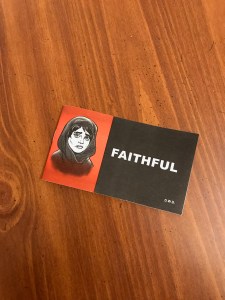
Although the answer to “why” questions will always remain provisional, I have an idea.  It’s kind of creepy, but true.  In my fundamentalist upbringing, I was taught that my life was being taped.  You see, it goes like this: since the book of Hebrews says “And as it is appointed unto men once to die, but after this the judgment,” some Fundies like Jack Chick illustrated this as an outdoor cinema in Heaven.  Or rather, in the clouds just outside Heaven.  Here you’d be summoned, buck naked, as soon as you died.  Other nude souls would gather round the big screen and your entire life would be projected for all to see.  Since everyone’s dead there are apparently no time constraints.  As a kid I realized that I was being watched.  All the time.  Now, I’m not conscious of this constantly, but I did translate it to public appearances.  We’re all, it seems, actors.

With a lifetime of performing experience, by the time I was a teen I wasn’t afraid of public speaking.  Introspection was a big part of my psyche, and when I had a speaking engagement, I knew that I had to be conscious of what I did and said, because people would be watching me.  I learned to play the part.  I did take a college course in public speaking, and even a preaching course offered by the Western Pennsylvania Conference of the United Methodist Church, but both of these were long after I’d begun taking public speaking roles.  I make mistakes, of course, and early on I learned to laugh at them before the audience did.  We were all being taped, after all, and there’s no outtake reel before the pearly gates.  Strange, but true.  If you’re afraid to speak in public just remember—you’re being watched, all the time.


Begetting Fear

Out on the nearby rail trail I use for jogging I often hear it.  Gun fire.  There’s a shooting range—out of sight, and hopefully, out of reach—not far from the path.  The loudness of the discharges, even from this distance, is enough to make you jump, even in mid-stride.  Often as I’m getting my exercise I reflect that fear begets fear.  Many people purchase guns because they are afraid.  Statistics support—although mass shootings must be catching up—that the vast majority of those shot receive their wounds from a family member because there’s a gun in the house.  And that only makes people more afraid.  Fear begets fear.  And a cycle of madness begins.  American exceptionalism convinces us that just because no other developed nation in the world experiences this level of gun violence the solution is to buy more guns and that military assault weapons should be available to the mentally unstable.

As life in Trump’s America erupts into the summer of hate, at least 31 people are dead from mass shootings, and the GOP stands firmly with the perps.  In the United States alone among “developed” nations this level of gun violence is prevalent.  In this country alone do the levels of poverty near the 50% mark while the top 1% give us guns with which to play.  If you elect a hate-filled man, society will become hateful.  Gun violence existed before Trump, of course.  Mass killings have been a problem as long as the Republican Party has been owned by the NRA.  Add racial hatred and people will die.  The GOP wouldn’t recognize an elephant gun if it saw one.

Fear can be treated.  While I’m no specialist, my own form of exposure therapy involves watching horror movies.  What more horror can there be to a society bent on mass murders and an oligarchy that turns a deaf ear?  To some madnesses there may be a method.  The movies I watch are, ironically, coping mechanisms.  In the midst of all this violence, one wonders at the utter lack of moral rectitude on the part of Republicans who loudly bray that gun ownership will make us safe.  Perhaps they hope we’ll become numb, at least on our way to the voting booth.  If we learn to deal with fear it can be subdued.  So I’m out jogging, listening to the rapid fire of guns somewhere out of sight.  And I’m pondering how fear often has the last laugh while the rest of us weep.


Ghouls and Dolls

It was my plan—as if plans ever really work out—to see Annabelle Comes Home on opening weekend.  July got away from me but I finally found my way to the theater yesterday.  My current book, Nightmares with the Bible, deals with demons in cinema.  One of the chapters covers The Conjuring universe, and since this is the sixth film in that diegesis (with one tangentially attached spin-off) watching the movie was as much research as it was fun.  While the demon utilizing the doll Annabelle is clearly the main villain, the film, as in most of the franchise, interjects any number of entities.  Ed and Lorraine Warren, in real life, kept a museum of occult objects in their house.  This room contained items that had figured in their cases—they maintained demons didn’t possess objects, but people—including the doll Annabelle.

The new film maneuvers three girls (Judy, the Warrens’ daughter, her babysitter, and a friend) into the house alone.  One of the girls releases Annabelle from her blessed case, and a nighttime of terror ensues.  The demon behind Annabelle animates several of the haunted objects, so the girls have to deal with many ghoulish threats.  The film knows it is following tropes such as a car breaking down by a cemetery at night, and the idea of a babysitter being attacked by monsters, and at times it gives a slow wink to fans of the genre.  Still, there are plenty of genuinely creepy moments and a few jump startles.  It also shows the clearly demon in its “true form” at the climax of the film.  When it does so, it matches traditional renditions.

Set to become the highest grossing horror series of all time, The Conjuring universe mixes films that claim to be “based on a true story” and others, such as Annabelle Comes Home, that use real settings but without claiming to follow actual events.  What I found engaging about this particular movie was the fact that the youngest girl, Judy Warren, was the one who figured out how to re-capture the demon.  There are holes in the plot, of course, but featuring a young woman not requiring a man’s help to trap a demon is somewhat unusual in a Catholic diegesis.  True, she doesn’t perform an exorcism, but Judy does contain the evil without a priest, or even her father’s direct help.  As this diegesis wends its way into American folklore, moments like this are increasingly important.  Even though there are demons here, the women don’t require men to do the heavy lifting. 


Witch Way from Here?

Häxan is often considered a horror film.  Produced by Benjamin Christensen, it was released in 1922, the same year as Nosferatu, eine Symphonie des Grauens.  Both are silent films and the term “horror movie” didn’t exist that early.  Framed as a documentary of sorts, Häxan deals with witches, or more precisely, with ideas about witches.  Taking a remarkably modern view, it presents how the church led to the persecution of women during the witch hunts.  It had been on my “to see” list for many years before I realized it is now in the public domain and is rather easily found on YouTube for free.  It presents reenactments that are still difficult to watch, although silent films have a difficult time scaring viewers used to CGI verging on virtual reality.

Banned in the United States upon its initial release, the movie dares address that sacred ruminant, the foibles of the church.  Christensen was largely correct in placing the blame for harm inflicted on thousands of innocent people—mostly women—on the zeal of a masculine church.  The prolonged dramatization of the destruction of an entire family based on forced confession and trickery, often by well-fed monks, makes the point clearly.  While modern explanations have recourse to the psychological motivations, often unknown to those whose worldview was ecclesiastical, we still haven’t relinquished the misogyny of the Middle Ages.  Considering that Häxan is nearly a century old itself, there’s cause for embarrassment in a world largely run by technology.  We still tend to ban that which causes us ridicule.  

When tragedies occur, it’s only too natural to blame someone or something for it.  Why the burden of that blame was laid on women by a male hierarchy is sadly only too easy to guess.  Häxan is one of those examples of the way horror can cross over between fact and fiction.  Today it can’t be taken as a documentary with any kind of seriousness, but it maintains an atmosphere of dread that finds it classified as horror before the genre itself began.  Movies about witches continue in the genre up to the present, and most are quite aware of the male culpability behind this particular variety of “monster.”  To test if witch trials continue all we need to do is watch how men in power continue to behave toward women.  It’s almost enough to make us believe hexes are real.


Born Once More

Every once in a while a reader, either here or on other social media, asks me what my religious beliefs are.  The expected answer to such a question is the standard label of a denomination of some sort.  My response, however, is that knowing the group I belong to (and I do) should not effect the way my thoughts are viewed.  With the exception of some groups suspected of mind control, standard religions are generally trusted as being motivated by pure intentions.  Having both attended and taught in seminary settings, and knowing a great number of clergy, however, it becomes clear that denomination is less important than one might think.  In short, I answer this question in the public forum of neither classroom nor blog as I truly believe there’s nothing to be gained by readers/students knowing where I personally seek meaning, denominationally.

It’s no secret that it was once the Episcopal Church.  (I could not have taught at Nashotah House otherwise.)  It was made pretty clear after being at said seminary for many years that the Episcopalians had no official place for me.  Even when I worked a few blocks from the church’s headquarters in New York City I could find no one willing to listen or consider my credentials.  Its Church Publishing branch wouldn’t consider me in their book wing.  Were it not for some former students who still minister to me, it was clear they did not miss me.  So it was with some surprise that I found myself in Nativity Cathedral in Bethlehem on Saturday for their Celtic Mass.  The Cathedral itself is lovely with a négligée of wrought iron tracery for a reredos, appropriate for a city built by steel.  Eight angels with outspread wings stood atop it.  Like most sanctuaries, it was a place of refuge from the busy, noisy street outside.

The reading from Amos 7 stood out to me.  Lectionaries, by definition, take pericopes (selections) out of context.  Amos’ vision of the plumb line is actually part of a series of visions, but here stands alone with the episode of Amaziah trying to send Amos back to Judah.  The prophet responds by saying he’s not a prophet, but just a guy who’s received a message from God.  In ancient times there were prophets paid for their services.  They supported the government positions and governments made sure they were cared for.  The situation hasn’t much changed, at least among conservative religious groups under a Republican administration.  There were other parallels here, but saying too much on them might end up giving too much away.


Bible Misunderstood

Okay, so I wrote a post a couple days ago about evangelicals challenging Trump’s China tariffs because it will raise the price of Bibles.  Little did I know that Miriam Adelson wants a “Book of Trump” added to that very Bible.  Now, heroes are a personal business; to each their own.  Adding someone to the Bible, however, especially when that person has no idea of what Jesus said, is problematic.  Biblical and ecclesiastical scholars know that even if most Christians agreed books simply can’t be added to Scripture.  Many think the Gospel of Thomas should qualify—it may actually be closer to the words of Jesus than some of the canonical gospels and was putatively written by a disciple.  Thomas, however, will never make the cut.  Early bishops and elders in the church set pretty firm limits to the New Testament.  

Some religious traditions, such as Mormonism, have gotten around this impasse by writing entirely new sacred texts.  Loyal Trump followers might indeed fit the description of what used to be called a cult.  Thing is, George W., and George H. W., and even Ronald Reagan were more religious than the incumbent and nobody suggested adding them to the Good Book.  Our world has somehow flipped upside down in the last three years.  All I know is that in the photos of Trump with the most Jesus-like Pope in modern memory the Holy Father wasn’t smiling.  Then again, the Pontiff would likely not autograph Bibles if asked to do so.  Has anyone suggested a book of George Washington?  There’s such a thing as getting carried away.  

The Bible, apart from being the sole recognized authoritative text of the world’s largest organized religion, is an iconic text.  This means that the Bible is recognized as an important book—perhaps even a stand-in for God—without considering what it actually says.  This was a major point behind Holy Horror and it’s essential to understanding American political behavior.  Manipulating Scripture for political ends is generally the most cynical of approaches to the Good Book.  In America you can drive down highways and see the Bible advertised on billboards.  Large segments of an increasingly secular society are still motivated by it.  There was a time when it was believed that such cavalier suggestions as that of Ms. Adelson would constitute blasphemy, or would at least profane the founding book of Christianity.  In the minds of some Trump has clearly become a god.  So it was in Rome before the fall.