Christian Computing

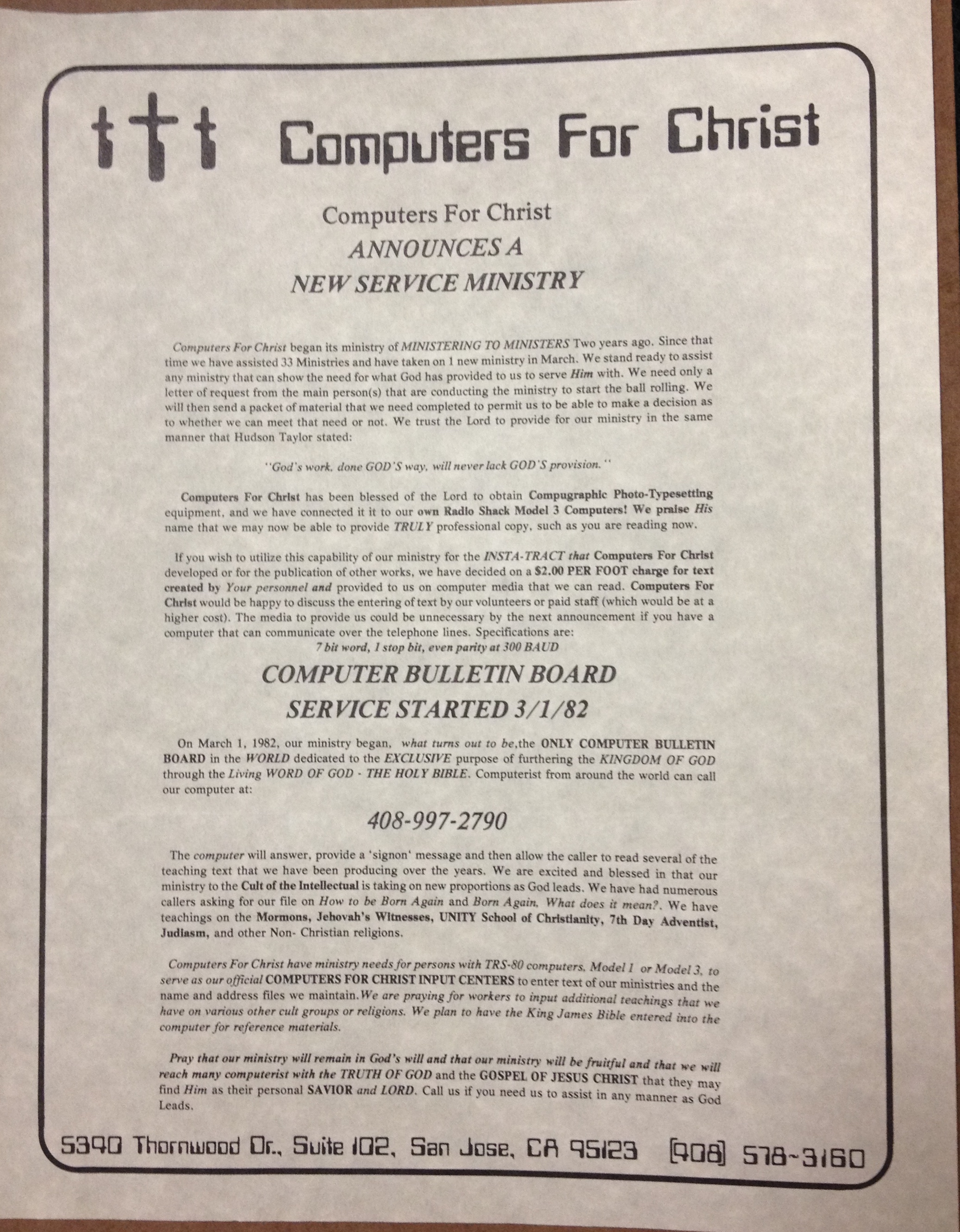
Science and religion are often portrayed as fighting like dogs and cats. Both claim superiority and a comprehensive worldview that should make sense of everything. With reality television probing deep into the lives of rural folk who still hold to the old ways, it is easy to think that religion is awkward and backward and an embarrassment to the technologically sophisticated. In electrons we trust. As with most simplistic views, however, this dichotomy is overly dramatized. I recently found a flier for Computers for Christ. I didn’t have time to read it carefully, but the space-age font immediately told me that this was vintage 70s or 80s, back when computers were still so new that most of us had never seen an actual exemplar and we had to guess what the future might hold. Would these things catch on or not? A little closer reading revealed the date of 1982, back when I was a college freshman. I had, by that point in my life, never knowingly glimpsed a computer.
IMG_1644

Sitting here with a computer on my lap, and another in my pocket, I wondered what ever happened to Computers for Christ with its space-age crosses and early embracement of technology. I didn’t find anything that really matches it with a half-hearted web search, but it did make me realize that some enterprising Evangelicals had latched onto computers long before I ever did. I recall making a pact with a couple of friends my senior year in college that we’d never give in and use computers. Since I can’t find them online, my guess is that they kept their end of the deal. As usual, I caved. By 1985 computers had found their way even to Grove City College. A strange thing called a “server” allowed people to access it via multiple “terminals.” The computer science professor wore a large cross around his neck. I would go on to seminary and graduate with a second degree not ever having used such a device.

Dogs and cats are both mammals, and neither regularly preys upon the other for food. Although Computers for Christ may no longer exist, the internet has been fully exploited by some of the religious. Jesus was an early meme. I remember when “the winking Jesus” was all the rage since an image on screen was actually animated! The savior virtually moved an eyelid! Now we can find Jesus doing everything from walking on water to riding on dinosaurs. The son of God has adapted to life on the web quite well, and often with a sense of humor. There are those who would argue that this is a travesty of true faith. There are others who would argue that it is a silly use of serious technology. I grew up with both dogs and cats and learned that when domesticated together they seldom fight. As I file away this aging paper, I wonder how the world might change if people behaved so sensibly.
Darwin Down the Road

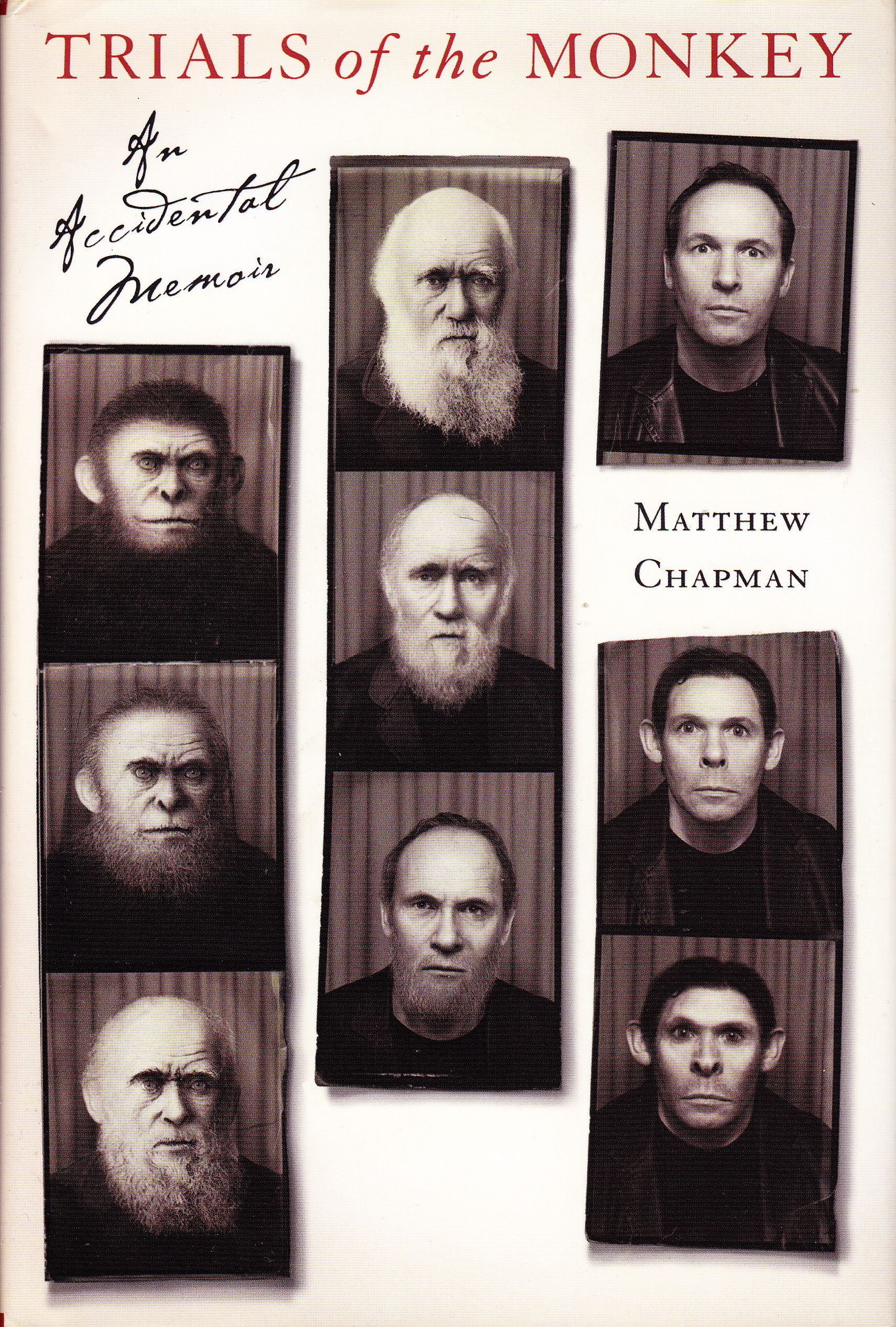
Chapman TrialsThe accidents of birth are the stuff of evolution. When I first heard of Matthew Chapman, direct descendent of Charles Darwin, over a decade ago, I was determined to read his book (then new). Like the accidents of birth, the finding of books at used bookstores is also a kind of evolution, so I picked up Trials of the Monkey: An Accidental Memoir recently and finally read it. Mission accomplished. It had been long enough that I couldn’t recall what the reviews said that made me so eager to read it—I had been developing a course on science and religion at Nashotah House and had been reading about evolution—but I’m glad I got around to it. The book was neither what Chapman nor I had expected. Maybe I’d better explain.

The year 2000, apart from its millennial aspirations, was also the 75th anniversary of the Scopes Monkey Trial. Chapman, a screenwriter from England, decided to go to Dayton, Tennessee to report on the reenactment of the Scopes Trial that was caused, accidentally, by his great-great-grandfather. With acerbic and self-deprecating wit, he narrates how he missed the performance by arriving for the wrong weekend and yet how he’d already begun the book based on it. Instead of reviewing the reenactment, he wove his own life story into those of the people he met on his two trips to Dayton, and left us with an engrossing memoir. Most Europeans, we know, consider American reaction against evolution with some puzzlement. As an Englishman, Chapman shares that curiosity and also, he admits, kind of wanted to make fun of southerners. His encounters, however, forced him to realize just how human all people are.

There’s a healthy dose of exposure to some of the weird ideas of fundamentalism here, but Chapman pulls no punches. The people he met treated him kindly. Some fundamentalists were even likable, even though they could not agree on much. At turns very funny and very sad, this autobiography represents, in its own way, the tensions of any life. The sensual confessions would have made famously squeamish Darwin blush, no doubt, but demonstrate to the reader that a man who can make a lot of money writing movie scripts can be very human as well. And so can the religious. The denizens of Dayton didn’t convince Chapman that their exclusive faith was true. They did, however, open him to the realization that such faith is not as simple as it may seem. A fortnight may have passed since the millennium, but creationism has continued to gain ground. Until more people take Chapman’s cue and actually try to understand those who believe, the trial of the century will continue to go on and on, ever evolving.


Earthbound

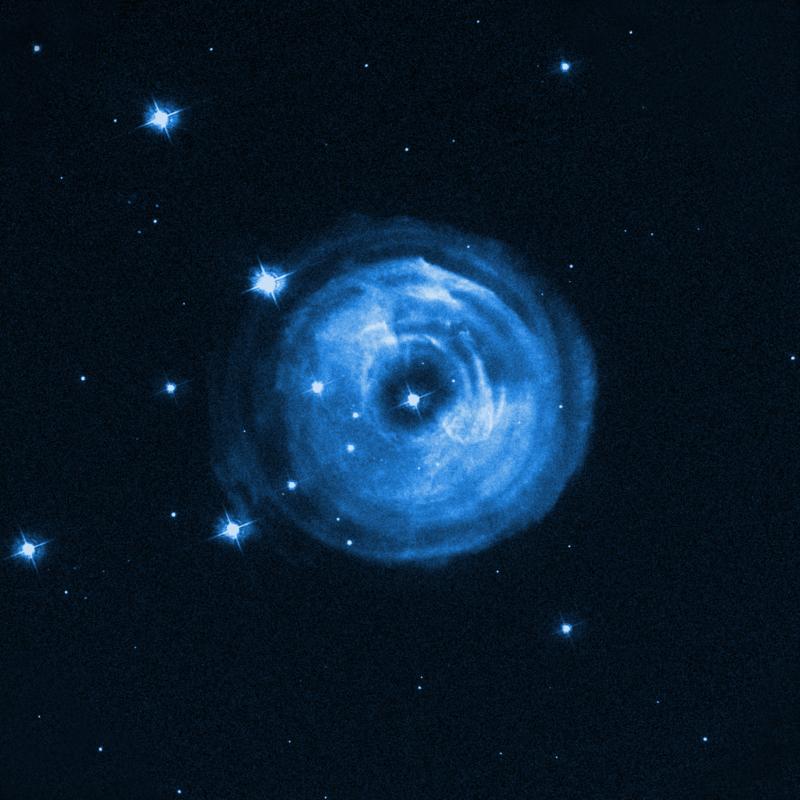
Major news outlets have been raving over Interstellar, the new Christopher Nolan film. I’ve not seen it yet, and it hasn’t had the same kind of hype that Noah received earlier this year. It isn’t, after all, biblical. Still, the reviews for the movie borrow liberally from religious language. One of the obvious reasons is that the vastness, the incomprehensibility—I think I’m safe to say it here—the impossibility of space, almost demand such language. Ironically, it is considered unsophisticated to say similar things of religion, that fall-back for those of weak intellects who, well, believe the impossible. Whether science or religion, we are faced, when we look at interpretations of reality, with something we barely comprehend. Even by conservative measures, on the scale of the universe, we are somewhere around the level of a sub-atomic particle to an earth-sized universe. And yet, with great confidence, indeed, at times arrogance, we claim that we have it all figured out. God? Not possible. Science, less than a millennium old? We’ve got it all figured out. And we haven’t even stepped beyond our own satellite yet.

Having grown up in a rural setting, I was used to seeing stars at night. From a young age astronomy fascinated me. My high school, built during the era around Sputnik, had a working planetarium (and this was not an affluent community). I took astronomy as a junior elective and ran into my teacher at a weekend retreat for lay preachers. A man of science who looked at the universe and came away with wonder. On clear winter nights, away from the light pollution that has become my daily bread here in the orbit of New York City, I would shiver and look upward, knowing that I was reaching both the limits of what the earthbound could see, but also infinity at the same time. The vastness of space still weakens my knees. Even more than my age does naturally.

hs-2003-10-i-large_web

In at least one of the many interviews, Nolan admits to having been influenced by 2001: A Space Odyssey. It was the genesis of the believable space movies, giving Star Wars a jump start and we’ve been exploring deep space in our celluloid fantasies ever since. The constant in all of this is the humility of humanity. “Humility” derives from Latin humilis, literally, “on the ground.” It is no accident when the concept of divinity began to emerge that the human, or perhaps porto-human, gaze was cast upward. The gods, whatever else they might be, weren’t down here with us. They have access to up there. And even a scientist can get away with calling the sky “the heavens.” This journey of Interstellar began long before Kubrick, and we are flocking in numbers to see what the latest rendition might be. Wonder might just be what the doctor calls for on a dark night, when the hope of humanity could use a little humility.


The Wars of the Worlds

Just as it is appropriate for news sources to carry religious stories without ridicule in weekend editions, October is the month when strange things might be reported with a degree of seriousness. I have often noted in the past that “paranormal” (think X-Files) phenomena are closely related to religion. Since our ruling paradigm is one of belittling the intellects of those willing to consider evidence beyond the accepted, news stories featuring the unexplained do so with a generous helping of scorn. I was amazed, then, when my wife sent me a story on the BBC News Magazine from the World Service Sport section. (Which is near enough to paranormal, as sports fail to interest me in the least bit.) A story by Richard Padula is entitled “The day UFOs stopped play.” Near this date in 1954 in Florence, Italy, a soccer game stopped as UFOs appeared above the stadium. Former World Cup players stared upward instead of at the ball. The event was documented and never explained. I kept waiting for the jowl-waggling punchline. It never came. Here was a news story from a reputable source taking something strange at face value.

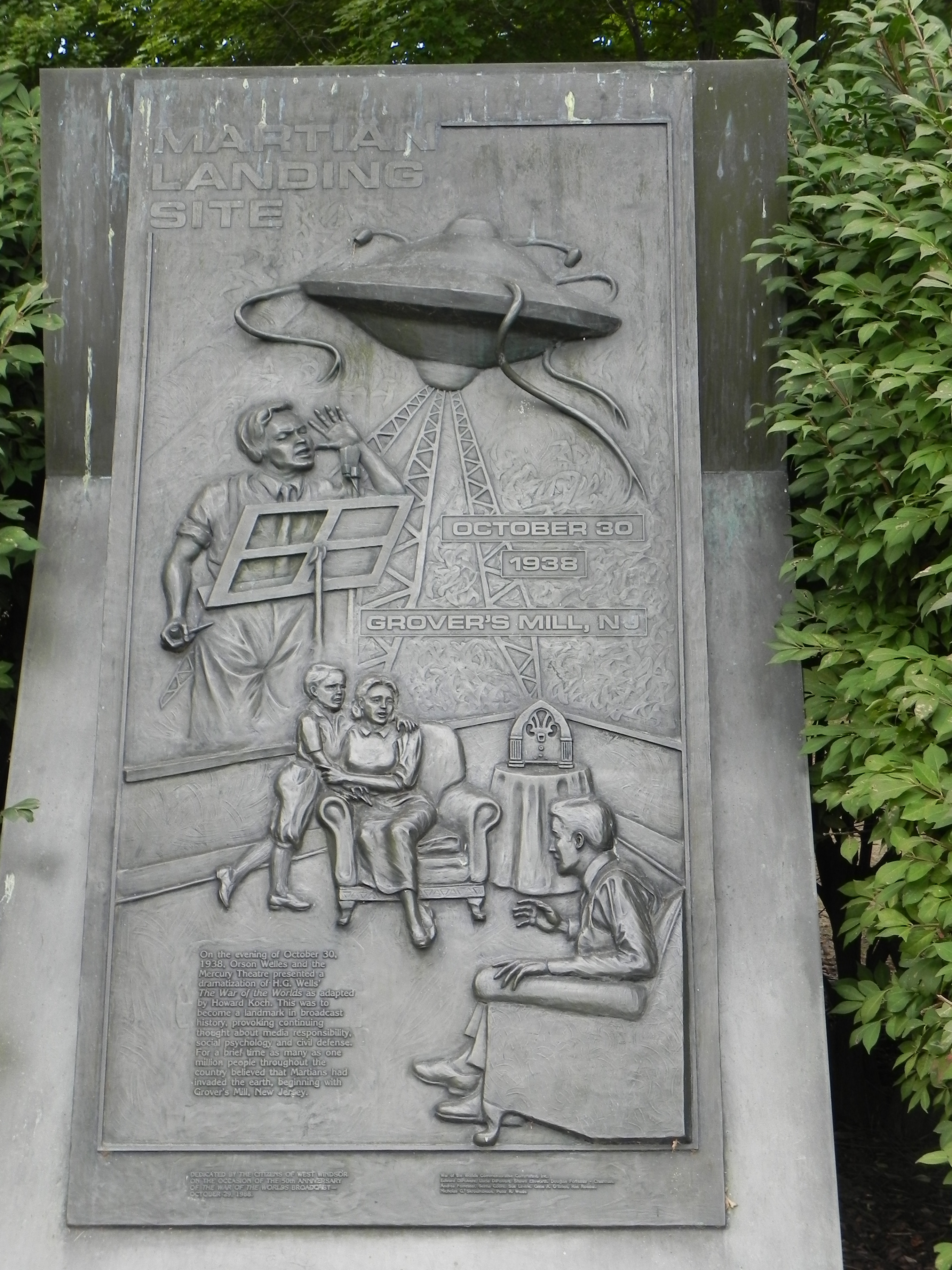
Paranormal activities and religious experiences are in the same category when it comes to a materialistic universe. They can’t exist and so the superior mind must laugh them off, stating they are an illusion, hallucination, or hoax. They still happen, nonetheless. Some world governments are beginning to announce to their citizens that they recognize unexplained arial phenomena exist and—truly astounding for government rulers—they have no explanation. Something weird is going on. It was on Halloween Eve in 1938 that Grover’s Mill, New Jersey, was invaded, according to an Orson Welles radio play. Since the inexplicable panic that came following that broadcast, extraterrestrial visitors have been laughed off the serious news page into the comic section. News stories have never taken it seriously since.

DSCN4237

A sports writer, casting about for an interesting story, might well focus on an event of such Fortean dimensions. Some highly respected people present at that game were interviewed with utter seriousness and traces of physical evidence were even gathered. A substance whimsically called “angel hair” was found all over the city, and despite the chemical signature, was declared to be the webs of a massive spider invasion (who needs aliens to be scared?) by many scientists who didn’t witness it. Laugh and the world laughs with you. The BBC doesn’t seem to be laughing in this story. Tomorrow is Halloween, when many improbable things seem possible, if only for a short time. Weather balloons, swamp gas, and Venus notwithstanding, sometimes people of normal intellect turn their eyes to the sky and wonder.


Non-Fiction Steampunk

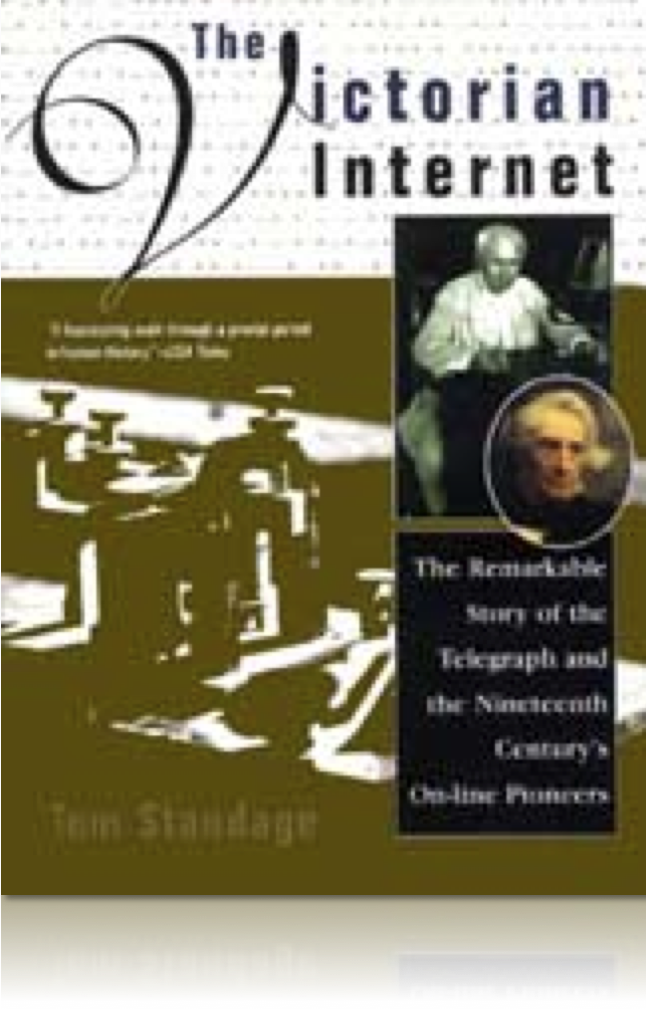
TheVictorianInternetThe histories of Tom Standage approach familiar things from unfamiliar angles. Being interested in Steampunk, and a daily user of the internet who has trouble recalling what life was like before then, I found The Victorian Internet fascinating. Subtitled The Remarkable Story of the Telegraph and the Nineteenth Century’s On-line Pioneers, the story of the wiring of the world did resonate in any almost eerie way to the early days of the world-wide web. Despite my disclaimer, I do recall those days clearly when the only way someone could get in touch with you immediately was the telephone, and you had to be at home for it to work. Prior to the telegraph, news traveled even slower and you could go months without hearing from those closest to you, if they happened to be away. Samuel F. B. Morse knew that first-hand, as Standage tells it. His wife died while he was out of town, and although he rushed back right away upon hearing, she had been buried before he reached her. Such was life when news arrived only by letter. Morse was among those who invented the telegraph, a device that made the world realize that yes, it was possible to send information to distant places almost instantly. It soon become a wired world.

Standage is also more circumspect than some writers who declare, with breathless awe, that some new device will cure the world’s ills. Showing how the telegraph generated much the same hyperbole as the internet (that peace would reign now that people could communicate instantly, that technology had brought a miraculous rapprochement, etc.) he notes that people remained people. Wars continued—intensified, in fact, into World War One where technology was devoted to destruction. People had always been able to kill each other. Now they could do it faster, and in more hideous ways. Still, there’s no denying that once the idea of instant communication caught on that we would continue to develop it rapidly. You never need be away from a network that covers much of the developed world and you can talk on your phone from deep under the Hudson River to the top of the Empire State Building. You can order a pizza from anywhere.

Ironically, Morse dedicated part of his earnings to endow a lectureship concerning how science related to the Bible. It was clear that technology had achieved the impossible (okay, well, the improbable) and yet, Victorian society still relied on the truths contained in Scripture. The telegraph, which began with the words, “What hath God wrought,” ended with the attempt to figure out how the Bible fit into all this. Just because humans had crossed the great barriers of oceans with electric cables didn’t mean the Almighty was out of a job. Even today God can be found on the internet. Along with many other choices of distraction and business. God is not so much dead as commodified. The difference between Morse’s day and ours was that then they knew that the Bible impacted daily life. It continues to do so today, but we’ve become too sophisticated to give it much of a nod. We might be well served, however, to look back once in a while as well as to look forward. We might be surprised at how little things have changed.


How God Became Male

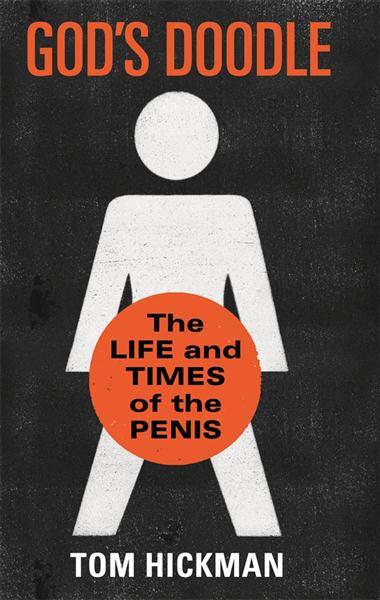
GodsDoodleWhat is gender? Okay, we all know about the mechanics of the thing, but gender is more than just sex. Indeed, it is a psycho-social construct that is difficult to pin down. Sexual reproduction is very common in nature, but we don’t really speak of gender among our fellow animals. Perhaps the decisive factor, in the human realm, is religion. Clearly religion is not the only element, but I often wonder if gender-based commandments didn’t lead many cultures into their current arrangements. The thought occurred to me as I read Tom Hickman’s God’s Doodle: The Life and Times of the Penis. As I informed students in my classes, religion has always shown an interest in sexuality, particularly on providing limitations for it. A recent issue of Christian Century has a cover story about marriage, noting that the widespread prohibitions about homosexual matrimony come from a religion that forbids it. When your stakes are eternal, many people won’t argue.

But I wonder if it goes deeper than that. Gender roles have traditionally been regulated by societies, often on the basis of their religious outlook. Meanwhile, biology, as Hickman reminds his readers, is somewhat more ambiguous. The line between the genders is somewhat of a line in the sand, easily erased. Humans come in a continuum of orientations and biological equipage. Those who don’t match the defined parameters have difficult questions to ponder with a male deity who could think of only two genders. What is a male without a female? Can a male deity exist without a goddess? What, otherwise, is the purpose of a deity’s gender? Wouldn’t a inter-sexual creator may more sense?

Male social behavior has often drawn its entitlement from a bad theology. When feminists first began to raise questions, the orthodox were quick to point out that Jesus was clearly male. As Hickman notes, however, representing him naked on the cross (as crucifixions were historically done) is still rare. Sounds like an effort at keeping the status quo tipped in the favor of one gender that doesn’t want to admit that it slowly morphs into another. We all begin life female, as biologists now understand. Some retain their original gender while males evolve into something different. And with that evolution they tend to make many unsubstantiated claims about the right to make decisions for the other half of the human race. Gender is a lot more complex than many religions would have us believe. Until we learn to treat all people as people, we will still have to ask, and will never adequately answer, how God became male.


Empire State

Hegemony is a funny word. In studies of antiquity it is commonly found since it denotes the “Leadership or dominance, especially by one country or social group over others,” according to the Oxford English Dictionary. Today it has a vaguely imperialist taint, although it doesn’t necessarily require that one nation actually pillage another’s wealth or resources. The idea that people are, and should be, free is pretty much assumed in developed nations. Or so at least our rhetoric dictates. The word hegemony came to mind, however, as I saw an interview with a corporate leader. He was discussing how his company had budgeted for technology development on an increasing scale, to catch up with current developments, and then leveled the tech expenses off after that so that the business could move into its prime objectives. The reality was vastly different, however. Each year’s budget saw increasing technology costs and it shows no signs of slowing down. Every industry, it seems, will have to keep devoting larger and larger shares of its budget to technology. Hegemony.

It’s not that any one company is solely responsible for our obeisance to technology, so this hegemony has no head. It is the idea of progress gone wild. Last year as I set out for the American Academy of Religion and Society of Biblical Literature annual meeting, a notice popped up on my laptop that a software upgrade was available. Since I file that I required was no longer accessible unless I updated, I clicked through all the agreements and provisos that I can’t understand and began the upgrade. Download and installation time measured in hours rather than minutes and I soon had to interrupt the process to get to the conference. This had consequences that nearly led me to becoming utterly lost in a part of Baltimore I’d been warned to avoid. The gods of technology demand their due. Now, less than a year later, I can’t access certain files unless I upgrade again.

Don’t get me wrong—I’m not a complete Luddite. I enjoy the instant gratification of finding information in seconds through a web search, but I’m not always sure that I can believe what I read. Technology means photos can be manipulated, sounds can be fabricated, facts can be created, all with no basis in reality. I used to have students ask me if such-and-such a fact they’d read online was true. Facts, it appears, are now negotiable. Nobody’s really in charge, it seems. Instead we are lead by the vague idea of progress, a new god with technology as its prophet. Even now I know people who think they never use computers but they drive without realizing their car is full of them, and turn on the television not realizing that the tech is no longer chip-free. Meanwhile those in the technology industry seem to have plenty of extra cash around, while those of us in the humanities ponder whether the ancient hegemonies have really changed at all. Let me look that up on the internet, once this upgrade is through.

600px-Astronaut-EVA


Know It All

Perhaps it’s the fact that I had a career malfunction in the middle of my chosen vocation, or perhaps it’s a natural consequence of earning an advanced degree. Whatever the cause, I am convinced that I know less than I used to know. That’s not the same as not having learned—indeed, it is a consequence of precisely that. You see, my education has led me to believe that things I thought I knew were not, in fact what I knew them to be. We all live with false assumptions—the sun rises and sets, the earth holds still, and that we aren’t made up of particles so tiny as to be invisible and that are mostly empty space. There was a time when I believed that science gave “the truth,” but we now think of science as ever provisional—the best theory to account for the facts at this time. It is open to change. And in fact, we know very little.

A deep irony lurks in the fact that many people treat their religion as the locus of certain knowledge. This is a known fact; Jesus resurrected, Muhammad was a prophet, Maroni spoke to Joseph Smith. When confronted with contrary data, such thinking withdraws into itself claiming all the more loudly that it knows the truth already. Learning should, I think, may one more humble. More circumspect. Of course I think I’m right about things. If I thought I was wrong, I would change to the correct way of thinking. What I know, however, is a different matter. As I set out to learn a new career, I find I know less than I thought I did. I know little and I know less all the time.

As an academic I can’t help but to spend my life trying to gain knowledge. I read voraciously, I try to engage in intellectual exchange with others. If I’m lucky, I learn something. And know that much less. That which I learn teaches me that I know less than I did before. The world is vast. The universe infinite, according to our best understanding at the moment. We travel through it all, picking up information and treating it humbly as we go along. I’m moving toward knowing nothing at all. Perhaps that is the true goal of all of this—to get to the point of knowing nothing. Then we shall be truly educated. Except, of course, for the true believers who already know everything there is to know. Of course we are all mostly empty space. I think.

DSCN4907


Monsters of Science

ScienceOfMonstersMaybe it’s the ebola in the air, or perhaps the gas from all the midterm elections verbiage, but I’ve been on a monster run this October. I just finished Matt Kaplan’s The Science of Monsters: The Origins of the Creatures We Love to Fear. It is a charmingly written book, at parts approaching the finesse of Mary Roach. Beginning with the ancient Greeks (and sometimes stepping back into the world of the Bible or the Mesopotamians) Kaplan examines the major categories of monsters and tries to offer scientific explanations for why people came up with them. It is a keen conceit and it is deftly handled. Noting that animals sometimes got jumbled in the fossilization process, he offers explanations for creatures such as the Chimera, Griffon, and perhaps even the Sphinx. Some of the unlikely episodes are quite fun to visualize as well, as when a snake slithers over a tar pit where a goat got stuck and was eaten by a lion that also got stuck. Beast after hideous beast he brings down to analytical size, sometimes convincing even this old monster lover.

One of the problems, however, is that science often doesn’t comprehend the symbolic nature of mythical thought. Quite apart from sheer creativity—and it does exist!—some of the material in Kaplan’s analysis would have benefited from having a mythographer’s look. For example, demons do not suddenly appear as monsters in the Middle Ages. Kaplan knows this, but that’s where he starts. The ancient Mesopotamians knew of them very, perhaps, too, well. And Lilith isn’t even mentioned when discussing succubi. Still, there’s a great deal of interesting conjecture here, and some scientifically, if not mythographically, viable suggestions on whence vampires and werewolves. As expected, modern sightings of cryptids are simply swept off the table, but I almost shouted aloud when I read that he gave credence to Wade Davis’s work on Haitian zombies.

The larger question here is one of approach. Do monsters lend themselves to scientific explanations at all? The case that elephant/mammoth skulls might suggest a cyclops seems reasonable enough, and the occasional dinosaur bone that represented a giant in ancient times is entirely possible. (Who can tell one femur from another anyway?) But the monster is primarily a creature inhabiting the shadowy realms of religion and psychology. Our fears are seldom directed toward science, although, now that I’ve read his chapter on “The Created” I’m not so sure. Constructing backward toward the unknown is always a dicey proposition, as those of us who’ve studied history of religions know. We may be able to find the genesis of modern monsters, but, admittedly, the fun for most of our scary friends is that they are mysterious. Impervious, as it were, even to science.


Literally Biology

In a New York Times opinion piece on a recent Sunday (ironically, always on a Sunday), college biology professor David P. Barash submitted an article entitled “God, Darwin and My College Biology Class.” Barash notes that increasingly students come to his class thinking evolution is more or less optional. I found the same thing teaching religion classes. When student presentations at state universities addressed Genesis it was fairly common to have a large number of undergraduates suggesting that evolution is “just a theory” and “intelligent” design was a viable option. I tried to show them in class that the Bible does not support the shenanigans that creationists impose upon it, but the message rolled off like rain from an evolved waterfowl. Still, I do have to take exception to some of Barash’s broad strokes. He feels that religion and science cannot coexist. I wonder, however, what he means by religion.

Religion is an ill-defined word. One of the most pragmatic usages I’ve heard is that religion is what people use to give meaning to their lives. Religions may be theistic or a. Religions may be anti-science or pro. Religion, per se, is no threat to science. Fundamentalism is not religion. Fundamentalists use religion to further their ends, which are often political. Since many religions grew up around sacred writings the urge was there from the beginning to take these holy words literally. They gave meaning in a pre-scientific era. Newton, Galileo, Darwin—and even before them Plato and Aristotle—simply shifted the angle of illumination. The problem is that many religious believers feel they have the answers already. New facts only confuse the issue. Left to their own devices such beliefs quietly go extinct.

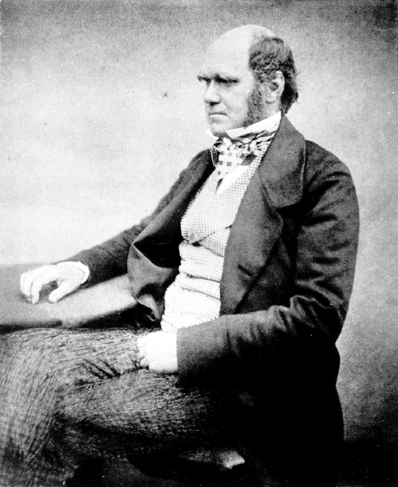
Charles_Darwin_aged_51

It is only when a conscious decision is made to champion archaic writ against empirical evidence that science and religion join combat. Most religious people in scientifically advanced societies have no problems with evolution or particle physics. They simply show the way the world is. The vastness of the universe should give us all pause, but it does make you wonder which way to point your telescope to spy the almighty. I sympathize with Barash. It is not easy to find many of your students, in either science or religion classes, with their minds already made up. Still, it might help to realize that religion is not the culprit here. Literalism is a kind of mental problem. Until it is rightfully separated from religion we will all be left wasting valuable class time trying to convince students of the facts of life.


See Serpent

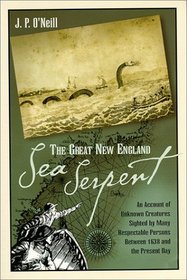
GreatNewEnglandSeaSerpentSeeing, it is said, is believing. I have a feeling that this truism may have become effaced somewhat in this age of deft photo manipulation and apps that are marketed to insert ghosts and UFOs into any picture. Nevertheless, anyone who has seen anything genuinely puzzling knows that it creates a lasting impression. A world without mystery, although a capitalist’s dream, is a nightmare for everyone else. So it was, now that October is here, I settled down with J. P. O’Neill’s The Great New England Sea Serpent. I found O’Neill’s book in a used bookstore a few weekends ago (appropriately water-damaged), and since I have a fascination with the ocean and monsters, this seemed like it would appeal to both of my avocations. It did indeed. O’Neill isn’t a sensationalist writer, but rather she is a normal person with normal jobs who has an interest in strange animals. Beginning in 1751 and up to three-quarters through the twentieth century, people had been spotting a classical sea serpent along the New England coast, and occasionally on ocean voyages across the Atlantic. Of course, we’re told, sea serpents don’t exist.

The Great New England Sea Serpent is a compendium of sightings from many reliable witnesses over the centuries. Of course, to many it is impossible. To me this appears to be the same kind of arrogance we apply to the universe—if we haven’t catalogued it by now, it doesn’t exist—to suggest there are no monsters of the deep. As any oceanographer will tell you, we know more about the surface of the moon than we do about our own oceans. If you turn your globe (or app) just right, there are views of our planet where virtually no land is visible. We are a watery planet. Even with current technology, the deep ocean is difficult, and very expensive, to explore. Who knows what might be lurking there right off the bow? O’Neill’s account is full of old salts and snarky journalists, but at the core of it all is a humility in the face of the largeness of the sea. What do we really know?

Of course, there is a fear of literalism. The Bible (and other ancient texts) take sea monsters for granted. Leviathan is a dangerous beast and, no matter what the pundits say, is no crocodile. And yet, for the past several decades the reports of the New England beast have dried up. Where has our beloved sea serpent gone? I have to wonder with both our polluting our oceans and our increasingly efficient (and massive) ships, if we haven’t simply forgotten that ancient maps used to leave space for dragons. Our great ships, guided by GPS, and our oceans running a temperature, are sure signs that greed has surpassed wonder. Have we, in our self-centeredness, slain the last of our dragons? O’Neill, please understand, does not call them dragons. Hers is a sober and straightforward account. But when October comes I just can’t help but hope there are still some monsters out there, deep under the waves.


Growing Up

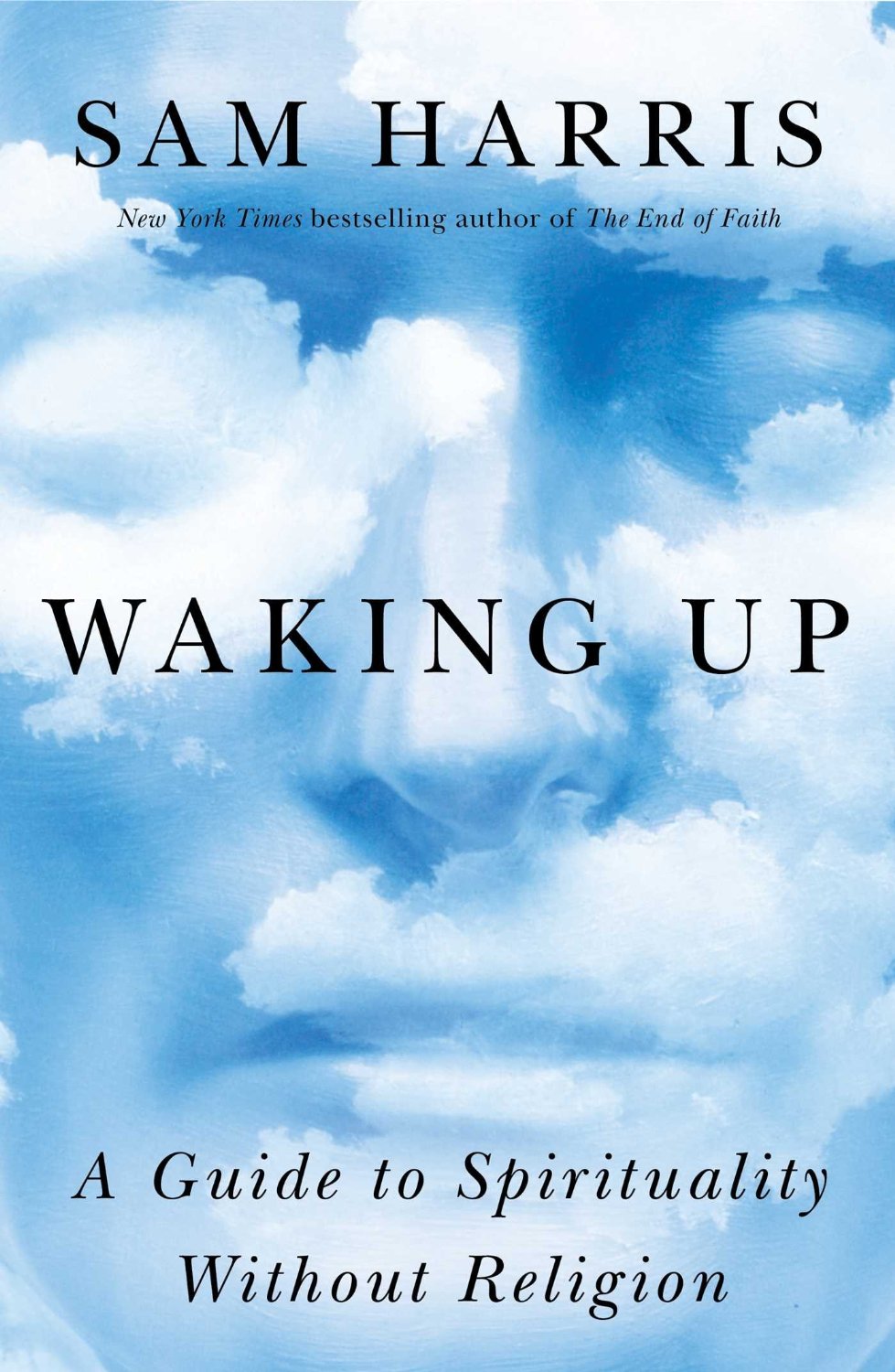
WakingUpI am in two minds about Sam Harris’s Waking Up. Literally. I haven’t read Harris since The End of Faith, and I have to admit that I found Waking Up to be a very engaging book. I can’t agree with everything Harris writes—that’s an occupational hazard of acquiring advanced degrees—but to have a scientist, an atheist no less, praise spirituality felt incredibly genuine. Spiritual experiences happen. I’ve had a few doozies over the years. I’ve also read a number of scientists who tell me they’re all an illusion. Harris admits that consciousness is a mystery. His use of “mind” instead of “brain” won me over from the beginning. I discovered that the atheist can also be a seeker. Dogmatism, of whatever stripe, is the enemy.

Harris has considerable experience meditating. This is no activity for posers or wimps. It is, despite minimal physical demands, hard work. Throughout the book we get the sense that Buddhism is among the least objectionable religions, when divested of its myths. I do wonder, however, if demythologized Christianity was ever given a fair chance. From my own experience, some of the selflessness advocated by Harris can be found in taking aspects of Christianity seriously. I understand, I think, Harris’s objections to religion. It can, and does, lead to horrors both obvious and subtle. Yet, every once in a perhaps great while, it does offer redemption. Meditation, for example, has its roots in religious practice. It is this that Harris calls spirituality. And it is good.

A Guide to Spirituality without Religion is an apt subtitle for this brutally honest and open book. Harris’s knowledge as a neuroscientist endows his ideas with great authority. He opines, and he is not alone, that meditation demonstrates that “I” is only an illusion. This loss of self will haunt me for some time. For decades I is all I seem to have. Still, I am pleased to find an open-minded scientist on this same path I tread. Raised to be both spiritual and religious set the trajectory of my otherwise logic-driven life. You can’t go back and change all that, but you can grow up. To read of Harris’s spiritual experiences in the geography of great spiritual masters as well as in the laboratory instill in this reader a profound hope. Whether or not this reader is merely an illusion. There may be morning after this long night, after all.


Cuneiform Lover

I’m busy. Too busy most of the time. You see, I used to be able to keep my mental files neatly in order. Recall was swift and efficient. I suppose that was back when I was doing the job for which I’d been preparing my entire life. Then a midlife, unexpected career change shifted things a bit. That mental file that you always kept here has now been shunted over to there. I suppose I always knew this was coming, and that’s why I started writing things down. Of course, this led to stacks of papers and a whole series of notebooks that follow varying forms of logic. “Commonplace books” as they used to be called. Then computers. I never used a computer until after my master’s degree. My wife showed me how. And then writing ideas down became pretty easy—who could ever afford more than one personal computer? And since they were as heavy as a small television (cathode-ray tube variety, of course), you always knew where you’d find it. Then laptops. iPads. iPhones. Something called “the Cloud.” A computer on my person at all times and I still can’t find that ruddy file, and has anybody seen my phone?

I wrote an important (for me) paper back in 2012. Just two years ago. I remembered vividly typing it on my laptop, working on it for weeks. Recently I wondered where I put it. I searched my laptop. Not there. I must have backed it up. Checked my backup files, on CD. Not there. Where did I put the thing? Although a Luddite at heart, I don’t delete old files. Please, tell me I didn’t do something like back it up on a floppy disk! I can barely remember when we used those. No, no, it was much more recent than that. Was it on this laptop or the one before? Maybe I stored it on the hard disk of the antiquated one. When you get a new computer (or at least when I do) it is such a rare occasion that you don’t bother backing up every single little loose file on your old machine—there’s too much shiny new stuff to admire. But the file wasn’t there. Finally I attached a terabyte backup, admittedly overkill for someone of my limited mental ability, and searched. Although the icon said it was on the terabyte drive, the file was actually on the Cloud, and since I hadn’t updated my software in a while, I was denied access.

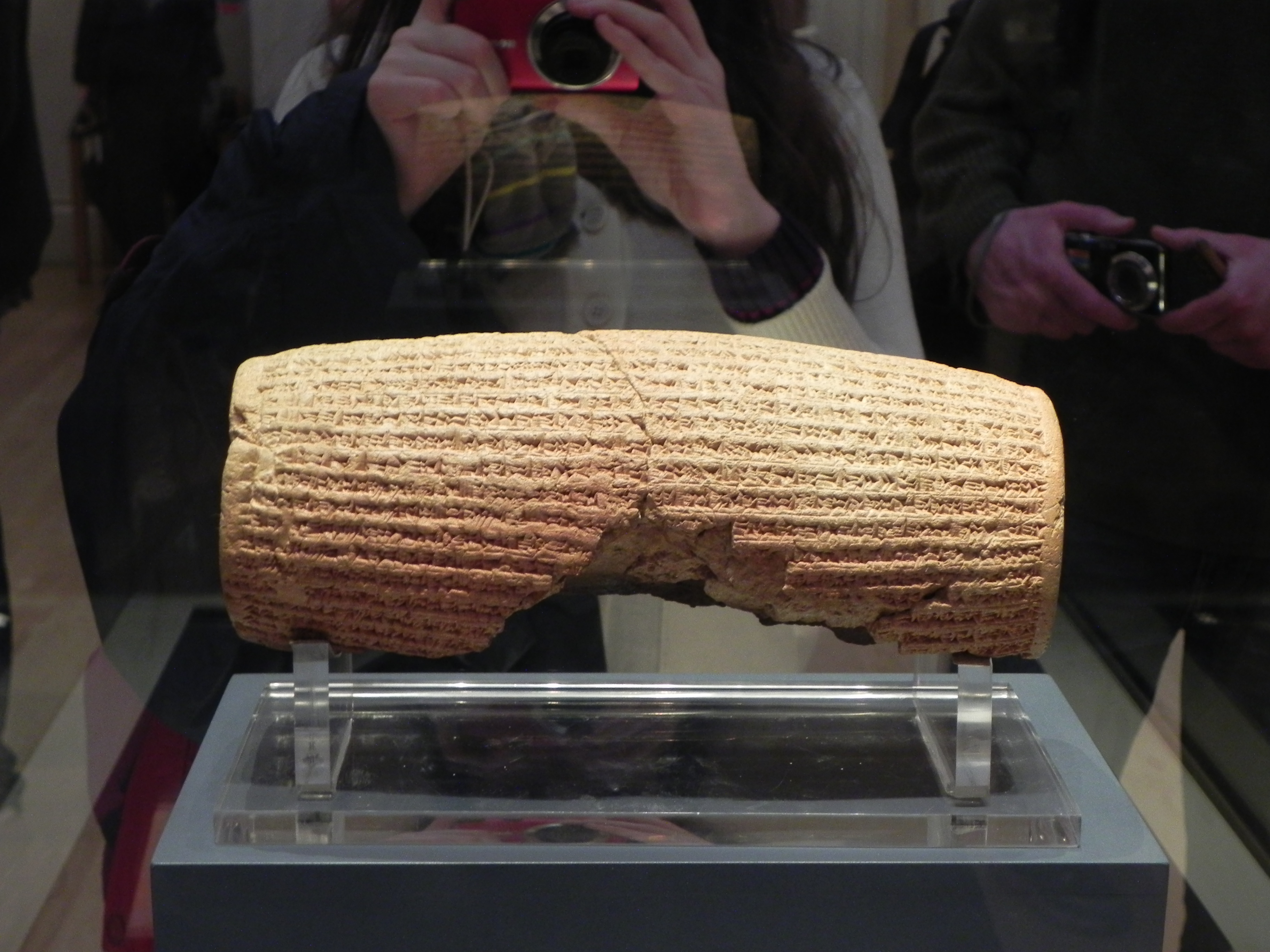
I learned to write with fallible pencil on cheap, lined tablet paper. Back when tablets were paper. Our ancient ancestors started the process by writing on clay. For some five thousand years this pressing stylus unto substrate method worked fine. All of scared writ was scrivener-mediated that way. When computers were new you stored your files on floppies. At least you knew where they were. Now dialogue boxes ask me questions in a language more obscure than Sumerian and quickly shuttle my files off to I-don’t-know-where, assuring me that I’ll be able to get them back. Honestly. As long as I remember to upgrade my system, which will, of course, require periodic outlays of substantial sums of money. You can choose not to pay, but your documents are with us. I’ve still got some clay here, and a sharpened flint taken to a twig will make a stylus, old school. And clay tablets have been known to last for millennia.

DSCN1816


Fighting with Monsters

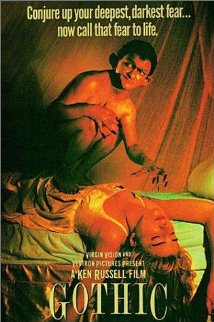
GothicThe Lady and Her Monsters reminded me of Gothic. A friend of mine in seminary showed me this “shocking” movie by Ken Russell just after it was released on VHS (I always was fond of ancient history). To my young eyes this was a challenging film, but it rated higher in moodiness than scariness. Roseanne Montillo’s book brought the movie to mind because, it turns out, several of the incidents in the movie were based on fact. Perhaps I need to take a step back because Gothic never made it big, and many may not realize that the movie is about the legendary night Mary Godwin (soon to be Shelley) came up with the idea for Frankenstein. In an early nineteenth-century walk of fame, Percy Shelley, Mary Godwin, Lord Byron, and John Polidori decided to write scary stories, as a kind of contest. Only two ever made it to print, Polidori’s The Vampyre, which inspired Bram Stoker’s Dracula many decades later, and Mary Shelley’s Frankenstein. The movie, with Ken Russell’s famous flamboyance, traced an unlikely story of the friends conjuring a ghost and then banishing it once again before the stormy night is over.

Ken Russell had the reputation for being obsessed with the church and sexuality. These interests are certainly well represented in Gothic, where Percy Shelley, famously an atheist and believer in the supernatural, struggles to make sense of it all. Polidori, Byron’s personal physician, is presented as a Catholic who admits, when each has to confess his or her deepest fears, that God terrifies him. The friends (perhaps in an unwitting prelude to a television series by that name) explore sexuality and the supernatural through the long night. Waking nightmares meet them at every turn. They even have a skull of “the black monk,” a character attested in all sincerity, at one time, at the most gothic seminary in the Wisconsin woods.

“He who fights with monsters,” Friedrich Nietzsche opined, “might take care lest he thereby become a monster. And if you gaze long enough into an abyss, the abyss gazes also into you.” That which we worship is that which we fear. Certainly the Christianity of the Middle Ages had as much of Hell as of Heaven in it. Bursting out into the light of rationalism, it seems, did not banish the darkness after all. We still have many questions left unanswered, and many intelligent people have begun to question whether any one paradigm fits all of the evidence. I suspect not. Human experience goes in multiple directions at once. We have ladies, we have monsters, we have scientists, we have God. And on rainy nights we have movies that make us see that we have combined them all into a tale often repeated but never fully understood.


Dark and Stormy Night

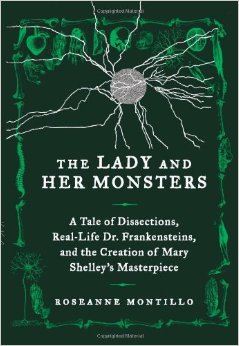
LadyAndHerMonstersI miss my monsters, especially when I stay away too long. I had eyeballed Roseanne Montillo’s The Lady and Her Monsters: A Tale of Dissections, Real-Life Dr. Frankensteins, and the Creation of Mary Shelley’s Masterpiece nearly a year ago in a busy Port Authority bookshop, and wanted to curl up with it right away. Well, work and the world intervened, but finally I found time for the beast. Although a member of the monster kid generation, as a child I never felt much kinship with Frankenstein’s creation. I think it is because there was so much human intention involved in his origins. Almost ungodly. Too godly. Vampires and werewolves, and even mummies, seemed to have come up on the wrong side of a curse and couldn’t be blamed for being what they were. Frankenstein’s monster had a willful, if neglectful, creator. A human being, and fully so. There was, it seemed, some kind of blasphemy at work here.

Montillo’s book, however, gives me pause to rethink this. I had never realized, foe example, that Shelley’s book unfolds over nine months, and that Mary Godwin Shelley had suffered as her own fate unfolded—or unraveled—after Percy Shelley’s death. Nor had I stopped to consider that in the lifetime of these young lovers scientists and poets were overlapping careers with philosophy holding them together. I also hadn’t realized that Percy Shelley also shared his beau’s enchantment with the fantastic. But Montillo gives us so much more, wandering through the seedy world of body-snatchers and scientists who experimented on the dead, often with an eye toward a secular resurrection.

Frankenstein’s monster has, of course, become an instantly recognizable fixture in our society. Indeed, it is almost the definition of monstrosity: the ultimate mischwesen while being technically only one species. A creature that crosses boundaries and is both dead and alive, a miracle and a curse, innocent and evil. Morillo places this creature in the context of a world where galvanism was thought to bring life and medical schools scrambled to find corpses to dissect and on which to experiment. A world where the Shelleys would visit Lord Byron and Polidori, literally on a stormy night, and give the world both Frankenstein and the prototype of Dracula. Where the three men of that night all died prematurely and tragically, survived by a struggling Mary who lived only to fifty-three and who gave the world one of its most memorable nightmares. Horror fiction was, and is, considered lowbrow entertainment, but there is something profound here. And we are richer, if more unsettled, for having it.