Blogday

Sects and Violence in the Ancient World is nine years old today.  Not that I’m keeping count.  Really, I’m not.  WordPress sent me a notice, and they ought to know, being the virtual womb whence my thoughts gestate.  The original plan for this blog was to take my abiding interest in the religions of antiquity and give them a more public face.  My brother-in-law, Neal Stephenson, thought I should do podcasts, because, at the time I spoke incessantly about ancient deities.  I can still hold forth about Asherah at great length, but ancient Near Eastern studies is, believe it or not, an evolving field.  You need access to a university library, or at least JSTOR, and a whole sabbatical’s worth of time to keep up with it.  Even though telecommuting, I’m a nine-to-five guy now, and my research involves mostly reading books.

So Sects and Violence began to evolve.  I realized after teaching biblical studies for over a decade-and-a-half that my real interest was in how the Bible was understood in culture.  Having a doctorate from a world-class university in the origins of the Good Book certainly should add credibility.  My own journey down that pathway began because of interpretations of Scripture that were strongly cultural in origin.  I first began reading with Dick and Jane but quickly moved on to Holy Writ.  It has shaped my life since before I was ten.  It’s only natural I should be curious.

Like most tweens, I discovered sects.  Why did so many people believe so many different things?  And many of them call themselves Christians.  And the Christians I knew said the others weren’t Christian at all.  And so the conversations went, excluding others left, right, and center.  As someone who wanted answers, this fascinated me.  The Bible was the basis for many belief systems of sects everywhere.  From Haiti to Ruby Ridge.  From New York City to Easter Island.  From Tierra del Fuego to Seoul.  And not just one Bible, but many scriptures.  And these beliefs led to behavior that could be called “strange” were it not so thoroughly pervasive.  Scientists and economists say we’ve outlived the need for religion.  By far the vast majority of people in the world disagree.  I couldn’t have articulated it that way nine years ago, but since losing my teaching platform, I’ve been giving away for free what over four decades of dedicated study—with bona fides, no less!—has revealed.  Happy blogday to Sects and Violence in the Ancient World.


Rewriting Dictionaries

When this is all over we’re going to need a whole lot of new definitions.  As news became public of the US government literally ripping crying children from their mothers’ arms and keeping them in cages, with the full blessing of the Republican Party, blame began to fly.  The liar-in-chief said it was the Democrats’ fault (of course), although they were the ones advocating for immigrants.  So he signed an executive order to stop what he started and proclaim himself a hero for doing so.  The images were so outrageous that even Evangelicals seem to have been shaken from their lotus-induced adoration of Trump to limply and lately raise a hand in protest.  Almost forgotten is the fact that in November of 2016, and even before, many were saying this was an Orwellian candidate.  We were warned that this would happen.  We walked into this with our eyes wide open.

Fox News, however, prefers to broadcast with its eyes shut.  A charming young man named Adolf can look appealing if you pardon the saliva dripping from his lips and the hatred in his eyes.  All you have to do is say “America” loud enough and long enough and the mindless will agree to just about anything.  This nation was founded on the abuse of children, after all.  That’s how you show you’re a big, strong, man, right?  That and carry your gun out in public where everyone can see it.  I can’t help but think overweening masculinity is the heart of the problem.

Another part is unclear definitions.  “Pertaining to or in keeping with the gospel and its teachings” is how Dictionary.com defines “evangelical.”  Problem is, there’s no part of the gospel that justifies the Grand Old Party.  I seem to recall Jesus saying something about “Let the children come to me, forbid them not.”  Or something like that.  And, oh yeah, “for such are the kingdom of Heaven.”  The Republican Heaven is starting to look a lot more like Purgatory to me.  The only difference is that Purgatory is intended to prepare the soul for Heaven.  Besides, what has any of that to do with Evangelicals—whoever they are?  They’re certainly not Catholic.  Unless Catholics support Trump and then they can be Evangelicals too.  Anyone’s allowed to join as long as their skin isn’t too dark.  This is a world where a police officer can become a prophet and a heart a spade.  As long as we can keep the brand everything will be just fine.


Moving Plans

I’m moving. I’m seriously considering Enceladus. Oh, you haven’t been? One of Saturn’s icy moons, Enceladus was discovered to have the basic elements of life as Cassini plunged to its death in Saturn’s shroud. But why Enceladus? I want to make space great again. You see, in my native country all sense of fair play has fled one of the political parties, of which there are unfortunately only two. There haven’t within my lifetime and many decades before, been any contested wins by Democratic candidates. There have been two by Republicans, among the last two elected, and yet they keep changing the rules about who can appoint Supreme Court justices. When I was a kid stacking the deck got you kicked out of the game. What’s fair’s fair.

I hear that on Enceladus they are open to actual intelligent life. You see, they’re evolving and they know it. Unlike my native planet, they believe representative government should be, well, representative. There should be some account taken of the majority. There are no Fundamentalists on Enceladus. See, there they realize that an outgoing president has the legal authority to appoint a judge, bypassing the senate. They believe, I hear, that the senate is controlled by a being called “the adversary.” One of their recruiters told me that the phrase translates, in Hebrew, to “the Satan.” They believe the adversary should not be able to change the rules every time. They’re not Fundamentalists, but they believe in Hell. They say it’s three planets from the sun, make a left at Lisbon.

Of course, they don’t see the sun much on Enceladus. They orbit Saturn, which doesn’t emit any light of its own, although it has the coolest set of rings in the solar system. It’s icy there for a reason. But the employment situation favors the workers. They believe in rationality there. They don’t put children in cages. Their scientists have studied the primates on our planet and have found that all species of them, except one, will reject leadership by individuals who bully the group. They have documented studies—for they believe in science there—that show chimpanzees will drive out an abuser of power because even they have a sense of fair play. Of course, chimpanzees don’t have a senate, but on Enceladus, some joke that it’s hard to tell the difference some times. They have a sense of humor there which, I think, goes a long way toward balancing out the chill. I’m moving, and Enceladus is firmly in the running.


What’s the Story?

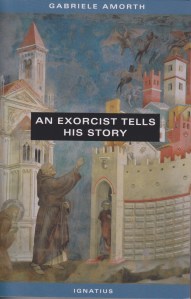
Belief is truly an amazing phenomenon. Even as we see it play out daily in the news, rational people ask themselves how people can accept something that all the evidence decries; just take a look at Fox news. In any case, those who study demons come up against the name of Fr. Gabriele Amorth with some frequency. Amorth was a true believer. Earlier this year I read one of his books and I wondered if he might reveal more in An Exorcist Tells His Story. Forgive me for being curious, but I really am interested in his story—how did this man become the passionate spokesperson for exorcism being reestablished in every Catholic diocese? What were the personal experiences that led him to this? Who was he?

Some people can’t write about themselves. Some, and I suspect clergy often fall into this trap, can’t write without the material becoming a sermon. This book is such an extended homily. Along the way Amorth does discuss a few cases of demonic possession and how it is to be confronted, but mostly he discusses the theology of his view of Catholicism and how that is essential to understanding demons. What is most odd about this is the inconsistency of a true believer in Catholicism admitting that Protestants too can drive out demons right after declaring the Roman Ritual is the only way for Catholics to do so. And only bishops, or those priests appointed by them, are permitted as exorcists. Is this a case of the enemy of my enemy is my friend? Protestants, according to the theology he espouses, shouldn’t be able to do this. If they can, why doesn’t it make him question his faith?

Known for his thousands of exorcisms, Amorth continues to have a healthy following. Anyone reading this book for a consistent outlook will be left wondering. How can Catholic exorcism work only if it follows the rules, and Protestant exorcism work when it is done by those who believe falsely? The same applies to his assertions that those who are possessed are not morally at fault, for it is the demon that makes them do evil things. At the same time those who lead “immoral” lives—according to Catholic standards—are more likely to become possessed. A few pages earlier we’d been told about saints who’d been possessed. I don’t mean to suggest anything about Amorth’s faith commitments—it’s celestially clear that he was a true believer. His commitment to help those who were possessed was legendary. Perhaps it’s just that demons are agents of chaos, and in such circumstances even theology can become a victim. I’m still wondering about his story, though.


Ezekiel’s Nightmare

I’m still thinking about Ruby Ridge. It’s not unusual for me to be a bit late catching up on yesteryear’s news, but being alive during Trumpocalypse has made me think of the 1990s as the good old days. Jess Walter’s book on the topic, on which I posted a few days ago (just scroll down), ends with a kind of optimism that seemed possible even when George W. Bush was president—the number of white supremacist groups was shrinking radically. Americans didn’t put up with that kind of backward thinking any more. The future was ahead. Now, just about a decade-and-a-half after the book was reissued, we’ve got not only a racist commandant-in-chief, but a Republican congress who goes along with everything he says. Strangely enough, I just read a newspaper article with a Jewish Republican saying “diversity is crap” (his words). No question we’re going backwards.

It’s easy enough to dismiss extremists unless you know some. I attended a conservative Christian college in the early 1980s. There were survivalists on the faculty. These are evangelical Christians who hoard guns and supplies, generally because they believe the end of the world is coming. Ironically, their belief in the rapture doesn’t seem to assure them that they’ll be “taken up” before the trouble starts. Or maybe they just want to hang around for a piece of the action—shooting infidels must earn points with the big white guy upstairs. Most of my classmates were as appalled as I was. We agreed that if these were the kind of people who were going to be around after the smoke cleared, we didn’t want to be.

The most disturbing development since November 2016 is the move of the GOP to follow a blind leader. History will bear me out on this. It doesn’t take a prophet to see it. 45 had no plan for winning the race. Once he did, however, he knew that sheep will follow any shepherd, no matter how incompetent. All you need to do is spout racist rhetoric and the fringe will become the center. But the GOP? They are among the most sheepish of all ungulates. A “leader of the free world” who has nothing but praise for dictators and autocrats around the world? The Republican has proven to be the perfect unquestioning follower. The wool is in their heads rather than on their backs. Less than two decades ago Timothy McVeigh was executed. Today there’s no doubt he’d be under consideration for a cabinet post. I think my watch just stopped.


The Pack

Maturity, in my experience, means knowing little and assuming even less. When I was young I grew up on a diet of books that were linear—plots were easily followed and there was clear resolution at the end. Who, as a kid, thinks that such a standard is impossible? One of this year’s reading challenges was a book nominated for an award in 2018. That assures a pretty current book, and I chose Emily Fridlund’s History of Wolves. Like life, it’s not linear. The narrator is unreliable. There are a lot of threads left hanging. It’s also a completely mesmerizing story. I selected it not because the content deals to a large extent with religion—I had no idea that it did when I selected the book, but, given what I do on this blog it was definitely a bonus.

I don’t want to give too many spoilers here since this is a novel well worth reading. I’ve always been impressed with writers who can convey accurately what it was like to be a teenager. A time of awkward discovery when we learn that things weren’t what we thought. Linda, the narrator, has been raised in a religious commune in the northern Minnesota woods. When a Christian Scientist couple moves into a cabin not too far away, she becomes a trusted “governess” for their young, sickly son. Unable, for religious reasons, to admit their son’s illness, they entrust him to Linda’s care. She comes to know each person in a unique way and learns that even adults don’t have the answers.

An interesting conceit for a story—one minority religion learning about another—the book ranges wide and far from that. Life as a teenager is when one typically both needs and rebels against religion. The awakening of adolescence, something our psyches aren’t equipped to comprehend much before this time, throws everything into confusion. History of Wolves won’t lead to any answers, but it is a useful discussion partner to have along the way. The Christian Scientists I’ve known have to face some of the same issues raised in this tale. Ironically, the advance of science has hit this group particularly hard. Novels such as this demonstrate that we, as a species, still turn to religion to explain our world. We’re frequently told that it’s safe to ignore—it’s from the childhood of our evolution. I wonder, however, whether Homo sapiens have just begun to reach adolescence and we are just starting to learn what it means to be adults in a world we don’t understand.


Faithism

Religion, in general, has come upon hard times. Many proponents of science and secularism point disparagingly toward what is, in all likelihood, one of religion’s strengths: its utter diversity. The fact is all people are believers. No amount of denial will change that. Whether the belief is in science or magic, we all take things as true, based on our outlook. My wife recently forwarded me a story about Faithism from the New York Times. A religion built around the Oahspe Bible, written about the same time as the Book of Mormon, Faithism very nearly went extinct before undergoing a modest revival in the present day. Instead of casting aspersions on it, a far better approach is to consider the basic, underlying human element to the movement.

Faithism was based on a book written by a dentist, a one John Ballou Newbrough. Although I’d never hear of Newbrough before, I can make a safe assumption about him—he was struggling with trying to understand a supernatural that can’t be measured or tested. This same element applies to scientists. Measurables have to leave at least a physical trace. Millennia ago, religions were already claiming that outside this mortal coil there was an entire realm that we could experience with our feelings but which would never offer any physical confirmation. There’s a pretty obvious difference between the living and the dead (at least to most people). Since nothing measurable changes at human death, it must be something incorporeal. Scientists begin to shake their heads here, but even they must face it some day.

The other takeaway from Faithism is that spiritual writings, like tiny particulate matter in clouds, can lead to the coalescence of something larger. Orally based religions, such as Zoroastrianism, seldom survive long. (Zoroastrianism, however, had very compelling ideas.) Written texts, once believed to be inspired, will naturally grow like a pearl over a grit of sand. The factuality of the text doesn’t matter, as long as it is the object of belief. When it rains, it pours. Some architects of new religious movements, such as L. Ron Hubbard, perhaps implicitly know that. While his science fiction may not have been inspired, his religious texts were. Unlike Scientology, science requires objective measures of what it considers reality. The title of Faithism, however, makes a trenchant point—it is belief in faith, like fear of fear itself, that makes religion. While historically few have believed in Faithism, even atheists have faith in what they don’t believe.


Mountain Tops

Idaho can be a peaceful place. I’ve spent parts of many summers there. I grew aware, over time, that the northern panhandle had an association with white supremacists, but if you stick to the touristed areas you don’t run into them. During the Ruby Ridge standoff I was busy trying to establish my teaching career in Wisconsin while living in Illinois—I guess my commuting life began all the way back then. I didn’t have much time for the news, and I don’t recall hearing much about the tragedy. It was shortly eclipsed by Waco. Jess Walter’s Ruby Ridge: The Truth and Tragedy of the Randy Weaver Family presents perhaps more than you need to know about this story with no winners and much strange theology. In case you missed it too, here are the basics:

Randy and Vicki Weaver were an Iowa couple who were drawn into the Christian Identity movement. This was a white separatist, apocalyptic survivalist faith. Convinced the world was going to end, they moved to a remote part of northern Idaho and built a cabin on a rocky ridge and stockpiled guns. Being a white supremacist was actually considered bad in the 1990s (now it’s mainstream Republican ideology) and federal marshals and the FBI got involved. The Weavers had four children and that complicated things. Predictably, the government attempt to shoot an extremist family out of their religion ended tragically. The Weavers’ only son Samuel was the first killed, and then Vicki. The locals, including many skinheads, gathered at the base of the mountain in support of the Weavers as the feds led a military operation into a nearly two-week standoff.

Apart from being too long, Walter’s book is an important reminder of many things at this time. Even though America had a Republican president in 1992, white supremacy was considered dangerous and was characterized as domestic terrorism. The standoff at Ruby Ridge quickly became a cause célèbre for religious freedom, no matter how strange beliefs might be. Ironically, even as the trial was going on the Branch Davidian compound in Waco was being stormed. Now we have a “president” who makes it plausible that a “k” has somehow dropped out of Waco, or at least has been tripled. The national narrative is America is for whites only. It’s as if Martin Luther King Jr., Woody Guthrie, and Abraham Lincoln never existed. I would say “How the mighty are fallen,” but that might sound a little too religious for some. Even the Religious Right has, since that time, left the Bible out of the equation.


Evangelical Angst

Unless you know what it’s like to face life with no real prospects beyond making it to Heaven when you die, you can’t understand evangelical angst. That last phrase might seem odd to you. Aren’t evangelicals uber-smiley, happy people angry over the way society’s going? Yes and no. Many of them were raised (or converted into) a faith that holds out no hope for this world and that constantly reinforces the idea that what we like is bad. Having grown up in that world, I knew what it was like to be hoodwinked by an evangelist. I can’t remember the guy’s name, but he was famous. He came to my small town and packed a local Methodist Church. During his rambling, long sermon, he had us afraid for Hell burning under our feet. Grateful that we’d just managed to avoid it, he announced there would be three collections that night: the first was your normal tithe. The second time the plates came around you were to empty your pockets and purses of all change. The third time, you were to contribute to his private jet. If you gave over a thousand dollars your name would be inscribed on a plaque inside.

Almost as if nothing has changed in the decades since then, a Washington Post story expresses amazement that evangelist Jesse Duplantis is asking his followers for a fourth private jet. Uncomprehending, the world doesn’t show much curiosity as to why otherwise intelligent people would give to what is so obviously a scam. Or why such people would vote for Trump. The academic world doesn’t understand evangelical angst. As I sat in that audience that night, a poor kid from a poverty-level family, I fervently wished I had more money to give. Until he asked for his plane. My young doubts crept in, for I had more angst than most other evangelicals I knew. Was this really the Gospel?

Later I saw him on television. His personal mansion had literal streets of gold. Jesus, he said, wanted us to get ready for Heaven right here on earth. Did this turn his followers against him? Decidedly not. In fact, he may have believed it himself. You see, neuroscientists have learned that our brains have the evolved capacity to hold and dismiss reason simultaneously, for strong emotional stimuli. Sex, for example, or music. Or religion. These can motivate people beyond the realm of logic, and they often do. Evangelical angst says you’re not buying a scam artist a jet to spread the Gospel, it says your trying to avoid Hell. Rational or not. And that, it seems to me, is more than adequate ground for evangelical angst.


Doubting Normal

The problem with being mainstream is that you have a hard time impressing anybody. “Mainstream church does something normal” is hardly an eye-catching headline. So when mainstream Christianity’s in the media it must be abnormal. According to a recent Washington Post story, mainstream leaders are protesting Christianity leaving Jesus behind. To be fair, that’s an Evangelical speciality, but still. Without naming the elephant named Trump in the room, these mainstream leaders are doing what every Christian in the nation should be doing, which is objecting to the abuse of their brand. The Religious Right has been driving this car and from all indications RR is drunk. Dietrich Bonhoeffer, once the darling of Evangelicals, once wrote that it is a Christian’s duty to wrench the wheel from the hands of fascists. Now they call shotgun and select the tunes.

I could be getting this wrong. As the child of an alcoholic, I don’t know what’s normal. My wife must tire of hearing the question from me, “Is this normal?” I just don’t know. One thing I do know is that being unable to know what to expect has prepared me well for Trump’s destruction of America. I can’t tell if it’s normal or not, so good thing we have the two-faced Evangelicals to tell us it is. Those who watch religion might say it’s odd to have mainstream Christians on the moral high ground over their more self-righteous kin, but these seem to be strange times. Religion, like anything that can be used, can also be abused.

Even our Orthodox siblings know the score. The Orthodox Church basically went underground in Russia, which is, after all, a Christian nation. Stalin, at least, was honest. He couldn’t stand that mamby-pamby opiate of the masses. He had the fortitude to call himself an atheist. 45, on the other hand, calls himself whatever it takes to make himself look good. What? Christians are fashionable this season? Okay, I’m one of those. Even people who should know better (just because your daddy was an Evangelist doesn’t make you holy—too many Evangelists were caught with prostitutes to make that claim) have delighted to invite a lion into the sheepfold. I don’t know about you, but I’d be edging toward the fence just about now. Something doesn’t smell right in here. But then again, don’t take my word for it. The situation looks normal to me.


Sects on the Highway

Here in the east, it’s not unusual to see Amish buggy road caution signs. Well, not so much in New Jersey, but in my somewhat frequent trips into Pennsylvania and upstate New York. On a recent trip to western Pennsylvania I mentioned to my mother that I’d never seen any Amish along the infamous route 322, where such a sign resides. Driving down 322 on my way home from that trip my wife and I passed three Amish carriages and one baby stroller. Religion has a way of surprising you along the highway. Roadside sects are not uncommon. Apart from the many biblical billboards I’ve been seeing lately, there are any number of indications that once you get out the urban areas of the nation, religion is alive and well. While driving to Ithaca, New York recently my wife and I simultaneously spotted a sign we’d never seen before. We have made this trip to upstate many times, mostly along Interstate 81. The sign was for a tourist attraction called “Historic Priesthood Restoration Site.”

Being hopelessly mainstream, we assumed this meant Catholic priesthood. The problem was, what was either historic about this area north of Scranton, or what might be this restoration? Once we found wifi access again, I learned that the priesthood referenced was that of the Church of Jesus Christ of Latter-Day Saints. I have to keep reminding myself that Mormonism had its start in parts of upstate New York—an area so prone to religious flare ups that it was called the Burnt Over District back in the day. So Joseph Smith and Emma Hale had lived just over the border in the area of Susquehanna, Pennsylvania while Smith was working on the Book of Mormon.

A great deal of America’s religious history may be found on roadside markers. We are an inventive people when it comes to ways of exploring what we consider the divine world. Mormonism has been one of the more successful brands of American religion and although we tend to associate it with Utah now, it was a faith that grew up here in the green hills of the mid-Atlantic states. Being inveterate seekers, Homo sapiens go after new revelations with surprising aplomb. And we’re willing to change the constitution of old religions to fit new prejudices. Religion is anything but static. To test this theory simply get behind the wheel and drive out into rural America. You’ll be surprised how much you can see even at highway speeds, if you have eyes to see.


Redefinition

The striking thing about Evangelicalism is its protean nature. The earliest forms of this conversion-based “Christianity” began with the Reformation among Pietist Protestants. They sincerely believed in two things: the Bible and Jesus. Today Evangelicals deny both. They believe in Donald Trump. Racism and subordination of women are their two main foci. And yet, they wish to keep the brand. Daily we see the standards of traditional “Christianity” tumble: turn the other cheek, love your neighbor as thyself, if a man asks your cloak give him your coat also. All of this jettisoned like so much non-capitalist clap-trap. Thing is, it’s in the Bible. Thing is, it was said by Jesus. And also anyone who even looks at a woman with lust in his heart is guilty of adultery, let alone those who pay them off so they can grab another on the way out the door. All of that’s now “Christianity.”

The funny thing is that those who object to such behavior are what Evangelicals scornfully call “liberals.” So much for the group that just three short years ago advocated the reinstitution of biblical law. Now that 45 would have committed a capital crime according to such laws, they have changed the Good Book rather than rebuke the pastor in chief. Ironically, some of the children of famous evangelists have drunk deeply from that Kool-Aid. It’s fine to sleep around as long as you lie the right way at the right time. Bear false witness? What does that even mean? You’d think liberals were suggesting that those God loves are chasteneth by him, for goodness sake!

Many of us feel as though we woke up to an alternate reality in November of 2016. We supposed the Republican Party would show some backbone, but when they didn’t we weren’t all that surprised. What shocked us most is that the leopard has changed its spots. Those of us brought up with the Bible were led to believe this impossible. After all, who can change a hair from black to white (although some of us would rather have it go the opposite direction)? We thought that Holy Writ would guide the Evangelical heart. We thought they would remember who Jesus was. All of this is negotiable now. The only solid rock on which they build their church—those to whom they give the keys to the kingdom—are those that fall into goose-step behind a “leader” for whom the truth changes daily. Opportunist be thy name. Were Jesus alive to see all this, surely he’d weep.


Only Which King James?

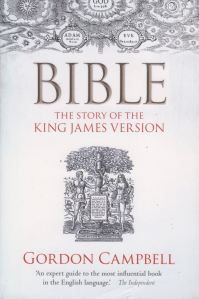
Nothing is as simple as it seems. Not that the Bible ever claims simplicity for itself. Among those who make up their minds before seeing all the evidence, there’s a strong preference for the “King James Version” of the Bible. Many with that preference will claim that they don’t interpret the Good Book, they just read it. Reading itself is an act of interpretation and stakes tend to be pretty high when the claim for divine authorship is on the table. So I figured I’d better interpret something about the King James Bible myself. Gordon Campbell’s Bible: The Story of the King James Version is an informative, authoritative, and often witty treatment of the topic. One of the immediate takeaways is that there is no single KJV.

Beginning in the beginning, Gordon tells the story of the Bible in English. There were translations before the King James, and its translation companies used these previous efforts and sometimes borrowed extensively from them. In other words, there’s nothing new under the sun. Once the King James was done in 1611 it had to be printed, and printing, being what it is, led to errors. Although these were of the secular, human kind, they nevertheless appear from the beginning and new typesettings led to corrections and other errors, some perhaps intentional. Then came the revisions. What readers buy—and some claim is an inspired translation—as the KJV is a revision of a revision. Of a revision. In other words, the inspiration seems to lie with the redactors rather than the translators themselves. There are many different “official” King James versions. Translations are never static.

King James Onlyists (a modern movement) may not realize that the New Revised Standard Version is the modern descendant of the King James. The Revised Version (RV), followed by the Revised Standard Version (RSV), and its more recent, feared progeny (the NRSV) are all based on the King James translation. That is the version “Revised” in each of these efforts. They consult improved versions of ancient texts that have been discovered since the Jacobean era, but where they earn the ire of conservatives is in the updating of the modern language. A Bible with no thees or thous hardly seems sacred at all. The line of continuity is there, however. Other Bible translations “start over” but still consult the KJV, such is its stature. The real problem comes in supposing that any one translation is the original. No original Hebrew or Greek biblical manuscripts survive, and no original King James Version exists. How uncomfortable these facts are, everyone will have to interpret for her or himself.


Driving Truth

One of the problems with driving is that you can’t get pictures of billboards. Well, given the way people drive around here, I suspect that may not always be true. Nevertheless, I always think of billboards as trying to sell something. There’s sometimes fairly easy to shut out, but in long stretches of otherwise uninteresting road you fall into their trap. Now having grown up in western Pennsylvania, we always thought the people out east—Philadelphia was the largest city in the state, after all—were more sophisticated. It is around here, however, that I often see billboards selling evangelical Christianity. If you put out your wares, you’ve got something to sell. Money to make.

As I was traveling that stretch of somewhat plain highway 33 between Stroudsburg and Easton I noticed a billboard reading “In the beginning God created the heavens and the earth.” To shore up its academic credentials the billboard footnoted Genesis 1:1. An inspirational sunrise, if I recall, shown over the Bible. Of to the left—of course to the left!—was a small “no circle” and inside the famous skeletal progression from ape to human. The message was “no evolution.” The more I pondered this, the more strange it became. Most Americans are well aware that billboards aren’t exactly the locus of truth. They are gimmicks to try to get you into the store. Like the one a few miles down that advertises the world’s largest humidor; even those with no interest in tobacco might feel just a touch curious what such a place might look like. Why would you take your most intimate personal beliefs and put them on a billboard? Does that make evolution any less likely?

A strange perception has lately taken over this country. The idea that an individual’s wants equate with the truth. Shout it loud enough and it has to be true. Billboards would never stretch the truth, would they? Is that image enlarged to show texture or what? And wouldn’t a better choice of anti-evolution rhetoric have been Genesis 2? That’s where God makes Adam from lowly dirt. Yes, Genesis 1 gives us the dramatic six-day creation, but Genesis 2 manages to say it all happened in one day—isn’t that more in keeping with capitalistic ideals? Greater efficiency leads to greater profits, after all. And profits, we all know, are the real purpose behind billboards for any product under the sun.


What Lies Ahead

Things change. You’d think the fact that we all now carry the internet around in our pockets would’ve demonstrated that. What did President Nixon ever tweet? Conservatives, however, want it both ways. They want to pretend nothing has changed, but they still want to keep and reap the benefits of that change. This was shown most clearly by the ouster of Paige Patterson from his presidency of Southwestern Baptist Theological Seminary. Seminaries don’t make national news without a good scandal. (And some good scandals are never discovered.) This one involves demeaning statements made about women in Patterson’s long storm track through the Southern Baptist Convention, of which he was past president.

Journalists seem to only now be catching on to the fact that “conservative” is a codeword for misogyny. Thus it has always been. The fact that it would take nearly two millennia before women could take leadership roles in Christianity (and in some very large sects they still can’t) should’ve been a hint. It’s the old frog in the slowly heating kettle thing. Nobody notices until it’s too late. Since conservative Christianity has always downplayed the worth of women, it didn’t come to public notice until the #MeToo moment. Enough women had to speak up before society took notice of the obvious. Many men feel theologically entitled. Entitled to run things, and they live by the lie that things haven’t changed since Jesus strolled out of that garden tomb a couple thousand years ago. Well, apart from the fact that men no longer wear dresses and keep their hair short, in Roman style. But let’s not call it that, let’s say Evangelical style.

You see, the way you say things matters. Said a certain way, a misrepresentation of the truth is called a lie. It’s considered one of the greatest sins possible in the conservative lexicon. In another way, however, the same statement becomes doctrine, and that’s a whole different way of looking at things. Make it the fault of the Big Guy up there and the other big guys down here are off the hook. After all, the Almighty’s a bachelor. Such a theology has no possibility of treating women equally. Theologians say God is sexless. What’s that like? We have trouble imagining it. English has no neuter gender so we use the masculine pronoun and once we do thoughts go back to sexual features. It’s deeply ingrained. That doesn’t mean it’s the truth, however. After all, Mr. Patterson will still be kept on as theologian in residence. The more things change, the more they stay the same.