Xenophobia’s Children

There are consequences, it seems, for not paying attention in school.  I have no way of knowing, of course, but I suspect most of us are taught that basic fairness is the social ideal.  Xenophobia is deeply embedded in the primate psyche, but to those who claim we haven’t evolved, there seems to be no way to convince them that “racial” differences are merely a matter of differing collectives separated by natural borders.  Over time traits favorable to the region predominate, and humans therefore have what seems to be a very wide array of potential appearances.  There should be nothing in all of this that suggests one group is superior to another.  Primate evolution, however, helps to explain but not to excuse.  Xenophobia is something from which we can evolve.

Fear is at the heart of any phobia.  In a society that measures the worth of individuals by their wealth, fear that another will take it is constant.  Perhaps, in a part of our souls we’d rather not acknowledge, we know it’s wrong to have too much while others don’t have enough.  It’s very cold this Martin Luther King Jr. Day.  In Manhattan on Saturday I saw many people on the street, those who’d met the wrong end of capitalism.  I’ve seen human beings shivering in Dickensian conditions in the twenty-first century.  I’ve known capable adults who couldn’t find work, even when they’ve tried.  We fear the street person.  We know that, but for slight shifts in capitalism, that could be us.
Xenophobia has come under threat with globalization.  We’ve made travel to remote locations affordable in order to spread capitalism to regions ready to be exploited.  And we see nothing wrong with taking from those who can’t prevent us from doing so.  Then we wonder why people just like us turn out to march in the cold.  Civil rights marches took place half a century ago.  Crowds thronged the nation’s capital seeking basic human treatment.  Fifty years later over a million women and supporters had to show up to make the same point again.  Fair treatment should not be a commodity.  Those who have fear the stranger.  Those who have don’t wish to share.  They claim the name of “Christian” and mock the very tenets upon which that belief system was founded.  It’s cold outside today.  As we huddle inside, we should have time to think.  It is a waste of a national holiday if we don’t at least ponder for a few moments what it is we celebrate.  And the real costs of xenophobia.


Truth Is Marching On

A funny thing happens to human minds when they’re in a crowd.  They begin thinking collectively.  We’ve all heard of “mob mentality” and dismiss it as so common that we don’t stop to think how remarkable it is.  Maybe we’re afraid to.  Yesterday I attended my third Women’s March, this time in New York City again.  Being an introvert, I find the prospect of putting myself into a large crowd daunting, and with a winter storm warning posted, worries  about getting home provided a convenient excuse.  My wife knows me well enough, however, to sense when my enochlophobia kicks in and tries to kick out that part of me that’s passionate about social justice.  You see, women are still not counted equal citizens in this “land of equality.”  The Equal Rights Amendment has never passed.  Pay is still based on gender rather than qualification.  And we have an unrepentant misogynist in the White House.

Once I’m in a likeminded crowd, supporting social justice, it’s clear that my thinking is influenced by the activity of all those brains around me.  Scientists know this happens in nature.  Ant colonies, for example, “know” more than a single individual does.  Recent studies have even suggested this “hive consciousness” can exist beyond a lifespan, creating an archive of learning that exceeds the lives of an entire generation.  If only we could teach Republicans to do that.  In any case, being in the crowd of bright, intelligent, hard-working women found me in a good head-space.  The men in DC are certainly doing nothing to make the male gender proud.

Although crowd estimation isn’t an exact science, the media has consistently underestimated the sheer numbers of these marches.  The National Park Service, on duty in Washington in 2017, estimated 1.3 million had shown up for the march.  It’s still not unusual to see the number cited as 500,000.  Regardless, with the sister marches it was the largest single-day protest event in U.S. history.  We have to keep marching as long as men continue to elect the most ignorant of their gender to high office.  There’s nothing controlled about the chaos in the White House.  Fake news, alternative facts, a revolving door of staff, and Fox News’ nose so brown you could grown corn on it is not the way to run a democracy.  I may have been part of a hive mind for a few hours yesterday, and it was a far better mind than those that abound in the federal government seeking only their own glory.  Let’s hope the collective mind outlives this generation.


Mephistopheles

Jeffrey Burton Russell is one of the clearest thinkers I’ve ever read.  I first encountered him in my background reading for Holy Horror, and have subsequently tracked down his books on the history of evil.  In what is a dangerous move for a scholar, Russell admits in The Devil that he believes in some kind of personified evil.  Except for religion scholars employed in seminaries, such thoughts are generally kept carefully guarded as academia has followed the materialist paradigm since it boldly declared that there’s no other way to know the world.  Russell’s intellect penetrates through that posturing and logically lays out what can or can’t be known based on empirical evidence.  And in Mephistopheles: The Devil in the Modern World, he concludes his historical sweep of an idea as old as civilization itself.

This is a wide-ranging book.  The previous three covered long periods as well: antiquity through the Hebrew Bible, New Testament through late antiquity, and the Medieval Period.  Mephistopheles has to cover from the Reformation through the present of the latter 20th century (when it was written).  Finding evil in the modern world is arguably way too easy.  Since 2016 it has become more fashionable to the point that an entire political party can laud it.  Russell writes with the strong conviction that love and the will to goodness can overcome the tendencies of humans to allow hatred, fear, and prejudice to rule.  What seems to be lacking, some three decades on, is the will.  We have given in to our cynicism and elected the worst of our inclinations.

In William Friedkin’s documentary The Devil and Father Amorth, Russell, looking depressed, is interviewed about the reality of demons.  His advice is to look for the good instead.  Nevertheless, having spent years of his life researching how evil appears and reappears, his own fascination demonstrates why we return to the subject time and again.  The world hasn’t righted itself.  His books indicate that there is a way, but we continue to ignore that way, preferring instead to follow the loudest of mouths rather than the warmest of hearts.  Some would personify this into Mephistopheles, the modern, entertaining aspect of the Devil.  Others would claim it’s merely a metaphor.  No matter which may be the case there’s no denying that evil exists.  And if it exists it behooves us to know about it.  And once we learn its identity we must name it.


Shut up or Shut down?

So the government’s shut down over a presidential temper tantrum.  Like most people, I suspect, I haven’t really noticed.  Except for two things.  When I drove up to Ithaca over the holidays, some of the highway rest stops were closed.  It seems our government wants to share the misery of not being able to relieve itself.  Secondly, the NOAA weather forecasts are no longer updated as frequently as they should be.  I’m no expert on the weather—I did write a book on meteorotheology, which took quite a bit of research on weather in ancient times, but I know that doesn’t qualify.  Still, I rely on weather forecasts to get daily business done.  In particular, we were expecting a winter storm around here that had been predicted, by NOAA, to arrive around 11 p.m.

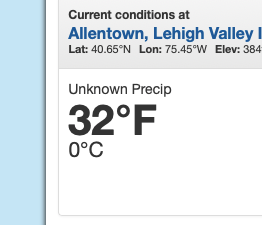
Okay, I thought, people will be off the roads by then, and crews will be out to treat the icy conditions by morning.  Seven hours early, around 4 p.m., I noticed a rain, sleet, snow mix falling.  The ice particles looked quite a lot like salt crystals, but I was pretty sure that the government doesn’t have that kind of pull.  In any case, when weather catches me unawares, I turn to NOAA since our government is apparently God’s own chosen one, figuring that the Almighty might know a thing or two about what goes on upstairs.  The current conditions, NOAA said, were “unknown precipitation.”  Apparently the government isn’t even allowed to look out the window during a shut-down.  Maybe it was salt after all.

So, among those of the “God of the gaps” crowd, the weather is perhaps the last refuge of a dying theology.  Their cheery refrain of “science can’t explain” has grown somewhat foreshortened these last few decades, but when unknown precipitation is falling outside all bets are off.  Come to think of it, Weathering the Psalms could’ve been titled Unknown Precipitation, but it’s a little late for that now.  A creature long of habit, I awoke just after 3 a.m.  Hastily dressing against the chill of the nighttime thermostat setting, I wandered to the window, wondering whether there would be a snow day.  It’s dark this time of night, as I well know, but in the streetlights’ glow it seemed as if no weather event had happened at all.  It’s just like our shut-down government to get such basic things wrong.  As long as I’m up, I might as well get to work on my current book on horror.  It’s only fitting.


Mastering Ravens

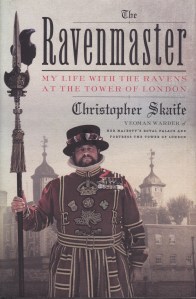
One of the most difficult things in modern life is to keep up with all the new jobs available.  That’s not to suggest that unemployment isn’t a real problem—it is—but that the game has changed since the days I went to the guidance counselors’ office and thumbed through the box of microfiche to learn about potential colleges.  (And what strange people the guidance counselors were!)  Since 1981, when I graduated from Oil City High School, the Internet has been invented and has changed employment forever.  I understand that making YouTube videos can now be a full-time job, with benefits.  Who knew?  So when I was kindly presented with a copy of Christopher Skaife’s The Ravenmaster: My Life with the Ravens at the Tower of London I wasn’t too surprised to learn that there is such a job.

Delightfully written, The Ravenmaster goes into the ins and outs of life in what is a ceremonial job.  That the Brits are fond of tradition is no secret, and this little book is so full of them that it becomes a delightful gallimaufry that includes, I kid you not, dog biscuits marinated in blood.  Although Skaife takes you on a few detours through his own life, the book is mainly about ravens.  We’re so used to materialists telling us that everything is simply cause and effect of neurons firing that I wonder how they might react to the obvious intelligence and personalities of ravens.  Reading about their antics as well as their wisdom it’s difficult not to surmise that consciousness isn’t a purely human preserve.  With the ravens and the wolves we are a piece.

Intelligence is more common in the animal world than in the White House these days, and this book may help to show why.  Ravens can plot, plan, and be cruel.  They can also be kind, compassionate, and friends.  I’ve long had a fascination with corvids, and I tried to befriend some before moving out of New Jersey.  It was a bit tricky with the strictures of my own Tower of London—the commute, the bus, the job—and so my friendship with the local crows in the back yard of our apartment remained strictly casual.  We lose so much by not paying attention to the natural world of which we are, increasingly, so unnatural a part.  When humanity disappoints and the ridiculousness of human behavior haunts, I recommend reaching for The Ravenmaster.  It’s comforting to know that real minds exist out there in the wild.


Evangelical Angels

Angels are everywhere at this time of year.  The Christmas stories of the gospels of Matthew and Luke have made them an indelible part of the tradition.  It’s not unusual for entirely secular individuals to be decorating with them and they are generally without controversy in public displays of holiday spirit.   A colleague once asked me why Americans were so credulous when it comes to a belief in angels—the numbers of believers are quite high, statistically.  I wonder if it’s because we need them.  Considering that the Republican Party is the Evangelical’s party, it’s no small wonder that even atheists embrace angels.  We all could use a little help from on high.  This time of year, such hope can be disguised behind tinsel and bows.

America must seem a strange country to those who immigrate (or had immigrated, when that was possible).  We wear our religiosity—and this is not the same thing as true religion—not only on our Christmas trees, but even on billboards by decidedly secular highways.  It’s as if even all the things America stands for, such as love of money, guns, and automobiles, only hold together with the saccharine glue of a sickly sweet religion.  A Bible-believing nation that has no idea what the Bible actually says and lauds a president who breaks at least a commandment a day and gains no reprimands.  We have shown our red neck to the rest of the world and yee-haw we are proud of it.  And we got the Good Book to prove it.

After all this shakes out we’ll be needing some angels, I suspect.  My colleague felt that sophisticates, big city skeptics, ought to be more willing to dismiss unenlightened beliefs such as those in spiritual beings.  The thing is, spiritual beings serve a very useful purpose.  They keep us honest—and I don’t mean in an Evangelical way; I’ve seen Evangelical honesty and it’s as corrupt as the Devil.  No, I mean that angels are important to show that we have hope.  Maybe they are secular angels—even the Bible doesn’t give any description of them at all, so how can you tell a secular from a religious angel?  That lack of pedigree doesn’t mean we don’t want them watching over us.  Belief is an important part of being human, secular or not.  The billboard space tends to go to those who want your money, and that applies to the ones that appear to be religious as well.  If this is the way the religious behave, we’d better hope there are angels everywhere.


You’re History

A story from Inside Higher Ed discusses a study of history majors and their rapid decline.  This occurs during a sudden onset of “job related” majors and the graph accompanying the article shows how STEM has taken over higher education.  These are the fields with actual occupations awaiting them at the end of the degree, while disciplines such as history and religion (also very near the bottom) have less clear career paths.  Indeed, when I’ve been in the job market I find that a religion degree is less than useless, no matter what the department recruiters tell you.  If you’re not bound for the clergy you undertake the study at your own peril.  History, I expect, suffers from a similar dynamic, but the peril in this case is to all of civilization.

We’ve seen over the past two years how a stunning lack of knowledge of history sets a nation on the path to chaos.  Businessmen with no classical education don’t make good national leaders.  Knowing where we’ve been, as Santayana so eloquently stated, is the only thing that keeps us from repeating past failures.  History is our only safeguard in this respect.  Over the Thanksgiving break I spent a little time delving into family history.  Since I don’t come from illustrious lineage, I felt the frustration of finding out what happened to obscure people from the last couple of centuries.  Lack of history on a personal level.  On a professional level, my doctorate is really in the history of religions (ancient religions) and I’ve become keenly aware of just how little history there is to the very popular modern Fundamentalist movement.

Maybe I said that wrong.  They do have a history, but the belief system that is touted as ancient is really quite modern.  Anti-modern, in fact.  When historical knowledge is lacking, however, people can make all kinds of claims based on nothing more than wishful thinking.  History keeps us honest.  Or it used to.  When we’ve outlived the need for history we’ve started down a path unlit by any embers of past human foibles.  We’ve been living in a culture in love with technology but not so much with critical reflection of where such innovations might take us.  Doctors are beginning to complain that they spend more time on their computers than with their patients.  The time freed up by the internet has been taken up by the internet.  And when all of this comes to its natural culmination, we would be well served by historians to make a record of what went wrong.  If we could find any.


Creatio Nihilo

Just when I think I’ve reconciled myself with technology, this goes and happens.  These precise words, in this order, have been written before.  In fact, all words in the English language have already been laid out in every conceivable order.  Technology can be friend or foe, it seems.  The website Library of Babel—with its biblical name—has undertaken the task of writing every conceivable combination of letters (using our standard English alphabet) and putting them into a vast, if only electronic, library.  This was not done by a human being like me, with intent or even any interest in the meaning of the words, but rather as one of those things people do simply because they can.  This entire paragraph can be copied and pasted into their search box and found.

The Library of Babel has made plagiarists of us all, even as it plagiarized everything written before it was programed.  After I learned about this library the wind avoided my sails for a while.  You see, what’t the point in writing what’s already been written?  Then it occurred to me.  Context.  The fact is, had I not scriven these very words, and put them on this blog, they would never have come to the attention of the kinds of people who read what I write.  The words have been spelled out before, but they’ve never been written before.   Those of us who write know the difference.  We spend hours and hours reading and thinking of ways to combine words.  We’re not out to kill the creativity of our species, we simply want to participate.

There should be limits to human knowledge, otherwise we’d have nothing for which to strive.  The internet may make it seem that all knowledge has been found—it is so vast and so terribly diverse—and yet there are people who never use a computer.  Their wisdom counts too.  It may seem that everything is here, but there is material that still has to be looked up in physical books.  There are crates and crates of clay tablets from antiquity that have never been transcribed and translated.  When that finally happens, the words they contain may be found, in a strangely prophetic way, in the Library of Babel.  But they won’t have any meaning there until it is given by the context.  And what can a library preserve if it isn’t the context that a (human) writer has given the words?


Christmas Time

As children we can’t wait for Christmas because we’ll be getting things.  Now that I’m older I try to avoid the frenzy building up to the holiday, although I look forward to the vacation days that I’ll cash in to take time to be with family rather than business.  It’s not that I don’t like holidays—it’s just I’m no fan of hype.  Still, now that December is nearing, and Thanksgiving has reminded us that work isn’t everything, I can feel the anticipation.  Yesterday I attended the Christkindlmarkt  in Bethlehem.  Amid the backdrop of the truly colossal, rusting stacks of the former Bethlehem Steel plant, this is a seasonal event with nothing but good spirit.  People of all descriptions were crowded into the massive event, but rudeness and complaining were strangely absent.  Everyone seemed to be having a good time.

When I worked at Nashotah House, the atmosphere for Advent was austere.  We weren’t really encouraged to look forward to Christmas, bringing a tree home before the 24th was frowned upon.  It was a time to reflect on our sins, not to anticipate our rewards.  Still, I had a kind of epiphany among the secular crowds seeking to get into the spirit of things yesterday.  Bethlehem is a city that has known hard times.  Its industrial base eroded away, residents were left unemployed and wondering about a very (and increasingly) uncertain future.  Recasting itself as the Christmas City is a way of throwing new light on a holiday famous for its commercialism.

Christmas can be about resurrection.  It’s a season to think of birth.  It matters not if the mother is a virgin or if the child is for an exclusive sect.  People throng here for hope.  Beauty in the midst of ruin.  Some businesses clearly spend all year building up to Christmas, selling ornaments so delicate that I feared even to look too hard at them lest they shatter.  Handcrafted goods that represent the livelihood of others who compel strangers that art is worth more than money itself.  Wandering through the four tents of booths, the feeling of resurrection was palpable.  We were all here seeking something.  Loosening the grip on the wallet just a bit.  Wanting to make others happy for a while.  Birth is the symbol of hope.  Advent, it seems, need not be a dreary season of wallowing in unworthiness, awaiting a mythology taken too literally.  The proof of the goodness before us is just down the road in Bethlehem.


Post Thanksgiving

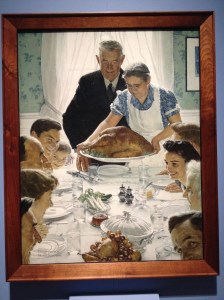
Yesterday morning, like many others mesmerized by the commercialization of holidays, I had the Macy’s Thanksgiving Day Parade on the television.  I can only speak from my own experience, of course, but I know that growing up poor we used to watch this, and that my wife’s family, from different circumstances, also watched it.  The friends with whom we ate our main meal watched it, and given the advertising revenues, I imagine many other people tune in every year as part of the holiday tradition.  What struck me were the testimonials just before or after the commercial breaks.  Celebrities shared what they liked about the holiday and many of them, unsurprisingly, focused on food.  Many indicated that overeating was pleasurable.  I began to think of what it means to be a nation of foodies.

Not everyone is of a cenobitic sensibility, but focusing on the food seems to be paying more attention to the finger pointing at the moon than to the moon itself.  Commercials for television shows of sweaty, nervous chefs wanting to be recognized as the best cooks in the world struck me as somewhat decadent.  Like many professionals I’ve had occasion to eat in “fine restaurants” from time to time.  Do I remember the food for long afterward?  No.  More often I recall the people I was with.  What we talked about.  The food, chefs may be pained to hear, was incidental.  There were deeper issues afoot.  If the internet’s any indication, I’m in the minority here.  Foodies rule.

Special foods on holidays are, naturally enough, a holiday tradition.  Many have their origins in the changing foodstuffs available as the seasons wend their way through their invariable cycle.  Thanksgiving is like the ancient festivals of ingathering—the celebration of plenty ahead of the lean months of living on what we’ve managed to store for the season when winter reigns.  Some animals cope by hibernating until food becomes available again.  Others scavenge their way through chilly, snow-covered days.  Gluttony, however, isn’t primarily a sin against one’s body; it’s the sin of taking more than one’s fair share.  Unequal distribution of wealth is a national sin that grows worse each year.  On Thanksgiving there are many people who don’t have enough to eat.  Jobs can be lost through no fault of one’s own, and want can haunt late November just as readily as jouissance.  Driving home we passed a shopping mall brimming with cars after darkness had fallen.  The larger holiday of Black Friday had begun.


Pleasant Dreams

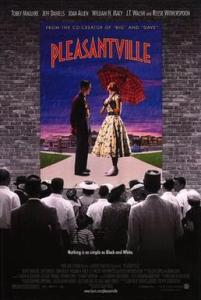
The last time I watched Pleasantville I didn’t have this blog running to discuss it.  It was also during the Obama administration where it felt more like nostalgia rather than a documentary.  In case you’re not familiar, Pleasantville is a movie about how a nerdy teen, David, and his cool sister Jennifer get sucked into a 1950’s sitcom, “Pleasantville.”  They find themselves in black-and-white and in a world as regimented as Stepford, but somewhat more humorously so.  As Jennifer is eager to get back home, she introduces this colorless world to sex, and as the two-dimensional characters begin to experience strong emotions colors start to appear.  The “picture perfect” Pleasantville begins to let the plastic facade of the 1950s slip to reveal a complex and messy world of true humanity beneath.

Watching the film in the age of Trump, as with most things, interjected a current of fear.  The townspeople feel threatened by those who are different, colorful.  They want everything just as it was—women serving their husbands, everyone the same hue, and pretending that sexuality doesn’t exist.  It may have been originally intended as an homage to the the 1960s, but what became clear in an age of MAGA is that crowds easily respond to suggestions of hatred.  Many of those in the group, individually, are “coloreds” themselves, but fear to let it show.  Conformity is much safer even if it means hating those who are different.  I wasn’t alive in the 1950s, but the superiority of the white man apparently was.  One of the characters is, tellingly, named Whitey.

Initially drawn to the film seeking biblical references (occupational hazard) I knew there was an Eden scene before I first watched it.  Margaret, on whom David has a crush, has discovered actual fruit at Lover’s Lane.  She brings him an apple which, the TV Repairman (if you’re lost, please watch the movie—it’s quite enjoyable) points out, is a form of sin in this world of simple answers and unspoken repression.  A mash-up of Jasper Fforde and American Graffiti, the film exposes the lie behind the idea that all were put on earth to serve the white man.  Jennifer discovers books and stays behind in colorized Pleasantville to go to college, something of a rarity in those days.  Although the movie bombed at the box office, it has a serious message to convey.  There was no perfect 1950s iconic America.  The process of becoming great is one of evolution, rather than that of a fabled Eden, available only in black-and-white.


Righteous City

I’m a stomach sleeper, if that’s not TMI.  This began many years ago when I realized that upon awaking from nightmares I was always on my back.  I started doing what I knew was dangerous to infants, safe since I haven’t been part of that demographic for decades.  Terrazzo isn’t one of my favorite sleeping surfaces, however, and on my back on the floor of Newark’s Liberty Airport I realized I couldn’t roll over, for many reasons.  My glasses, for one thing, were in the internal pocket of my Harris Tweed.  For another, on one’s stomach one’s wallet is exposed in a way that’s maybe too inviting.  Before suggesting I could’ve placed my wallet and glasses elsewhere, let me write in my own defense that rationality isn’t my strong suit after midnight.

The night before

I found a spot next to a set of escalators where the constant thrumming alternately kept me awake and soothed me to nod.  I heard many languages spoken as I drifted in and out of consciousness for the few hours I had to wait for dawn.  And nobody disturbed me.  This is rather remarkable—a person asleep is a vulnerable being.  Doing it out in public with no private walls was a new experience for me.  I don’t sleep on planes, buses, or trains.  Or, until two days ago, airports.  It brought to mind the biblical world.  A town was considered a righteous place if a stranger could sleep unmolested in a public place.  The traveller—please take note, United—was in need of special consideration.  My situation revealed something unexpected about Newark Airport.

The morning after

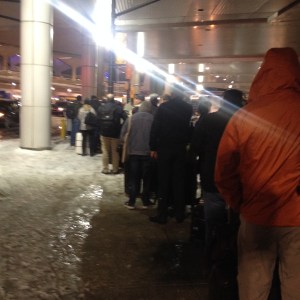
It was full of angry, frustrated people.  I opened my eyes at five a.m. to find a very long line snaking down the corridor behind me—a queue that had been there when I first drifted off.  These were people trying to reschedule flights since United couldn’t bump that day’s passengers because they’d decided not to fly out the night before.  Despite the weariness and intensity of emotions, there was very little bad behavior.  We were biblical strangers, mostly in the same circumstances.  No creature comforts, no privacy.  An east Asian woman said the next morning that in her country the airline would’ve brought food, and blankets at least.  In the United States fiscal concerns reign supreme, however; do you know how much it would cost to care for all these stranded people?  When I opened my eyes the situation was about the same as when I closed them.  I couldn’t help noticing I awoke on my back.


Odyssey in Blue

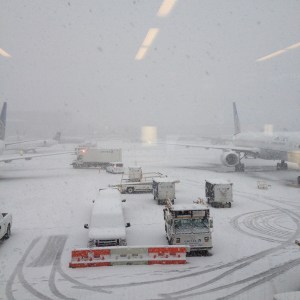
Now I have the United bastardization of Gershwin’s “Rhapsody in Blue” stuck in my head.  This comes from listening to the same recording approximately a quarter-gazillion times while on hold.  I expected to awake this morning in Denver, but instead I learned a very valuable lesson about refugees.  It went down like this: yesterday’s east coast storm over-performed while United Airlines under-performed.  Seeing the forecast, I changed to an earlier flight to try to beat it out of Dodge.  I arrived in Newark only to have my flight incrementally delayed until it was cancelled around 9:30.  By this time all the hotels within 11 miles of the airport were booked solid from earlier cancellations.  Taxis were running into Manhattan only.  Access to New Jersey Transit was not possible.  I’d been awake since the 4 a.m. text alert from United that said bad weather was on the way.  Finally, around 1 a.m. I found an unoccupied piece of floor and slept next to total strangers.

The experience opened my eyes to the plight of refugees.  Weary airline employees (probably worried about getting home themselves) were not friendly and didn’t welcome questions.  The line for rescheduling flights was, by no exaggeration, at least 400 individuals long, one of whom told me this morning she’d waited 8-hours to talk to someone.  Since cancelled flight baggage is not checked, it had to be retrieved, and the line for doing such was equally as long as the rescheduling queue.  United was under-staffed, stressed, and not in control of the situation.  Nobody wanted to listen to you.  You were just another stranger with a sad story and all of us have problems, don’t you know.  The refugee has no place to go.  Nobody to care.

With my aging cell phone dying, my lifeline to those who cared was fading.  The shops closed, cutting off access to food.  Ground transportation was not responsive.  Hundreds and hundreds of people were stranded, relying on their own wits (or in my case, lack thereof) to decide what to do.  I just wanted someone to say “Go here.  Do this.”  Instead I found myself wrapped in tweed, using my carry-on, Jacob-like, for a pillow.  I felt for the strangers around me.  They were suddenly friends as we were all in the same category—displaced people.  This nightmare lasted under 24 hours for me, but I am now keenly aware that it never ends for some.  Refugees need a caring glance.  A kind word.  And it would help if the powers that be would leave Gershwin alone.


Paying Troll

There was a time, should the media of my youth be believed, when a man insulted another man’s wife at his peril.  A barroom fight, or perhaps a sober brawl, would ensue.  Such chivalrous days are likely over and the internet makes nasty comments so easy to disseminate (how terribly masculine!) for all the world to see.  Hiding behind assumed names, avatars, or delusional fictions, you can feel like a big man by saying unkind things to a person you’ll never meet.  Such is the world of Trump’s America.  Although he may think himself divine, Trump didn’t invent Twitter or the internet.  Neither did Al Gore.  Still, the distasteful political rancor leading up to the midterm elections led to a man (I presume) trolling my wife behind a mask of Facebook anonymity.

It’s hard to tell how to react.  Feminism doesn’t always want a man to step in and defend, but we’re all raised with tales of princesses and those who honor them.  Having been raised by a woman with an absentee husband, I have nothing but admiration for strong women.  Although categorized as a “white man,” I can’t see my own brand as better than any other.  We are all human beings, and with some rare exceptions, we deserve respect.  Like all evolved creatures, however, I sometimes reach deeply back into my primate roots and the tropes of my childhood begin to simmer.  Who trolls another man’s wife over politics?  Who doesn’t stop to consider that every woman is a daughter and many are mothers and sisters?  If you want to pick on someone, well, you know how the saying goes.

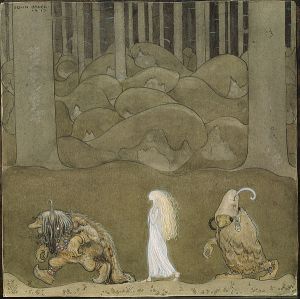
The midterm elections brought some much-needed balance to a government way off kilter.  There are still trolls under the bridges, however.  The storybooks tell how knights vanquish trolls and even the liberated male can’t help but imagine himself on that proud steed.  What kind of man takes a keyboarded cheap-shot at another man’s wife?  The quality of his discourse speaks volumes.  Those on the left believe in equality and can’t respond in kind.  It is, ironically, a far more biblical response than trolling on the right.

I’ve lost readers of this blog due to politics.  Some of my former readers have even told me so.  I appreciate their candor.  We can’t all agree, I know.  What we can do, however, is be civil.  Those who put themselves in elected office know that they are opening themselves to criticism.  It is very hard to slander a United States president, in the words of the Good Book, “how the mighty are fallen.”  Those with thin skin should think twice (or even once) before running for the most criticized office in the world.  Most, until now, knew that what they said would set the tone for the nation.  We’re all entitled to an opinion, and, for the time being, are free to express it.  Still, I’d think twice before insulting another man’s wife.  But then, I’ve always been a hopeless idealist.


Centuries

Although it may not be obvious, history marks us as hopelessly shortsighted.  As a species we’ve only been keeping written records for about four millennia.  History, as we know it—without the intervention of gods—is an even more recent phenomenon.  Since living a century is a rarity (although becoming more common), a hundred years seems like a very long time.  Our lives spin out over a brief span of active decades until we run out of energy and let others make the important decisions.  We hope, against hope, that they will have learned from our collective mistakes.  Learning isn’t always our strong suit as a species.  In just one century we forget and arrogantly refuse to read our history.

One hundred years ago the War To End All Wars ended.  World War One was a slaughter on a scale unimaginable, involving nations around the world distrusting each other and hating one another enough to threaten all the advances of millennia of civilization.  When the war was over we thought we’d seen the last of conflict.  Two decades later it started all over again and the Second World War wiped out millions of lives.  The aggressors, known collectively as fascists, were strong nationalists, believing in racial superiority and privileged rights for those in power.  When that war ended, just about seven decades ago, a stunned world took little for granted beyond the awareness that fascism was, at least, gone for good.

Today we stand on the brink of a chasm that spans one century.  Fascists are in power in the United States and elsewhere.  International tensions are running high and the “leader of the free world” openly eschews reading history.  Protests against the war in Vietnam were largely prompted by the real-time coverage on television.  Now we have a world-wide web, but no basis for truth beyond the tweets of madmen.  For many people the decade-and-a-half that they spend in school seems a long time.  We used to believe that it took that long to learn what our restless youth need to survive in a complex society.  We teach them, among other things, history.  The need to learn from our past is perhaps even more important than technology.  My generation of academics, reaching over half-a-century now for many of us, has been taught that lifelong learning is the value we must instill in students.  Given that we’ve collectively had a century to learn, and that we’re still edging toward the same collapsing precipice, a hundred years seems not nearly long enough.