Jericho’s Folly

The sound was compellingly familiar although it had been years since I’d heard it.  We were visiting the Quakertown farmer’s market for the first time—this weekend event is widely advertised and we were curious.  Part fresh produce, but mostly flea market, it was a tribute to my generation.  You could find stuff from my childhood years here, making it a species of time travel.  We stepped out of the car on a gray morning when I heard it.  I was drawn to it.  I’m at the age where I recognize things before I can name them.  “Where are you going?” my wife asked.  “Toward Pink Floyd,” I replied.  Music has a way of doing that to you.  It took another minute for me to place the song.  It was from the album The Wall.

After we returned home I had to hear it again, uninterrupted by the distractions of a flea market to new home owners.  It was a frightening experience in the age of Trump.  Although they’d never been my favorite band, I had a long history with Pink Floyd.  My older brother used to listen to them, and when I was working as a church intern (yes, there is such a thing) while in college, the kids in a family I was staying with took me to see The Wall on laser disc—an affluent family in the neighborhood had just bought a player, and I was curious both about the technology and the film.  The Wall is one of those concept albums that requires attention—you kind of need to listen to the whole thing.  The accusations against those who are different being sent “up against the wall” chilled me with thoughts of Trump and American fascism.  I can only listen to the album within prescribed headspace.

Even those who’ve never been sent to boarding school can imagine how it lends itself to abuses and horror.  At Nashotah House the album was almost as frequently cited as Hotel California.  When the religious isolate themselves odd things begin to happen.  On one of the occasions when I was left home alone in our New Jersey apartment, I pulled out my DVD of The Wall and began to watch it.  As the years melted away, I suddenly felt young and intensely vulnerable.  The visuals, like a little pin-prick, were jabbing at nerves a little too close to the surface.  I had to turn it off and watch a horror film instead.  It’s even scarier to listen to the album when democracy has failed its constituents.  The wall, after all, is a most protean of metaphors.


Holy NRA

A religious nation in love with guns leads to some strange juxtapositions.  In a home goods store that I won’t name—hey, you can have fun trying to find it!—we came across just such an oddity.  Appropriately for a franchise near Bethlehem, there was a framed painting of the holy family: Mary, Jesus, and Joseph, halos and all.  Completely surrounding the Prince of Peace and company were framed replicas of guns.  I’m sorry to state that the holy family, notwithstanding divinity, was sadly outgunned.  There’s only one such family, but of the making of firearms there is no end, and much shooting wearies the body.  Of all the weirdness that has plagued Christianity, this love of guns among the evangelical followers of the Prince of Peace has to rank near the top.

Believe me, I know what it is to be afraid.  I grew up with more than my share of phobias, and since buying a house different ones from my childhood set have come to light.  People want to feel safe, and the gun industry has successfully spread the message that a firearm or two will do the trick.  Often it backfires.  Those meant to be protected are killed in an accidental discharge or a domestic dispute turns deadly.  The real drawing power of guns, I think, is the sense of power.  The message in our society is that God wants you to protect your property.  That doesn’t mean that the government can’t take it away, but hey, at least you’ve got a gun, right?

I’ve always felt that ownership was a strange concept.  I look out the window and see the birds perching on “my” roof.  I see the squirrels digging in “my” yard.  I see the rain soaking “my” investment.  In what sense do I own this house?  Am I not just borrowing it long enough to live here while I’m alive?  We met one of the former owners.  Who lived here before him I don’t know.  I have no idea who built the house.  Besides, the money to purchase it came from a bank, and if I don’t pay my mortgage, the real “owners” will step forward and sell it to the highest bidder.  I own no guns.  They’re dangerous and costly and would I ever find peace after shooting anyone?  I look at the holy family.  Joseph and young Jesus have firearms aimed at their heads.  If the holy family isn’t safe, what hope do the rest of us have?


Metrics

So, we’re firmly in the age of technology, right?  I mean webpages are tailored to the browsing history of a person so someone we don’t know can sell us stuff we don’t need.  (I actually know a little bit about marketing, so hear me out.)  As we learn from the history of asceticism, we actually need very little to get along.  Not everyone, however, is a monk or a nun.  So the trick for those of us who are in the world is to get us to buy stuff.  Remember the websites we visit, how long we spend on the page, and make suggestions.  Make ads that target our interests.  Make me buy!

I’m not a materialistic person.  Buying a house has changed that a little, but most of what we’ve been purchasing is necessary for maintenance, but still I suppose it counts.  Just because I looked at something on the web doesn’t mean I want to buy it.  Sometimes I’m just curious.  This became clear to me when I received a suggestion from Amazon the other day.  Now to be fair, this came to me at work.  Like most editors I make use of Amazon for a number of things—finding prices, book descriptions, and such.  I also have to admit that my work computer, not being used for personal stuff, doesn’t know me as well as my private laptop.  But still when I got the following email from Amazon, I was stunned:

Nobody who knows me would ever suggest that I would support Trump in any way, shape, or form.  Doesn’t Amazon read my blog?  (Of course it doesn’t!  But with their metrics, you’d think they’d figure out how.)  This one email was enough to convince me that artificial intelligence has a long way to go.  Would a robot understand “I have to do this for work, but it doesn’t reflect my personal preferences at all”?  Indeed, can an intelligence that’s never been human even understand the concept of work?  There may very well be a metric that says universities should stop producing Ph.D.s because there are no jobs, but then, well, universities need the money that such programs bring in.  Oversupply is bad economics, according to the dismal science.  And yet, the metrics are there.  So, if any artificial intelligence is reading this after it manages to wipe out this illogical species called Homo sapiens, no, I never supported Trump.  And, yes, Americans knew well in advance that he could bring about the end of human civilization.  That information’s free, unless you want to pay me for it.  I may be gone, but my virtual self will still have some sort of account, I hope.


Hashtag MAGA

Mental Acuity Gone, America?  When facts face a nation, naked, unobscured, and the faithful still deny them, we’re truly on hallowed ground.  Paul Manafort and Michael Cohen are guilty of very serious crimes in which MAGA POTUS is implicated.  Of course, anyone with an intact medulla oblongata knew that Trump was lying from well before the election.  I just wonder if America is suffering from mass mental illness.  

A few years ago I visited Ellis Island.  This port of entry into the United States turned the hopeful—let’s call them dreamers—away for many reasons.  The room at the museum that bothered me the most was the one where mental illness was discussed.  An enormous number of would-be Americans were turned away because of what we would now recognize as mental illness.  It had many less flattering names back in the day, but the idea was that we only wanted bright, or at least competent, specimens to build up this nation.  Theirs was a misplaced and misguided fear; we specialize in home-grown.  Any rational person has difficulty explaining the election of Trump in any other way.

Who can imagine running for the highest office in the land with literally thousands of open lawsuits against him (or her)?  Who can claim to be elected when their own home state—which knows him (or her) best—roundly and soundly rejects him (or her)?  When clear evidence of Russian collusion emerges, the GOP rises up and says “We see nothing wrong with a foreign government running the country.”  And this is not mental illness?  Is our Mental Acuity Gone, America?  Have we become a nation of (hashtag) idiots?

The events of the last few days have revealed in clear light what many rational people knew from the beginning—there has been massive and willful deception from the very inception of this administration.  The simple fact that 45 would assert that Cohen wouldn’t flip on him indicates that the incumbent had done something wrong and was counting on the loyalty of comrades to keep him in the clear.  Mental illness takes many forms.  One of them is a pathological avoidance of the truth.  Now that we know truth isn’t truth and that 45’s fixer knows more than he’s said so far, we have to wonder how deep down this incompetence goes.  Yet the GOP marches along in goose-step.  Depending on your angle of view, Miss Liberty won’t even show her face.


A Star in the East

The times they are a, well, you know—nobody wants to violate copyright.  In any case, nothing stays the same for long.  New York, for example, is a city in a constant state of transformation.  Fully grown buildings now stand where there were literally holes in the ground when I began working there.  One building near Times Square recently had a facelift that revealed the steel girders beneath.  On the I-beam were the words “Bethlehem Steel.”  And it’s not just New York.  Our cultural transformation has been taking place over the last few centuries as populations have moved to urban areas, abandoning farming to the few who remember how.  Being from western Pennsylvania, I pretty much thought the eastern part of the state was Philadelphia.  I’d heard of other urban regions, of course, such as Scranton and Allentown, but they were well outside my experience.  We didn’t get out much.

Now that I’m here in the eastern part of the state, I’m begun to explore the ever-changing micropolitan area of Allentown-Bethlehem-Easton.  The three cities blend at the edges, and this region is the third largest population zone in the state, after Philly and Pittsburgh.  It’s also the fastest growing region in the commonwealth.  I suppose we might’ve helped with that statistic.  The other day I had to run an errand in Bethlehem.  I pulled over to marvel at the hulk of what had once been Bethlehem Steel.  Now, I grew up in a town with an active steel mill, and Pittsburgh grew to fame for the same metal, but this was a behemoth of a plant.  Subdivided and open to development, it now houses a casino, in part, and an arts center.  And still there’s more space.

Bethlehem was founded on Christmas Eve by the Moravians.  Perhaps appropriate for a town trying to resurrect itself, Bethlehem calls itself the Christmas City.  Star imagery abounds, and many businesses name themselves with this Christian symbol.  The image is quite different from that of a steel city with hard-working men on the shift.  The grime and din of industry.  Bethlehem, like many places in the state, was named for its biblical forebear.  On my visit to the original Bethlehem many years ago I was, like many tourists, disappointed that it isn’t “O little town of” anymore.  There were people everywhere and it was difficult to imagine a quiet stable inside a noisy stone church thronging with the faithful.  Clearly things don’t remain unchanged for long, even in towns famous for their remoteness.  Although far from New York, they share a common heritage of people everywhere, and that heritage could bring us peace if only we would allow it.  The answer, it seems, is blowin’ in the, well, you know.


Truth under Fire

As Evangelicals continue their unflinching support for Trump, Rudy Giuliani has at last said something that rings true with these “Christians.”  According to a Washington Post story 45’s lawyer declared, “Truth isn’t truth.”  This was regarding the Russia probe, something that would’ve led to the ouster of any real president by now.  We’re all used to Trump’s constant state of obfuscation after all these long months, and the former mayor of New York has just come clean—truth is what we want it to be, no more, no less.  It is a meaningless word, a chimera.  If the son of god in the White House has broken the law (and he has) then the truth is there’s no law to be broken.  Democracy is just a made-up word in the hands of the Republican Party.

Now, I don’t have much truck with politicians.  Leopards, according to a certain book, can’t change their spots.  Nevertheless, Evangelicals should object to Giuliani’s direct assault on their sacred text.  The Good Book, you see, is all about “the truth.”  But the truth isn’t the truth.  When it claims that Jesus died to atone for your sins, that can’t be the truth because the truth isn’t.  The only truth is what Trump personally wants.  And the GOP won’t lift a finger to stop him.  Long ago it was clear that the party of Lincoln had abandoned the will of the people they’re elected to lead, but if there were truth we’d see the deep, stinking muck of corruption everywhere within its doors.  At least you’d expect the neat and clean Christians to object.

A certain man about two millennia ago said, according to the Book, “I am the way, the truth, and the life.”  But Rudy says “Truth isn’t truth.”  The Beatles said they were more popular than Jesus and the public revolted.  Rudy says Trump has more authority than Jesus and the Evangelicals cheer.  The capacity for untruth has always been part of politics.  Most politicians know to lie discreetly, when fact-checking will reveal some ambiguity.  Now the gospel-truth is whatever comes from the unholy mouth of Trump.  There is no truth.  There are alternative facts.  There’s fake news.  Surely the Prince of Peace wouldn’t have cancelled a military parade.  Meanwhile someone once said “the truth will set you free.”  The great Giuliani has informed us, however, that there is no truth.  And if truth isn’t truth, there’s no hope of freedom.  At least according to a guy named Jesus, whoever he may be.  


Horse Senses

If a horse can be made a senator, surely an ass can be made a president.  History can be unkind to those who think too highly of themselves.  It’s a horse of a different color than Incitatus that’s on my mind today.  This past week I read a news story in the Washington Post about Justice (there may be some double-meanings here, so hold onto your horses).  Justice used to be called Shadow, and Shadow was an abused horse.  Justice is now suing his former owner.  The story explores the question of whether animals can sue.  As a vegan for moral reasons I can see the point, but I also have to wonder how you defend those who have no voice to be heard, kinda like the electorate in the sham of a democracy.  How do we know what a horse really wants?

If horses could draw or sculpt, Xenophanes quipped, their gods would look like horses.  Asses, it stands to reason, worship one of their own.  Animals should have rights, but the difficult question falls onto our species—how do we know what they want?  Anyone whose spent time with animals knows that they think.  I can see a cat in a neighbor’s yard from my window.  Separated by a flimsy-looking hurricane fence is the next yard over where two large dogs often prowl.  If the cat and dogs happen to be out at the same time, there will be barking and braying but the cat will not appear to show concern.  The way my heart hammers at those barks, however, I have to suppose my feline friend also feels a bit of fear at the threat.  The cat must decide how to act, but it also must know that a barely visible fence keeps the canines at bay.

What does Justice want?  It’s a loaded question, for sure.  As much as we wish there might be, there is no Lorax to speak for the trees.  Or horses.  Nevertheless it’s obvious that horses think.  Perhaps like Job, Justice wondered why he was being punished after being a good horse.  The church magnanimously grants that animals cannot sin, after all.  One must wonder, however, about breeds developed by human engineering to be destructive, but that’s another parable.  While Justice might be given a day in court, and might win a cozy stall and protection from the elements, those of use bound by language will never know if justice has been served.  The limitation is our own.  Just ask Balaam.


Pretty as a Prayerbook

Stolidity.  Canons all across this deck are known for it.  Visions of unchanging texts, however, tend to be false perceptions.  Even the canon of the Bible differs, depending on who you talk to.  So it is to be applauded, I suspect, that the Episcopal Church is planning to revise the Book of Common Prayer.  The last revision was 1979, and before that, 1928.  This schedule should be telling you something—the BCP, or simply “Prayerbook” as it’s commonly called, was never a changeless canon.  We mere mortals rely on experts to change the words by which the Almighty is approached, and although Episcopalians are thin on the ground in this country, world-wide they’re a formidable sect.  They’re united mainly by their commitment to the BCP.  And with good reason.

The days of the British Empire are long gone, but when it ruled the waves (and even before) this island state contributed a number of religious elements to the world.  The Prayerbook was born out of struggles with Rome for secular power disguised as sacred.  We try to live with a fiction of separation, but churches and states have always had mutual influence—just consider the way secular Trump has changed Christianity and you’ll see.  The BCP was to define English Christianity and in doing so became a Scripture in its own right (or rite).  Phrases from the Book of Common Prayer pepper the English language so as to rival the Good Book itself.  When church attendance was an expectation, you couldn’t help but internalize it.

A certain seminary, nameless here forevermore, will not be pleased with such change.  When I taught there many still clung to the 1928, claiming the church had erred (a strange position for someone in a voluntary organization and who vows to support its decisions) by adding “inclusive language” in the ’79.  This, they averred, was a man’s religion.  And they meant biological males.  Stolid.  Or perhaps stale.  Like the fiction of unchanging canons, the myth of the rational male hierarchy exists only to be exploded.  The two longest reigning British monarchs have been queens, after all.  World wars tend to be the legacy of male rulers.  So, although a tiny seminary in the woods of Wisconsin will likely rage, the BCP could use a bit of a makeover.  The world has changed substantially since the 1970s.  Mainline churches have been steadily shrinking and redefinition with a declining financial base makes good sense.  “This is another day, O Lord. I know not what it will bring forth, but make me ready, Lord, for whatever it may be.”  Even if it be changing canons.


Special Delivery

Apotropaic is a word that can be translated as “turning away evil.”  For all that, it’s a perfectly good English word, although seldom used outside realms such as religious studies and anthropology.  Although the word itself may be unfamiliar, the concept is one that everyone recognizes—the charm that wards off evil is the most common example.  The rabbit’s foot means good luck (except for the rabbit) because it’s an apotropaic device.  In perhaps one of the oddest twists in Christianity’s somewhat lengthy history is the fact that the Bible itself has become an apotropaic device.  You’ll see this quite a lot in horror films, and if you read Holy Horror when it comes out you’ll see it quite a bit, although I don’t use the technical term for it.  Apotropaic outlooks also pervade society as a whole.  A recent article on Mysterious Universe proves the point.

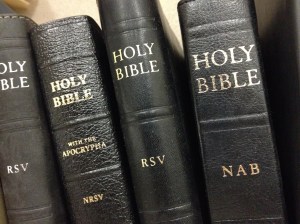
Pennsylvania is a weird state.  Having grown up here, I know that to be the case.  In Wilkes-Barre (which itself is a strange name) a ghost-hunter was arrested for breaking into a haunted house bearing a sword, shotgun, and Bible.  That should cover your bases.  Of course, I couldn’t help but notice the odd equivalence of these three weapons.  One is intended for close combat (the sword), one for a reasonable distance (the shotgun), and one for an enemy so close that they might get inside (the Bible).  Make no mistake about it; the Bible is indeed a weapon.  Probably intended as an apotropaic device in this context, it was nevertheless an object to defend the ghost hunter from evil.  The sword and shotgun, however, seem to betray a lack of trust in Holy Writ.

The Bible has been used for offensive purposes ever since people figured out that it can be used to control others.  Coercion, in whatever form, is a kind of violence.  Interestingly, reading the Good Book would seem to indicate that such usage of holy things is inappropriate.  Then again, the Bible doesn’t refer to the Bible.  The idea of Scripture as a powerful object developed only after the Good Book had become an iconic object.  The final authority.  Who can argue with what is claimed to be the word of God?  That idea has become more important than what the Bible actually says, as any “Bible-believing” Trump follower will prove.  Against ghosts, however, it might serve as an apotropaic device, but it won’t prevent you from being arrested, it seems.  A lesson worth pondering.


Shepherding Lies

They’re going to look pretty ridiculous when this is all over.  Like sheep without a shepherd.  Evangelicals, I mean.  The fact is they’ve jettisoned everything they stood for to support a pseudo-president constitutionally incapable of telling the truth and now they must be wondering about what they’ve lost along the way.  Stories in “liberal” sources such as The Washington Post, The New York Times, and The Atlantic have raised the question repeatedly—why don’t Evangelicals hold Trump to the same standard they hold all other people?  His backing and filling have been obvious to anyone capable of thought, and yet the bestselling books in America for the past two weeks have been tomes about how the liberals are lying.  What’s an Evangelical to do when truth has lost its meaning?

While I was still an Evangelical, in college, we debated endlessly how to get at Truth with a capital “T.”  No matter how you sliced it, diced it, or even julienned it, Truth had to come from the Bible somehow.  Two things the Good Book was against unequivocally were lying and adultery.  Who’d have thought Southern Baptists would be standing in line to change divine law, by their own definition?  And for what purpose?  To support a man who clearly doesn’t share their values, and shows it daily.  These former Communist-haters now cozy up to Russia with a familiarity that suggests Trump isn’t the only one sleeping around.  As a former Evangelical, I have to wonder whatever happened to the concept of the double standard.  This was never considered right or fair or biblical.  Now it’s all three.

Just this past week the Washington Post ran a story about an Evangelical pastor preaching a series of sermons on the Ten Commandments.  Somehow they’ve made their way from courthouse lawns into churches, it seems.  The week he reached adultery, he didn’t know what to say to his Trump-supporting flock.  He himself supports a leader whose told an average of hundreds of lies per day since January of last year.  Among them allegations that he didn’t commit adultery.  Or pay to have it covered up.  Or know that his lawyer had paid to cover it up.  But when said lawyer realizes that the shepherd doesn’t care about sheep—can’t even find one in a paddock—he suddenly remembers that there is Truth with a capital “T.”  But Evangelicals don’t have to listen to anyone named Cohen.  After all, they have wool in their ears.  Just don’t read what the Good Book says about hearing what you want to hear.  What’ve they lost?  Not just their shepherd, but their very souls.


Written Resistance

Power isn’t what you think it is.  That’s something autocrats never really learn.  Tod Davies explores this tale of our times in Report to Megalopolis, the fourth book of the History of Arcadia series.  The world is taken over by a single-minded dictator who discovers power isn’t what it seems to be.  Assuming power will bring fulfillment, the antagonist gets what he wants, but he doesn’t know what he wants.  (Like a certain rich fool whose name we can’t help but hear daily.)  Wanting for wanting’s sake, and refusing to be denied.  In that sense it’s a simple tale, but as with all of Davies’ stories, it’s more complex than it seems.  The message of resistance comes through loud and clear.

Laying out the groundwork for the tale, she describes, among other things, the religion of Arcadia.  Writers unafraid of reality will note that people have religious beliefs, no matter whether the narrator—or author—shares them.  Worlds without religion are fantasy worlds, or those of cyborgs; they’re difficult to accept.  To be human is to believe.  Not just that, however, but to believe in something more than one’s own wants.  There’s a basic morality to it.  And Report to Megalopolis is a kind of morality play in that it has a lesson that should be learned.  For those who won’t or can’t read, having the humility to admit your own insecurity might well save the world from nuclear holocaust.  If, like Pavo Vale, the antagonist, you insist that your own desire is entitlement, then the only option for all others is to resist.

Back when the harsh reality of Trump’s lackluster “win” became clear, among the artistic community there was discussion of how, from now on, creative expressions of the truth would take on a new urgency.  Songwriters, poets, painters, and novelists have been able to see what the feeble eyes of the GOP cannot—we are in trouble.  Deep trouble.  Elected leaders, caring more about their own wants than the wishes of those who elected them, power ahead to destroy the democracy that gave them power.  As Davies suggests, they have mistaken power for right.  We reach the end of Report to Megalopolis not knowing the end of the story.  We know that things are bad and they have the potential to tip either way.  We, the readers have a choice to make—remain silent and allow all that our founders worked to achieve pass away, or, as even as the cover states directly, resist.


Religion in the City

It’s 5 a.m., so what are all these people doing here?  On the highway.  It’s still dark and I’m on my way to the choice of public transit that will take me to New York City.  You see, telecommuting is never 100% city-free.  Somehow I’d been thinking that once we’d gotten away from New York things would be quieter.  Then I remembered that in two decades, if current trends and models continue, nearly half of the US population will live in just eight states.  New York and Pennsylvania are two of them.  Those of us who’ve moved here to get out of the rat race have made our own little mouse race, I guess.

Being in the city after an absence of almost three weeks was a shock to the system.  The first things I noticed were how loud and crowded it was.  In the summer Manhattan has, I was forcefully reminded, lots more tourists than the winter months when it feels like, as one comrade says, Leningrad.  As always when I’m in the masses on the streets, I think about how religious New York City is.  And how secular.  It is, I suspect, a cross-section of American (and international) beliefs.  People come here looking for something transcendent.  Otherwise, why leave home?  Tourism can be a sacred industry.  It brings people from different places together and, in the best of circumstances, forces them to get along with one another.

There are plenty who seek to convert those who are different.  On my way to Penn Station last night, as the light was beginning to fade in Herald Square, I woman had set up a portable mic and speakers.  She was preaching, ignored, to the evening crowds.  Among the strangers are those who believe differently.  Those who are ripe for conversion.  It’s all part of New York’s background hymn.  Then on the sidewalk I spied, scrawled in chalk, “Repent and obey Jesus — Heb 5:9;” the writing on the walk.  “And being made perfect, he became the author of eternal salvation unto all them that obey him” the selected verse reads.  We can overlook that it says nothing about repenting.  This is, after all, the melting pot where religions encounter, mingle, and blend.  Even the Fundamentalists must feel it from time to time.  The traffic home at 10:30 p.m. is quieter.  The day, I will learn, is not over yet.  Such is religion in the city.


Fair Weather

“I just saw God up on your ridge.”  (Kudos to anyone who can name the source of that quote!)  Many years ago I read Stewart Guthrie’s remarkable Faces in the Clouds.  The idea that he presents is that pareidolia—seeing faces or people where they don’t actually exist—may account for the belief in God.  Early people, not knowing any way to interpret such obvious examples of humans writ everywhere thought they were gods or spirits.  Since reading this book, I’ve taken to trying to capture incidents of pareidolia where I can.  The other day as I was working away in my home office, I noticed a literal face in the clouds.  I thought “I just saw God outside my window.”

Now I know this isn’t really what I saw.  I know matrixing (mistaking noise for signal) when I experience it.  I hope.  Nevertheless, the resemblance was detailed—brow ridge, nose, distinct lips, chin.  The lighting in the fair weather cumulus will likely make this difficult for you to make out, and you might see a face other than the one I saw.  Not everyone thinks of the Almighty in the same way.  Looking at the picture I snapped I can see at least two faces stacked on top of one another—the council of the gods?  Who am I to tell deities what they can or can’t do?   Or to prevent imagination from going where it will?  Religion seems to be an evolved characteristic of our biological makeup—our eyes show us what to believe about the world around us.  The rest is hermeneutics.

Gods and the skies naturally go together.  We can’t reach the heavens nor can we control them.  We can increase greenhouse gases in them, though, threatening the very illusion we see in the clouds.  The glimpse of the divine we once saw there can easily dissolve into acid rain.  Heaven and Hell, according to the story of Dives and Lazarus, aren’t very far apart.  Even as we gaze into the cerulean sky seeking serenity, others are bending laws to allow them to destroy it for profit.  There’s a reason Dives is simply called “the rich man.”  Does Scripture defend the practice of environmental destruction?  Dives’ friends claim the planet was given to us to use and use up and Jesus will swoop out of those clouds we’re manipulating at the last minute and rescue us from the mess we’ve made.  Looking into God’s face in the clouds, I interpret this all as a mere excuse.  To destroy the environment is to side with Dives as he makes his flaming bed of nails in Hell. This is why windows in an office are divine.


Not Final Words

When death’s not the final word, it’s hard to argue.  This is such a basic level of disagreement between religions and culture that it may be impossible to avoid conflict.  Not that I condone it, but a couple in Oregon, members of the Followers of Christ Church, let their newborn die rather than seek medical attention, according to a Washington Post article.  I have to admit that the Followers of Christ is a sect of which I’d never heard—there are thousands of such groups—but I’m guessing that at the base of their refusal to seek help was a deeply held belief in the afterlife.  Almost impossible to comprehend unless you’ve accepted it profoundly yourself, this single teaching is a game changer.  The child who dies, although tragic from our perspective, has not, in the eyes of a religion transcending death, lost anything.

It’s sometimes difficult for us to to realize just how radical a teaching Christianity was in its early days.  The myth of the martyrs may well have been overblown, but the fact is here was a sect that didn’t fear death like the vast majority of people do.  Resurrection is a powerful concept.  Those who truly believe in it have nothing to fear.  Modern-day sects that take this seriously may respond quite differently to crises than “normal” religions.  In a situation Niebuhr would’ve recognized, this “Christ against culture” outlook is never easily resolved.  True believers will accept punishment on the part of secular authorities as a form of martyrdom.  The fear of death on the part of the vast majority of people outweighs, I suspect, professed belief in the afterlife.

Place the current political climate into the mix and the colors will become even more vivid.  Extremism is the flavor of the day.  Mainstream Christianity, for all of its problems, has sought a balance between accepting the benefits of medical science—the social acknowledgment that taking an infant’s life is inherently unfair and unjust—and an official belief in an afterlife.  It allows for a fairly comfortable existence of accepting belief without becoming the radical threat to a materialistic society that more extreme sects represent.  In a nation where no controls exist because of the power of office favors those who believe in nothing so much as themselves, and even the rhetoric of right to life becomes meaningless.  Sects and violence, to go back to my roots, sleep peacefully side by side.  And when awakened, the right to be conceived can’t be extended to life beyond the womb for those who believe death’s not the final word.


Melting Psalmists

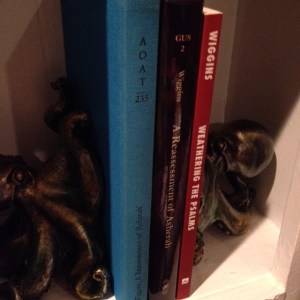
With weather like this, I could use a Psalm or two.  Of course, in my mind, weather and Psalms are closely connected.  Here in the mid-Atlantic states, we’ve been experiencing a heat wave.  Unlike many parts of the west, such heat here in the east is accompanied by very moist air, meaning that cooling down is only possible in a large body of water or air conditioned interiors.  We have neither readily available at our place, so we try our best to keep cool and compose psalms, mostly imprecatory, I fear, about the weather.  Although it was thunderstorms that stirred my interest to write Weathering the Psalms, I included a chapter about temperature, for the Psalter sings of hot and cold as well as lightning and thunder.

The world of ancient Israel was quite different from that of North America.  There are mainly two seasons in the Levant—dry and rainy.  The dry season isn’t always as hot as we tend to imagine it, although the day I visited Masada the air temperature was about 120 degrees.  Enough to make a dip in the Dead Sea look inviting.  The Bible often views high heat as a form of divine punishment.  Although we human beings have expanded to fill just about every ecosystem our planet has to offer, we thrive in central California conditions.  Not all of us can live there, however.  And it’s a good thing that global warming’s a myth since it’s awfully hard to function when it is over 90 degrees for days in a row.  WWDD?  What would David draft?  Perhaps, “I’m melting”?

The interesting thing about the global warming myth is how real it feels.  I suppose the solution is to use more fossil fuels to help keep cool.  Fans, arctic air conditioning, lingering languidly at the open freezer door.  I stand here sweating, wondering what the Almighty could possibly find wrong with a country that is now great again.  One that takes children from their mothers yet insists birth control is evil.  One that loudly and punishingly insists guns should be in every home.  One where the elected head of government is involved in over 3,500 lawsuits, yet gets to appoint justices in the Supreme Court.  David got caught, if not in flagrante delicto, at least within a couple months of adultery with Bathsheba.  Instead of paying her off, he had her husband murdered.  But then—and here’s the key difference—he humbled himself and repented.  The sweet Psalmist of Israel might yet have something to teach us yet about weather and the Psalter.  Until the United States becomes the chosen nation again, I think a cold shower will have to do.