Learn and Let Learn

My wife often works weekends.  Generally this involves trips to New Jersey, and since my unconventional schedule means we see each other awake only a brief time during the week, I often tag along.  The colder months of the year, and general economic caution, mean things to be done around the house can wait.  Most of the locations where she works have nearby bookstores, but even a guy with proclivities like mine finds it hard to spend more three or four hours in one place, even in such a welcome environment.  It finally occurred to me that one need not be a resident to find shelter, and free wifi, in the public library.  I’ll pack my laptop, and if it’s going to be a full day, a sack lunch, and head to the library for a change of scenery.  It has led to a kind of renaissance for my spirits.

Public libraries generally do not house the books I read.  The source of my jouissance has rather been discovering how well used the libraries are.  In both affluent and more modest neighborhoods, people willingly spend part of their Saturdays in buildings dedicated to learning.  Not all are there for the books, but they seem comfortable surrounded by them.  We gather in a temple to the human mind.  And everyone’s generally quiet.  Mentors coach young people who want to learn.  Some even dress well, as if the library might be a place to be seen.  In a nation where education is under attack, I always leave refreshed without spending a penny.

Such opportunities are a rarity.  Before the library opens, if we happen to be at her venue early, I may need to find a Starbucks.  They more or less assume you’ll consume to utilize their free wifi, but beyond that a day at the library comes without cost and considerable gain.  A variety of ethnicities are always present, and nobody’s right to be here is questioned.  It’s a microcosm of what we could be as a nation, had we the will, the desire to learn and let learn.  People generally have a difficult time with silence—just ask any introvert.  I suspect this is one reason not everyone shares my enthusiasm for a cloistered experience of a Saturday.  Libraries are where we’re forced to be relatively quiet to respect the needs of those actually there to read.  Hoi polloi prefer to be loud, as any bar on a weekend afternoon will reveal.  But the libraries remain, and even in their own way, are buzzing hives of the life of the mind.


Mostly Clear

“Chiasm” is a literary technique based on the name of the Greek letter chi, shaped like a latinate X.  The idea is fairly simple and generally resembles a sideways V more often than an actual X.  It goes like this: a poem, or story, begin at a large, or wide premise, narrows down in steps to a center, and then, by corresponding steps, again out toward a larger, or wider resolution.  Another way to think of it is a set of Matryoshka dolls; first you take them apart, and then you put them back together.  David Mitchell’s Cloud Atlas is a chiastic story.  Starting on a cross-ocean voyage at an indeterminate time in the recent past centuries, it moves on to a Briton on the continent in about the turn of the last century, then a mid-twentieth-century American investigative journalist, a late twentieth-century or present-day rogue publisher in Britain, a clone in future Korea, and finally, to a planet of the apes-like Hawaii of the distant future.  Not really finally, though, since after the center of the X, it moves back outward through the nesting stories to bring us back to the beginning.

I’m not going to attempt to retell the story here, so don’t worry—it doesn’t get any more complicated.  There are, however, a couple of remarkable things about the tale.  In the brutish, nasty, post-collapse future that marks the center of the narrative, religion is central.  Some of the Hawaiians have come to believe the protagonist of the nesting story, the clone mentioned above, was a god.  To find her story, however, you’ll need to read the book.  Suffice it to say, that origin myth is part of the overall complex structure.  The second of the remarkable features, and one that makes this book very salient, is that in all the ages the issue of accepting those who are different is central.

In the outside framing story, the initial and terminal points of the chi, one of the characters is a missionary.  He’s trying to “improve” he life of Polynesians by making them into slaves, whereby they benefit from the largess of Christianity.  Quite a bit of the narrative draws its energy from the eventually faltering sense of superiority of the AngloSaxon “race.”  In that sense it’s definitely a parable for our time.  A story that deserves to be read.  Defying easy genre identification, Cloud Atlas is a thought-provoking novel that doesn’t fear religion and its larger implications.  A couple of the nesting stories have exquisite twist endings worthy of the Twilight Zone.  This book will make some demands on your time, but its message makes it a sound investment in a world rapidly heading toward a future that reveals just how troubled our species is.


Sustainability

There comes a time, it seems to me, when each generation realizes it’s made a mess of things.  Well, at least the thinking members of a generation do.  I mentioned a few days ago that I kind of idealize the sixties.  The book about them that I mentioned wasn’t shy about showing the misguided aspects of the time.  In many respects life is better for many—not for all, and that’s important to remember!—and we’re more connected with better, if too expensive, medicine.  More people are finding some kind of enlightenment and realizing that we continue to use up this limited planet far too swiftly.  At the moments when such thoughts become oppressive, I recall the young.  Perhaps we’ve done something right by gifting ourselves our forward-looking offspring.

A website my wife recently pointed out to me, Sustainable Millennial, is a locus of hope.  For too long we’ve bought the lie that anything really is disposable.  Bread cast upon the waters comes back, even if you put it on a rocket and send it to space.  You see, society has bought into what was a deliberate economic plan—help people find meaning in consuming (the war was over and the economy slowing, we were restless).  If you could get people to spend money for things to make themselves happy, well, just ask MC for the results.  Problem is you only have room for so much stuff.  Better make it “disposable.”  Trash heaps never fill up, do they?  Heaps become hills and hills become mountains, and all the sudden we need to get Daniel on the phone.

Our young understand something we’re slow to ken.  We’ve polluted, used up, and “thrown away” what can never be replaced.  The good news is that there are other ways to live.  We can reduce waste and even stop paving any space wide enough for a car to squeeze through.  All that’s being made is mere money.  What we’ve needed is voices not long enough vested in the system to try to change it.  By the time you’re middle aged you spend far too much energy trying to figure out how retirement’s supposed to work to have any left over to challenge the system.  The young are, and always have been, the future.  There are fewer angry white men because they realize that the plan of their forebears for personal gain simply hasn’t worked for the majority of people.  Daniel isn’t the only visionary, but even his young companions fade before they started worrying about disbursements and tax consequences.  If the young don’t lead we’re lost.  


Christianity sans Christ

Pieter Breughel the elder

“He that is without sin among you, let him first cast a stone at her.”  (Please pardon the sexist translation, but the King James is in the public domain.)  That verse, and many others, have been going through my head since my former United Methodist Church decided to close its doors to those who are different.  The reason this verse sticks out is pretty obvious—according to the Good Book we’re all sinners.  The “Christianity” that the UMC has embraced is that of Paul, not that of Jesus.  In fact, Jesus seems to have exited, stage left.  You see, only with a great deal of casuistry of exegetical caliber can anyone claim that Jesus (aka God) said anything about homosexuality.  Not a single word.  His response in the famous story of an adulteress (what of the adulterer who partnered in her crime?) caught in flagrante delicto, he gave our opening quote.

At one point Peter, exasperated with his master’s kindness, sputtered how many times did he have to forgive—seven times?  More like seven times seventy.  The one without sin has itchy fingers where stones are abundant.  Once at Nashotah House we had a student from Kenya.  He was already a priest, and he had a family back home.  At one point I asked him about his wife.  He informed me that his brother now had her as wife while he was gone.  It was the way of their culture.  This same student—for we are all students all the time—had harsh words for American sexual practices.  He later tried to find a way to stay in the United States, leaving family behind.  The Bible may turn a blind eye to polygamy, but polyandry is definitely stone-worthy.  Who is without sin?

Ironically the UMC has lined up against the Gospels.  Christianity’s sexual hangups began with the apostle from Tarsus, not the carpenter from Nazareth.  We have been forced to see, time and again, what comes of making priests remain celibate.  It’s against nature, and none of us has a free hand to grope for a stone.  Instead, we queue up ready to judge.  Love, the church says, is wrong.  God, says the Gospel, is love.  There’s a mansion with many rooms above our heads.  We’re not told if the doors come with locks or not.  Unless this seem unnaturally profane, anyone who has truly loved another knows it is more than just a physical act.  Such spiritual intimacy is difficult to spread too thinly without cheapening it to the point of a tawdry sit-com.  Even then, however, we shouldn’t judge.  There aren’t stones enough in the world for that.


Like a River

It still gives me the creeps, to be honest.  Although a myth, well, let’s not dignify it with that noble term—although an urban legend, the origin of the “peace sign” with “Nero’s cross” upset me as a child and still has its hooks in me.  I remember distinctly the Christian comic book that showed a “Christian hater” turning a cross upside-down and breaking it.  The physics of it puzzled me even as a youngster—to break something like that you needed to have some kind of tension.  Snapping two arms off a cross simultaneously must’ve required some kind of magic.  In any case, it was a scary thought.  Now I’ll be the first person to admit that I need more time to study the symbols here, but it seems that “Nero’s cross” was a myth—er, urban legend intended to demonize the peace sign.

The “peace sign” has a documented history going back to the 1950s.  Gerald Holtom designed it based on the superimposed semaphore letters N and D which stood for “nuclear” and “disarmament.”  This was part of the British Campaign for Nuclear Disarmament, a cause that even then evangelical Christians did not support.  Being hawkish, this aggressive, masculine belief system wanted no long-hairs wearing a sign that to them looked like an inverted, broken cross.  Back in Nero’s day crucifixions were disturbingly common.  I suspect many people would’ve been only too happy to see crosses broken and government behaving a bit kinder.  Did they actually circulate a “Nero’s cross” as a hate sign for Christians?  You have to wade hip-deep through Evangelical websites claiming so before you can get anywhere near a site that has actual history on it.  Even then you’ll be left scratching your head.

Some liturgical vestments (sorry to talk shop) such as a chasuble, occasionally have a cross with “broken arms” on them.  Back in the 1950s Evangelical cats hated Catholic dogs and even as a kid I heard rumors about how such symbols were “anti-Christian.”  Were they inverted “Nero crosses?”  Religious symbols have long, rich histories.  We know that the “peace sign” first appeared in the 1950s to protest nuclear buildup.  We know that Evangelicals prefer to sacrifice doves on the altar of “national security.”  Might as well use some olive branches for kindling while you’re at it.  Although I know the origins of the “peace sign,”  I still always hesitate a moment before using it.  Such is the power of early indoctrination.  Even if it defies the laws of physics. 


Qaulity Education

Perhaps it’s from having a stubbornly blue collar, but snobbery has never appealed to me.  While in seminary at Boston University, I applied for a transfer to Harvard Divinity School.  In spite of being accepted, I stayed at my alma mater and paid the consequences.  There’s a strange loyalty among the working class, you see.  And now I’m finally seeing my former mistress, academia, taking a turn toward the lowly but worthy.  The title of a recent article in the Chronicle of Higher Education says it all: “As Scholars Are Driven to Less Prestigious Journals, New Measures of Quality Emerge.”  Hmm, why might that be?  The industry mantra, “publish or perish” has grown more aggressive over the years and the number of publishers has decreased.  Your academic net worth, it seems, can no longer be based on how elite you are.

People are funny that way.  We’re very impressed by those paraded before us as successes—as if some kind of magic clings to those who are where we wish we were.  In academia where you went to school matters more than what you’ve proven yourself capable of.  If you attended the “best” schools your work will be accepted by the “best” journals and publishers.  What rarified company you’ll keep!  For the rest of us, well, we have the numbers.  And blue collars aren’t afraid of hard work.  Let the academic aristocracy enjoy its laurels.  Laurels are poisonous, however, for those with an eye open for parables.

Primates, according to those who know them best, can see through pretense.  I often wonder if our political chaos isn’t based on this simple fact of biology.  As a priest I knew once told me, “We put our pants on one leg at a time too.”  This didn’t prevent many postulants I knew from anticipating the day when they would be ontologically transformed.  Priesting, I was informed, would make them better than the laity.  Closer to God.  Here it was, even among the clergy—the desire for prestige.  Chimpanzees will take down an alpha who abuses his power.  Nature has a set of balances.  Tampering with them leads to, well, scholars being driven to less prestigious journals and the like.  The net result, as the Chronicle suggests (if read one way), is that the last shall be first and the first last.  Probably it’s the result of reading too much Bible in my formative years, but I’ve always appreciated parables.


Lore of the Folk

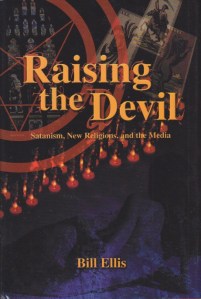
Once in a great while you read a book that has the potential to shift paradigms.  The unusual and provocative Raising the Devil: Satanism, New Religions, and the Media, by Bill Ellis, is such a book.  Perhaps the main reason for this is that Ellis is a folklore scholar who takes his subject seriously.  He cites some unusual sources non-judgmentally, but critically.  He suggests that folklore can actually dictate reality for its believers, while not demanding that it defines how everyone else sees the world.  This fine parsing allows him to examine the satanic cult scares of the 1980s and ‘90s with a kind of passionate dispassion.  He traces the historical contexts that made such panics possible, all the while keeping belief structures in place.  In the end, the giving in to this folklore on the part of society can lead to tragic results.  Understanding folklore might well prevent that.

Since our prevailing cultural paradigm is a materialism based on empirical observation, at least among those deemed “educated,” it is easy to lose track of how belief constructs our worlds.  Ellis finds the cradle of satanic panics in the Pentecostal tradition where deliverance ministry—a Protestant form of exorcism—takes seriously the belief in demons of many kinds.  This leads to a study of ouija boards and Spiritualism.  Although neither led to Pentecostal theology, both play into it as doorways for demonic activity, in that worldview.  Add into this dissociative identity disorder (what used to be called, and what Ellis refers to as “multiple personality disorder”) and the recipe for a spiritual mulligatawny is simmering away.  You need not believe what the victim says, but if s/he believes, you must pay attention.

Outside the strict confines of Satanism, other cultural phenomena allowed for panics to grow.  Popular narratives, largely false, of satanists cum evangelists (think Mike Warnke) mingle with cultural fears such as the Highgate Vampire scare and cattle mutilations to make a narrative of satanic ritual abuse believable.  A folklorist sees the connections that a strictly wielded razor by Occam tries to shave away.  All of this fits together.  When we don’t pay attention to how real this is to those involved, a half-baked public panic can erupt.  Ellis suggests such circumstances might well have led individual witch hunts into large-scale witch crazes.  While both are unfortunate, the latter tend to lead to many, many ruined lives.  The subtle awareness that one need not believe in order to understand those who do is something worth pondering.  Reality may be far more complex than the activity of electro-chemical signals in a strictly biological brain after all.


Remembrance

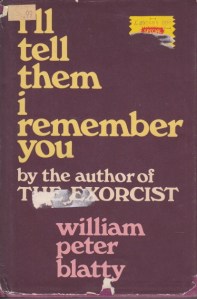
When reading C. S. Lewis’ Surprised by Joy, a number of things stood out in high relief.  One of them was his statement that the early years of autobiographies are often the most interesting.  Now, many people may have difficulty drawing a straight line between Lewis and William Peter Blatty, but the overlaps are there.  I’ll Tell Them I Remember You is a young man’s autobiography, so mostly it deals with early years.  Even more than that, it deals with Blatty’s mother.  Those of us who write often find a kind of inspiration in the life stories of other writers.  To hear Blatty tell it, or rather, to read him tell it, it was his mother who made him the man he became.  It’s a nice tribute.

Blatty is probably best remembered as the author of The Exorcist, but his background as a comic screenwriter comes through in his account.  (He also wrote, for example, the Pink Panther screenplay A Shot in the Dark.)  But more to the point currently, with a spoiled child wanting to try to force a wall that America doesn’t want on it, Blatty’s parents were immigrants.  From Lebanon.  It may be that since I’m writing a book about demons in movies that The Exorcist seems like an important national achievement to me, but it also seems an apt parable for the situation in which we find ourselves.  It worth thinking about—the invasion of evil and how to expel it.  Metaphorical writing is often the best.

Perhaps writers are naturally obstreperous people.  If my novels ever get published you’ll see that characters don’t do what you want them to.  And yet we like what happens when they don’t.  I would have found a bit more information about Blatty’s life an asset.  His mother certainly makes an impression, even if its third-hand.  Writers, if my own experience is anything to go by, often feel they are conduits.  Receivers.  It’s like listening to the radio when driving a car through the mountains.  Suddenly a station comes in clear, but just for a moment.  Ideas for stories are like that—they often arrive when you can’t do anything about them.  Writers carry notebooks for a reason.  I used to have a waterproof one in our shower.  You never know when the signal’s going to come in loud and clear.  And you never know when the people you’re trying to block out might be adding more value than you’d ever imagined.  You might be surprised.


Love, Not Fear

How do we celebrate Valentine’s Day when our governments advocate hate?  You have to wonder when the autocrats last fell in love.  Building entire polities on hatred harshes the elevated feelings of letting love, well, love.  The only time Republicans seem to smile is when they’re taking advantage of someone else.  But it’s Valentine’s Day, so I’ll try to think charitable thoughts about even them.  

My reading recently has been taking me into the realm of sin.  Let me rephrase that—I’ve been reading a lot about sin recently.  One of the more striking aspects about badness is that it seems closely related to love, or at least lust.  I’ve often pondered why Christianity especially has tended to treat sex as bad.  While all religions take an interest in sexuality, not all of them declare it a negative aspect of life.  In fact, many see as it quite the opposite.  Since I like to trace things to their origins, I wonder why this might be.  Why did Christianity, whose putative founder declared the greatness of love, decide that although love is well and good that making it is problematic?

Paul of Tarsus, whom some credit with being the actual founder of Christianity, considered his celibate lifestyle to be superior.  While he didn’t mandate it of his followers, he highly recommended keeping their commitments to divine causes rather than to prurient human ones.  He believed a second coming was going to occur any day now, and that was nearly two millennia ago.  He was also, through no fault of his own, an inheritor of an incorrect understanding of gender and sexuality.  Even today there’s much about these that we don’t understand, but we do have more evidence-based ideas about what’s going on.  And not surprisingly, we tend to find that love is good and expressing it (appropriately) is also good.  Valentine, after all, was a saint.

Looking out my window, it’s still clearly winter.  There’s snow on the ground from the most recent storm and I’m aching from the upper-body workout that it required to get it off the walk.  But still, in the pre-dawn hours I start to hear—rarely but clearly—the birds begin to sing.  The amaryllis on the sill has sprung into full bloom.  The thing about love is that there’s enough to go around.  It’s a renewable resource.  If only our leaders showed a fraction of interest in it as they show in hate and fear. 


Terror Text

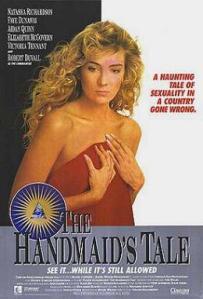
Dystopia reading and/or watching may be more practical than it seems.  History often reveals authors who may be accused of pessimism more as prophets than mere anxious antagonists.  Two books, according to the media, took off after November 2016.  One was George Orwell’s 1984,  and the other was Margaret Atwood’s The Handmaid’s Tale.  I’d read both long before I started this blog, but I recently asked my wife if she’d be interested in seeing the movie of the latter.  While teaching at Rutgers, I had a 4-hour intensive course and to give students a break from my lecturing I’d have us discuss Bible scenes from secular movies.  The Handmaid’s Tale was one of them.  Watching it again last night, I realized the problematic nature of Holy Writ.

The Handmaid’s Tale is a movie (and novel) that involves what I call “Bible abuse” in Holy Horror.  That is to say, the Bible can be used to oppress rather than to liberate.  To cause human suffering instead of eliminating it.  Sure, to make Atwood’s dystopia work a future catastrophe of fertility has to occur, but the military state, the assumed superiority, and the will to control on the part of men are all too real.  We’ve witnessed this in the United States government over the past two years.  A lot more has been revealed than personal greed—that side of human nature that quotes the Good Book while doing the bad thing.  In the movie it’s literally so, while our “leaders” are only a metaphoric step away from it.  Although it’s not horror, it’s a terrifying movie.  I still have trouble watching The Stepford Wives.  Why is equality so easy in the abstract, but so difficult when it comes to actual life?

Aggression is not a social value.  This is perhaps the most ironic aspect of using Scripture to enforce oppressive regimes.  The whole point of the New Testament is self-denial for the sake of others.  That may be why the only Bible reading in the movie comes from the Hebrew Bible, the story of Jacob and Rachel.  Although this isn’t one of the traditional “texts of terror,” to borrow Phyllis Trible’s phrase, it nevertheless illustrates the point well.  A culture that values women only for their reproductive capacities is dystopian to its very core.  When a book, no matter how holy, is divorced from its context it becomes a deadly weapon of blunt force.  Atwood moves beyond Orwell here—the government that sees itself as biblical can be far more insidious that one that only weighs evil on the secular scale.  Not only the Bible ends up being abused.


May Care

The thing about the Devil is that evil is no laughing matter.  Darren Oldridge had no easy task limiting the dark lord to The Devil: A Very Short Introduction.  He nevertheless does an admirable job packing lots of provocative stuff into a small package.  The historian of religion part of me found his short history of Satan in chapter 2 a compelling synthesis of the character’s background.  Longer sources get tangled in theological weeds once the New Testament’s over, what with erstwhile saints being recast as heretics over some minute point of doctrine.  Lots of ideas about the Devil were floating around in those days, even as they are today.  A particularly important point, however, is made early in this book: even during the Enlightenment most intellectuals—including scientists—assumed the reality of the spiritual world.  It was only when materialism alone came to reign that there could be no Devil because there could be no spirits.

A vast disconnect continues to exist between “public intellectuals” and hoi polloi.  The vast majority of people in the world are religious.  Even in, especially in, the United States a great number of people believe in the Devil.  Many of those same people can’t recognize political evil when it stands naked before them.  Here’s the irony of it all: Oldridge discusses how an evil system, let’s say Nazism, blinded many otherwise decent people to the evil they were asked to perform.  Rhetoric that demonized the other, when dispersed over large crowds, has historically had that effect.  Today we see “Christians” claiming that a social system of helping those in need is of the Devil.  The greatest weapon of the prince of darkness is the sincerely believed lie.

Lies have always been associated with the Devil.  When the number of untruths coming from the White House has broken the very meter for measuring lies, those who claim the name of the crucified man who advocated care for the poor shout all the more loudly.  Not at the lies, but at those who don’t accept them.  Historically, the reign of facts has kept some checks on the Devil.  Even Jesus accused Herod of watching Fox—or was it being a fox?—too bad there are no facts to check.  Oldridge doesn’t tip his hand as to whether there is an actual Devil or not.  Society has, however,  no trouble making up its mind.  All they need to do is turn on the television.


Something Blue

I’ve worked for two British publishers.  This probably has nothing to do with the fact that I lived in the United Kingdom for over three years, but the two situations have this in common: they’re bloody complicated.  I say that for a reason.  I’ve always wondered why “bloody” is considered swearing in Her Majesty’s realm, but not over here.  Profanities tend to be culturally specific, of course, while some forms (scatological and blasphemous, in particular) are generally universals.  I had always assumed “bloody” had something to do with religion, kind of like the more tame “zounds” is an abbreviated form of “God’s wounds.”  In fact, the folk etymology of bloody suggests just that.  Folk etymologies, I learned as a budding philologist many years ago, aren’t the same as scientific etymologies.  In other words, like folklore, they aren’t entirely accurate.

One of the lessons I learned in Britain was that if you wish to cite a lexicon, it should be the Oxford English Dictionary.  It’s The authority.  So I thought I’d bloody well check it out on this.  There, it turns out, the emphatic use of bloody has to do with breeding, not bleeding.  Back in the seventeenth and eighteenth centuries there were rowdy aristocrats, or “bloods,” that gave the phrase it’s referent.  These privileged wealthy classes, as befitting the stereotype, could afford idle drink.  They did not work, so life was a matter of passing the time with aristocratic pursuits, such as imbibing.  This led to a phrase “blood drunk,” which, disappointingly, didn’t refer to Dracula, but meant drunk like a blood.  It was only a short, tipsy walk to “bloody drunk.”

Antoine-Jean Duclos, from Wikimedia Commons

Disengaging the adjective—like the saucer part of the Enterprise pulling away from its iconic Star Trek hull—you get stand-alone “bloody.”  This swear has nothing to do with sacred blood, but rather blue blood.  Which brings us to the realm of sacre-bleu, in which the word “blue” (bleu) features.  But this has nothing to do with the color blue (such as Marian blue, known from mythology of the virgin) but from the fact that bleu rhymes with dieu, and using the name of a deity (although “god” is actually a title, not a name) is swearing.  In fact, it is technically what is meant by blasphemy.  Working for British-based publishers has been its own kind of education.  It’s easy to get lost in etymological labyrinths.  But is that the bloody time?  I’ve got to get to work.


McChristianity

Christianity isn’t known for its sense of humor.  The same can be said of other religions as well, of course.  What else should we expect concerning belief systems that claim eternal consequences?  A story by Colin Dwyer on NPR explains that the Haifa Museum of Art had to remove a sculpture titled “McJesus” due to public violence.  The sculpture depicts a crucified Ronald McDonald, and a number of althoughs follow: although Haifa is in Israel a large number of Christians protested.  Although the practice of crucifixion was uncomfortably common in ancient days it has come to be associated with one particular case.  Although the message might be interpreted as a condemnation of commercialism, protestors took it to be aimed at their faith.  Perhaps it was.  Artists can be notoriously ambiguous in that way.

Ronald McDonald is a liminal, if ubiquitous figure.  Instantly recognizable, he has been challenged before as a threat to christendom.  I once heard a priest lament that children recognized the golden arches more than the cross.  Well, that’s not surprising—we don’t go around telling our kids about crucifixion daily.  (Or shouldn’t.)  A massive Ronnie, on the other hand, floats down Manhattan every Thanksgiving Day.  He’s on posters, commercials, and 42nd Street.  He’s the patron saint of branding.  With his garish clashing color palette, his red and yellow never mix to orange and they linger in our minds to ensure us that no matter where we might be there’s always cheap, if unhealthy, food nearby.  Mr. McDonald has become a religious symbol of capitalism.

Even as a child I noticed the great deal of excitement that accompanied the opening of the local McDonald’s.  In a small, corroded corner of the rust belt, families piled into cars to drive to Oil City to see this wonder.  It was like an epiphany.  Eating out that the poor could afford.  Just about everything in downtown Oil City is now closed, but the last time I was there that McDonald’s still stood.  Back in Haifa an ironic depiction led to real violence.  Angry Christians carrying stones couldn’t see the statue as a condemnation of consumer culture.  Their beleaguered religion was at risk.  Blood flowed and the art piece was removed and packed off to Finland.  Although the point of the display was to question religious appropriation in the support of consumerism, and although that message could ultimately support the teachings of the religion it evokes, the branding came across all wrong.  Church is your kind of place…


For the Love of Dog

All I have to do is say “Old Yellar,” and everyone will know the feeling.  Everyone of a certain age, I should add, who’s owned a canine.  The love of dog.  From where I pass my days I can see out the window into the neighbors’ back yards for four houses over.  They all have dogs.  Big dogs, mostly.  They also have fenced in backyards.  One of the things I haven’t seen too much in our neighborhood is dog walking.  People let their dogs out to frolic, and do their, ahem, other outdoor activities in the yard.  Once a day some member of the family, either with the basic plastic bag or with the specialized, long-handled brush and scooper, slowly surveys the yard to remove any offensive matter so the space may be used for human activities.  It’s a level of care that most would shudder to provide for their own species.

Wolves were the earliest domesticated animals.  In those hunter-gatherer days either they or humans—the jury’s out on which—realized the advantages of working together.  Kind of like we were fated to be partners.  Besides, unless the dog turns on us, there’s no question of who’s the master here, and everyone likes to be the boss.  When I catch a glimpse of one of the neighborhood pets being scolded, or praised, it’s clear they share emotions with us.  The bond is deep.  I often wonder about this—they recognize the tone of voice, something that takes humans a while to learn.  I grew up with dogs and I found out that even if you insult them in a friendly, encouraging tone of voice they’ll love you for it.  Dogs are just that way.

Our first real dog—the one that ended up staying with us his whole life, was a beagle pup we got at a farm.  Dogs like to be with others.  Unlike humans, they don’t have to pretend.  (Although they can do that too, as when they growl at you during a game of tug-o-war.)  Then we leave home and go to our places of business, where capitalism reigns.  We treat other humans coldly, clinically.  “It’s only business,” we’ll parrot, especially if we feel bad about doing what the boss tells us.  That’s the way we treat our own species when money’s involved.  And we’ll sit at our desks, daydreaming of our dog at home that will be so glad to see us when we walk through that door.  And we’ll gladly clean up after our pets what we find obscene even to write in human language.  It kind of makes me wonder when I glance out the window while at work.


Walls and Calls

With a barely concealed chortle the man’s ebullient voice burbled on my answering machine.  For a donation right now, he gushed, Republicans would send bricks to Chuck Schumer and Nancy Pelosi to show my (non-existent) support for Trump’s wall.  Our government has been shut down for a record period over a temper-tantrum by a man desperate to leave something tangible from his wasted term as president.  Apart from the clean-up of the Trumpian incontinence that has befouled this nation, his legacy as the most incompetent holder of the office is likely all that will be left behind in the swamp.  With two full years of control of both houses of congress and the White House there has been pitifully little to show.  Now the GOP has turned to pranking the citizenry to deflect once again the fact that nothing worthwhile has been done.

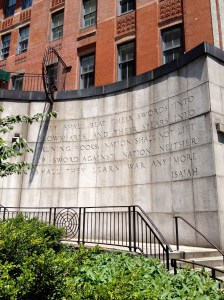
Read the wall

Walls, for those who know how to read, don’t work.  Republicans have forgotten how their former darling, Ronald Reagan, both gloried in his purported role in knocking down the Berlin Wall and his hatred of the Russians.  In a matter of three decades a major political party has excelled only in having outdone Watergate and completely reversing its position on everything that used to define it.  Claiming to be the party of Lincoln they nominated and elected a man who publicly supports the klan.  Branding has never smelled so cheap.  And get off my phone—I’m expecting some important calls.

What the GOP doesn’t seem to understand is that the price of a soul is far more than a long distance call.  Building a wall is mere rhetoric reified.  It would be an incredible waste of taxpayer’s money.  I’ve been paying into the system for 42 years now—others have been paying longer—and I’ve not yet met a rank and file Republican who wants a wall.  And yet our government, one of the most powerful in the world, is shut down over it.  The 2016 election itself was stolen by a game called the electoral college.  We’ve sat two years and watched democracy crumbling.  Now that a small check has been introduced we have an unbalanced man insisting on his own way over the will of the nation.   There are more important things to buy, for my money.  With my money.  Acknowledging how government works shouldn’t be a great effort for someone who aspires to be president.  If his party has to resort to sending novelty bricks, the wall has already been built.