A Walk in the Park

About five years ago my wife and I took a drive along the infamous Shades of Death road in Warren County, New Jersey.  Urban legend has all kinds of creepiness associated with it.  It was a pleasant enough autumn drive for us, and we didn’t see any ominous signs.  History has moved on since the road had been named and, as is typical, the origins had been lost to time.  Something I’ve noticed in moving from east to midwest back to east and a little further west again is that names tend to travel with westward expansion.  I haven’t read enough local history to gain a good sense of this, but we noticed that if New Jersey has a “Devil’s Half Acre,” so does eastern Pennsylvania.  

Yearning to get outdoors for a bit—it’s been rainy here and the pandemic limits options for seeing much of anything—we decided to visit Hickory Run State Park in Carbon County.  Not a bad drive from where we live, we decided to pick out a hiking trail before making the trip.  With over forty miles of trails, your choice of parking depends on which one you want.  We found that there was a Shades of Death trail.  The website tries to dispel the fear factor of the name, noting that early settlers referred to heavy woods and rocky terrain when they named the area.  It is some of the more challenging hiking offered in the park, with passages over small boulder fields and some slippery rocks.  It also turned out to have some wonderful scenery.  We’d arrived early enough to avoid the crowds that’ve made walks in the woods less pleasant in pandemic times.

Indeed, as we finished our hike near noon, families with kids excitedly shouting “Shades of Death” were making their way along the at times narrow path.  I couldn’t help but think how our lives have become so much easier, at least with physical challenges, than those of the original settlers who named these once treacherous places.  We find the names quaint and a little amusing.  Indeed, at the visitor center, the outdoor art emphasizes that particular trail, demonstrating its popularity.  Part of the draw of horror is, of course, reading or watching it from a safe location.  On a sunny morning with modern conveniences never far away, the name gives a little thrill even as it reminds us that a walk in the woods once held a peril difficult to imagine when you can drive right up to the trailhead for a walk in the park.

Walnuts

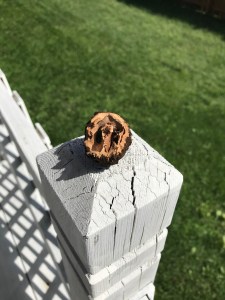
The walnuts are always the first to turn.  At least around here they are.  Their yellow leaves began to litter the bike path in August.  Their nuts can be quite a hazard to a jogger if it’s not quite light.  Still jacketed with their spherical rind, an unexpected foot landing on one can lead to a rolled ankle or even a fall on the pea gravel.  Such incidents led me to wait until it’s light enough to see clearly before going out for a jog.  You see, I like to exercise before starting work, so I jog at first light.  In June this can mean heading out even before five if the weather’s clear.  Since I start work around 6:30 this is a comfortable time to go.  Nobody else is on the bike path then.  And with Covid lurking, that’s a good thing.

The earliest sunrise comes about a week before the summer solstice.  By the time summer officially begins I already have to delay my jog slightly.  This is one of the great disappointments about Daylight Saving Time.  After winter’s long darkness, it starts to get light in the morning and I think to myself “I’ll soon be able to jog before work again,” but then we set the clocks back and set sunrise progress back by another month.  During the darkling months of the year I have to jog at lunchtime.  The changing walnuts always warn me that such a time is drawing near.  Already here in early September I’m getting back late for my usual work time since the sun is reluctant to throw its first crepuscular rays over the brow of the hill before six a.m.  The problem with this is that many more people are out on the bike trail at six than I ever see at five.  And often they don’t care to share.

There are a couple of older guys who walk abreast, taking up pretty much the whole trail every day now.  They hear me coming, look back, but like the marching band in “American Pie,” refuse to yield.  Single file for them is a sign of weakness.  I have to divert into the dew-soaked grass on chilly mornings to get around them with my now-wet feet.  I long for the days when I could easily jog before they even think of heading out to the trail.  The solitude of half-light.  The walnuts are the prophets of the tree world, however.  Their fruit is both nutritious and dangerous.  Scattered across the trail in the persistent dusk of a cloudy morning, they’re both a hazard and a warning.  And it’s a sign that the morning jog may already have to wait until mid-May to reappear.


Addenda

One of the perceived advantages of electronic publication is the possibility of corrections.  I say “perceived” because this casts us into the deep sea of uncertainty when it comes to citing sources.  If you read an article, and something really struck you, then the author revised that very thing later, you would be “misquoting” if you quoted that fact you found so stunning.  In our mania for keeping up-to-date you would need to constantly recheck your sources to ensure that you were working with the latest version of your resource.  This level of change speed isn’t conducive to academic practice.  When I was young I was taught that a book of the same edition, published under the same title, by the same author, would be the same across printings.  That’s no longer true.  Due to the ability to insert corrections, the same ISBN can result in two very different books.  Call it the hang-up of an ex-literalist, but this bothers me.

Back in the old days it was common to publish books with a “addenda et corrigenda” page that listed the known errors.  Beyond that you just had to suck it up and admit that there might be errors in your book.  You had to face with fortitude when someone pointed them out.  Now you can go back to the publisher, particularly if the book is in electronic form, and have your errors corrected.  The only ones to be confused will be your readers.  Why are we so bad at owning up to our mistakes?  Electronic reading can lead to a slippery slope of confusion about what publishers call “the version of record.”  Your permanent record, it turns out, can be changed after all!  Mistakes can be erased.  Sins can be forgiven.

In publishing the set standard had been that you had to wait for a new edition to change the interior text of your book.  The International Standard Book Number (ISBN) was your guarantee that the contents would be identical to any other copy with the same ISBN.  That’s no longer true.  If you don’t pay attention to which printing you have (which is never cited in footnotes or bibliography) you could be citing in error.  This practice has deep and worrying implications.  It has come to a crisis under Trump, a president who constitutionally lies.  Truth is what he says it is.  And if you want to check the facts, well you better be sure that you cite your printing because any of your critics could easily stick a [sic] next to your words if they find any “error” at all.

No longer “Standard”?


A Little Bit

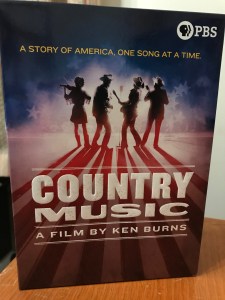
I don’t know about you, but I have a complicated relationship with genres.  As a fiction writer I have great difficulty classifying what I write, and that shows in the reluctance of publishers to embrace it.  We tend to suppose that some kinds of Platonic types exist out there by which we can map what we find here in the physical world.  These genres, however, are far more permeable than they seem.  My wife and I just finished watching the eight-part Ken Burns documentary Country Music.  Neither one of us is what you might call a fan of the genre but I can say that I learned an awful lot.  My stepfather was a country music fan, so many of the names and songs, particularly of the early years, were familiar.  What became clear throughout the century or so covered by the films was that the dividing line was always a blurry one.

While today we tend to think of country music as a southern phenomenon, the documentary made clear that its beginnings were folk music.  And folk lived most places.  While certain styles predominated in certain ages, across the years it was hard to tell some country music from pop music and rock (especially in the early days of the latter).  Even rock is difficult to classify.  What it often comes down to is self-identification.  An artist or band that identifies as country is country.  It is a distinctly American art form and it quite often identifies with religion.  Like rock, it also has some roots in gospel music.  When it becomes secular, gospel can go into many unexpected places.

Another association—again, a generalization—is country music and conservatism.  Partly it’s the promoting of Americanism, but partly it’s based on a false perception.  Performers are actors, after all.  Many of the “clean cut” examples of country singers struggled constantly with drug abuse (often considered the demon of rock-n-roll) and alcoholism.  It’s often right there in the lyrics.  The listeners, however, tend to think of them as stories.  That was the other great takeaway from the series—people are drawn to the stories.  I think that’s something we all know, but country music often excels at the hard-luck story that resonates with people down on their circumstances.  I’m not about to become a country music fan, but watching this series, like any educational venture, has opened me to a new tolerance for what I previously classified as a genre that didn’t have any appeal.


Yellow Jackets

Deeply conflicted.  That’s how I feel about calling the exterminator.  The longer I’m alive the more eastern my thinking becomes.  What right do I have to kill other animals for doing just what they’ve evolved to do?  The yellow jackets who made a nest in our siding were doing just what nature directed them to do.  In what sense is our house natural?  When they started getting inside, though, memories of having been traumatized by stepping on a yellow jacket nest when I was younger came to too sharp a focus.  Terror is probably the right word.  We were catching and releasing five or six a day and summer doesn’t look to be about to give way to autumn very soon.  There’s nothing like being startled by an angry bee when you walk into a room in summer-weight clothes.  So the exterminator came.

As the yellow jackets fled into the house to escape the poison I pondered what right I had to deprive them of their lives (here’s the eastern thinking part).  How was my comfort, or my lack of terror, more important than their need for a home?  Couldn’t we peacefully coexist?  You see, I’m no fan of violence of any sort.  In my ideal world there would be no war and no meanness.  You might not be able to call yellow jackets cuddly, but they don’t seem the happiest of creatures with whom to interact.  They’re industrious, like business owners want their drones to be, but their people skills aren’t too good.  Maybe it’s just projecting, but when they swarm the only word that comes to mind is anger.  Even their evolved body armor reflects that.  Still, I didn’t want them killed.  I just wanted them not to misunderstand our human interactions while shut in during a pandemic.

Life is a gift to all creatures.  I became a vegan years ago because of humanitarian concern for our fellow creatures.  The mess our world’s in now because of our lack of care for anything but money plainly shows.  Bees, it could be argued, make more of a contribution to the well-being of the planet than I do.  Who am I to make any claim of superiority?  Still, I’m responsible to pay half my salary on a mortgage that will keep me in one location until the situation betters.  When I see that silhouette in the window a sting of terror from my childhood comes back as I grab an empty peanutbutter jar to catch and release, only to have another bee replace the first.  Childhood traumas are like that, of course.  But now I apologize for bringing on the death of fellow creatures and I walk through the rooms through which they had freely flown.


Nightmares’ Progress

Ironically for someone who works in academic publishing, I have my own issues of how books are priced.  I understand why, however, because I can see sales trends.  When it comes to authoring my own books I’ve learned how to write for general readers.  Not all publishers know how to price for that.  Already I’ve had one friend blanch at the price of Nightmares with the Bible and the hope is that it does well enough in the library market to earn a paperback.  I also know paperback sales seldom reach the level of hardcover sales from academic presses.  Much of it is driven by demand.  If people know about the book and ask their libraries to buy it, and this is key—check it out—that has a way of sometimes snowballing enough to convince a publisher that there’s an individual market.

Since I’m plotting the progress on Nightmares here on this blog, I’ll point out that the book has its own page on my website (located here).  Actually, all my books have their own page, but since my website is in the low-rent district of the internet not many readers venture here.  Yesterday I added the back-cover blurbs to the page.  I did so with fear and trembling.  Life has taught me not to take well to compliments.  They make me uncomfortable, like strangers entering my house without masks on.  Since I have no institution backing me, however, I need the praise of colleagues to convince others to buy this book.  In my long-term thinking on the topic, I’m hoping Nightmares gets reviewed and people will get interested in Holy Horror, which didn’t get reviews but which is half the price.

In the biz we call this “platform building.”  Those with healthier egos than mine hire their own publicists who boost their number of Twitter followers and get their names out there on the internet.  My own platform building has been of the budget kind.  I’m active on Goodreads to get followers.  I’ll engage with any comments I get on social media.  But I’m also a working stiff hoping desperately not to lose my job during this pandemic.  The blurbs on Nightmares are very nice, and they note that I write for non-specialists.  This blog is open to all comers, after all.  Likes, shares, and comments all help.  My thanks to my endorsers—you know who you are!—you made my day with your kind words.


Permanently Changing

Classifying the world of thought into “eastern” and “western” is a gross oversimplification.  Nevertheless we require some handles by which to grip this unwieldy beast of mental life.  One of the first distinctions that we’re taught is that western thinking tends towards the default of permanency while eastern thought emphasizes change.  Change, of course, is the lack of permanence.  The older I get the more I see the wisdom in accepting change as the only thing that’s really permanent.  It’s a lesson you learn as a homeowner.  In my typical western way of thinking, I assume things will pretty much stay the same, but the myriad of small, external forces work constantly toward change.  The only way to keep a house well is with constant upkeep.

The other day I found a rotted windowsill that our inspector somehow missed.  That it hadn’t happened on our watch was clear by the fact that the previous owners had slapped a thick layer of paint over what was clearly a broken and decaying sill, in essence ignoring the problem.  Change, you see, is constant.  Things really get interesting when you start to apply this to religion.  Although the Bible only hints at it (for the view isn’t entirely consistent) God is considered unchanging.  The same yesterday, today, and forever.  Meanwhile everything down here is constantly in flux—changing, evolving, decaying, reproducing.  Religions of eastern Asia tend to embrace this change as a given.  Our frustration in life, as Buddhism recognizes, has its roots in attachment to permanence.  Things inevitably change.

On the one hand this is so obvious that it might appear simplistic.  But then think how we live our lives here in the western hemisphere.  Our employers hire “change management” teams.  We suppose things will return “back to normal” after this pandemic is over.  We’ve been living the cloistered life for nearly six months now and things have been changing.  Especially in the early days people could be heard lamenting how quickly information and circumstances shifted.  Change is permanent.  For the homeowner anxious about the ability to keep up with upkeep, the constant growth of the lawn and the aggression of weeds can be their own kind of trial.  At times it feels like you need to be paid just to take care of your home since it’s a full-time job.  It is overly simplistic to draw an arbitrary line from pole to pole, but it does seem that some cultures, tending toward the east of the birthplace of monotheism, have some basic insights from which we might learn.


Google Scholarship

The other day I had to check something on Google Scholar for work.  Since our computers now know who we are, mine asked if I would like to update my profile on the site.  I figured it couldn’t hurt.  I waited until after work, however, since my scholarship is strictly separated from my job.  When I went to complete the profile I learned that you can’t do it without a .edu extension on your email.  In other words, and independent scholar is no Google Scholar at all.  It’s not the first time I’ve run into this bias.  I have sat through many meetings where those with no institutional affiliation are spoken of with deep suspicion, as if the extreme shortage of academic jobs has left only the worthiest employed.  Classic blaming the victims.

Having once been a full-time academic, I have watched the job ads for nearly three decades now.  The number of positions has steadily decreased while the number of new Ph.D.s has readily increased.  There aren’t enough jobs to go around and those who don’t land one of the few available are considered inferior scholars.  Even Google says so.  The interesting thing about this is there is little outcry from academia itself.  You’d think that, given the protests that go on in other areas of perceived injustices that the educated would call for redress.  You’d think incorrectly.  As a society we distrust those who don’t have an institution backing them.  Unless they’re rich (for money is a kind of institution).  It’s a strange state of affairs.

In my line of work citations on Google Scholar don’t really matter.  In fact, many publishers are kind of embarrassed when their employees are published, or are even cited in the books they produce.  Scholarship, in other words, is institutionalized.  The thing is, life in our society isn’t so neatly categorized.  My first job, in a poverty-level family, was working as a janitor.  I was always surprised at how philosophical the discussions were among the cleaning staff at our local school district.  Many of these guys were deep thinkers behind a  broom.  In the schools where they worked the students tended to make fun of them.  You certainly won’t find their musings on Google Scholar.  I tend to think that our society might be more equitable if we’d recognize intelligence where it exists rather than sticking it behind the walls of academe.  But then, I’m no Google Scholar so you need not believe a thing I write.


Laughing Maher

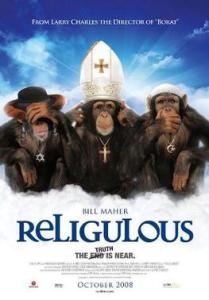
I recently rewatched Bill Maher’s Religulous.  I posted on it some years ago, but time changes perspectives.  Thinking back over the fun he makes against the religious, it is really only the Fundamentalist stripe that he scorns.  Whether Christian, Islamic, or even Jewish, he has little tolerance for those who take their sacred texts literally.  The Vatican scientist he interviews makes it through unscathed, but mainly because he’s arguing Maher’s point that the Fundamentalists aren’t at all stable.  Having noted that, Maher barely scratches the patina of the whole wide spectrum of religious outlooks.  Many of them are quite sensible, and some don’t even rely on the supernatural.  What he seems to have overlooked is that there is a vast complexity to religious thinking and people who believe aren’t always benighted.

Long, hard reflection on religion may be rare, but traditionally the seminary was the vehicle for those with the capacity for such thinking.  (Today seminaries are likely to accept just about any applicant and churches are facing shortages of clergy, making the rigorous thinking an elective course.)  It’s easy to make fun of the monks in their scriptoria, but those who learned to think logically—scientifically even—about matters of belief informed the best philosophers and other ”thought leaders” of the time.  If religion was the inspiration of scientific thinking (which then developed into humanism), it can’t be all bad.  Certainly there are and always have been abuses of the system.  Like science itself, thinking through this is a complex exercise.

Religulous is a fun movie.  Bill Maher is a likable narrator and he admits, at several points, to not knowing whether there is a God or not.  It is pretty easy to spot those whose religious beliefs are really more scarecrows than solid granite.  Literalism is pretty indefensible in the age of smartphones and the internet.  We’ve been far enough into space to know there’s no literal Heaven “up there.”  But this doesn’t mean religion has no value.  Many, many sensible religious people exist.  Most of them don’t cause trouble for society or embarrassment for their co-religionists.  Extremists, however, do both.  Unswayed by the damage they do, convinced with no evidence beyond personal feeling, they are willing to risk very high stakes indeed.  Those are the ones Maher is trying to take to task in his documentary.  On the ground religions are complex and psychologically helpful.  Complex subjects, as any thinker knows, bear deep reflection.


The Birth of Nightmares

It’s often said that it takes a village to raise a child.  A similar idea lies behind the writing of a book.  Sure, the lion’s share of the research and writing are done by the author—the person who gets credit for the work—but publishing is an industry.  That means other people’s livelihoods are based on the end result as well.  The author often doesn’t know what’s going on when the book is in production.  It was a pleasant surprise, then, to find the publisher’s website for my book is up.  You can see it here.  My own site for the book has been up for months (here; go ahead and take a look, there’s not much traffic).  Those who only read these posts on Facebook, Goodreads, or Twitter may not realize there’s a whole website out here that addresses things like books and articles.  (I think the CV part requires updating, though.)

In a writer’s experience, seeing a book’s website—receiving an ISBN—is like the quickening of a baby.  You’ve known for some time that it’s there, but the proof is in knowing that other people can find out.  I only learned of this because a friend wanted a link to the book page.  If you google the title without quotation marks you’ll find lots of websites about Christians and nightmares.  (Who knew?)  People of my generation still often don’t realize that, much of the time, searches with quotations marks are increasing necessary on a very, very full internet.  I’m still not sure of a publication date for Nightmares with the Bible, but you can preorder it.  (Sorry about the price.)

Once a friend asked me why we do it.  Writers, I mean.  Unless you’re one of the few who are very successful you don’t make much money off the project that has taken years of your life to complete.  I’ve never earned enough in royalties even to pay for the books I had to purchase to research the topics on which I write.  It’s not an earning thing, although that would be nice.  For some it’s an expectation of their job.  For some of us where it’s not, writing books is perhaps best thought of as monument building, a long and intensive “Kilroy was here.”  You notice something you think other people might find interesting, and so you write it down.  Chances are the number of other interested people will be small.  Family (maybe) and a few dedicated friends will lay down the cash for an academic book.  But still, there’s a village behind it, and I need to thank them here.


Summer of Horror

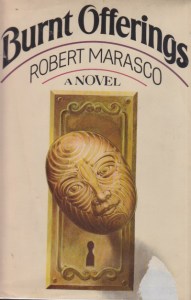
Summer vacation—or at least what used to be known as summer vacation—is winding down.  Unlike most years when the season is marked by a carefree sense of time off and travel, many of us spent it locked down while the Republicans have used revisionist history on the pandemic, claiming against all facts that America handled it best.  Is it any wonder some of us turned to horror to cope?  My latest piece in Horror Homeroom has just appeared (you can read it here).  It’s on the movie Burnt Offerings.  The movie is set in summer with its denouement coming just as vacation time ends.  I’ve written about it here before, so what I’d like to mull over just now is transitions.  The end of summer is traditionally when minds turn to hauntings.

Doing the various household repairs that summer affords the time and weather for, I was recently masked up and in Lowe’s.  Although it was only mid-August at the time, Halloween decorations were prominent.  Since this pandemic—which the GOP claims isn’t really happening—has tanked the economy, many are hoping that Halloween spending (which has been growing for years) will help.  My own guess is that plague doctor costumes will be popular this year.  Unlike the Christmas decorations that we’ll see beginning to appear in October (for we go from spending holiday to spending holiday) I don’t mind seeing Halloween baubles early.  There is a melancholy feel about the coming harvest and the months of chill and darkness that come with it.  Burnt Offerings isn’t the greatest horror film, but it captures transitions well.  (That’s not the focus of the Horror Homeroom piece.)

Many of us are wondering how it will all unfold.  Some schools have already opened only to close a week or two later.  Those in Republican districts are sacrificing their children (this is the point of the Burnt Offerings piece) in order to pretend that 45’s fantasy land is the reality.  The wheels of the capitalist economy have always been greased with the blood of workers.  (Is it any wonder I watch horror?)  As I step outside for my morning jog I catch a whiff of September in the air, for each season has its own distinct scent.  I also know that until the situation improves it will likely be the last I’ll be outdoors for the day.  It has been a summer of being cooped up and, thankfully, we’ve had movies like Midsommar and Burnt Offerings to help us get through.


The Birth of Horror

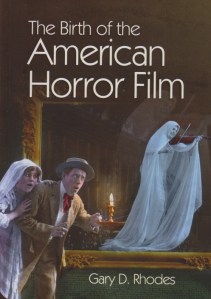
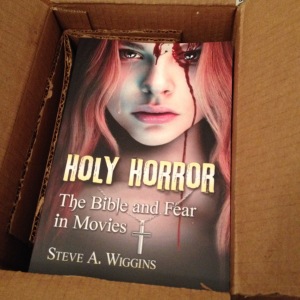
In both Holy Horror and Nightmares with the Bible I concern myself with horror films that have appeared since 1960.  I’m not enough of a cinema studies type to argue eloquently about the various stages of the horror genre on celluloid, but the many histories I’ve read settle on 1931, the year Universal’s Dracula and Frankenstein both appeared.  Dealing with more contemporary fare, I often use that as a mental benchmark.  Gary D. Rhodes has changed  that perspective, however.  The Birth of the American Horror Film is a somewhat sprawling treatment of a subject that’s more involved than I had supposed.  Early films didn’t suddenly appear, of course, and Rhodes spends some time surveying what came before the film that eventually produced what we recognize as cinema.  One of the things he notices is that which we call “horror” was pretty much there from the beginning.

Call it morbid curiosity.  While not everyone admits it, it is a pretty widespread human condition.  After surveying literature, theater, and visual culture, Rhodes moves on to consider many different genres of pre-1915 horror.  Some of them don’t strike every reader as horror today, but that’s a point I tried to make in Holy Horror.  The definition depends on the viewer.  Rhodes suggests throughout that American viewers tended to prefer non-supernatural horror.  While statistically this may be true, he devotes several chapters to genres that fall into the supernatural category.  These were, in the opinion of this reader, the best in the book.  One of the reasons is that horror and the supernatural naturally go together.  Many of us working in this field have noticed, some with embarrassment, that the two are closely related.

What might strike other readers as starkly as it did me, is just how terribly prevalent “horror” films were before there was a proper genre.  Rhodes makes the point that even if we like to think otherwise of ourselves, if there hadn’t been a substantial market for such movies they wouldn’t have thrived.  Some of them, like murder mysteries and other dramas, we might cast more as “thrillers” today.  I included a few of them in Holy Horror.  The real terror, however, often arises from subjects that were somewhat taboo in the late eighteenth and early nineteenth centuries.  Religion was handled with all seriousness.  I wonder if this might be one of the reasons that the supernatural didn’t appear, in the early days, as much as it would later.  This is one of those books that raises many questions such as this, and that makes me glad that the author is working on a sequel.


Creation of Horror

I recently read the article “The Christian Worldview of Annabelle: Creation” by Neil Gravino on Horror Homeroom.  I’m pleased to see that the complex world of religion and horror is being addressed by other scholars.  (I know that many actually work in this area, but if you don’t have access to an academic library finding their articles can be impossible.  Also, did I ever think I would miss Religion Index One and Two so much?)  Since I have a piece that is scheduled to appear on Horror Homeroom concerning the 1976 movie Burnt Offerings, I’m glad for the company.  As in my article, Gravino makes the case that the relationship between horror and religion (the Christianity of Annabelle: Creation and its need to be a horror film) is fraught.  This is something I describe in some detail in Nightmares with the Bible.

Back when I was writing Holy Horror I realized that putting individual horror films into a series creates continuity issues.  Annabelle: Creation is part of the wildly successful Conjuring franchise, the latest installment of which has been delayed by the pandemic.  Depending on how you count it, there are already seven films in that particular universe and the shifting of the story is the focus of an entire chapter in Nightmares.  The reason it requires such sustained attention is that, apart from being the most successful horror franchise after Godzilla, these movies are squarely based on Christianity.  Lacking the unrelenting gravitas of The Exorcist, they feature (in the main branch of the diegesis) the Catholics Ed and Lorraine Warren.  In an almost Dantesque view of Heaven and Hell, the characters struggle with monsters that hover between ghosts and demons.  They’re closer to the latter.

Many horror films—but by no means all—are based on fears associated with religion.  That religion isn’t always Christianity, as both The Wicker Man and Midsommar show, but the warnings against extremism apply equally to belief systems across the board.  Another thing I miss, being outside the academy, is the funding to do some in-depth research on this.  It’s good to know that others are seeing what I’m seeing as well, as is appropriate when you encounter something unexpected.  Our religion haunts us.  The reasons we believe are often tied to the self-same fear that the religions themselves generate.  And like religions, horror movies hold the possibility of earning quite a lot of money.  The parallels should not, I believe, be overlooked.


More than Kids’ Stuff

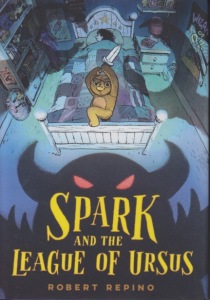
Children and Young Adult literature (which has its own Library of Congress acronym!) has come a long way since I was a kid.  Don’t get me wrong—I enjoyed the books I read as a young person, but there are many more choices that use a lot more imagination these days.  I’ve been reading Robert Repino’s books since Mort(e) appeared in 2015.  Spark and the League of Ursus is his latest and it continues his trademark use of animals (and stand-ins) to get at very human situations.  Spark is a carefully crafted story based on the idea that teddy bears do more than provide cuddles at night.  They are, in fact, a force for good, protecting human children from monsters.

As usual when I discuss books, I won’t give too much away.  I’m one of those guys who doesn’t even like to read back-cover blurbs because I’m afraid they’ll spoil the story.  Instead, I’m going to applaud the use of imagination in a world that seems stuck on a limited number of plot points.  Books like this, which stretch the imagination of the young without talking down to them—why does it cost us so much effort to admit that kids are smart?—are a great addition to CYA literature.  I was exploring this concept with another friend who writes when I read Hank Green’s An Absolutely Remarkable Thing.  A story’s intended audience is often signaled by the age bracket of the protagonists.  I’d suppose ‘tweens might be about the age here, based on that metric.  (Green was more like New Adult, a category that lasts until about age 30.)

Reading material written for younger readers makes me feel younger myself.  I read Ransom Riggs first three Miss Peregrine novels (also published by Quirk, the house that publishes Spark).  You see, I’m really encouraged by this growth in younger readers’ material.  If we can get kids into books with such engaging stories I suspect there’ll be less chance that they become unimaginative, straight-laced adults who want to keep things just like they were when they were kids.  Imagination has that kind of liberating ability.  Besides, who doesn’t want their teddy bear to come to their rescue once in a while?  It’s not just children that can take a lesson from imaginative story-telling.  Repino’s War with No Name series was intended for adult readers but it is good preparation for getting a sense of the possibilities for readers who might, in all hope, never have to face wars at all.


Mummy’s Daddy

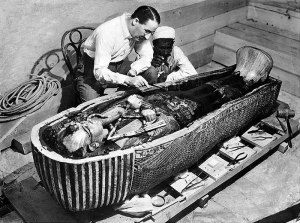
Now that I’ve broached the subject of the Agade listserv, I’m bound to find some interesting stories therein.  The title of this blog “Sects and Violence in the Ancient World” is an artifact that demonstrates eleven years ago I was still keeping up with Ancient Near Eastern studies.  I was calling it “Ancient West Asian studies” then, but I’ve been in publishing long enough to know that shifts in terminology are frowned upon by those in an industry that moves at a glacial pace.  (Just remember that the tortoise wins in the end.)  In any case, one of the recent articles on Agade had to do with the “curse” of Tutankhamen’s tomb.  This is an idea that goes back to the 1920s and was in some respects expressed in the Universal monster film The Mummy.  In pop culture the idea lives on.

Photo credit: The New York Times (public domain)

It seems that some, but not all, of those involved in opening Tut’s tomb died in unusual ways shortly thereafter.  The deaths were not concentrated within a day, let alone a week or a month, and some of them were natural but premature.  The ideas of curses, however, fit the spiritual economy of the human psyche so well that they suggest themselves in such circumstances.  A run of bad luck may last for years, causing the sufferer to think they might be living under a curse.  It is, in many ways, the pinnacle of magical thinking.  No matter how scientific we become the idea never goes completely away.  Just when Mr. Spock seems in control of the Enterprise Harry Potter beams aboard.  Our minds are funny that way.

The particular article I saw was one that had clearly followed on an earlier piece that I had missed.  It mentions “the documentary” but doesn’t say which one.  I suppose there are many such filmed attempts to make sense of memes such as the Pharaoh’s curse.  From my teaching days I have documentaries about a number of weird things that the History or Discovery channel, and maybe A&E, spun out back in the Dark Ages.  I’m not convinced that scientific thinking is really under any threat from such journeys down the paths of speculation.  I’m also not sure that there really is any connection to the various deaths surrounding the Carter expedition in 1922.  In just two years’ time we’ll be at the centenary of the discovery of the tomb and I’m sure there will be plenty of information on offer then.  As long as the curse doesn’t get us all first.