Digging Even Deeper

What does it mean to exist for someone else? Isn’t this the very definition of slavery? Yes, we may voluntarily give ourselves to someone for the sake of love, but woe to the person who thinks he owns his spouse. Human beings may be an acquisitive lot, but that doesn’t excuse it. To be civilized, after all, means to be more advanced than we are by nature. These thoughts follow on hearing one of my colleagues interviewed on Game Plan on Bloomberg. In the light of the Harvey Weinstein scandal, Francesca Levy and Rebecca Greenfield are interviewing people in different professions to see what inappropriate treatment women receive at the behest of men. Their job is, unfortunately, not one where it’s difficult to find examples. In this particular case, they interview Beth Alpert Nakhai of the University of Arizona. Dr. Nakhai is an archaeologist and she describes the perils faced by women in the field.

In 1987 I volunteered on the dig at Tel Dor in Israel. I had just graduated from seminary, didn’t have a job, and was pretty sure I’d be going on to graduate school. Tel Dor, like many digs, had different loci excavated by different university teams. I was on the Boston University area, B1, next to the section being worked by one of the universities in California. At one point one of the seasoned men—I can’t remember who—remarked to me that digs in Israel were great because of the three A’s: “alcohol, adultery, and archaeology; in that order.” It was intended as a joke, but it had that time-worn feel of a sentiment that’s been around for a while. At the time I thought little of it. I was there only for the last A, and, had circumstances been different, I might’ve made that my career choice.

Listening to Beth’s interview, however, showed me the darker side of careless remarks like this. Archaeologists often work in remote locations where local laws treat women differently than men. University professors have great power over graduate students and are able to make or break careers. Often married men leave their families in safe locations while they spend their summers directing teams that include female students and other volunteers. I’d never thought of the experience from that angle before. As a man I didn’t have to worry about anyone coercing me into an unwanted physical relationship far from prying eyes or legal systems which, at least in theory, protect women. The truly sad thing about all this is that forces are, especially now, at work to make women victims again even in this country. The point of archaeology is to try to understand civilization writ large. And yet, civilization in the advanced world is now moving backward. How long before we too are buried under a pile of shiftless dust waiting to be discovered by some future excavators whom we can only hope are more advanced than we are?

Amityville Revisited

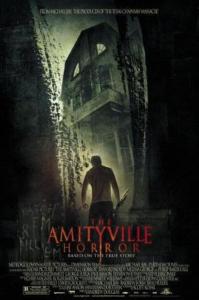
Remakes, standard wisdom holds, are seldom as good as the originals. When the original wasn’t great to begin with, the bar should be lower. Should be. I’ve been curious about the Lutz haunting in Amityville, having just read the book that started the phenomenon back in the late 1970s. I saw the movie first. That was several years ago now, but I do recall that even as horror movies go it had its failings. Some of that goes back to the book (presuming that anything happened)—nobody had a solid grip on whether this was a ghostly haunting or a demonic infestation. What the movie did do well is show how fragile family relationships can be, especially when under the pressures of supernatural supervision, not of the positive kind. Although, as is to be expected, the book was scarier.

Overcome by curiosity I finally watched the remake from 2005. Clearly I’m not the only one still curious about this alleged haunting, alleged hoax. I also have the alleged burden of looking for religion in horror. Only on this final count was it not disappointing. Well, that and in featuring burgeoning scream queen Chloë Grace Moretz. Although Father Callaway’s role is late in the film and brief, early on religious ideas are implicated. If the movie hadn’t tried so hard to be The Shining these themes might’ve been developed to good advantage. Instead it introduces Rev. Jeremiah Ketcham (also late in the film) as the first owner of the house in 1692 (did the real-estate agent’s mention of that date make you shiver?). Ketcham was a sadist to the Indians under his care, torturing them to death in the house. No time is left to explore the sinister minister’s motivation as the family implodes in its attempt to escape the house by boat.

As is frequently the case with the supernatural, we’ll likely never know what happened at the Amityville house. The story Jay Anson told is now generally classified as a novel. The preternatural can be judged neither in the courtroom nor the laboratory. The best that we can do is make celluloid adaptations to make some money on the deal. The DeFeo murders happened in living memory. The Lutzes left the house in a hurry shortly after purchasing it. Anson’s Indian “asylum” was never really there—and there were no such Native American practices in any case. What the remake left out was demons. Although the movie attempted other religious scares, the house just isn’t the same without them.


Turn the Other What?

The man next to me on the bus is reading his Bible. At one point in my life that would’ve made me feel safe. I would’ve known that the person next to me was committed to the same value system as mine—love for all, peace, equality, and acceptance. Now, however, I see that Bible and I’m afraid. You see, I’m reading Chris Hedges’ American Fascists: The Christian Right and the War on America. I can’t remember the last time I’ve been so scared. Hedges’ book was published a decade ago. What he wrote about then is coming true now and it’s because the elites of society—university folk and all—don’t take the radical religious seriously. In their delusional ways, they assume all will be well. If you think like that, read this book.

Dominionism is fascism dressed in Christian garb. It has no room for tolerance. It teaches that those outside its circle are to be ignored at best, and murdered without compunction at worst. This is not exaggeration. It is their teaching. It’s like that computer game that used to come with Macs where a time-traveling dinosaur collected the eggs of other species to save them from the coming asteroid. You could kill other dinosaurs without guilt because you knew they were going to die in 20 minutes anyway. That is very much the way Dominionists feel about you and me. We aren’t saved—their word is “Christian”—God has rejected us, and therefore we deserve to die. Many of them stockpile weapons just for this reason. Their goal, not at all hidden, is to take over the United States and make it a Christian nation. Already many in the houses of Congress are their candidates. They have a president who shares their values. We should be very afraid.

Hedges does a very good job providing the statistics that back his assertions. There is no question that this is real. Those who blithely vote Republican out of fiscal conservatism have risen to the bait. Trump has proved that once and for all. These “Bible believers” do not value or treasure love. They treasure treasure (many of them are very wealthy) and what they desire is power. Tolerance, in their view, is evil and compromising with the literal Satan in which they believe. Their Jesus does not love. He fights. And he fights for white, straight, privileged men. If you’re willing to forsake sleep, read this book. And if you think it’s exaggerating read the headlines.


Spirits and Souls

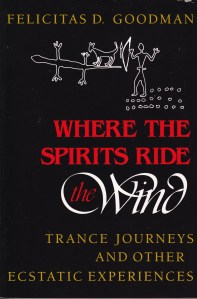
I first became aware of the work of Felicitas D. Goodman because of her classic text on spirit possession. Published by the reputable Indiana University Press, that book has become a standard for anthropological understanding of a strange phenomenon, which includes demonic possession. I found Where the Spirits Ride the Wind: Trance Journeys and Other Ecstatic Experiences in a used bookstore. Recognizing Goodman’s name, and always eager to learn about spirituality, I picked it up, It’s one of those books that makes you wonder. In an effort to experience trance states, Goodman began to experiment with various posture represented in the archaeological record. When she taught classes where students had no foreknowledge on the postures, she found they they reported similar visions during their trances while using the same posture. Matter, it seems, can effect mind.

I couldn’t help but wonder, as I read her account, what Indiana University Press must have thought about what they were publishing. This could be some serious woo, depending on how far you’re willing to go with Goodman. She was a doctorate-holding professor, so academic convention suggests she should be taken seriously. The BISAC classifications (those categories that often appear on the back cover of a book) tell the reader that this is Anthropology and Psychology of Religion. Neither field tends to give a whole lot of credence to the supernatural. At least not necessarily. And yet, there it is. Neither field really captures what Goodman describes in this book. Nobody really doubts that trances can happen; alternate states of consciousness are acknowledged phenomena. What we don’t have, however, is an explanation of what’s really going on.

A good deal of the this book consists of her students’ accounts of their visions. Although a native of Hungary, Goodman, through fieldwork and experience, became quite adept at Native American and other indigenous religious practices. The images that suggested the postures to her come from archaeological contexts around the world. This suggests that, according to Goodman’s worldview, these are some universal experiences. Attaining trance states, like meditation, takes practice. They can shift perceptions of reality. We tend not to hear too much about religion faculty who explore such things too openly. It’s a dangerous move in academia. Ironically, the institutions we build to understand our world tend to restrict themselves to the physical world or those fields that make ample lucre. I’m impressed that, even if by labeling it anthropology or psychology of religion, at least one university press took a chance at offering an exploration that might have some real world consequences.


All Hallows Eve

I can tell that I’ve been far too busy when I don’t have time to prepare for Halloween. I don’t mean commercially—running out and buying decorations and the like—but mentally. For reasons perhaps only understood by psychologists, Halloween is my favorite holiday. I love the comfort of being with my small family on Thanksgiving and Christmas, huddled inside while the cold whistles against our windows. The sense of relief at not having to go to work even though it’s a weekday, and that increasingly rare luxury of simple breathing space. Still, Halloween takes me back to a childhood with which I resonate in a way against which other holidays only vibrate in sympathy. The days are undeniable darker. My fears, I’m told, are not unfounded. I wear a mask and am free to be myself.

Commuting prevents me from getting out to see the decorations for which some neighborhoods have become notorious. The large, billowing, air-filled frights, however, are just hot air. Even the younger generation at the office, whispering among themselves that this is also their favorite holiday, decorate their cubicles in a way that’s more cute than chilling. No, I’m not a fan of gore—this is more subtle than that. Those who’ve long dwelt with existential angst are connoisseurs of dread. We know, for example, that it will be many months now before we step out into the morning light or come home from work able to see our way clearly. The shades of darkness aren’t always the same. There’s a texture to them. To prepare properly, you need time. The very commodity of which I’m being drained.

Those who know me as a mild, “uncomplicated” sort of person don’t know me. They’ve only become accustomed to the Halloween mask that I wear almost constantly now. Life can do that to you. Instead of the creepy novels which generally crowd my autumn, I’ve been spending time with the existentialists, listening to them reflect on death and its meaning. Or lack thereof. Religions, of course, hurl themselves into that void offering plans of escape. And yet in October that man who walks his dog before dawn wearing a white bathrobe sure looks like a ghost to me. And I’m standing on this street corner utterly alone as the wind blows down the avenue, chasing frightened leaves past me, sending a chill down my spine. I’m looking forward to sitting on a bus to get out of the cold. I’m complicit, I realize, in the death of Halloween.


Contracting Something

Book contracts make me happy. After slipping from higher education into the limbo of editing, it took a few years before realizing that not all books have to be academic monographs. For the past couple of years I’ve been silently writing a book intended for general readers. The subject will remain hidden for now, but a contract for the book has arrived and I’m happy. As my friend Marvin says, “for a man being published is about the closest you can come to giving birth.” There’s a bit of truth to that. Several months of thoughts growing in your head finally culminate in a full developed form, capable of surviving outside the confines of your protective mind.

The motivation for many academics to write is “publish or perish.” In my career track I both published and perished. The thing is, I write because I read. It seems unfair to read so much and not to share a bit of what I’ve learned. If you read this blog regularly you know that I have a restless intellect—the kind of thing that in the old days would’ve made you a professor. I no longer have access to university libraries with their arcane journals and massive collections, but reading on the bus is its own kind of research. (Anyone who’s tried to write notes on a bus, however, knows that the research is limited strictly to what can be remembered after a wearisome 90-minute-plus ride in stop-and-go traffic.) A few years back I decided to start writing up what I’d been observing. Slowly a book was formed. The process is not a swift one.

Many people question the ability of editors to write books. No, seriously. Agents are generally only interested in professors, celebrities, and journalists, not those who may have been one of the above once upon a time. That’s why this book contract feels like a small victory. Weathering the Psalms was written for other professors while I was still one myself. A lot has happened since then. I’ve read hundreds of books in the intervening years. Slow study that I am, it took some time before I realized I could begin to analyze all of this and write it in a way the average educated reader could find engaging. Agents declined the project, but now I’ve found a publisher who believes. When you work on your own, like many authors do, finding just one believer is sometimes all that it takes.


Kings of Israel

Eating out is something that has become more of a habit than it should. Still, when we get together with friends it’s a cause for celebration, and a restaurant is usually somehow involved. You only live once. Well, maybe. In any case, while waiting for a seat at a new place I happened to glance over at the bar. Two huge bottles of wine stood there. I asked our friends if they knew what they were called. I can’t recall how I’d learned, but the proper name for them is “Jeroboams.” Jeroboam, in case your reading of 1 Kings is somewhat rusty, was the first king of Israel when the “United Monarchy” split into Israel v. Judah after Solomon’s reign. The curiosity of my friends led me to research the subject a bit. What I found was alcohol of biblical proportions.

Another name for the same size bottle as a large Jeroboam is Rehoboam. Rehoboam was Solomon’s son, the king of Judah while Jeroboam took over Israel. Moving up to a 6 litre bottle the name becomes Methuselah. Methuselah, of course, is the Bible’s oldest man. Symbolically, if you do the math, he drowned in the flood. Nine litres will be called a Salmanazar, also known as Shalmaneser, a king of Assyria who attacked Samaria. Twelve litres, and perhaps the namers were getting a bit tipsy here, is either Balthazar or Belshazzar. The former, while not biblical, is the name of one of the three Magi from the visit of the wise men. Belshazzar was, according to Daniel, king of Babylon and is somehow scripturally mixed up with Nebuchadnezzar. Nebuchadnezzar, by the way—famous for his madness in Daniel—denotes 15 litres. An 18 litre bottle, depending on which line you’re following (if you can) is either Melchior—another of the Magi—or Solomon, the father of Rehoboam and one time boss of Jeroboam. The 27 litre bottle is called Goliath, for obvious reasons. And if you’re still standing, the 30 litre bottle may either be Midas or Melchizedek. The latter is the mystical king of Salem, later to be called Jerusalem.

I’m personally no fan of wine, so much of this was news to me. Not all bottle sizes are biblical, but many of them are. Spirits, in all seriousness, were taken to be related to the spirit world in ancient times. And the Bible, a book most familiar to those engaged in the industry of wine, was a natural place to find often ironic names. According to John, Jesus’ first miracle was changing water to wine at the wedding at Cana. Prohibitionists shudder to read that the carpenter from Nazareth changed six jars, each holding between 20 and 30 gallons, into free spirits. Wine bottles, perhaps to society’s benefit, never grow so large. But it’s time to go, our food has arrived.


Justice for All

One of the perks of working for a publisher is author talks. I’ve worked for three publishers now, and the last two have made great efforts to bring authors to their New York offices to present their work, in a kind of dry run, to those in the industry. When an author (whose book will eventually feature on this blog, so I don’t want to provide any spoilers just yet) was to speak on misogyny this week, I quickly signed up for a seat. Perhaps it’s a lack of imagination, but I could never understand how one human being could ever feel superior to another. As a child with no father around, my experience suggested that women were the strong ones. Yet when out in society I saw men always stepping in to take charge. What was wrong here?

I realize that I view life through male lenses. I’m also aware that gender isn’t nearly as definitive as we tend to think it is. Biology fits us with bits and pieces, and some of those constructed somewhat like me assume this gives them the right to dominate others. And they say we’re better than animals. Better at what, I ask? No, this isn’t about chauvinism—a man stepping in to support weaker women. This is about justice, plain and simple. We’re all born human. Humanity is nothing without those of both genders as well as those somewhere between. What should separate humankind from the vicissitudes of nature is the inherent commitment to fairness. Life is harsh and not all receive fair treatment. Do not listen to the narrative coming out of Washington, DC! The father of lies dwells there. And yes, I mean “father.”

We used to take pride in having climbed above the mere animals. We have constructed something that used to be known as democracy. Lawmakers, while fighting against women’s rights in word, nevertheless tacitly supported them at home. Now our government has declared open war on women. Men who have no idea what it is like to be viewed as and treated like an object every single day of their lives are making laws to punish those who do. I feel as though the sky is about to crack open and that blind principle we call justice is about to shout “Enough!” That’s not, however, the way that nature works. It is only when women are treated equally with men that we’ll ever be able to call ourselves civilized. Or even human. Until that day we’ll hunker down in our caves and await lawmakers who have any inkling at all of what fairness, what justice, even means.


Hiding Out

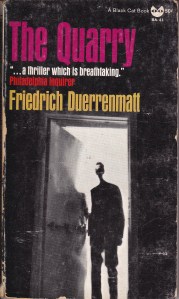
It’s seen better days. The spine is coming unglued and the pages are brittle, fracturing into tan snowflakes as I turn the pages. Still, this unusual little book is crowded with memories. I recall the used book store where I bought it—the Boston Book Annex, now sadly defunct. Unlike any other paperback I’d purchased, this one has gray-dyed page edges, adding an appropriate October gloom to the reading. Friedrich Duerrenmatt may not be properly among the existentialist novels, but that’s where he lives on my bookshelf. I picked up The Quarry three decades ago when “Der Besuch der alten Dame” was still relatively fresh in my mind. If I were a younger man I might’ve tried to find an edition in German, but the internet didn’t exist in those days and after a few years of no use, my Deutsch was dusty. It had been my gateway language.

As I read The Quarry I wondered why I had waited so long to do so. The story is brief but intense. And like novels of the period, it is philosophical and theological. (Like many translations it is sold under different titles; this one is also known as Suspicion, but The Quarry captures the duality nicely.) Hans Bärlach, a Swiss police commissioner, is on the trail of a Nazi war criminal. Suffering from cancer, Bärlach is bed-ridden but his quarry is a doctor and he finds a plausible excuse to become his patient. To help him set the trap, he enlists the aid of Gulliver, a Jewish concentration camp survivor. Their dialogue is what makes this brief story so theologically pregnant. Gulliver calls Bärlach “Christian” and reflects on how that feels to a Jew who was intended to be exterminated. I won’t spoil the ending here, but when Bärlach meets his quarry and realizes that he is also the quarry, the conversation once again turns to religion.

There’s an honesty to such novels as this. Writers were not yet afraid to invoke philosophical dialogue. A friend at the time I purchased the book once told me “nobody writes like that anymore.” Since his father-in-law was a novelist, I supposed he was right. I should have instead relied on my memories from high school German. We read “Der Besuch der alten Dame” and even went to see a stage adaption at the local community college. I’d shortly discover the existentialists. Their views on the absurdity of life mingled so readily with a theology becoming broken, tired, and top-heavy. Those ideas I’d met in class such as, if memory serves, Ilse Aichinger’s “Wo Ich Wohne,” became a part of my young psyche and, not surprisingly, many years later I’m finding myself their quarry.


Trained Witnesses

The problem with lying is that it generally doesn’t hold up. Eventually people will figure out that a falsehood is exactly that and the liar will be scorned. In other words, truth is determined by witnesses. This is tested and confirmed every day in our legal system. The witness is invaluable (except in the hands of lawyers). Since no one person can see everything, we rely on others to help us fill in the blanks. Think of it; when you see something unusual don’t you ask whoever’s with you “did you see that?” We witness the world around us, and unless we’re untruthful that observation becomes part of the collective narrative of what the world is like.

A story from IFL Science! sent by a friend describes “Ancient Legends And Myths That Were Later Proven True By Science.” Apparently this is part of an annual series. What the article lays out are recorded myths later confirmed by science. Scientists are trained witnesses. Taught to silo information, they separate belief (so they say) and eschew non-natural causation. They peer into the mirror each morning with Occam’s razor firmly in hand. Then everybody seems to be surprised when non-scientists have actually observed something correctly. This is the ancient bickering between religion and science—you can’t have it both ways, the reasoning goes. This is a zero-sum game. The winner takes it all. Reality, we observe, is seldom so simple. Articles like this one express surprise that non-scientists can get it right once in a while. The fact is, we’re all witnesses to what happens on this planet. Some of us are just taken more seriously than others.

Don’t get me wrong—I’m not equating religion and science. Nor am I suggesting that all people are equally good observers. It’s just that sometimes things happen when there’s no scientist in the room. Or if there is there’s no time to wire everything up appropriately. The events in the IFL Science! piece are all like this. Observed by people before science was invented—some of them before civilization was invented—events were called myths until scientists came round with their notebooks and validated the long-departed witnesses. The problem with occasional phenomena is that they don’t come on cue. The universe isn’t here to please us or satisfy our curiosity. It’s just that sometimes we see things that don’t match up with the textbook. Whether you call an exorcist or a scientist depends entirely on your point of view.


Infinite but Expanding

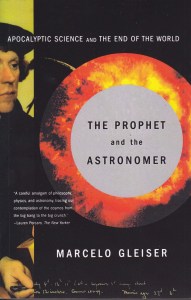
What could be more humbling than living in an infinite but expanding universe? Since the days of Copernicus, Brahe, Kepler, Galileo, and Newton we’ve known that the apparent reality of both our own lives and that portrayed in Holy Writ is inaccurate. The earth doesn’t hold still, and the sun doesn’t rise or set. The universe isn’t a layer-cake with Heaven above and Hell beneath. Instead it’s mind-numbingly massive. The only appropriate response, it would seem, would be silent awe. Marcelo Gleiser, whose work I’ve mentioned before, is a rare scientist. Rather than continually slapping the rationalist card on the table and declaring science the trump suit, he brings an element of humility to his writing. So much so that he’s willing, almost eager, to engage religion. Not in debate, but in conversation.

The Prophet and the Astronomer is a wide-ranging book that is tied together around the theme of the end of the world. A few weeks back we had yet another brush with a biblical literalist declaring the end of all things. Gleiser, although his book was published over a decade ago, was called in to comment in various places. This book opens by discussing ancient ideas of the end of the world. These are necessarily religious ideas. We don’t fully understand ancient concepts, but enough remains for us to see that apocalypses have their origins in Zoroastrian thought. Judaism encountered such thinking and the book of Daniel ran with it. Early Christians also had the world’s end on their minds, and the book of Revelation developed into a full-blown apocalypse. The world, or at least the western hemisphere, has never been the same since. Centuries of living under the threat of a cataclysm that could come at any second surely takes its toll.

Gleiser then shifts to the real harbingers of potential apocalypses. Comets and asteroids still exist and could theoretically deliver what the Bible implies might happen—a fiery end to the planet. This is sobering stuff. But the book doesn’t stop there. Bidding adieu to the dinosaurs, The Prophet and the Astronomer sweeps us into this great, expanding universe and how it may end, scientifically. Black holes and the heat death of the universe can be truly terrify. What is remarkable about the book, however, is that Gleiser openly acknowledges that science can’t give the comfort and meaning that religion can. Instead of saying, “be tough, face facts” he suggests that scientists might consider a narrative that adds value to a cold, dark universe. That’s not to say some of the story isn’t technical and some of the concepts aren’t difficult to grasp, but it is to suggest that science and religion should sit down and talk sometime. Hopefully before the end of the world.


Milkweed and Honey

I’ve never thought of bugs as an ethical concern. Well, not directly anyway. I had some truly frightening encounters with insects and arachnids as a child, so I tended to avoid bugs when I could. At times, I hesitate to admit, I took advantage of my size and smooched them. I did, however, mature out of that. Many years ago I stopped killing bugs that got inside, choosing instead to favor capture and release. I’d trap them in one of a variety of empty peanut-butter jars we kept around the house expressly for that purpose. The imprisoned intruder is then escorted outside and released. It seemed the only fair way to handle the situation—I don’t believe in exploiting size, and hating things with too many legs is prejudicial. Then I heard that insects are dying out.

Public domain, from Wikimedia Commons

Instead of bringing glee, this instilled a kind of panic. According to a story in the Washington Post, scientists have noted a 75% drop in bug biomass over the past several years. Stop and think about that. Insects contribute so much to our lives that we barely pay them any mind. Everything from pollination to breaking down decomposing organic matter, bugs do it. We need our insects. As with most things these days, it seems that we humans are the likely culprits. We destroy habitat, we spread pesticides everywhere, we try to take all kinds of land and make it in our own image. And we’ve sacrificed our insects along the way. As the article states—driving around country lanes on a summer night doesn’t bring up the windshield splatter that it used to. I stopped to think about that. It seems to be true.

The tiny members of the animal kingdom do a tremendous amount of work. I know they’re not doing it for us, but the things they do we don’t have to—and oftentimes can’t—do. All fruits and vegetables are pollinated by insects. Honey has been the main place where some of this shortage has been felt most directly. Bees have been disappearing. So have monarch butterflies. The fact is, we can’t live in a world without bugs. This does make it an ethical issue. If we’re going to claim dominion over all things we have no right to overlook the smallest creatures. Sure, they can, well, bug you. They fly in your face or bite you while you’re sleeping. They’re only doing what they evolved to do. I don’t mean to bug you about it, but we need to look after the minuscule and vulnerable among us.


How to Talk to an Editor

There are right ways and wrong ways to get your book published. When approaching an editor, there are a few things to keep in mind. For one thing, we’re human. Yes, I know that I have something you want. The usual career track for an academic is Brown, Harvard, dissertation published by a certain academic press with which I’m familiar. I get that. The internet, however, has made publishing into something different than what it used to be. First of all, you can self-publish. Sorting through all the self-proclaimed experts can be a full-time job when you’re trying to find the latest authoritative treatment of a subject. Also, the internet has made research into publishers much easier than it used to be. My first book, back in the day, was simply sent off to a European publisher that specialized in academic monographs in my subject area and then I moved on. Today authors see flashy first books online and want just that. You can have it all, they’re told.

My LinkedIn profile took a definite boost once I became an editor. Now I often think it would be great if someone asking to connect actually knew me. But I digress. One way not to get your book published is to state right on your LinkedIn profile—or other social media—that you have a great book and you’re letting all publishers know. You then invite them to connect on LinkedIn and your book announcement, like a peacock’s tail, is supposed to attract the hungry editor. In reality what attracts an editor is professionalism. Research publishers, find out what they actually publish. That’s pretty easy these days; there’s more than funny videos on the internet. Even browsing titles similar to your own on Amazon can help. Pay attention to the publishers of the books you’re using for your research. If a publisher has done several books in your area they are more likely to be interested in your proposal than a publisher who’s never ventured into those waters.

It may be easy to think of us editors as sitting bored in our lonely cubicles, awaiting the next great thing. The fact is we receive plenty of submissions and we have to sort through them. Treat the subject professionally. Many of us hold doctorates and are keenly aware of hyperbole when we see it. You don’t need to tell the editor your book is ground-breaking. They will make that decision based on the evidence before them. And trust your editor when it comes to things like how a book should be titled or placed or marketed. Publishers—some of which have been around for centuries—daily face the harsh realities of producing books in an era of YouTube and online television. We know it’s difficult out there. Many of us want to help. Some of us write books and have to go through the same travails as other authors in finding publishers of our own. Do your research on publishers. When an editor offers free advice, take it. A little bit of extra work by an author goes a long way in helping a book proposal succeed.


Uncomfortable Truth

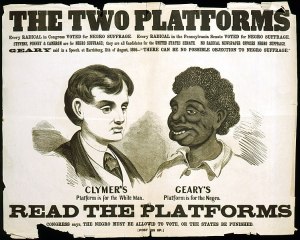
Ugly. That’s not a word I use lightly. The phenomenon of racism is ugly. More than that, it’s insidious. I recently attended a community course on racism sponsored by the Central Jersey Community Coalition. Since our government won’t condemn racism our communities must. This five-hour course was an eye-opener for me. I had known that race was a social construct with no basis in biology or any kind of science. What I hadn’t realized is that race was invented as a means of maintaining “white” power. And it was done so deliberately. The course leaders outlined the history of the modern concept of race and showed how it is primarily an American phenomenon (not exclusively, but it was intentionally orchestrated here). The idea was to keep property in the hands of wealthy whites.

During the discussion many topics came to mind. The primary two, for me, were capitalism and the Bible. These strange bedfellows are far too comfortable with one another. Both can be made to participate in the racism narrative. Capitalism appeals to the basest and most vulgar aspects of being human. Greed and selfishness. Wanting more for me and less for you. As one participant put it, it’s a zero-sum game. Your loss is my gain. We support this system every time we buy into the myth that life is about consuming. Buying more. Contributing to the economy. That which is lost is mere humanity. This is the narrative our government has adopted. The election of one of the uber-wealthy has demonstrated that with a nuclear missile shot heard round the world.

And what of the Bible? As the story of the flood unfolds in the book of Genesis, Noah develops a drinking problem. Naked in his tent, his shame is seen by his son Ham. Hungover the next morning, the only righteous man alive curses his son’s progeny. Then after the tower of Babel story, those cursed races, in biblical geography, end up in Africa. Christian preachers long used this myth as the justification of slavery. Races, after all, were decreed by God at that very tower. The tower shows us for who we truly are. Human hubris led to divine folly. And now we have a nation of liberty built on the basic premise of inequality. Racism is beyond ugly. It’s evil. The Bible may be complicit, but we need to take over the narrative. Race does not exist. Scientifically there is no such thing. Although race doesn’t exist, racism most assuredly does. Like all evils we must bring it to the light to make it disappear.


Colleagues

The death of a colleague is a shocking grief. Although my teaching career was cut short at Nashotah House, the faculty there was always small, and often close-knit in a way that an insular school promotes. I had been teaching there for about eight years when Daniel Westberg was hired to teach ethics and moral theology. Dan was kind, gentle, and non-political. At first he was part-time, but eventually he became a regular member of the faculty at some personal expense. We came to know him and appreciate his wisdom and patience. Dan was a priest and had earned his doctorate at Oxford University. Just over a decade my elder (the faculty from which I left was generally at his age; I was the youngster), Dan kept in good physical shape, as befits a truly spiritual person.

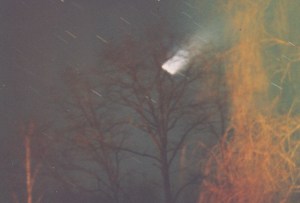
Nashotah House takes its name from the lake by which it was built. Colleagues sometimes joked about the fact that the seminary was wooded, lake-front property and implied that recreation time belied research time. It was, however, a place of intense study for the faculty. It did also offer the opportunity to experience nature. Dan drowned in a boating accident on Upper Nashotah Lake this past week. The image of that lake is etched forever in my mind. The night before I learned of my colleague’s death I was reflecting how I stood on the shore of that very lake late one night to photograph comet Hale-Bopp burning in the western sky. I had been reading about comets and that night by the lake stands out in my mind as a numinous moment. The lake, it seemed, had always been there.

After I left Nashotah House I let my colleagues fall into the safe mental compartments of memories. A few of my students kept in touch, but in general I heard from my colleagues only very rarely. Some may assume I spend more time on Facebook than I do. There are painful memories associated with the seminary. Now one more painful memory is added to the rest. I ate with Dan and his wife. Talked with him. Attended chapel with him. We had that distance that always separates clergy from laity, but I considered him a man that could be trusted. A priest with integrity. We went through quite a lot together in that small community on the lake. The death of a colleague comes with a guilt for not having kept in touch. A sadness for an opportunity missed. A life of kindness extinguished is a shocking grief.