Internet of Happiness

Are we really happier for instantaneous news?  Has the internet brought us paroxysms of ecstasy with the quality of information?  Wouldn’t you just rather wait?  I don’t think we should go to extremes, or go backward.  Samuel Morse, it is said, developed the telegraph in part because he was away from home and only found out about his wife’s death after her burial, for which he could not return in time.  More rapid communication was necessary and the telegraph provided the means.  No, I’m not suggesting that happiness lies in being uninformed, but perhaps I lingered long enough among the Episcopalians so as to believe in the via media, the middle way.  Some of the happiest times of my life have been spent without a screen glowing in my face.  There is, however, good stuff here.

One example is blogging.  I wish I had more time to read blogs.  Verbomania, for example, showcases writing that sparkles.  The weekly posts set me up for a good weekend.  There are many more that I could name as well—and for me blogging has become a way of life.  Marketers call it “platform building” but I think of it as fun.  And the practice I get writing this blog daily has made my books much more user-friendly.  A family friend with no college education tried to read Weathering the Psalms, with “tried” being the operative word.  There’s no comparison with Holy Horror.  (Weathering the Psalms was written to be my “tenure book,” and it may well be my last technical monograph.)  I have this avocation of blogging to thank for that.

But instantaneous news—does it make us happier?  Sometimes perhaps, but often the opposite.  It’s a phenomenon I call the internet of unhappiness.  (There’s a whole field of study emerging called “the internet of things,” which, no matter how much I ponder I just can’t comprehend.)  News, after all, tends to focus on negatives, as if there’s too much happiness in our lives.  Just yesterday there were early morning helicopters hovering not far from where I live.  Within seconds I could learn of some kind of domestic dispute about which I’d otherwise have been none the wiser.  The next few hours I spent occasionally reloading the page for updates.  They didn’t make me happy.  Add to that the three-ring sideshow that the American government has become and you’ll soon be wanting just three channels from which to select before turning off the TV and going outside for a walk.  And when the 1970s start to look like happy times, you go to your closet and start digging for the semaphore flags.
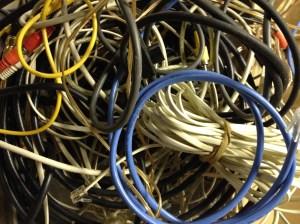
They must be in here somewhere…



Appily Ever After

While in the theater to see The Nun (which ended up being the biggest take) this weekend, I couldn’t help but notice that the pre-movie adds were all about apps.  I couldn’t help it because, much to my own chagrin, I’d left the house too quickly and I hadn’t brought a book to read while waiting.  This may not be news to some people, but different cinema chains have different “channels” of what passes for entertainment and ads to try to draw viewers in early.  The movie house we used to frequent in New Jersey had a variety of goods on show, most of the time.  The one we visited here in Pennsylvania presumed that everyone had their phones in hand, waiting for the show to begin.  On screen was the idolization of the app.

My phone is old enough that most modern apps don’t work on it.  Most of the time that doesn’t matter to me since I’m not addicted to the device.  Of course, when you’re trying to park your car in a town that offers only online options for such a convenience, I sometimes wish I could download the relevant necessary software.  Otherwise, I often wonder what we’ve lost in our lust for connectivity.  Coming out of New York on the longer distance bus recently, the driver called out, as leaving the Port Authority, “Lights on or off?”  The unanimous chorus, for I didn’t speak, answered “Off!”  I glanced around.  I was surrounded by devices.  I carry a book-light with me on the bus, for this has happened before.

“Drink the Kool-Aid” has become post-Jonestown slang for simply following the suggestion of someone without considering the consequences.  I sometimes wonder if our smartphones come in more than one flavor.  I’m not talking about features or physical colors.  As apps chip away at our money, a little bit at a time, they also take larger pieces of our time.  I’ve experienced it too, but mostly on my laptop (I don’t text—my thumbs aren’t that limber, and besides, the apocopated messages often lead to misunderstanding, emojis or not), the wonder of one link leading to another then realizing an hour has disappeared and I still feel hungry.  Perhaps that’s the draw to the modern commuter.  Or movie goer.  I’m sitting in the theater, taking a break from unpacking.  In my version of multitasking, I’m also doing research by watching a horror movie.  Around me eyes glow eerily in the dark.  I’m lost in the forest of unsleeping apps.


Slow to Travel

A family friend recently died.  I was in New York City when I received the news, and I mused how recent a phenomenon this speed of information is.  The news wasn’t necessarily a shock—this friend had been experiencing failing health, he was a close friend of my grandfather—but for some reason Samuel F. B. Morse came to mind.  The story goes that Morse invented the telegraph because of his experience of being away from home when his wife died.  By the time he received the news and was able to get home by the conveyance of the day, she’s already been buried.  He set his inventive mind to improving the speed of communication over a distance.  In these days of receiving texts mere seconds after something momentous happens, it’s difficult to imagine that for the vast majority of human existence, personal news traveled slowly.

Feeling in a reflective mood I recalled how when I was in college I wrote letters home.  Yes, the telephone existed by then—don’t be so cynical!—but long distance bore a cost and college students find ways to save their money for girlfriends or spending a weekend in Pittsburgh.  News traveled more slowly.  Back before Morse, the swiftest option was the letter.  The death of a friend might take days or weeks to reach those close.  Distance in time, as well as space, may not have lessened the shock, but the immediacy of a text wasn’t there.  The death had occurred days or weeks ago.  There was nothing left to do but grieve and get on with life.  Like Samuel Morse—perhaps the only point of comparison between us—I was unable to get away immediately.  New York City isn’t easy to escape quickly.

We move swiftly and slowly at the same time.  I know news moments from the event, but this physical mass I inhabit is sluggish takes some time to get around.  Manhattan’s an island, and although it’s not Styx we’re crossing, the Hudson creates barriers enough.  Now my journey includes crossing the entire state of New Jersey before I can even reach home.  Were I to drive back to my original home, it would add another five hours at least in the car.  Sometimes I wonder if the immediacy of knowing is a blessing or a curse.  The shock is immediate and visceral.  But like an injection, the sharpness is quickly over and the dull ache sets in.  Our family friend had been suffering for some time.  Now he’s at peace.  I like to think he’s with my granddad, and that the two of them together won’t judge me too harshly for moving so slowly.


Traveling Unplugged

Those who pay close attention, or who have nothing better to do in July, may have noticed that I missed a day posting on this blog on Saturday.  That hasn’t happened for a few years now.  I think maybe I ‘m growing up.  Or learning to resist.  Saturday was a travel day—the first I had to make from Pennsylvania, back to Newark in order to fly to Washington state and drive a few hours to the lake.  All in all, it turned out to be a long day in which I didn’t even notice that I was unplugged.  I had a book that I read along the way.  Although it’s against my religion—(call it Moby)—(but I jest)—I even fell into a cat nap or two on the plane.  I didn’t have a window seat and strangers don’t like you staring in their direction for five hours at a time.

Upon awaking, eyes refusing at first to work in tandem, in the chill mountain air, I realized I’d spent the entire day off the internet.  We had to pull out at 2:30 a.m. to meet TSA requirements, and you have to pay for the privilege of connecting to the web in airports and on board jets.  I’ve become so accustomed to being wired that I feel I have to explain why I wasn’t able to post a few thoughts when circumstances were so adverse to getting tangled in the world-wide web.  Yes, it still has a few gaps where one might buzz through without being caught.

It was remarkably freeing to be unplugged.  I believe Morpheus may be correct that they want us to believe reality is otherwise.  I feel guilty for not checking email manically.  What if someone requires something right away?  Some sage response to a communique that just can’t wait until I’m back from vacation?  Some reason that I must ask to be inserted back into the matrix if just for a few moments, to hit the reply button?  We’ve perhaps been exposed to what The Incredibles 2 calls the Screenslaver, the force that draws our gaze from even the beauty of a mountain lake to the device in our hand, whining for attention.  We have wifi here, of course, for the fantasy of living raw is sustainable for only a few hours at a time.  Reality, as you know if you’re reading this, is electronic.  But until I have to reinsert myself at the cost of my soul, I think I’m going to take a dip in the lake.


The Moved Unmover

To say it was an easy move would be a lie.  I write this on a beautiful, cool, clear July morning.  Only I can’t even calculate the last time I slept.  Not new house syndrome, but that move!  Our personal account manager at International Van Lines was supposed to call us between 4 and 6 p.m. on Friday to confirm the time of the move.  She would also tell us how much money was needed, in cash, by the movers.  In cash?  She’d taken my deposit by credit card; why couldn’t the balance be paid that way?  She was supposed to call to clarify.  I suspect my tone makes it sufficiently clear that she didn’t.  I went to bed not knowing if we would be moved or not—I only reread her email after packing the last box (or so I thought) at 7 p.m.  The IVL offices were closed.

I awoke at 3:30 to an email saying they would be there between 9 and 11 a.m.  And they would be wanting an uncomfortably large amount of cash.  My wife went to get it, and three guys and a truck arrived at 9:15.  I could see their faces blanche at the walkthrough.  They’d been told it would be a ten-hour job.  It turned out to be seventeen.  Nothing makes you feel a cad quite like being thought a snake-oil salesman.  Our bill of lading was just a bit short of reality.  Packing the truck wasn’t finished until 9 p.m.  Unpacking until 2:30 a.m.  Our three guys were joined by two more for the unpacking.  Most everything went into the garage because, well, no stairs.

Twice during the day the amount of cash needed was upped by a significant amount.  This was one of those “we’re in it now” situations.  We paid what was requested.  The internet guy was arriving potentially by 8 a.m. this morning.  Who can sleep knowing the alarm is set for four hours from now?  And our labeling scheme was so arcane that, well, most everything ended up in the garage.  The movers themselves?  Absolutely fantastic!  I’m sure they’ll be talking about this move for months to come.  

Looking outside, the yard wants mowing.  The internet guy is coming.  Who needs sleep when my life of telecommuting begins tomorrow?  The good news is it took only half an hour and one trip to the garage to find the coffee filters.  I’m looking out at a beautiful, crisp morning.  Over an Everest of boxes.  But you won’t know any of this until the internet guy gets here.  Somehow I sense we just accomplished something quite extraordinary.


Eternity, Technically

When the robot uprising comes, we have a factor in our favor, we biological beings. That is our parts, although they do break down, generally heal themselves. I write this as kind of a forecast, because I’m not at home due to the holiday weekend, and neither is the internet at my home. You see, our internet service (which is not cheap) has been going out from time to time. Our service provider thinks it may be old parts. The box was installed in our basement over a decade ago and when the technician sent me down amid the cobwebs before leaving town I had to report to her that all cables were hardwired into the box. No clip and slip here. She thinks the cable has gone bad.

The cable just sits there. It never gets moved or jostled. How it could fail I don’t know. But the consequences are two. There may not be posts on this blog for a while once I return home. I’ve posted every day, holiday and secular-day, for years now. Technology, however, is a jealous deity and will not permit humans taking it for granted. The second consequence is more optimistic; when the robots rise up against us, their parts will wear out and they won’t be able to regenerate them organically. They’ll need to order them and hope they can find a delivery system even more efficient than Amazon’s. Good luck with that! I ordered a book the other day and less than 24 hours later it was at my door. That’s service.

I decided to post this advance warning so there may be no weeping and gnashing of teeth (please—dental work is expensive!) on Monday or Tuesday when no new post appears on this blog. It’s not that I’m not thinking of you all, it’s just technical. Robots may run system tests, but can they feel it in their bones when something’s about to go? Do they indeed sing the body electric? Can they feel the poetry they write? To be human is to think with our emotions and to reason ourselves out of irrational angst. I see the slaves to technology putting on weight as they rely more and more on labor-saving devices to make their lives automated. I’m guilty too. As I sit here many miles from home, however, I worry about the internet back there. Is it sick? Is it dying? And if so, to which mechanical god should I pray to save its technical soul?


Urban Evolution

They say ten city blocks are a mile. They also say the internet is fast. Putting these two theorems to the text, I’ve logged several foot-miles in Manhattan to find things that aren’t there. I don’t mind the exercise, but apparently the web can’t keep up with Midtown. I’ve been working in Manhattan for going on seven years now. I very seldom leave the office during the day, eating at my desk and trying to give the man his due. Once in a great while there’s something I’m either compelled to see, or that I must find for various reasons. Almost without fail, such lunchtime expeditions lead to frustration. I recently had to visit a business that shall remain nameless (conflict of interests, you see). According to Google Maps it was a mere ten blocks—a mile—from my office. At a brisk pace I could make it there, transact my business, and return to my cube all well within an hour. As I grew close, I got that sinking feeling I recognize now as internet ghosting. Nothing remotely like my goal was at this location.

I walked in and smiled at the man at the security desk. He was even older than me. “Ah, they used to be here,” he said, “but they left a long time ago. Long time ago.” Apologizing in advance, I asked if he had any idea where they might’ve gone. “I heard they moved across from Bryant Park, on 6th Avenue. But I heard they moved from there, too. You might try it, though.” Since this was roughly in the direction of my office from where I was, I decided to swing by. When I worked for Routledge I went by here every day, and I didn’t recall ever seeing this particular business there. Their security guard was equally as friendly. “I’m afraid there’s nothing like that here.” I had to return to work. When I got back to my office and googled their store locator, the website froze. This was truly unobtainable via the internet.

Some times you’ve just got to let your feet do the walking. Things aren’t always where the internet says they will be. I’ve come to realize that New York City is constantly changing. Buildings now stand where mere holes in the ground used to be when I began working here. Commuting in daily all these years is like time-lapse photography of a plant growing. Buildings emerge behind the green plywood walls, and next thing you know what used to be a synagogue is a new retail opportunity. It may not, however, be the business you’re looking for. Before spending your lunch hour walking a mile to get there, you might try calling first.


Taking Time

Good writing is hard work. One of the mixed blessings of the internet is that it makes publication so easy. Get yourself a blog and nobody has to approve anything! Ideas come tripping across your fingers onto some electronic substrate and, viola! You’re an author! The problem is that being an author’s not the same as being a good author. Writing well (and I make no such claim for myself—after all this is just a blog) is hard work. A piece has to be written, and then read again and again. I’m reminded of the story of a convicted murder whose name I’m forgotten (call it a defense mechanism). This was early last century. The murderer was caught, initially after having been found wandering, disheveled, in public. As a respectable man (he was a doctor, I think) part of his defense was that he’d never have left his house without being presentable. He would have on a collar and hat. People would see him, and he had to convince them of his presentability every single time he walked out that door. (This isn’t an affliction that I share, by the way.) Writing for publication is like that—you need to take care to look respectable every single time.

I can’t speculate about how other writers do their thing, but for me the main requirement for this is time. Any piece that I want anyone else to see, has to be written. Read. Edited. Re-read. And probably edited again. All before the public sees it. This is just for the informal stuff. I’m currently writing a book (which is pretty much a constant state with me). The draft was finished months ago. I started thinking about a publisher. Then I read it again. I couldn’t believe I’d ever thought it was ready for a publisher. Several rewrites followed. I’m in the midst of another one at the moment. I think of it like my ill-used rock tumbler. You want shiny rocks, you’ve got to send them through with finer and finer grit. If you do it right, they’ll come out looking like they’re wet, and they’ll stay looking that way. Polished writing takes time.

Some things can’t be hurried. As a middle-schooler I had a summer job with the school district. One of my assigned tasks was painting bus shanties. Many of these were, as you’d expect, way out in the middle of nowhere. I’d be dropped off with a couple other teens and we’d paint the shelter inside and out. One day I got tired of the constant, boring, and repetitive task of filling a paint pan with white paint, carrying it into the shelter, using it up, and then doing it all over again several times. I decided to pour the paint directly on the plywood floor of the shelter. All I’d have to do would be to roll it out and who’d be the wiser? I only did it once. Little did I consider that the best painting, like the best writing, is a thin layer over the substrate. You need to go over it more than once, leaving time between layers. More importantly, I didn’t realize that you can’t gauge how much paint you need this quick way. The best thing is to run out and refill. Then you can pour the remainder from the pan back into the can. The floor took hours and hours to dry. Not only that, but the top surface dried first, so when I stepped in, I pulled up a thick layer of paint off on the bottom of my shoe. Tom Sawyer I was not. I had to redo it. What I learned that day, though, was a lesson about writing. Take your time. But you don’t have to take my word for it. I just write a blog.


Who Knows What?

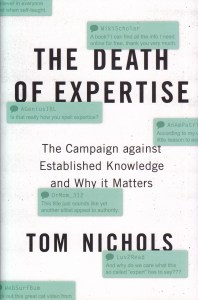
Nobody likes to have their shortcomings pointed out. I suspect that’s why many people might find Tom Nichols’ The Death of Expertise: The Campaign against Established Knowledge and Why it Matters a little uncomfortable. Nichols doesn’t pull any punches. Nor does he claim to be an expert on everything. What he does claim, however, is very important. He shows how America has taken a distinctly hostile attitude toward experts and specialists. Somewhere along the line hoi polloi began to mistake everyone has a right to their opinions for “everyone has the right to be an expert on what they express in those opinions.” This isn’t a new problem, but there’s no doubt that the Internet has exacerbated it. We’ve got people arrogant of their lack of training claiming alternative facts that are “just as good as” established facts. One of them resides in the White House. There’s no arrogance in claiming you have extensive, highly specialized training if you do. It’s a simple, non-alternative, fact.

A perfect book for our times, The Death of Expertise should be—must be—widely read. It’s not likely to change the minds of those who’ve already decided that with the Internet giving them a voice they’ve become the gurus of a new generation of the “Know Nothing Party.” The rest of us, however, should read and ponder. Nichols doesn’t shield himself in his ivory tower—he admits there’s plenty that he doesn’t know. He’s not shy, however, in saying he’s an expert on what he does know. I remember when facts used to stand for something. Winning at Trivial Pursuit was a matter of pride. Now everyone’s a contestant on Jeopardy and Alex Trebek has taken the express train home. All answers are right, for all people are experts. Seems like we have a surplus economy in arrogance these days. And that surplus just keeps growing.

An area where Nichols isn’t an expert is religious studies. He wouldn’t claim he is. I did find it interesting, however, that when he wants to make some of his strongest points he quotes C. S. Lewis. Any evangelicals out there should read The Screwtape Letters again and check what Nichols says. Lewis would not have been a Trump supporter. Not by a long shot. And he uses the word “ass” in his books, even when he’s not referring to literal donkeys. He may have been onto something. We have an anti-expert president who has appointed anti-experts at the head of major government agencies. He anti-expertly launches missiles at Syria illegally. C. S. Lewis was an expert Anglican. 45 may be an expert of the sort Lewis wasn’t afraid to name. We need to be educated. Read Nichols and give our nation a fighting chance. There’s always more to learn.


Size Does Matter

While not exactly a Luddite, my grasp on technology is tenuous. I grew up in what may be the last generation where computer use was considered optional—I made it through a master’s degree without ever using one, and could have managed my doctorate without. Like many of 1960s vintage, I resisted computers at first, somehow believing that the status quo ante would ante up and resist the technobabble that was already beginning to bubble just beneath the surface. I never really had a clear idea what a byte was, or how a simple 0 or 1 could be used to convey complex information. I heard about “blogs” but had no idea what they were. Next thing I know I found myself writing one. To my way of thinking any kind of log is essentially a “once a day” thing, although I know bloggers who post remorselessly all day long. At the beginning I was confused until a friend gave me some advice: don’t write too much in any one post. Keep entries down to about three to five paragraphs, and between 300 and 500 words. That way, he intimated, people will look at it.

Recently, wondering why amid the millions and millions of pages available on the web, mine gets so few hits, I read something by an “industry analyst.” (That phrase makes me shudder, but this is no place to be squeamish.) Want more hits? he provocatively asked, followed by—here are the tips. One of his first bits of advice was write longer. At least three times longer than I do (1,500 word minimum). I don’t know about you, but I often think of such things in holistic terms. That’s a lot of words to ask someone to read. If you’re going to put that much together, you’d better have something really profound to say. You’re asking for an investment.

Those of you who know me will understand that multiplying words is not an issue. In addition to this blog I write both fiction and non-fiction books and stories (the vast majority of which have never been published). I answer a simple question with a 50-minute lecture. In other words I have other words. I just tend not to think that you necessarily want to read them all at once (or at all). It’s obvious that size does matter. I can’t help being disappointed when I open a post and find I haven’t the time to read it because it’s just too long. Life’s not fair in its allotment of time. As usual, I err on the side of caution. I value your time to take up too much of it here.

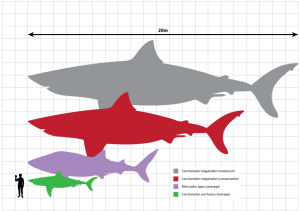
Image by Scarlet23, Wikimedia commons

Image by Scarlet23, Wikimedia commons


Radio Nowhere

Those of us who somehow managed to be educated without the use of computers, at least nothing more advanced than a TI-30 calculator, fumble our way through the world-wide web. I’ve got this blog, a Twitter and a Facebook account, and I’m on Google + and Medium, and I really don’t know how any of these things work. One of my motivations for starting this blog was to continue the tradition of speaking to audiences that I used to have in my lectures while I taught. I was told that such a format was known as a podcast and I found a host site where I could leave my recordings for free. I could then make a link and bring them onto the podcast page of this blog. How any of that works, I have no idea.

img_2855

Recently a few would-be listeners have asked what has happened to the podcasts. Since I don’t really know where they were in the first place, I’m not sure how to send a map to them now. One of my readers, however, has kindly set up a new webpage where all 23 podcasts are available. You can find it by clicking on this link. My thanks to Ahmed Fasih for setting this up. The podcasts cover various aspects of ancient religion. Even now, every great once in a while, a world-recognized name in academia will ask me about some of these topics. When you’re an academic you have the opportunity to spend vast amounts of time focusing on a single subject. The only subject you have that privilege with outside academia is money. I do hope my friends in the academy realize just how lucky they are.

In any case, the podcasts are back. Maybe now that they’re not invisible any more, and since in coming days it may be important to remember when things were better, I may find time to add to them. Blogs—at least those that are regularly read—are locations for discussion. I’m always glad to answer questions that are posted here. During the work week my time is constrained, so you might need to wait for a weekend, but I will respond. I know religion is passé. I know people have better things to do with their time. I also know that for the vast majority of humankind religion remains a vital and integral part of their lives. Exploring it seems to make sense to me. For those who’d rather listen than read, the podcasts are once more available.


Twitter Me This

Techoncrat I’m not. At least I understand that to be authentic in this world you need to be on social media. I have a Twitter account. Have had for years. I don’t follow it religiously, but then, I don’t treat any social media like holy writ. The other day I noticed a disturbing trend. Donald Trump’s tweets end up on my bird feed. No, I didn’t accidentally follow him—I have a natural aversion to fascists with delusions of divinity—but nevertheless his mug shows up so frequently that I tend not to follow the bird maybe as much as maybe I should. I wonder how someone thinks s/he has the right to buy part of my consciousness.

Tweet or honk?

Tweet or honk?

The world-wide web is without laws, like the subconscious mind. Thoughts from around the world—at least the affluent part of it—milling, swirling about in an electronic soup thickened by irony. It’s addictive. The opiate of the masses. Perhaps it is a religion after all. Tweets are micro prayers. Blogs are sermons. Facebook is coffee hour. All these connected minds have created a consciousness of their own. Like Victor Frankenstein, we too know what it feels like to be God. It’s not a particularly joyous place to be. Does God, I wonder, lack the control that we experience on the Internet?

I like Twitter. It doesn’t demand much. The only problem is that to stay on top of things you have to have it going all the time. I turn it off and when I come back on I’ve missed hundreds of tweets. And then there’s Donald Trump again. I can come up with my own nightmares, thank you. I don’t need Twitter to suggest any.

Perhaps this is the apotheosis of capitalism. The ability to buy anything, including space on somebody else’s bird feed. Buy the most powerful office in the country, if not the world. Buy hatred and distribute it freely. One thing you can’t buy is intelligence. At least, up until now, some universities still understand that. It has taken me years to gather Twitter followers, like Mrs. Partridge the family band-mates fall behind in a neat, technicolor line. I have no money. I have very little influence. I’m really not a very good capitalist at all. I give away for free what universities charge for. Just like in the classroom, few pay attention. What do I expect? Who really listens to sermons anyway?


Evolving Technology

Speaking of prediction, after yesterday’s post my wife sent me a BBC story entitled “The Machine Stops: Did EM Forster predict the internet age?”. Although the story by Chris Long is classified as Entertainment and Arts, the issues raised are very serious. Vital even. Now I have to admit that I’ve never read E. M. Forster’s work. As much as I love short stories, I tend to use my reading time on novels and non-fiction and Forester’s focus on class distinctions isn’t what I always find the most engaging. Still, as the BBC story makes clear, what makes “The Machine Stops” so important isn’t its “prediction” of the internet, but rather what that envisioned technology does to people. It changes them. One of the unrealized facets of evolution is that our fellow beasts without opposable thumbs have fallen somewhat behind in the race to invent technologies that impact the entire planet in an intrusive way. No atomic bombs have been built by whales. Of course, I’ve always suspected they’re smarter than we are.

With the internet—a kind of accidental technology—we have changed the world for most people. There are still many millions who aren’t constantly wired, but for those of us who’ve allowed ourselves to become assimilated, we can imagine life no other way. I, for one, couldn’t do my job without the web. Well, I suppose I could, but expectations would have to be much, much lower. And my check couldn’t be deposited electronically into an account that I have to take it on faith really exists. Long, in this BBC piece, notes that the poignancy of the story is that being connected by an “internet” changes the nature of human interactions. Anyone who’s shared an elevator with three other people all texting their friends simultaneously knows what I mean. I’ve gone entire days without an actual human being uttering a word to me. And this is while working in a city of 8 million people. Keep the business virtual. Are we not men? (Pardon the gender-based noun; it’s only virtual.)

2015-11-07 18.47.57

I’ve loved and lost many readers on this blog. Those who are perceptive will realize this is merely an electronic voice meant to replace a human one. A voice, if I may be so bold, crying in the webberness. Technology changes us. I bought my first computer to be a glorified typewriter. Now my life revolves around its more evolved descendants. Technology has raised to an even higher level that question that has haunted since technology was no more than a good fire to sit around at night: what is it to be human? Today that answer involves the internet. And I’m not sure if I should be worried or not, but last night I dreamed of electric sheep.


Bible Search

The Bible is, in many ways, not suited to internet study.  Let me explain: this artificial world of the internet is based on searchability.  To search for something, you need to have a distinctive word, a keyword, or catchphrase.  As perhaps the most successful book of all time, the Bible has undermined its own uniqueness.  How many books are titled The Gun Bible or the Dog Bible or substitute your favorite noun Bible?  Web searches for “the Bible” bring up a large number of relevant hits, but then quickly devolve into other Bibles.  Too many Bibles. Not only has the noun “Bible” been appropriated, so have many aspects of its story.  Particularly the Good Book’s penchant for using short, common words for titles of individual books.

Search for Mark, or John, for example.  Don’t bother adding the word “Gospel” since it too has become widely utilized to give any popular subject an air of authenticity.  Not only did the four evangelists write such books—the Gospel according to Biff, Trump, the Simpsons, or Bruce Springsteen will likely pop up ahead of the original fab four.  Or consider the books whose names became common nouns: genesis, exodus, numbers, judges, kings.  Then there are the ambiguous titles: Job, Proverbs, Song of Songs, Acts.  Sure, you can lengthen them out a bit: Acts of the Apostles, Song of Solomon, the Proverbs of Solomon, but the results you get tend to skew evangelical that way.  Job is just a non-starter. Do you mean employment or enlightenment? Do I need to get a job or to get Job? At least it’s not a popular name for kids.

The other area where the Bible’s success works against it in the computer age is its success at giving names to people.  In a culture so biblically based, the Bible has been treated as a name-list for newborns for centuries.  Even though the Anabaptist penchant for using prophetic names has faded from popular culture, there are plenty of Isaiahs, Jeremiahs, and  Ezekiels out there.  Even some minor prophets, too.  Amos, Micah, Zechariah.  (Habakkuk, Zephaniah, and Haggai haven’t particularly caught on.)  Daniel, David, Joseph, Abraham, Isaac, Jacob.  We live in a world of biblical nomenclature.  There’s even more than one Jesus running around.  (Jesus, is, of course, Greek for Joshua, so there may be even more than one might suspect.)  I spend a good bit of the day searching various biblical material online.  I wonder if anyone ever imagined, over two millennia ago, that a three-letter name was bound to cause problems in a world of billions? Were it submitted for publication today, the editor would’ve sent the Bible back to the author for a rewrite, along with a list of suitable keywords.

IMG_1364


Hello, I’m Not In

I recently received two “out of office” replies to my own “out of office” message. Being a fan of futility in all forms, this struck me as a great paradigm for the modern age. Email has made vacation superfluous, of course. I was actually out of town moving my daughter back to college, so email was not high on my list of priorities. When I’ve tried to leave work without putting on a message explaining that I’m not there (I tend to respond to emails quickly for an editor, so I’m told) I’ve been politely informed that it is rude not to let people know you’re away. Or computers. My non-message prompted a non-messages from other vacationers’ email accounts, and when I returned, I had to read them as well as the original email that had received my impersonal reply. Both had sent their replies, despite their out of office messages. This is indeed a brave new world.

It is a world where human interaction is optional, at best. Our industry grinds away making devices and services that people will buy with electronic money sent over a network that no one really controls. And we think nothing of it. Business has blinded us to how meaningless humanity has become. Business runs for business’s sake. Even so, we’re asked to check our email when we’re on vacation, in case something important comes up. I used to think vacation was important. It is the sop we’re thrown for working jobs that lack the visceral appeal of growing our own food and relying upon ourselves. Thoreau on the web.

Benjamin_D._Maxham_-_Henry_David_Thoreau_-_Restored

Science fiction is the great predictor of where we might go. Most of it is completely fiction, or course, but some manages to catch glimpses of the truth. Skynet, or even the Matrix or Hal, have sent messages to us. Machines that think are devices we don’t understand. We haven’t even defined consciousness to a level that satisfies anyone. We know it because we feel it. Oh, I’m not really an alarmist about all that. I do wonder, however, where we are headed when technology races ahead while the humanities are disparaged. All those who emulate Spock seem to have forgotten that his appeal is that he’s half human. We build our aliens to specification. And they now pass polite greetings when they speed past each other on the cyber-highway with no laws.