Bell’s Hell

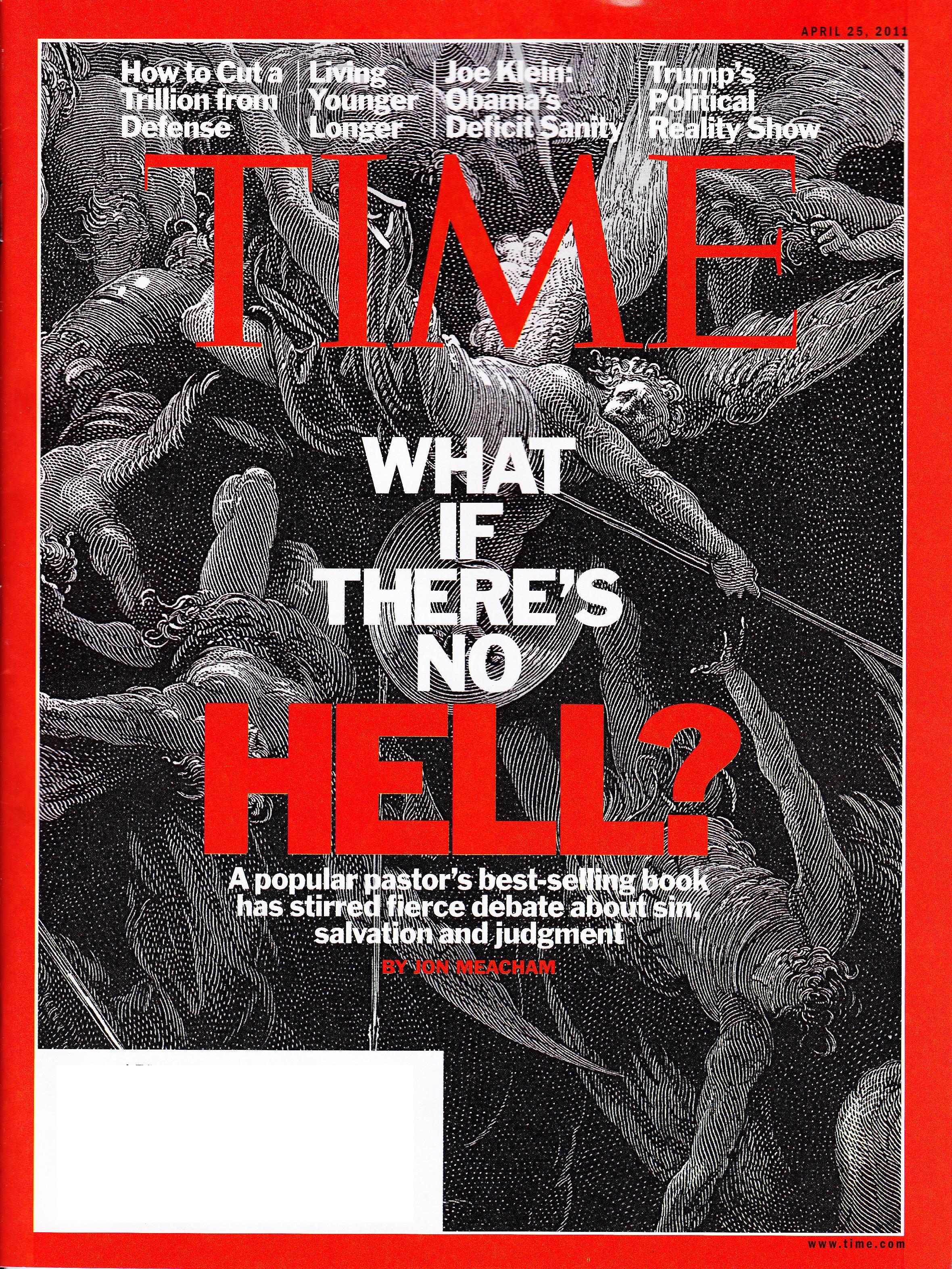
Hell makes the cover of Time. Or at least its absence does. For those of us who’ve delved deeply into the Bible for many years, it is no surprise. In fact, the uproar, as Time confesses, is among Evangelicals. So why Hell? Why now? The Evangelical pastor of Mars Hill Bible Church, Rob Bell, has just published a book questioning the existence of Hell and his fellow Evangelicals are in a conflagration about the loss of the sacred icon of God’s omnipotent stick that threatens them all into Heaven. It is a sad day when love cannot encourage enough that hatred becomes religion’s motivating factor.

The loss of Hell, however, represents so much more than just the loss of the scariest place under the earth. It represents the loss of control. Without Hell to wield and Hell to pay, many of the faithful may wonder what they might get away with. Neo-cons have been eager to court the Hell-mongers because the issue is making others lock-step in their own pattern. Diversity is not encouraged or appreciated. Lawns must be cut to the same height, trees carefully trimmed, shirts must be conservative and cookie-cutter, and one must wear that blessed smile that proclaims “Hell-dodger.” Cast any doubt into this fabled world and the results might be, well, realistic.

The Hebrew Bible knows no Hell but the one we make for ourselves. We hardly need a Devil to tutor us in the ways of evil. Human history reveals that we’ve had it in us all along. Instead of celebrating the death of Hell, several Evangelical pastors are simply adding Bell to its numbers. Time’s news is not news for many of us, but for those who haven’t considered seriously the implications of their faith as Holy Week rolls around, this may be a good time to take stock of options for eternity. What do we gain by fabricating an eternal torment devised by the most loving deity ever conceived? Hell can now claim its rightful place as a metaphor for the wickedness Homo sapiens devise for each other and for their planet.

8 thoughts on “Bell’s Hell

  1. Is Hell really ‘an eternal torment devised by the most loving deity ever conceived’? Or is it a case of a parent loving us enough to make us face the consequences of our own actions and choices?

    I was just reflecting and writing on Dante’s Inferno, and how it’s not a judgy book, primarily concerned with which of the poet’s enemies are condemned to which circles of Hell. Instead, in Dante, punishment consists of wallowing in your own sins. There’s an eerie justice to it: the suggestion that choices that seemed attractive are less exciting when they’re stripped of their glamour.

    Obviously, Christ’s good news is that we’re not just stuck with having to wallow in our sins (because no one’s perfect). The gospel of love and redemption needs to be preached. However, the traditional depiction of Hell with the devils and the pitchforks, and the ragged clothing, and the heat (my God, the heat!) has perhaps outlived it’s usefulness as a cautionary warning to most enlightened folks in the twenty-first century. Unless they’re hardcore Dante scholars, they probably dismiss that picture of Hell as laughably cartoonish.

    Like

  2. Vicki Natzke

    I read the book and the article. I enjoyed the paragraph about this not being news if an Episcopal priest had written it. Or an Episcopal bishop about thirty years ago or an Episcopal theologian from Oregon in recent years.

    Like

  3. Steve Wiggins

    Thanks for the comments!
    @Jonathan, you’re right that Dante has led to much of the modern conceptions of Hell, but the origins are clearly an over-achieving deterrent, imho. The juxtaposition says it all.
    @Vicki, I noticed that too — contrast it with the administration of a certain Episcopal seminary we both know and the result is even more striking.
    @Sabio, as far as I’m concerned all Hells should go to, well, you know where!
    @Jon, I need to take a look at this blog. During the semester I’m so busy that I don’t do as much exploring as I should.

    Like

  4. @ Paul
    “Eternal” means jack-shit to a child. If you looked at the “comic” books I have from both Japan and India (Hinduism) which warn children to be good or SUFFER hell, you would see that hell, in any flavor, is horrible abuse to children and most religions have some history of capitalizing on its sick use in someway.

    But perhaps you find Buddhisms and Shintoism as escaping the foibles of human manipulation. I didn’t and don’t.

    Like

Leave a reply to Jon Hendry Cancel reply

This site uses Akismet to reduce spam. Learn how your comment data is processed.