
It was just a small blurb in the paper. Down at the bottom of page 17, it could have been easily overlooked. “Alleged witch killed by being set on fire” the small headline stated. And the date was 18 February 2012. This sad incident took place in Nepal. The story notes that “Each year hundreds of women in rural Nepal are abused after being accused of being witches.” Just last week, to the scorn of many, Cologne, Germany reopened the case of Katarina Henot, a woman burned as a witch 385 years ago. Katarina Henot was declared innocent because of the efforts of a priest to raise awareness of the persecution of women around the world. Five days after the story hit the news, Theganidevi Mahato was burned to death in Nepal. Although some called the action in Cologne a publicity stunt, it was anything but. We need to put names on those we continue to allow society to brutalize. Katarina Henot and Theganidevi Mahato, separated by 385 years and many, many miles, both died for the insanity that equates tragedy with women.
How blithely the word “witch-hunt” spills off the tongue. Each time we invoke it, the very phrase trails the ghosts of many thousands of women made to pay the price for society’s paranoia. The answers to why such tragedies occur may never be fully understood, but the events are preventable. The key is education. Even in the most advanced culture in the world, as we like to style ourselves, we heap contempt upon education, claiming that teachers barely work and that professors get paid for doing nothing. We have fallen into the fallacy that one size fits all—not all jobs can be measured by the wicked, black dip-stick of the oil industry, or the quick-cash-and-crash of the stock exchange. Education is a lifelong process, and as the political ridiculousness we constantly hear reminds us, lessons must be endlessly repeated until they sink in. Too many people think it is just easier to burn witches.
Witch-hunts arise when societies are stressed. Scapegoating is one of the most unfortunate legacies religion has left us. Evidence points to the scapegoat as being earlier than the Bible, although it takes its characteristic form there. We hear how the sins of the people were transferred to the goat on a day not so different from Ash Wednesday, to be symbolically born away where the animal would die instead of us. Somehow we’ve come to believe that burning the representative of our neuroses will somehow cure our society. Does it? Has it ever? This day as millions of Christians contemplate their sins and wear ashes on their heads, I suggest that we think of the women whom religion has allowed to become its victims. Whether due to the superstition of a remote village in Nepal or the irrational fear of “civilized” Europe with the blessing of the church, we’ve let scapegoating go too far. And those who’ve been killed are not the nameless females of forgotten times, but are the Katarinas, Theganidevis, Marys, and Rebeccas who were just as human as their neighbors.
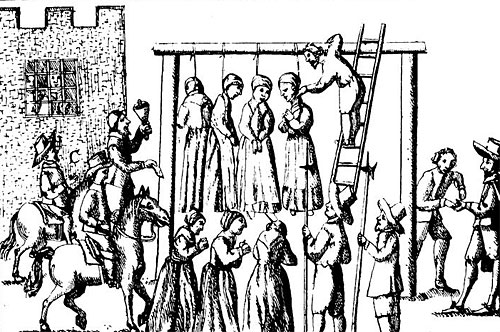
What are their names?
 Steve A. Wiggins
Pingback: This Has All Happened Before, Does It Really Have To Happen Again? « Thurman's Notebook