
When I first saw the trailer for Congo, back in 1995, I was a new father and my interest in talking apes understandably took a back seat. While the movie sat back there like a quiet child, it was slowly forgotten. Something prompted my memory over the weekend, so I finally watched it. Now, I had plenty of time to read the negative reviews, but I have a soft spot for both talking apes and bad movies. The really fascinating aspect of Congo, however, was the fantastic liberties it takes with the ancient world, particularly the kingdom of Solomon. Solomon has been under investigation over the past few decades. Archaeologists have not found evidence of the biblical opulence concerning both his wealth and fame. It seems likely that he was an actual king, but the king of a small nation that did not have quite the pull that later tradition granted to it. Still, Solomon has become a cultural trope for great wealth and splendor, and if a movie-maker wants an easy frame of reference, well, some people will recognize old Sol. Those who do recognize Solomon probably won’t have a ready inventory of his assets to interrupt their enjoyment (that presumes a lot) of the movie.
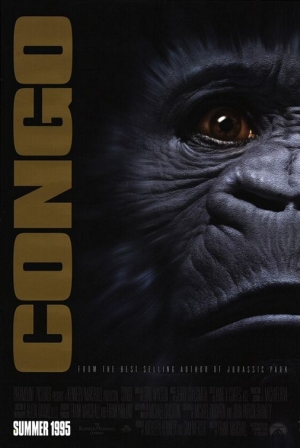
The motive factor that brings our unlikely traveling companions together in Congo, are the fabricatedly mythical diamond mines of King Solomon, located in the Congo. A self-styled archaeologist and professional con-man from Romania assists to finance a flight to Africa to help return a homesick gorilla (Amy) who also, by the way, talks. The only realistic aspect of the heroes is that the university professors are the ones who are completely broke and have to rely on corporate funding to get their monkey off their back (well, actually she’s an ape). And then there is the huge communications giant (TraviCom) that needs the diamonds for their communications equipment. And a bunch of Africans who just want to stay alive (most don’t succeed). Solomon was never really associated with diamonds in the Bible. His wealth is described in terms of gold, silver, bronze, peacocks, and suprizingly, apes. Why and how he would have managed a mine in central Africa when even the Egyptians didn’t travel there is never explained.
Well, I shouldn’t be so hasty about the Egyptians. Our Romanian con-man is also able to translate Egyptian heiroglyphics, liberally scribbled on the walls of the fortress surrounding Solomon’s mine. These preserve the story of the “myth of the killing apes” that generated an honest-to-god guffaw from my cynical self. New mythology and corny characters aside, the movie didn’t fail to reach me. I’m always a sucker for talking apes and under-funded education, both of which represent a kind of extinction. If Solomon really had a reach all the way to the Congo, and if he extracted the huge diamonds the movie showed scattered around on the surface of the ground and if universities could actually get media attention for causes other than the shortcomings of their football programs, there could be cause for hope. In what is a bit of probably unintended social commentary, after the mine is destroyed in a volcanic eruption, only one diamond remains. And that diamond benefits neither the single surviving African nor the underfunded university professor. It becomes a weapon in the hands of a large, private corporation.
 Steve A. Wiggins
2 thoughts on “Leggo My Congo”