
Apart from being one of the most controversial films of all time, The Devils is also devilishly difficult to locate. For as influential as it was (you can’t tell me nobody in Monty Python saw this before making Holy Grail) it has largely been buried, at least in the United States. It doesn’t stream and to get a viewable copy you are limited to a Spanish language import DVD and have to manually select English as the language if you want to hear it as produced. The question is if you do want to see/hear it. Written and directed by Ken Russell, it is over-the-top. Chaotic and cacophonous, it’s almost distracting and somewhat boring for about half its run time. Then it turns incredibly violent and grotesque. So why did I watch it? Well, for one thing, it was something I knew I could’ve included in Holy Horror, had I been able to access it then. For another thing, I’d read about it many times and was determined to find it.
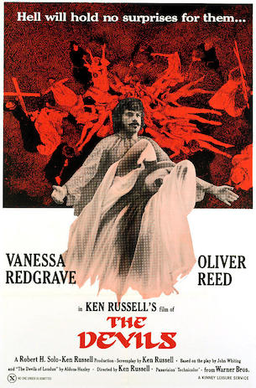
Based on historical events (but stylized to the point of abstraction), the film is about the Loudun possessions of 1634. Nuns in an Ursuline convent began displaying the kinds of tics that girls would display in Salem some 58 years later. A local, unconventional priest, Urbain Grandier, was accused of bewitching them and was burned at the stake. The film makes much of the political machinations taking place, and revels a little too much in the behavior of the nuns. It also enjoys portraying medieval torture methods and has an almost Clockwork Orangesque feel to it. Released in 1971, it was given restrictive ratings where it was permitted to be shown, and although some horror has surpassed the excesses in recent years.
Religion’s relationship to horror is a frequent topic of discussion on this blog. This movie is a textbook example of that. After my nerves stopped jangling so much, I recollected that Ken Russell was also responsible for Lair of the White Worm. Another story of debauched nuns and religion gone awry, it made me wonder what Russell’s personal interaction with religion might have been. He apparently converted to Catholicism and then converted away again. It certainly doesn’t get much sympathy in his movies. Father Grandier is somewhat heroic in The Devils, but the overall institution is clearly corrupt. In some cases religion is the means of fighting horror. In other cases it is the cause of the horror. Here the latter is clearly on display, and even that is, unfortunately, over the top.
 Steve A. Wiggins
2 thoughts on “What the Devil”