
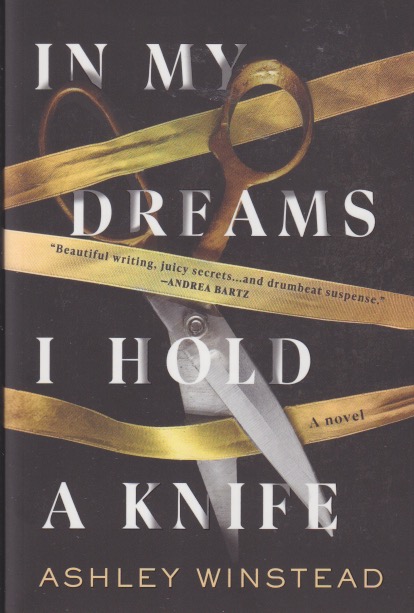
I’ve been pondering the role of religion in dark academia. While not a major element, it’s certainly present in Ashley Winstead’s In My Dreams I Hold a Knife. There are plenty of plot twists, and I’ll try to avoid giving away whodunit, at least ultimately. The basic idea is that a group of seven students, the “East House Seven,” band together at Duquette University, a near-Ivy League school in North Carolina. They get into some college hijinks, but things turn dark when one of them (Heather) is murdered their senior year. Jessica Miller, one of the seven, has become a corporate climber, despite her family background, and ten years later she goes to Homecoming to show off her accomplishments. But things don’t work out as planned. Heather’s younger brother, who works at Duquette, has been doing some detective work and uses Homecoming to confront those who remain about the murder.
The seven (which actually involves an eighth student) pretty much date among themselves. Some of them, including Heather, are quite wealthy, but not all. Jessica isn’t among the affluent, and another of the seven, Coop, ends up dealing drugs to make money on the side. Heather’s boyfriend was suspected in the murder, but had to be released for lack of evidence, and he decides not to attend Homecoming. Those present for the event are confronted by Heather’s brother and the story is told as flashbacks from the Homecoming to events that took place during the college years of the seven. As I say, I won’t reveal who did it, but each of the remaining seven is suspected until the reveal comes near the end.
For me, these kinds of stories are a little difficult to follow because of the number of active players. Jessica reveals herself to be an unreliable narrator, and although the story felt long to me, it takes quite a bit of space to get to know all the characters well enough to understand their motivations. Two of them were raised religious, which is what ties this theme into the novel. The wealthy students aren’t exactly the kinds of people to emulate, and those raised religious end up being the good ones at the end, although they do participate in Greek life with its parties and other activities that college encourages. (Sorry about the long sentence.) Overall, this is a good story, but it’s hard to give too much sympathy to the group as they do have shifting alliances and are mostly power-hungry. Yet, isn’t that like life itself? It is dark academia.
 Steve A. Wiggins