A Decade

Please pardon my being sentimental, but today marks one decade of blogging on Sects and Violence in the Ancient World.  I realized, thinking this over, that I used to make some interesting, perhaps even quotable statements back then.  Why not, I thought, farm those older posts to celebrate what I was thinking when I was a tenth-of-a-century younger?  So for today’s post, I’m presenting some quotable quotes from July 2009, starting with one of the zingers from my very first post.  For convenience, I’ve even provided the links to the posts so you can see them in context, if your July has somehow not filled itself up already.

Sects and Violence in the Ancient World, by the way, was the name given when one of my nieces thrust a recorder in my face and asked me what I would call a blog, if I had one.  She subsequently set this site up for me.  One aspect of the title may not have been evident: it’s a quasi-anagram for my initials.  It has been, from the beginning, mostly metaphorical.  Without further ado, then, a few of my favorite lines from a decade long gone:

“He had a sidekick called Cypher (sold separately), and arch-enemies with such names as Primordious Drool and Wacky Protestor. I marveled at the missed opportunity here — they could have called them Text Critic and Doctor Mentary Hypothesis!” First post: Bible Guy, July 12, 2009. <https://steveawiggins.com/2009/07/12/bible-guy/>

“Technology has outstripped reality.” Asherah Begins, July 13, 2009 <https://steveawiggins.com/2009/07/13/asherah-begins/>

“Black and white are not in the palette of serious religious studies.”  God is Great (not)?, July 14, 2009 <https://steveawiggins.com/2009/07/14/god-is-great-not/>

“When he [Aqhat] refuses to release it to the goddess he is unfortunately pecked to death in a hitchcockian demise by a swarm of buzzards with attitudes.” Sects and Violence, July 15, 2009 <https://steveawiggins.com/2009/07/15/sects-and-violence/>

“Indeed, one may think of them [religion and monsters] as fellow ventricles in the anatomy of fear.” Vampires, Mummies and the Holy Ghost, July 16, 2009 <https://steveawiggins.com/2009/07/16/vampires-mummies-and-the-holy-ghost/>

“Better to consider it [weather] human than to face unfeeling nature.” Changing Faces of the Divine, July 18, 2009 <https://steveawiggins.com/2009/07/18/changing-faces-of-the-divine/>

“As the gods are drinking themselves senseless (how else can the latest Bush administration be explained?)…” Drunken Moonshine, July 20, 2009 <https://steveawiggins.com/2009/07/20/drunken-moonshine/>

“As usual, we kill off what we don’t comprehend.” Not Lion, July 22, 2009 <https://steveawiggins.com/2009/07/22/not-lion/>

“A bonobo was recently documented as uttering the word ‘yes’ to a keeper’s question, officially making her more articulate than some clergy I’ve known. Even today there are churches that still call their leaders Primates!” Religious Origins, July 23, 2009 <https://steveawiggins.com/2009/07/23/religious-origins/>

“I never used a computer regularly until I began my Ph.D., and then it was only a glorified typewriter, qwerty on steroids.” Who We Were, July 27, 2009 <https://steveawiggins.com/2009/07/27/who-we-were/>

“I grew up in a blue-collar household where paying ladies for favors was itself considered a sin.” Yes, Mammon, July 28, 2009 <https://steveawiggins.com/2009/07/28/yes-mammon/>

Where do you suppose we’ll be a decade from now?

Trumping the Bible

The media is chattering about one of the very many contradictions of evangelicals who support Trump.  Since I have a foot in the world of the Bible business, I read with interest how Trump’s tariffs on China will put Bible publishers in a bind.  You see, the Good Book is generally sent offshore since printing costs (and technologies) are too expensive to replicate in God’s new chosen nation itself.  This lack of divine foresight should be a bit disturbing.  The entire evangelical enterprise is based on their reading of Scripture, and the belief that the divine choice of America is behind such momentous events as 45’s election.  Maybe we should check our pipes for lead.  In any case, Bibles, which are printed cheaply in high volume overseas, are set to become too expensive to give away because of the great pretender’s tariffs.

A few media outlets have picked up this story, including one that noted Trump’s favorite Bible verse is “an eye for an eye, and a tooth for a tooth.”  The famous lex talionis statement was famously, well, trumped by Jesus who said that the ideal was to turn the other cheek.  In a rather Philistine way, evangelicals have sided with a man who says Jesus was wrong.  If you want to check up on me in your Bible you’d better get your wallet out.  Ironically from a Republican point of view, tariffs are themselves the breaking of the commandment of free trade.  Still the party that claims to believe that does nothing to prevent the sale of their souls, cash on the barrelhead.

Many evangelicals may find the idea of Bibles as a business distasteful.  It is, however, extremely profitable for those on the supply end of the deal.  Bibles are printed at a volume that would make most authors green, and due to its size the Good Book requires specialized paper most of the time.  This is so much the case that Bibles not printed on “Bible paper” just don’t feel like sacred writ.  Since costs of living in the United States are quite high, and since this kind of specialized printing would be too expensive in this situation, publishers outsource God’s word.  Some publishers have been pleading with the government to exclude books from Trump’s tariff so the Good News can continue to spread.  The fact is that only one deity, called Mammon in the Bible, runs this enterprise.  And to continue to buy Bibles at the evangelical rate will soon be requiring an act of sacrifice.  I guess the lex talionis still applies.


The Job of Theodicy

Most people, I suspect, don’t think about diseases until someone they know is afflicted.  It’s natural enough to try to avoid thinking of the negative, and I know that I’ve always felt overwhelmed when it came to worthy causes seeking donations.  I surprised myself, therefore, but putting up a Facebook fundraiser for the Crohn’s and Colitis Foundation.  Someone close to me was diagnosed with the disease, and seeing suffering first-hand has a way of changing your perspective.  You want to do whatever you can to help.  Instead of feeling completely at the mercy of chance, I put my fundraiser online and I’m hoping for the best.  A doctor I know informed me that foundations for diseases are among the most helpful websites for those with the condition.

In my mind, as in that of many others, disease is intricately tied in with theodicy—the problem of innocent suffering in the presence of a God supposed to be good.  Theodicy is frequently the first stop on the road to non-belief, as a careful reading of many of the “new atheists” reveals.  No theologian has devised a satisfying theodicy.  The question always comes down to the fact that a universe without debilitating diseases can be imagined by those of us with feeble human abilities, so why not by an almighty being with no limitations?  Human evil can be attributed to free will.  Natural evil, such as diseases not keyed to behaviors that lead to them, is a different matter.  Often we’re left to our own human devices against conditions we don’t fully understand.

Facebook may not be the best place to post a fundraiser, however, it has a reach far greater than this simple blog, and the Crohn’s and Colitis Foundation page helps to get such fundraisers set up.  For all of its problems, Facebook does provide a way to bring people together for common causes.  Seeing someone we know suffering is never easy.  And there are so many worthy causes out there.  The situation naturally reminds me of the book of Job.  People who turn to it looking for an answer to why innocent people suffer (Job is presented as perfect in the prologue to the story) come away disappointed.  No reason is given and the question of theodicy is left unanswered beyond the claim that human understanding is limited.  God may ask how Job has the boldness to question divine action, but there’s no suggestion that he shouldn’t try to find relief with his broken potshard.  My Facebook fundraiser is my potshard, I guess, although the larger questions still remain.


Waiting for a Miracle

A friend recently sent me a New York Times story about Marianne Williamson’s spiritual background.  Before I say anything more about this I have a confession to make.  I didn’t know who Marianne Williamson was and, consequently, I’ve never read any of her books.  I also didn’t know about her presidential bid, although she seems much more grounded than whatever it is that sits in the Oval Office these days.  In any case, it’s the spiritual background part on which I’d like to focus.  Williamson is apparently a devotee of A Course in Miracles, a book written by Helen Schucman in the 1970s.  According to the NYT article, Schucman penned the book by the dictation of a divine voice.  This aspect seems worthy of further exploration, regardless of politics.

You see, sacred books have a long history of divine dictation.  The Bible makes such claims only obliquely, but clearly there were some who believed that Moses was the recipient of narration from on high.  Mohammed heard a voice saying “Write.”  Centuries later the Book of Mormon was written out at the dictation of Joseph Smith.  The point is that such texts are often believed to have had sacred origins.  I find Schucman’s reluctance to put herself down as the author of A Course in Miracles instructive.  She didn’t believe she wrote it.  Not to devalue any of these sacred texts mentioned, I would nevertheless note that authors often feel that their words come to them.  Maybe academic books don’t count, but when I’m writing fiction, it’s like somebody’s hands are on the wheel, but I’m not sure I’m the one driving (with apologies to Jeff Daniels).

A Course in Miracles has been translated into double-digits languages, something quite rare even among many bestsellers.  What this says to me is that people still crave answers from an authoritative text.  The written word has a power that electronic publication lacks.  Who wants to point to a screen and say, “this is divinely revealed truth”?  Hefting a heavy book, printed on actual paper, has a symbolic power that outweighs that of ebooks.  Probably it’s because the Bible paved the way.  We’re already primed for a sacred text, in physical form.  The longer I study holy books the clearer it becomes that they will unlikely ever cease to be written.  Helen Schucman didn’t have the last word.  As long as people write it’s doubtful anyone ever will.


Truth or Dare

I once knew a man who was what can only be called a pathological liar.  I never knew when he was telling the truth.  It was a disorienting experience relating to him because, as a literalist I wanted to believe what others told me.  In this case you simply had no solid ground on which to stand.  Recently someone else who knew him (he died some time ago) asked me for some information about him.  I was at a loss to come up with anything.  Since he seemed routinely to mix fiction liberally with fact, I didn’t know where to start.  In this post-truth world we now inhabit, I fear this may become much more common.  Everyone lies from time to time, but when it is a way of life, well, even Jesus had a name for the “father of lies.”

It’s with a bipartisan sense of sadness that I lament how the Republican Party has completely backed up a man that they know is like this.  Intentionally or not, political leaders set the character of nations—just consider how often we think of Russia as Putin or North Korea as Kim Jong-un.  America has become the nation of lies.  Don’t believe me?  Maybe I’m lying.  See what I mean?  Often I tried to figure out what this man I knew was up to.  What was his endgame?  I couldn’t be sure I’d ever know, even if he told me.  Especially if he told me.  You see, I was quite young at the time, and the young often don’t have the experience to get to the truth.  And when the truth is bartered for power, well, the father of lies is lurking nearby.

Recently I finished reading M. Scott Peck’s People of the Lie.  This person I knew was in my mind quite a bit as I tried to sort out all the psychology being presented.  If I’m honest I know that even as a child I said this man was evil.  It was clear to me that he wanted to survive on his terms or no terms.  To do so, he believed his own lies.  Now I don’t know if he lied at work.  He had a job where many people depended upon him to carry out his tasks.  He seemed to do so conscientiously.  When not at work, however, he was back in the land where he felt the most comfortable, the land of untruth.  Recently someone again asked me about him.  I tried to recollect as much as I could, and like much of the world these days I answered, “I just don’t know.”


Utterly Indifferent

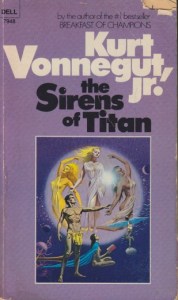
One of the main purposes of this blog, apart from being a kind of daily tablet for my thoughts, is to demonstrate that religion continues into the age of secularity.  It would be an uncomfortable stretch of the imagination to suggest Kurt Vonnegut was a religious writer, but it would also be a disservice to him to ignore just how much religion shows up in his novels.  Often the remarks are subtle and perhaps easily missed, but one of his early works, The Sirens of Titan, treads pretty solidly in that territory.  From the fact that monument to the twelve great religions was made by artisans who don’t know what those religions are to the founding of a new religion to unify humankind, this story never strays far from it.  It’s also, in my experience, the most science-fictiony of Vonnegut’s books.

The Church of God the Utterly Indifferent is the goal of Winston Niles Rumfoord’s doomed Martian attack on earth.  Because the Martians are actually brainwashed earthlings, they are sacrifices to the grand vision of all people sharing a single religion that recognizes God does nothing to help humans and humans, therefore, should not worry about serving God.  Clearly a religion that functions the opposite way of most actual religions—which try to keep God happy, often by harming other humans—Rumfoord’s vision is a united Earth.  One of the pawns in his scheme is his unhappy wife, and another is the biblically named Malachi Constant.  Constant built a ship to take humans to Mars.  Christening it The Whale, Constant took the pseudonym Jonah, which is something readers are increasingly ill-equipped to understand, but which demonstrates Vonnegut knew his Bible.

Religion plays throughout Sirens of Titan in ways that both poke fun at the seriousness with which religion is treated and with a certain respect for its power.  Vonnegut’s famous nihilistic leanings pervade the novel with an almost Job-like portrayal of Rumfoord, and several ethical questions lie beneath the apparent space-travel story.  Genre fiction, as I’ve intimated before, is intended to be slotted easily into recognized categories.  Critics reserve the sobriquet of “literary fiction” for those pieces that don’t really fit other patterns—not all fiction obeys the rules—and that’s where I’d put Sirens.  Yes, people zoom around in flying saucers and invasions from space are standard sci-fi tropes.  Engagement with religion, even if it is to question it, tends to move fiction into more serious categorizations, excluding, of course, novels written to promote a particular religion.  None of them would suggest a Church of God the Utterly Indifferent.  Unless, of course, they came from Kurt Vonnegut.


Evolving Tales

There’s nothing like a six-and-a-half hour flight to get some reading done.  I’d made good progress on Kurt Vonnegut’s Galápagos before leaving for England, but the plane ride gave me time to finish it.  While nobody, I think, can really claim to understand Vonnegut, there are clearly some trends in this novel that demonstrate his struggle with religion.  There may be some spoilers here, so if you’ve been saving this book for later you might want to wait before reading the rest of this.

As the title suggests, it’s a story about evolution.  Charles Darwin had his first divine epiphanies about evolution while visiting the Galapagos during his voyage on the Beagle.  Land creatures isolated from others of their species adapted to the environment in which they found themselves, and over eons passed on useful traits to their progeny.  If humans only had as much foresight!

With his trademark cast of quirky characters about to set out on a cruise from Equador to the Galapagos, Vonnegut has war break out.  Riots and pillaging take place.  Vonnegut takes broad aims at capitalism and business-oriented thinking, and how these represent the devolution of our species.  Of course, being Vonnegut, he does it with wit and verve.  Vonnegut was a writer not afraid to use the Bible in many ways, including what experts would call misuse.  As the surviving passengers make their way onto the stripped, but functional ship, he notes that they are like a new Noah’s ark.  They end up populating Galapagos with humans that evolve a million years into the future.

A thought that caught me along the way was a line where he wrote that in the long history of David and Goliath conflicts, Goliaths never win.  This kind of sentiment could do the world some real good right now.  In fact, although the book was written decades ago, one of the characters, Andrew MacIntosh, reads very much like a foreshadowing of 2016, down to the descriptions of how he regularly mistreats others.  In Galápagos MacIntosh gets killed during a rebellion, showing that grime doesn’t pay.  The cruise goes on without him.  Galápagos is a book that points out the evils that our system encourages, or even necessitates.  There can be another way.  The survivors land on the barren islands and set about adapting because they have no other choice.  A more egalitarian scenario evolves largely because females are in mostly charge.  While not intended as an actual solution to social ills, Galápagos is nevertheless not a bad guide, especially when shipwreck seems inevitable.


Built To Last

Those pyramids sure are sturdy.  The other day I was reading something from a biblical literalist that was discussing the pyramids.  The great pyramid of Khufu and its companions in Giza were built between about 2590 and 2505 BCE.  They’ve been around a long time.  Somewhat later this author casually mentioned Noah’s flood.  It had never occurred to me before, but since Archbishop Ussher dated the creation of the world at 4004 (and so it appears in the Scofield Reference Bible), the flood took place in 2348 BCE.  Now this flood was so catastrophic that it carved out the Grand Canyon and buried all those dinosaur bones that would eventually become fossils.  It was more than a little inconvenient, and terribly disruptive.  Except the pyramids had been around for well over a hundred years by that point.  It’s a wonder they weren’t harmed.

Such inconsistencies populate much of literalist literature.  When the Bible is the full measure of science and history and all human knowledge, there’s bound to be some issues, given that it was written at a specific time and place.  You see, the pyramids aren’t even held together with mortar.  These are loose stones we’re talking about, under great pressure.  The “Bent Pyramid,” at Dahshur, changed its angle at half-way up.  A physicist calculated that if they’d continued at the original angle, the weight of all that stone would’ve caused it to act like liquid, flowing like water.  Best repent and rethink your plan.  But these monuments were built to withstand world-wide floods!  And the mummies weren’t even mildewed.  If only Jericho’s walls had been so well built.

From WikiCommons

Maybe that’s why so many modern myths about the pyramids developed.  This sacred shape somewhere between a square and a triangle is said to have unusual properties.  I’ve read that if you put a dull razor (whatever that is) underneath a pyramid shape when you go to bed at night you’ll awaken to find it sharpened.  Made of wire, that shape on your head will not only prevent aliens from reading your thoughts, but will boost the power of your psyche as well.  The funny thing about the Bible is that it never mentions the pyramids at all.  Joseph spent a bit of time there and his descendants stayed for centuries.  Nobody bothered to note those wonders of the ancient world.  Since we’re literalists, though, that gives us a way out.  If the Bible doesn’t mention the pyramids they might not exist at all.  Problem solved.


The Lagoon

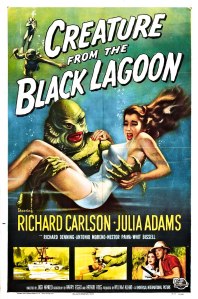
My current book project has me watching The Creature of the Black Lagoon again.  One of the Universal monsters—indeed, arguably the last of them—the Gill-man fascinated me as a child.  There was a strange contradiction here.  The creature had evolved in the Devonian Era and remained unchanged into the 1950s.  But the movie opens with a voiceover of Genesis 1.1.  There’s a mixed message here, appropriate for scriptural monsters.  Watching the film again brought back many of the innocent perceptions of youth, as well as the trajectory of my own life.  I don’t often get to the theater to see horror movies anymore, but at the same time the Universal monsters aren’t quite the same thing as modern horror.  As a genre it had to evolve.

Strangely, as a fundamentalist child, the evolution aspect didn’t bother me.  I was after the monster, you see.  The backstory was less important.  Growing up, at least in my experience, means that the backstory becomes more essential.  It has to hold together.  There are, of course, inaccuracies in the story—many of them, in fact.  Still, within the first three minutes Genesis and evolution are thrown together in a happy harmony that belied what I was being taught at church.  The Gill-man is a monster mainly for being a creature out of time.  When modern humans invade his lair, he defends his territory.  The story might’ve ended there, had he not spied Kay.  He doesn’t so much want to kill her as get to know her better.  For a movie posthumously rated G, it has a body count.  Five men die but the Gill-man apparently just wants to evolve.

There’s been a recent resurgence of interest in Creature from the Black Lagoon with both the publication of The Lady from the Black Lagoon and the death of Julie Adams this year.  The Gill-man seldom shows up in the same billing with Dracula or Frankenstein’s monster, or the Wolf-man.  He’s a bit more inaccessible in his watery abode.  Both cold and hot-blooded, he represents how science and Scripture might get along, at least on the silver screen.  The film holds up remarkably well, if a modern viewer can handle the pacing.  Underwater filming was pretty new back in the day, and watching humans swim in many ways suggests the truth of evolution in its own right.  These aren’t the childhood observations of the movie, but rather the reflections of a guy wondering if there might not be some hidden wisdom in the monsters of yesteryear.


Identified or Not

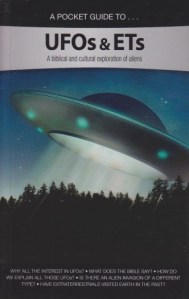
Okay, so this will require some explanation.  It came about like this: I was in a used bookstore.  (This in itself requires no explanation, of course.)  I noticed a slim book, cover out, called A Pocket Guide to UFO’s and ETs: A biblical and cultural exploration of aliens.  Biblical?  I picked it up only to discover it was from Answers in Genesis.  Please note: I do not buy books or paraphernalia of Fundamentalist groups unless I can get it used.  I don’t want to support this particular weirdness in any way.  Well, the money for this used book was going to support a used bookstore and not a religious aberration, so I figured it would be good to see what the Fundies have to say about a topic that seems to have started to engage public interest again.

The book begins by helpfully pointing out that if there’s life on other planets the Bible doesn’t mention it.  And since the only way it could’ve got there is by evolution—for surely the Almighty would’ve said something about it in his book, if he’d invented it—the whole idea is a non-starter.  Evolution, as everyone knows, is a satanic idea meant primarily to challenge the Bible and secondarily explain the diversity of life forms on earth.  And since earth is the only planet the Bible recognizes, it is the only one with life.  So, UFOs, it stands to reason don’t exist.  Well, that’s not quite fair.  They do exist but most can be explained away and those that can’t may well be demonic.  Since there can be no aliens, and since some sightings can’t be otherwise explained, then demons—which the Bible does mention—must be responsible.  They (demons) can also explain why other world religions exist.

There’s plenty in here to offend just about everyone apart from the Answers in Genesis crowd.  The screed spends quite a bit of time knocking down ancient astronaut ideas, and taking Erich von Däniken to task.  Science is useful in explaining how pyramids were built, but not in how the rock used to build them was formed (it takes far too long to make limestone the old fashioned way; God simply used a variety of different rock types to make the one inhabited planet more interesting geologically).  And those UFO religions?  Inspired by demons, no doubt.  In fact, even reading a little book like this could lead you to become interested in the subject, so be careful!  In fact, the safest thing of all (and I’ve only got your well-being in mind) is to leave it on the shelf.


Adversaries

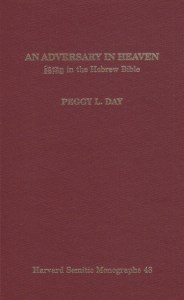
Satan isn’t who we think he is.  Inheriting a tradition from across centuries, it can be easily supposed that modern ideas help to explain the reality of that tradition.  Sorry, let me try this with more specificity.  The character of “Satan” does not occur in the Hebrew Bible.  By the time of the Gospels, however, he’s there.  We tend to use modern ideas of Satan to understand the enigmatic person of “the satan” in the Hebrew Bible.  Peggy L. Day explored this idea decades ago in her revised Harvard dissertation, An Adversary in Heaven: śāṭān in the Hebrew Bible.  Reading this took me back to those heady days when I consumed Harvard Semitic Monographs like breakfast cereal.  To those of us not from Harvard we pretty much knew what to expect, but we read anyway.  Scholars are like that.

In any case, Day here explores what is sometimes surprising to those who read the Devil back into the Hebrew Bible: the satan is mentioned in only four passages and in none of them is he “Satan.”  In Numbers the satan is identified as a good angel sent to knock Balaam off his ass.  In the book of Job the satan is a member of the divine council and he does his job by accusing Job.  Day shows, by the way, that his accusation is really against God and not the mere human sufferer.  Her outlook on Job is still amazing after all these years.  After Job, the satan appears in the short book of Zechariah to accuse Joshua the high priest of the restoration era.  He’s no Devil here either.  The final reference comes in Chronicles where instead of God tempting David to take a census a satan does.  By this time the reader already knows a satan is an accuser and need not be superhuman.

This monograph raises the perennial issue of how to understand ancient texts without chaffing under the weight of tradition.  The character of the Devil developed over many centuries and, when he appeared, he was only one of many iterations.  The New Testament made Satan “biblical” and later readers tried to explain the Devil (who came from Zoroastrian mythology) as part of the Christian divine economy.  In Judaism he went on to play a much lesser role.  Once Christian writers established this character, he was read back into the Bible, even where the original writers didn’t see him.  Day isn’t the first to have noticed this, but she handles it very well and her book is still thought-provoking after all these years.


Leggo My Lego

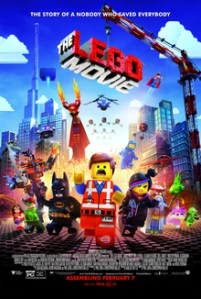
Given my proclivity to seek the profound in what is often considered the banal, I have been mulling over The Lego Movie.  Before you cast the first brick, yes, I know this movie is five years old and I know that it has sophisticated intertextuality with other movies and sly humor.  I use banal in the sense that Legos are, quite literally, plastic and they don’t work well in conveying the human form.  Our overactive psyches help here, and we give the characters their necessary humanity, but this is a movie for kids, even with its Trump-like President Business forecast some two years before the last election.  With all of that being said, and the word “forecast” already being used, my “Bible radar” zeroed in on the prophet in the movie, Vitruvius.

Vitruvius is based on a combination of Tiresias, the blind prophet, and any number of biblical characters who forecast the future.  Dressed like Moses, but named after a Roman author and architect, Vitruvius utters the prophecy at the beginning of the film and returns as a character that combines Obi-Wan Kenobi and the prophet Samuel.  (I said there was sophisticated intertextuality.)  Whether any of this is intentional is difficult to say—well the Obi-Wan part is pretty obvious—but it plays into the common view of prophets.  One of the points I make in Holy Horror (which deals with a different genre of movie) is that people understand biblical ideas through the lens of pop culture.  Prophets, through that lens, tell the future.  In the Bible itself they don’t do that very much, but since the New Testament reads itself into the Hebrew Bible (more intertextuality) the idea became pretty fixed that prophets told the future all day long.

Ironically, Vitruvius—a name that sounds like “virtue”—was famous for describing perfect proportions.  Indeed, Leonardo da Vinci’s “Vitruvian Man” sketch is based on this idea.  As ideas go, this is a false one against which many of us struggle our entire lives.  There is no perfect, Platonic human body.  Yes, certain people are attractive, but genetics and circumstances make us who we are.  And some of us grew up without Legos, but despite that deficiency we came to know the product.  The Lego characters aren’t in any sense of Vitruvian proportions.  Witty and intertextual, they’re made of plastic and they encourage us to buy for our children.  And one wonders whether Vitruvius is a prophet or a hidden symbol of that word’s homonym.  Let the building begin.


Q

If you haven’t spent much of your precious time attending to theories of how the gospels were written, you might not be familiar with the dilemma I’m about to describe.  A brief primer: Matthew, Mark, Luke, and John were not eyewitnesses of the events described in their gospels.  In fact, each of these books is anonymous—the titles were only added on later.  Despite their New Testament order, Mark was written first and Matthew and Luke borrowed from it rather extensively.  Mark is the shortest gospel and Matthew and Luke also share material that’s not in Mark.  Since John was written much later (and doesn’t have these common stories), scholars proposed many years ago that Matthew and Luke used a source—in German Quelle—that no longer exists.  This is called “the two-source hypothesis.”  As scholars are inordinately fond of abbreviations, Quelle is known as simply Q.  Other than in explanations like this you’ll never see it referred to by its full name.

So here’s the dilemma: many websites don’t allow for a single-letter search.  If you’re wanting to learn about Q, and you know no scholar worth their s (by which I mean salt, of course) who will spell it out, how do you search for it?  The same might be said for J, E, D, and P, who, along with R, put together the Pentateuch, but at least there you can search for phrases involving more than one letter.  You see, scholars existed before the internet and its search parameters.  Books and articles used to be written on paper, and the former had indexes, so looking up your sources—single letter or not—was fairly easily.  With electronic searching, it has become more difficult.  That’s not to say that single-letter searches can’t be coded—they can—but apart from biblical scholars and their alphabet soup of sources, apparently most people don’t want single-letter options.

This is the trouble with specializing in ancient things.  The internet was originally designed for academic and military purposes—serious stuff.  But then, like everything else in the world it became commodified.  Like a once pristine countryside it has billboards plastered everywhere after one’s Gelt.  (Scholars also like to throw in random foreign words to show how smart they are.)  And when it comes to searches, why enable atomistic, single-letter searching when it won’t end up in the sale of something?  In any case, my search did not end successfully.  I eventually gave up.  And in the light of the ever-shining internet, I’ve opted for the one-source hypothesis.

It must be in here somewhere…


Evil Origins

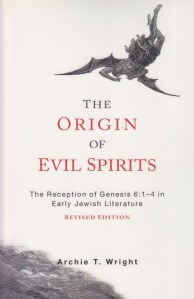
I remember well the eerie, uncanny feeling I had as a child reading Genesis 6.1-4.  This wasn’t a story we heard in Sunday School, and it wasn’t in any children’s Bible or Arch Books.  It was mysterious and strange, and not understanding what sex was made it even weirder.  The sons of God, or perhaps angels, came down from Heaven to mate with human women.  Although not stated directly, their offspring seem to have been giants.  Abruptly the story ends.  Archie T. Wright was clearly fascinated by this story as well.  His book, The Origin of Evil Spirits: The Reception of Genesis 6:1-4 in Early Jewish Literature, isn’t so much about demons as it is about the influence of this very brief, extremely odd story.

As a young person I knew about the book 1 Enoch.  Living in a rural town with no bookstore and no library (there was one in the town three miles away, but I didn’t drive and out-of-towners had to pay for a card), I had no way to read it.  Wright writes quite a bit about it here.  (In case you’re wondering, yes, in subsequent years I did read it.)  His history of transmission is a little suspect, but he explores the impact of these four brief verses on what can perhaps best be described as a diegesis.  This universe includes Watchers (the first part of 1 Enoch is called The Book of the Watchers), archangels, angels, evil spirits, giants, and demons.  Later Judaism moved away from this world, while early Christianity grew fascinated with it.  The mythology that emerged from it is sprawling and quite bizarre.  All encapsulated in a few verses before the flood.

Wright’s book is academic; it’s a revised dissertation.  Still, it’s a source more credible than a lot of what you find on the internet.  This particular biblical episode is an example of what happens when you don’t explain enough.  Granted, the writer likely had no idea that this brief account—shorter than a blog post—would eventually make it into a book that some people would consider from the anthropomorphic mouth of God himself, but because of this brevity questions, like angels, hung in the air.  As Wright shows, these verses were incorporated into ways of explaining the existence of evil in the world.  It was known by many names, and even took on personification in the form of Satan and his ilk.  This is a world of the unexpected, and it readily took me back to a childhood of wonder concerning the inexplicable passages in the Good Book.


Fear of Religions

There’s a narrative of fear in Christianity that seems to have been absent at the beginning.  This is evident when driving the highways of America where you’ll see billboards (which are meant for selling things) advertising the truth of a kind of biblical Fundamentalism.  On my recent trip across Pennsylvania this fear stood out in some rather obvious ways.  And it doesn’t reflect the Christianity reflected in the Good Book.  Stop and think about it: although the persecution of early believers was probably never as widespread as the usual narrative says it was, the writings we have describe facing persecution with joy.  Believing that they would be delivered, the oppressed welcomed the opportunity to prove their faith.  The Chick tracts I read as a child, however, focused intently on how scary the future persecution would be.  Fear, not joy, was the motivation for belief.

As we stopped in a turnpike rest area, we noticed a kiosk of Christian books amid snacks both salty and sweet.  The only other reading material available had to do with tourist attractions and finding directions.  It was, upon retrospect, odd.  Pondering this I recalled the narrative I heard repeatedly in my youth—a time was coming when it would be illegal to be Christian.  There would be persecution and the only proper response was a faith borne of fear.  This was not a religion of love thy neighbor.  No, this was a religion of armed survival based not on turning the other cheek, but on asserting itself with a show of firepower.  This kind of weaponized evangelicalism has taken over the narrative of Christianity.  Paul of Tarsus, knowing he would likely be executed, wrote of his joy from prison.  In the land of plenty we tremble.

The more cynical side of my experience suggests that politicians—who have learned that fear gets them elected—found in this form of Christianity a convenient set of sheep without a shepherd.  There’s fear in these billboards.  Fear that another religion may take over.  Or that secularism may make cherished beliefs illegal.  This isn’t cause for celebration, as the sermon on the mount proclaims it should be, but rather a call to arms.  In this country we have more than enough.  Among those left out, however, this fear grows just as rapidly as among those who fear they may lose the abundance they have.  They try to convert the weary traveler whose eye is drawn to the billboard.  And even those who stop for a drink of cold water which, the Bible suggests, should be freely given.