The Truth of Fiction

The thing about reading is that it’s a lifestyle.  I record books both here and on Goodreads, but I read a lot more than books.  Although I don’t have much time for magazines or even newspapers, I read a lot on the web.  And billboards.  And sidewalks.  I’m quite content doing it.  One thing I’ve noticed in all this reading is that fiction writers tend to be more often cited as experts and intellectuals than do non-fiction writers.  Oh the non-fic practitioners get their footnotes, and other specialists mention them, but fiction writers get analyzed, probed, and explored.  Literary types wonder what they meant by some obscure doggerel they wrote.  When’s the last time a non-fiction writer drew that kind of attention?  It makes me wonder about all the time I’ve been spending on non-fiction lately.

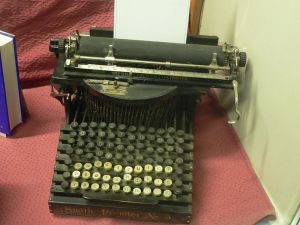
I suffer from graphomania.  There’s no cure.  The other day I went looking for an old, pre-electric typewriter to get my fix in case the power goes out.  I have notebooks, zibaldones, commonplace books.  I carry one in my pocket.  I have one on my bedside stand.  And the thing I’ve noticed is that the ideas that come to me unbidden are often fictional.  You see, I have a hidden life as a fiction writer.  That persona is very poor since he’s never made any money from his writing.  He was nominated for a Pushcart Prize some years ago, but he never won.  That fiction writer has been suffering cabin fever because I’ve been finding publishers for my non-fiction work.  I wonder, however, if maybe I shouldn’t be spending my time on fiction.  It’ll never get me to the point I can make a living on it, but it might get quoted after I’m gone.

Writing, after all, is a stab at immortality.  Those of us who do it are legacy builders.  Even as the web has moved us more and more toward visual, iconic forms of entertainment, it has still left a few dusty corners for the written word.  When I pass the sometimes impressive graffiti on the way into New York I think I know what the vandals are feeling.  We’re kindred spirits.  We don’t want to be forgotten.  Whether with spray can, fingers on a keyboard, or fountain pen (or maybe even an old-fashioned typewriter) we are trying to say, “I was here.”  I used to print out all my blog posts in case the web failed.  It grew to thousands of pages.  I had to stop.  I was beginning to act like a fictional character.


Not about Pigs

Pseudepigrapha always struck me as a great name for a pet guinea pig.  Neither members of the porcine family nor from Guinea, these rodents are remarkably companionable.  But like the word pseudepigrapha, this post isn’t about guinea pigs.  I’ve been reading various documents among this sprawling category of texts, and I can see the fascination they hold for scholars of Second Temple Judaism.  My own specialization was on the earlier end of the spectrum—Ugarit had ceased to exist even before a first temple was built and provided clues to how this whole religion got started in the first place, but that’s a story for another time.  The account of the pseudepigrapha  cannot be summarized easily.  Some of the documents have been known to scholars for a very long time.  Others have been (and continue to be) discovered, some quite recently.

Not a pig.

The documents classified as pseudepigrapha generally bear the name of someone who couldn’t have been their “author.”  We now know that ancients didn’t think of writing the same way we do.  They didn’t publish books like modern writers do, and scholars have been exploring how the category of “book” distorts even the Bible, let alone books that didn’t make the cut.  None of this diminishes the intrigue of these ancient texts.  The world into which Jesus of Nazareth was born contained many texts and traditions.  There was no Bible as we know it today—it was still being written (or compiled)—and no canon, literally a measuring stick, existed to determine what was holy and what was not.  

As discoveries in Mesopotamia have made clear, although few could read or write, writing itself was prolific, at least given the technological limitations.  Today if one wishes to specialize the literature of one subsection of one time period, and probably even some subdivision of that, has to be selected.  Universities don’t see the point, and much of this ancient material is understudied because there remains money to be made in looking at economically viable topics.  The pseudepigrapha have nevertheless come into their own.  Perhaps because some of the stories these documents contain have made their way into pop culture.  Even as I make my way through many of these texts that are young in my eyes, I realize the proliferation of writing made such growth almost inevitable.  There remains, however, a high-pitched squealing that demands attention, regardless of what the exact genus and species of the creature may be.


Mephistopheles

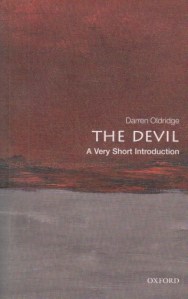
Jeffrey Burton Russell is one of the clearest thinkers I’ve ever read.  I first encountered him in my background reading for Holy Horror, and have subsequently tracked down his books on the history of evil.  In what is a dangerous move for a scholar, Russell admits in The Devil that he believes in some kind of personified evil.  Except for religion scholars employed in seminaries, such thoughts are generally kept carefully guarded as academia has followed the materialist paradigm since it boldly declared that there’s no other way to know the world.  Russell’s intellect penetrates through that posturing and logically lays out what can or can’t be known based on empirical evidence.  And in Mephistopheles: The Devil in the Modern World, he concludes his historical sweep of an idea as old as civilization itself.

This is a wide-ranging book.  The previous three covered long periods as well: antiquity through the Hebrew Bible, New Testament through late antiquity, and the Medieval Period.  Mephistopheles has to cover from the Reformation through the present of the latter 20th century (when it was written).  Finding evil in the modern world is arguably way too easy.  Since 2016 it has become more fashionable to the point that an entire political party can laud it.  Russell writes with the strong conviction that love and the will to goodness can overcome the tendencies of humans to allow hatred, fear, and prejudice to rule.  What seems to be lacking, some three decades on, is the will.  We have given in to our cynicism and elected the worst of our inclinations.

In William Friedkin’s documentary The Devil and Father Amorth, Russell, looking depressed, is interviewed about the reality of demons.  His advice is to look for the good instead.  Nevertheless, having spent years of his life researching how evil appears and reappears, his own fascination demonstrates why we return to the subject time and again.  The world hasn’t righted itself.  His books indicate that there is a way, but we continue to ignore that way, preferring instead to follow the loudest of mouths rather than the warmest of hearts.  Some would personify this into Mephistopheles, the modern, entertaining aspect of the Devil.  Others would claim it’s merely a metaphor.  No matter which may be the case there’s no denying that evil exists.  And if it exists it behooves us to know about it.  And once we learn its identity we must name it.


Care and Keeping of Books

I take good care of books.  It’s my personal goal that after I’ve read a book you won’t be able to tell.  I used to mark books up, but it occurred to me that I want the books to outlast me and if someone else is to get the full benefit of them I shouldn’t be doing such scribbling.  Of course, when a book has to commute with you there’s bound to be some scuffing from being put into a briefcase along with other necessities.  On the days I don’t commute, I try to replicate bus time for reading.  I curl up in a chair with my book and a cup of coffee to warm my fingers, and read.  The other day as I did this, a drop of coffee made its way from my mug onto the open page.  I was aghast.

Reading a marred book page is eternally distracting.  My eye is immediately drawn to the imperfection and I sometimes can’t even make sense of the sentence in which the blemish occurs.  Not because I can’t read it, but because I can’t get beyond the hurt.  Coffee rings are chic, I know, on the cover of a book or a notebook page.  It’s one of the truest clichés of the literary crowd.  Coffee and a good book.  Not coffee in a good book!  I tried to get back into the flow of the narrative.  My eye kept wandering back to the spot I’d unintentionally marred—I’d violated my own principles.  Unintentionally of course—this isn’t Starbucks where the heat is set at a reasonable level and you don’t have to scrunch up to keep warm.  But still.  But still.

After many minutes of feeling like I’d shot a friend, I managed to move on.  I kept turning back to my coffee page to see if the damage was as distracting as I thought it was.  After work that night when I picked my book up again—commuting is a twice a day activity—I turned back to the damaged page and frowned.  Books are, to some of us, friends.  I want to treat them right.  I line them up in order on their shelves, knowing just where to find them when I need them again.  One careless drop of coffee had taken its eternal toll on an innocent tome.  I realize this world lacks perfection; I’m not naive.  Still, this book, which wasn’t cheap, now bears a scar that I dealt it.  Will I ever comprehend what that one page says?  I hope my silent friend will forgive.


Instant Gramification

To be a writer these days, so industry publicists tell us, one must be savvy on social media.  But do not spend too much time, they tell us, on that same media.  What publicists don’t understand is that social media has become a zero-sum game.  It demands your time.  Just for instance, I was trying to get set up on Instagram.  Why?  Because, apparently, there is a large presence of those who like looking at pictures of books on Instagram.  The real problem for anyone who writes is to let people know when you’ve got a book out.  (By the way, I have a book out.)  Print catalogues and newspaper ads don’t have the same punch they used to, and social media is the reason.  So I tried to get set up on Instagram.

It took a few hours before I realized that Instagram is meant only for mobile devices.  My phone is several years old now and although it does (mostly) what I need it to do, it has trouble with upgraded apps.  Instagram, for instance.  You might say “it’s time for a new phone, then,” but I don’t like feeling coerced into upgrading when an iPhone 4S is already smarter than I am and it functions just fine as a phone.  And a camera.  And a GPS.  And a tape recorder.  What it doesn’t do so well is social media.  Ah, yes, and that’s what got me into this mess in the first place.  My thumbs aren’t dextrous enough to text, let alone post.  I feel old fashioned because I use a computer.

After a few hours, during which Dropbox kept telling me my storage was almost full and for a recurring charge I could upgrade it, I finally managed to get a photo (not my best) posted on Instagram.  I can’t access my “library” where a number of decent photos dwell.  It complains vociferously if I try to access said photos.  I’m not even sure it will do any good to bring awareness to my recent publication.  Our publicists like Twitter better anyway.  You can’t tweet during the day, however, when people from your company follow you.  Herein lies another of the dilemmas of a working writer.  You’ve got to manage to keep your day job.  Writing books, unless you’ve got an agent, doesn’t bring in enough money to pay your electric bill, let alone your mortgage.  And besides, work is where I learn such valuable things from publicists, like using social media so that I have a readership for my reduced time to write.


Mastering Ravens

One of the most difficult things in modern life is to keep up with all the new jobs available.  That’s not to suggest that unemployment isn’t a real problem—it is—but that the game has changed since the days I went to the guidance counselors’ office and thumbed through the box of microfiche to learn about potential colleges.  (And what strange people the guidance counselors were!)  Since 1981, when I graduated from Oil City High School, the Internet has been invented and has changed employment forever.  I understand that making YouTube videos can now be a full-time job, with benefits.  Who knew?  So when I was kindly presented with a copy of Christopher Skaife’s The Ravenmaster: My Life with the Ravens at the Tower of London I wasn’t too surprised to learn that there is such a job.

Delightfully written, The Ravenmaster goes into the ins and outs of life in what is a ceremonial job.  That the Brits are fond of tradition is no secret, and this little book is so full of them that it becomes a delightful gallimaufry that includes, I kid you not, dog biscuits marinated in blood.  Although Skaife takes you on a few detours through his own life, the book is mainly about ravens.  We’re so used to materialists telling us that everything is simply cause and effect of neurons firing that I wonder how they might react to the obvious intelligence and personalities of ravens.  Reading about their antics as well as their wisdom it’s difficult not to surmise that consciousness isn’t a purely human preserve.  With the ravens and the wolves we are a piece.

Intelligence is more common in the animal world than in the White House these days, and this book may help to show why.  Ravens can plot, plan, and be cruel.  They can also be kind, compassionate, and friends.  I’ve long had a fascination with corvids, and I tried to befriend some before moving out of New Jersey.  It was a bit tricky with the strictures of my own Tower of London—the commute, the bus, the job—and so my friendship with the local crows in the back yard of our apartment remained strictly casual.  We lose so much by not paying attention to the natural world of which we are, increasingly, so unnatural a part.  When humanity disappoints and the ridiculousness of human behavior haunts, I recommend reaching for The Ravenmaster.  It’s comforting to know that real minds exist out there in the wild.


Web Design

As those who read this blog on the actual site will have noticed, I’ve been playing around a bit with my “look.”  Neither famous nor influential, I’m just a regular guy with a doctorate who wants to make some use of it.  This blog is a way of doing that.  In any case, as I was changing templates and background images, I noticed my rather lengthy blogroll.  Apart from sounding like a particularly tasteless eastern appetizer, blogrolls are pretty much outdated these days.  Back when I started this, there was a community of like-minded bloggers who linked to each others’ pages and helped stir some stats.  In those days doing something like posting on the winner of the Super Bowl could garner you a thousand hits in a day.  The web’s become a bit more crowded since then, I suspect.

So I went to edit my blogroll.  As I did so I found no other blogs linked to mine—no offense taken!—and many that had become defunct.  Many, many.  And there were many blogs that hadn’t been updated in years.  Now, I understand that it is possible to make a living as a blogger these days.  According to my stats, this will be my 3,447th post.  When I consider the time it takes each day to write one of these things, I realize it’s a considerable piece of my life.  Seeing the blogs that have become inactive was like walking through a technological graveyard where many virtual comrades are buried.  For me, the exercise of writing (and I don’t mean the physical typing) is an essential part of each day.  I’d miss it if I stopped.

My redesign focuses on a couple of things: books and pelicans.  Since the books part should be obvious, the pelicans might need explaining.  The background image is one I took while visiting the University of California, Santa Barbara for Routledge.  On my lunch break I went down to the beach and this flock of pelicans flew right over my head.  The iPhone was new in those days, so I pulled it out and snapped a picture.  It won a company photo of the month prize (no monetary value).  There’s quite a bit of symbolism in this image of birds against the California sun.   This blog tends to be metaphorical and those who’ve complained on it over the years don’t really get that.  That’s because things are not what they seem.  There’s something valuable about having to dig for meaning, even if it means looking up.


New Horror

Now that Holy Horror is out I’ve been noticing an increasing number of scholars who are writing on the topic of monsters.  Book writing takes several years, as a rule, and when I began work on my contribution to the discussion the bibliography was a touch slim.  There weren’t many books out there and academics who addressed the topic did so warily.  Now scarcely a day or two will pass when I won’t find another book I should read on the topic.  Publishing may be an industry in crisis, but there’s no dearth of new books being produced.  Monsters—which define horror—are a means of coping with the realities of a world out of control.  Since 2016 many of us have felt a vague, if at times pointed, sense that something is seriously threatening out there.  Horror seems a logical response.

Academia tends to run behind trends rather than setting them.  Academic books in general don’t sell too well, and monsters often have crossover appeal.  The longer I’m at this, the more I think of how knowledge as a whole is gathered.  Having that shiny Ph.D. doesn’t do so much anymore when it comes to credibility.  It may get you in the publisher’s door, but to attract readers it helps to pick topics that scholars have typically avoided.  Monsters are a calculated risk in this regard.  Those who publish in the field become somewhat suspect among their colleagues, as if the subject is one that can only play itself out in naivety, an under-developed sense of sophistication.  Anything popular tends to be devalued in the academic mindset.  It is, therefore, encouraging to see others addressing my beloved monsters.

A new year is starting and, like many people I have high hopes that it will show some improvement over the past.  I can actually dream of a world without monsters and although pleasant it isn’t realistic.  We have evil with which we must deal.  Horror allows for a fair amount of practice in that regard.  I’m very well aware that many people find the topic repugnant, or at least distasteful.  Academics, it seems, are following their restless curiosities to the darker corners of the mind.  It’s getting difficult to keep up with the monster books appearing, even from reputable presses.  Holy Horror is my first contribution to the discussion and Nightmares with the Bible, which I hope to finish this year, will continue the conversation.  It looks like it’s becoming trickier to find a voice in this crowd already.  I wonder if that implies a better 2019, as we run behind the times.


Yearn Books

While this blog ranges over an outdated map of my mind, one of the two common elements that hold it together is books.  I don’t have many bibliophile followers, but for any who happen upon my pages, welcome.  Each year at this time I look back over the year in books.  I started doing this when I joined Goodreads.  I don’t put every single book in Goodreads, but it’s a fair register of what I’ve been up to.  This year I set a reduced goal of 65 books (I knew I’d be moving and commuting less, and I do most of my reading on the bus).  Happily I ended the year with 83 officially read, but then the first five months of the year were still spent in daily commutes.

Three years ago my wife discovered the Modern Mrs. Darcy’s reading challenge.  I can’t say just how much I look forward to the new year just to begin reading the books I select to meet that challenge.  The reason I do this is to force myself into reading things I might not feel like reading, or often, books I’ve been putting off for some reason or another.  It only amounts to a dozen books and if I can’t get through twelve in a year, something’s terribly wrong.  Margaret Atwood once said something like “Show me a person who’s read a thousand books and I’ll show you an interesting person.”  I didn’t really need that quote to set a goal, and I don’t think of it as bragging for readers to share their experience with books.  I started getting into books in middle school, and although I didn’t keep track in those days I likely read a thousand books before I graduated from high school.  Branches begin to bend to the light early on.

So, were there memorable books this year?  My reading, due to contractual obligations (I brought them on myself), has tended to be dark.  There were, nevertheless, spots of light.  Thomas Hardy’s Jude the Obscure and Paul Bogard’s The Ground Beneath Us were early favorites.  I managed to stop my ears enough to miss spoilers from Jeff Vandermeer’s wonderful Annihilation.  Carl Sagan’s The Demon-Haunted World was artfully done, and Gregory Alan Thornbury’s Why Should the Devil Have All the Good Music? was a saunter down memory lane.  Selections from my reading challenge fiction that I really enjoyed were Anne Tyler’s Vinegar Girl, and Emily Fridlund’s History of Wolves. And Lee Irby’s Unreliable.  And and Carlos Ruiz Zafón’s The Shadow of the Wind.  The last inspired non-fiction title I read was Susan Fair’s American Witches.  I always appreciate suggestions, just sayin’.  Reading is the balm in my personal Gilead, and I look forward to a 2019 full of books, even if I can’t keep the pace of years past.


The Night before Reading

Like many people bound to their circumstances by work (and now a mortgage) I see travel to far-off places is a dream.  On my personal bucket-list is Iceland.  Perhaps that’s a strange place to yearn for in winter, but it’s on my mind today because of Jolabokaflod.  I’ve posted on Jolabokaflod before, but in case the concept is unfamiliar I’d summarize it by saying Icelanders, who are exceptionally literate, give each other books on Christmas Eve and spend the dark hours reading.  For the past three years I’ve taken part in a reading challenge that lists a book in translation, and invariably I choose one by an Icelandic author.  Publishers in Iceland, being less corporate than our native species, accept books for publication somewhat more readily—I’ve been shopping a novel around for nearly a decade now and I’ve read worse.  If it doesn’t jack up the dollar signs, so nobody around here’s interested.

I’m sure it’s not all sweetness and light in Iceland.  I suspect, for one thing, it’s hard to be vegan there.  Then there’d be the need to learn Icelandic.  The nights would be even longer in winter, but then, those long nights would be filled with books.  I sometimes imagine how different America would be if we loved books that much.  I remember well—as you may also—the classmates who grumbled about “having to read” as part of their school curriculum.  And this began well before high school.  Young people’s bodies are full of energy and they want action (which can be found in books, I might add) and new experiences (ditto).  Our culture feeds them the myth that such things lead to happiness.  Instead, they find sitting still tedious.  When life leads them to commute, they fill bus time with devices.

The other day I had an electrician in our house—the previous occupants had some strange ideas about power distribution.  He, as most visitors do, commented that we have a lot of books.  I’m beginning to feel less apologetic about it than I used to.  We have books not only because it’s been part of my job to read, but because we like books.  One of the painful memories of 2018 was the loss of many volumes due to a rainstorm that flooded our garage right after our move.  It still makes me sad to go out there, remembering the friends I lost.  Nevertheless, it’s Christmas Eve, at least in my tradition, and the thought of books combined with the long hours of darkness brings a joy that I’d almost characterize as being Icelandic.  At least in my mind.  Jolabokaflod might well be translated, “silent night, holy night.”


Slight Reading

It will soon be time to turn to holiday-oriented posts, but if you’re like me you’ve been seeing the decorations and hearing the music for some time now already.  Given that, at least in name, Christmas is a religious holiday it fits naturally into this blog.  So does the supernatural in itself.  This year I have read most—there’s one book unavailable—of the book-length work of/about Ed and Lorraine Warren.  The latest, some five years after Ed died, was Conversations with Ed and Lorrain Warren by T. Sealyham.  My copy, which came used from a library, has all the marks of self-publication.  It really needed an editor to go over it.  The transcribed radio interviews with Tony Spera, the Warrens’ son-in-law, the accounts told are familiar to those who know the Warrens’ other work, with a few new ones thrown in.

What is immediately striking here, apart from the factual errors (the Isle of Skye is not in the North Sea and Loch Ness is not between Edinburgh and Jedburgh) is the strong desire for credibility.  Personal anecdotes are offered as proof.  Even on the radio claims are made to having photographs (which can’t be seen in that medium) that aren’t shown because of various restrictions.  There’s no doubt that Ed and Lorraine were completely sincere in that they believed in the reality of the phenomena they studied.  They have to be credited with taking seriously what mainstream science simply cannot study.  I often found myself wondering why there can’t be any middle ground here.  The truth only appears when all the hands are face-up on the table.

Volumes like this, that preserve misstatements of a clearly aging Ed, do not help the cause of credibility.  Yes, people get forgetful with age.  Yes, people sometimes misspeak.  Credulity, however, doesn’t lead to credibility.  Many times Tony, after receiving an intriguing answer to a question, would immediately switch the subject instead of following up with a probing request for more detail.  The interview becomes a pastiche of friends remembering old times and claiming this is the truth because they all agree that it is.  Perhaps my negative response comes from the fact that truth itself is under attack by the United States government even as I write.  The world has lost the ability to judge objective evidence and come out with a reasoned assessment.  Are there ghosts?  Perhaps so, but to get to the truth of the matter will require more than the insistence that we believe “because I told you so.”


Reading Lights

Late one night in Wisconsin—I had just come off the train from Champaign-Urbana—one of the students from Nashotah House was driving me to my spooky apartment on campus as part of his work-study job.  He mentioned what seemed an obscure topic to me, and I asked him why he liked it.  “Who can say,” he responded, “why they like anything?”  He had a point.  Work on Nightmares requires reading current studies of horror, and one that came out just before Halloween was Darryl Jones’ Sleeping with the Lights on: The Unsettling Story of Horror.  I don’t know why I like such things, but when the book was first announced I knew I’d need to read it, and soon.  It had to wait until the Warren books were finished, however.

This little gift book (with a novelty cover, even) contains quite a bit of insight.  In fact, while reading it I discerned that Jones had spotted something that I’d begun to write down independently.  Horror does that to people.  The book is divided up into chapters addressing different genres of monsters and analyzing why they have proven so popular with both horror authors and auteurs.  The discussion is lively and even witty at times, as befits a topic that most people really misunderstand.  I myself used to misunderstand it—I went through a terrible period of repudiating the things I liked when growing up (who could say why?).  I jettisoned my interest in the Gothic even as I visited ruined castles in the Scottish highlands, and thought that horror was something best left to the uneducated.

One of the realities of my own life—perhaps some of my readers will find it true as well—is that once you’ve been put through the mill once or twice your mind starts going back to childhood in what may be a vain effort to start all over again.  The likes of your youth come flooding back—this is why I began reacquiring Dark Shadows novels.  They aren’t fine literature, but they were one of the guilty pleasures with which I grew up.  As Jones notes, vampires are one of the most enduring of monsters.  He suggests that Bram Stoker’s Dracula was among the notably influential books of Victorian English literature.  As Jones points out, there are people who back away from him when he tells them he studies horror.  He also makes a clear case for its enduring connection with religion.  I might add as a coda here, that telling people you study religion often gets the same response as telling them you study horror.


Solstice Musings

Should my posts of late be castigated as against the Christmas spirit I would rely on Andy Williams’ song, “The Most Wonderful Time of the Year” in my defense.  “There’ll be scary ghost stories,” the crooner sings amid images of cheer and celebration.  What may not be appreciated by my less sober celebrants is that the long nights of winter have as close an association with ghosts as they do with the numerous religious holidays that fervently pray for the return of the light at this time of year.  In merry old England, which along with Germany developed the modern concept of Christmas, the holiday was observed with evening ghost stories as is well represented by Charles Dickens’ A Christmas Carol (likely the source behind Williams’ lyric reference).

So I read about ghosts when the light begins to fail.  Or at least that’s my excuse.  When Ghost Hunters took to the air in 2004 the world became aware that electronic devices can pick up anomalies and other ghost-hunting groups began to appear.  Alan Brown, apparently curious about this development, wrote Ghost Hunters of New England as a field guide of sorts to paranormal investigators.  The book divides the region by states and includes the answers to survey questions asked to each of them.  The result isn’t especially inspirational, however, as these groups share in common the obvious absence of scientists.  It may be that professional scientists fear the career impact of such associations, but as is the case in many academic disciplines, their lack of participation simply erodes the credibility of science in the eyes of many.

Human investigation of the world has reached a point where many academic specialists can no longer communicate effectively with the average person.  I work in academic publishing and it is clear that many specialists simply do not recollect the level at which those without advanced training read.  We therefore see the rise of hoi polloi as self-appointed experts.  If scientists won’t investigate ghosts, plumbers will.  And since, no matter what science declares, many people experience ghosts, they will listen to those who at least seek answers.  The problem with books like Brown’s, of course, is that if a fad fades the groups disappear leaving the information outdated.  A couple of the groups were interesting enough to send me to the websites listed only to find the domain name for sale and the ghost hunting shingle removed from the door.  Still, the book had some useful information for those willing to consider the possibilities.  After all, the nights can be awfully long in December.  And there’ll be scary ghost stories…


Deliverance

Ed Warren died in 2006, effectively ending the cooperative ghost-hunting venture with his widow Lorraine.  The Warrens rose to prominence after being among the first to investigate what is now known as the “Amityville horror.”  Not being writers, the Warrens hired those more talented in the literary arts to recount some of their more famous adventures.  Their books were a hot commodity in the 1980s, selling well through commercial publishing houses.  These accounts then went the way of out-of-print books, settling into used bookstores and attic corners.  With the release of the horror movie The Conjuring, these titles came back into demand and enterprising publishers licensed the content in order to resurrect the books.  The latest effort was Deliver Us from Evil, written by J. F. Sawyer and published after Ed’s death.

Now, if you’ve been following the thread of my posts on these books you’ll know they were never belles lettres to begin with.  Many of them are disturbing to read, regardless of whether you believe in the supernatural or not.  Deliver Us from Evil, which is subtitled True Cases of Haunted Houses and Demonic Attacks, reads like a collection of juvenile ghost stories.  Unlike many of the other books in this informal series, it doesn’t go into detail of how the Warrens investigated the cases.  Although it doesn’t state this directly, it seems that since Ed couldn’t narrate the procedures and outcomes, the stories are simply left to stand on their own.  There isn’t much glue between them and the accounts themselves, which occasionally eerie, lack the conviction that a self-convinced Ed apparently gave to the other exemplars.

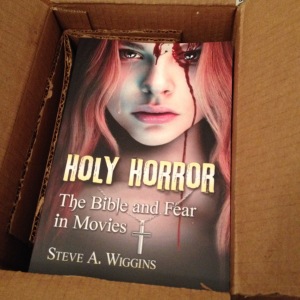
Since my follow-up to Holy Horror (which just arrived on my doorstep) deals with movies about demons, I have been eager to read the entire Warren oeuvre.  There are two remaining books, as far as I’m able to determine, and one has become a collectors’ item and is priced that way.  This is, it seems to me, an odd but working-class way to do research.  Books, even if not by academic publishers, are part of the public record, and as such, deserve consideration of some kind.  Yes, many books can simply be dismissed.  Nobody has time to read them all.  Nevertheless, it’s true that to be informed a researcher should put aside prejudice and see what the public record states.  Deliver Us from Evil was a quick read from that record with no real plot and a kind of haunting ending.  I wonder what Ed would’ve thought.


Better Late Than

It seems that Holy Horror is now available, although I haven’t seen it yet.  According to the McFarland website it’s in stock just in time for the holidays.  Those of you who know me (few, admittedly) know that I dabble in other social media.  One of my connections on Goodreads (friend requests are welcome) recently noted that he does not like or watch horror.  Indeed, many people fall into that category.  His follow-up comments, however, led me to a reverie.  He mentioned that reading the lives of the saints and martyrs was horrific enough.  One of the claims I make in Holy Horror is that Mel Gibson’s Passion of the Christ is a horror film.  My friend’s comment about martyrs got me to thinking more about this and my own revisionist history.

Traditionally horror is traced to the gothic novel of the Romantic Period.  Late in the eighteenth century authors began to experiment with tales of weirdly horrific events often set in lonely castles and monasteries.  From there grew the more conventional horror of vampire and revenant tales up into the modern slasher and splatter genres.  I contest, however, that horror goes back much further and that it has its origins in religious writing.  Modern historians doubt that the mass martyrdoms of early Christianity were as widespread as reported.  Yes, horrible things did happen, but it wasn’t as prevalent as many of us were taught.  The stories, nevertheless, were written.  Often with gruesome details.  The purpose of these stories was roughly the same as the modern horror film—to advocate for what might be called conservative social values.  The connection is there, if you can sit through the screening.

Holy Horror focuses on movies from 1960 onward.  It isn’t comprehensive, but rather it is exploratory.  I’ve read a great number of histories of the horror genre—a new one is on my reading stack even as I type—and few have traced this phenomenon back to its religious roots.  Funnily, like horror religion will quickly get you tagged as a weirdo.  Perhaps it’s no coincidence that both goths and priests wear black.  As I’ve noted before on this blog, Stephen King’s horror novels often involve religious elements.  This isn’t something King made up; the connection has been there from the beginning.  We may have moved into lives largely insulated from the horrors of the world.  Protestants may have taken the corpus from the crucifix for theological reasons, but for those who’ve taken a moment to ponder the implications, what I’m saying should make sense.  Holy and horror go severed hand in bloody glove.