Not Your Father’s Demon

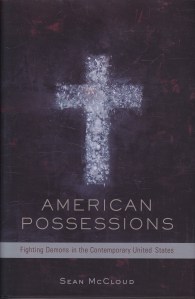
AmericanPossRegan MacNeil is a name that can still send shudders up and down stout spines. Despite advances in CGI and special effects, The Exorcist is consistently rated among the scariest movies of all time. Demon possession, clearly, is a very troubling thing. American Possessions, by Sean McCloud, is not a place to go to find Catholic priests expelling the forces of darkness. Subtitled Fighting Demons in the Contemporary United States, the book, one might suspect, is saying more than it seems to be letting on. This is a book about Third Wave evangelicalism and its demon-fighting manuals. Although the term “Third Wave” may be unfamiliar, the next time you go to a Tea Party you’ll know you’re among them. These born again uber-capitalists believe in a literal demonic world. In fact, demons are so common that Jesus would’ve had a hard time keeping up with their exponential economic growth. These demons are more frightening than those that possessed Regan. The are more akin to a different Reagan.

Especially popular among Pentecostals (the fastest growing form of Christianity) this modern day belief in demons sees them in places Jesus didn’t think to look. Family curses (at places ruled out in the Bible, but still, apparently, possible), addiction, depression, sexual urges—these are all demonic. And once these modern demons are cast out, unlike that of Regan, they can come back. And if they don’t possess you they will oppress you. And they can live in your material goods, your house, and even the land it is built upon. They are everywhere, and they have to be fought against constantly. They also, apparently, vote Republican.

This view of the world, strange as it is to many people with a basic education in science, motivates a large sector of the United States population. Expelling these demons requires a specific view of Christianity—a view that absolutely excludes Catholics. And it is a view that promotes free market economics, blaming the victims of poverty for allowing themselves to be oppressed by demons. Many aspects to this belief system will strike the reader as completely unbelievable, all the more for being so seriously believed. At the same time, we are told, we should pay no attention to religion, at least as educated people. The problem with this is that these true believers vote. And the kingdom they would have come on earth is, in a way they would certainly deny, possessed.
Monstrous Intentions

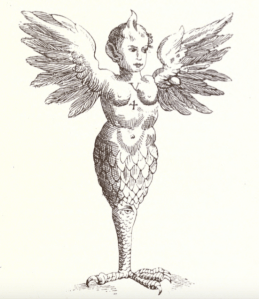
Atlas Obscura is one of those websites where you could spend all day and feel like you’ve just traveled the world. Featuring less know locations, and strange spots that you might like to visit, sometimes it also has stories about monsters. Well, at least one story about monsters. A friend of mine recently shared Cara Giaimo’s story about thirteen lesser-known monsters from history. While none of these are likely to keep you up at night, they do demonstrate the endless imagination people devote to the unknown. Monsters, like religion, defy easy categorization. Is something that’s “too big” or “too small” for its type a monster? Is it a monster if it is a mix of things that don’t normally come together? Or is it merely a matter of baleful intention? What doth a monster make?

Taking a page (almost literally) from John Ashton’s Curious Creatures in Zoology, the Atlas Obscura page runs down some monsters once believed to have existed. Some of them, despite our flattened world seen only through the eyes of rationality, were actually reported to have existed. The “monster” of Ravenna, for example, was apparently a sad case of a medieval/early modern birth defect that, in the popular imagination took on monstrosity. We now know that birth defects may contain throwbacks to earlier stages of evolution, or that genetic coding may contain mutations. None of this suggests any evil intention on the part of anybody. Accidents of nature may be the saddest kind of monster of all.

Screen Shot 2016-01-27 at 5.42.32 AM

A surprising number of the monsters from Ashton’s sampler here are mixes between human and animal. Indeed, that mix is still a potent force, theologically. One of the loudest voices speaking out against evolution is the one that says people are “not animals.” Having grown up with that belief, it took a couple years of college to convince me that we fit into the greater biological scheme of things. We fear that which resembles us, but is not quite us. Perhaps part of the mystique is that we haven’t quite yet learned to be humane to one another. Being a monster may just have more to do with what one does with prejudices than it does with physical features of their bodies.


When Gospels Mattered

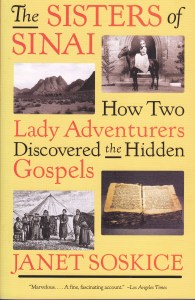
SoskiceOnce I met with a group of writers and intellectuals in the Pacific northwest to discuss ancient—indeed, dead—languages and their cultures. I’d never before been accorded “rock star” status for what, for me, seemed a natural progression. I had spent my youth learning archaic languages and reading documents that few people had heard about and even fewer cared about. It was a delight, therefore, to read Janet Soskice’s The Sisters of Sinai: How Two Lady Adventurers Discovered the Hidden Gospels. I have to admit having never knowingly heard of Agnes and Margaret Smith, also known as Mrs. Agnes Lewis and Mrs. Margaret Gibson, nineteenth-century Scottish twins who chose to use their inheritance in finding, reading, and preserving ancient documents. To appreciate the importance of this avocation, as Soskice points out, in 1881 when a new translation of the Gospels went on sale based on recent manuscript finds, Oxford University Press sold a million copies on the first day of sale and carts carrying the Bibles caused traffic jams in London. Today a doctorate in those ancient languages and five bucks might get you a cup of coffee.

What makes this story so intriguing, admittedly, is that here were two women in a men’s world, accomplishing great scholarship when the University of Cambridge refused to grant women degrees. (The twin sisters lived in Cambridge.) It is with some sense of familiarity that I read how, after discovering and photographing the Syriac palimpsest which turned out to be perhaps the earliest complete copy of the Gospels known at the time, the sisters could not even get Cambridge professors to look at their photographs. Professors, as we all know, are too busy to bother with amateurs like the rest of us. As soon as one of the more promising Cambridge scholars almost accidentally viewed one of the pictures, the men stepped in eagerly claiming the discovery for themselves. The manuscript was in Saint Catherine’s Convent in the Sinai peninsula, a journey not easy to make, even today. Agnes had discovered the palimpsest there on a journey to discover ancient manuscripts. But she was a woman in a man’s Cambridge.

We can congratulate ourselves on many things in academia today. In many fields a woman stands a better chance than a man in landing a teaching job. But we still have far to go. Salaries for women continue to lag behind those of men for doing the same work in general. Healthcare issues that effect primarily women are decided on by legislatures that consist mostly of men. In many parts of the world, women are, by default, treated as the property of men. Two Scottish sisters managed to help upset the world, in their quiet way, at the turn of the twentieth century. They did it by acts of scholarship. Genteel, proper, and very Presbyterian. If only we could say that in the century since then we had reached equality, we might have done something of which we could truly be proud.


Quaker Way

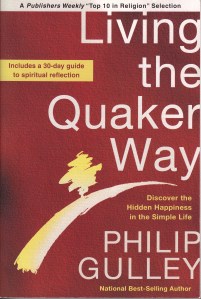
QuakerWayDoctrine can be an immense stumbling block. As a person who’s been involved with many churches in my life, the virtue of virtues often seems to be sacrificed on the altar of doctrine. If you don’t believe X, you’re not one of us. It was a great delight, therefore, to read Philip Gulley’s Living the Quaker Way. Having grown up in Pennsylvania, you might think I’d know a great deal about Quakers. I never met any, however, when I lived in the state. And I really didn’t know much about their beliefs. I knew they called themselves Friends, and I knew “Quaker” was originally a derogatory title, like “Methodist,” “Jesuit,” or the near homonym, “Shaker,” later reappropriated as a name for the group. I also knew that numerically they were on the smaller end of the religious demographic. Reading Gulley’s insightful little book was an epiphany.

I learned of Calvinism at a Presbyterian College. There I was taught TULIP: Total depravity, Unconditional election, Limited atonement, Irresistible grace, and Perseverance of the saints, the first three of which struck me as dangerous and unholy. What a beaming of light to read instead of SPICE: Simplicity, Peace, Integrity, Community, and Equality. This acronym is Gulley’s shorthand for what defines the Religious Society of Friends. Doctrine is nowhere on the list. A deity who creates people just to throw them into Hell is also missing. As is Transubstantiation. And religious violence in the name of spiritual purity. There is an awful lot to be learned from the simple message of people who understand that they are people and every other person is too. Gulley is not naive; he knows Quakers aren’t perfect. What he does show, however, is that those who are willing to relinquish self-assured self-righteousness make far better neighbors who resemble what Jesus taught than do many who would rather destroy the livelihoods of those with whom they disagree.

The beauty of what this book describes is that one need not be a Quaker to live this way. Not being doctrinal, a Quaker wouldn’t insist on that and still be true to the ideals of the Friends. If we could learn to want less, to get along with those with whom we disagree, be honest, welcome others, and treat all people as if they had a bit of God inside them the world would be a better place. There can be no doubt about that. One might say, “that’s just common sense.” I would guess that most Quakers would agree. Religion, freed from platitudes, could be a viable and valuable way of being in the world.


Free Words

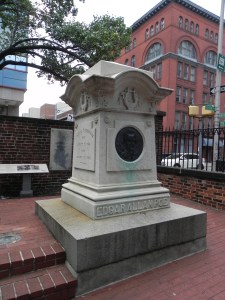
Just over a couple of centuries ago on this date, Edgar Allan Poe was born. That auspicious moment is an inspiration for those of us who write, and not just those of us who like scary stories. Poe was one of the first Americans to try to support himself by his writing—an occupation that has remained difficult to replicate and attain, even centuries later. There had, of course, been earlier writers. Mostly they wrote as an avocation to their jobs or they had family wealth, but Poe knew his own talents well enough to believe that writing was his occupation. He still stands out as an icon to those who are hopefully of making some kind of mark in the literary world. The surface is, however, much harder than we anticipate. It is like diamond, which may be marked only by another diamond. It is worth stopping to think of literature today.

DSCN2335

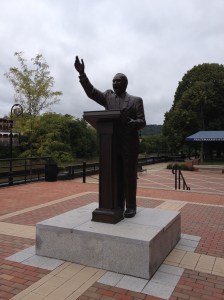
Over the long weekend, celebrating the human spirit in the person of Martin Luther King, Jr., I decided to read William Shakespeare’s King Lear. Probably not the source of as many famous quotes as some of the Bard’s other plays, it was nevertheless fitting as a tribute to writing. King Lear is sometimes cast as Shakespeare’s most thoroughly tragic works. The mood of misfortune hangs over the entire play. And although Lear is likely a fiction from the mind of Geoffrey of Monmouth or his sources, his name recounts the Celtic god of the sea, Llyr. Historians and grammarians tell us that Lear is not directly derived from the god’s name, nevertheless, there is a divine madness about the drama that unfolds as love and power vie for control in ages long past. In the present day the tragedy is that love seems no longer to be part of the equation and raw power is left to mark those who would be kings.

IMG_0969

The holiday weekend afforded the opportunity to visit a local bookstore and to ask the owners what to read. It would give Poe, I’m sure, some hope to know that despite the difficulties there are those who still strive to live by their words. Indeed, it is difficult to conceive of a better way of celebrating freedom than to indulge oneself with the written word. Words lead to liberty. Although Poe’s life was short, and often tragic, Martin Luther King, Jr. lived to about the same age, and through his often tragic life, changed the world with his words. In this day of money hunger and electronic stimulation, it is good to set aside some time to reflect on the words that have made us who we are. Words are our ultimate freedom.


Monk over Matter

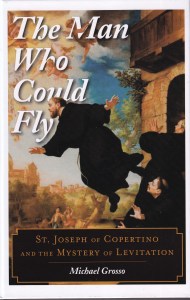
ManWhoCouldFlyPeople can think with their emotions. At a young age we begin formal schooling to teach us the rational ways that we must develop to live in society. Emotions are trained, tamed, and sometimes repressed as we are taught that “higher brain” functions are what make us distinctly human. Even in our supremely rational world, however, we can’t figure out consciousness. It remains elusive, provocatively bordering on the supernatural, and the experience of being human gives the lie to consciousness being emergent from a physical brain. These are the kinds of issues that underlie the strange case of Joseph of Copertino. The subject of Michael Grosso’s recent book, The Man Who Could Fly: St. Joseph of Copertino and the Mystery of Levitation, Joseph may well be off the radar of most people. In fact, in the seventeenth century church in Italy, his presence was downplayed and hushed, almost as an embarrassment to Roman Catholicism of the day. Why? Joseph was known to levitate. In fact, his levitations were often in public and were witnessed by individuals whose credibility was not in doubt. With the Reformation going on, however, the last thing the church needed was a miracle.

The standard historical line of dealing with Joseph is to laugh and wave our hands in the directions of those credulous early moderns. They thought they saw him levitate, but it was all imagination. Even if we have to invoke mass hallucination. People just can’t levitate. Grosso’s book, however, takes a different approach to Joseph. Looking at first-hand accounts, carefully considering the political situation of seventeenth-century Italy, and being open to parapsychology, this book presents a very different portrait of the flying saint. There was nothing to be gained by hiding such a prodigy unless, as Grosso argues, there was actually something to the story. It may come down to a basic misunderstanding of consciousness, his book suggests.

No doubt The Man Who Could Fly will be simply dismissed by many. Those who dare to read it, however, will find a cogently argued, rational exploration of a man who was lifted by spiritual ecstasies in a way we have yet to understand. Grosso demonstrates that, depending on perspective, such events do not violate laws of physics so much as demonstrate that we have much yet to learn about them. Categorizing events as supernatural puts up an artificial barrier to exploring scientifically events that have evidence in the form of multiple witnesses. Obviously we can’t go back to the 1600’s and visit Joseph in some obscure convent where he’d been shuffled by church authorities to keep him out of the public eye. Even if we could there would be no way to prove his extraordinary gifts. When it comes to the life of emotion, the only way to accept the impossible is with belief. And at times belief may be the most rational response at hand.


Death by Molasses

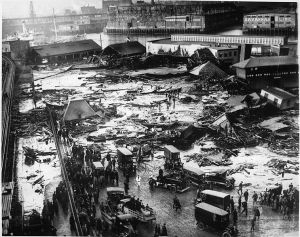
Ninety-seven years ago today, 21 people were killed by molasses. Even having lived in Boston, I had never heard of the Boston Molasses Disaster. Credit for my awareness has to go to my wife, who read me the story from the Oxford Companion to Sugar and Sweets. I had no idea that molasses had been weaponized. The sweet sap, apart from making cookies, can be fermented into ethanol, used for munitions manufacture. In the North End of Boston a hastily constructed tank holding about 2 million gallons of molasses burst on this date in 1919, creating a sticky, 25-foot-high wall that raced through the North End at 35 m.p.h., killing those unfortunate enough to have been in the way. According to the Companion, 150 others were injured.

BostonMolassesDisaster

We’ve all heard about the slowness of sap in January. Apparently the temperature had risen to above freezing this particular day, after several days of seasonal chill. The tank containing the heavy fluid burst under the strain. I have to admit that visions of walls of water have always frightened me. The images of the Boxing Day Tsunami back in 2004 were horrifying. I’d read of pilgrims to Petra (if you’re not familiar with Jordan, think of the crevasse through which Indiana Jones and company ride at the end of Last Crusade—that’s Petra) being drowned by sudden meltwater from distant mountains suddenly filling the canyon without warning, and shuttered. Having walked Hezekiah’s Tunnel without a flashlight, such images can be all too real at times. Would the offending wall made of molasses have made it any better or worse?

The tragedy is that the event is so little remembered today. I’m sure long-time residents of Boston still tell the tale of death by confection, but why don’t we hear of such things in the natural course of things? I suppose there are too many disasters to follow them all. Millions had just died in the nightmare of the First World War. The strange fate of those individuals killed by molasses might easily be overlooked, despite the fact that the goo had more victims than the Boston Massacre and the Boston Strangler combined. Maybe it’s just that things seem to move a little more slowly in January, but I feel as though I’d missed a part of history about which I might have been informed if I had more of a sweet-tooth.


Creating English

From Wikimedia Commons

From Wikimedia Commons

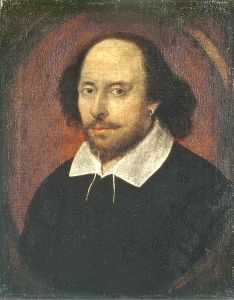
The seventeenth century was a portentous time for the English language. Well, I suppose every day is portentous in some way, but in the year 1611 the King James translation of the Bible was published, and it still has considerable staying power in the English-speaking world. Quotes from it show up regularly among the modern media with many readers (and likely a few writers) having no idea of the origins of the phrases they use. Just five years after the King James Version made its debut, William Shakespeare died. Many languages can point to formative individuals or literatures that codified their forms of expression. In English the honor is shared by the forty-seven translators of the KJV and William Shakespeare. This four-hundredth anniversary of Shakespeare’s death is set to be a year of celebration among Anglophiles worldwide. We will gladly acknowledge that the words we write and speak owe much to the Bard and his lasting influence that still has high school students griping all the way through English class their senior year. I have read a Shakespeare play or two that I was never assigned in school, as many come to do. This year, among my reading goals, is at least one more of the works I’ve never read.

As with the text of the Bible, there is doubt about some of Shakespeare’s plays. Scholars scrutinize. (That’s what we’re supposed to do.) And scrutiny raises doubts. The seventeenth century was a time of generally acknowledged authorship. Some great English epics, such as Beowulf, have no author we can cite by name. Over time, however, quality came to be associated with the person who produced the literature. Even today a name often sells a book far more readily than the contents do. Some of Shakespeare’s plays may not go back to William himself, but the English language wouldn’t be the same without them, in any case. We are heirs to this legacy. Spelling began to be standardized. Grammatical expressions were codified. Classic stories predating Shakespeare became endlessly replicated and copied by those who know there’s no replacing an original.

A story on NPR notes that the First Folio—the first bound copy of all of Shakespeare’s plays—is being sent around the country this year by the Folger Shakespeare Library. Each state will host the first edition during the course of the year. The article by Susan Stamberg notes that this folio is the literary equivalent of the Holy Grail. Shakespeare is nearly as canonical as the biblical canon itself. Even if the Bard’s authorship is in doubt, it is still holy writ. Those of us who’ve spent considerable time with religious texts recognize the hagiography readily. No, these aren’t signed editions. Some of the work may have been done by someone else. Nevertheless, four centuries ago, through a combination of Bible and what we would today call “fiction,” the English language as we know it, was itself becoming canonical.


Dead of Winter

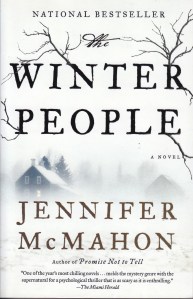
WinterPeopleOne of the commonalities of all religions, I used to tell my students, is the concern with death. Not that all religions react to it in nearly the same way, but the fact is no religion ignores it. For people, obviously, our awareness of our own mortality marks us as indelibly as our birth does. Once we become aware of death, we will never be able to forget it. This inevitability fuels many horror stories, whether literary or cinematic. When I saw Jennifer McMahon’s The Winter People, I knew that I would read it. Like most book consumers, I had to wait for the paperback edition, and once it was on offer I got a copy and waited for winter. Well, this year I’m still waiting for winter, but I began reading the story once the nights were long enough to qualify. It is an appropriate story for the season and it introduces what might be considered a kind of monster as well. Like most monsters, however, sleepers are not evil. The undead, however, have to find a way, ironically, to live.

The Winter People is a sad story, and tangled in the way that makes for successful novels. The main issue at play, however, is that with which all religions are concerned. Death is perhaps the most noble of literary subjects. Since we all have to face it, it is universal and yet somehow frightening. Fear of the unknown. The dead, unlike in the stories, don’t really come back to tell us what it’s like. Even those who do, in fiction, give us a distorted view. Theirs is a world inverted from our experience of it. It lacks finality. It is a place between. There is a macabre logic to it.

The living have never been comfortable with the dead. Memory reminds of who they were. McMahon is clear, in her vision, that memory is not who they are. We put them underground, but theologically we can’t let them go. Heaven, Nirvana, Purgatory, reincarnation, or even Hell—we feel that we need to give our dead a sense of place in a life after life. McMahon builds a sober mystery into her non-final afterlife. There are some, I’m sure, who will be kept up at night by her imagination. For me, I now have something to ponder. Many are the stories, like Stephen King’s Pet Sematary, that warn of resurrection. We can’t keep the departed with us, and winter, when it comes, is a season of harsh reality.


To Nature, and Beyond

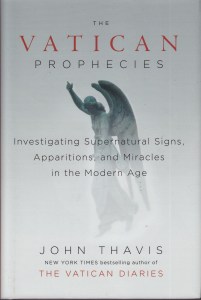
VaticanProphIt might seem odd to differentiate the supernatural from an established world religion like Roman Catholicism. After all, be premise of traditional Christianity is based on a miracle or two. Church officials, however, are not naive. It has been known from the early centuries of the church that although miracles are still from time-to-time proclaimed, they are a relative rarity. Few are claimed, like Jesus of Nazareth, to have the ability to summon the supernatural at will. When my wife gave me a copy of John Thavis’s The Vatican Prophecies, I wondered if this might be a sensationalist exploration of “the hidden Vatican” and its penchant for keeping things hushed. After all, the subtitle is Investigating Supernatural Signs, Apparitions, and Miracles in the Modern Age. Thavis, however, is one of the most even-handed writers on the topic I might imagine. Clearly respectful of the Catholic faith, he doesn’t go after any pet theories or conspiracies. He lets those in the church answer with their own words. And those words paint a fascinating picture.

Beginning with the concept of holiness, Thavis shows that the point of the spiritual life is not to seek signs. Nevertheless, signs are reported. Apparitions of Mary have a long history, as does the shroud of Turin. Those who write about such things often have a clear bias, but Thavis gives the facts, interviews those who know, and offers a narrative full of possibilities. The supernatural can take a darker turn, however, as his chapter on demons and angels demonstrates. Although demons have been cast into the outer darkness by science, it doesn’t prevent people from apparently being possessed. And of course miracles come under scrutiny, particularly in the context of making saints. Prophecy, in the sense of knowing the future, is the last major topic up for discussion.

The Vatican Prophecies is a curious book that seems neither credulous or overly skeptical. It’s more like reporting than it is declaring what is or isn’t possible. Yes, the Roman Catholic Church does still profess miracles, but a vast number of them that come up for testing fail. Scientists serve as expert witnesses and personal claims are not sufficient to win the day. Although there are a few characters in this account, the majority of those mentioned in the book are understated, thoughtful individuals who happen to know they can’t decide what really happens or not. Instead, they simply deal with it. For those of use who live in a world of uncertainty, this book is a most apt introduction to topics taken seriously by some very intelligent people.


Local Lore

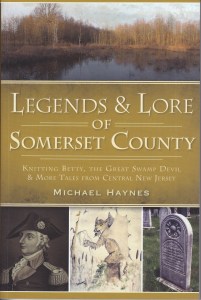
SomersetOne of the true joys of having more than a day off work at a time is the privilege to spend days reading. Although I read on the bus as a matter of course, it is a defined time, and editing isn’t as much reading as most people think it is. While doing research for my Sleepy Hollow paper, the question naturally arose: where did Washington Irving get the idea for the headless horseman? According to Irving’s biographers, the story was not an uncommon one. Headless ghosts are not unique, and he wrote the story while living in Europe as part of the serialized Sketch Book of Geoffrey Crayon, Gent. There is no practical way to know where he first heard the story. During my research I heard of a local source: Legends and Lore of Somerset County (New Jersey), by Michael Haynes. In this little compendium of stories of my current county, there is a claim that Irving learned about the story right here in New Jersey, where a traditional headless ghost rides. Again, it is impossible to say where he got the idea, but people like to feel that their local traditions are important enough to engage a major writer’s imagination.

Haynes presents several other regional tales that may rival the Jersey Devil and give ghosts a location just down the road. I suspect most places have tales of ghosts and mysterious beasts. It is always interesting to find out about those lurking in your own neighborhood. Scholars are now beginning to turn their attention to the sanctity of space. Location is very important to mobile beings like ourselves. The place where we find ourselves becomes “our place” and with the patina of time, often a personally sacred space. Tales of what happened here often take on the cast of the supernatural.

Local history has always held a deep fascination for me. Any region that I know, in a sense, intimately, is a region that has become part of my personal history. My region of Pennsylvania, for example, defines me although neither of my parents, or their parents were born in that state. And Massachusetts, Michigan, Scotland, Illinois, Wisconsin, or New Jersey, places I’ve lived, have become somehow alive with history. Legends and Lore of Somerset County contains tales that are not always believable in the workaday world we inhabit, but that’s the beauty of sacred space. Going beyond the mundane is entirely the point. Although Washington Irving may or may not have first heard of the headless horseman here, we have that legend, and there’s only so much that history can do to remove such a claim.


And a Literate New Year

One of the most common criticisms of religion, among its detractors, is that it is “uninformed.” I suspect that this is intended to critique the education of those who adhere to religion. It is not too often, however, that you see those who disdain religion giving credit where credit is due. Reading, for example. Although reading has changed in its accidents and character over the millennium, it remains the case that texts—what would eventually evolve into books—were originally a religious creation. Once writing moved beyond keeping track of things like how many cattle a person owned, and grew into literature, that literature was based on religion. We recognize many of these stories as myths today, but that does not devalue them. They are our earliest stories. For many literate people throughout history, their initial reading material was the texts of their religion. One of the purposes behind public education was to teach children to read the Bible. Religion and reading naturally go together.

Now that a new year is upon us, many websites are offering reading challenges for the new year. Long ago I gave up on resolutions. I figured if I noticed something wrong in my life, I wouldn’t wait until January to fix it. Nevertheless, the start of something new is inspiring and full of hope. So it was when my wife showed me Modern Mrs. Darcy’s 2016 Reading Challenge, I gladly accepted. Like many reading challenges, the goals are based on about a book a month—twelve titles for the year. My personal goal is to get over one hundred books read this year, but I like the challenge to read particular kinds of books. On this particular challenge, for example, are books that intimidate you, or that you’ve previously abandoned. Books, such as many of us have, that we own but have never read. Although we may not know what it is yet, a book published this year.

Apart from being a kind of religious activity, promoting literacy is surely one of the best ways to address social ills. Those who read learn to consider the viewpoints of others. I disagree with a great deal of what I read, but I would not wish not to have read it. “Iron sharpens iron,” as one old book says. To put it in modern terms, the only stone hard enough to cut diamond is diamond. Reading material that engages critical faculties is like that. Even so, reading books that are simple or fun also offers bonuses. A guilty pleasure read is one of my favorite rewards. For our own sakes, for the sake of the world itself, I hope that everyone takes up a reading challenge, no matter how modest, as a way of celebrating a new year and, I truly believe, a better tomorrow.

DSCN5025


Books of 2015

Screen Shot 2015-12-28 at 3.38.16 PM

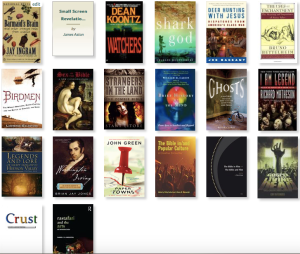
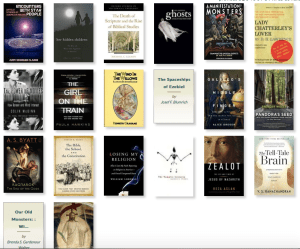
It’s the end of 2015 and looking at my records on Goodreads it looks like I read 100 books this year. That tends to be my goal mark, but after twelve months of reading I like to think back over which were the books that have made the biggest impact on me over the year. Joe Bageant’s Deer Hunting with Jesus remains on the most important list. It is joined by Andrew Newberg’s How God Changes Your Brain, Spencer Wells’ Pandora’s Seed, Alice Dreger’s Galileo’s Middle Finger, and Paul Levy’s Dispelling Wetiko. Bageant, Dreger, and Levy especially address some of the root causes of social ills and even make suggestions about how to address them. Newberg offers advice on how to improve brain functioning and Wells taps into the ever-important issue of care for our planet. I read some good academic titles as well: Diana Walsh Pasulka’s Heaven Can Wait, Darren J. N. Middleton’s Rastifari and the Arts, and Ronald Hutton’s The Triumph of the Moon.

Screen Shot 2015-12-28 at 3.37.33 PM

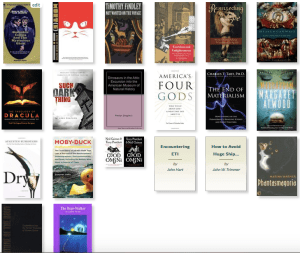
Being a religionist, books with supernatural themes are always of interest. Among these I found intriguing Michael Murphy’s The Future of the Body, David J. Hufford’s The Terror that Comes in the Night, Ardy Sixkiller Clarke’s Encounters with Star People, and Jeannie Banks Thomas’s Putting the Supernatural in Its Place. It seems important to have reasonable people address unconventional issues. These are related to books on monsters, noteworthy among which were: M. Jess Peacock’s Such a Dark Thing, Kim Paffenroth’s Gospel of the Living Dead, Brenda S. Gardenour Walter’s Our Old Monsters, and Lisa Morton’s Ghosts. Long ago I realized that I no longer needed to justify including monsters or the supernatural categorically with religion. They share too many roots to be separated out artificially.

Screen Shot 2015-12-28 at 3.36.54 PM

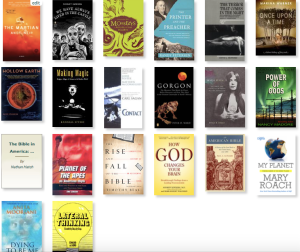
Finally, it was also a year of novels. Pride of place here goes to Robert Repino’s debut, Mort(e). I am compelled to mention Margaret Atwood’s MaddAddam, John Green’s Paper Towns, Shirley Jackson’s We Have Always Lived in the Castle, and Valerie Martin’s The Ghost of the Mary Celeste. Although I’m not much of a fantasy reader, Tod Davies’ The Lizard Princess has stayed with me since reading it. For any of these books you’ll find an individual blog post from this year. That’s not to say that other books I read weren’t good. Nearly every book I post on Goodreads has a write-up here. I tend to like most books I read, although I’m occasionally disappointed when a book does’t reach its full potential. 2015 was a rich year of reading and I’m looking forward to a very literate 2016.

Screen Shot 2015-12-28 at 3.35.38 PM


Simple Gifts

Thing Explainer, a whimsical gift for my daughter at Christmas, is perhaps the trendiest present found here this year. Randall Munroe, who makes a living as a web comic artist (who knew this was even possible?) wrote/illustrated the book to explain complicated things in simple words. Indeed, he limits himself, with some license, to the thousand most common words in English. Due to the almost viral success of the book, websites now exist so that even those of us with advanced degrees can explain things with common words. It reminds me of the Common English Bible in that it attempts to make something complicated easy to understand by using a level of writing accessible to the majority of readers. Thing Explainer is, naturally, for fun. There is, however, an underlying question.

Have we reached a point where reading itself has to be enhanced by making it simple? Some things are, by their very nature, complex. At a time when more and more kids are being encouraged to attend college, the traditional basis of higher education (the classics, classical languages, the humanities) has eroded so far that higher education is not what it once was. My daughter’s engineering program is highly technical and doesn’t naturally promote the things I recall as “college.” Maybe I need someone to explain it to me in simple words. What’s wrong with being literate? With finding challenging books worth the effort to get through? Some things are complex.

A young couple's anniversary in Wales.

A young couple’s anniversary in Wales.

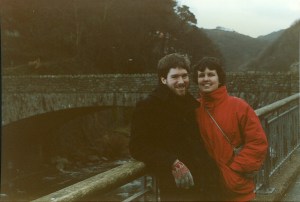
I wonder how a society survives when complexity disappears. Today my wife and I celebrate our twenty-seventh anniversary. Marriage can be a complex thing, but it is something that can be explained in simple words. When we decided to marry the idea was lifelong commitment, not knowing the twists and turns that life would take. If the Internet existed in those days I didn’t know about it. (Certainly, being a web comic artist wasn’t a job that yet existed.) Doctorates still led to teaching careers. 9/11 hadn’t happened so that living in a modified police state wasn’t yet part of daily reality. There weren’t really words to explain it. It was one of those most basic human things. Turning to Thing Explainer I find that love is one of the thousand most-used words. It does perhaps show, after all, that complex things can be stated in a word we all understand.


Mother Divine

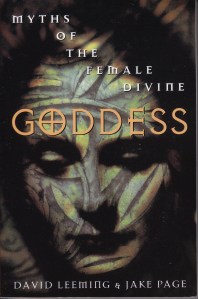
GoddessReligions, by nature, exercise a distribution of power. That power is perceived to be on several axes at once, the “vertical” is intended to represent the power of deities over humanity, and the “horizontal” is that of humans over humans. Historically all we can know is the latter dimension, and during the time of written records, that has been a male-dominated plane. Several years ago a theory developed which would be wonderful, were it true. The goddess hypothesis suggested that before male dominated civilizations took over, culture was run in a more egalitarian way and the goddess was the main deity. Since this theory sets itself before recorded history, artifacts had to be interpreted as evidence, and certainly such bits and pieces of past times have emerged. The goddess interpretation has, however, has faced severe criticism, and not just from male scholars. There are still those who find it tenable, and one such pair is David Leeming and Jake Page. Goddess: Myths of the Female Divine was a book intended to demonstrate the commonality of goddesses, but it didn’t always rise to the challenge.

No doubt, the motivation behind the book was noble. It is important to show that goddesses have been just as important as gods in the history of mythology. The problem emerges when the evidence is forced into a mold it doesn’t fit. “Goddess” is not a singular figure, any more than “woman” implies that all women are the same. Each chapter retells stories of various goddesses, and again this is problematic. Specialists in any one tradition are sure to spot errors and oversimplifications that suggest descriptions of other goddesses may not be completely trusted. There’s an overcompensation here. Men, at least some men, wish to show their support of women by suggesting that women once held esteemed places in the cult as well as in the throne room. What we know of history, however, gainsays this concept since, in one form or another, might has always made right.

Goddess is one of those little reference books whose main value lies in bringing previously disparate characters together to show some commonality. There is utility in placing goddesses side by side to form a phalanx of resistance to a hierarchy that has established itself as normative, backed by a more powerful male deity (or deities) in the sky. Goddesses have been part of religious thinking from the beginning. The early abstractions of natural powers, reason would seem to dictate, would have involved both masculine and feminine powers. We don’t know how such societies were organized, but the divine female was clearly present. By consciously acknowledging what we know, and creatively applying such knowledge, there may be a hope for the future of religions that is far more certain than a reconstructed past.