Alien Signs

Personally, I find alien home invasion movies scary.  The combination of being awoken at night by a terror that seems plausible and the fact that there is nothing you can do to prevent it is genuinely terrifying.  Having said that, I wasn’t aware that was what Dark Skies was about when I decided to see it.  It does a good job of some things while others are less effective.  The Barrett family (parents, two sons) is going through a difficult patch when their younger son, Sammy, starts talking about “the sandman” visiting him at night.  At the same time, inexplicable events happen at night inside their locked house.  Daniel, the father, is unemployed and Lacy (mother) is having trouble at work.  The police think the kids are playing pranks but Lacy begins to realize they’re not alone in this.
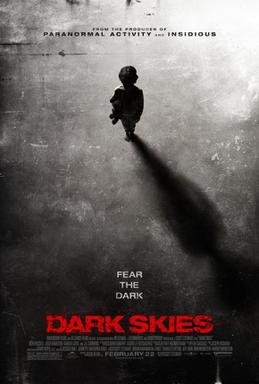
Discovering the alien abductee phenomenon, she realizes that they have all the signs.  Having finally landed a job, Daniel doesn’t believe her.  Until he experiences it for himself.  The problem is nobody will believe them if they report it.  A fellow experiencer tells them they can fight back, but there is little they can hope to achieve.  The aliens, he says, take the one they first contact in a family.  When the aliens return, the Barretts try to protect Sammy, not realizing that Jesse, the older son, is really who they’re after.  There’s a lot of tension that works for this film but there’s also a number of questions raised.  The final reveal feels like a bit of a let down after all the build up.  The financial stress of Daniel’s unemployment seems to have done nothing for the plot.  And the burgeoning love between Jesse and a girl he likes simply drops.  As does the visit of child welfare.

Still, the ideas here are quite scary.  If you know something is happening and know nobody will believe you, that’s scary.  The idea that we are inferior to the technology of a more advanced race is also frightening.  The whole not knowing the motive of the monster works.  The tension build-up is good but the resolution leaves too much unaddressed.  Overall it isn’t a bad movie.  It did make me feel a bit paranoid after watching it, which is usually a good sign.  The acting is good, but the fatalism makes you wonder if there’s a point to the story other than to be afraid.  Dark Skies wasn’t bad for a last-minute pick for a rare free slot, if you can accept aliens as viable monsters.
Machen’s Monstrance

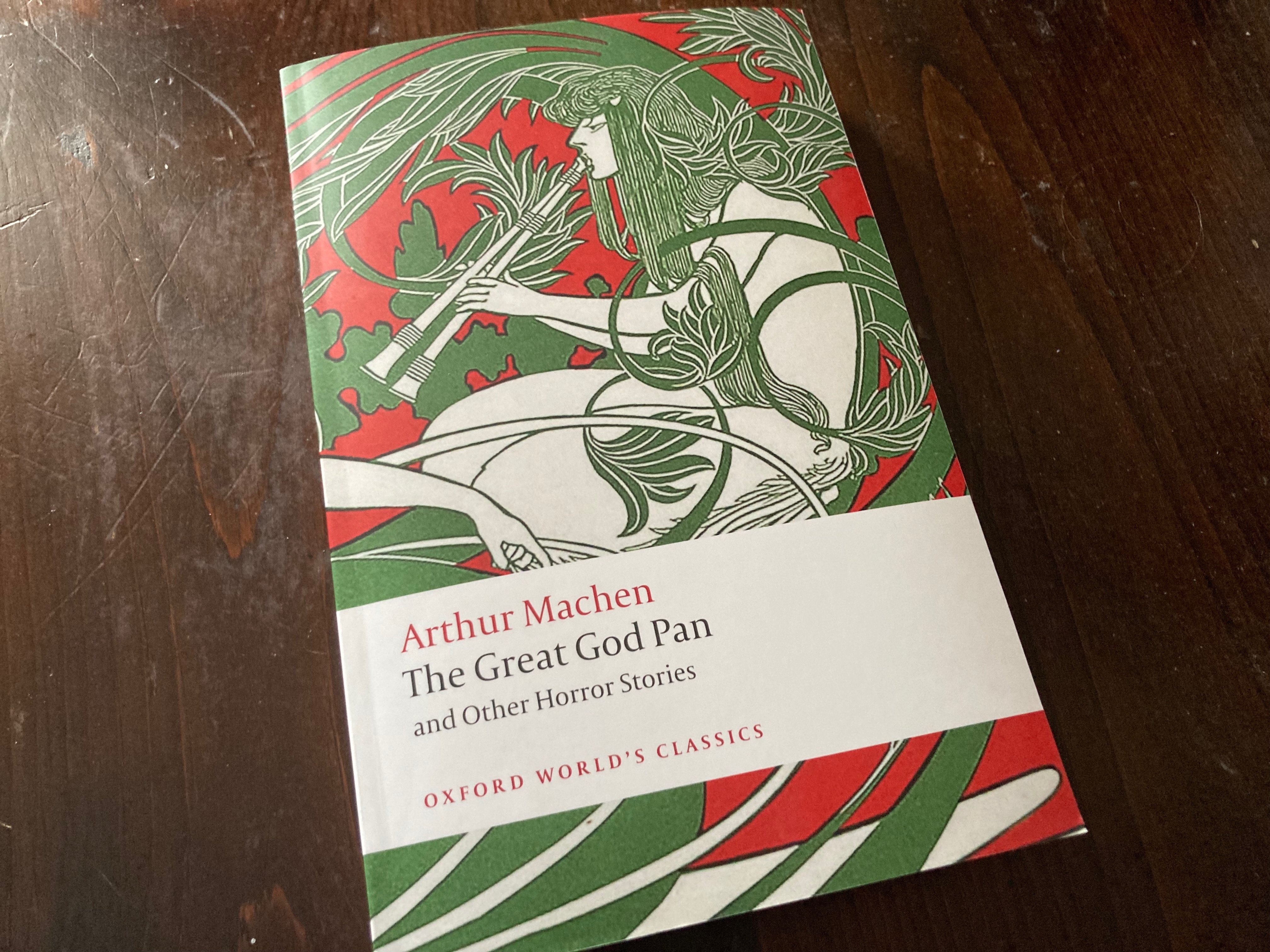
It was a coincidence worthy of a story written by a mystic.  Arthur Machen became famous for his novella The Great God Pan.  Descended from a clergy family, his interests were in supernatural stories, but Pan was considered extreme in his day, which, of course, made it famous.  I have the Oxford World Classics series volume of Machen’s stories and I had only a few minutes, not enough to read Pan.  Flipping through the table of contents, I noticed that the story “Monstrance” was brief.  I decided to read that one.  It’s about a German major-sergeant Karl Heinz, during World War One.  As he is trying, with several others, to set up a machine-gun emplacement unnoticed by the English, a vision he has been seeing leads him to cry out and die.  Through the discovery of his diary, it is learned that he’d committed a war atrocity at a church and the procession with the monstrance became a vision haunting, and ultimately killing him on the battlefield.

The coincidence grew even more appropriate when, reading about Machen, I learned that his probably second most famous story was “The Bowmen,” which also happened to be short, and which in the Oxford World Classics edition, is printed right before “Monstrance.”  Of course I had to read it also.  The reason I chose “Monstrance” in the first place wasn’t because of its famous neighbor, but because of the religious symbol of the monstrance and because it is brief.  Since I still didn’t have time for The Great God Pan, I was led to his second most well-known story by looking for something short and landing on the story immediately following it.

“The Bowmen” is also a war story in which a miracle occurs.  It led to the rumor that the event, which involves angels fighting for the British forces, actually happened.  It is, however, fiction.  As a result, “The Bowmen” became the second most popular Machen story.  I wouldn’t have read it—at least not any time soon—had it not been for its placement before “Monstrance,” even though the two stories are somewhat similar.  It’s easily imagined that God is fighting on your side, and it should be remembered that often the enemy believes the same thing.  That most futile of human activities, war, certainly spawns stories as so many lives are meaninglessly lost.  There is, however, a mystical element to these tales, in keeping with Machen’s outlook on life.  Not bad for having about 20 minutes to fill.


Still Growing

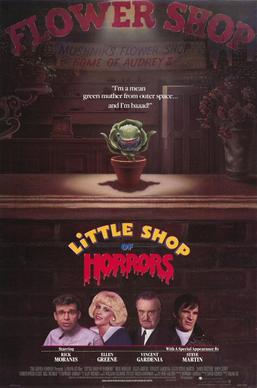
A couple of years ago I posted about Roger Corman’s Little Shop of Horrors.  Now life is so busy that when Friday rolls around my wife and I find ourselves at odds for deciding on a movie.  She’s not into horror and I’m often not in the mood for human drama after a week at work.  We recently compromised on the 1986 Little Shop of Horrors.  It has been many years since I’ve seen it although I watched it shortly after it came out.  Like Rocky Horror, the music makes the movie.  That and the appearances of Steve Martin, Bill Murray, Jim Belushi, and Christopher Guest.  The original was a comedy horror shot on a very short schedule but this Frank Oz production is a bit more lavish.  And the songs.  I’m a fan of classic rock-n-roll, and the show tunes here seem like a combination of Cats (the original) and Rocky Horror.  There’s an optimism to them.  And who couldn’t use a little hope?

Seeing the movie again brought home a phenomenon that’s been on my mind lately.  What you see first becomes your benchmark.  I only saw the 1960 version a couple years back.  Little Shop of Horrors was, to me, a musical.  It does use some classic horror tropes: thunderstorm at night, shadows of violence on the walls, and the ubiquitous fear of being eaten.  But unlike Roger Corman’s vision, this is primarily a love story about escaping Skid Row.  And, strangely, a feel-good film.  I suppose the lingering question is whether this is a horror movie or not.  Another phenomenon that’s been kicking through my gray matter lately is that “horror” really isn’t the best description for many movies so labeled.

My interest in origins led me to go back to the original a couple of summers ago.  That story developed because Corman had access to a set from a previous movie and wanted to shoot another using it.  The story took many forms before settling on a human-eating plant.  By the way, that still works for horror, as The Ruins shows.  Since his previous movie was a horror comedy, the movie I’m sitting down to watch on a Friday night was born.  Between the original and this one, the story was adapted into a stage play.  The movie version of the stage show was a box office success, and it still appeals to me on a night where we just have trouble deciding on a movie by which to unwind.


Leaving Soon

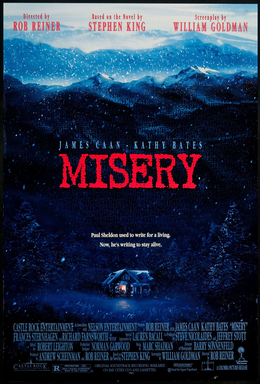
I’d been hoping to read the novel before seeing the movie, but there’s nothing like the words “leaving soon” on your streaming service to spur you into action.  So I watched Misery before I was ready to.  I remember the newspaper reviews from 1987, when the novel came out.  I didn’t read any Stephen King novels until those I’ve posted about on this blog.  There’s a full record here!  I do remember the reviews saying it was self-referential.  The protagonist, as in The Shining (is Jack Torrence a protagonist?), is a writer.  And the book is a writer’s nightmare.  When the movie came out in 1990, I had no interest in seeing it.  A couple of things changed my mind, however.  First of all, it is referenced all the time.  I didn’t even know how it ended.  Another factor was that it was a Rob Reiner horror movie.  And Reiner himself had been murdered a few weeks before I sat down to watch it.

I really wanted to read the novel first.  My reading pile is pretty high.  And currently the next Stephen King novel on it is The Dead Zone.  And yes, I have already seen the movie.  Unlike some critics, I think King is a substantial writer.  He has profound things to say, especially about religion.  And, of course, the movie Misery has plenty of that.  Annie Wilkes is a religious fanatic.  She’s also a fan of Paul Sheldon (the writer).  God tells her things.  She wears a cross.  She can’t stand swearing.  But even so, I wonder if King clearly had her religion in mind.  I would’ve guessed that, given her cinematic profile, she would’ve not been a wine drinker.  And I would’ve guessed that the Bible would appear in the movie.  She drinks and she doesn’t even quote the Good Book—at least not that I caught.

Some day, if I keep doing this long enough, I might make the connection between religion and horror plain.  I know scholars, not shackled by a 9-2-5 are working on that.  And like the books I have to read, there’s a waiting list for those I want to write.  One has my particular attention at this point, and I’ll be trying to put that to bed before starting on a new one.  Before working on such a book I’ll have to read Misery, the novel.  I do plan to do so.  I’m not a fast reader and I have quite a big stack.  In fact, I wouldn’t even be thinking about reading it now.  But my streaming service came up with those fatal words, “leaving soon.”


Don’t Look

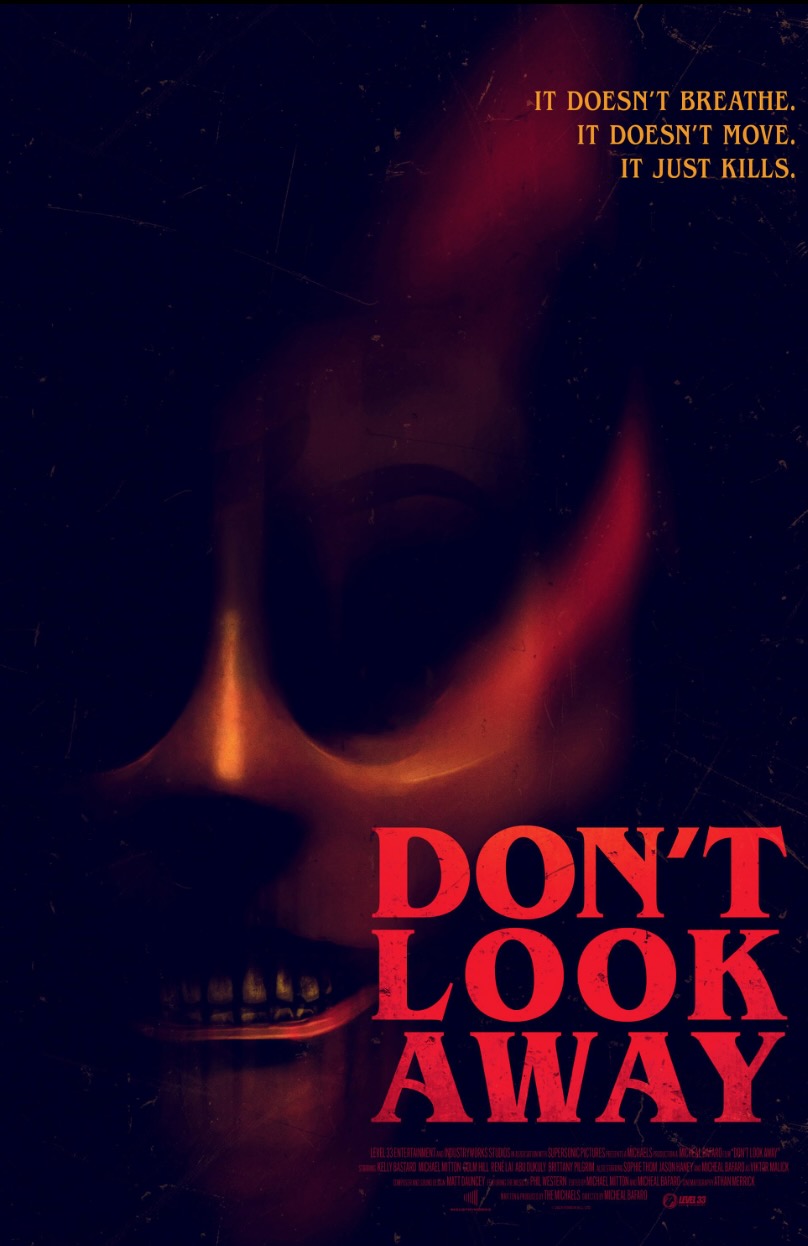
The title of this movie could stop one word shy.  Of course, I had been warned.  Don’t Look Away is a low-budget horror film.  A low budget in and of itself doesn’t make a movie bad.  Poor writing, poor acting, and poor directing do, however.  Since I’m learning to appreciate bad movies, this was an obvious candidate to watch because it was a freebie. So, a group of college-age friends fall afoul of a supernatural mannequin that kills.  Its origin is never really explained, except a vague reference to “the Devil.”  It is being hauled by long-distance freight so that its handler can bury it, rending it harmless.  But truck-jackers in New Jersey try to rob the truck and release the dummy.  It is seen by Frankie and begins following her, killing many of the people it encounters.  No reason is given—it just does.

Frankie’s boyfriend, Steve, is a rather clueless, and completely insufferable, grad student.  Her more reasonable friends realize that the menace is real, but the police don’t believe in killer mannequins.  After a considerable amount of time they realize that the mannequin can’t disappear if someone is looking at it.  They decide to stare at it until they can figure out how to dispose of it.  They need to prevent other people from seeing it, otherwise they will become its victims as well.  It’s all a rather silly premise.  Finally the handler shows up in New Jersey.  Since he’s blind he can’t see the mannequin but he figures if he kills the surviving friends, the menace will be stopped.  Frankie discovers that it’s almost impossible to hide or defend yourself against a blind man.

As far as the horror element goes, it really isn’t scary.  The face on the mannequin is decidedly creepy, but since no explanation is given of how it kills, there is no focus for any fears.  Yes, looking out your window at night and seeing a mannequin standing on your lawn would be frightening.  There’s so much not to like about this movie.  The pacing, the slipshod story, the soundtrack by one artist who is likely a friend of the director.  I’m glad to have seen it although Don’t Look Away isn’t one of those movies that’s so bad that it’s good.  When I next meet with the friend who recommended it, we can compare notes.  It gives you something to talk about.  If you do decide to look, you have been warned.


The Help

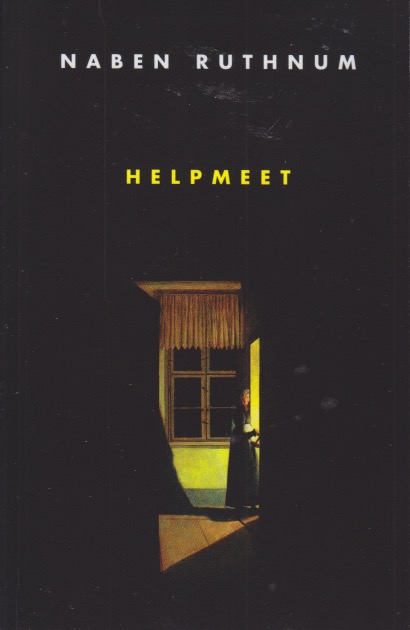
Helpmeet was recommended to me by a friend.  Since most of my reading these days seems to be in the form of long books, I welcomed a brief one.  And the story, which is gothic and distinctly creepy, unfolded quickly.  I’ll not give away the ending, but the premise is spooky enough.  Edward is a physician who is married to Louise.  This is in the late 1800s.  Louise is aware that Edward has been unfaithful, but she loves him nevertheless.  He is dying.  His request is to end his days in his ancestral home near Buffalo, New York.  Travel is difficult because his body is literally falling apart.  Other doctors don’t know what’s wrong with him.  Some acquaintances suggest a venereal disease, since, well, he hasn’t kept his love in one place.  Louise agrees to the move.  Edward has lost both his eyes and his nose, and some other extremities.

He has to be wrapped carefully for the move, which is by train.  In a private car.  Secrets are revealed.  The mysterious woman with whom he had an affair.  How she was able to reach inside his body.  And how she is coming to visit in their new location.  After all this the plot takes an unexpected twist, which I’ll leave out in case it’s a spoiler.  Atmospheric and melancholy, this is one of those horror stories that is easy to get into and difficult to put down.  Body horror is a sub-genre that can be disturbing since we all have to deal with bodies and their issues.  And bodies are tied to mortality.  We are pretty sure from the beginning that Edward is not long for this world.  His body has begun to decompose with him still in it.  Louise’s care for that body is also a factor that forces us to look at what we’d rather not see.  Out of love, in her case.  And maybe revenge.

Spare stories such as this can still be powerful.  There’s a supernatural element to the twist, but it doesn’t feel like a deus ex machina.  It has been there from the beginning, but the reader couldn’t see it.  Helpmeet also raises the question of how well we really can know another person.  Even couples have to spend much time apart and individual experiences can change a person.  Edward isn’t a sympathetic character here, but he’s not evil.  Louise has to accept him as a man with weaknesses, and one who requires, as the title suggests, a helpmeet.


No Reservations

Having watched, and liked, Oddity some months ago, I was glad when a friend told me that Caveat was by the same writer/director, Damian McCarthy.  I don’t always pay close attention to director’s names unless I’m writing a book where that’s relevant.  I should pay more attention, since Caveat was also quite good.  And I found it on a streaming service for the price of watching commercials.  The premise is quite creepy.  Isaac is suffering from amnesia.  His landlord offers him good pay to watch his niece for a week.  She has a mental condition, he says, but she’s harmless.  She lives in a remote house and all he has to do is stay with her.  Distressed to learn that the house is the only one on an island, since he can’t swim, nevertheless he takes the job.  But there is a caveat.  He has to be chained in a harness that limits how far he can go.

Olga, the niece, is catatonic when they arrive.  When she starts walking and speaking she’s armed with a crossbow.  She tells Isaac that he was on the island before and that he locked her father in the basement where he shot himself with the crossbow.  His landlord, her uncle, is the one who sent him to do that.  He has no memory of it.  Isaac and Olga distrust each other, each attempting to get the upper hand.  Supernatural events take place while Isaac struggles to remember.  Isaac escapes the harness and locks Olga into it, but she shoots his leg with the crossbow.  There seems to be some indication that  Olga’s mother—killed by her father and uncle and buried behind a wall in the basement—is the source of the supernatural occurrences.  The landlord comes to the island and Olga shoots him and his dead sister-in-law stalks him in the dark.  Isaac manages to escape.

There is a bit of confusion about parts of the film, but it works as a distinctly unsettling horror story.  The toy bunny that Olga, and then Isaac, uses is very creepy.  Mostly it’s the premise that makes this folk horror scary.  Being left on an island with someone of questionable sanity while chained up in a house is already frightening.  The supernatural elements, which are few and brief, add enough fear to tie all of this together as a good example of Euro-horror that has elements of folk horror to it.  I will be adding Damian McCarthy to my list of horror directors to keep an eye on.


Popping Clowns

You need a scorecard to keep track of all the killer clowns.  While not the greatest horror movie, Clown in a Cornfield isn’t bad.  As with most of my movie posts, there may be spoilers here.  Before I get into it, I should note that this is a horror comedy, so it doesn’t take itself too seriously.  That’s important to help you get the most out of it.  So, Quinn and her father have moved from Philadelphia to Kettle Springs, Missouri.  Quinn’s mother had died that summer and her father was having trouble coping.  In the new town, however, the adults are generally jerks to the kids, not trusting them.  Even harassing them.  Quinn’s father supposes that she’s acting out when she begins to hang out with a “bad crowd.”  These kids like making prank videos of Frendo the Clown killing people and posting them online.  The problem is, there is really a killer Frendo on the loose.

The movie seems to enjoy indulging in cliches—the Black kid is the first to get killed, clowns as monsters, and kids at a loss when faced with old-timey devices such as a stick-shift car and a rotary phone.  These do make the film fun to watch.  Anyway, one night at a party the kids discover that there isn’t just one Frendo.  There are many.  And they come out of the cornfield in a horde, killing the teens.  Quinn has to watch her new friends being slaughtered, but two of them, a gay couple, manage to survive.  The final girl here (Quinn) is hardly virginal.  And it turns out that the adults in the town are Frendo.  Their kids are a “bad crop” and they’re only to glad to kill them off and start over again.

Some of the social commentary is quite good, and some of it is aimed at the cultural moment in which we find ourselves.  Our species is strange; the longer we live (ideally) the wiser we become.  Yet, for procreation we depend on the boldness and general lack of knowledge among the young.  It creates an interesting dynamic, and one that is explored in horror in many ways.  Having the young turn on the old has been done, as in Children of the Corn.  Hmm, maybe corn is dangerous?  Clown in a Cornfield turns that around.  Of course, an older generation that wipes out a younger dooms itself to extinction.  And that’s to say nothing of the psychopathic lack of feeling for your own family.  Clown in a Cornfield is a strange movie, but it is pretty well done.  And it adds yet another clown to that long list of those to fear.


Little Gems

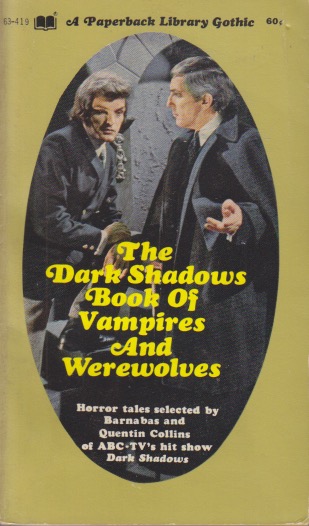
On a recent diversion to a curio shop we like, I found that one of the “Dark Shadows” paperbacks they had was one I hadn’t read.  Dark Shadows had, of course, spurred a pretty amazing franchise for its day.  It’d sunk its fangs into many young people who would not have otherwise been inclined towards soap operas.  I’ve written several times about the spin-off books by Marilyn Ross.  That series encompasses much of my childhood.  This particular book was a knock-off with the same branding titled The Dark Shadows Book of Vampires and Werewolves.  Now, to be fair, the asking price was about the same as a trade paperback price today—a little less, even—and the collection included, I saw at a glance, Polidori’s “The Vampyre.”  So now it sits on my shelf next to the other Dark Shadows books.  Apart from the gimmick of listing the book as edited by Barnabas and Quentin Collins, it is actually a nice period piece.

In addition to Polidori, eight stories I’d never read.  Two of them make the claim of being non-fiction, and a third maybe.  The tales, which favor vampires over werewolves, also include what are some little gems.  One is a story by M. R. James (“Count Magnus”).  Other noteworthy members are “Wolves Don’t Cry” by Bruce Elliott and “The Vampire Nemesis” by “Dolly.”  “For the Blood is the Life,” by F. Marion Crawford, is also good.  In other words, the collection was better than I suspected it would be.  I’d not read any of these before, so they were all new to me.  I was particularly intrigued by “Dolly.”  Apparently the author of The Vampire Nemesis and Other Weird Tales of the China Coast has remained anonymous since its 1905 publication.  The book has been rediscovered in modern times, and I’m now curious about it.

Although I like to think myself immune, I am sometimes susceptible to branding.  For whatever reason, that olive-green oval-cutout cover design, when spotted in the wild, makes me ecstatic.  My childhood wasn’t ideal, and I remember when I started to find these books used.  It was a very challenging phase in my younger years.  I knew even then that these cheap paperbacks would take me away from my troubles for a while.  And they would transport me back to an even more troubling period of my childhood when I would watch the show after school with my brothers.  A visit to the curio shop from time to time may be just what the doctor prescribes.


Cool Book Festival

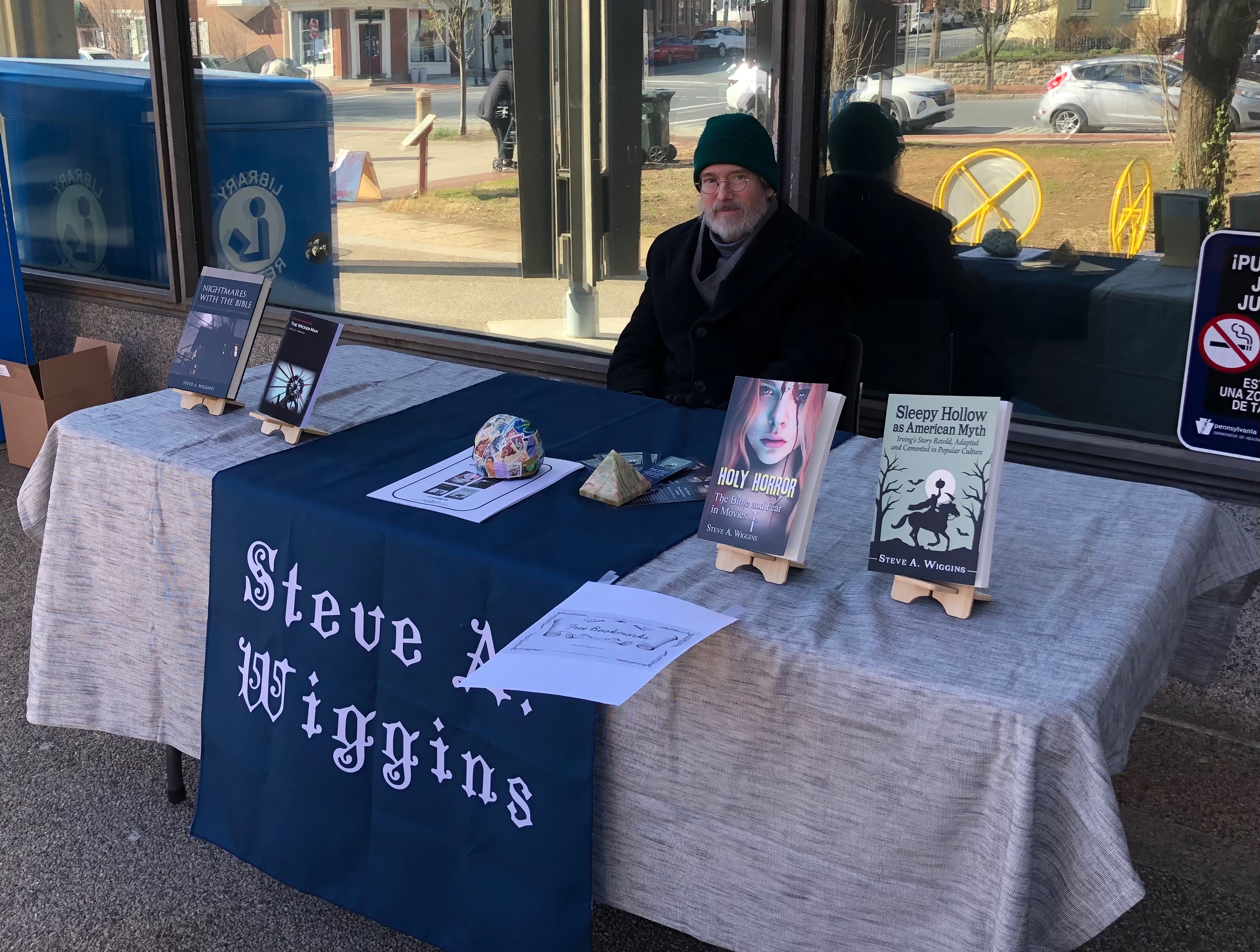
So yesterday I was at the Lehigh Valley Book Festival.  (It occurs to me know that I should perhaps post such notices in advance, but I know few people in the area where I live.)  I was there displaying my books.  I have participated in the Easton Book Festival for at least four years now, but I had only recently learned about this event held in Bethlehem.  The weather was clear, but cold for an outdoor event that involves a lot of sitting—it put me in mind of having to put on gym shorts and tee-shirts to go outside one November in college to have the coach lecture us about football, with no moving or actual playing involved.  It turned out to be an endurance test.  Not quite of the Shackleton magnitude, but I am sensitive to cold and it was struggling to reach 40, and this on the 28th of March.  At least there was a cool breeze.

Several lovely people stopped to talk and showed some interest in my work.  I’m grateful to all of them.  As an author you often wonder if you really are alone in your interests.  Since my table was next to a run of three tables of children’s books—when those authors decided on an unauthorized move of their tables into the sun (we were on the shaded side of the building), they did not invite me to join them—I was a bit self-conscious.  Parents hurried their kids past my modest display.  I took a quick swing through the other stands and I think mine was the only one for adults.  Many people glanced and frowned as they walked by, but several people got it.  I know there are local horror fans out there, but I have trouble finding them.

The Lehigh Valley Book Festival isn’t huge and several people just happened upon it, asking why we were there.  It was held at the main branch of the library and it is fairly centrally located in town.  Also, there was a cherry blossom festival taking place on the other side of the library.  I couldn’t be certain but it seemed that many more people were headed for that.  And honestly, I’ve lived in this area for going on eight years and I just learned about the festival last fall.  And I’m a book guy.  Not too connected locally, I’ll admit.  There was enough interest that I might consider it again next year (if selected again).  Especially if the temperatures are back towards the seasonal norm.


Together Again

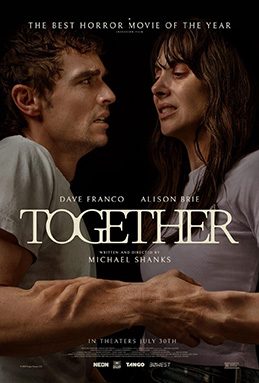
Body horror can be gruesome, but also thought-provoking.  Together shares a similar them to The Substance, namely, bodies merging.  They differ in the details, and some spoilers may follow.  Before I get there, however, I’ll say that this is yet another example of horror and religion working, one might say, growing, together.  The basic premise is that a pool of water in the woods, located at the bottom of a cave, causes two people (or animals) who drink it, to physically merge.  Tim is an emotionally immature, and troubled man and Millie, his girlfriend, refuses to give up on him.  They buy a house together outside the city, but their relationship continues to struggle.  Out on a hike, they fall into the cave and drink the water.  Soon Tim, who has refrained from intimacy with Millie for a long time, can’t be away from her.

As the movie unfolds, they try to resolve their differences, but if they try separating, they are physically forced together.  Religion comes into this in that a New Age church, which collapsed into the cave, had formerly accepted this new form of marriage.  Those who have gone through with it experience a level of belonging and intimacy that is otherwise unattainable.  One of Millie’s coworkers was a member of that church and encourages her to go through with the union.  Meanwhile, Tim discovers the horrific fate of those who resist.  Despite all these positive reassurances, the two resist it until Tim tries to stop a deep wound of Millie’s from bleeding.  Stuck together once again, they decide to go through with it.

Interestingly enough, the rationale given for the New Age church in the movie is a story taken from Plato’s Symposium.  People, the claim is made, once had doubled bodies.  When these were forced apart, they thereafter cannot be at peace until they find their other body to merge with.  The fictional church even has a painting representing this.  Anyone who’s been in love knows the feeling.  Together exploits the fear associated with it—the loss of self to become someone new.  Literally.  In that way it can almost be a parable of parenting a child, although one of the couples that merges in the movie is a gay couple.  And he, it can be argued, is the most content person in the film.  Movies like Together and The Substance tend to find praise among the critics because they concern issues of embodiment and what it implies.  That in itself is thought provoking.


Actual Intelligence

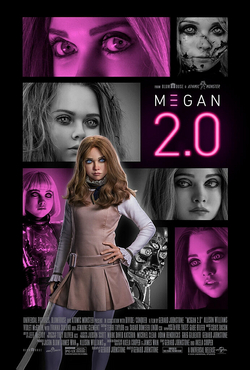
Horror movies love a good sequel.  A self-referential genre, there’s a lot of give and take and reassessing.  I may have waited a little too long to watch M3GAN 2.0, however.  I remembered the premise of M3GAN: an AI robot companion built to keep a young girl company misreads its protocol and ends up killing people.  I’d forgotten the details of how this came about, but as I watched the sequel, it started coming back.  It might’ve been best if I’d rewatched M3GAN first, but weekends are only so long and I’ve got a lot to do.  In any case, it isn’t bad.  This is sci-fi horror, but the future it foresees doesn’t seem very far off now.  So, M3GAN was destroyed at the end of the first movie.  Her maker, Gemma, has become kind of a Neo-Luddite, such as yours truly, and is advocating for control of AI by the government.  This need is underscored when a military application of M3GAN goes rogue and starts killing people.

Fighting fire with fire, Gemma decides she needs to bring M3GAN back to stop AMELIA.  After the usual chaos and action, it seems that AMELIA is going to merge with the motherboard of the first AI system built, which is now super-smart, and will then wipe out the human race.  M3GAN, however, has “learned” empathy and is able to stop AMELIA by sacrificing herself.  The film doesn’t have a clear message, although overall it seems to advocate caution regarding artificial intelligence.  On that I agree.  (Of course, we’ll need to get some kind of actual intelligence in the White House before we can consider any of this.)  This does seem less horror and more action than the original, but it goes quickly and is fairly fun to watch.

A few months before seeing this, I’d watched Companion, another AI cautionary horror movie.  A few months before that, Ex MachinaCompanion was a bit better, I think, but the original M3GAN was out of the gate first.  Ex Machina, however, was even a decade earlier.  The films are very different.  Companion is about a sex-bot and M3GAN concerns a, well, companion for a lonely young orphan.  Ex Machina is about an AI woman developed just because she can be.  She, however, can’t be controlled either.  All three films represent the zeitgeist of an underlying, lurking fear that we are really going the wrong direction with all the tech we’ve created.  All feature female robots, and none of them end well for humankind.  At least if the implications are followed through.  It might not be a bad idea to pay attention to the human creative side when thinking about Actual Intelligence.


Still Haunted

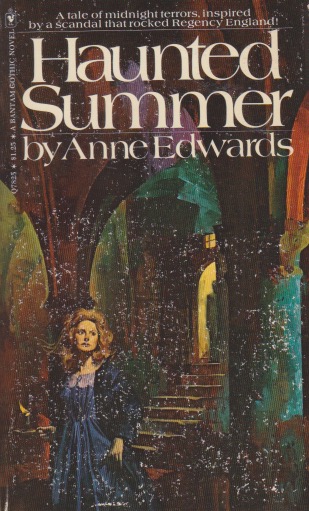
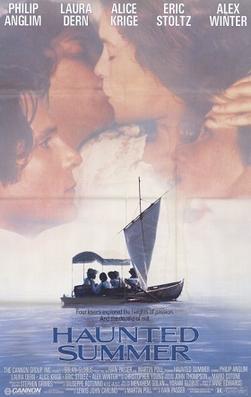
Having watched Haunted Summer, I was curious about the origin of the screenplay.  I’d read that the movie was based on a screen treatment by Anne Edwards, a screenwriter and novelist, but that it had been rejected.  Edwards then transformed her screenplay into a novel that was published in 1972, over a decade before the film came out.  It’s sometimes easy to forget that movies spend quite a long time in development.  For example, about four or five years ago it was announced that Lindsey Beer was going to write and direct a new Sleepy Hollow movie.  That was the proximate cause for my writing Sleepy Hollow as American Myth.  I wrote the book, found a publisher and then watched as sales only bumped along the bottom and still no Beer film appeared.  Timing isn’t always my strong suit.  In any case, I decided that it would be good to read Edwards’ book as a follow up to the film.

Marketed as a gothic novel, it came out in my beloved mass market paperback form.  It’s now not easy to find.  The story is well researched, but fictionalized, of course.  The five Regency Era creatives—Lord Byron, Percy Bysshe Shelley, Mary Godwin, John Polidori, and Claire Clairmont—had gathered near Lake Geneva in the summer of 1816 (the “haunted summer”).  Famously, the idea for Frankenstein came out of ghost stories they told each other to pass the time during a rainy summer.  Polidori’s story, “The Vampyre,” also traces its origins back to that night.  Edwards’ novel focuses on Mary, making her the narrator.  Since it is a novel some fictional elements are added to what happened that summer.  To me, the most obvious was moving the ghost stories from Villa Diodati to Castle Chillon.  This allows Edwards to introduce Ianthe, a tragic keeper of the castle.

The story focuses on Mary as a strong woman very much devoted to Percy Shelley and standing up to Lord Byron.  Her lack of regard for Polidori was a little jarring since, it seems, historically, she felt sorry for him.  In any case, other than the changes Edwards introduces, the plot largely follows what happened during that summer.  The climax of the book is Mary’s telling of the  basic story of Frankenstein in Chillon Castle.  I found the Author’s Note of particular interest; novelists are also researchers, even if not always treated as such.  The historical incident of this meeting drives my interest, and this largely overlooked novel is a piece of a larger puzzle.


Summers and Hauntings

I’ve written before about that odd Ken Russell movie Gothic, one of my “old movies.” In case you missed it, the film is a fictional retelling of the gathering of Lord Byron, Percy Shelley, Mary Godwin, John William Polidori, and Claire Claremont in the summer of 1816.  They read ghost stories to pass the time and decided to try writing them.  Two famous stories came of it: Frankenstein and Polidori’s “The Vampyre,” a story that would go on to influence the genre.  I hadn’t realized, being generally the one invited to someone else’s choice of film, that two years following Gothic a movie called Haunted Summer was released.  Directed by Ivan Passer, it is a slow-paced romance that tells about the same meeting.  It’s somewhat more believable than Russell’s movie, but it has some oddities.  Perhaps the most telling is that it doesn’t mention the famous “contest” at all.

No doubt, one of the most compelling aspects of that summer meeting was the fact that a nineteen-year old Mary Godwin would go on to write one of the most influential fictional books of all time.  The influence of Frankenstein is visible in most unexpected places.  Internet personalities create “Franken” products by mixing together discrete products.  (For example, “Frankensoap” is when you cut up and blend different soaps.  You’ll actually find Frankensoaps in our bathrooms at the moment since that’s the way I handle soap scraps.  Soap never seems to go fully away before it becomes unusable.)  Frankenstein influenced everything from feminists to science fiction.  Not to mention horror.  Haunted Summer, however, although it has Polidori as a character, doesn’t mention his story at all.  It really focuses on the sexual tension between Byron and Mary Godwin.

Our imagination of that meeting of two famous writers and one soon-to-become famous one, often doesn’t make room for the fact that Shelley and Godwin were actually traveling with their infant son William—not shown in the movie.  (Mary had delivered a premature daughter the year before, who didn’t survive.)  I suppose putting a baby in the mix might, in Puritan America, dampen the romance implied in Haunted Summer.  Both that movie and Gothic make use of Henry Fuseli’s painting “The Nightmare.”  And although Haunted Summer isn’t a horror movie there are a few moments of fairly high tension—one when Godwin has her dream of the creature approaching her bed at Villa Diodati.  The story, however, had already been told by Ken Russell’s movie and Haunted Summer failed to make much of an impact.  That isn’t, however, quite the end of the story.


Not Conan

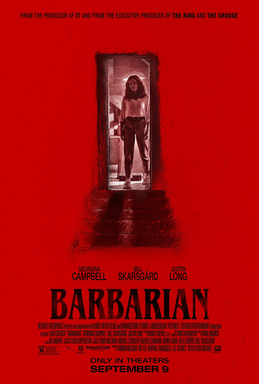
What are Weapons without a Barbarian?  I learned about the latter movie after reading about the former.  After watching Weapons I knew I had to see Barbarian.  It is outlandish but decidedly scary.  I haven’t been that tense during a movie for some time.  Nor have I watched one where there were so many moments when the average person in real life would’ve just left before things got so bad.  There may be some spoiler-level information here, but I won’t give away the ending.  Tess is booked into an AirBNB in Detroit, but arrives to find another renter already checked in.  It’s a rainy night and there’s a convention in town so all the hotels are booked.  Tess decides she can trust Keith and stay the night.  They end up getting along very well, and she’s planning on staying the next night as well, even with the double-booked situation.  Then Tess discovers a disturbing room in the basement.

We then learn that Keith, whom we’re all suspecting (Bill Skarsgård has become well known for playing horror villains), isn’t the real threat.  In one of the moments when I would’ve left, she goes to find him after he falls silent in the basement.  She discovers a sub-basement where a strange, inhuman woman dwells.  This woman kills Keith.  Cut to California where AJ, a guy who’s not exactly evil but certainly not good, is being accused of rape and is losing money.  He’s the owner of the AirBNB and he flies to Detroit to get the house ready for selling.  He sees that it’s occupied, but the agency says no one is staying there.  He discovers the secret sub-basement and we learn a sexual predator has for years been abducting women, having children with them, and then having children with their children, thus producing the scary woman.

As I say, outlandish, but the story is quite effectively filmed.  The real monster is not the woman, but modern people such as AJ.  The police refuse to help because they assume everyone in that neighborhood is a crackhead.  The urban blight reminded me very much of It Follows, another horror film set in Detroit.  This is kind of a new form of folk horror where the landscape becomes a monster.  Instead of using traditional folklore, however, films like It Follows and Barbarian suggest that the landscapes we build and then neglect become scenes of supernatural horror.  This is quite effective.  Having grown up in a much smaller town, but one which is equally neglected, this kind of horror really works.  Zach Cregger has become another horror director to keep an eye on.