
As most horror fans know, on a stormy night in 1816 a group of Romantics gathered and a scary story “contest” was suggested. The best known result of this contest was Mary Shelley’s Frankenstein. More devoted horror fans will also know that John William Polidori’s short story, “The Vampyre,” also had its origins on that night. It was built on a very slim skeleton suggested by Lord Byron. Percy Bysshe Shelley’s efforts are lost to history. As are those of the most overlooked of the group, Claire Clairmont; her story was finished some time later, unpublished. Claire’s birth name was actually Jane, and she was Mary Shelley’s step-sister. (Mary was Godwin at the time.) Percy, Mary, and Claire had traveled to Geneva at Claire’s suggestion. She was pregnant with Lord Byron’s child. Shelley and Byron became fast friends and the three young men present on that night would all die within eight years.
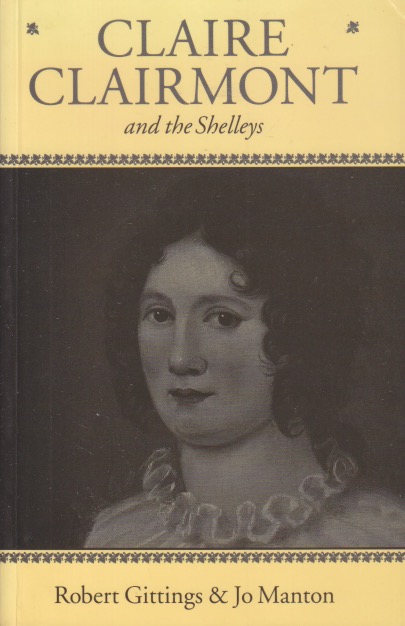
Claire is unjustly forgotten. Of the five gathered in Villa Diodati she lived the longest, making it to eighty. She had a difficult but occasionally warm relationship with her step-sister. This book by Robert Gittings and Jo Manton is the first real biography of Claire. She lived a fascinating life. Drawn from diaries, letters, and reminiscences of friends, as well as the other sources of the historian’s art, Claire Clairmont and the Shelleys is quite readable. And moving. Claire was young and infatuated with Byron when she set out to seduce him. He never returned the love she felt for him, and took responsibility for their daughter on the condition that Claire never see him again. Her inability to see her own child was the great sorrow of her long life.
Claire went on to live in Italy, France, Russia, and Austria. She was fluent in French, Italian, and German. By all accounts she was a gifted musician. She hobnobbed with high society, often by being a governess in aristocratic households. She lived near poverty at times, but inherited a living from Percy when his father died. It’s the sad fate of many who don’t get published that they are forgotten to history. (Being published is, I hasten to add, no guarantee either!) Claire’s personality comes through in this account as that of a strong, vivacious woman who defied the conventions of her era. She made her own way in the world, never marrying, yet being sought out by those who latterly wanted accounts of Shelley’s life. She’d lived with Percy and Mary for several years. This is a story of a different but fascinating time. I hope that future treatments of that famous night in 1816 might take a bit more notice of this deserving, if forgotten, woman.

