Read a Book

A huge shout-out to Andrew Laties for conceiving and organizing the Easton Book Festival!  Easton may not be the largest city in the state, but the Lehigh Valley is Pennsylvania’s fastest growing area.  As we discovered when we moved here almost a year-and-a-half ago, it is a region that supports bookstores.  Even before the Festival we’d explored some six or seven and after moving from central New Jersey—where keeping a small shop or two open was a struggle.  We’ve become spoiled for choice.  Writers may not be the easiest people to herd—many of us are quiet and tend to live in our own heads quite a bit—but the festival has brought some 200 of us together, and we write on all kinds of things.

Although the panel on which I participated had religion as one of its themes, my wife and I noticed that at each session we attended religion was mentioned.  Either it was in an author’s background, or it figured into their writing, or most embarrassingly, it objected to and tried to silence them through censorship.  Although my book’s subtitled The Bible and Fear in Movies, it was evident that I wasn’t the only person who found the Bible’s effect on people scary.  And the theme continued into the evening as I attended the author’s banquet solo.  Many of the people I met had religion in their background or in their present motivations for writing, and not one of them was judgmental toward a guy like myself who’s trying to find his way.

The Easton Book Festival is in its first year.  Although by late afternoon the weather had deteriorated into the rain we can’t seem to shake around here, it was wonderful to see people walking around with festival booklets (there are enough events to warrant one) and not bothering to conceal and carry.  Books, that is.  For a moment, they were cool.  My second session is this afternoon.  As I learned both last weekend at my book signing and at sessions yesterday, a sell-out crowd is unlikely.  This is a free event and even authors who had more fingers than attendees were gracious and glad for the opportunity to explain what they were trying to do with their writing.  And they unstintingly shared what they’d learned with one another.  This was community, centered around books.  It was a small slice of what Heaven could be like, if we’d all just take an interest in each other.  Even if we’re shy and secretly would rather be home writing.


Rescued, Technically

One of the scariest tropes in horror (or other) movies is where the protagonist has to rely on the monster (or antagonist) to be rescued.  All the time the viewer is wondering if the monster is going to turn on the hero since, well, it’s a monster.  The tension builds because the situation is untenable to begin with, but there is no other way out.  So lately that’s the way I’ve been feeling about technology.  The first and only time I drove to Atlantic City (it was for a concert some years back), navigating by GPS was still new.  In fact, I didn’t have a device but my brother did so he brought it along.  I remember not trusting it to know the local traffic rules, but once we got into an unfamiliar city I had to rely on it to get us to the venue.  The fact that I lived to be writing this account suggests that it worked.

I no longer commute much.  Still, I’m occasionally required to go into the New York office for a day.  It’s a long trip from here, and to handle the true monster of New York City traffic, I have to leave the house before 4 a.m. to get a spot on the earliest possible bus.  If I do that I can justify catching the bus that leaves the Port Authority before 5 p.m., the daily urban traffic apocalypse.  The last time I did this, just this week, it was raining.  Rain almost always leads to accidents in New Jersey, where the concept of safe following distance has never evolved.  And so I found myself on a bus off route because the major interstate leading into Pennsylvania was completely closed.  The driver announced he wasn’t lost, just trying to find the back way home.  When the streets turned curvy and suburban he asked if anyone had a maps app on their phone.

Lately I’ve been complaining about smartphones.  Truth be told, I do use mine as a GPS when I get lost.  It’s at that stage in an iPhone’s life when it shows you a full battery one second and the next second it’s completely dead, so I let my fellow passengers—every single one of whom has a smartphone—do the navigating.  People on the narrow, off-route roads might’ve wondered what a bus was doing way out here, but we finally did get to the park-n-ride.  The monster had helped us to escape.  And people wonder why I like horror movies…


Book Festival

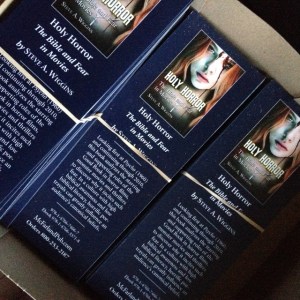
So it’s here.  The Easton Book Festival begins today.  The weather?  Partly sunny, temps in the mid-60s.  There’s no excuse not to go!  (Well, actually, there are plenty of reasons, but if you’re in the area please consider it!)  I have to admit that my involvement with it was opportunistic.  I contacted the organizer because I was looking to promote my autumnally themed book, Holy Horror, in the season for which it was written.  I understand delayed gratification.  What author isn’t delighted when her or his book arrives?  Thing is, mine came around Christmas time, and, while a wonderful gift, nobody was thinking about scary movies during the joyful winter season.  My observation is this: books are lenses to focus thoughts.  I enjoy Halloween, but I also enjoy Christmas.  One follows the other.  The Easton Book Festival just happens to be during the former rather than the latter.

It’s heeerrreee…

My own involvement with the festival doesn’t start until tomorrow.  Today’s a work day, after all.  Employers don’t give days off for self-promotion (or even for writing books) so festivals are extra-curricular activities.  I’ll be on a panel discussion tomorrow at the Sigal Museum and on Sunday afternoon I’ll be doing a presentation on my book, same venue.  Maybe I’ve got this backwards (nobody tells you these things), but I’m not doing this primarily to sell books.  I’m doing it to promote dialogue.  During my less-than-stellar book signing last week at the Morvarian Book Shop I had only one brief conversation of substance.  It was with a scientist who pointed out that science and religion had nothing to do with one another.  I guess my hopes for the events of the next two days are that folks might want to discuss the ideas in the book.  Or at least think about them.

Sunday morning I’ll be giving a church presentation on the book as well.  Being in the publishing biz I’ve learned the importance of authors getting out there to talk about their books.  Hands up, who’s read a McFarland catalogue lately?  Case in point.  The only problem with all of this is that I still have to get my weekend errands done.  My daily schedule doesn’t allow for trips to the grocery store or even putting gas in the car.  And no matter how much time I put into work, there’s always more to do.  Festivals, of course, are intended to be time set apart from regular pursuits.  So I’m going to put on respectable clothes and I’m going to speak about what’s on my mind this time of year.  If the Lehigh Valley’s in your orbit, I’d be glad to see you there.


Influential Brethren

Outsized ideas from under-recognized sources always captivate me.  I have to admit that my own childhood fascination concerning, and fear of, “the rapture” still haunts me.  While our house isn’t large, the other day I couldn’t see or hear my wife anywhere when I knew she was home and my first thought was that she’d been raptured and I’d been left behind.  Please don’t try to console me with logic; I know very well the problems with this initial assessment and knowing the history of the idea of the rapture can’t stop the primal fear when it strikes.  So it is with religious ideas inculcated in the young.  That’s why I knew I had to read Massimo Introvigne’s The Plymouth Brethren as soon as I heard of it.  The Plymouth Brethren, and specifically one of their formative leaders, John Nelson Darby, were the inventors of the rapture.

Introvigne’s book doesn’t trace rapture history (other books do that), but he does narrate, in an admirably succinct treatment, whence the Brethren arose.  In the nineteenth century in the British Isles, some were very concerned that Christianity had gone off the rails.  Accommodating with secular society, it had become heavily doctrinal and, worse, political.  Breakaway groups were common, including those who went back to the “Bible alone” as the basis for assessing what being Christian truly was.  The Plymouth Brethren developed in this atmosphere and they still remain a relatively small Christian sect (I use that term completely neutrally).  Even though they themselves splintered over time, they were never a very large group.  They, however, invented the rapture.

John Nelson Darby, one of the founders of the movement, believed history was divided into dispensations, or periods, predetermined by God.  The dispensation in which we now live (and in which they lived two centuries ago) would include a dramatic rapture that would allow Darby’s understanding of eschatology to fall within the system he developed.  This idea was picked up by Cyrus Scofield and included in his enormously influential Scofield Reference Bible.  That Bible, although many evangelicals considered the Plymouth Brethren as a kind of “cult,” was used as the unquestioned roadmap for the end times.  It was picked up by such promoters as Hal Lindsey and Timothy LaHaye and made into a meme that just about any educated person recognizes.  We all know what “the rapture” is, although the Bible itself doesn’t spell it out at all.  Introvigne’s book is very informative on the Brethren but his chapter on their ten main divisions is, necessarily, a touch confusing.  Well balanced and fair, this is a great source for those who wonder who these people were that gave us such worries when our wives have “disappeared” into some other part of the house.


Who Owns Whom?

Who’s ready to sue?  Now, I’m not a litigious person, but when someone (and corporations are people, according to the law) to whom I’ve been paying buckoodles  of money for many years tries to force me to do things as quid pro quo, it’s time to sue.  I started using Apple products during the Reagan Administration.  I can’t recall how many laptops, computers, iPods, iPads, iPhones, and iTunes cards that entails, but it’s been a year’s salary’s worth at least.  Okay, my phone—which is a classic—has been fine until… and this is the kicker… we bought a new phone for my wife.  Since then my iPhone has started having problems it never had before.  Our service provider knows we bought a new phone.  There’s got to be more money available there, “What’s he got in his pockets, my precious?”, right?  As soon as it was activated, mine began acting up.  Coincidence?

Look, tech gods.  I don’t need a whole universe in my pocket.  My phone is a camera, a GPS, and a text-sender.  That’s all I need it to be.  I can still read cursive.  I have LPs—not the modern retro ones either—in my living room.  I own pens and pencils.  You have no right to make me buy an upgrade I don’t even need!  I hate the capitalist game.  Come here into my closet with me.  (It’s okay, nothing weird, I promise.)  See this shirt?  I still wear it.  I bought it in 1981.  I know that’s 38 years ago.  That’s precisely my point.  The shirt’s still good, so why throw it out?  You guys in Silicon Valley need to get out more.  There’s more to life than upgrading people’s software while they’re asleep.  I don’t know how you sue gods, but I’m going to figure it out.

Some of us are minimally middle class.  Maybe in California you don’t have a lot of rain, but around here we do.  And that means roof replacements.  Maybe the tech gods pay you guys better, but I spent my youth earning a Ph.D. so I could earn less than a tree-trimmer in Iowa.  That is true, by the way.  So the last thing I need is some tech god extorting me to buy a new device.  Leave my phone alone!  And don’t tell me the tech doesn’t support it because I know people with cellphones over a decade old that still work.  Republicans and tech gods know how to ignore subpoenas, I guess.  But it’s time for the rest of us to file a lawsuit.  Who’s with me?


Amityville Rehaunted

One of the problems with scarce resources is the desire not to squander any of them.  Time is so rare these days that I keep multiple writing projects going (and growing) and when they’re ripe I pluck them and take them to market.  One of my writing projects had me read Hans Holzer’s Murder in Amityville.  Why?  Fair question.  It was the “inspiration” behind Amityville II: The Possession.  I discuss this film in Nightmares with the Bible, and I’ve been going back and reading those period pieces from the 1970s that formed so much of our culture through the end of the last century.

In case you didn’t grow up with an interest in parapsychology, Hans Holzer was a pretty big name then.  I can assert that with some confidence because I grew up in a small town without access to big city resources (where fame is made) and I knew about him.  Holzer wrote well over 100 books, which might give you a hint regarding their quality.  He was an interesting person.  Like Ed and Lorraine Warren he made a living by investigating, writing, and lecturing.  (I can’t seem to break into that cycle—times have changed!)  A firm believer in ghosts and demons, Holzer was naturally drawn, like other moths around the candle, to Amityville.  Murder in Amityville is his summation of his investigation and all I can say is it’s a good thing he wasn’t a lawyer.  Apart from containing lengthy transcripts of Ronald DeFeo’s trial, the book also contains interviews conducted by Holzer.  Full of leading questions and lacking evidence, it fails to convince even a sympathetic reader.

Still, you’ve got to give Holzer credit for including interviews where his loaded questions get him nowhere.  In interviewing a town historian for Amityville, Holzer kept bringing up allegations about the house at 112 Ocean Avenue only to have the nonplussed historian tell him point blank that his (Holzer’s) allegations are incorrect.  His assertions of an “Indian burial ground” are taken for granted, although no historical records substantiate it.  His interview with DeFeo demonstrates Holzer’s irrepressible faith.  After being told by DeFeo that he’d heard no voices—something he made up for a failed insanity plea—Holzer keeps coming back to what the voices told him to do.  Not only that, when Holzer does stumble upon a good question he fails to follow up, chasing some other notion down another rabbit hole.  There was clearly enough material here to work into a horror movie, but for sorting out the troubled home life of the DeFeo family the critical reader finds her or himself being asked to take a lot on faith.


Home Phone?

I wonder if anyone’s done a study on how cell phones affect our psyches.  The other day my wife upgraded her phone.  What with this being technology and all, the setting up rendered both her old and new phones useless so we would have to go back to our dealer.  Since she has to drive to work and I don’t, I gave her my phone for the day.  I use my phone little on most days.  Soon, however, I began to feel very isolated.  Anyone could reach me by email or landline, but I was without my cell phone for about 10 hours and I grew edgy.  What had happened to me?  Was I experiencing withdrawal from tech?  My smartphone is with me all the time and I’ve come to depend on it being there, even if I don’t use it.  Is this healthy?

That night we were back at the dealer’s shop.  One of the techies was trying to help us and because of the uber-security state in which we live, he had to text me a passcode to get into my wife’s phone (it’s my name on the joint account).  When his text didn’t come through he asked if he could see my device.  I handed him my iPhone 4S and he acted as if I’d just passed him a human-alien hybrid baby.  As if he’d never seen anything so antiquated.  In all seriousness he said, “You have to upgrade.  Soon this phone will no longer work.”  I have to wonder about the extortion of companies that sell you expensive devices then force you to upgrade when your salary doesn’t keep up with inflation.  My old phone does what I need it to do.  A new one will be capable of much more for which I won’t use it.  I work at home and I don’t give my cell number out to work colleagues.

There’s a psychological study in here.  I don’t want people who don’t know me personally calling my cell.  That’s what a landline is for.  Not only that, but my hours are unconventional.  Even people I know forget and send me texts after 8 p.m., waking me from a night’s sleep.  You see, the phone is always present, and those of us who don’t conform must pay the price.  The thought of being out of contact with others feels like solitary confinement.  Tech companies have given us tweeting presidents and bosses that can reach us at any hour.  And we happily comply.  I appreciate the welcome text or call from family or friend, but when it comes to work and other necessities, I still prefer to receive a letter.  Maybe I need to see a shrink.


Thoughts on a Book Signing

I’m a small-town boy.  Having the opportunity to hold a book signing, even if nobody requested said signing at the event, in the oldest continuously operated bookstore in the country was an honor.  This is a prelude to the Easton Book Festival next weekend, in which I have two roles—part of a panel discussion and an individual presentation on Holy Horror.  Putting yourself out there when you’re a writer is important, even if nobody pays attention.  I thought quite a lot about it; horror movies are almost always successful, but do people like reading about them?  Well, some of us do, obviously, but the average viewer, probably not so much.  And then there’s the somewhat embarrassing juxtaposition of the Bible.  People know what it is, but don’t want to talk about it.

Two people stopped to chat at the signing desk.  One was an adjunct geology professor.  We discussed science and religion, which is something on which I used to teach classes.  He thought the book idea was interesting, but not enough to read it.  The Moravian Book Shop scheduled this on the evening of their sold out ghost tours.  Quite a few people came in for a Saturday night, mostly for the haunted Bethlehem walks.  The second conversation was with a ghost tourist who thought the book idea was unusual.  It is.  I admit it.  As I say in the book itself, “If you see something, say something.”  So it was with me, with Bibles in movies.  The bookstore did a nice display, but then, I have an awareness of the smallness of my impact.  No surprises here.

The thing that really struck me was just how many people avoid looking at you when you’re behind a table with your books.  I know I’ve done the same thing.  I’ve gone into bookstores when an event was going on, not knowing about it and having no interest whatsoever in the book being presented.  That’s the way these things go.  I wasn’t doing this to make sales.  McFarland isn’t the kind of publisher you use to make money.  For me it was all about the experience.  It was like seeing my name outside a church in Manhattan.  It doesn’t do anything for you materially, but at least you can say you had it happened to you once.  The signing was advertised in the local paper, and on its website.  Maybe someone out there took a glimpse and saw something that sparked their curiosity.  It doesn’t matter if they buy the book.  As a teacher at heart, it is simply the interest that I’m hoping to raise.


Local Hauntings

In my on-going research (as I think of it), I watched The Haunting in Connecticut.  I recently wrote about A Haunting in Connecticut, distinguished from the theatrical version by an indefinite article.  Both claim to be based on a true story and the story itself is disputed because it doesn’t fit into a materialist paradigm.  Ah, but that’s another can of worms.  Regarding the movie, it abandons the base story to add an entirely fictional subplot that drives the horror.  Or so the writers and director think.  The tale ends up jumbled and the confusion it generates is not the kind borne of intelligent planning.  The Campbell family, struggling to pay the bills against a case of childhood cancer is real horror.  In our healthcare system that is a true story.

According to the diegesis of the movie, Matt Campbell can see the dead because he’s close to death.  In case you don’t know the story—the family has to move to be closer to the hospital where Matt is receiving his treatment.  Once ensconced in their new house they learn it used to be a funeral home and hauntings ensue.  The writer of the original book claims to have made much of it up, while interviews with witnesses make the claim that much of it actually happened.  Matt ends up in a mental hospital.  In the movie a subplot of necromancy and a young boy medium are added.  Souls whose bodies have been bound are trapped in the house until Matt figures out how to break the spell with the help of the medium’s ghost.  Instead of Ed and Lorraine Warren investigating, a local minister is added.  Also suffering from cancer, he figures it out too, but too late to help the Campbell family.

In Holy Horror and Nightmares with the Bible I do not treat made-for-television movies.  A large part of the reason is that they often lack the cultural impact of a theatrical release.  (Although Game of Thrones and The Walking Dead may have reached a point of familiarity with numbers to rival big screen efforts.)  In the case of the cinematic treatment of the Snedeker (“Campbell”) family, however, the television treatment might well have been scarier than the big-budget studio effort.  Whether fictionalized or not, the Discovery Channel show stays closer to the book (In a Dark Place, by Ray Garton).  Using the Usher-like ending of destroying the house doesn’t seem to offer any release in the big-screen version.  Sometimes reality is scarier than the tales we tell after dark.


Seasonal Music

Music is deeply, deeply personal.  That’s why I don’t write much about it.  There are pieces, I swear, if someone walked in to shoot me when I was listening to them I wouldn’t even notice.  This effect is amplified in autumn.  I don’t listen to music all the time.  In fact, I rarely do.  The reason is, counterintuitively, I fear that music may cease being meaningful to me.  Good things have a way of running out.  The music I like is only very slowly supplemented.  So as the clouds encroached this month, I put on some tunes and I began thinking of appropriate songs of the season.  I’ve heard attempts of more recent artists to sound spooky, but their lyrics don’t match the mood I’m seeking—remember, it’s deeply personal.  So what is autumnal music?

Despite being a fundamentalist, I was raised on rock-n-roll.  My favorite artist growing up was Alice Cooper; in fact, to this day Alice is the only secular rock artist I’ve seen in concert.  Two tracks on Welcome to My Nightmare are among those eerie autumn songs: “Years Ago,” and “Steven.”  This album was profoundly sunk in my psyche before I discovered others.  While not scary in the same way, “Brilliant Disguise” from Bruce Springsteen’s Tunnel of Love hits a similar chord.  The melancholy of autumn must be appeased and this song begs to bring it on.  Many of Leonard Cohen’s songs are like the angst of this season bottled up for a restorative tincture, but I was quite a bit older when I discovered Nick Cave.

The Boatman’s Call with its willowy sound and occasionally explicit lyrics, walks that line between a deep-seated spirituality and fear.  There are others, of course, some even fairly recent.  Imagine Dragons’ “Demons” from Night Vision certainly qualifies, as do the first two tracks on Muse’s The Resistance.  But this is my list, and I fear to reveal too much.  Someone who knows your music knows very much about you.  I hear some people discuss music as if it’s a throw-away commodity.  For others of us it has become part of our souls and we’re reluctant to reveal too much.  New members of this autumn music club are added only very slowly, and I reacquaint myself with the long-term members not frequently enough to rob me of their impact.  So it was as the clouds thickened and the cold wind began to blow as the leaves were beginning to turn that I put on my personal songs of the season.  And there was transcendence, but it was, as transcendence tends to be, deeply personal.


Shortchanging Halloween

In a local mall over the weekend where Christmas decorations were being uncrated, I felt cheated.  Now I’m not naive enough to suppose retailers can get by without the black season around Christmas, but as a writer of books Halloween themed I felt as if my thunder were stolen.  The normal person, I suspect, thinks of scary things only about this time of year.  Monsters and horror films are on people’s minds in fall, even though a good horror flick will make a few bucks even in spring or summer.  Halloween has a very small window of appeal, however, followed on closely, as it is, by Thanksgiving and Christmas.  Why can’t we give Halloween its due?

My wife pointed out that Halloween is a big retail event.  Indeed it is.  I started noticing Halloween paraphernalia on the shelves fairly early in August.  I know that even without capitalistic prompting I start to sense the season then.  It’s in the air.  Certain early August mornings you can smell a faint whiff of autumn on a breeze slightly cooler than expected.  The first leaves start to change and fall before September.  It will be another couple of months before the season makes itself felt in full force, but the early hints are there.  A believer in delayed gratification, I hold back.  I  don’t buy, but I absorb.  The melancholy grows through September until as the calendar tells me it is now officially October I can begin to exhale.  This is the time when those of us who are horror misfits can seem somewhat normal.  I walk into a store and “Ho, ho, ho!”  The joke’s on me.

Autumn already slips by too quickly.  Every year before I know it the ephemeral beauty of changing leaves is gone and the subtle chill in the air turns frigid.  Damp leaves are raked up to make room for snow.  The swiftness of this season is perhaps one reason so many people value it.  Summer can stretch long with its uncomfortably warm days and winter can linger for nearly half the year with its opposite feel.  Halloween is a holiday that intentionally falls in the midst of transition.  That transition has been commercialized, however, into buying seasons.  Only halfway through October the price of Halloween goods drops to sale rates.  Corporate offices are chomping for Christmas cash.  What I really need is a walk through the fallen leaves and a few untrammeled moments to consider where we are rather than what we might earn.


Trolls and Tolls

Fall creeps up on me every year.  I like to have an array of seasonal books to read so that when it arrives I’ll be ready.  With house repair costs this year I’ve had to curtail book buying.  That, and most of the titles on my to-read list are used books that seem to have become extortionately expensive since the 1970s.  In any case Cherie Priest’s The Toll stood face out on the shelves of Buffalo Street Books in Ithaca and it caught my attention.  Set in the Okefenokee Swamp in Georgia, this unsettling novel brings the reader into the liminal space of the dying small town.  There’s a bit of magic in Staywater, although everyone who lives there knows it hasn’t got long before it goes altogether.  And every thirteen years a monster comes.

Priest knows not to describe the nameless creature too clearly.  The monster seen in broad daylight can quickly lose its patina of fear.  This is some kind of supernatural swamp beast and everyone local seems to know it’s picking them off.  The outside authorities, however, pay no attention to small towns that have “nothing to offer” to the greater economy.  That aspect resonated with me as the erstwhile denizen of a community of less than a thousand.  I watched the dissolving of my adoptive hometown as the tax-base shrank to the point that they could no longer afford to pave the streets and decided to go back to gravel.  Once the oil refinery—what gave the town “value”—closed, outside interest disappeared.  Ah, but I digress from fiction.

The Tool is a moody novel that doesn’t take itself too seriously.  There’s backstory here that remains untold.  Two of the protagonists are elderly female cousins who are comfortable with the spiritual world.  They are the past saviors of this little town in the swamp.  The other characters have all come to an uneasy peace with their periodic tormentor and they have nowhere else to go.  When the monster strikes against unwary outsiders the locals don’t welcome outside attention.  Those acquainted with small communities know that’s what life is like.  Attention brings cash, but often unwelcome change as well.  One of the more haunting aspects of this novel is the number of threads left dangling in the wind.  Not everything is resolved, and life goes on much as it always has, without or without the monster.  A moody read, this ghost story has, it is clear, a deeper message.


Digital First

Publishers these days are all yammering about being “digital first.”  Now, I use technology when I write these days, despite the fact that I am coerced to shut down programs at 3:30 a.m., my writing time, because tech companies assume people are asleep then and that’s when upgrades happen.  Still, even as an author of the modest academic sort I know the unequalled thrill of seeing that first printed copy of my book.  Authors live for that moment.  It’s our opiate.  Publishers don’t understand that.  Five years back or so I had a novel accepted for publication.  (It never happened, but that’s a long story.)  At one point the publisher changed its mind—post-contract!—and decided that my story would be only an ebook.  They tried to make me feel better by saying they thought it would do well in that format.

Who wants to hold up a plastic device and say “Look what I wrote!”?  It makes about as much sense as smoking a plastic device.  No, writing is intended to lead to physical results.  Even those of us who blog secretly hope that someday someone will say, “Hey, I want to publish your random thoughts as a book.”  As long as it’ll be print, where do I sign?  In some fields of human endeavor there are no physical signs that a difference has been made.  Is it mere coincidence that those who work in such fields also often write books?  I suspect not.  Writing is a form of self-expression and when it’s done you want to have something to show for it.  All of that work actually led to something!

Since I work in publishing I realize that it’s a business.  And I understand that businesses exist to be profitable.  I also know that technology sits in the driver’s seat.  Decisions about the shape of the future are made by those who hold devices in higher regard than many of us do.  I’m just as glad as most for the convenience of getting necessary stuff done online.  What I wonder is why it has to be only online.  The other day I went looking for a CD—it’s been years since I bought one.  At Barnes and Noble about all they had was vinyl.  I’m cool with records, but my player died eons ago.  I had to locate a store still dedicated to selling music that wasn’t just streamed or LP.  That gooey soft spot in the middle between precomputer and 0s and 1s raining from the invisible cloud.  I went home and picked up a book.  Life, for a moment, felt more real.


Spiritual Fear

There’s an old adage that if a headline asks a question the implied answer is “No.”  I’ve found that to be true, largely.  I hoped differently when I saw the article titled “Are Horror Films Secretly Spiritual?” by S. Rufus in Psychology Today.  Rufus, admittedly not a fan of horror, ponders whether it might not meet a spiritual need for some.  She would not count herself among that number, should the assertion prove to be the case.  Indeed, her post has more sentences ending in question marks regarding this assertion than it has straightforward declarative ones.  Rufus notes that ancient religions involved a kind of fear-based response appropriate to the lifestyle of those open to constant threat by the natural world.  She seems to believe that civilization has saved us from that.

Now one of the questions with which I constantly struggle is why I watch horror.  I do not like being afraid, and when people find out about my fascination with horror they tend to treat me as if there’s something wrong with me.  I guess maybe I think that civilization has not so much eliminated the sources of threat so much as changed them.  Those who grow up poor know fear.  Fear of want is extremely prevalent in our capitalist society.  I see the “street people” when I go into New York City.  They are not few.  Once you start to get away from affluent suburbs just about anywhere you start to see the run-down houses of those who can’t cope with the demands of a consumerist society.  Even those of us with an education are liable to joblessness and the very real terror that attends it.

Civilization, in other words, comes with its own costs.  Religions originally began—some of them at least—largely from the fear response.  Yes, people were afraid.  The gods, properly propitiated, stay the hand of disaster.  For now.  Some religions, such as those in the monotheistic family tree, tend to suggest higher principles like love can be the motivation.  These religions, however, quickly begin to make threats against those who are heterodox, and reintroduce fear into the formulation.  I suspect, from my own experience of all of this, that the answer to the question may actually be “yes”—horror films do offer something spiritual.  There is a catharsis, if I may borrow a term from psychology, in them.  The spiritual element may, however, run much deeper than that.  Until human society truly takes love and justice as its operating principles, we will have horror films to help us learn to cope.


Haunted State

Some few years back, when FYE was still a thing, I’d hunt for bargains at our local.  I came across a two-for-one DVD that seemed promising, but when I got it home I discovered it was a made-for-television combo, and movies of that ilk often fudge on many angles.  I watched them nevertheless.  These were the Discovery Channel’s first two specials in what would become a series titled “A Haunting.”  I have to admit A Haunting in Connecticut freaked me out so much that I decided to trade the disc back in—something I rarely do.  (The other feature, A Haunting in Georgia, I could barely remember.)  As is usual with things I get rid of, I grew curious once again—this time a decade later.  Fortunately both movies are included in Amazon Prime, so I was all set.  I just needed that rarest commodity of all, time.

You might think that a guy who gets up at 4 a.m. on weekends would have plenty of extra time.  That’s not the case.  Nevertheless, I squeezed the clock to watch these shows again for research purposes.  Neither one was so scary as I recall—I’ve seen quite a few movies since then—but they did get October off to a moody start.  Of the two I recalled far less of the Georgia story.  Perhaps part of the reason is that it left so much unresolved.  The Wyrick family apparently experienced many ghosts and their investigator, William G. Roll, took their claims seriously.  While not an Ed and Lorraine Warren film, like its sibling, it follows the pattern of repeated, reported activity, investigation, and, well, not quite resolution.  The family attends a Pentecostal church, and, interestingly, the documentary treats it respectfully.

Unlike A Haunting in Connecticut, A Haunting in Georgia films some events in real time—notably the church service.  The pastor is interviewed and he, unlike Dr. Roll, believes the entity to be demonic.  The documentary treats him with the same gravitas as it does the Berkeley-trained psychologist.  There’s too much going on here to make a memorable narrative, though.  Stories, at least in the classical fictional sense, have some kind of resolution.  The Georgia narrative has too much complexity and too little sense that anything has been solved.  To me the amazing thing was that I had watched this film before and I remembered maybe only the first fifteen minutes.  Both films went on the bigger things, getting remade into theatrical features that I’ve never seen.  But then again, I barely have time for my own unresolved story.  Maybe FYE offers its own brand of local haunting.