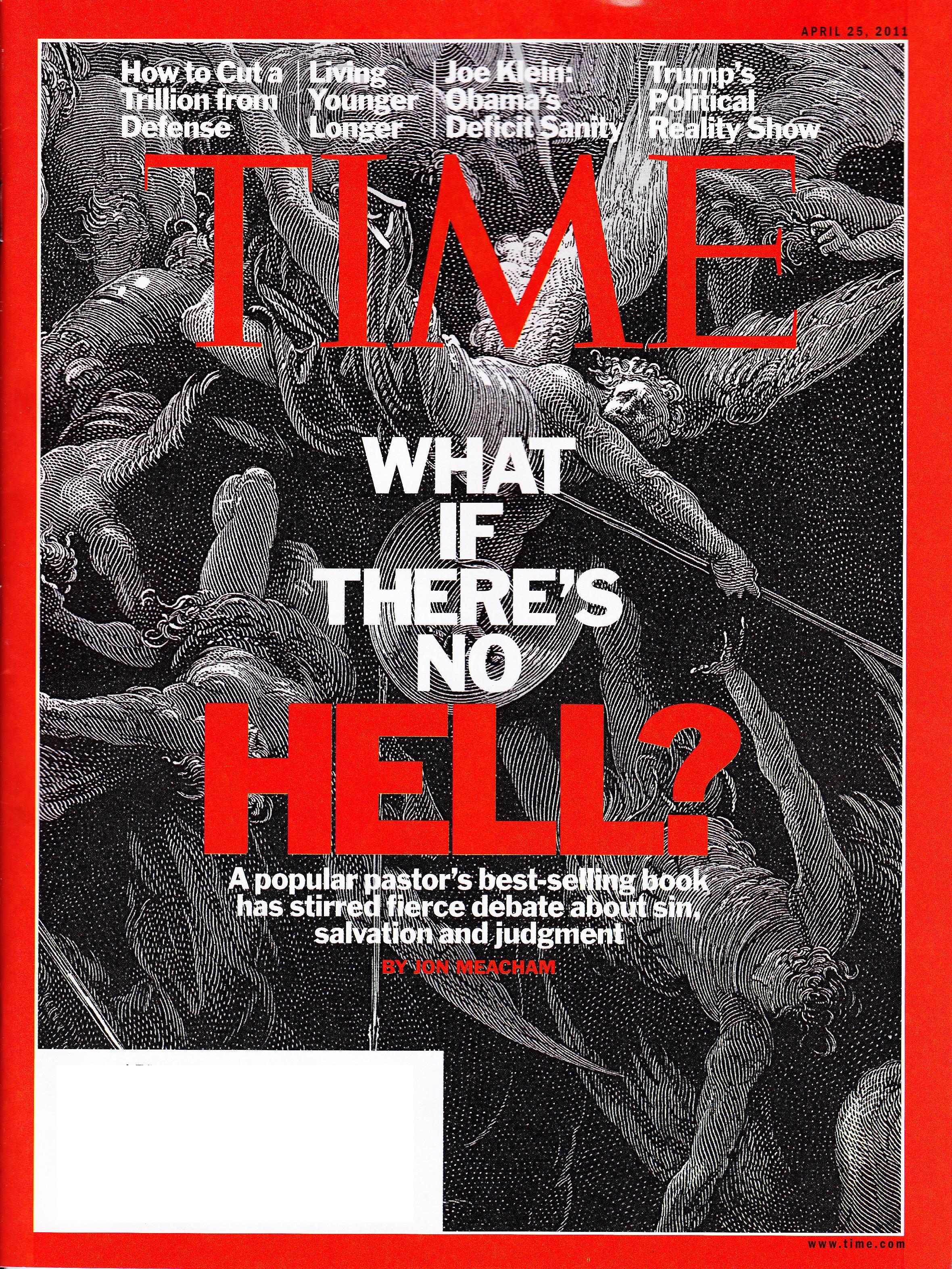
Bell’s Hell

Hell makes the cover of Time. Or at least its absence does. For those of us who’ve delved deeply into the Bible for many years, it is no surprise. In fact, the uproar, as Time confesses, is among Evangelicals. So why Hell? Why now? The Evangelical pastor of Mars Hill Bible Church, Rob Bell, has just published a book questioning the existence of Hell and his fellow Evangelicals are in a conflagration about the loss of the sacred icon of God’s omnipotent stick that threatens them all into Heaven. It is a sad day when love cannot encourage enough that hatred becomes religion’s motivating factor.

The loss of Hell, however, represents so much more than just the loss of the scariest place under the earth. It represents the loss of control. Without Hell to wield and Hell to pay, many of the faithful may wonder what they might get away with. Neo-cons have been eager to court the Hell-mongers because the issue is making others lock-step in their own pattern. Diversity is not encouraged or appreciated. Lawns must be cut to the same height, trees carefully trimmed, shirts must be conservative and cookie-cutter, and one must wear that blessed smile that proclaims “Hell-dodger.” Cast any doubt into this fabled world and the results might be, well, realistic.

The Hebrew Bible knows no Hell but the one we make for ourselves. We hardly need a Devil to tutor us in the ways of evil. Human history reveals that we’ve had it in us all along. Instead of celebrating the death of Hell, several Evangelical pastors are simply adding Bell to its numbers. Time’s news is not news for many of us, but for those who haven’t considered seriously the implications of their faith as Holy Week rolls around, this may be a good time to take stock of options for eternity. What do we gain by fabricating an eternal torment devised by the most loving deity ever conceived? Hell can now claim its rightful place as a metaphor for the wickedness Homo sapiens devise for each other and for their planet.


Blue Monkey God

A friend of mine pointed me to the following YouTube video:

Having spent many years in Wisconsin, I have to admit that this isn’t the weirdest thing I’ve witnessed. Not even the weirdest thing in the name of religion. Nevertheless, the fact that grown adults are running around the Wisconsin woods dressed as Na’vi and throwing toilet paper onto innocent trees shows just how diverse religions can be. My ears perked up at about the 3:50 mark on the video where Tsu’tey says “I didn’t believe in God before Avatar” – a statement that catapults James Cameron into the role of father of God, I guess. What will it take to make some people believe?

I have said for years that movies are the new mythology. At the risk of showing my age, and blowing my coolness factor, I recall the episode of Northern Exposure (“Rosebud”) where Leonard Quinhagak, a Native American shaman, tries to discover the healing myths of the Caucasians. The inhabitants of Cicely simply don’t know any myths. Meanwhile, in a separate plot, Ed Chigliak attempts to make a movie. The juxtaposition illustrates quite nicely how movies are indeed modern myths. The sense of transport many viewers reported upon seeing Avatar (critics, be quiet) also illustrates this phenomenon. Movies take us outside ourselves in a way most religions would kill (some literally do) to achieve.

Donning a blue body suit and freezing your tail off in Wisconsin may not be everyone’s favored form of religious expression. It is healthier than much of the religion I saw expressed at Nashotah House. In fact, when Tsu’tey and Eytukan are shooting arrows at the manikin of a woman I thought I had slipped back into my accustomed pew for a spell. The myth of Avatar is that peace, love, and tolerance may indeed coexist without the greed of the sky people who only want the money. There is a truth deeply buried here. If a few more cassocks could be shed along with a few more human tears perhaps we could embrace the contents of Pandora’s box unafraid.


One Percent Solution

A colleague just pointed out an article in Vanity Fair that should be required reading for all Americans and it should be offered with a generous quaff of nepenthe. Please pardon any excess indignation you may find in today’s post. Whenever I’m teaching my course on the Hebrew Prophets I tend to get swept into the spirit of their oracular outrage. The latest statistics reveal that 40 percent of American income goes to only 1 percent of the population. Despite protests to the contrary, wealth does not trickle down like milk and honey (even though the latter takes its sweet time). The disparity between the ultra-wealthy and the middle class, as suggested by the article, has its closest analogues in Russia and Iran. Once the top is reached all political systems begin to look the same. Even President Obama’s budget will continue the legacy of tax cuts to the wealthy.

Where is the outrage? Americans are among the most complacent people in the world. Kept at the cusp of sufficiency, most people will not complain. Louis XVI himself could waltz into congress and be heartily greeted by his peers. All things being equal, if we the bottom 99 percent have enough then complaint is only sour grapes. All things being equal, however, is always hypothetical. All things are not equal. While many hard-working people are caught in a cycle of diminishing returns the bloated oligarchs help themselves to performance bonuses lofty enough to support hundreds of suffering families for a year. “Let them eat fake,” one can almost hear them say.

In the idealistic world of the Bible a pipe-dream was touted. Wealth itself is not evil, but it comes with an obligation. Trickle-down is a dried wadi in summertime. The wealthy are obligated to make certain that their fellow citizens all have enough. No one gets two houses before everyone has one. Once this level of fairness is reached, go ahead and get stinking rich. But that principle has never been realized. Those who have always require more. From those in such stratospheric positions magnanimity cannot be expected; for others to benefit some of their astronomic wealth must be taken. What are taxes for? Josef Stalin is laughing in his grave and shaking hearty hands with P. T. Barnum. They share a cigar and neither one of them need speak the motto they both know to be as true as the gospel.

Trickle-down economics


This Year’s Apocalypse

Sundays are notoriously slow news days. The local paper, therefore, ran a whimsical headline: “Will the world end on May 21? Are you ready?” Nearly 40 billboards are asking Garden State commuters (as if they aren’t already stressed enough) if they are prepared to meet their doom. This year’s apocalypse is sponsored by Howard Camping, a California prognosticator with an history of calculating the world’s end. Given that our daily experience confirms uniformitarian processes on this planet have been in place for millennia – and even longer – the belief in a cataclysmic termination of billions of years’ work is rampant as ever. The end of the world, as touted in the media, is always based on religious precepts of some sort or another. Our scientifically scheduled apocalypse is about five billion years away when the sun becomes a red giant. (The biggest threat to capitalism since the collapse of the Soviet Union.)

Why do so many religions want to see it all burn? Life certainly has more than its fair share of misery and suffering. Apocalyptic scenarios abound in disadvantaged communities – the final leveler of all inequalities will put us all in the same place. Privilege creates as many problems as it does boondoggles. A truly evolved race would wish to share its good fortune to those without access to resources of the more fortunate. It is a severely effaced line between inequality and iniquity at the best of times. Those who don’t get a fair shake in this life look for a better lottery pick in Heaven’s jackpot.

But why do affluent people share this urge to watch it all explode to a theological fantasy-land? The local electrical engineer funding the billboards, is quoted by Star-Ledger staff as saying, “Seven billion people are facing their death! What else could I do?” My humble suggestion would be to put that money toward helping those who do not have enough. The underprivileged could be made to suffer considerably less with the obscene income of the Left Behind franchise. Instead that money is being funneled into questionable political causes. Maybe it is best that the world end next month after all. I’ve put it on my calendar, but I’m still expecting to be around for the 2012 apocalypse as well.

An apocalypse worth waiting for!


Waiting on a Miracle

A Google search for Morgan Freeman and FIRST Robotics will bring up an online invitation to the FIRST Robotics national championship in St Louis. After having spent yesterday at the Philadelphia FIRST Robotics regional competition I was once again struck at how emotional such events can be. I reflect on how emotion often drives religion and it is obvious that humans crave this kind of fulfillment. We look for something to believe in. Science and technology fields of inquiry are offering answers to age-old questions and present-day problems. God has been removed from the machine, but a divine residue remains. Whenever I attend these competitions I am alert for how religion manages to cling on to this highly humanistic art of robot building. I’m never disappointed.

The Dean of Temple University’s College of Engineering (which was hosting the event) spoke of the emotional rescue of the Chilean miners last year and how the press hailed the feat as 75 percent engineering and 25 percent miracle. The Dean espoused that the goal of engineering is to bring the engineering factor up to 100 percent. A world where we no longer rely on miracles. Any of us who’ve every waited on a miracle know that the outcomes are chancy at best. And yet the religious language was not over. DuPont, one of the corporate sponsors for FIRST Robotics, had a promotional slide on the projection system reading “The Miracles of Science.” Of course, that is one of their corporate logos, but the question left lingering in the air is: does the miracle come from God or human engineering?

Teams from a wide variety of high schools participate in the FIRST Robotics Competition. The founder of FIRST, Dean Kamen, was present yesterday to celebrate the final regional event. Several parochial schools compete in the competitions, and religious language is evident in team names, logos, and mascots. One of the winning alliance members yesterday was the Miracle Workerz (I didn’t catch what high school they were from) making a hat-trick of miracle references. Another team mentor was caught on the camera making the sign of the cross as he left the robot to make its way into the finals. Even though my team did not make it out of the elimination rounds this time, I left feeling inspired. Dean Kamen revealed new ways that FIRST is promoting technology to better the future while the headlines remind us how dangerous religious extremists can be. At the same time, even in this future that our engineers are designing, God is still hidden in the machine.

A gift of the gods or human innovation?


Born to Shun

Being of rather slight build, I have always held a natural antipathy toward bullies. I’ve always liked to believe that, were I in any position of power, I would care for those under my authority. Emulating this ideal as much as possible in the classroom seems to have made me a popular teacher. The message we send our young, however, shouts at decibels I cannot hope to achieve that throwing your weight around is the only proper way to govern. And some governors carry considerable excess weight. New Jersey used to pride itself on its educational system, a system that is currently being gouged in nearly every possible way by an insatiable governor. And now he is taking shots at Bruce.

I seldom write about my admiration for Bruce Springsteen because it is a very personal matter with me. Having grown up in a working-class family, I discovered Bruce at a fairly young age and I suspected his concern was authentic. That suspicion has grown over the years as he has campaigned for the common worker, never forgetting where he began. Now Chris Christie is attempting to besmirch the Boss. Using the newest entry in the Neo-Con lexicon of swears, Christie has leveled the “L-word” at New Jersey’s native son. Seems liberal is always a bad thing. Good thing Jesus – the original liberal – isn’t here or the Neo-Cons would nail him as well.

I'll see you after school

The Neo-Con movement delights in out-shouting the competition. Shut down National Public Radio because if reason is broadcast on the airwaves some people might end up looking ridiculous. Let us have no dissension here! If you leave the wealthy alone, they will leave you alone. Seems that “conservative” social responsibility was crucified some two millennia ago. Instead of Christ we now have Christie. The devil himself, however, would make a more compassionate governor, if we could ever get him away from the endless tea parties of perdition that occupy all his time.


Scooped!

A book by a disgruntled adjunct instructor revealing the seedy underside of academia. This was a book project I had planned to write for some time; in fact I have over a chapter already written. My wife brought home a New York Times on Wednesday and I saw that I’d been scooped. Professor X’s book In the Basement of the Ivory Tower is reviewed in the Times. Curiously, his subtitle – Confessions of an Accidental Academic – was suspiciously close to my own proposed title. I guess I was just a little too busy teaching 11 courses this year to get around to writing the tome. In any case, I wish Professor X well. He has managed, however, to capture the attention of Viking so my insignificant wishes likely matter little.

Misery loves company, as the saying goes, and it is a strange and profound comfort to know I am not the only one consistently suffering at the hands of academe. University life has become a caste system of privileged professors and administrators and their minions while those of us who’ve had to try to earn our own respectability end up wallowing in it. Well-meaning professors suggested a doctorate from Edinburgh would make my resume stand out. I’m sure it is one of the more exotic ones in the waste-can. Meanwhile I have students coming to me asking questions about the department because none of the full-timers are ever in their offices.

I raise a glass to Professor X. Somebody needs to tell it like it is. Those who are heavily invested in the system cannot be expected to speak out against it. Courage is not the hallmark of the average academic. Those of us who dare challenge the abuses we see above us will most definitely live to pay for it; I know others who’ve shared my fate in this regard. It is the paradigm of education in the United States: we promote it until somebody has to pay. At that point those who’ve spent years after high school becoming specialists are asked not to crowd the others in the bread-line. Professor X, I salute you.


Dreams of Equality

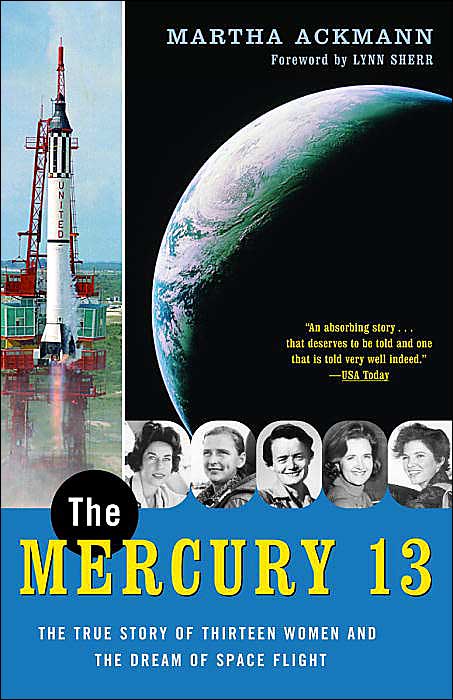
Shortly after my wife and I married, over twenty years ago, while living in Scotland we needed cheap entertainment. Growing up one of my chores had been washing the dishes. I continued this calling all through college, working in the dishroom to pay my way through. My wife was pleased with this trait and offered to read to me while I scrubbed away. This was our cheap entertainment, but now, after more than twenty years of the practice, we have read over 100 books together. Last night the book we finished was Martha Ackmann’s The Mercury 13. Most Americans do not realize that during the space race, thirteen women received non-official tests to qualify as astronauts, many of the tests more extreme than those undertaken by the Mercury 7 crew. Because of social prejudices of the 1950s and ‘60s, the women were never given the opportunity to actually achieve space flight.

Apart from the moving account of how these women strove for the stars, this account also chronicles a social prejudice that remains today. Ackmann reveals that during the ‘50s and ‘60s, scientists and physicians had never really taken an interest in women’s physiology. They were, in this McCarthyian era, considered to be an inferior version of males, the dominant social gender. Although the Mercury 13 were accomplished pilots – some with more flight hours than the chosen astronauts – many political and military decision-makers feared that social fabric would fray should women prove as adept as men. It wasn’t until 1983 that an American woman was allowed to enter space.

Here in the 21st century, many religions throughout the world still staunchly hold to the myth of female inferiority. In a monotheistic worldview where non-gendered deities need not apply, one sex will always be somehow less god-like than the other. In a world where men still pay women less, they are reminded daily that God is a white man and that the mythology declares man was created first. Religion is as often used to repress as it is to liberate. The women who sacrificed careers without personal reward to demonstrate that space belongs not only to men deserve our gratitude. And even that old white man, sitting up there beyond the dome that surrounds our flat earth, must be smiling.


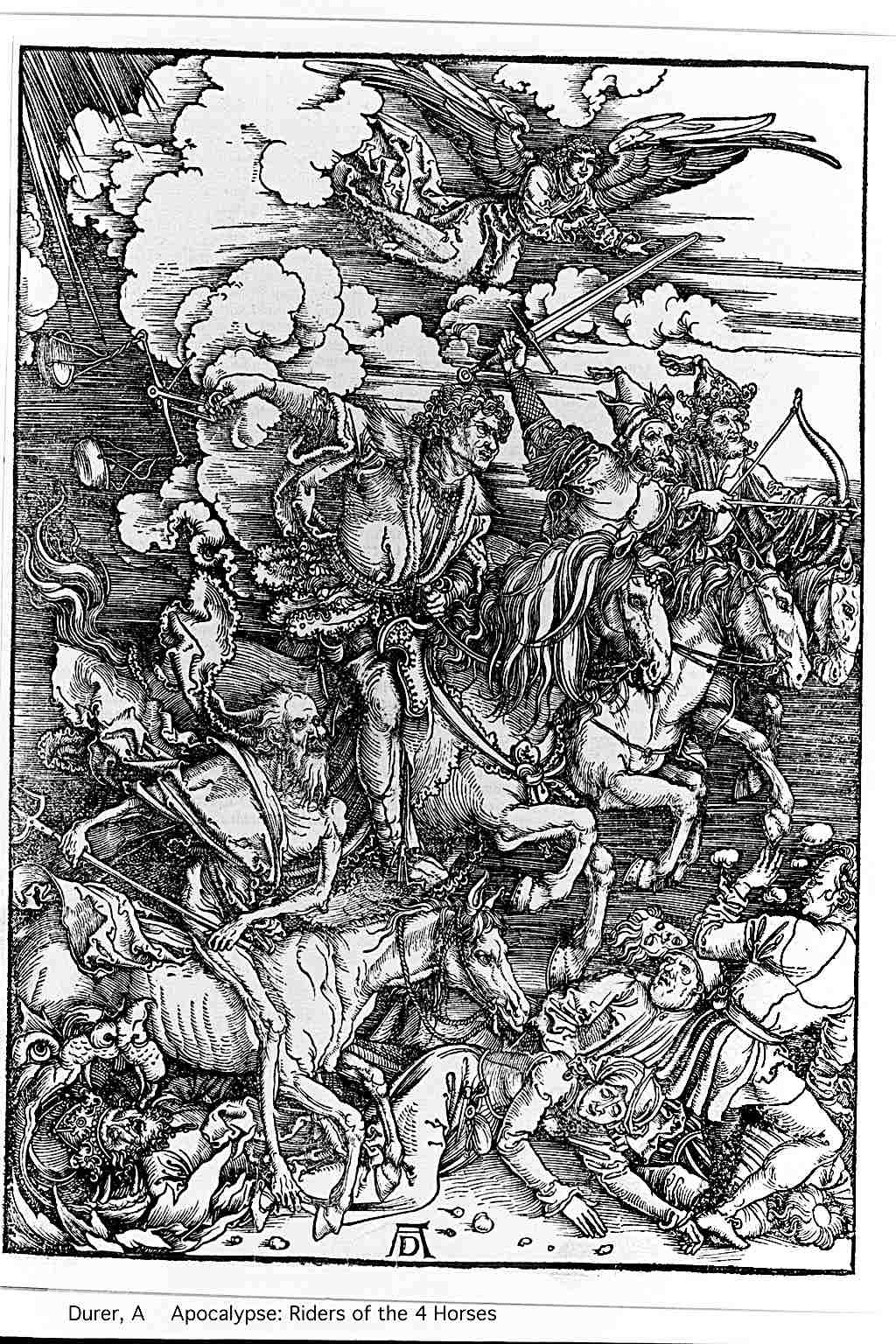
Fire and Blood

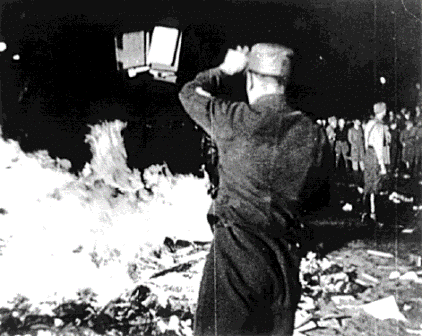
Religious intolerance again claims lives, and yet the self-righteous never flinch from their smug smiles. What insane pressure drives extremists like Terry Jones to desecrate the symbol of another religion? What did burning a Quran accomplish other than a feeling of personal satisfaction at a religious one-upmanship? Did he even stop to think that his own religion was once persecuted and that this nation that allows him the freedom to spit in the face of other faiths also welcomes his imaginary enemies? Now innocent people are dead in Afghanistan because of his intolerance. It may be that Terry Jones’ personal act of impropriety may soon blow over, but the damage has already been done. These dead will have died in vain.

Putting match to paper proves no superiority of intellect, spirituality, or especially, righteousness. The problem Terry Jones’ brand of Christianity faces is that Mohammed was born before the metaphorical return of Jones’ Christ. It is clear from the (unburned) Christian scriptures that early believers were convinced Jesus’ return was imminent, within their own lifetimes. For those who did not successfully transition to the meaning of the metaphor, it has been a weary two-millennium wait. The emergence of new religions in the meanwhile has become a threat to the superiority of their own. Apocalypticism claims many victims. Now people are dying because Terry Jones can’t cool his heels to see how this one comes out.

Religions that prove their point by trying to brutalize other religions have already shown their true character. Muslims do not burn the Christian scriptures because they accept the validity of Jesus’ teachings as well as those of Mohammed. Has Terry Jones damaged Islam by burning a book? No. Has he damaged the already languishing opinion on western supersessionism? Certainly he has. It is now incumbent on the rest of us to declare that we excoriate the acts of Terry Jones and his contemptuous version of Christianity. Islam need not try to give Christians a bad image; we are quite capable of helping ourselves.

Terry Jones' ideological companions


The Sign of Jonah

The Sign of Jonah?

Each year during the spring semester my Prophets class brings new levels of fixation on those familiar characters that so few actually know. The process began early this year. With several students of eastern Christian persuasion, Jonah became an issue based on the folkloristic nature of the tale. Jonah is particularly prone to a literal interpretation because of the “sign of Jonah” trope cited by none other than Jesus himself. Also, as I learned in my doleful days at Gorgias Press, many eastern Christians understand Jonah as a special favor to them, sent by Yahweh well before Christianity began. Even with the full weight of history against them, the students are unwilling to relinquish Jonah to his native literary genre. Then came Isaiah.

Isaiah is the most heavily co-opted prophet in the canon. Well, one might put Elijah in the running, and it would be a Chariots of Fire finish I’m sure, but as the most quoted prophet in the Christian Scriptures, Isaiah would come out on the Liddell end. So massive is this sense of ownership that Isaiah’s direct prophecy concerning the Syro-Ephramite Crisis in 7.13-17 is incapable of being understood as anything other than a prediction of a virgin birth some seven centuries down the road. Interestingly enough, it is the literal sense of this passage that is generally overlooked in favor of a later interpretation.

Even the sense of what prophecy was in the ancient world has been altered to an unrecognizable jumble by later agendas. Prophets spoke out regarding current issues (“the two kings you dread”), occasionally providing future, generally conditional, remarks. In our apocalypse-hungry society, pundits are eager for the culmination of all things and the more fireworks the better. If old Jonah and Isaiah were sitting together in a bar I can imagine the stories they’d exchange. And it wouldn’t be a whale (excuse me, “big fish”) that would be doing most of the swallowing.


Freedom or Religion

Reform seems to be in the air. Its effectiveness varies from location to location, but what remains constant is the impact on religion. Or religions’ impacts on those dissatisfied with its application. As Syria begins to follow Egypt and Libya, a sense that the authoritarianism imposed by religious ideals is somehow flawed is sublimated in the news, yet clearly present. Regimes, be they Islamic, Christian, Hindu, or any other belief system, count on unquestioned authority to maintain control. Even the Catholic Church has been toying with reform – quietly, slowly – for any admission of change calls into question the authoritarian roots of power. Once that basis begins to crack, freedom has a chance to emerge.

In American society where freedom has perhaps blossomed most fully, there should be no surprise that a religious backlash is underway. In many ways liberty and religion stand at odds with each other. Religions make universal claims, drawing authority from none other than the One who started it all. Freedom begins at the ground and works its way up. Humans are natural followers, flock animals. Remember, Jesus said he was like a shepherd. When the shepherds apply the crook a little too liberally, even the sheep begin to plot. In many nations of the Middle East, the faithful have been kept in poverty and subservience. The Berlin Wall, however, was in the minds of the intimidated.

The United States has even backed the cause of the oppressed overseas, attempting to break up dictatorships that began before I was old enough to remember. And yet in our own backyard the Religious Right continues to make America like a western version of Syria or Libya. A nation of people under the rule of legislated morality that certain distorted versions of the Christian gospel advocate. Prevent equal rights to women and minorities by keeping the seat of power within the WASP community, although you may have to bring in some Catholics and Mormons to assist with the cause. The eyes of the world are on the Middle East, for any whiff of freedom, however faint, is cause for hope.


Garden of Nede

Dystopias fit the Zeitgeist of the twenty-first century a little too well. The level of disillusionment has soared since the administration of Bush the Less when an unprecedented degree of ridiculousness tempered every political decision filtering out of a Washington that has become a little too religious. So it is that the genre of the dystopia is strangely therapeutic. I first became aware of Margaret Atwood because of an introduction to the Bible that pointed out the misuse of Holy Writ in her classic The Handmaid’s Tale. An allegory that demonstrates the power of religion to reduce women to mere reproductive objects is frightening enough in itself, let alone the post-optimistic view of a future of endless possibilities gone bad. Now that I’ve finished her more recent Oryx and Crake, I see that her outlook has grown more bleak, if more believable.

Like most dystopias, Oryx and Crake is filled with religious and biblical allusions. A society that does not know its Bible is easily manipulated by it. The book has been out long enough that I won’t worry about spoilers – does any dystopia end well? The basic idea is that the eponymous Crake of the title has tried to replicate Eden with genetically improved human beings. To prevent them from entering a world filled with human-inflicted suffering, he devises a way to wipe out the world’s population, leaving these innocents to carry on a genetically modified human gene pool. One survivor of the old days, Snowman (Jimmy), has to explain to these innocents what their world is about. He concocts a myth where Crake becomes a new god. Although Crake tried to modify the brains so that the “bundle of neurons” that make up God are gone, the new generation stubbornly develops a rudimentary religion.

Is it possible for humans to build a better future? I have never been swayed by the perverted notion of total depravity; people are quite capable of doing good. Our great ape cousins demonstrate that it is within our genes to produce a harmonious society. Although religions have motivated some extremely noble behavior in the past, they have also introduced heinous distortions of anything of which it might be said “behold, it was very good.” Atwood has offered us a world to ponder seriously. It is a world where humans play God and end up rotting under an unforgiving sun. Perhaps if politicians were more literate and less religious we might be able to counteract our partial, self-inflicted depravity.


Holy Matrimony

BBC Two is currently airing a series entitled The Bible’s Buried Secrets, unfortunately not yet viewable in the United States. The episode “Did God Have a Wife?” is presented by my colleague Francesca Stavrakopoulou, who did, no doubt, an admirable job. So once again Asherah finds herself in the news. The issue of monotheism is intricately tied up with how gods related to one another in the ancient conceptual world of Israel and its neighbors. Since the gods were modeled on humans, their behaviors could be embarrassingly human as well. Myths of actual divine marriages are rare, and extra-consortial affairs seem to have been pretty common. This aspect survives in the classical Greek world where Zeus’ many trysts are among his most notable deeds.

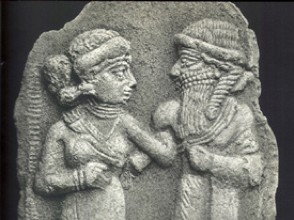
In a society like ancient Israel where marriage was a regular expectation of all young people who survived to marriageable age, an obvious mystery attends a single god. If Yahweh is male – and the Hebrew Bible seems not to dispute this point – would he not require a spouse as well? The well known Kuntillet Ajrud and Khirbet el-Qom inscriptions appear to suggest that Yahweh had a wife, and if he had the Religious Right should only rejoice since that would seal their definition of marriage forever in this literalist nation. And yet, the Bible remains decidedly mute on this point. In the end, it is interpreted that male is superior to female, again, pleasing certain religio-political factions.

Marriage in a human institution. It is a practice concerning which the Bible is strangely taciturn. In ancient times marriages (unless among the gods) were secular, not sacred ceremonies. Among a human population in danger of dying out through attrition, marriage ensured prolific reproduction. According to Christianity, even God had a kid. In a world that has changed in ways that biblical writers could never have imagined, marriage as a source for an increasing population is more problematic than it is essential. It seems that the jealously guarded definition of marriage is really just another green-eyed monster lurking in the Neo-Con closet. Maybe once Yahweh’s marriage certificate surfaces the issue of what marriage is really about will be discussed rationally.


Frippery or Faith?

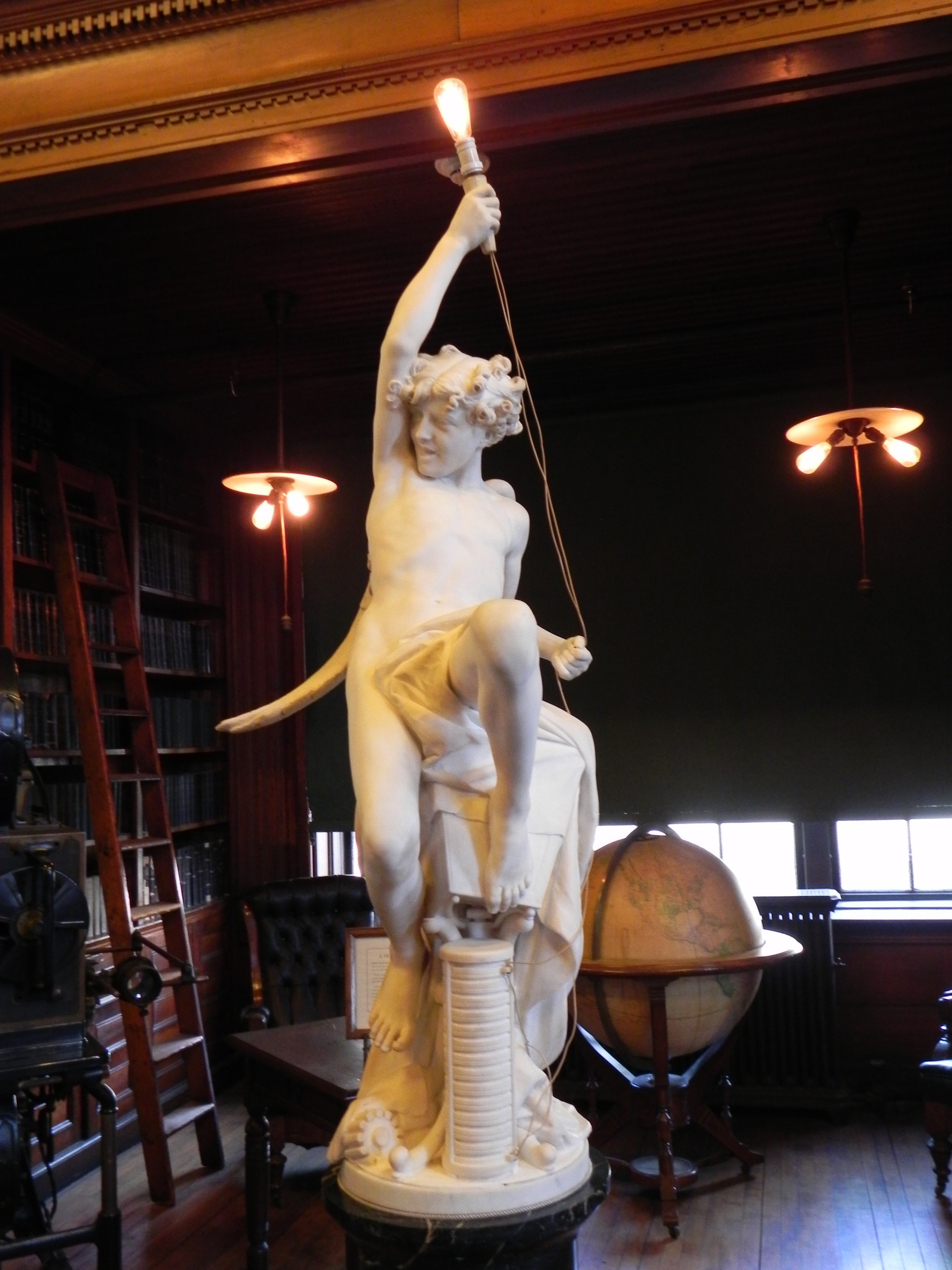
A lesson quickly learned in New Jersey is that the state has housed its fair share of geniuses and that inspiration takes many different forms. From Albert Einstein to Thomas Edison, these thinkers have changed the complexion of not only the state and country, but also of the entire world. While on a visit to Edison’s final factory and laboratory in West Orange yesterday, his devotion to thinking could not be overlooked. With little formal education, Thomas Edison taught himself what was necessary to become one of the most prolific inventors in the history of the world. The key to what he believed to be purpose of human existence is, sadly, under fire from politicians who’d rather keep the populace in the dark while they (the politicians) make the important decisions. “The man who doesn’t make up his mind to cultivate the habit of thinking misses the greatest pleasure in life.” So Edison said. Bully governors would rather turn out the lights.

As politics and conservative Christianity become even more intimate – if that is even possible – those who do not share their views are considered dangerous outsiders. As a religion specialist, it is difficult to gauge how sincerely such politicians take their religion. As their lifestyles clearly indicate, what they practice is as far from what they preach as the east is far from the west. Manipulating sincere, if misguided, believers into marks that will propel them into seats of power, they talk the talk. “Faith, as well intentioned as it may be, must be built on facts, not fiction – faith in fiction is a damnable false hope.” So said Edison.

If we measure the religion of the Religious Right in terms of action, it clear that their principles have far less to do with what Jesus said and did than with securing personal gain. Women are placed in subordinate positions; the poor, minorities, those who work to keep the economy afloat while the wealthy suck in more than they could possibly use, these people become targets rather than neighbors. Roman emperors knew the society was dissatisfied and provided bread and circuses. The Religious Right is perfectly capable of learning the more insidious lessons of history. If they had been around in Edison’s lifetime, no doubt they would have tried to turn off the lights so that we’d all remain in the dark. In such a situation it might be wise to leave the final words to Edison: “Religion is all bunk.”

Let there be light!


Dream Quest

H. P. Lovecraft was a writer who remained unappreciated during his life but who has become a very influential literary figure after his death. So it is with artists. Known mostly for his short stories, one of the novellas he wrote, “The Dream-Quest of Unknown Kadath,” carries immense religious implications. Those familiar with Lovecraft’s fictional world know of the god Cthulhu and the “Other Gods” that he places in outer space. In “Dream-Quest” Lovecraft states that these Other Gods, “are good gods to shun.” While mere fiction, the concept of divinity has become pliable in the hands of its human author. Mortals are those who describe gods, those who decide what their deities will be like. The dream of the titular quest involves the earth gods having been removed from their shining city to leave the dark and dangerous other gods in charge.

While some would dismiss Lovecraft as overly inventive, his view of the earth being clouded by the crawling chaos Nyarlathotep strangely matches what we see playing out in the headlines. Those who are supposed to protect the masses, their leaders – elected or otherwise – have shown themselves to be interested in personal gain above all sense of duty. Throughout the world, and increasingly clearly in the United States, the working poor are seen as simple commodities easily manipulated and programmed to support those who would exploit them. Crawling chaos has landed.

Lovecraft’s “Dream-Quest” has a host of unlikely heroes, among them the cats of Ulthar. These cats maintain a true divinity appropriate for the descendents of Bastet. Feline divinity represents hope to Randolph Carter, Lovecraft’s protagonist. They also represent the tendency of the earth gods only to appear when most sorely needed, otherwise simply to set their own agenda. Where are the cats of Ulthar now? The problem with gods is they don’t always show up when you need them. Many dismiss Lovecraft as just another overly imaginative writer of cheap fiction, but to those will to listen carefully he was an author that could hear a very faint pulse. Even if that pulse was coming from under the floorboards to haunt a reality where the earth gods had gone away.

A little writer shall lead them