Bad Boy

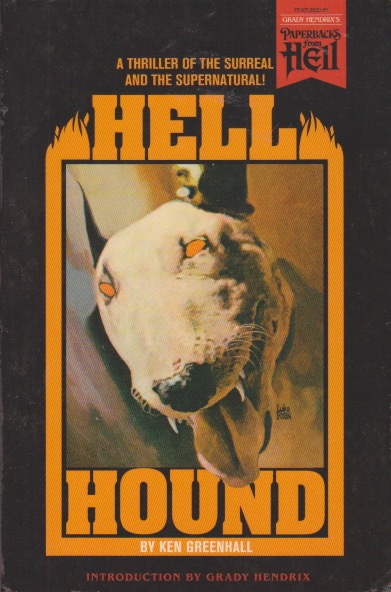
I’m still trying to figure out what I think about it.  The introduction by Grady Hendrix got me interested in the novels of Ken Greenhall.  The introduction was in Hell Hound and it described how Greenhall’s books whispered horror rather than shouted it.  That’s also true of the horror stories I write, and it’s clear I still have plenty to learn.  Baxter is a bull terrier whose thoughts are recorded for part of each chapter in this short book.  What we read isn’t terribly welcome.  Baxter is aware and intolerant of human weakness and he has a strong will.  So strong that he uses it to get people he doesn’t care for out of his way.  At the same time, as the story unfolds, you can’t see Baxter as evil.  He obeys his nature but he has morals.  Spoilers follow.

His first owner, an old woman with little joy in life, is his first victim.  He’s adopted by a young couple but they’re about to become parents and when they do his jealousy appears in the worst way.  They couple give him away to a young boy who aspires to be a Nazi.  A fan of Hitler, he appreciates Baxter for his power and his, as he thinks, killer instinct.  But Baxter doesn’t kill for the sake of it.  Misguided as he might be, his kills all have a purpose.  The boy is a bit different.  He demonstrates his callousness by trying to have Baxter kill another boy.  Then the Nazi kills the pups Baxter has sired.  The two face off and the story is written well enough that you find yourself hoping that Baxter will prevail.  But alas, opposable thumbs do give a fatal advantage.

It’s unclear by the final chapter how much, if at all, the boy has changed.  He knows how to manipulate others and his own interest is what guides his actions.  It’s kind of a bleak story in the end.  It is, however, well told and compelling.  Greenhall wasn’t known much during his life, but he did manage what’s rather difficult today—he had a series of novels published.  He died over a decade ago and is now starting to be recovered.  That’s often the sign of quality writing.  Those who make an impact are often overlooked in their own time.  Hell Hound isn’t my favorite horror novel, but it is a strangely affective and effective one.  And it shows that dread need not take place over many hundreds of pages to work.  I’ll likely be coming back to Ken Greenhall for more.


Note to Myself

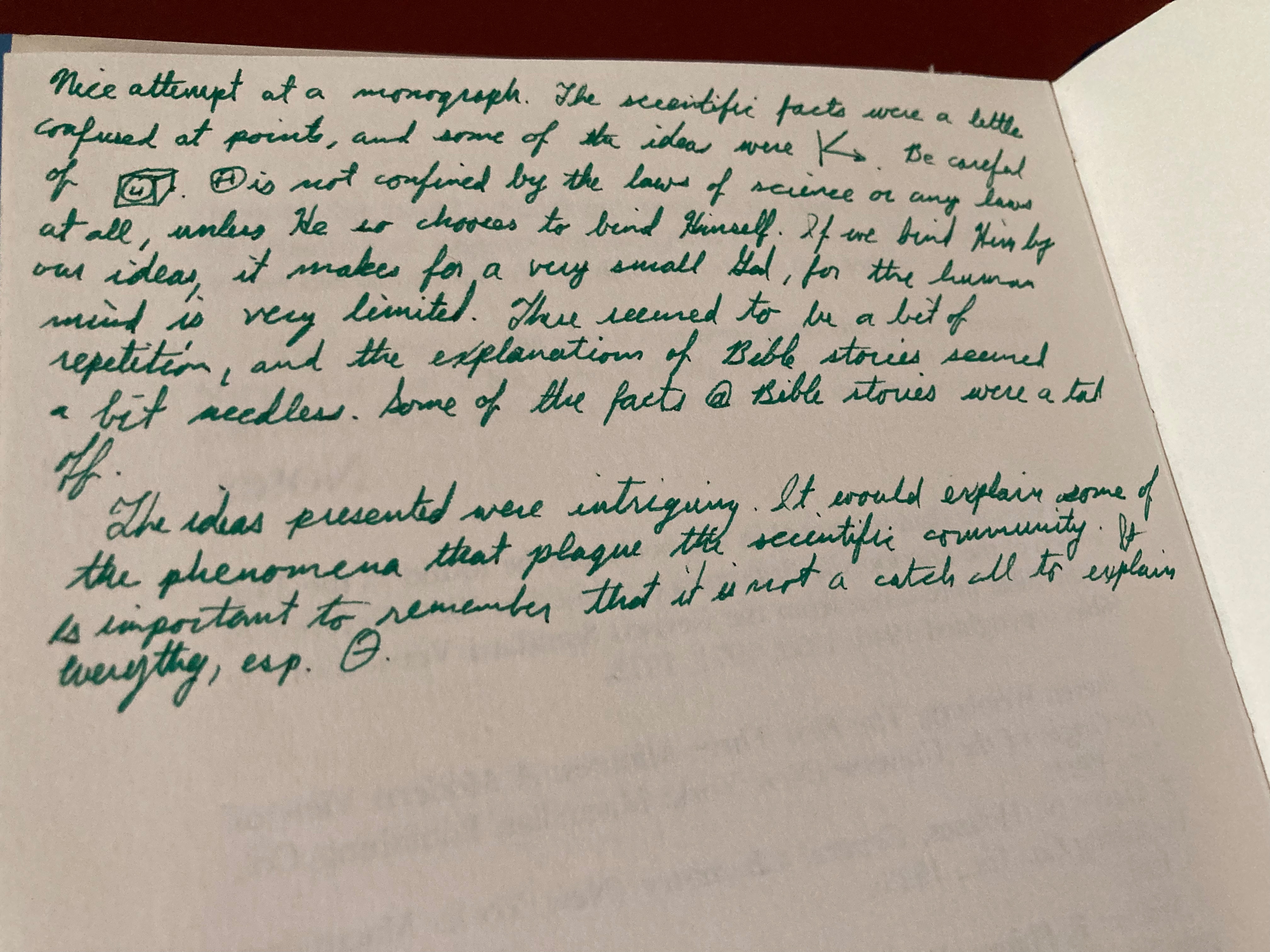
A note to myself (perhaps the best title for this blog) in a forgotten book.  Well, not exactly forgotten, else the post unwritten would remain.  In a book I’d been gifted at twenty-one.  I was working that summer as an intern in a church in Pittsburgh where my duties included visiting parishioners.  One of them was an elderly scientist that everyone mentioned with awe because he’d written a book.  In the eighties, writing a book still meant something.  He gave me a copy.  I could tell, even at that tender age, that the publisher was a vanity press.  Part of the satisfaction of “traditional” publishing is knowing that you’ve convinced at least a handful of people that your writing is worth publishing.  Vanity presses take your money and produce your words with wanton abandon.  Still, I read the book.

This was during those heady college years when I annotated everything.  So many books later, annotation is rare for me now.  Other people will want these books when I’m gone.  Then, I critiqued as well.  You see, the scientist (with a master’s degree) had undertaken a theological topic, trying to explain God with science.  I’m sure he died long ago and now knows more than I.  Still I had to express myself.  That’s what those of us who write do.  Here’s an image of my summary.  It took me a while to figure out the symbols the younger me made up.  One looks like a capital K with the lower diagonal ending in an arrow.  What did that mean four decades ago?  Context gave me the answer: “off the wall.”  Why not write it out?  Perhaps I was afraid someone would find the note to myself.  This is the danger of writing things down.

Another symbol gave me pause.  A circle with a stretched capital H in it within a cube.  Ah, a capital theta, my usual shorthand for God.  In a box.  I flipped through the pages.  Yes, some of his suggestions definitely put God in a box.  Did I ever discuss this book with anyone?  It occurs to me that since my teaching career tanked, I’ve discussed very few of the books I’ve read with anyone, except readers of this blog.  We who write know there’s always the danger that someone else will read our thoughts.  In my experience, putting them in book form is about the best way to ensure that nobody will.  Still, for anybody who’s written a book, if you google them, their tome will be the first thing that shows up.  That’s true of the scientist who died, I’m pretty sure, before the new millennium.  When, as it turned out, that writing a book would become as common as starting a website with a catchy title.


Books Left out

I’m still working on my bibliography of this blog.  It’s going to take some time yet to finish it.  One of the things that has surprised me already, though, is the number of books I read but didn’t discuss here.  In the first five-plus years of this blog I tried to tie every post in to religion.  A friend had told me that staying on topic would get me more readers and I think he was right.  I now discuss many subjects and my readership has fallen off.  But my writing in general has moved away from all religion all the time.  The real loss, however, is that many very interesting books didn’t get discussed here.  Were I to want to do so I’d have to go back and re-read them.  And I don’t have time for the reading of the books required for my current book project.

Books have defined my life since I got past that stage of eating candy and running around to burn off the energy.  I began early with the Bible but started reading seriously when I was a tween.  And I haven’t stopped.  My bibliography, and this is just a guess, has about 600 books on it so far.  These are books that I’ve discussed on this blog.  Goodreads shows me I read far more than that since 2013 (this blog began four years earlier than that).  I don’t regret being a bookworm.  The neighbors might be out mowing the grass, but I’m behind a book living in a different world.  Maybe for a future project I’ll take the books from Goodreads that didn’t make it to the blog and give them their own post.  It might cause red cheeks because I remember that some of them I didn’t post on because I was embarrassed for having read them.

You see, to publish fiction you’re often told to read books from the independent publishing houses to which you’re pitching.  That accounts for several of the no shows.  Early in my blogging life I avoided posting on the paranormal (I like weird things—they help with writing), those books didn’t show up here either.  Others simply weren’t religiony enough.  Or I couldn’t think of anything to say about them.  Still, it might be interesting sometime.  Goodreads has my list at over 1,100 books at the moment.  I’ll be curious to see how many have shown up here.  I was in my late forties in 2009, when this blog began.  I’d been reading for some three decades before that.  How many books?  Well, the bibliography won’t be half the story.


Cool Summer

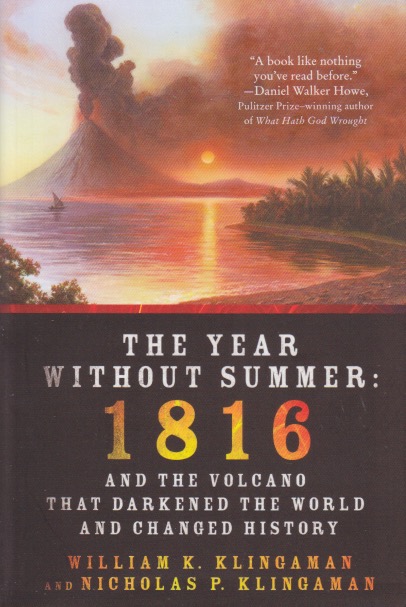
Daily readers may recognize the cover of this book.  Some time back I posted on a misprinted book I’d received from Amazon.  It was the first time I had to return something to the retail giant in exchange for the book I’d actually ordered.  Although the volume itself  doesn’t say, I suspect William K. and Nicholas P. Klingaman, the authors, are kin.  (Some publishers make a big deal of such things.)  Regardless, I was reading for content.  It was strange reading this during a May when temperatures have generally been running about 1816-average levels below normal (mean temperatures can be deceiving).  It was also a good reminder how erratic weather can be and how dependent we are upon it.  So, basically, the volcano known as Tambora had a massive eruption—the largest during human recorded history—in 1815.  The ash in the atmosphere contributed to a year (1816) with cold temperatures that in many places devastated agriculture and led to widespread starvation.

The Year Without Summer is an interesting book, even if overwritten (which could be a function of having two authors, each with a lot to say.  One is a meteorologist and the other an historian.  And historians, especially, tend to write long.  That’s partially because so many interesting connections can be made.  Certain things happened because precipitating events owed their existence to a volcano.  There were several points, however, where I said to myself, wait, now, what does this have to do with the weather?  All authors (including yours truly) are selective and tend to focus on what they find interesting.  Detours are permitted.

The combination of meteorology and history was very interesting in its own right.  The weather is something we talk and perhaps think a lot about, but to which we tend not to ascribe too much ultimate importance.  The many, many pages of loss, despair, and death that make up this book should belie that understanding.  The weather is vitally important for our entire way of life.  We often take food for granted, but it’s anything but.  Many of those who starved to death in 1816 did so because they couldn’t afford food.  It was sometimes available, but at princely prices.  Many otherwise law-abiding citizens opted for riots and many governments didn’t see it as their responsibility to care for the people they governed (that still happens in capitalism).  This book, a bit overwritten, is nevertheless full of interesting information and creates some weighty thoughts.  If a Tambora-level eruption were to take place today, we’d see capitalism on display with all of its very ugly teeth.


Walking Sleep

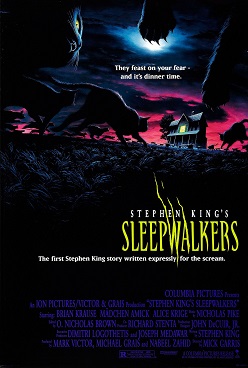
It has been suggested to me that I might try screenwriting.  I’ve always resisted this, even though some of my fiction may be movie-worthy (one editor told me it was, but then I have a huge stack of rejections from others).  In any case, I had high hopes for Sleepwalkers.  I’d never heard of it before, but I saw that it was Stephen King’s screenwriting debut.  Not all novelists can, or should be screenwriters.  I like King’s novels.  The only one that really didn’t wow me was The Tommyknockers, and even it was well written.  This movie struggles.  Part of the reason is, undoubtedly, that directors depart from the script sometimes.  And the budget doesn’t seem to pay off its estimated 15 million.  For one thing, it’s set in Indiana but the scenery is clearly, clearly California.  They didn’t even try to make this look like the Midwest.  And the acting isn’t great.  The little jokes fall flat.  Something’s wrong in Kansas.

The story seems promising enough.  Sleepwalkers are shapeshifting cat people.  They’re also psychic vampires, drawing their energy from virginal girls.  So far so good.  Then it gets weird.  They transfer energy to each other through incest.  And they can turn invisible.  And turn cars invisible, even at a distance.  They’re super strong and can survive gunshots.  You can kill one by poking its eyes out, however.  And cats are their natural enemies, setting them on fire if they scratch them.  Slow down—there’s too much going on!  And there’s a quasi-comedic tone that prevents this movie from ever really feeling like a Stephen King novel.

A couple of things: those of us who write horror often find humor in our stories.  Sometimes we just can’t avoid it.  And the other thing is writers are often typecast.  For example, we think of Edgar Allan Poe as a horror writer because his best known stories are the scary ones.  Poe wrote funny, however.  And what we’d call, for lack of a better word, literary fiction.  Writers write.  Other people categorize.  In the case of Sleepwalkers, however, it does seem that it was intended as (it was certainly advertised as) horror.  And it has horror moments.  It also has quite a bit of sympathy for the monsters, which isn’t a bad thing.  Predators have to feed—that’s the way of nature.  The sleepwalkers are, to all outward appearances, human.  And they have human emotions.  Stephen King’s first screenplay wasn’t his best work, but we all have to start somewhere.


Dr. 2 P 2

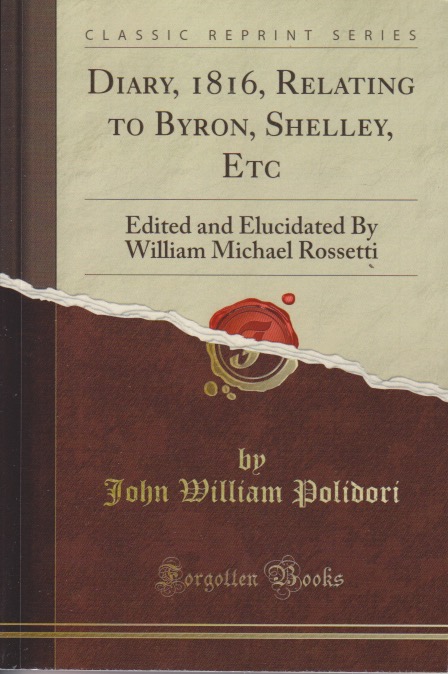
Before reading Lord Byron’s Doctor by Paul West, I started reading John William Polidori’s diary.   This is freely available online, but I need a book in my hands to truly read.  A little backstory: before his trip to Switzerland in 1816 with Lord Byron, the poet’s publisher paid Polidori to write this diary.  After Polidori died by suicide, his sister edited out what she thought reflected badly on the family, and destroyed the original.  The diary was published in 1911, edited by Polidori’s nephew William Michael Rossetti.  The edition I read was a reprint by Forgotten Books, containing the University of Toronto’s Library’s edition for scanning.  While not the most exciting reading, it is revealing.  Polidori appreciated the finer things in life (he qualified as a medical doctor), but he sometimes missed the point.  For example, being paid to write about Byron’s travels, his mentions of Bryon are relatively few.

You get the real sense that Polidori was jealous of the Lord with whom he traveled.  Then, when Percy Bysshe Shelley and his party arrived in the neighborhood, it becomes clear that Polidori was jealous of Byron’s attention to Shelley.  I sympathize with the author; both Byron and Shelley were already famous and infamous for their writing and lifestyles.  Both were from aristocratic families and had no profession other than writing and traveling.  For Polidori this was a working trip.  His mood seems to be reflected in that, just after the famous ghost story contest, entries begin to focus mostly outside the gathered writers until they stop altogether.  Much of the summer is left blank.  In September Byron sent Polidori packing, and the remainder of the diary is about his, often penurious, travels through his ancestral Italy.

Polidori is now known as the author of “The Vampyre,” which he wrote during the period covered in the diary.  He doesn’t talk about it much.  For me, Polidori is a sympathetic figure.  A lonely man, he was intimate with the most famous English poet of his day.  He often, however, in his own accounts, wasn’t in control of his emotions, particularly when he felt he’d been slighted.  Jealousy can be a very difficult monster with which to wrestle.  But reading this diary does lead to the uncanny sense that the most interesting parts were the things he didn’t discuss.  The diary has been used as the basis of more than one fictional treatment of the events of the summer of 1816.  And since some of the juicy bits are left out, free rein is given to the imagination.


Rabbit Holes

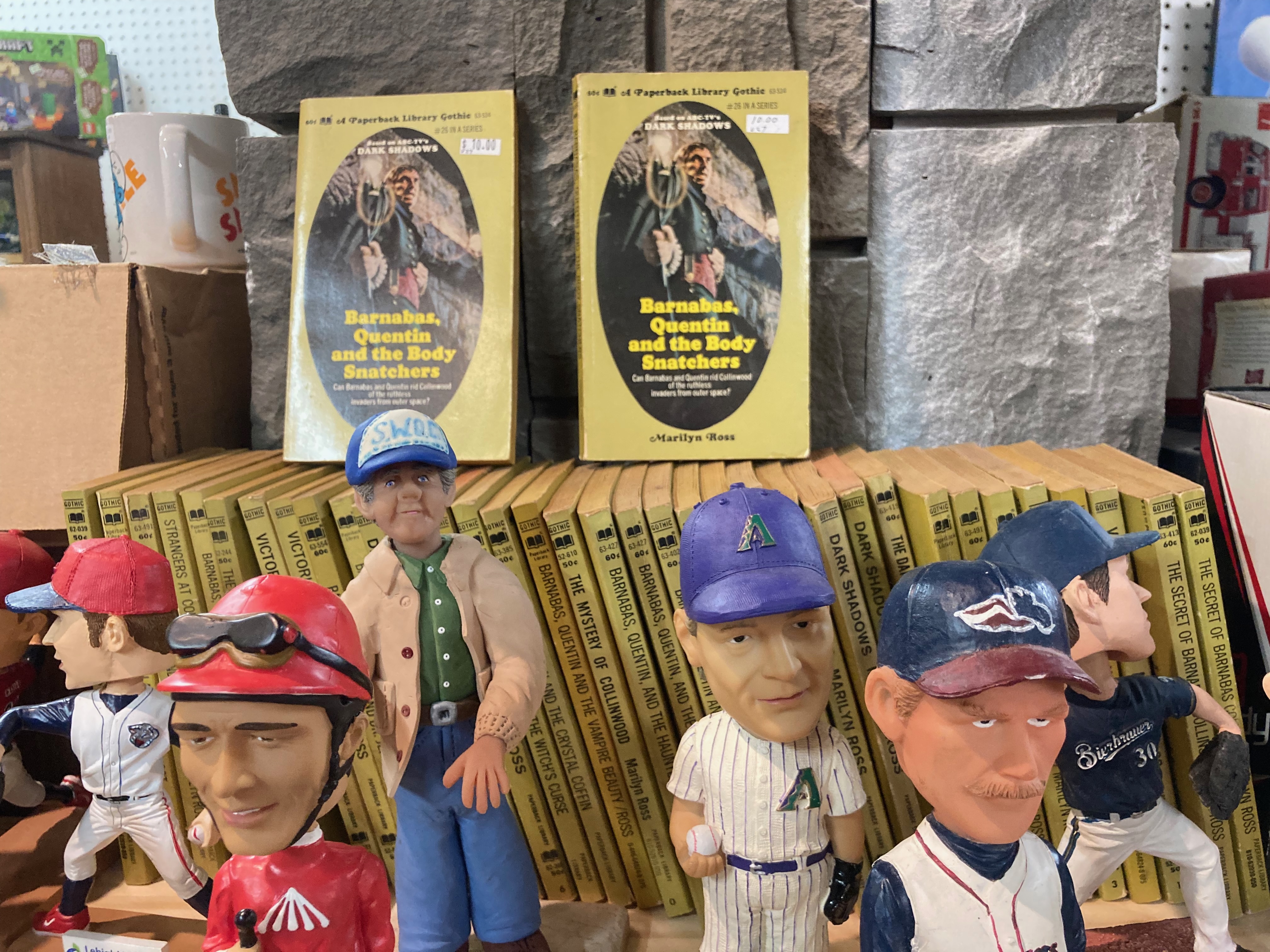
Rabbit holes are my favorite part of the internet.  They can be used for heavy-duty research, but in my case they’re mostly just fun.  I’ve written about Dark Shadows many, many times on this blog.  Although I did watch many episodes of the original run with my brothers, my memories of the story line tend to come from the concurrent series of pulp fiction books by Marilyn Ross.  These books, which I have only ever seen used, were distinguished by their olive green covers and an oval cutout on the front where an image from the television series, sometimes apparently selected at random, was shown.  There were a total of 32 of them and, as an adult I collected them all.  Some months ago I wrote about my delight at finding several of them, in very good condition, at an antique and curio shop not far from us.  Recently in that shop again, I looked over the titles and discovered one that wasn’t in the series but was in the larger series, Paperback Library Gothic.

I’d never really given much thought to it, but the book was in great shape and was riffing off the Dark Shadows series.  It was reasonably priced, so how could I not?  Excited as a schoolboy coming home in time to catch the series on TV, I looked up the series online and fell down a rabbit hole.  There was an entire series in the mass market paperback format that I adore, from the sixties and seventies.  Shy of writing a bestseller myself, I’d never be able to afford them all.  The series included some classic titles out of copyright by such authors as Ann Radcliffe, Jane Austin, Bram Stoker, and Wilkie Collins (no relationship to Barnabas).  To these they added contemporary gothic titles including several by W. E. D. Ross, writing under the pseudonym Marilyn.  These were pre-Dark Shadows books.  There were well over a hundred of them.

Paperback Library was an independent New York City publisher founded either in 1960 or 1961, capitalizing on the pulp fiction and mass market paperback models.  They were bought out by Warner in 1970.  Warner eventually became Grand Central Publishing—still in New York.  In the large conglomerations that brought us down to only five major publishing houses in English, Grand Central was acquired by Hachette, one of said big five.  Recently the main distributor of mass market paperbacks decided it would no longer handle that format, essentially dooming it.  And with it a piece of my childhood.  Thankfully there are still some rabbit holes to fall down.


Hopeful Reading

Although I prefer independent bookstores, I happened to find myself in a Barnes & Noble between other activities on a recent weekend.  This ended up being good for my spirits, although I didn’t buy anything.  The reason was, perhaps, ageist of me, that I was buoyed up by seeing so many young adults there buying books.  Granted, it was a cold, gray Sunday afternoon, but I read so much about the death of reading that this particular trip gave a bit of balance to all the doomsayers.  There is still a reading public.  And many of them are a good bit younger than yours truly.  I do wish more people my age would spend time in bookstores as well, but the future is with those who know to put down their devices and pick up actual books.

I’ve had more than one academic tell me that they do not assign e-reading for their classes.  One of them was a decade or two younger than me.  The reason?  Students don’t retain well what they read on a screen.  I tend to agree with this.  The context of setting aside time to open a book with no interruptions from texts, emails, or social media, is sacred.  You shut out the world and concentrate.  I try to do this for an hour each day (most days more than an hour) and it has to be done with print books.  I have no great love of electronic “books.”  The experience is sterile.  Devoid of true engagement.  And I’ve even been forced to read ebooks with other people’s highlights left behind.  When I buy a used book I try to make certain it’s an unmarked copy (although some sellers don’t look very carefully).  Why would I want an ebook with somebody else’s notes?

The visit to a bookstore is a restorative one.  In the rare instance where I know the proprietor, it becomes a social visit as well as a financial transaction.  Books are a kind of currency among some of us.  Although I know none of the names of the young people that I saw at Barnes & Noble, I do know something about them.  They enjoy books.  That is one of the most hopeful thoughts I can have.  As long as we manage to survive as a species, there is hope for the future if young people are interested in books.  Reading is a mind-expanding exercise.  Our life together is so much more enriching when we invite others in.  And some of them we meet between the covers of books.


Academic Reading

There is an art to writing biographies.  In the course of my training myself to write on literary horror, I’ve read a number of them.  Those written by literary scholars tend to veer into literary analysis, derailing the narrative.  Academic writing encourages such things, whereas the reader simply itches with boredom until the author gets back to more interesting things, like who the subject met, or what s/he did.  This is a shame, really, since I’ve read many books that could’ve been made much better by leaving the academese out of it.  Scholars far more brilliant than me have argued this for years.  I find it particularly ironic among English professors.  When they write biographies of literary figures, look out.  Obfuscation being mistaken for erudition is the order of the day.  Why do we teach those who study literary expression to make their own writing so turgid?

I know!  I know!  “If you can do better, you’re welcome to try.”  But I’m only after information.  If I’m reading a biography of a writer I don’t want her or his literary output analyzed.  I want to know about their life.  What made them tick.  Chances are, I can read what they wrote for myself and I don’t need anyone to tell me how to do that.  As an editor, I see a lot of academese.  My face falls when I do.  This stuff is so dull that only a true specialist would appreciate it.  Of course, I grew up in an uneducated family and I valued teachers who were good at explaining things.  There’s plenty I don’t understand (i.e., I can’t do it better myself), and I read to try to comprehend.  It reminds me of that witty academic bumper sticker I see from time to time in university towns: eschew obfuscation.

Is it really so difficult to write well?  I suspect some of the less accomplished biographies I read are in reality revised dissertations.  Dissertations are written for a committee, and rare are those that can be read by general readers with any appreciation.  But then, there are so many interesting people in the world who deserve biographies who’ve never been discovered.  The one who realizes this is often the doctoral student and when they begin to write up their findings, they bury this interesting person again under so much unnecessary verbiage that they continue to remain obscure.  Perhaps there’s a reason I was never really welcomed into the academy.  I am, perhaps, too easy to understand.


Substitutes

I discovered Mary Roach in a Borders store in Somerville, New Jersey.  Well, it might’ve been Raritan, technically, but it was right off the infamous Somerville Circle.  We were fairly new in town and I was looking for reading material.  I found Spook, her second book.  I enjoyed it so much I went back for her first book.  I introduced my wife to her third book and, starting with book number four, we’ve been reading them together.  (All of her books are at least mentioned on this blog; I rarely follow an author like that.) That brings us to Replaceable You, which published last year.  The subtitle, Adventures in Human Anatomy, gives you an idea of the content.  Roach is a charming science writer.  The two traits don’t often meet.  She peers at things that most of us shy away from, which, in a way, makes her a good potential horror writer.  Instead, she looks at her subjects with humor, often self-deprecating, and a sense of wonder.

Replaceable You isn’t my favorite of her books, but it’s not her fault.  Roach is about four years older than me and she too is facing aging.  This book is about parts of bodies that can be replaced, printed, or engineered.  Some of it is surprising and much of it almost incredible.  The reason that it isn’t my favorite is that it hits pretty close to home.  Two of my immediate family members have chronic health conditions.  (Life, of course, is a chronic health condition.)  I often think about the implications, but reading about them makes me uncomfortable.  As one reviewer once indicated, though, reading Mary Roach on any subject is enjoyable.

We are embodied creatures.  This is one reason that “artificial intelligence” will always retain the emphasis on the first word.  One of the surprising things I learned from this book was that organs/tissues are now starting to be 3-D printed.  Last time I looked, 3-D printing involved plastic, but in some places biological components are being used.  The tech isn’t far enough along to print actual organs yet, but there is incredible work being done.  It’s quite possible, and this is me, not Roach, that people born in a couple of decades (depending on whether we can get Republicans out of the White House, and science funding can be restored) may well be able to have biologically personalized health care that includes new organs made from their own cells.  That gets too close to eternity for my liking.  I enjoy living, but wouldn’t want to do it forever.  I’ll be okay along the way, however, as long as there are Mary Roach books to read.


Crafting Byron

For a man who lived to be only thirty-six, Lord Byron tends to be featured in very long biographies.  I’ve been curious about him, but maybe not to the tune of 500-plus pages.  I’d seen references to Elbert Hubbard’s Little Journeys to the Homes of English Authors: Lord Byron, and since it was only a handful of pages, and not very expensive, I got a copy.  As a biography it turned out to be exceedingly slim.  And written with a flowery prose.  In fact, you could read this easily in a day.  I did learn about about Lord Byron, but in this instance the author took precedence over the subject.  I knew nothing of Elbert Hubbard.  A free-thinker of the turn of the twentieth century, he was born in Illinois in 1856.  He was a successful traveling salesman but then started a commune called Roycroft outside Buffalo, New York.

The Roycrofters were crafters and artists living together and producing, in some cases influential, artworks.  The community operated from 1895 to 1938.  The buildings, which survive, are now National Historic Landmarks.  Elbert Hubbard was a philosopher and artist, as well as a socialist and anarchist.  It’s not surprising he took a liking to Lord Byron.  One of the crafting supplies at Roycroft was a printing press.  Hubbard published a series of Little Journeys, some sumptuously bound, others with paper covers, and, from experience, uncut pages.  Lord Byron was volume seven, published in 1900.  Roycroft continued for the remainder of Hubbard’s life, and a little beyond.  Hubbard and his second wife died in the sinking of the Lusitania during World War One.  His son kept the community going for another couple of decades.

American history is filled with colorful and creative individuals.  All I knew of Elbert Hubbard was that he wrote a reasonably short treatment of the life of Lord Byron.  Reading it I learned a bit about the other intensely curious and talented writer who’d died just over thirty years before before Hubbard was born.  Byron was then still alive in memory for many.  It turns out that both subject and author lived extraordinary lives.  And each, in their own way, influenced larger society.  And now, having read this small book, I’m inclined to plan a trip to East Aurora, outside Buffalo, to see the settlement of the Roycrofters.  That’s not a bad thing to come from a brief book, not expensive, to read about a poet.


Reclaiming the Past

It started after Nashotah House.  That event shook me to my very core.  And I was approaching middle age.  I started taking an interest in my childhood.  I learned some uncomfortable truths that probably help explain the way that I am, but more tangibly, losing that job launched me back to both monster movies and the earnest need to collect books that I’d given up when I went to college to “grow up.”  Fortunately (perhaps) the internet had been invented and it was possible to locate used copies from the seventies.  I’ve written many times about the Dark Shadows books that I began collecting shortly after the incident in Delafield.  But there were others.  Many others.  Often it became a matter of identifying and finding the same edition that I’d had as a child.  (Modern reprints complicate this, but with enough patience the exact book editions can be found, and usually no more expensive than  contemporary bookstore prices.

The goal has never been to replace all of my childhood books, but those that evoked a palpable sense of wonder in my young psyche.  This was strange because I was very religious and these books sometimes challenged what my fundamentalist upbringing taught.  Some years back I had to find the exact edition of Erich van Däniken’s Chariots of the Gods? that I had.  The curiosity did not extend to several of his other books from the seventies.  I got rid of these because they caused me to question my faith.  Teenagers.  In any case, I also had a compulsion to replace a book of Twilight Zone adaptations.  The cover of that book still sends me back to Rouseville.  Then I had a hankering to reread Logan’s Run.  It’d been reprinted many times, and the one I had as a kid was itself a reprint.  I needed that exact one.

My wife has been very patient with me.  I’m seeking something here.  I’ve always been haunted by the truth and there is a nagging feeling that I had grasped, only by the very tips of my fingers, a little bit of it before college.  Facing higher education (the first in my family to do so), I felt I needed to “put away childish things.”  The library that sustained me through those difficult Rouseville years was scuttled.  There’s a saying about babies and bathwater.  I’m beginning to think there may be something to it.  There were some very dark incidents in my early childhood, before I learned to read.  I think of them often.  And yet, a sense of wonder remains.  Mostly in the escapism of  old, mass market paperbacks from the seventies.


Confidential Hazing

Set in a Long Island prep school, among a somewhat secret society called the Players, this is a dark academia tale of murder and discovery.  The Players, usually numbering eight in the senior class at Gold Coast Prep, are down to six.  One of their number was murdered and the one who confessed to that murder has been jailed.  Most of the students are extremely wealthy, but Jill Newman isn’t really rich.  This is what lies behind They Wish They Were Us by Jessica Goodman.  Although technically a young adult novel there are several disturbing elements here, some worthy of Lord of the Flies.  For that we need to dig a bit deeper.  To become a member of the Players, hazing is involved.  Since this isn’t an official program of the school, the hazing is entirely controlled by the seniors who are Players, to initiate their underclassmen into the club.

Some of the hazing is pretty intense, even for an adult reading the novel.  Kids aren’t always good about thinking through the consequences of traumatic activities on other kids.  People tend to be resilient, but at the same time scars heal in different ways.  In the course of one of the hazing tasks, something goes wrong and one of Jill’s friends, her best friend, ends up dead.  Since there’s a lot of drinking and drugs involved, it isn’t always easy to piece together what might’ve happened.  The crisis occurs for Jill when her younger brother joins the Players.  She has to watch him face the hazing, and at the same time comes to have suspicions about what really happened to her best friend.  Things get pretty tense.

As adults we can easily place ourselves, in our minds, back to our teenage years.  This is something that we didn’t appreciate as teens, and even now most teens don’t realize this about adults.  Wisdom, hopefully, comes with age.  In this fictional setting, rich adults are seldom around.  Their kids, with access to nearly unlimited money, can set their own rules.  Even the police treat them differently.  I’m deliberately not saying too much about the story since it would be too easy to give away the ending.  The school officials in the book care more about preserving the reputation of Gold Coast Prep than they do about the welfare of their students, even if this leads to blackmail to maintain its good name.  And this is something that teens will come to understand only once they start to work for a company with its own secrets.


Uncut

I remember well the first time I encountered a book with uncut pages.  It was in Edinburgh and the book was mine on inter-library loan.  This presented a dilemma: should I, a mere post-graduate student, cut the pages of a book older than me?  The librarian told me it was fine to do so.  I wasn’t sure how to go about it.  I’ve never trusted myself with scissors and this seemed like such a permanent act I was about to commit.  I settled on a butter knife, figuring a sharp knife might cut into the meat of the page.  It worked fairly well.  I later bought a book with uncut pages.  I didn’t do so well on it, but I need to read what was inside (and it wasn’t a cheap book).  

This is more common in Europe than it is in the United States.  I recently bought an out of print book for my research.  The pages were uncut.  Now we have the internet which can be useful from time to time.  The proper technique, it turns out, is to use an index card with a saw-like motion.  It works extremely well.  Fighting paper with paper.  And I love these old books.  The heavy paper.  The actual, clear imprint of where the type hit the page.  This was an object being crafted, not electrons cycling around a screen.  When it was done you were left with something that felt permanent.  Something that wouldn’t disappear when an online vendor went out of business.  These old books also give you an idea of how they were made.  Offset books (those made on a traditional printing press) are printed on paper that is then folded and bound together.  Most modern presses also trim the edges, but you can, on rare occasions, still see where metal met paper.

Substantial.  These books feel substantial.  Don’t get me wrong—I enjoy the trim, clean look of the modern book, but part of me misses the solidity of old fashioned books.  As much as I enjoy visiting new bookstores, I also like used bookstores.  There used to be several around here, but I think the pandemic killed them off.  You can browse their inventory online, but it’s not the same experience as that dusty, musty smell of books aging well.  Now that mass-market paperbacks are being discontinued, they have their own place of pride as being the books that brought reading to the masses.  Now people stare at screens and call it reading.  I, for one, will be keeping my index cards handy for the next book with uncut pages that comes my way.


Leaving Soon

I’d been hoping to read the novel before seeing the movie, but there’s nothing like the words “leaving soon” on your streaming service to spur you into action.  So I watched Misery before I was ready to.  I remember the newspaper reviews from 1987, when the novel came out.  I didn’t read any Stephen King novels until those I’ve posted about on this blog.  There’s a full record here!  I do remember the reviews saying it was self-referential.  The protagonist, as in The Shining (is Jack Torrence a protagonist?), is a writer.  And the book is a writer’s nightmare.  When the movie came out in 1990, I had no interest in seeing it.  A couple of things changed my mind, however.  First of all, it is referenced all the time.  I didn’t even know how it ended.  Another factor was that it was a Rob Reiner horror movie.  And Reiner himself had been murdered a few weeks before I sat down to watch it.

I really wanted to read the novel first.  My reading pile is pretty high.  And currently the next Stephen King novel on it is The Dead Zone.  And yes, I have already seen the movie.  Unlike some critics, I think King is a substantial writer.  He has profound things to say, especially about religion.  And, of course, the movie Misery has plenty of that.  Annie Wilkes is a religious fanatic.  She’s also a fan of Paul Sheldon (the writer).  God tells her things.  She wears a cross.  She can’t stand swearing.  But even so, I wonder if King clearly had her religion in mind.  I would’ve guessed that, given her cinematic profile, she would’ve not been a wine drinker.  And I would’ve guessed that the Bible would appear in the movie.  She drinks and she doesn’t even quote the Good Book—at least not that I caught.

Some day, if I keep doing this long enough, I might make the connection between religion and horror plain.  I know scholars, not shackled by a 9-2-5 are working on that.  And like the books I have to read, there’s a waiting list for those I want to write.  One has my particular attention at this point, and I’ll be trying to put that to bed before starting on a new one.  Before working on such a book I’ll have to read Misery, the novel.  I do plan to do so.  I’m not a fast reader and I have quite a big stack.  In fact, I wouldn’t even be thinking about reading it now.  But my streaming service came up with those fatal words, “leaving soon.”