
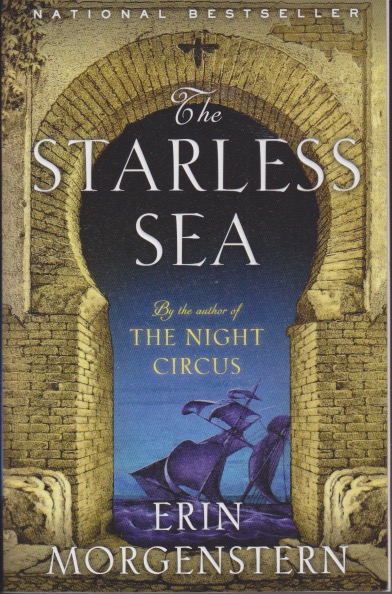
Having really enjoyed Erin Morgenstern’s The Night Circus, I was looking forward to The Starless Sea, despite its nearly 600 pages. I don’t mind getting lost in a book; in fact it’s one of life’s true and simple joys. The Starless Sea came to my attention as a dark academia book. The story is a good one, but in my uninformed opinion, a bit too long. The fault is my own, I’m sure. My sensitivity to high fantasy has reached a point where swords tend to put me off. And some bits, particularly in book V were a bit confusing. Still, Morgenstern’s writing is beautiful, and at some points sublime. If it’d been a bit shorter I’d probably be gushing. Instead I’m reflectively admiring. As a sometime writer myself, I know that you write what you write and others may not get it. That’s life.
The story generally follows grad student Zachary Ezra Rawlins as he finds a book from a library of a world that’s beneath the ground. A world that includes a harbor on the Starless Sea. That world is inhabited by the surviving members of a decaying society made up of stories. Most members of this world (and it’s difficult not to see this as an allegory) have left for the world above (this world). Access between the two worlds is through doors. Sometimes real doors, other times doors painted on a wall. Zachary finally goes through one, having not tried one outside his house when he was just a boy. He’s not sure if he wants to stay in the Starless Sea world or not, but he gets roped into the story.
Many other characters, at varying levels of the story within a story get involved, of course. He meets his true love, and one of the undergrads he taught gets interested in his fate, and the denizens of the world below are intriguing characters in their own right. Despite the length of the book, there are still plenty of gaps left for the readers to fill in for themselves. Again, my own limitations prefer to have not too many gaps because I get confused. The story tips a hat to several of its influences explicitly, and in many ways reminded me of Susanna Clarke’s Piranesi. With its grad school protagonist, lots of libraries, and even a secret society, this fantasy is a card-carrying dark academia novel. The genre encompasses may differing books and styles. And I’m glad to have read this one as part of my own quest in that genre. It was a sustained escape from life in the upper world.

