Re-Telling Poe

Retelling stories is a very old tradition.  Fiction writers often do it.  Some even argue there are no new stories (I tend to disagree with that).  In any case, T. Kingfisher decided to try retelling my favorite short story, Edgar Allan Poe’s, “The Fall of the House of Usher.”  What Moves the Dead has Roderick and Madeline Usher and their creepy house but the story revolves around the narrator, Easton.  (There’s a helpful author’s note at the end that discusses this.)  As Kingfisher notes, the narrative warps around fully-formed new characters and the question is whether that works or not.  Anyone who’s spent much time on this blog will know that I’m a diehard Poe fan.  It takes a lot to convince me that anyone has done him justice.  What Moves the Dead is a quick read, but perhaps unsurprisingly I had trouble accepting Easton as the interloper to the story.  

One of the most compelling aspects of Poe’s tale is the point of view of his unnamed narrator.  He expresses his horror at what happens but manages to keep himself out of the spotlight.  Easton intrudes a bit too much in the narrative.  And other characters also tend to overshadow the Ushers.  The main thing that is missing, however, is Poe’s unity of effect.  There is a dread running throughout Poe’s “Usher,” and analysts have suggested that every detail of the story is relevant.  There’s a reason it’s my favorite short story—it is just so good!  So good that the few times I’ve ridden on a horse in my life, the first thought that always comes to mind is the opening of Poe’s story.

If you’re looking for a quick horror book to read, which has a bit of humor to it, What Moves the Dead isn’t bad.  Kingfisher is a talented writer and her characters are creative.  It’s just that they muddy the waters, as it were, of Poe’s masterpiece.  Ironically, I think the story would’ve been much more compelling without the Poe tie-in.  The idea of infecting mushrooms (she also discusses this in the author’s note) can be a really compelling tactic.  In fact, it is used quite a lot in horror these days (and I completely understand Kingfisher picking up another book that does what you’re trying to do when you’re in the middle of a project—that has happened to me more than once).  For me, Poe’s story is pretty much perfect and it’s difficult to improve on perfection.


Life’s Work

It’s official.  I’ve now worked as an editor longer than I was a professor.  The latter was my chosen vocation, the former my fall-back.  I feel like I’ve tipped over a precipice.  As I’ve written before, I still think like a professor and would welcome back life in the classroom.  This came home to me in a major why when I realized that in my current position, in less than a month’s time, there will be only five people remaining in my starting department who were at my employer before I was.  At least twenty editors who were there when I started have left, most of them younger than me.  This was a world-rattling revelation.  You can’t choose your destiny.  You can do everything possible to make your plans happen, but change is constant and you have to make do.  None of this changes my mind, however.  A life has a calling, fulfilled or not.

I’m very grateful for all that I’ve learned about publishing, even if there’s still so much to learn.  As a young person I knew that writing would be part of my life.  I didn’t know what form it would take, and I guess I still don’t.  I’ve been getting positive signals from a publisher about a novel I completed thirteen years ago.  I’m doing my last set of edits on a very different novel that I finished initially last year.  I’ve made good progress on my seventh nonfiction book.  And there are many shorter projects in hand as well.

I was reading a book the other day where I was cited.  This got me to thinking about the concept of “life’s work.”  For some of us that’s measured in words.  I have no idea how many academic books cite me.  There’s software to measure such things, but it doesn’t capture every publication and I’m not that deluded that I’d spend much time checking on it.  Still, I do wonder if my life’s work (which is generally measured in written form) has made any difference at all.  I post thoughts here daily and they cover disparate topics.  (I had a record five “likes” recently for a post on the Bible.  Sometimes posts on monsters near that record.  Just sayin’.)  Academics tend not to cite blogs.  This one is, believe it or not, research-based.  That’s why I’m working on a bibliography.  When I’m dead and gone, and the auto-renew on this blog runs out, a good chunk of my life’s work will be archived away somewhere until electronic media cease to exist.  But one thing seems certain, most of the mentions I will have in print will be in the form of acknowledgements from having been an editor.


Rumblings

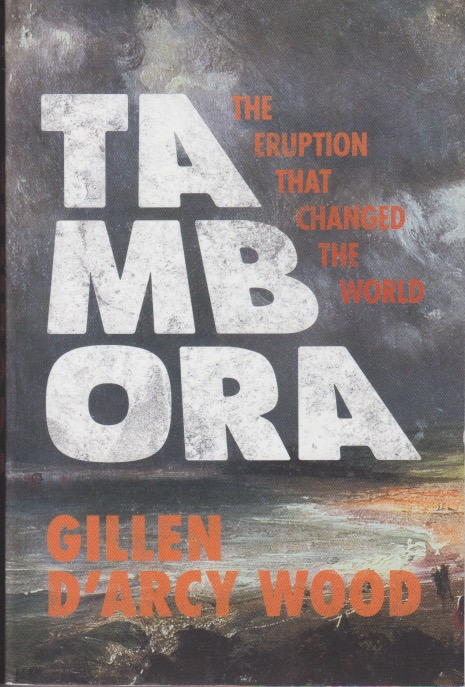
Despite the many books on Tambora, it surprisingly gets little press.  Of the volumes on the volcano I’ve read, Gillen D’Arcy Wood’s Tambora has been the best.  He, like many others, makes a case for the world-changing impact of that eruption that led to “the year without a summer” in 1816.  Knock-on effects remain with us to this day.  Wood also throws in a good bit of concern about our current climate crisis.  As he points out, the volcanic aerosols of Tambora remained in the stratosphere for three years (leading to three chilly summers), but our current carbon emissions, on-going, have no end in sight.  We all already know that weather has become more extreme.  As I write this, family members in Europe are experiencing 100-degree temperatures that used to be unheard of on that continent.  We’ve seen hurricanes increase in intensity, and have had our own erratic weather for a few years now.  The atmosphere’s too large for us to predict just who might receive the God-like wrath of the weather.

Wood uses Mary Shelley’s Frankenstein both as an illustration of the year without a summer and as the atmospheric monster we’ve created.  He also narrates other historical events brought on by the temporary change in climate in the eighteen-teens.  One of them was the breaking up of Arctic ice that led to the ill-fated Franklin expedition many years later.  (I was unintentionally also reading Dan Simmon’s The Terror even as I read Wood’s chapter about the expedition.)  More than that, this book describes the typhoid outbreak and pandemic that followed on from erratic weather in South Asia.  And deadly changes in parts of China.  The disaster of the breaking of the Giétro glacial ice dam, and an earlier famine in Ireland fueled by British hostility toward the Irish, as well as Tambora’s weather.

The developments that grew out of the human response to the changed climate caused by Tambora led to many institutions still with us.  Governments, slowly, of course, realized that disaster preparedness and care for the working class were necessary for any nation to remain strong.  The privileged lose said privilege when there’s nobody else left to compare it with.  (Capitalism has blood all over its hands.)  Overall, this is a provocative book making the case that the world we recognize today evolved this way largely in response to an environmental crisis that occurred before steam engines had been invented, when sails drove shipping and horses drew vehicles.  When a single volcano changed everything.  And although we should learn from such things, being what we are, we tend to overlook that largest volcanic eruption in recorded human history.


Long Winter

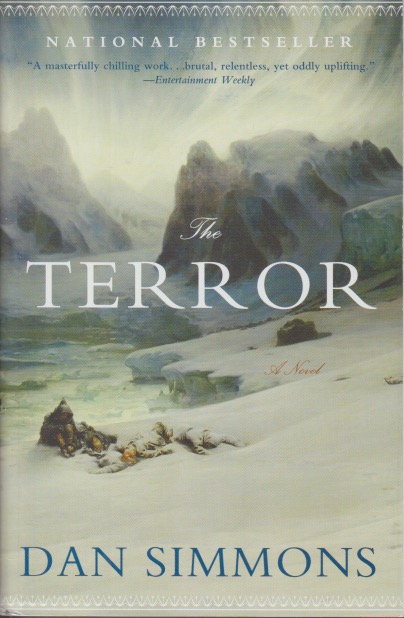
I have to confess that I often feel uncharitable towards very long books.  Mainly, I think, that is because one of my main blogging topics is books and when it takes a long time to read one I have to come up with other things to write about.  Still Dan Simmons’ The Terror had been strongly recommended.  I found it in an indy bookshop on independent bookstore day and began reading it sometime back in May.  It started out strong, but about three-hundred pages in began to feel a bit tedious and self-indulgent.  (I’ve done that myself with my fiction, so this criticism is also aimed at the one writing this reflection.)  In case you haven’t read it, the Terror of the title is HMS Terror, the ship captained by Francis Crozier under the command of Sir John Franklin, captain of HMS Erebus.  Both ships, seeking the northwest passage, froze in the Arctic ice in 1846 and their combined crews of 129 died without ever being found.

That’s a strong basis for a horror novel.  Your mind can’t help but wonder what it’d be like to be stuck in the dark, sunless winter, temperatures well below what most of us could survive, and realizing that you were never going to get out.  Simmons traces the story arcs of several of the crew that historically populated the ships.  Since there were no survivors, just about anything is fair game.  Including creating a monster to attack them.  Even as I began to warm to the book in the last hundred or so pages, it seems that some of this could’ve been trimmed and the same sprawling majesty been preserved.  Maybe I’m just jealous because none of my novels have been published and I keep being told you have to keep things short to get any traction.

In any case, by the end of the book I was really drawn in.  This was after the villain got his own, and Crozier starts to recognize the indigenous Arctic people for their truly remarkable survival skills.  (Not vegan friendly, of course, since vegetation doesn’t thrive in ice-bound conditions.)  It comes to a remarkable conclusion and I gradually found myself letting go of my petulance for having to invest so much time in one book.  I’m a slow reader with a very large pile of books yet to read.  In any case, Simmons won me back.  I quite enjoyed his Night of Summer and A Winter Haunting many years ago.  If you’re not afraid of big books, and you’d like to read about what can go wrong with a group of men trapped in the Arctic, then The Terror may be for you.


Novelization

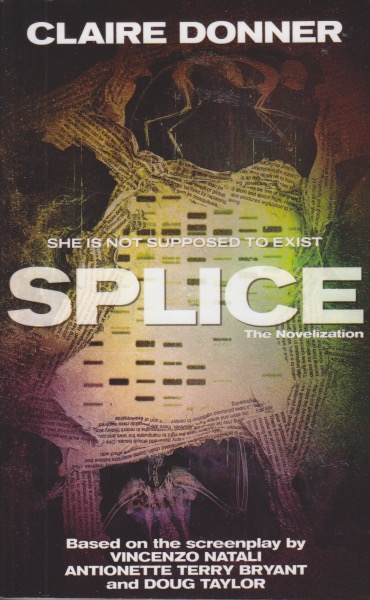
I watched the sci-fi horror film Splice a few years ago.  Long enough that I don’t recall many details.  When Claire Donner, a friend of mine from Miskatonic Institute of Horror Studies, told me she’d written a novelization of Splice, I knew I had to read it.  If you’ve seen the movie then you know the story.  If you haven’t, you can read it in her book.  I don’t often read novelizations—I read the one for Tim Burton’s Sleepy Hollow, and as a young person read the original three Star Wars novelizations.  Such books really only apply to movies not already based on a novel, of course.  They give the reader a path into the inner lives of the characters.  Naturally, now I have to watch Splice again to see it through Donner’s lens.  The basic idea, if you want some encouragement, is that a couple of scientists add some human DNA into a gene-spliced animal being lab grown for enzymes to fight disease.

In the rawest sense, this is the story of Frankenstein for a more technological crowd.  Like Frankenstein, it is a sad story.  And like said sad story, it involves reproduction without two human parents.  The real builder this time, however, is Elsa and Donner gives considerable development to her motivations and thought process.  (I’m very curious to know if I can see that in the movie or not.)  Clive, her partner, isn’t aware of the source of the human DNA.  The spliced creature grows into the passably human Dren, who finds herself asking the questions Frankenstein’s creature asked about his own existence.  Like said creature, Dren has to be hidden away, and controlled.  At the same time, she is evolutionarily superior to her maker.  There’s a lot to see here, folks!

Having written a fair bit of fiction in my time, I do wonder what it might be like to do a novelization.  I suspect most of us, if a movie is well made, decide on the motivations of characters but how often do we delve into their inner lives?  I’m not sure that I do that most of the time.  When I write fiction I do it all the time.  I want to know my characters and why they are the way they are.  Sometimes they remain mysteries to me, but that doesn’t prevent me from trying.  This novelization is deftly done, and approved by the screenwriter/director.  And the deep motivations make the scenario plausible.  If you haven’t seen Splice you might enjoy doing so.  And then read the novel.  Or the other way around.


Folk Exorcism

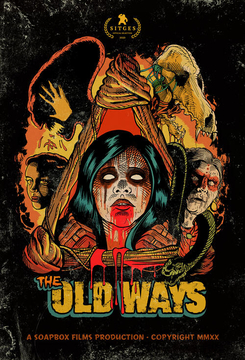
The consensus seems to be that The Old Ways is pretty good.  This folk horror, demonic possession film didn’t impress me too much, however.  The premise is good: there is a ruin in Mexico that explorers leave having been possessed.  They don’t know it.  At the same time, it seems that the possession of Cristina, the protagonist, came from her mother.   And she also visited the ruin.  Most of the movie takes place in a room where a bruja and her adult son attempt to exorcise Cristina while her cousin Miranda watches.  Things are a bit more complicated than that, however.  Cristina has returned to her hometown with the intention of dying via a heroin overdose.  Apparently the demon was luring her there to finish her soul.  In any case, it felt quite confusing to me.  

The story actually begins with Cristina finding herself held captive by a bruja named Luz.  She insists that Cristina can’t go until the demon has been destroyed.  Cristina feels fine, though, and doesn’t believe there is a demon.  Meanwhile she’s able to smuggle in her heroin and uses it at night.  But she also starts seeing what seem to be demonic entities.  She escapes but finds that she can’t cross a line of salt.  She’s forced to admit that she does have a demon and submits to a painful “old way” extraction.  Luz performs the ritual—nothing like Exorcist style—and even performs surgery on Cristina with her bare hands.  In the end, the exorcism leads to Luz’s death.  Cristina prepares to go back to Los Angeles, but then discovers the demon has taken possession of her cousin Miranda.

Becoming a bruja herself Cristina performs the ritual on her cousin.  The results are less dramatic but lead to a confrontation with a particularly nasty demon.  The cousins together are able to destroy it.  Meanwhile, Cristina’s boss has come looking for her and he too went to the ruin and has been possessed.  Cristina prepares to do another ritual, the old way.  There seems to be too much going on here and much of it is unfamiliar and therefore difficult to understand.  It is a good example of religion and horror cooperating and the use of folk methods for handling a demon felt fresh.  The eeriness of the situation is perhaps more uncanny than scary, but the biggest problem for me was that the origin of the possession kept shifting.  There is a character (a little boy) who’s not really explained, but who isn’t a good sign.  This isn’t a bad movie, but it made The Exorcist feel like old school.


Bad Boy

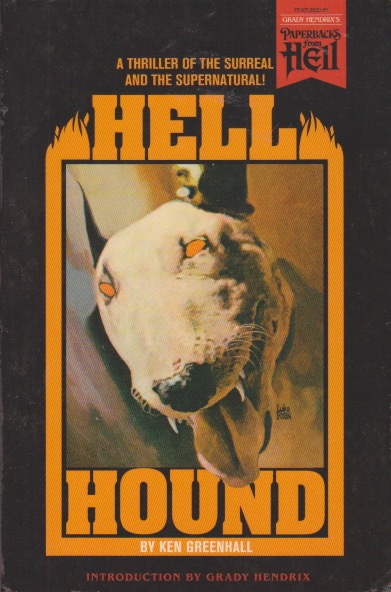
I’m still trying to figure out what I think about it.  The introduction by Grady Hendrix got me interested in the novels of Ken Greenhall.  The introduction was in Hell Hound and it described how Greenhall’s books whispered horror rather than shouted it.  That’s also true of the horror stories I write, and it’s clear I still have plenty to learn.  Baxter is a bull terrier whose thoughts are recorded for part of each chapter in this short book.  What we read isn’t terribly welcome.  Baxter is aware and intolerant of human weakness and he has a strong will.  So strong that he uses it to get people he doesn’t care for out of his way.  At the same time, as the story unfolds, you can’t see Baxter as evil.  He obeys his nature but he has morals.  Spoilers follow.

His first owner, an old woman with little joy in life, is his first victim.  He’s adopted by a young couple but they’re about to become parents and when they do his jealousy appears in the worst way.  They couple give him away to a young boy who aspires to be a Nazi.  A fan of Hitler, he appreciates Baxter for his power and his, as he thinks, killer instinct.  But Baxter doesn’t kill for the sake of it.  Misguided as he might be, his kills all have a purpose.  The boy is a bit different.  He demonstrates his callousness by trying to have Baxter kill another boy.  Then the Nazi kills the pups Baxter has sired.  The two face off and the story is written well enough that you find yourself hoping that Baxter will prevail.  But alas, opposable thumbs do give a fatal advantage.

It’s unclear by the final chapter how much, if at all, the boy has changed.  He knows how to manipulate others and his own interest is what guides his actions.  It’s kind of a bleak story in the end.  It is, however, well told and compelling.  Greenhall wasn’t known much during his life, but he did manage what’s rather difficult today—he had a series of novels published.  He died over a decade ago and is now starting to be recovered.  That’s often the sign of quality writing.  Those who make an impact are often overlooked in their own time.  Hell Hound isn’t my favorite horror novel, but it is a strangely affective and effective one.  And it shows that dread need not take place over many hundreds of pages to work.  I’ll likely be coming back to Ken Greenhall for more.


Access Denied

We like to pride ourselves on our levels of knowledge obtained.  But access to it is limited to the club.  I’ve run into this several times since being booted from academia.  I still research and write books.  They sell like academic books (not well), but I am blocked from academic resources.  I was attempting to access an article in a book from an academic press, named here nevermore, only to find every path blocked.  I had to verify that I was human a time or two, but being human isn’t enough.  You need to be a wealthy human.  I went to Academia.edu.  The author hadn’t posted the chapter.  It was posted on Research Gate, but to request a PDF I had to have an institutional email, which I do not.  I tried Internet Archive, which has saved me many times.  They didn’t have a full view and the link to the book told me I could purchase for a mere $150.

I know other academic presses that do this.  Limit the knowledge to those in institutions that can pay such high fees.  Academia is becoming more and more privileged all the time.  I get it.  You can’t just give the stuff away.  Whenever possible I post my articles for free on Academia.  I wrote them to be read, not to be tucked away and inaccessible as the world made love to the electronic revolution.  Not all scholars think that way.  And academic presses charge prices that can only be described as exploitative.  It’s as if they think we’re all paid like professors are.  Privileged.  And this pains me.  As a former professor I know that not all academics are paid well.  We’re in it for the knowledge.  But once you lose that academic email, it’s access denied for you.

Sadly, I’m not the only one in this category.  There’s an entire generation of us who’ve been thrown from the ivory tower.  Here’s the thing: your curiosity doesn’t die just because you’re not called “Professor” any more.  Maybe this is why I enjoy dark academia so much.  The truth is that there is something very wrong with our higher educational system.  University presses, stressed to make money when everyone just asks some AI that was never human and has no knowledge for an answer to a difficult question.  There used to be a way to find that answer through the hard work of research.  And when you were done you had the pride of accomplishment.  Now all that we have is access denied.


Field Hockey

Friends recommended We Ride Upon Sticks by Quan Barry.  I’m glad they did.  A woman-empowering novel, it ties together so many important things: what it’s like to grow up as a girl, what it means to trust other people, and the importance of believing in yourself.  My experience of reading it as a man at times made me want to apologize for my sex.  So many guys have trouble reining it in and that leads many women to feeling uncomfortable, or even threatened.  The book’s also a great story of awakening to who you really are.  Set in Danvers, Massachusetts in the late 1980s, it’s the tale of the girl’s field hockey team and their “deal with the devil” to win the state championship after being a team having a reputation for losing.  The eleven players on the team are sketched so wonderfully that you get a good idea of that many distinct protagonists.

There is a tie-in with the Salem Witch Trials—much of which actually played out in Danvers.  Although the assumed implication is that the girls begin winning because they’ve made a pact with the darkness, the story doesn’t give it up that easily.  There’s a subtlety at play here and even if you’ve never been on a sports team, the sense of camaraderie is palpable.  The real magic comes in believing in yourself.  Barry is eloquent about such life and how it can change you during the difficult period of adolescence.  I’m always impressed with adult writers who can capture so well what coming-of-age feels like.  For many of us, I expect, there is a trauma associated with it.  Cultural expectations on young women are burdensome in so many ways.  At the same time this story is so well written that you hesitate to put it down.

While I never participated in high school or collegiate sports—I have no particular gifts in that regard—regular readers may find it difficult to believe that I played on the Nashotah House football team for a couple of years.  Lest you get the wrong idea, the seminary played one annual game of flag football against Seabury-Western Seminary in Chicago, styled as conservative vs. liberals.  I was younger, and in better physical shape than many of my students, so I made a team effort for a couple of years.  Still, the team spirit demonstrated in We Ride Upon Sticks is of an altogether different sort.  Fun and thoughtful at the same time.  It’s the kind of book I’m glad to have pointed out to me.


Note to Myself

A note to myself (perhaps the best title for this blog) in a forgotten book.  Well, not exactly forgotten, else the post unwritten would remain.  In a book I’d been gifted at twenty-one.  I was working that summer as an intern in a church in Pittsburgh where my duties included visiting parishioners.  One of them was an elderly scientist that everyone mentioned with awe because he’d written a book.  In the eighties, writing a book still meant something.  He gave me a copy.  I could tell, even at that tender age, that the publisher was a vanity press.  Part of the satisfaction of “traditional” publishing is knowing that you’ve convinced at least a handful of people that your writing is worth publishing.  Vanity presses take your money and produce your words with wanton abandon.  Still, I read the book.

This was during those heady college years when I annotated everything.  So many books later, annotation is rare for me now.  Other people will want these books when I’m gone.  Then, I critiqued as well.  You see, the scientist (with a master’s degree) had undertaken a theological topic, trying to explain God with science.  I’m sure he died long ago and now knows more than I.  Still I had to express myself.  That’s what those of us who write do.  Here’s an image of my summary.  It took me a while to figure out the symbols the younger me made up.  One looks like a capital K with the lower diagonal ending in an arrow.  What did that mean four decades ago?  Context gave me the answer: “off the wall.”  Why not write it out?  Perhaps I was afraid someone would find the note to myself.  This is the danger of writing things down.

Another symbol gave me pause.  A circle with a stretched capital H in it within a cube.  Ah, a capital theta, my usual shorthand for God.  In a box.  I flipped through the pages.  Yes, some of his suggestions definitely put God in a box.  Did I ever discuss this book with anyone?  It occurs to me that since my teaching career tanked, I’ve discussed very few of the books I’ve read with anyone, except readers of this blog.  We who write know there’s always the danger that someone else will read our thoughts.  In my experience, putting them in book form is about the best way to ensure that nobody will.  Still, for anybody who’s written a book, if you google them, their tome will be the first thing that shows up.  That’s true of the scientist who died, I’m pretty sure, before the new millennium.  When, as it turned out, that writing a book would become as common as starting a website with a catchy title.


Coming for You

Skimming through the freebies on a streaming service I came to Serpent’s Lair.  Having written a book about demons, I try to keep an eye out for possession movies I might’ve missed and that may add something new to the discussion.  This one turned out to borrow quite a lot from other films, most noticeably, The Omen.  Tom Bennett and his wife Alex buy a unit in a house that could’ve stepped from Rosemary’s Baby.  I kept wondering what the unnamed city was where they worked.  It turns out that the entire film was shot in Romania, so that’s why identifiable landmarks were missing.  In any case, their unit had been inhabited by a college professor who’d been dabbling in the dark arts.  Some of his stuff was left behind.  By the way, there is a lot of religious imagery in this film—maybe not directly Bible (so not Holy Sequel material), but plenty of religion.

Their kindly next door neighbor is a doctor who smokes a lot for his profession.  The couple adopts a stray cat in the courtyard.  The cat turns out to be a kind of conduit for a succubus.  Naturally, the cat takes a dislike to Alex, finally causing her to fall down the stairs and end up in the hospital.  When she’s out of the house the former resident’s sister comes to close his estate.  I don’t think I’m spoiling anything if I say she is the succubus.  While Alex is away, she coaxes the faithful Tom into a torrid affair.  Tom really loves Alex and is reluctant, but succubi can be very persuasive.  Meanwhile more cats move into the building.  When an archaeological colleague of the former tenant arrives, he notes that said tenant had no sister.  Research indicates Tom is dealing with a Bast succubus.  Of course, the colleague is killed.  Spoiler alert:

It turns out the the doctor next door is Satan himself.  The only way to get rid of a succubus is to set it on fire.  Alex has already left Tom, so the next time the demon shows up, he lights her up.  Satan, next door, sees the whole thing and laughs.  Roll credits.  While a low budget film for its time (1995), it isn’t a cheap movie.  Serpent’s Lair at least tries.  The story is a touch weak because much of this has been done before.  It takes advantage of something that had been discovered a couple of decades earlier—religion is a great setting and source for horror.  Even if the explanation doesn’t really satisfy.


Story Book

Book people, ironically, often don’t know much about how publishing works.  That’s not a condemnation; I was the same way before I took up a job in editing.  “I’ll write a book and let someone else handle the details,” was pretty much the thought process.  Now I find the whole enterprise fascinating.  The Untold Story of Books by Michael Castleman is an important book.  It is one of the most clear-eyed accounts of publishing that I’ve encountered in my long years at this practice.  There are many myths busted here.  Most—the vast majority of—writers make very little money from books.  Most never become famous.  Publishing is a low margin business.  We see the Stephen Kings and Dan Browns and say, “that could be me!”  Dreams are fine and good and sometimes come true, but writers write because that’s who we are.

As someone historically inclined, I was primarily interested in the storied days of early publishing.  This is what Castleman calls the first book business.  You didn’t expect to make much money from publishing in those days; you usually had to pay for the privilege.  Then publishing became a business.  I found this part of the story utterly fascinating.  Publishers and authors have often been at loggerheads.  Authors tend to come out on the short end of the stick (don’t quit your day job!) and Castleman doesn’t pull any punches here.  This is valuable information.  It also helped me understand why it seems that so few people in the publishing industry are authors.  I know a few besides myself, but not many.  There are reasons for that, and this book helps the curious to explore them.

Publishers began mergers for practical, if capitalistic, reasons.  Among presses that sell primarily fiction (or trade nonfiction) there are two main sources of income: bestsellers and backlist.  The backlist is the unsung bank of many publishers.  Bestsellers may be stocks, but the backlist is bonds.  Balancing these, publishers get by.  And of course, many are bought out by bigger companies.  As I mentioned here before, there are really only five big publishing houses in the English-language market.  They own most of all the publishers that may be household names.  Castleman also goes into the third book business, which covers publishing in the electronic era.  I love his sense of optimism.  Books are durable and people do enjoy reading.  Castleman has had more success with his writing than I’ll ever have, but reading him is like meeting a friend who understands what compels you to write.  Even if the devil is in the details.


Books Left out

I’m still working on my bibliography of this blog.  It’s going to take some time yet to finish it.  One of the things that has surprised me already, though, is the number of books I read but didn’t discuss here.  In the first five-plus years of this blog I tried to tie every post in to religion.  A friend had told me that staying on topic would get me more readers and I think he was right.  I now discuss many subjects and my readership has fallen off.  But my writing in general has moved away from all religion all the time.  The real loss, however, is that many very interesting books didn’t get discussed here.  Were I to want to do so I’d have to go back and re-read them.  And I don’t have time for the reading of the books required for my current book project.

Books have defined my life since I got past that stage of eating candy and running around to burn off the energy.  I began early with the Bible but started reading seriously when I was a tween.  And I haven’t stopped.  My bibliography, and this is just a guess, has about 600 books on it so far.  These are books that I’ve discussed on this blog.  Goodreads shows me I read far more than that since 2013 (this blog began four years earlier than that).  I don’t regret being a bookworm.  The neighbors might be out mowing the grass, but I’m behind a book living in a different world.  Maybe for a future project I’ll take the books from Goodreads that didn’t make it to the blog and give them their own post.  It might cause red cheeks because I remember that some of them I didn’t post on because I was embarrassed for having read them.

You see, to publish fiction you’re often told to read books from the independent publishing houses to which you’re pitching.  That accounts for several of the no shows.  Early in my blogging life I avoided posting on the paranormal (I like weird things—they help with writing), those books didn’t show up here either.  Others simply weren’t religiony enough.  Or I couldn’t think of anything to say about them.  Still, it might be interesting sometime.  Goodreads has my list at over 1,100 books at the moment.  I’ll be curious to see how many have shown up here.  I was in my late forties in 2009, when this blog began.  I’d been reading for some three decades before that.  How many books?  Well, the bibliography won’t be half the story.


Spiraling

I’m not the world’s biggest manga fan, so when I post about it it’s a safe bet a friend lent me a book.  This happened a few years back with Kouta Hirano’s Hellsing series I blogged my way through.  (I don’t own the books so please don’t come knocking at my door.)  Another friend recently let me Junji Ito’s Uzumaki.  I lack the finer points of manga (or anime, for that matter) interpretation, but I see the appeal.  Both of these series are horror, and my friends know that I read and watch horror.  Uzumaki is fascinating in the sheer number of ways it involves both body horror and folk horror.  There will likely be spoilers here, so be warned.  It’s all about spirals.  At first I had difficulty seeing how they could be made scary, but there are some seriously disturbing images in this work, if you read through the entire collection.

The story follows Kirie Goshima and her boyfriend Shuichi Saito and their life in Kurouzu-Cho, a town infested with spirals.  The spirals become the vehicle of horror as some people go insane because of them, but others twist into spirals, or have spirals cut into their bodies, or become jack-in-the-boxes, or grow into snails with spirals on their backs, or turn into vampires because of umbilical cords.  The town is plagued with hurricanes and tornadoes.  The ancient lighthouse’s beam becomes an incinerating spiral.  There’s no way out of the town because all exits spiral back into it.  People who stay in the old houses in town twist into each other’s spiral bodies.  That kind of thing.  Kirie (and her family) and Shuichi try to escape but end up surviving until it becomes clear that an ancient spiral culture still has a grip on the town and it will never let go.

As a kid, much to my mother’s chagrin, I used to read American horror comics.  Some of them contained images frightening to a child.  I really wasn’t expecting that this could be replicated on an adult level, but I’m willing to admit I was wrong.  Uzumaki  is compelling as horror.  Creative and bizarre, the comic shows what can be done with a concept that is pressed for more and more ways of developing fear from something otherwise quite benign.  Junji Ito has an eye for horror and my limited exposure to manga makes me think I’d be open to borrowing more of it.  If I can fit it into my spiraling schedule.


A Matter of Trust

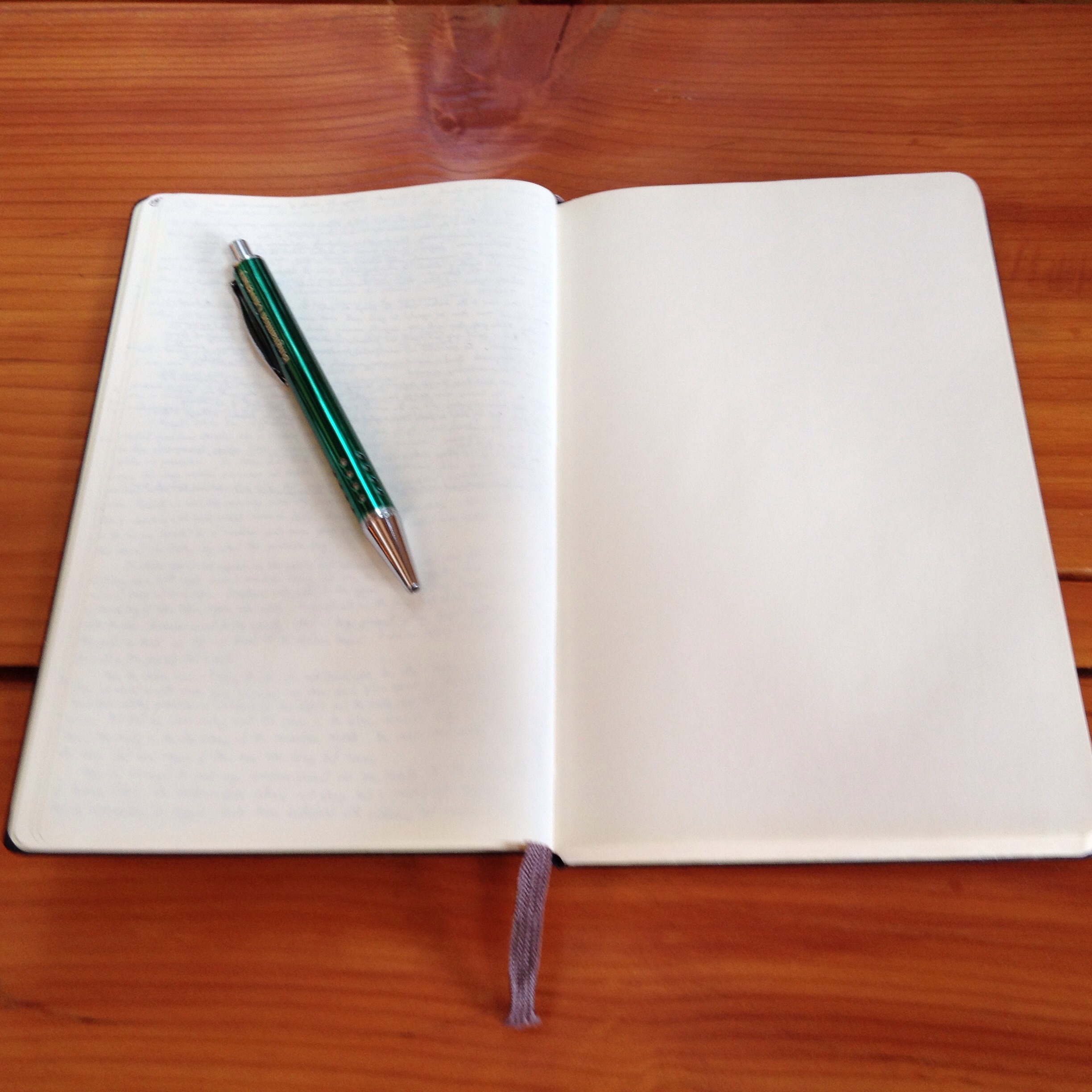
I used to write everything by hand.  We bought a used typewriter when I was in high school, and when I was in seminary I graduated to one of those strange devices that would print, like a typewriter, but had an LCD on the keyboard so that you could back up several characters before it printed.  This let you proofread while on the go.  I write a lot.  It may be a form of sickness, but I have hundreds of story ideas and little time to develop them.  Now I write on a computer but I’ve begun to lose trust.  It’s not just the whole AI debacle.  No, it’s that even with frequent backups, computers just lose things.  After having my hard drive wiped following a scam last year, I began work on some documents that I had to back up to the Cloud when the USB C ports on my laptop went bad.

After the repair was done I could download my files and pick up where I left off.  In theory.  I was working away on a new story and thought that I might be able to connect it to an earlier story I’d started.  Looking at the file, I remembered that the tale was much further along when I’d left off.  Where was it?  I looked on the Cloud version and it was the same as the one on my hard drive.  Then a larger project came along.  I went to start it again and discovered many, many pages missing.  Again, the Cloud shrugged its nebulus shoulders saying “I dunno…”. I pulled out my back-up disc.  (This was in April.)  I tried going back to January.  Same thing.  December.  Ditto.  Finally, my last backup in November had the full files.  Why these files didn’t backup to the Cloud, when done by a professional at the Apple Store, I can’t fathom.

What was especially disturbing is that one of the files (which I duplicated and put back on my hard drive, where they belong) showed that I’d completely reorganized things in a much clearer way.  After the laptop came home from the hospital, I’d forgotten (I’m not young and I’d been using a borrowed device for a few days).  I’d probably just picked up a story and, with my usual tunnel vision, began writing.  Not unrelatedly, I’ve been going through a spate of printing out any stories far enough along to warrant such treatment.  From what I’ve seen of the housekeeping on the Cloud, I’m glad I’ve been doing so.  I miss writing by hand.