
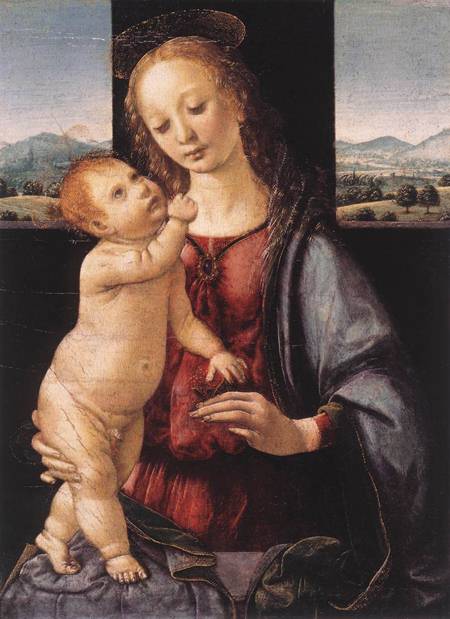
Yesterday at Princeton’s annual seasonal choral concert, the program consisted of Bach. The first piece was a Magnificat, a piece that, in prose form, I quickly memorized at Nashotah House. With our daily double dose of chapel services, liturgical standbys such as the Magnificat quickly became reflex recitations, made with little thought beyond getting on to the next piece. It occurred to me as I listened to it at leisure, the hopes of poor Mary haven’t really materialized after these 2000 plus years. After a couple of millennia, perhaps it is time for a state of the theology assessment.
Despite the veneration of Mary in the liturgical branches of Christianity, the collective handmaids of the Lord have made slow progress in being integrated fully into church leadership. Only with the last century, and fairly late therein, did many Protestant denominations finally recognize that Mary’s gender might have something to teach the men. Paul, for one, would have had none of it. Even today the Roman Catholic Church stalwartly refuses to consider female priesthood. Perhaps Mary’s prayer should be uttered yet again within its walls?
At the section labeled “fecit potentiam,” however, I noticed further lack of fulfillment. “God has shown strength with God’s arm,” the program translates, “God has scattered the proud.” The hopes expressed in the next several verses have been silenced beneath the greed of an economic system with no responsibility. “God has deposed the mighty from their seats.” When did that happen? Those of the Occupy movement who’ve received a face of pepper spray might beg to differ. “God has filled the hungry with good things, and the rich God has sent away empty.” Sent away to their summerhouses, their mansions, and their penthouse apartments? Away from the working class who oil the gears of their massive machines. No, it seems that the Magnificat has not fared so well at predicting the new era to be brought in by a special child.
Of course, Luke’s song of Mary is based on Hannah’s song at becoming the mother of Samuel from the Hebrew Bible. Samuel was the great judge and prophet who saw to the law and order in the land. Strangely, however, the Bible manages to confuse Samuel with his erstwhile enemy Saul, conflating their birth accounts. Isn’t it just like the Bible to confuse the oppressed with the oppressor? The strength shown with the divine arm, the wealthy inform us, is the strength they wield. After all, god and gold differ by only one letter.
 Steve A. Wiggins
2 thoughts on “Fecit potentiam”