
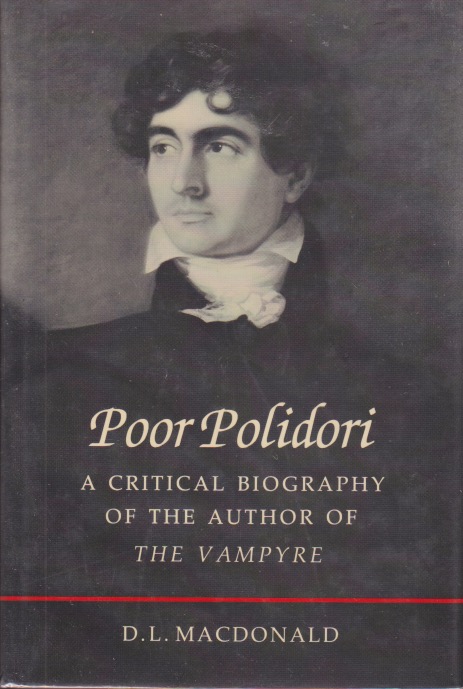
I’d been very curious about D. L. Macdonald’s Poor Polidori for several years. This is not an easy book to find. (I have noted before that I find university press book pricing illogical and unconscionable.) John William Polidori was, as the subtitle states, the man who wrote “The Vampyre,” treated sometimes as a novel, at other times a short story. Polidori, apart from being treated as a fictional character, is a difficult man to get to know. This critical biography contains much useful information. There are sections, however—and probably the reason for the pricing—, that interest only scholars of literature looking to find an exegesis of works of Lord Byron and Polidori himself. My curiosity about him derives from the fact that “The Vampyre” was a very influential story and yet its author is somewhat consistently considered insignificant. This seems to have predated his association with Byron; Macdonald points a finger at his father.
So who was Polidori? Born in England of an Italian father and English mother, he was raised with literary aspirations but his father (who was a writer) had other plans for him. Catholic in a period of strongly Protestant sentiments, John was sent to Catholic school and considered the priesthood. His father eventually sent him to Edinburgh University to become a medical doctor. Clearly this wasn’t John’s interest, but he complied. Finishing his qualifications, he found setting up practice difficult because of both his foreign-sounding name and his Catholicism. Lord Byron, about to exile himself from England because of scandals, wanted a personal doctor and settled on Polidori. He knew of Polidori’s literary ambitions and frequently belittled them. Polidori was present in the summer of 1816 when Percy and Mary (soon to be) Shelley visited Lord Byron along with Claire Claremont, Mary’s half-sister pregnant with Byron’s child.
Famously, the group read ghost stories and at Byron’s suggestion each started writing their own. Byron’s fragment led to an idea Polidori later wrote out, after Byron had dismissed him, as “The Vampyre.” Mary Shelley’s story, of course, everybody knows. “The Vampyre” was published without Polidori’s knowledge and was attributed to Byron. Even Goethe read it and thought it Byron’s best work. Polidori was eventually credited with the story and tried to make a living as a writer. He produced other works, but no real success. He decided to become a lawyer. Unable to establish his independence from his father, he died at 25 by ingesting prussic acid. Even during his life, which was quite interesting, he was called “Poor Polidori” by more than one acquaintance. His literary output isn’t bad, according to critics. To me, he’s a kind of patron saint of those who would write but who are overshadowed by Byrons and Shelleys.
 Steve A. Wiggins