
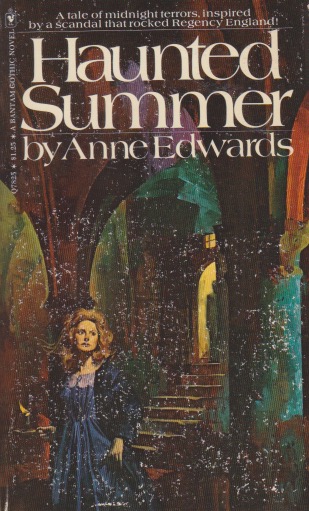
Having watched Haunted Summer, I was curious about the origin of the screenplay. I’d read that the movie was based on a screen treatment by Anne Edwards, a screenwriter and novelist, but that it had been rejected. Edwards then transformed her screenplay into a novel that was published in 1972, over a decade before the film came out. It’s sometimes easy to forget that movies spend quite a long time in development. For example, about four or five years ago it was announced that Lindsey Beer was going to write and direct a new Sleepy Hollow movie. That was the proximate cause for my writing Sleepy Hollow as American Myth. I wrote the book, found a publisher and then watched as sales only bumped along the bottom and still no Beer film appeared. Timing isn’t always my strong suit. In any case, I decided that it would be good to read Edwards’ book as a follow up to the film.
Marketed as a gothic novel, it came out in my beloved mass market paperback form. It’s now not easy to find. The story is well researched, but fictionalized, of course. The five Regency Era creatives—Lord Byron, Percy Bysshe Shelley, Mary Godwin, John Polidori, and Claire Clairmont—had gathered near Lake Geneva in the summer of 1816 (the “haunted summer”). Famously, the idea for Frankenstein came out of ghost stories they told each other to pass the time during a rainy summer. Polidori’s story, “The Vampyre,” also traces its origins back to that night. Edwards’ novel focuses on Mary, making her the narrator. Since it is a novel some fictional elements are added to what happened that summer. To me, the most obvious was moving the ghost stories from Villa Diodati to Castle Chillon. This allows Edwards to introduce Ianthe, a tragic keeper of the castle.
The story focuses on Mary as a strong woman very much devoted to Percy Shelley and standing up to Lord Byron. Her lack of regard for Polidori was a little jarring since, it seems, historically, she felt sorry for him. In any case, other than the changes Edwards introduces, the plot largely follows what happened during that summer. The climax of the book is Mary’s telling of the basic story of Frankenstein in Chillon Castle. I found the Author’s Note of particular interest; novelists are also researchers, even if not always treated as such. The historical incident of this meeting drives my interest, and this largely overlooked novel is a piece of a larger puzzle.
 Steve A. Wiggins